
Introduction
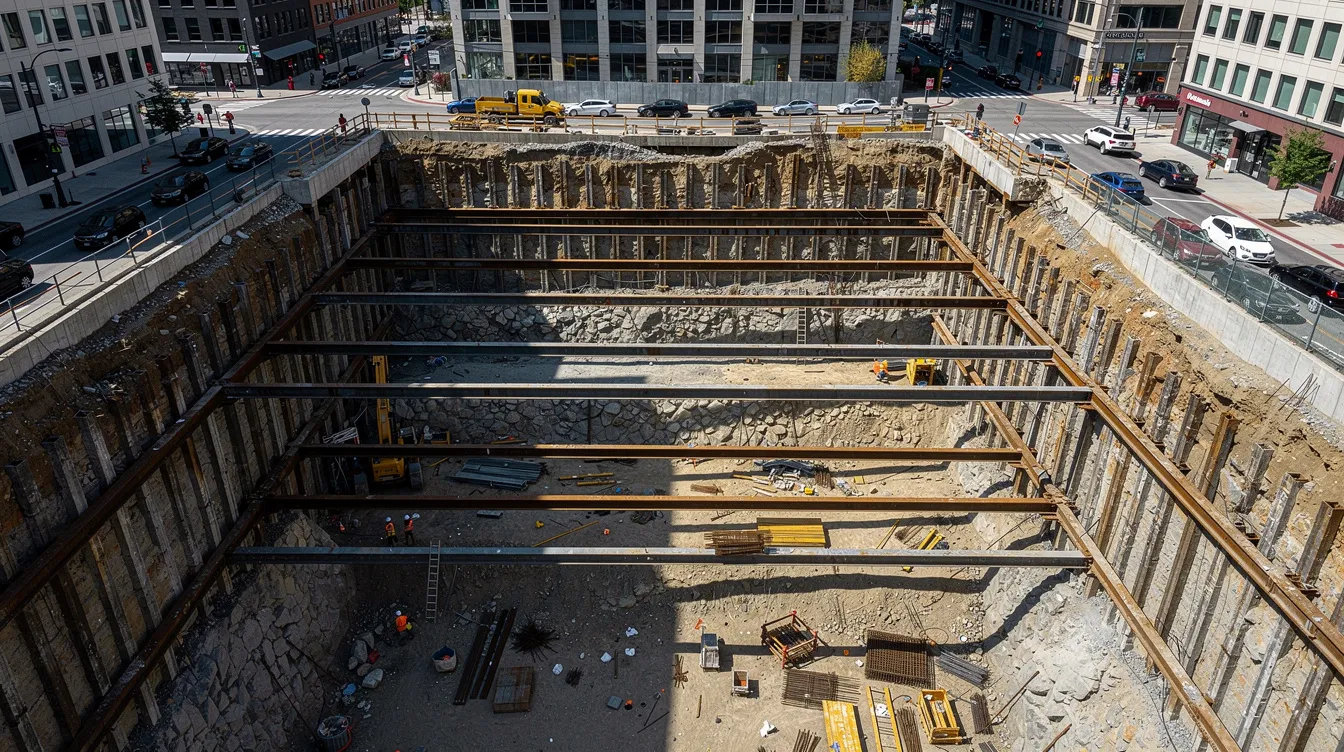
In Singapore, every basement excavation project requires a formally appointed qualified person to supervise building works under the Building Control Act (Cap. 29). This article explains the full scope of services and deliverables that a qualified person (supervision) – commonly abbreviated QP(S) – must provide for basement excavation, from pre-construction coordination through project completion and authority certification.
A qualified person QP supervision for basement excavation covers the translation of approved plans into correctly executed site works, real-time monitoring of excavation and earth retaining stabilising structures (ERSS), risk-based inspections calibrated to ground conditions and project complexity, production of detailed site records, and preparation of the statutory certifications needed for Temporary Occupation Permit (TOP) or Certificate of Statutory Completion (CSC). The QP holds legal accountability for ensuring excavation works comply with approved plans and all relevant regulations throughout the construction process.
This article is written for Singapore developers, contractors, quantity surveyors, and project managers who are planning deep basement works – whether 1–3 storey commercial basements, infrastructure underpasses, or excavations near MRT interfaces – and need clarity on what QP(S) actually does, what documents must be produced, and how to structure an engagement that covers the full spectrum of regulatory requirements.
The scope covered here focuses on structural and geotechnical professional supervision for basement excavation. It does not address temporary traffic management, main contractor method statement preparation, or generic project management activities.
By the end of this article, you will:
-
Understand the legal and technical role of the QP(S) for basement excavation in Singapore
-
Know the standard and project-specific services expected from QP(S) during each construction phase
-
See a concrete list of deliverables, from pre-construction submissions to monitoring reports and completion certifications
-
Learn how AMAN Engineering Consultancy Pte Ltd structures QP(S) engagements and coordinates with BIM, inspections, and authority submissions
-
Recognise common challenges in basement supervision and how professional oversight addresses them
Understanding Qualified Person Supervision for Basement Excavation
A qualified person (supervision) for basement excavation is a registered Professional Engineer – in Civil, Structural, or Geotechnical disciplines – who is formally appointed under the Building Control Act to supervise excavation, retaining systems, temporary works, and permanent basement structures on site. A Qualified Person (QP) must hold a valid practising certificate issued through the professional engineers board to fulfil this statutory role. The QP(S) is legally accountable for the entire team’s work and must take all reasonable steps for supervision throughout the project.
Basements are classified as high-risk building works in Singapore because of the country’s dense urban fabric, variable geology (marine clay, soft silts, old alluvium), high groundwater table, and proximity to MRT tunnels, deep-piled foundations, and critical utilities. These conditions mean that the supervision scope must be clearly defined – both in regulatory terms and in the contractual deliverables the building owner and main contractor can expect.
Legal and Regulatory Framework in Singapore
The Building Control Act (Cap. 29) is the primary legislation governing building control and QP appointment in Singapore. Section 8 mandates that every developer appoint a qualified person to supervise structural works, and where underground building works are involved, a geotechnical QP must also be appointed. The Building Control Act defines the QP’s statutory duties, and the Building Control Regulations – especially Regulation 24A and the Eighth Schedule – spell out the specific responsibilities of the supervising QP for geotechnical aspects of underground works.
BCA guidelines further require the QP(S) to prepare a Site Supervision Plan (SSP) that details how “all reasonable steps and due diligence” will be exercised. For large building projects with a project value exceeding S$7.5 million, this includes provisions for full time supervision of structural elements. The BCA Framework for Risk-Based Inspection classifies works by risk profile – based on excavation depth, ground conditions, and proximity to sensitive structures – and sets minimum inspection frequencies accordingly. Risk-based inspection minimizes potential safety gaps during construction by focusing on what and when to inspect for effectiveness.
Relevant Codes of Practice and guidelines also apply, including Eurocode-based design standards adopted in Singapore, BCA advisories on excavation near existing buildings, LTA requirements for works near MRT infrastructure, and PUB drainage and groundwater control requirements. Together, these regulatory requirements translate into minimum expectations for supervision frequency, documentation standards, and the reporting obligations that define the QP(S) engagement.
Basement Excavation as a High-Risk Category
In Singapore’s construction industry, “basement excavation” typically encompasses:
-
1–3 storey basements for residential and commercial developments, reaching depths of approximately 6–18 metres below ground level
-
Infrastructure basements and underpasses near live traffic corridors, MRT tunnels, or adjacent deep foundations, which attract the highest regulatory scrutiny
Excavation projects must adhere to local building codes and workplace safety standards. Several risk factors make supervision more intensive for basements than for shallow foundations:
-
Groundwater management is crucial during basement excavation to prevent soil instability, base heave, and piping failures that can destabilise retaining systems and adjacent ground
-
Impact on adjacent structures – buildings, utilities, roads, and tunnels can be affected by ground movement and settlement, requiring continuous monitoring and pre-construction condition surveys
-
Complex temporary support systems including diaphragm walls, secant piles, steel struts, ground anchors, and top-down slabs, all of which demand stage-by-stage verification against design assumptions
Compliance requirements differ based on excavation depth and project context. For example, ERSS submission requirements specify that excavation deeper than 1.5 m triggers formal submission needs, with progressively higher oversight – including Accredited Checker involvement – as depth exceeds 4 m and 6 m. These risk thresholds directly shape the services and deliverables the QP(S) must provide, as discussed in the sections that follow.
Core Roles of the Qualified Person (Supervision) for Basement Excavation
Understanding the regulatory background sets the stage, but what does the QP(S) actually do day-to-day on a basement project? The role centres on design-to-construction integration: ensuring that what was designed and approved by the QP(Design) is faithfully executed on site, that risks are identified and managed in real time, and that all statutory documentation is produced. A single Qualified Person (Supervision) must oversee entire projects, coordinating closely with the QP(D), main contractor, and the resident engineers and resident technical officers who form the on-site supervision team.
Distinguishing QP(Design) vs QP(Supervision) for Basements
The functional split between these two roles is critical for complex projects:
-
QP(Design) (Structural/Geotechnical) is responsible for the design of basement walls, struts, slabs, ground improvement measures, and all supporting calculations. They define the design intent, loading assumptions, and performance criteria that the structure must meet.
-
QP(Supervision) is responsible for ensuring that excavation and installation works are carried out according to approved plans and conditions imposed by BCA. The QP(S) must develop a comprehensive Site Supervision Plan, verify construction quality, review monitoring data, and issue certifications at project completion.
AMAN Engineering Consultancy can act as QP(D), QP(S), or both. However, contractual scopes must state deliverables for each role clearly, regardless of whether one firm or multiple firms are engaged. In Singapore’s construction projects, it is common for different firms to handle design and supervision – particularly on large infrastructure basements – which makes interface management between QP(D) and QP(S) a critical success factor. Coordination issues between these roles can cause delays, compliance gaps, and disputes if responsibilities are not clearly delineated from the outset.
Interaction with Resident Engineers (RE) and Resident Technical Officers (RTO)
The QP(S) leads the supervision team, while qualified site supervisors – specifically resident engineers and resident technical officers – provide the continuous on-site presence that deep basement works demand. Effective supervision requires coordination among engineers, contractors, and safety personnel. The division of responsibilities is as follows:
QP(S) responsibilities:
-
Develops and endorses the Site Supervision Plan, sets inspection hold points and critical stages
-
Reviews and interprets monitoring data, endorses key inspection reports
-
Liaises with BCA, PUB, LTA, and other authorities on regulatory submissions
-
Makes engineering decisions on non-conformances and deviations
-
The QP(S) must report any contraventions of the Act immediately
RE/RTO responsibilities:
-
Conduct daily site checks, recording excavation levels, strut preloads, and concrete pours
-
Witness tests (concrete cubes, rebar, anchor pull-out tests) and maintain photographic records
-
Maintain supervision logs and detailed site records for every inspection
-
Escalate anomalies immediately to QP(S) for engineering assessment
Projects over $7.5 million require full-time supervision. For projects over $150 million, 2 REs and 3 RTOs are required under BCA’s tiered requirements. Even small-scale projects up to $7.5 million need appropriate QP supervision scaled to their risk profile.
Risk-Based Supervision for Deep Excavation
BCA’s Framework for Risk-Based Inspection is applied specifically to basement works through risk classification that considers excavation depth, soil conditions, proximity to MRT and existing buildings, and groundwater regime. Qualified Persons assess the risk level of building works, and supervision must match the determined risk level of projects. This means:
-
Higher-risk excavations (deeper than 6 m, near MRT, in marine clay) attract more frequent inspection cycles – daily checks during critical excavation stages, with increased monitoring when reaching strata changes or approaching trigger levels
-
Lower-risk excavations (shallower basements in competent soil, away from sensitive structures) may follow less intensive schedules, but still require milestone inspections at every strut level and formation
The QP(S) must customise the Site Supervision Plan to reflect the actual basement risks rather than relying on generic templates. This risk-based approach directly determines the scope of services and the deliverables that the QP(S) must produce at each stage of the project.
Scope of Services for QP Supervision in Basement Excavation
This section lays out a typical scope of services for QP(S) on a basement excavation project in Singapore, structured along the project phases that AMAN Engineering Consultancy uses when defining engagements. The QP supports risk management by evaluating site conditions and potential hazards throughout every phase.
Pre-Construction and Design Coordination Phase
Before excavation starts, the QP(S) establishes the supervision framework that will govern the entire construction phase. Pre-construction reviews involve assessing geotechnical reports and design calculations to confirm that supervision can be effectively planned. Key services include:
-
Design review and coordination: Review of approved structural and geotechnical designs, ERSS drawings, and method statements for excavation, bracing, and groundwater control, to identify supervision focus areas and potential risks
-
BIM-based constructability reviews: Participation in BIM coordination sessions using Revit or Tekla models to detect clashes with utilities, MRT protection zones, and adjacent structure foundations – reducing coordination issues before they become site problems
-
Site Supervision Plan development: Preparation and endorsement of the SSP specific to basement excavation and retaining systems, covering risk classifications, supervision intensity, roles of RE/RTO, and communication protocols
-
Inspection and Test Plan (ITP): Definition of clear hold points – completion of guide walls, diaphragm wall panels, toe levels, first strut installation, top-down slab casting – where work cannot proceed without QP(S) endorsement
-
Authority coordination: Liaison with BCA, LTA, PUB, and other relevant authorities for submission requirements, pre-condition survey requirements, and protection measures for adjacent structures. Qualified supervisors must verify compliance before excavation activities commence.
Construction Phase: Excavation and Retaining Structures
This is the most intensive phase of QP(S) engagement and represents the core of construction supervision for basement works. Routine inspections are conducted to monitor excavation pit and structural integrity throughout this period.
ERSS installation verification:
-
Witnessing and reviewing records of bored piles, diaphragm walls, sheet piles, or secant piles including toe levels, concrete test results, and reinforcement placement
-
Checking compliance with alignment and verticality tolerances that directly affect wall performance and structural integrity
-
Visual inspection of panel joints, cage connections, and concrete quality at pour stages
Excavation sequence supervision:
-
Confirming that excavation does not exceed designed stages or advance before temporary works are ready
-
Issuing written instructions when unanticipated ground conditions, obstructions, or seepages are observed
-
Incident response involves providing assessments and corrective actions for unexpected events during excavation
Strutting, anchoring, and top-down slab supervision:
-
Review of strut preloading records and stressing logs; verification of waler and connection details against approved drawings
-
Inspection of top-down slabs and temporary openings for compliance with design assumptions and load paths
Monitoring and environmental oversight:
-
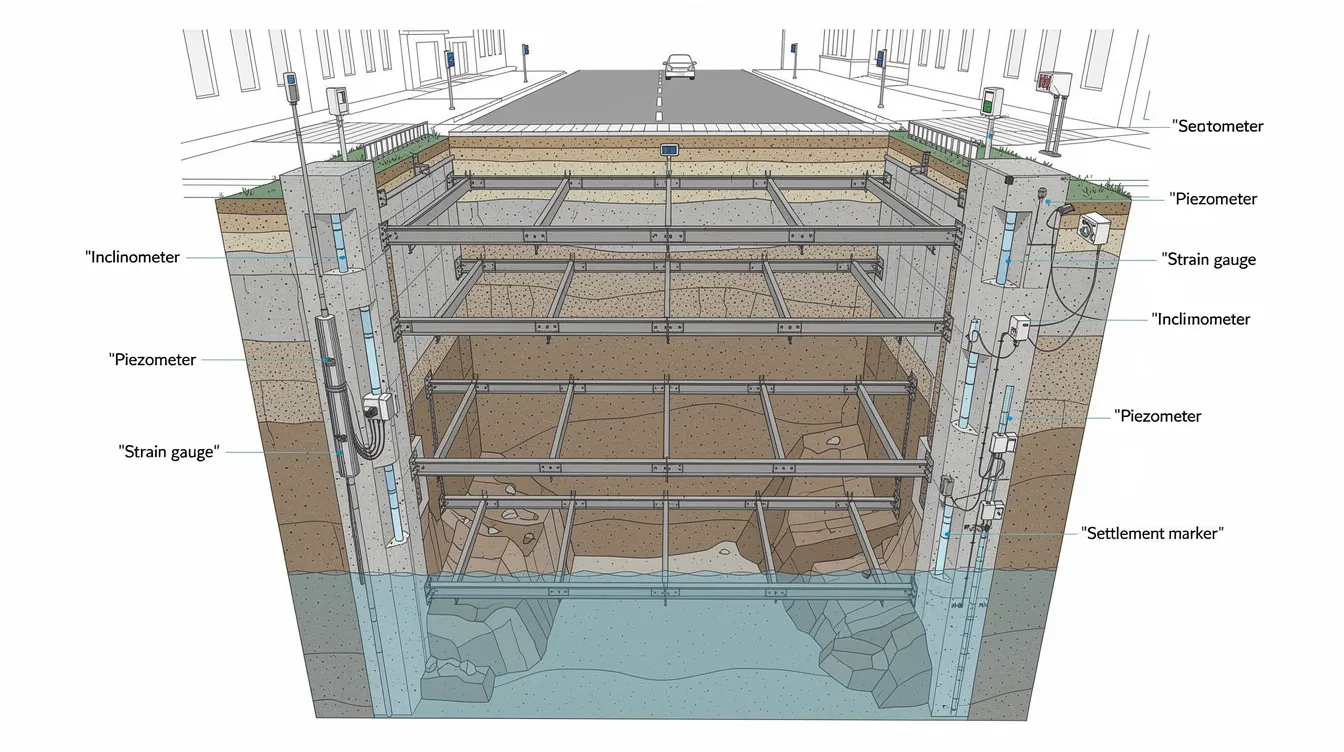
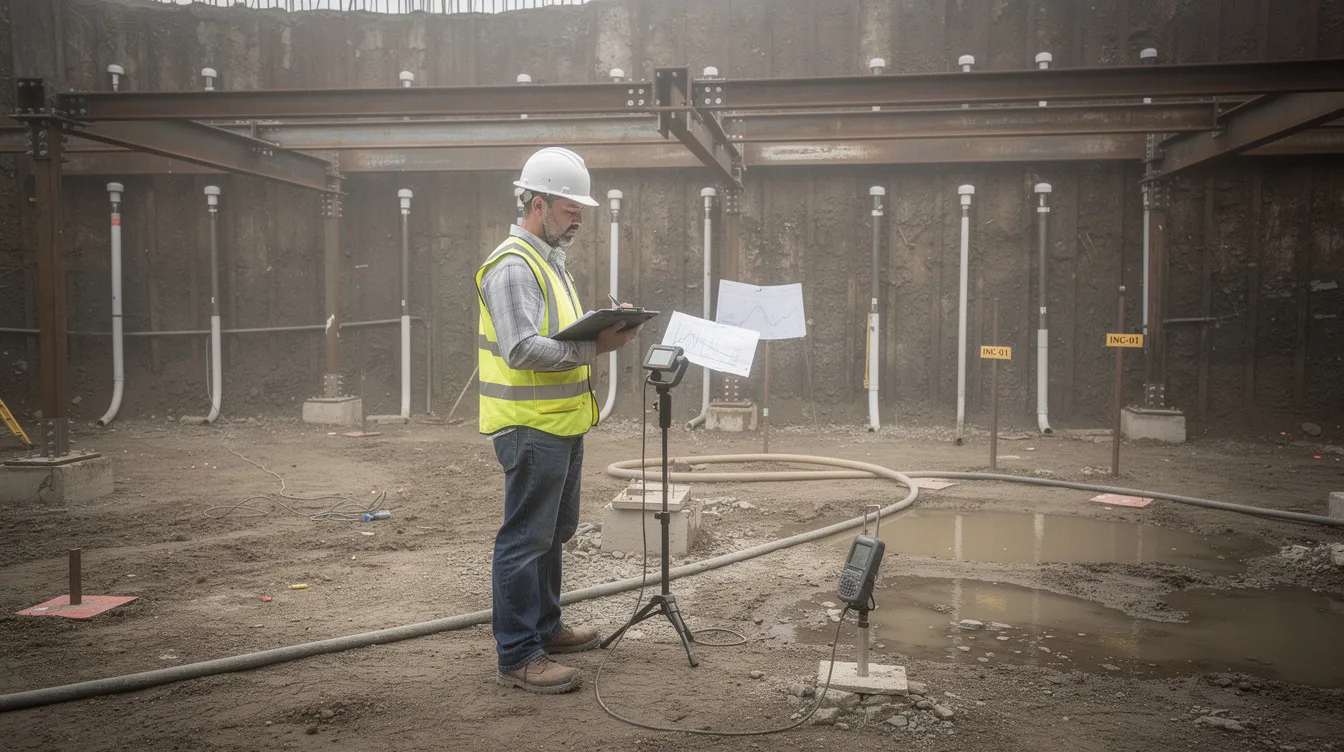
Geotechnical monitoring involves overseeing instrumentation like inclinometers and piezometers, as well as settlement markers and strain gauges, at intervals defined in the instrumentation and monitoring plan
-
Assessment of movements against trigger and suspension levels and initiation of contingency measures when limits are approached
-
Compliance auditing ensures adherence to statutory safety regulations and engineering plans
AMAN uses digital tools – including BIM-linked dashboards and structured inspection forms – where applicable to streamline supervision and produce traceable documentation for each inspection event.
Interface Management with Adjacent Structures and Infrastructure
Basements in Singapore’s dense urban environment often sit directly next to existing buildings, utilities, roads, and MRT lines, making interface supervision a distinct and critical service area. A Qualified Person ensures compliance with safety regulations during basement excavation by managing these interfaces proactively.
Services in this category include:
-
Pre-condition surveys: Review and endorsement of building plans, structural condition surveys, and photographic baselines for adjacent properties and roads before excavation commences
-
Asset owner coordination: Managing monitoring requirements imposed by LTA for MRT protection, PUB for drainage infrastructure, and SP Group for electrical utilities, ensuring that each authority’s specific requirements are met
-
Monitoring trend evaluation: Assessment of settlement, tilt, and ground movement data affecting neighbouring structures, with recommendation of mitigation measures such as strut load adjustments, excavation pauses, or remedial grouting
-
Stakeholder risk meetings: Participation in regular risk review meetings with the contractor, client, and external stakeholders during critical excavation stages to ensure professional accountability and coordinated decision-making
Post-Excavation and Basement Structural Works
QP(S) supervision continues after the excavation reaches formation level, as the permanent basement structure is completed and temporary works are removed. This phase is essential for providing continuity between excavation supervision and the structural completion that authorities assess for TOP/CSC.
Key services include:
-
Supervision of bottom slab casting, basement walls above final excavation level, and permanent drainage and sump installations
-
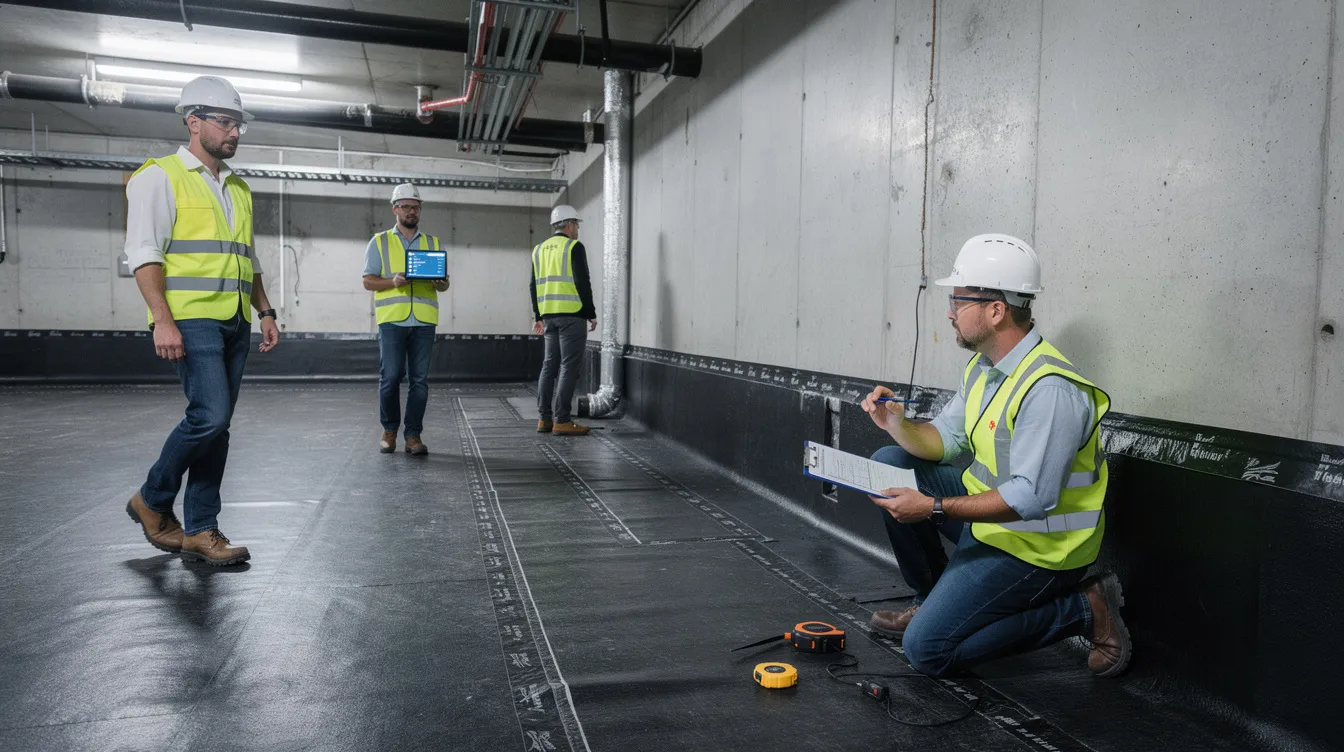
Verification of waterproofing details and penetration treatments that tie back to structural design assumptions, ensuring long-term performance
-
Monitoring during backfilling and temporary works removal (strut removal sequence) to confirm no overstressing of the permanent structure or excessive movement of surroundings
-
Final design review of as-built levels, reinforcement, and deviations prior to regulatory submissions for project completion
Key Deliverables from QP Supervision for Basement Excavation
Beyond professional oversight and “being on call,” the QP(S) must produce concrete, traceable deliverables at defined milestones. Documentation includes logs of inspection findings and monitoring data for supporting compliance. This section lists the tangible outputs clients should expect from AMAN Engineering Consultancy for a typical 1–3 storey basement project.
Planning and Approval Stage Deliverables
The following documents are produced before or at the start of excavation:
-
Endorsed Site Supervision Plan (SSP) tailored for basement and ERSS works, submitted to BCA in accordance with the Guide-Book for SSP requirements
-
Review memos and comment logs on construction sequence and method statements for excavation, strutting, and groundwater control
-
Instrument monitoring plan endorsement, including trigger, action, and limit levels and the reporting protocol for escalation
-
BIM-based coordination review notes – clash reports and risk registers – where AMAN is engaged for BIM modelling services
-
Authority approval forms and notices, including notification of commencement of ERSS or underground building works, and permit or no-objection letters from BCA, LTA, and PUB
Construction and Monitoring Stage Deliverables
During active excavation, deliverables are produced at defined frequencies:
Inspection records (milestone-based):
-
Signed inspection checklists for critical stages: ERSS installation, each excavation stage, strut installation, base slab pours, top-down slabs
-
Photographic documentation tied to drawing references and dates, including pre-condition records of neighbouring properties
-
Annex C forms – site inspection and approval records completed before proceeding to the next excavation stage or support level, as required by BCA Advisory Note 1_09
Monitoring and assessment reports (periodic):
-
Weekly or monthly instrumentation summaries comparing inclinometer, piezometer, and settlement readings to trigger levels, with trend charts
-
Technical assessments and recommendations when movements approach or exceed thresholds – including instructions for mitigation measures
-
Monthly Annex E forms submitted to BCA for underground building works monitoring
Non-conformance and corrective action documentation:
-
Qualified Persons issue Non-Conformance Reports to address deviations from approved plans, with endorsed corrective action plans and rectification records
-
Records of design deviations and QP(D)/QP(S) approvals for minor and major changes affecting basement performance, maintaining compliance verification throughout
Completion, Handover, and Authority Submission Deliverables
At the end of basement works and overall project completion, the following deliverables are mandatory:
-
Completion certifications: Form C1 (Certificate of Supervision of Piling) and/or Form C2 (Certificate of Supervision of Structural Works), submitted within 14 days after completion. Form C3 where departures from building plans are present.
-
As-built documentation: Record structural plans and as-built drawings for basement structure and ERSS, coordinated with BIM models where applicable, confirming all deviations have structural adequacy confirmation
-
Final instrumentation report: Complete monitoring dataset over the full excavation period with interpretation of performance, trend plots, and confirmation that movements remained within prescribed limits
-
Material and test certificates: Compilation of concrete cube results, rebar mill certificates, anchor pull-out tests, and strut preloading records, referenced in QP(S) certification
-
Waterproofing completion reports: Water tightness testing procedures and penetration sealing verification records
-
TOP/CSC support documents: QP(S) declarations and structural forms confirming that works were supervised with due diligence and in accordance with approved plans, supporting the building owner’s application process for occupation
-
Client handover briefing: Documentation of any residual risks or ongoing monitoring recommended after occupation – particularly relevant for large infrastructure basements where long-term settlement checks may be prudent
Service Models, Fees, and Coordination for Basement QP Supervision
The scope and deliverables discussed above translate into different service models, levels of supervision intensity, and fee structures. The right model depends on excavation depth, project value, risk profile, and the project timeline for active excavation versus structural finishes.
Full-Time vs Immediate Supervision for Basement Works
Supervision intensity for basements in Singapore is determined by regulatory thresholds and project-specific risks:
-
Full-time RE/RTO presence with QP(S) oversight is required for deep excavations and building projects above S$7.5 million. The QP(S) conducts scheduled and milestone inspections, while qualified site supervisors (RE/RTO) maintain continuous on-site professional supervision during all structural works
-
Immediate or part-time supervision may be appropriate for shallower basements or smaller landed projects, with agreed minimum visit frequencies documented in the SSP. Even here, supervision must match the determined risk level
-
Infrastructure-grade basements – underpasses, MRT-connected developments, or works adjacent to live tunnels – typically attract the most conservative supervision model, with authorities expecting full-time presence regardless of the total cost threshold
Typical Engagement and Fee Structures Used by AMAN
AMAN Engineering Consultancy structures QP(S) engagements for basement excavation to align effort with risk and project requirements:
-
Base scope vs enhanced scope: The base scope covers statutory minimum supervision and deliverables (SSP, milestone inspections, Annex C/E submissions, C-Forms). Enhanced scope adds daily site presence, BIM integration, progress reports with digital dashboards, and additional monitoring assessment cycles
-
Phased fee structure: Monthly retainers are typically higher during active excavation phases – when supervision intensity peaks – with lower fees during pre-construction coordination and post-excavation completion periods
-
Risk-aligned scoping: The supervision scope is tied to the SSP risk classification and a signed client brief, so that both parties understand exactly what is included and what constitutes additional services
Clients should budget higher supervision effort during the critical excavation months when testing procedures, monitoring, and staged inspections are most intensive, and lesser effort during finishes and MEP stages.
Coordination with Other Professional Services
Basement QP(S) services do not operate in isolation. Coordination with other professional engineers and specialists is essential:
-
Structural inspections of adjacent buildings – periodic condition surveys that compare current state against pre-construction baselines
-
Impact assessments for infrastructure or sensitive neighbours, where AMAN may prepare or review assessment reports for LTA engineering group requirements
-
BIM and digital delivery – creating 3D excavation and strut staging sequences, clash detection models, and digital inspection records that reduce coordination issues between trades
Appointing a single consultancy like AMAN to handle structural design, QP(S), BIM, and authority submissions delivers coherent risk management and avoids the interface gaps that commonly plague building projects where multiple firms share responsibilities without clear accountability.
Common Challenges in Basement QP Supervision and How to Address Them
Even with a well-defined scope, basement construction projects face recurring technical and contractual challenges that affect supervision effectiveness and deliverables. AMAN’s deep experience across complex projects informs the mitigation strategies below.
Unanticipated Ground and Water Conditions
The problem: Unexpected soft layers, artesian water pressure, boulders, cavities, or contaminated soil encountered during excavation can invalidate design assumptions and compromise safety standards.
QP(S) response:
-
Immediate site inspection and review of instrumentation data to assess extent of the condition
-
Coordination with QP(D) and QP(Geo) to adjust design or sequence – for example, additional struts, ground treatment, or recharge wells for groundwater management
-
Issuance of written instructions and formal updating of the supervision and monitoring plans, with notification to BCA where statutory requirements demand it
Deviation from Approved Excavation Sequence
The problem: Contractors may propose or attempt sequence changes for speed or logistics, which can compromise the structural integrity of the retaining system.
QP(S) response:
-
Assess the proposed change against design assumptions; require revised calculations and drawings where the change affects structural or geotechnical performance
-
Reject unsafe sequence changes and document reasons with clear reference to the approved building plans
-
Report serious contraventions to BCA when required by law – the QP(S) must report any contraventions of the Act immediately
Instrumentation Data Not Properly Interpreted or Acted Upon
The problem: Monitoring can become a “tick-box” activity if readings are collected but not subject to engineering evaluation. Groundwater management is crucial during basement excavation to prevent soil instability, and missed trends can lead to failures.
QP(S) response:
-
Set clear trigger, action, and limit levels with defined review cycles, coordinated with the monitoring specialist and the site supervisor
-
Use simple, visual dashboards – traffic-light status charts shared with contractors and client – so that trends are immediately visible to all parties
-
Conduct joint reviews when trends change direction, even before triggers are formally exceeded, maintaining the highest standards of professional accountability
Scope Creep and Unclear Deliverables
The problem: Building owners and contractors often assume that “all basement issues” are covered under the QP(S) appointment, while contracts only specify statutory minimum duties. This leads to disputes, delays in progress reports, and gaps in regulatory compliance.
QP(S) response:
-
Define in writing the exact reports, visit frequencies, and meetings included in the base fee before the engagement begins
-
Establish change-order mechanisms for additional supervision, new authority requirements, or expanded monitoring triggered by changed site conditions
-
Use a deliverables schedule aligned to programme milestones – tender award, start of excavation, reaching formation level, completion – so that all parties understand what is due and when
Conclusion and Next Steps
Qualified person supervision for basement excavation is a structured, legally defined service – not a series of ad hoc inspections or occasional site visits. The Building Control Act, BCA guidelines, and associated Codes of Practice establish a comprehensive framework of responsibilities that the QP(S) must fulfil, from pre-construction design review through to the submission of completion certifications for TOP/CSC.
Clearly scoped services and documented deliverables are essential to manage safety, regulatory compliance, and programme risk on any basement project. When the scope is well-defined – covering everything from the SSP and monitoring plans to Annex C/E submissions and as-built records – all parties benefit from reduced disputes, fewer delays, and traceable professional accountability throughout the construction process.
If you are planning a basement project in Singapore, these actionable next steps will position you for a successful engagement:
-
Assess your project parameters – identify excavation depth, proximity to sensitive structures (MRT, adjacent buildings, utilities), and project value to estimate the required supervision level and whether full-time RE/RTO presence is mandatory
-
Prepare a draft list of desired QP(S) deliverables – plans, reports, meetings, and authority submissions – before requesting proposals, so that you can compare offerings on a like-for-like basis
-
Engage a consultancy like AMAN Engineering early during concept and scheme design to align design, BIM, and supervision strategies from the outset
-
Ensure contracts clearly distinguish between QP(D), QP(S), RE/RTO duties, and any additional inspection or impact assessment services – ambiguity here is the most common source of scope disputes
-
Build contingency into your project timeline and budget for enhanced supervision during critical excavation months when risk is highest
Readers interested in related topics can explore structural inspection regimes for retaining walls, impact assessments near MRT, and BIM-based construction supervision for deeper understanding of these interconnected service areas.
Frequently Asked Questions on QP Supervision for Basement Excavation
The following answers address specific, practical questions that developers and contractors in Singapore’s construction industry frequently ask when planning basement works.
When is a separate QP(S) specifically for basement excavation required?
Under the Building Control Act, a QP(S) must be appointed for all structural works, which includes basements. For underground building works classified as Geotechnical Building Works (GBW) – typically excavations deeper than 6 m or any basement excavation – a separate QP(Geo)(S) may also be required to supervise the geotechnical aspects. For very deep shafts, MRT interfaces, or excavations in particularly challenging ground conditions, the joint accreditation committee and BCA may require specialist appointments beyond the standard QP(S) role. Only one QP(S) can supervise an entire construction project for structural works, though the geotechnical QP(S) is a separate concurrent appointment.
How many site visits should I expect from the QP(S) during excavation?
Visit frequency depends on the risk classification and project complexity. During active excavation and strut installation – the highest-risk stages – weekly or more frequent visits by the QP(S) are standard, supplemented by daily checks from qualified site supervisors (RE/RTO) who maintain continuous on-site presence. For large infrastructure basements or works near MRT, the QP(S) may need to be present at every critical hold point, which can mean multiple visits per week. During less intensive stages such as backfilling or finishing works, visit frequency typically reduces to fortnightly or monthly, as documented in the SSP.
Can digital tools and virtual inspections replace physical QP site visits?
While BIM models, 360° site photography, video calls, and digital dashboards can significantly supplement and document professional supervision, they do not replace the QP(S)’s statutory duty to exercise due diligence through physical presence at critical stages. BCA guidelines still require the QP(S) to personally inspect and endorse works at defined hold points. Digital tools are best used to enhance the quality of supervision logs, enable faster data analysis, and improve communication between the site team and the QP(S) – but the responsible qualified person must attend site when the safety and compliance of the works require direct visual inspection and engineering judgement.
What information should I prepare before engaging AMAN for basement QP(S) services?
To enable AMAN to define a precise scope and deliverables from the outset, prepare the following:
-
Preliminary design drawings and building plans for the basement structure and ERSS
-
Soil investigation reports and any geotechnical interpretive reports
-
Project schedule with key milestones for excavation start, formation level, and structural completion
-
Site constraints – location and condition of adjacent buildings, MRT lines, utilities, and roads
-
Any existing authority correspondence (BCA, LTA, PUB) and conditions of approval
-
Project value estimate and expected fixed installation inspectors or external cladding requirements if applicable
With this information, AMAN can prepare a tailored proposal that matches supervision intensity to your project’s actual risk profile, defines every deliverable, and avoids the scope ambiguity that undermines many basement supervision engagements in Singapore’s demanding construction environment.