Call Us/Whatsapp Us: +65 8385 9933 | Email: aman@amanengineering.com.sg for inquiry and free quotation

Impact Assessment for Building & Utility Conditions

Why Impact Assessment Matters in Singapore

Impact assessment essential for:

  • Protecting existing infrastructure investments worth billions of dollars
  • Ensuring public safety during construction activities
  • Maintaining utility service continuity for residents and businesses
  • Complying with strict regulatory requirements from BCA, PUB, and other authorities
  • Minimizing construction delays and cost overruns

Building Condition Survey

A detailed building condition survey forms the foundation of any impact assessment. Our experienced engineers conduct thorough inspections of all structures within the zone of influence, typically extending 2-3 times the excavation depth from the construction boundary. This survey encompasses:

Structural Elements Assessment:

Comprehensive evaluation of foundations, columns, beams, slabs, and load-bearing walls using non-destructive testing methods including rebound hammer tests, ultrasonic pulse velocity tests, and ground-penetrating radar (GPR) surveys

Facade Inspection:

Detailed documentation of external cladding, windows, architectural features, and any existing defects using high-resolution photography and 3D laser scanning technology

Interior Survey:

Room-by-room documentation of finishes, fixtures, and any pre-existing cracks or damage, with particular attention to brittle finishes such as marble, granite, and glass panels

Foundation Investigation:

Assessment of foundation types, depths, and conditions through review of as-built drawings and selective excavation where necessary

Utility Mapping and Assessment

Singapore’s complex underground utility network requires meticulous mapping and assessment to prevent service disruptions and ensure safety:

  • Utility Detection: Employment of advanced detection equipment including electromagnetic locators, ground-penetrating radar, and acoustic methods to identify buried services
  • Service Identification: Coordination with utility agencies (PUB, SP Group, SingTel, etc.) to verify service locations, depths, and criticality
  • Condition Assessment: CCTV inspection of accessible sewers and drains, pressure testing of water mains, and visual inspection of exposed utilities
  • Risk Categorization: Classification of utilities based on material type, age, condition, and consequence of failure

Numerical Modeling and Analysis

Advanced numerical modeling forms the backbone of modern impact assessment, allowing engineers to predict ground movements and structural responses with high accuracy:

PLAXIS 2D/3D Analysis

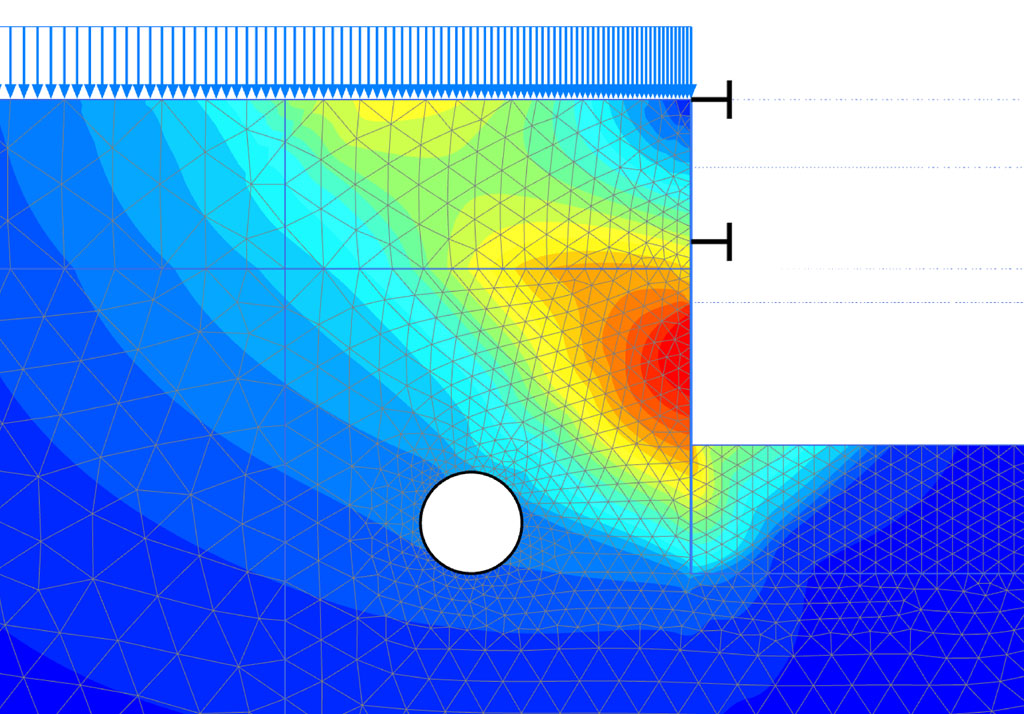
PLAXIS finite element software is the industry standard for geotechnical analysis in Singapore. Our modeling approach includes:
  • Model Development: Creation of detailed geometric models incorporating soil stratification, groundwater conditions, existing structures, and proposed construction sequences
  • Material Modeling: Implementation of appropriate constitutive models (Mohr-Coulomb, Hardening Soil, Soft Soil Creep) calibrated against laboratory test results
  • Construction Staging: Simulation of excavation sequences, support installation, dewatering effects, and time-dependent behavior
  • Sensitivity Analysis: Parametric studies to assess the impact of uncertainties in soil parameters and construction methods

STAAD Pro Structural Analysis

STAAD Pro provides comprehensive structural analysis capabilities for assessing building response to predicted ground movements:

  • 3D Structural Modeling: Development of detailed finite element models of affected structures including all structural members, connections, and support conditions
  • Load Application: Implementation of predicted ground movements as support settlements and lateral displacements
  • Stress Analysis: Evaluation of induced stresses, moments, and deformations in structural members
  • Crack Width Prediction: Assessment of potential cracking in concrete elements and masonry walls
  • Dynamic Analysis: Vibration assessment for sensitive structures and equipment


Risk CategorySettlement CriteriaAngular DistortionTypical Structures
Category 1 (Low Risk)< 10mm< 1/500Robust structures, open ground
Category 2 (Medium Risk)10-25mm1/500 – 1/300Typical residential/commercial buildings
Category 3 (High Risk)25-50mm1/300 – 1/150Sensitive structures, heritage buildings
Category 4 (Very High Risk)> 50mm> 1/150Critical infrastructure, hospitals

PLAXIS Suite - Geotechnical Analysis Excellence

PLAXIS has become the de facto standard for geotechnical finite element analysis in Singapore, offering unparalleled capabilities for modeling complex soil-structure interaction problems.

PLAXIS 2D Features and Applications

Advanced Constitutive Models

  • Mohr-Coulomb Model: Basic elastoplastic model for preliminary analysis
  • Hardening Soil Model: Stress-dependent stiffness for accurate deformation prediction
  • Soft Soil Creep Model: Time-dependent behavior of Singapore marine clay
  • HSsmall Model: Small-strain stiffness for sensitive structures

Construction Simulation

  • Staged Construction: Sequential excavation and support installation
  • Consolidation Analysis: Time-dependent settlements
  • Safety Analysis: Factor of safety using phi-c reduction
  • Flow Analysis: Groundwater flow and dewatering effects

Output and Visualization

  • Deformation Contours: Clear visualization of movement patterns
  • Stress Paths: Understanding soil behavior under loading
  • Time Curves: Settlement vs. time relationships
  • Animation: Construction sequence visualization

PLAXIS 3D Advanced Capabilities

For complex geometries and corner effects, PLAXIS 3D provides:

  • True 3D Modeling: Accurate representation of excavation corners, irregular shapes, and non-uniform loading
  • Tunnel-Structure Interaction: Essential for MRT tunnel impact assessments
  • Pile Group Analysis: 3D effects on pile foundations near excavations
  • Complex Stratigraphy: Modeling of inclined layers and geological features

STAAD Pro - Structural Analysis Powerhouse

STAAD Pro’s comprehensive analysis capabilities make it ideal for assessing structural response to predicted ground movements:

Key Features for Impact Assessment

STAAD Pro Advantages

  • Comprehensive Element Library: Beams, columns, plates, shells, and solid elements
  • International Code Compliance: Built-in checks for BS, Eurocode, and Singapore standards
  • Dynamic Analysis: Modal, response spectrum, and time history analysis
  • Nonlinear Analysis: P-Delta effects and geometric nonlinearity
  • BIM Integration: Direct import from Revit and other BIM platforms

Building and Construction Authority (BCA) Requirements

Approved Code of Practice for Building Works

The BCA’s requirements for impact assessment are outlined in several key documents:
  • SS 609: Code of Practice for Building Information Modelling (BIM): Mandates BIM usage for projects >5000m²
  • Building Control Act: Legal framework for building safety and permits
  • Approved Document on Temporary Works: Design requirements for support systems
  • Guidelines on Instrumentation and Monitoring: Minimum standards for monitoring programs

Permit Requirements

Essential Permits for Deep Excavations

  • Building Plan Approval: Required for all excavations >6m depth
  • Temporary Works Permit: For support systems and protective measures
  • Demolition Permit: If existing structures require removal
  • Crane/Equipment Permit: For heavy machinery operations

Land Transport Authority (LTA) Requirements

Code of Practice for Railway Protection

Projects near MRT infrastructure must comply with LTA’s stringent requirements:
Zone Distance from MRT Requirements Approval Level
First Reserve 0-6m Prohibited except with special approval LTA Board
Restricted Zone 6-30m Detailed impact assessment mandatory LTA Engineering
Influence Zone 30m-2H Standard assessment required Qualified Person

Monitoring Standards for Railway Protection

  • Track Monitoring: ±2mm absolute movement limit
  • Tunnel Monitoring: ±5mm movement, 1:2500 distortion
  • Station Box: ±10mm movement, 1:1000 distortion
  • Automated Systems: Real-time monitoring with SMS/email alerts