
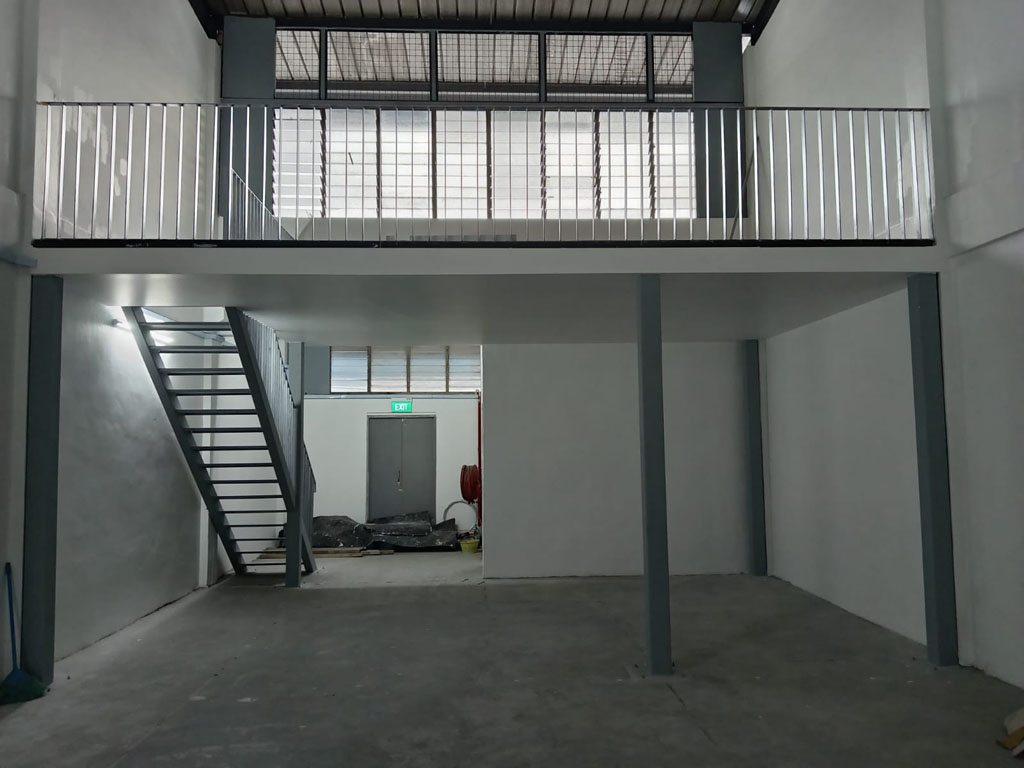
This guide provides detailed information on the entire process of obtaining approvals from BCA (Building and Construction Authority), JTC Corporation, SCDF (Singapore Civil Defence Force), URA (Urban Redevelopment Authority), and other regulatory bodies for mezzanine installations in commercial, industrial, and residential properties.
A mezzanine floor is an intermediate floor level between the main floors of a building, typically not counted as a full storey in building regulations. In Singapore’s context, mezzanine floors are extensively used in industrial facilities, warehouses, commercial spaces, and even residential properties to maximize vertical space utilization. These structures can significantly increase usable floor area without the need for building expansion, making them a cost-effective solution for space optimization.
Heavy-duty structures designed for manufacturing, warehousing, and logistics operations. These systems must withstand significant loads and comply with JTC industrial building requirements.
Retail and office space solutions that enhance customer experience and maximize rental yield. Must meet BCA commercial building codes and fire safety requirements.
Loft-style additions in HDB flats, condominiums, and landed properties. Subject to specific URA guidelines and structural limitations.
The complexity of Singapore’s regulatory environment for mezzanine installations necessitates professional expertise. A qualified consultant brings comprehensive knowledge of building codes, submission procedures, and approval requirements across multiple agencies. This expertise is invaluable in navigating the intricate approval process, avoiding costly mistakes, and ensuring timely project completion.
Professional consultants specializing in mezzanine submissions understand the nuances of different regulatory bodies and their specific requirements. They maintain updated knowledge of changing regulations, possess established relationships with authority personnel, and have proven track records of successful submissions. This expertise translates into smoother approval processes, reduced rejection risks, and optimized designs that meet both regulatory requirements and client objectives.
The Building and Construction Authority serves as the primary regulatory body for construction and building works in Singapore. For mezzanine installations, BCA oversees structural safety, building code compliance, and professional engineer certifications. Understanding BCA’s requirements is fundamental to any mezzanine project’s success.
Mezzanine designs must comply with multiple codes and standards recognized by BCA. The primary structural codes include the Singapore Standard SS EN 1993 for steel structures, which governs the design of steel mezzanine frames, and SS EN 1992 for concrete structures where applicable. These Eurocodes have been adapted for Singapore’s context with National Annexes that consider local conditions such as seismic requirements and wind loads.
| Code/Standard | Application | Key Requirements |
|---|---|---|
| SS EN 1993-1-1 | Steel Structure Design | Material properties, design procedures, connection details |
| SS EN 1991-1-1 | Loading Requirements | Dead loads, imposed loads, load combinations |
| SS 555: 2018 | Protection Against Lightning | Lightning protection for elevated structures |
| Fire Code 2018 | Fire Safety | Fire resistance ratings, escape provisions, sprinkler requirements |
JTC typically allows mezzanine floors up to 50% of the floor plate area without counting towards gross plot ratio (GPR), subject to specific conditions. However, this allowance varies by development type and must be verified for each project. Key considerations include:
Fire safety design for mezzanines involves multiple elements working in concert. The fire resistance rating of structural members must meet prescribed durations based on building type and height. For industrial buildings, this typically ranges from 1 to 2 hours, while commercial buildings may require up to 4 hours for critical elements. The selection of appropriate fire-resistant materials and protection systems is crucial for compliance.
Means of escape provisions require careful planning to ensure occupants can evacuate safely within prescribed time limits. This includes maintaining required travel distances, providing adequate exit capacity, and ensuring clear wayfinding. For mezzanines exceeding certain floor areas or occupant loads, multiple escape routes become mandatory, significantly impacting design flexibility and cost.
URA’s involvement in mezzanine approvals primarily concerns land use compliance, development intensity controls, and urban design guidelines. Their requirements ensure that mezzanine additions align with master planning objectives and do not result in unauthorized intensification of land use. URA’s controls are particularly stringent for conservation buildings and developments in special planning areas.
| Property Type | URA Control Parameters | Typical Restrictions |
|---|---|---|
| Commercial (CBD) | Plot ratio, building height | Mezzanines counted in GFA if accessible |
| Industrial (B1/B2) | GPR, ancillary office quantum | 60% ancillary use cap, height limits |
| Residential (Landed) | Building coverage, setbacks | 50% attic/mezzanine rule, height controls |
| Conservation | Heritage preservation | Strict architectural controls, material specifications |
The submission management service encompasses numerous detailed activities that require specialized knowledge and experience. Consultants prepare comprehensive submission packages tailored to each authority’s specific requirements, ensuring all necessary documents, drawings, calculations, and certifications are included and properly formatted.
| Submission Component | Key Elements | Common Issues Addressed |
|---|---|---|
| Architectural Drawings | Plans, sections, elevations, details | Scale accuracy, dimension clarity, code compliance notation |
| Structural Documentation | Calculations, drawings, PE endorsement | Load path clarity, connection details, design standards compliance |
| Fire Safety Plans | FPP, means of escape, active systems | Travel distance compliance, compartmentation, system integration |
| M&E Coordination | Services integration, load analysis | Headroom clearance, services routing, capacity verification |
| Usage Type | Minimum Imposed Load | Additional Considerations |
|---|---|---|
| Light Storage | 5.0 kN/m² | Uniformly distributed load, 2.7 kN point load |
| Heavy Storage | 7.5-15.0 kN/m² | Racking loads, forklift impact, concentrated loads |
| Production Areas | 5.0-10.0 kN/m² | Equipment loads, vibration isolation, services integration |
| Office Areas (Ancillary) | 3.0-4.0 kN/m² | Partition loads, filing systems, IT equipment |
Analysis of numerous projects reveals consistent patterns distinguishing successful implementations from problematic ones. These insights form valuable guidance for future projects, helping clients and consultants avoid common pitfalls while optimizing outcomes.
Pre-consultation meetings with regulatory authorities identify potential issues early, allowing design adjustments before formal submission. This proactive approach typically reduces approval timeframes by 30-40% and minimizes costly redesigns..
Concurrent development of architectural, structural, and M&E designs prevents coordination issues and optimizes solutions. Regular design coordination meetings involving all disciplines prove essential for complex projects.
A: The complete process from initial consultation to construction completion typically takes 4-8 months. This includes 2-3 months for design and approval preparation, 1-2 months for authority reviews and approvals, and 2-3 months for construction. Complex projects or those requiring multiple authority approvals may extend these timelines.
A: Generally, a minimum clear height of 5.5 meters is recommended to achieve comfortable 2.5-meter clearances both below and above the mezzanine. However, specific requirements vary by usage type and building regulations. Industrial applications may function with lower clearances, while commercial spaces often require greater heights for aesthetic and code compliance reasons.
A: Yes, all mezzanine installations require proper approvals regardless of size. Even small structures impact building fire safety, structural loading, and means of escape. Attempting installation without approval risks enforcement action, insurance invalidation, and potential safety hazards. The approval process for smaller installations is typically streamlined but remains mandatory.
A: Fire protection methods include intumescent paint coatings (aesthetic, suitable for exposed steel), spray-applied cementitious coatings (economical for concealed applications), board systems (highest ratings, clean installation), and composite systems combining multiple approaches. Selection considers required rating duration, aesthetic requirements, and environmental conditions.
A: Primary cost drivers include floor area and loading requirements, structural complexity and span lengths, fire rating requirements, access provisions (stairs, lifts), services integration complexity, and special features (clean rooms, automated systems). Early design optimization can significantly reduce costs without compromising functionality.


