
Introduction
When selecting excavation support systems in the Kallang Formation, engineers consider diaphragm walls and secant pile walls as the two primary permanent earth retaining stabilizing structures (ERSS) for deep basement construction in Singapore’s marine clay deposits. The selection between these embedded retaining wall design approaches hinges on four interrelated performance criteria: wall stiffness, watertightness, constructability in constrained urban sites, and long-term movement behavior under sustained loading from soft soils.
This article provides a comparative analysis of diaphragm walls and secant pile walls specifically for permanent ERSS applications in Kallang formation clays, covering structural stiffness performance, groundwater cut-off capability, construction method constraints in dense urban Singapore, and time-dependent settlement and deflection profiles. The analysis draws on monitored Singapore projects including MRT station excavations and mixed-use developments founded in marine clay. Topics such as soil nailing, sheet pile walls, soldier piles, and other temporary supports fall outside the scope of this comparison, which focuses exclusively on permanent retaining wall systems.
Target audience: Structural engineers, geotechnical engineering consultants, and project developers planning permanent basement construction in Singapore’s soft clay deposits-particularly those navigating BCA structural submissions and regulatory compliance for deep excavation projects.
Direct answer: For Kallang formation clays, diaphragm walls typically provide superior watertightness (permeability ≤10⁻⁹ m/s) and flexural rigidity for excavation depths exceeding 25 m, while secant pile walls offer better constructability and cost-effectiveness for depths under 20–25 m where site access is restricted. Hybrid solutions combining diaphragm walls and secant piles are common in major Singapore developments where ground conditions vary across the site.
After reading this article, you will understand:
-
How wall stiffness (flexural rigidity) directly governs lateral wall deflection and ground movement in soft marine clay
-
Why watertightness performance differs fundamentally between continuous D wall panels and overlapping bored piles
-
Which construction sequence and site constraints favor each system in urban projects across Singapore
-
How long-term consolidation and creep behavior in Kallang formation clays affects permanent structure performance over the building lifecycle
-
When hybrid ERSS solutions provide the optimal balance of cost and performance

Understanding Permanent ERSS Systems for Deep Excavations
Permanent earth retaining structures in Singapore serve a dual function: they support the surrounding ground during excavation works and remain as integral components of the finished basement envelope. The Building and Construction Authority (BCA) requires that permanent ERSS be designed with factors of safety no less than those for permanent works, incorporating full earth pressure, hydrostatic loads, and surcharge loading for the entire design life. BCA mandates strict safety protocols for excavation works, and Qualified Persons must certify excavation designs in Singapore under the regulatory framework governing structural design and foundation design.
The distinction from temporary works is critical. Temporary ERSS-such as steel struts, sheet piles, or contiguous bored piles used only during construction-can be removed once the permanent structure is complete. Permanent ERSS, by contrast, must satisfy durability, long term durability, and serviceability requirements over decades. BCA classifies excavation works based on depth and risk, and permanent ERSS integrated into basement structures must be incorporated into coordinated BIM models for CORENET-X submissions.
Diaphragm Wall Technology
Diaphragm walls are cast-in-situ reinforced concrete walls constructed by excavating a narrow trench under bentonite or polymer slurry support, then placing reinforcement cages and concreting via tremie pipe. Diaphragm walls require excavation using bentonite or polymer slurry for trench stability-a process that demands specialized equipment including crawler cranes, trenching grabs, and guide walls.
Typical permanent diaphragm walls in Singapore range from 0.8 m to 1.5 m thick, with 1.2 m being the most common configuration for deep basements. Full longitudinal reinforcement is arranged to resist bending moments from lateral earth pressure and hydrostatic loads. Diaphragm walls behave as a continuous plate providing high bending stiffness under lateral loads, and they provide superior flexural and shear stiffness as continuous reinforced concrete panels. Diaphragm walls can reach depths of 40–60 m, making them the preferred solution for MRT stations, underground tunnels, and deep basements where the retaining wall must also resist massive vertical loads as part of the permanent structure.
Diaphragm walls can serve as permanent basement structure elements, enhancing project cost efficiency by eliminating the need for a separate internal basement wall.
Secant Pile Wall Systems
Secant pile walls are constructed using overlapping reinforced concrete piles arranged in a sequence of “primary” (female, typically unreinforced or lightly reinforced) and “secondary” (male, fully reinforced) bored piles. The secondary piles are drilled to intersect and cut into the primary piles, creating a continuous wall with overlaps typically of 75–200 mm depending on pile diameter and verticality tolerances.
Pile diameters commonly range from 600 mm to 1,500 mm for permanent secant piles in Singapore. Secant pile walls typically support excavations up to 30–40 m deep, though they are most cost-effective for moderate depths of 15–25 m. Secant pile walls depend on precise verticality and overlapping tolerances for structural integrity-any deviation can create “windows” that compromise both structural continuity and water tightness.
Secant pile walls are adaptable to construction challenges where access and equipment size are restricted, making them a practical alternative to diaphragm walls in confined urban spaces with high water pressure. However, their discrete-pile geometry produces lower effective flexural rigidity compared to the continuous concrete plate of a D wall, a difference that becomes increasingly significant with greater excavation depth.
Understanding these fundamental differences in construction method and structural behavior sets the stage for examining how each system performs under the specific soil conditions of the Kallang Formation.
Kallang Formation Clay Characteristics and ERSS Implications
The geological challenges of Singapore marine clay impose unique demands on permanent ERSS that distinguish local practice from excavation design in firmer ground conditions. Kallang Formation’s soil characteristics affect excavation stability in ways that directly influence the choice between diaphragm walls and secant piles.
Geological Profile and Engineering Properties
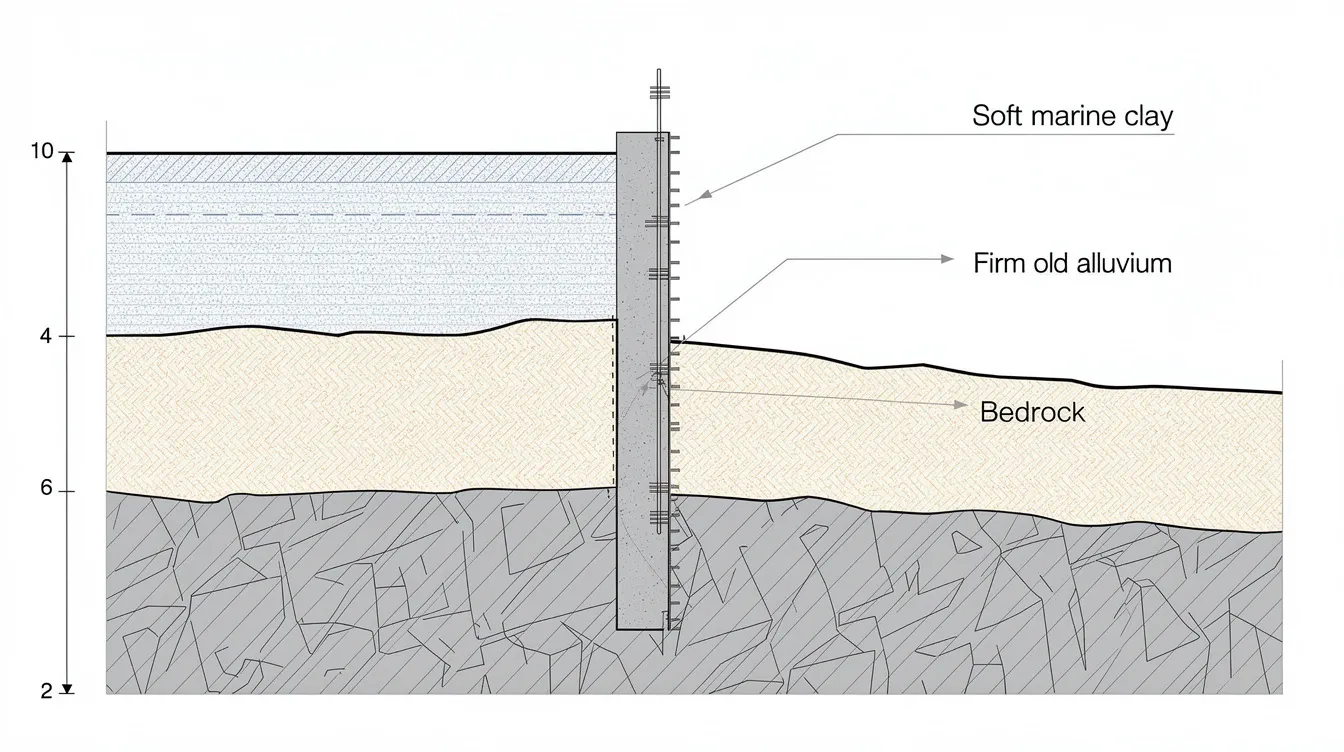
The Kallang Formation consists of soft, organic-rich clay deposited in marine, estuarine, and fluvial environments. The formation spans multiple sub-units-upper marine clay (UMC), lower marine clay (LMC), fluvial clays, estuarine deposits, and fluvial sands-with upper and lower marine clays being the most problematic for deep excavation in soft clay.
Key engineering properties that govern ERSS selection include:
-
Moisture content: 60–80% in marine clay layers, indicating high void ratio and compressibility
-
Plasticity: High (CH or CV classification), with plasticity index typically 50–80
-
Undrained shear strength (sᵤ): Upper marine clay ~10–25 kPa; lower marine clay ~20–40 kPa
-
Compressibility: High compression index (Cᵤ), low preconsolidation pressure, extensive primary and secondary consolidation
Kallang Formation has low shear strength compared to Old Alluvium, which is 2 to 7 million years old and provides the competent stratum into which retaining wall toes are typically embedded. Excavation in Kallang Formation requires careful soil characterization through field vane shear tests, UU triaxial testing, and consolidation testing on undisturbed samples.
Long-term Settlement and Consolidation Behavior
Primary consolidation in marine clay proceeds slowly due to low permeability, while secondary consolidation (creep) continues for months to years after construction. In monitored diaphragm wall basements in Kallang Formation, wall deflection continues to increase through temporary stages including strut removal and slab casting.
Numerical studies suggest advanced constitutive models for Kallang marine clays to accurately predict long-term movement. Research published through ASCE demonstrates that the soft soil creep model produces better agreement with measured long-term deflections than simplified Mohr-Coulomb approaches, particularly in upper and lower marine clays. The hardening soil model is more appropriate for fill, fluvial, and estuarine layers within the formation.
This time-dependent behavior means that permanent ERSS must be designed not just for peak construction-stage loads, but for decades of sustained and evolving soil pressures-a requirement that favors stiffer wall systems in deep excavations.
Structural Design Implications
Earth pressure development in soft clay under undrained conditions is complex: active pressures may not fully mobilize until significant deformation occurs, and wall-soil interaction depends heavily on the retaining system’s stiffness and the configuration of support systems (steel struts, slabs, or cross walls).
Excavation can induce lateral wall deflection and ground settlement, with allowable wall deflection typically less than 0.5%–1% of excavation depth per BCA requirements. In Kallang Formation, typical unsupported diaphragm wall deflection ratios range from 0.2–0.5% of excavation depth (H). When cross walls or internal supports are used, deflection can be reduced to 0.07–0.12% H-a critical capability when adjacent structures or critical infrastructure require stringent movement control.
These soil mechanics fundamentals establish why the comparative performance of diaphragm walls and secant piles diverges so significantly in Kallang Formation clays.
Comparative Analysis: Diaphragm Walls vs Secant Pile Walls in Kallang Formation
With the geological context established, a systematic comparison across four performance domains-stiffness, watertightness, constructability, and cost-reveals where each system excels and where it falls short in Singapore’s soft soils.
Wall Stiffness and Deflection Performance
Diaphragm walls provide superior flexural and shear stiffness as continuous reinforced concrete panels. For typical permanent configurations (1.2–1.5 m thick, fully reinforced), flexural rigidity (EI) reaches approximately 3–5 × 10⁶ kN·m²/m. Secant pile walls, constructed from discrete overlapping piles of 0.9–1.5 m diameter, achieve lower effective EI of approximately 1–2 × 10⁶ kN·m²/m, heavily dependent on overlap quality and reinforcement configuration.
This stiffness difference translates directly into deflection performance. Diaphragm walls effectively minimize lateral wall deflection and surface settlement in Kallang Formation:
-
MRT station excavation (28.5 m depth): 1.5 m thick diaphragm walls with cross walls at ~6 m spacing produced maximum deflection of 25–35 mm (~0.09–0.12% H) at final stage before base slab casting
-
South Beach Mixed Development (18 m depth): Circular diaphragm wall system produced deflections of 10–40 mm (~0.06–0.23% H), with maximum values occurring in zones with thick Kallang clay overlying deep Old Alluvium valleys
For secant pile walls at moderate depths (15–20 m), typical deflections range from 0.2–0.4% H without additional stiffening-potentially acceptable where adjacent buildings are less sensitive, but problematic near MRT infrastructure or conserved structures where maximum wall deflection must be less than 0.5%–1% of excavation depth.
Diaphragm walls are preferred for deep excavations exceeding 15 m to 20 m in the Kallang marine clay, particularly where the braced excavation performance must meet stringent ground movement criteria.
Watertightness and Groundwater Control
Groundwater levels significantly affect the design of retaining walls in Singapore. Groundwater levels in Singapore are consistently high due to its tropical climate, with the water table typically sitting at approximately 1 m below ground surface. High groundwater levels create significant hydrostatic pressure on walls, making water cut-off performance a primary selection criterion.
Diaphragm walls offer superior groundwater cut-off compared to secant pile walls. The continuous cast-in-situ concrete panels achieve permeability coefficients of 10⁻⁸ to 10⁻⁹ m/s when properly constructed. Joint sealing in diaphragm walls uses waterbars, hydrophilic strips, or jet-grouting overlap between panels, with toe embedment into Old Alluvium providing base cut-off. Diaphragm walls provide excellent water tightness for deep excavations-the South Beach project recorded minimal seepage despite high hydrostatic pressures.
Secant pile walls achieve moderate watertightness (typically 10⁻⁷ to 10⁻⁸ m/s) when overlap is properly maintained, but permeability increases significantly if verticality deviations reduce or eliminate overlap. Bored secant piles help prevent necking or squeezing of the bore in soft marine clay, though the pile-to-pile interface remains inherently more permeable than a continuous concrete wall. Grout injection and sealing treatments can improve performance, but at additional cost and with less certainty than D wall joint systems.
Designing for pore pressure reduction is vital for excavation safety, and the superior cut-off capability of diaphragm walls often proves decisive in deep basements where sustained dewatering would be impractical or would cause consolidation settlement in adjacent soft clay.
Constructability in Urban Singapore Conditions
Constructability in Singapore’s dense urban environment involves equipment access, noise and vibration constraints, construction sequence duration, and quality control requirements.
Diaphragm wall construction demands significant site infrastructure: crawler cranes, trenching grabs or hydraulic cutters, bentonite or polymer slurry management systems, tremie concreting equipment, and guide walls. The construction sequence is inherently slower-each panel requires trench excavation, reinforcement cage placement, concreting, curing, and joint construction before the next panel proceeds. BCA requirements mandate slurry testing (density, viscosity, gel strength, pH, sand content) and maintaining slurry level above the highest piezometric level. These are specialized operations requiring experienced temporary works designers and qualified contractors.
Secant pile wall construction uses standard piling rigs with auger or under-slurry drilling tools-equipment that is generally more compact, more widely available, and produces less site disruption. Once mobilized, individual pile construction proceeds more continuously than panel-by-panel D wall work. Secant pile walls are effective in confined spaces with high water pressure where D wall trenching equipment cannot be accommodated.
However, secant pile quality control is equally demanding. Verticality monitoring during drilling is critical-small deviations compound with extra depth, potentially eliminating overlap and creating seepage paths. Sonic logging, crosshole testing, and core sampling verify pile integrity. The qualified person overseeing construction must ensure that verticality tolerances are maintained throughout every pile.
For both systems, modern construction practice in Singapore requires comprehensive monitoring using inclinometers, settlement markers, and piezometers to verify that braced excavation performance matches design predictions.
Comparative Selection Matrix
The following matrix synthesizes the key design parameters for permanent ERSS selection in Kallang Formation:
|
Selection Criteria |
Diaphragm Walls |
Secant Pile Walls |
|---|---|---|
|
Wall Stiffness (EI) |
Very High (3–5 × 10⁶ kN·m²/m) |
Moderate-High (1–2 × 10⁶ kN·m²/m) |
|
Watertightness |
Excellent (≤10⁻⁹ m/s achievable) |
Good with proper overlap (10⁻⁷–10⁻⁸ m/s) |
|
Suitable Depth Range |
25–60+ m; diaphragm walls can support excavations deeper than 40 m |
15–30 m cost-effective range |
|
Construction Complexity |
High (specialized equipment, slurry management) |
Moderate (standard piling rigs, verticality control) |
|
Construction Duration |
Slower (panel jointing, curing, sequential construction) |
Faster mobilization; continuous pile installation |
|
Deflection in Kallang Clay |
0.07–0.25% H (with appropriate lateral support) |
0.2–0.4% H (without additional stiffening) |
|
Adjacent Structure Protection |
Superior-tight deflection control possible |
Adequate for moderate sensitivity requirements |
Interpretation: For excavation depths exceeding 25 m, adjacent to critical infrastructure, with stringent deflection limits (<0.1% H) and water cut-off requirements, diaphragm walls are the clear choice. For depths of 15–25 m where site access is constrained, cost pressure exists, and adjacent structures tolerate moderate ground movement, secant piles provide a practical and economical permanent retaining system. Sheet pile walls remain suitable only for shallow excavations up to 20 m and are not typically used as permanent ERSS in Kallang Formation.
These comparative advantages and limitations manifest as specific challenges during implementation in soft marine clay.
Common Challenges and Solutions in Kallang Formation
Permanent ERSS installation in Kallang Formation clays presents recurring challenges that both diaphragm wall and secant pile systems must address through targeted engineering solutions.
Basal Heave and Stability Issues
Soft marine clay overlying stiffer Old Alluvium creates high basal heave risk during deep excavation. Ground stability depends on adequate wall toe embedment into competent strata and, where necessary, ground improvement beneath the excavation level.
Solution: Embed wall toes a minimum of 3–5 m into Old Alluvium to provide passive resistance and cut off seepage paths. Where Kallang clay extends to significant depth, ground improvement methods such as deep cement mixing (DCM) beneath the formation level can increase base stability. One documented case used a 5 m thick DCM layer below a 14 m deep excavation to reduce wall deflection and improve basal stability. Contingency measures should include provision for additional struts or cross walls if monitoring reveals excessive movement.
Long-term Wall Movement and Building Integration
Wall movement in Kallang Formation does not stop at the end of excavation. Secondary consolidation and creep drive continued deflection for months to years after structural completion, affecting structural integrity and serviceability of the permanent structure.
Solution: Detailed finite element analysis using soft soil creep models (rather than simplified hardening soil model alone) captures time-dependent soil behavior. Numerical simulations should model actual joint stiffness between wall panels and cross walls-research shows that assuming perfect contact overestimates system stiffness, while soft contact joint models better match measured deflection curves. Comprehensive monitoring during construction and early service life using inclinometers and settlement markers validates design assumptions and triggers corrective action if needed.
Construction Quality in Marine Clay
Both wall types face quality risks specific to soft soil conditions. For diaphragm walls, trench stability under bentonite slurry requires continuous monitoring of slurry properties and groundwater levels. For secant piles, bore squeezing in soft marine clay can compromise pile geometry and overlap.
Solution: Enhanced inspection and testing protocols are essential. For D walls, this includes slurry density and viscosity testing per BCA circular requirements, panel straightness verification, joint leakage testing, and core sampling. For secant piles, sonic logging and crosshole testing verify integrity, while real-time verticality monitoring during drilling prevents overlap loss. The Accredited Checker system provides independent verification for high-risk excavations.
Groundwater Management and Dewatering
Groundwater levels significantly affect excavation safety in Singapore. Even with excellent wall cut-off, residual seepage through joints or base requires management. Uncontrolled dewatering can trigger consolidation settlement in surrounding soft clay, damaging adjacent buildings.
Solution: Design multi-stage dewatering systems with relief wells beneath the base slab and drainage blankets. Monitor piezometric levels both inside and outside the excavation to detect drawdown effects on adjacent structures. Where diaphragm walls achieve near-complete cut-off, dewatering requirements are significantly reduced compared to secant pile installations. All groundwater extraction must comply with PUB guidelines and consider the positive impact of recharge systems on surrounding ground stability.
These solutions demonstrate that successful permanent ERSS in Kallang Formation requires not just correct wall type selection, but integrated design, construction quality assurance, and monitoring throughout the project lifecycle.
Conclusion and Next Steps
The choice between diaphragm walls and secant pile walls for permanent ERSS in Kallang Formation clays is fundamentally a function of excavation depth, deflection sensitivity, watertightness requirements, and site constraints. Diaphragm walls excel in deep excavations requiring maximum structural stiffness and groundwater cut-off-delivering deflection ratios as low as 0.07–0.12% H with cross wall support and permeability below 10⁻⁹ m/s. Secant pile walls provide a cost-effective solution for moderate depths (15–25 m) with acceptable performance, particularly where confined access makes D wall equipment impractical. Hybrid solutions combining diaphragm walls and secant piles are common in major Singapore developments where soil conditions and performance requirements vary across the site.
Immediate next steps for project teams:
-
Conduct detailed geotechnical investigation with field vane shear, UU triaxial, and consolidation testing focused on marine clay soil parameters-determine Old Alluvium depth and water table profile across the site
-
Perform comparative finite element analysis using the finite element method with appropriate constitutive models (soft soil creep for marine clays, hardening soil for other Kallang sub-units) to predict deflection and settlement for both wall types under site-specific conditions
-
Engage a qualified person (PE Geotechnical) for design verification and BCA submission, ensuring regulatory compliance with current building and construction authority approved documents
Related topics worth exploring include ground improvement techniques for marine clay beneath basement formation levels, instrumentation and monitoring requirements for permanent ERSS during and after construction, and integration strategies for combining retaining wall systems with building foundation design in underground Singapore.
Additional Resources
-
BCA Advisory Note 1_09: Design Considerations for Earth Retaining or Stabilising Structures – mandatory reference for permanent ERSS design parameters, surcharge requirements, and safety factors
-
Soil Parameters for Numerical Modeling: ASCE publication on Kallang Formation and Old Alluvium soil parameters for excavation study with PLAXIS – includes calibrated small strain stiffness parameters and constitutive model recommendations
-
AMAN Engineering Consultancy provides professional ERSS design, structural modelling and analysis, and BCA submission services for deep excavation projects in Singapore’s Kallang Formation and other challenging soil conditions