
QECP ECM Endorsement for Earthworks Scope: A Complete Contractor’s Guide in Singapore
Introduction
QECP ECM endorsement for earthworks scope is the regulatory gateway every infrastructure and building project in Singapore must clear before breaking ground on any works that expose bare soil. Without a valid QECP ECM endorsement for earthworks scope-comprising a fully designed, endorsed, and authority-accepted Earth Control Measures plan-contractors are legally prohibited from commencing bulk excavation, cut-and-fill operations, or any earthworks that could generate silty runoff into public drains and waterways.
This guide is written for main contractors, developers, civil contractors, and design consultants working on construction projects in Singapore between 2024 and 2026. Whether you are delivering an expressway widening, a new rail depot, industrial platform formation, or deep basement excavation, understanding the QECP endorsement process and correctly defining the earthworks scope will determine whether your project starts on schedule or faces delays, stop-work orders, and statutory liability consequences.
In direct terms: QECP ECM endorsement is mandatory for any earthworks that disturb erodible soil surfaces capable of discharging silted runoff to public drainage. Construction projects with earthworks ≥ 50 m³ require QECP endorsement, and ECM plans are required for projects exceeding 0.2 hectares. Earthworks must not proceed until the approved ECM plan is in place, ECM installations are verified on site, and the necessary PUB clearance is secured.
This article covers PUB, NEA, and BCA-related requirements, the qualified erosion control professional’s role, ECM submission procedures, and earthworks-specific design criteria. It excludes generic environmental management frameworks and overseas regulations.
What you’ll learn:
- Who carries legal responsibility for ECM-developers, contractors, QECPs, QPs, and site teams
- What documents, drawings, and calculations are needed for QECP-endorsed ECM submissions
- The step-by-step endorsement process from pre-engagement through authority approval to site implementation
- Typical timelines and how ECM endorsement coordinates with other authority approvals
- How AMAN Engineering Consultancy Pte Ltd supports end-to-end compliance across infrastructure projects
Throughout the guide, references to site photos, ECM layout images, and example calculation details indicate where visuals should be placed to support understanding.

Understanding QECP and ECM in Singapore
Earth Control Measures (ECM) are the engineered systems and site practices that prevent silt-laden runoff from construction earthworks from entering Singapore’s public drains, canals, and reservoirs. An earth control measure plan is an engineering document for managing soil erosion, silt runoff, and sediment pollution at construction sites. Given that Singapore experiences an average annual rainfall of 2,400mm-with intense tropical downpours common year-round-uncontrolled runoff from exposed construction sites can rapidly overwhelm drainage capacity, cause localised flooding, and degrade water quality. ECM exists to intercept, treat, and safely discharge this runoff.
A Qualified Erosion Control Professional (QECP) is the registered professional recognised in Singapore to design, endorse, and audit ECM for earthworks. Plans must be endorsed by a Qualified Erosion Control Professional before any earthworks commence. PUB regulates Earth Control Measures to prevent silt-laden runoff in Singapore, and the entire ECM framework is built around ensuring that every construction site with significant earthworks has a QECP-endorsed plan in place.
The Role of a Qualified Erosion Control Professional (QECP)
A qualified erosion control professional is a civil or environmental engineer registered under the Professional Engineers Act, holding IES membership, and who has completed the accredited IES-ACES specialised course in erosion control. QECP certification is recognised by Singapore’s Building and Construction Authority, and QECPs are listed on the IES-ACES QECP Registry. QECPs ensure compliance with environmental regulations in construction, carrying a specific and non-delegable accountability for the adequacy of erosion and sediment control design on every site they endorse.
Core duties of a QECP include:
- Site assessment: evaluating topography, soil type, existing drains, service alignments, and site conditions before design begins
- ECM concept and detailed design: producing layouts for cut-off drains, sedimentation ponds, silt traps, silt fences, wheel washes, and treatment systems
- Endorsement: signing and stamping ECM drawings, calculation reports, and method statements to confirm regulatory compliance
- Periodic site audits: conducting regular inspections and post-rainfall checks to verify that installed measures match the approved ECM plan
- Amendment and sign-off: revising ECM plans when earthworks scope changes and providing final sign-off before ECM removal at project completion
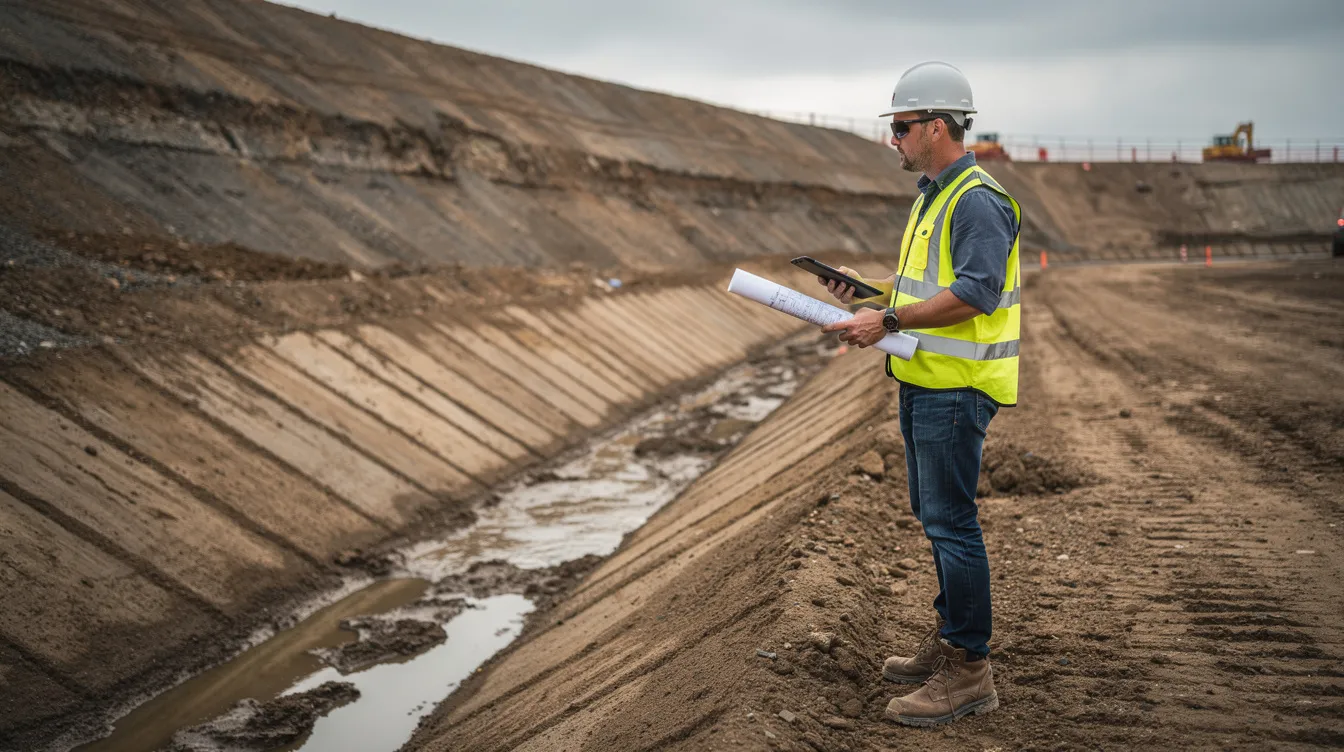
The QECP works alongside Professional Engineers (PEs) and Qualified Persons (QPs) but carries specific professional liability for the erosion and sediment control design. Their endorsement is explicitly referenced in contract specifications and authority submissions. If a QECP provides erroneous advice or an inadequate design, they can be held liable for resulting non-compliance, property damage, or environmental harm. Contractors and developers should understand that the QECP’s role is not ceremonial-it is a legal term indicating direct accountability under government regulations.
Regulatory Framework for ECM in Earthworks Projects
The primary regulatory framework governing ECM in Singapore comprises the Sewerage and Drainage Act (Chapter 294), the Sewerage and Drainage (Surface Water Drainage) Regulations, and the Code of Practice on Surface Water Drainage (7th edition, December 2018, with the latest Addendum issued October 2023). BCA mandates ECM plans for projects with gross floor area ≥ 5,000 m², while PUB’s ECM Guidebook provides detailed technical requirements. For infrastructure projects, LTA and JTC impose additional ECM requirements through their own project specifications and sustainable practices guides.
PUB is the principal authority reviewing ECM plans. ECM submissions are coordinated through the project’s QP and lodged via PUB’s clearance process (and, where applicable, CORENET e-submission). A PUB Clearance Certificate to commence earthworks must be issued before any earthworks begin on site. NEA requirements under the Environmental Protection and Management Act provide complementary regulations, particularly regarding discharge quality and workplace safety around construction activities.
Compliance triggers for ECM approval include:
- Construction projects involving site clearance, cut-and-fill, deep excavation, trenching, or substructure works
- Any activity that exposes bare soil and creates potential silty discharge to public drains or watercourses
- Projects exceeding specific disturbed area thresholds (e.g., 0.2 hectares for full QECP endorsement)
- Infrastructure works including expressways, MRT-related works, road widening, viaducts, bridges, reservoirs, and industrial platforms
Even short-duration infrastructure works-such as a 6–9 month road-widening project-still require endorsed ECM if earthworks disturb soil. Under PUB’s ECM Self-declaration Scheme Phase 3 (effective 1 January 2024), certain minor works meeting prescribed thresholds (e.g., building works ≤ 0.5 ha site area, road/trench works ≤ 0.2 ha exposed area, drainage works width ≤ 2 m and length ≤ 40 m) may qualify for simplified self-declaration rather than full submission. However, misclassification of project size or scope under this scheme is a common pitfall that can lead to breach of regulations.
Understanding these triggers is essential because QECP endorsement must be tied to a clearly defined “earthworks scope”-a concept that contractors frequently misunderstand or underestimate.
Defining the Earthworks Scope for QECP ECM Endorsement
Accurately defining the earthworks scope is the foundation of every successful ECM submission. The scope determines the extent of ECM design, the number and size of sedimentation facilities, the content of authority submissions, the cost of compliance, and the boundaries against which PUB audits are conducted. Getting the scope wrong-whether through omission, underestimation, or poor phasing-cascades into undersized ponds, missed discharge points, and non-compliance findings that can halt a construction project.
For infrastructure projects such as expressways, link roads, bridges, and drainage channels, the earthworks scope often spans multiple workfronts with phased start dates. Each phase or workfront may require its own ECM coverage, and the overall scope must account for how construction phasing affects runoff patterns across the entire site.
Typical Earthworks Activities Requiring ECM
The following activities on infrastructure and building sites are deemed earthworks within the scope of QECP ECM endorsement:
- Large-scale cut and fill for platform formation or road alignment
- Embankment construction and slope cutting
- Retaining wall excavation and formation
- Deep drainage channel excavation
- MRT cut-and-cover box excavation
- Utility corridor trenching and services diversion
- Deep basement excavation and substructure works
- Temporary stockpiles, haul roads, and casting yards that expose soil or alter runoff patterns
These activities cross the threshold where QECP ECM endorsement is required based on the disturbed area (typically ≥ 0.2 hectares), proximity to public drains or watercourses, and depth of excavation. QECPs must endorse Earth Control Measures plans for projects over 0.2 hectares. Even seemingly minor works-such as temporary stockpile areas or haul roads-fall within ECM scope if they expose bare soil to rainfall or redirect surface water flow.
Site Boundaries, Phasing, and Drainage Catchments
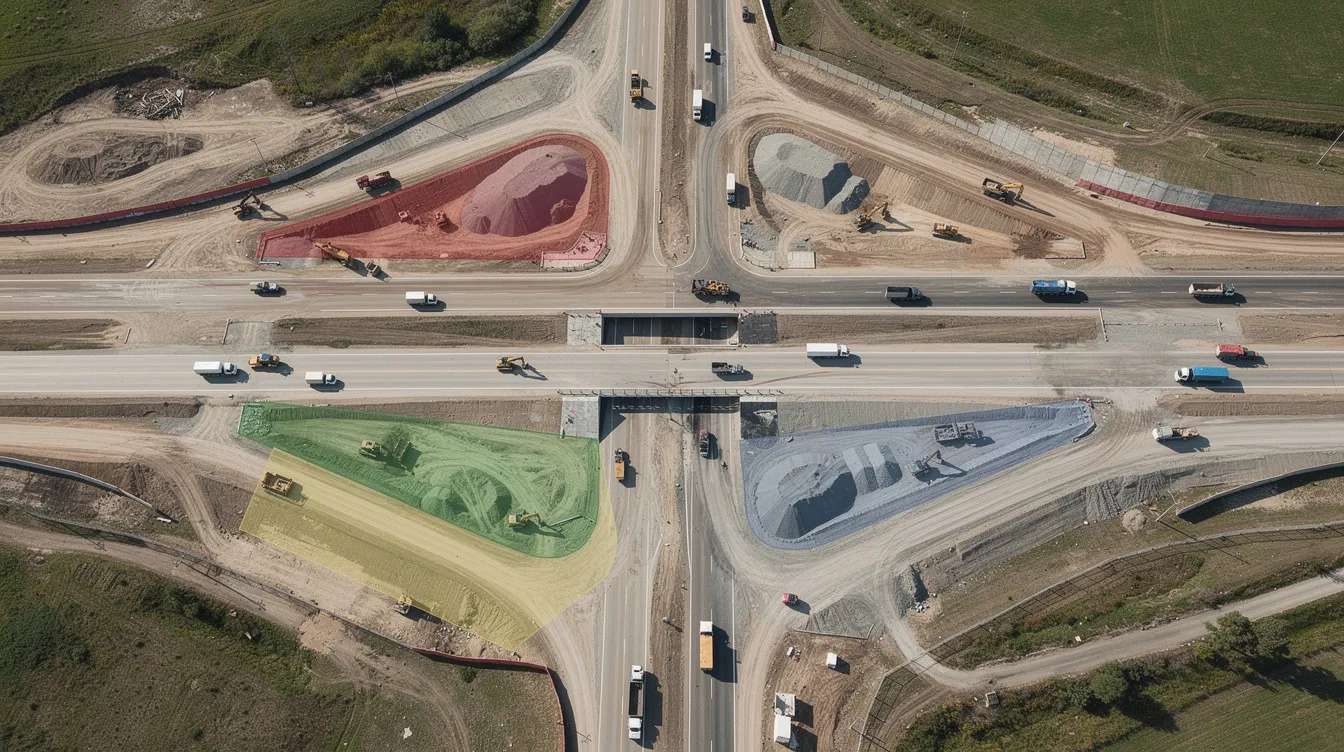
Defining the earthworks scope requires mapping several overlapping boundaries:
- Legal site boundary and hoarding line: the physical perimeter of the worksite
- Upstream catchment: areas contributing external runoff into the site
- Downstream receptors: public drains, canals, rivers, or reservoirs receiving discharge from the site
- Earthworks zones by phase: distinct areas where soil will be exposed at different stages of construction
Dividing the site into catchments or phases (e.g., Zone A, Zone B, Zone C) is essential for matching the ECM design to the construction programme. For long linear infrastructure, multiple catchments per phase are typical. The QECP and contractor must coordinate to align earthworks phasing-for example, Q1 through Q4 of a given year-with the ECM sequence so that measures are installed before soil is exposed in each zone.
Incomplete scope definition is one of the most frequent causes of ECM failure. If upstream catchments are missed, ponds are undersized. If future phases are excluded, new discharge points go unprotected. If the construction site layout changes but the scope is not updated, the entire endorsed plan becomes misaligned with reality.
Documenting the Earthworks Scope in the ECM Plan and Drawings
Endorsed ECM drawings must clearly communicate the defined scope. Required elements include:
- Coloured hatching for each earthwork zone, with distinct identification per phase
- Boundary lines showing site limits, hoarding, and adjacent properties
- Existing and proposed drains, culverts, and outfall structures
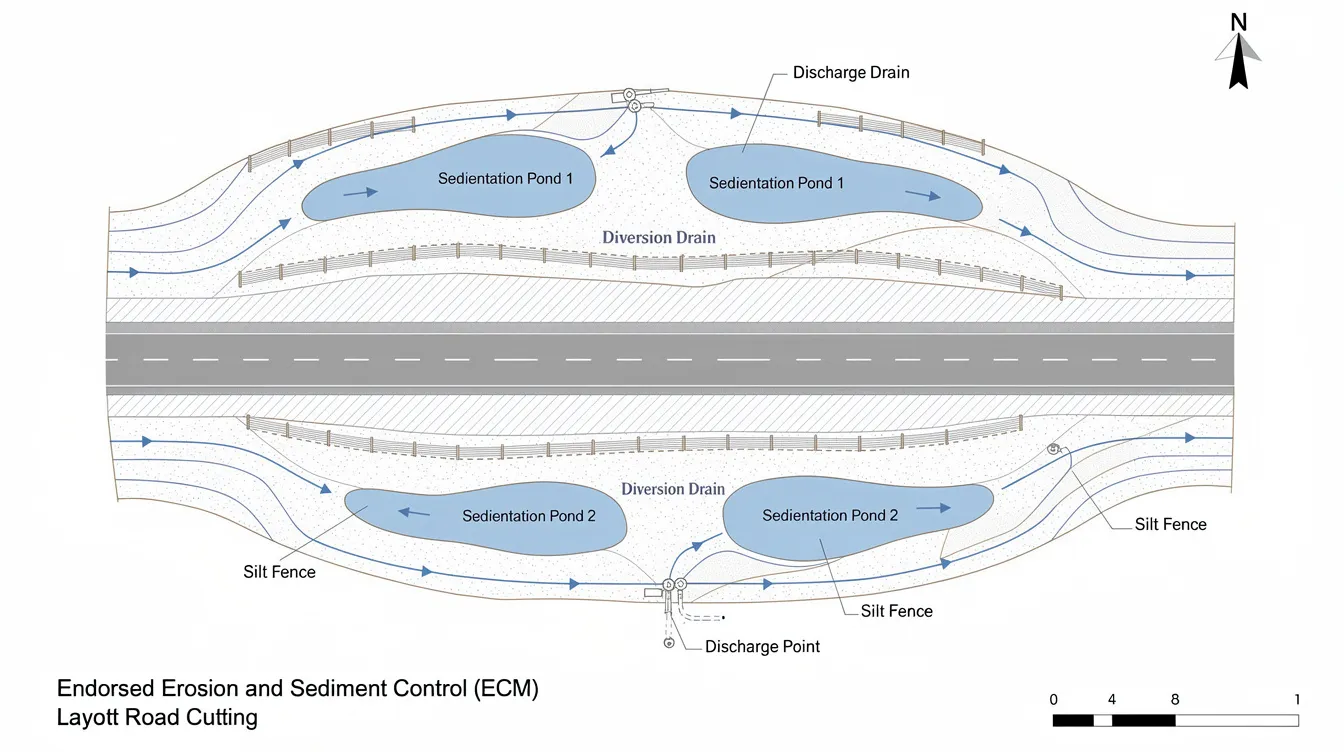
- Location and sizing of temporary drains, sedimentation ponds, silt traps, silt fences, and wheel wash facilities
- Clear legends, spot levels, elevations, and chainages (for road or rail infrastructure)
- Discharge points to public drainage, marked and referenced
ECM drawings should also include schedule tables summarising each phase: area in square metres or hectares, expected duration of exposure, ECM systems applied, and target completion or handover dates. This level of documentation ensures that the QECP endorsement scope is traceable on site, and auditors can verify compliance phase by phase.
Once the earthworks scope is properly defined and documented, the QECP can proceed to the design and endorsement of ECM systems specific to that scope.
What QECP ECM Endorsement Covers for Earthworks
QECP endorsement is not merely a signature on a drawing. It is a professional confirmation that the ECM design complies with PUB, NEA, and BCA requirements for the defined earthworks scope, and that the systems specified are adequate to intercept, treat, and safely discharge runoff under Singapore’s intense rainfall conditions. The ECM design must include temporary drainage systems and sedimentation facilities as core components.
Key deliverables within the endorsement package include endorsed plans and drawings, hydraulic and sediment calculations, method statements, monitoring regime specifications, and emergency response protocols. ECM plans must include emergency response plans for severe weather to address situations where design capacity is exceeded.
Design Elements Included in QECP Endorsement
The QECP signs off on all ECM systems required for the earthworks scope. Typical systems include:
- Perimeter cut-off drains (often concrete-lined) to intercept and channel runoff
- Temporary earth drains within earthwork zones
- Sedimentation ponds or sumps for settling suspended solids
- Silt traps at drain junctions and before discharge points
- Silt fences along boundaries and around exposed stockpiles
- Geotextile covers and erosion control blankets over slopes and embankments
- Turfing or close-turfing of completed slopes
- Wheel wash and wash bay facilities at site exits
- Hoarding sealing and boundary bunds to prevent uncontrolled overflow
For linear infrastructure projects-such as expressway widening or road alignment earthworks-ECM typically involves long sequences of cut-off drains, temporary catch pits at regular intervals, and large sedimentation ponds positioned at low points. Building platforms and industrial yards require closer coordination with structural excavation and shoring systems.
The endorsement confirms adequacy of pond volume, drainage gradients, overflow arrangements, and the robustness of silt fences under high-intensity storms. It also verifies redundancy provisions-backup capacity in case of blockage-to protect downstream drains and waterways.
Hydraulic and Sediment Design Calculations
PUB expects quantitative justification for every component of the ECM plan. QECP endorsement covers calculations using established methods:
- Runoff estimation: using the Rational Method with local intensity-duration-frequency (IDF) curves, designed for a minimum 1 in 5-year return period storm
- Sediment yield assessment: sediment yield assessments are performed using empirical formulas like the Universal Soil Loss Equation, incorporating soil erodibility factors from PUB’s Soil Erodibility Chart, catchment slope, and terrain characteristics
- Pond sizing: sedimentation pond capacity must handle the design storm volume, with draw-down time within 10 hours after a design rainfall event so the system is ready for the next storm
- Discharge quality: Total Suspended Solids levels must be controlled and usually should be below 50 mg/L, in accordance with Regulation 4(1) of the Sewerage and Drainage (Surface Water Drainage) Regulations. Maximum allowable turbidity is 50 NTU above background levels, and maximum allowable turbidity for construction sites is 50 NTU above background
- Treatment train design: flow routing through capture, primary settlement, and secondary treatment before discharge
The QECP documents all assumptions-soil type, catchment sizing, safety factors, and the treatment train approach. At AMAN Engineering Consultancy, these assumptions and formulae are compiled in a concise calculation brief appended to the ECM plans, ensuring transparency during PUB review.
Documentation, Method Statements, and Monitoring Plans
The complete endorsement package includes:
- Written ECM method statement: step-by-step procedures for erosion control, sediment treatment, and maintenance
- Maintenance schedule: frequency of pond cleaning, silt fence replacement, and drain clearing
- Inspection checklist: daily and post-rainfall inspection forms for site teams
- CCTV and TSS monitoring plan: for sites ≥ 0.2 hectares, CCTV must be installed at discharge points with Silt Imagery Detection System (SIDS) to detect silty discharge or camera downtime, with automated alerts
Roles are clearly allocated: who on site checks ponds after storms, who downloads CCTV imagery, who logs TSS readings, and how often the QECP attends audits. Site inspections during construction help ensure the efficacy of erosion and sediment controls. The endorsement pack should also define triggers for corrective actions-for example, pond overflow, CCTV downtime, or repeated high TSS readings at discharge points.
Joint site audits verify that installed ECM provisions comply with approved designs. This verification step closes the loop between paper design and field reality, and is a critical element that PUB inspectors will check.
With the endorsement scope and content understood, the next section walks through the structured multi-step process to obtain and maintain QECP ECM endorsement.
Step-by-Step QECP ECM Endorsement Process for Earthworks
The QECP ECM endorsement process for earthworks follows a structured workflow from initial engagement through authority approval to ongoing site implementation. For Singapore infrastructure projects, this process must be carefully sequenced to align with other approval milestones-PUB clearance, piling permits, LTA submissions, and drainage approvals. Delays in any step can cascade into programme slippage.
Typical Endorsement Workflow
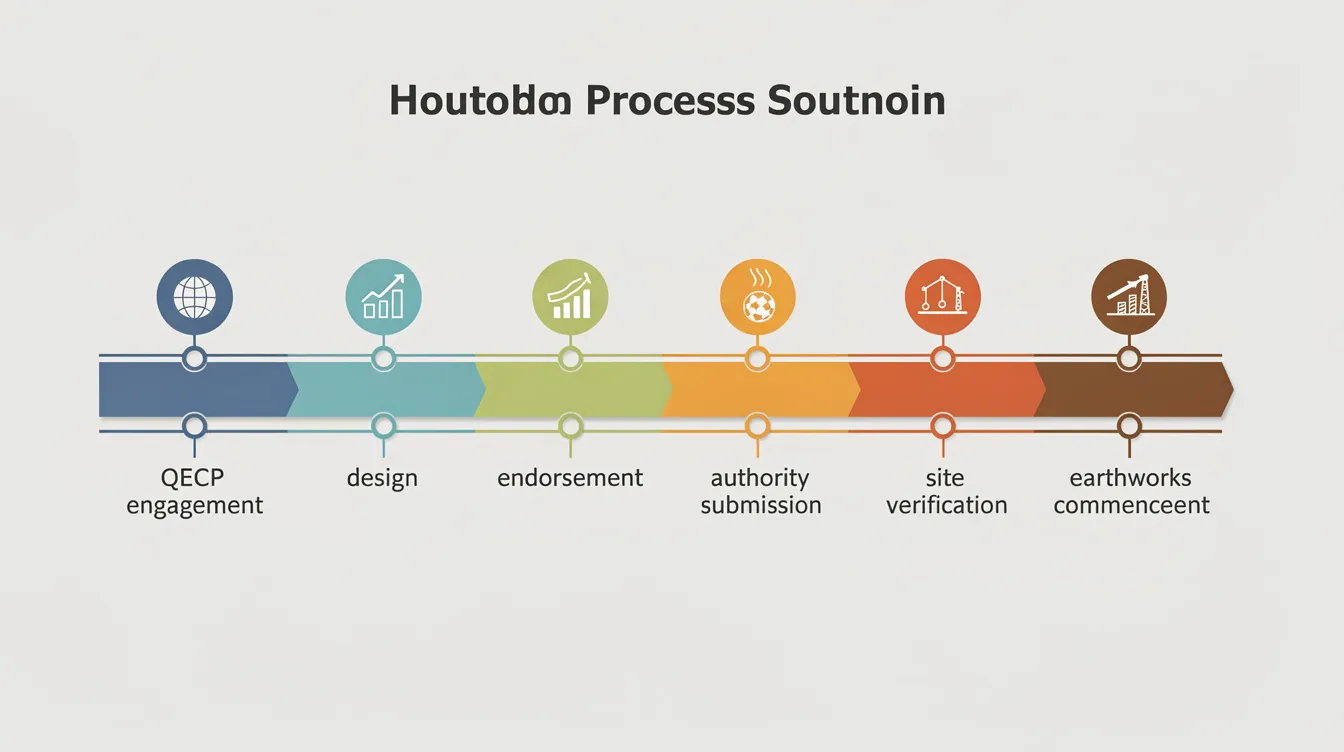
The following steps outline the standard endorsement process. Each step identifies the responsible party and key actions:
- Pre-engagement briefing: The contractor or developer shares project information with AMAN Engineering Consultancy-topographic survey, preliminary site layout, intended earthworks start date, and programme milestones. Early appointment of a QECP at this stage is strongly recommended.
- Site and scope review: The QECP conducts a desktop review of available data and, where possible, a joint site walk to verify terrain, existing drains, service alignments, and practical constraints. Site conditions are assessed against ECM guidelines to determine the appropriate level of control.
- Draft ECM concept: The QECP produces a provisional layout showing pond locations, cut-off drains, silt fences, stockpile zones, and wash bay positions, aligned with construction phasing. This concept is shared with the contractor for coordination with the overall site layout.
- Detailed design and calculations: The QECP finalises sizing for all ECM components-drainage gradients, pond volumes, overflow paths, structural details for concrete drains-and prepares calculation sheets documenting soil erodibility, rainfall intensity, and treatment capacity.
- QECP endorsement and PE/QP sign-offs: The QECP stamps and signs all drawings, calculation reports, and method statements. Internal QA review within AMAN Engineering Consultancy confirms completeness and regulatory alignment. PE endorsement is obtained where required.
- Authority submission: ECM submission is lodged via PUB’s clearance process, coordinated with the project QP. PUB reviews the submission and may issue queries or request resubmissions. For projects eligible under the self-declaration scheme, approval is typically faster.
- Pre-earthworks verification: Before bulk excavation starts, an on-site check confirms that ponds, drains, silt fences, CCTV equipment, and all ECM installations match the endorsed plan. This is a mandatory step-earthworks must not proceed until verification is complete.
- Ongoing review and amendments: As the construction project progresses and the site layout evolves, the QECP reviews and re-endorses the ECM plan whenever earthworks scope changes significantly. Updated drawings are resubmitted to PUB if changes affect public drainage or exceed endorsed parameters.
Information and Drawings Required from Contractors
To avoid delays in the endorsement process, contractors must prepare the following information early-ideally at tender stage:
- Latest topographic survey with spot levels and slope contours
- Soil investigation report including soil type and erodibility factors
- Proposed platform levels and earthworks cut/fill volumes
- Existing and proposed service alignments (utilities, telecom, power)
- Boundary and hoarding layout
- Permanent drainage layouts and road alignment chainages (for infrastructure)
- Construction programme with earthworks phases and exposure durations
- Confirmed discharge points (PUB roadside drains, canals, outfalls)
- Identification of nearby sensitive receptors (reservoirs, water intakes, nature areas)
Early BIM or CAD models help AMAN’s team optimise ECM alignments, especially for complex infrastructure like interchanges or depot platforms where multiple temporary works compete for space.
Indicative Timelines and Coordination with Authority Approvals
Once full information is received, QECP design and endorsement typically takes 5–10 working days for straightforward sites, and longer for major infrastructure with multiple phases and interfaces. PUB’s service commitment for ECM submissions requiring review is 14 working days when the submission is complete. Under the self-declaration scheme, approval is often issued within a day.
ECM endorsement must precede and coordinate with several other approvals:
- Earthwork plan approval and PUB Clearance Certificate
- Piling permits and earth retaining structure submissions
- LTA clearances for works affecting transport corridors
- URA/BCA approvals for building works
Earthworks cannot commence before ECM approval is secured. To buffer for authority clarifications and internal reviews, contractors should engage a QECP at least 3–4 weeks before the planned earthworks start date. Strict liability applies-intent is not required for prosecution if earthworks begin without an approved ECM plan.
Integrating ECM Endorsement with Infrastructure Project Delivery
Infrastructure earthworks present unique challenges that make ECM integration essential rather than optional. Long linear sites, multiple stakeholder interfaces, constrained corridors running alongside live traffic, dense utility networks, and phased construction over months or years all demand that ECM planning is embedded into overall project delivery-not treated as a last-minute compliance submission.
When ECM is designed in isolation from the broader construction project, conflicts emerge: ponds end up where cranes need to stand, drains clash with utility corridors, and silt fences block critical haul routes. Integrating ECM with civil design, BIM models, and construction sequencing from the outset prevents these costly rework cycles.
Coordination with Civil and Structural Design
ECM design must reference civil and structural drawings including retaining structures, permanent drains, culverts, and underpasses. Temporary ECM measures should not conflict with permanent works that will be constructed in later phases. For example, a temporary sedimentation pond positioned over a future pile cap location creates an avoidable programme clash.
AMAN’s multi-disciplinary team aligns ECM drawings with structural design, ensuring that temporary cut-off drains follow alignments compatible with permanent drainage routes. Where permitted and properly phased, portions of permanent drains can be reused as temporary ECM channels-reducing material waste and construction time while maintaining compliance.
For projects involving slope stabilisation or deep excavation in soft clay, coordination between temporary earth retaining systems and ECM becomes especially critical, as groundwater seepage and excavation dewatering add complexity to runoff management.
BIM and 3D Modelling Support for ECM
BIM and 3D terrain models-developed in platforms such as Civil 3D, InfraWorks, or Revit-allow QECPs to visualise catchment boundaries, pond locations, flow paths, and potential overflow routes in three dimensions. This spatial understanding is difficult to achieve from 2D plans alone, particularly on undulating sites or complex interchange geometry.
Benefits of BIM integration for ECM include:
- Clash detection between ECM components (ponds, drains) and other temporary works (site offices, tower cranes, stockpile areas)
- Catchment delineation using digital terrain models to accurately calculate contributing areas
- Construction phasing simulation through 4D BIM to verify that ECM installations precede earthworks exposure in each zone
- Visual communication for site teams who can see exactly where ECM measures must be installed
Contractors are encouraged to provide AMAN with federated BIM models where available. For complex transport or utility schemes, BIM-supported ECM coordination can reduce design iterations by identifying conflicts before they manifest on site.
Aligning ECM with Tendering and Cost Planning
QECP-endorsed ECM concepts prepared during tender or early design phase improve the accuracy of ECM cost allowances in infrastructure bids. When ECM costs are estimated only after contract award, they are frequently underbudgeted, leading to pressure for cuts that compromise compliance.
Typical ECM cost components include:
- Concrete for cut-off drains and silt traps
- Geotextiles, erosion control blankets, and silt fences
- Excavation and formation for sedimentation ponds
- CCTV and TSS monitoring equipment
- Ongoing maintenance labour (pond cleaning, drain clearing, silt fence replacement)
- QECP professional fees for design, endorsement, and audits
Including a dedicated ECM line item in tenders protects the budget from later “value engineering” that might strip out critical compliance measures. Companies can face lawsuits for accidental breaches of law if cost-cutting results in inadequate ECM, and statutory liability insurance protects against fines and legal fees in such scenarios. AMAN’s complementary QS support and value engineering services help balance compliance with budget control-ensuring that ECM specifications are right-sized for the project without over-design or under-provision.
Common Issues with QECP ECM Endorsement for Earthworks (and How to Avoid Them)
Many delays and non-compliance findings stem from recurring, avoidable mistakes in ECM scoping and endorsement. Statutory liability holds parties accountable for specific legal breaches, and directors can experience personal liability under statutory laws when ECM obligations are neglected. The following problems and solutions draw from common patterns observed across Singapore infrastructure projects.
Problem 1: Late Engagement of QECP
Contacting a QECP only days before scheduled earthworks leads to rushed designs, incomplete ECM submissions, and PUB queries that push back the earthworks start date. In the worst cases, contractors mobilise plant and labour to site only to discover that no ECM approval exists-resulting in idle resources and potential lawsuits if earthworks proceed without clearance.
Solution: Engage a QECP at concept or tender stage. Plan backwards from the target earthwork start date, allowing at least 3–4 weeks for design, endorsement, submission, and authority response. Incorporate ECM milestones into the master programme alongside piling permits and structural submissions. Seek legal advice early if there is any uncertainty about whether your works trigger ECM requirements.
Problem 2: Poorly Defined Earthworks Scope and Catchments
Underestimating the disturbed area-by excluding temporary stockpiles, haul roads, or future phases-results in undersized sedimentation ponds, repeated flooding during storms, and difficulty demonstrating compliance during PUB audits. If the ECM plan does not cover all earthwork zones, the entity accountable for compliance is exposed to enforcement action, and the damaged party could include downstream property owners or the public drainage system.
Solution: Conduct an early site walk with the QECP. Use the latest topographic survey and cross-reference with road, drainage, and utility plans. Map all areas where bare soil will be exposed, including temporary works areas. Align ECM phasing with the actual construction sequence, and document every zone in the ECM drawings with area calculations and exposure durations.
Problem 3: Inadequate Integration with Site Layout and Traffic Management
Typical clashes occur when ponds are sited where haul roads must pass, wheel wash facilities are missing at busy exit points, or silt fences are cut by workers to create shortcuts. These conflicts arise when ECM is designed in isolation from the construction site’s operational layout-traffic management, crane positions, material storage, and worker access routes.
Solution: Hold multidisciplinary coordination meetings involving ECM, safety, traffic management, and construction teams. Jointly review the site layout and mark “no cut / no move” ECM zones on all planning drawings. Ensure that ponds, drains, and fences are positioned to coexist with active business activities on site without creating bottlenecks or safety hazards.
Problem 4: Missing or Weak Monitoring and Maintenance Regimes
Frequent failures include uncalibrated TSS meters, incomplete inspection logs, clogged ponds before monsoon periods, and CCTV offline without escalation. Once ECM is in place, neglecting maintenance means measures progressively lose their effectiveness. Silt fences collapse, ponds fill with sediment, and treatment systems become blocked-none of which is acceptable under ECM guidelines even if the original design was sound.
Solution: Implement simple daily and weekly checklists. Assign a designated ECM champion on site with clear responsibilities. Set automated alerts for CCTV downtime and TSS threshold exceedances. Schedule joint audits with the QECP at regular intervals and after every significant rain event. Maintain photo records and logs-these are essential evidence during PUB inspections and protect against claims of negligent act or omission.
Problem 5: ECM Not Updated When Earthworks Scope Changes
Contractors often expand workfronts, open new cuttings, or re-align drains without seeking QECP re-endorsement. The ECM plan on record no longer matches the site reality, creating a gap that auditors will identify as non-compliance. The party held responsible is typically the contractor, but the developer and QP may also be held accountable for failing to maintain an up-to-date approved ECM plan.
Solution: Establish a change management procedure that flags any earthworks scope change for QECP review. Hold periodic coordination workshops-monthly or at phase transitions-to compare the as-built site layout against the endorsed ECM drawings. Produce “as-executed ECM drawings” updates and resubmit to PUB when changes exceed the endorsed scope or affect discharge points.
How AMAN Engineering Consultancy Supports QECP ECM Endorsement
AMAN Engineering Consultancy Pte Ltd is a Singapore-based multi-disciplinary consultancy experienced in infrastructure design and authority submissions. The firm offers professional services spanning civil and structural design, BIM modelling, temporary works engineering, and regulatory compliance-with QECP ECM endorsement as a core service for infrastructure and building projects.
AMAN’s company structure integrates QECP services with broader engineering capabilities, allowing ECM design to be coordinated seamlessly with permanent works, drainage, and structural submissions under one project team.
Our End-to-End QECP and ECM Services
AMAN’s QECP and ECM services cover every stage of the endorsement process:
- QECP appointment: formal appointment of registered QECPs to the project
- ECM concept and detailed design: from preliminary tender-stage layouts to full design with calculations
- Endorsement: stamping and signing of all ECM drawings, reports, and method statements
- ECM submission support: coordination with QP for lodging with PUB, handling authority queries and resubmissions
- Periodic site audits: regular inspections and post-storm assessments to verify that ECM installations match the endorsed plan
- Close-out services: final QECP sign-off before ECM removal at project handover
Complementary services for infrastructure projects include drainage and road design, structural inspections, BIM modelling, and impact assessments-all coordinated under a single project team to reduce interfaces and accelerate delivery. AMAN’s internal workflows target fast turnaround while maintaining regulatory compliance and documentation quality.
Example Scenarios for Infrastructure Projects
Expressway widening (planned start Q2 2025): For an expressway widening project spanning 2.4 km, AMAN produced the ECM concept during the tender stage, enabling the main contractor to include accurate ECM cost estimates in their bid. When the contractor was appointed, detailed design commenced immediately-ECM phasing was aligned with traffic management stages, and pond locations were coordinated with temporary road diversions. Early QECP involvement prevented rework on drain alignments and helped secure PUB clearance two weeks ahead of programme, avoiding a potential stop-work situation.
New bus depot with large-scale platform earthworks: A depot project required removal of 85,000 m³ of earth across a 4.2-hectare site area, with phased platform formation over 14 months. AMAN’s QECP team designed ECM for three distinct catchment zones, each with dedicated sedimentation ponds and cut-off drains. Ongoing monthly audits identified a need to relocate one silt trap when the contractor adjusted the haul road alignment mid-project. The re-endorsement was completed within five working days, keeping the project compliant without programme disruption.
Engagement Model and Contact Information
Contractors and developers typically engage AMAN through the following process:
- Initial enquiry: Share project overview, location, and anticipated earthworks start date
- Information checklist: AMAN provides a structured checklist of required survey, layout, and programme information
- Fee proposal: Scope-specific fee proposal issued within 3–5 working days
- Formal appointment: QECP officially appointed to the project on behalf of the developer or contractor
- Project kick-off meeting: Joint session with QECP, contractor, and QP to align scope, programme, and ECM strategy
Prospective clients are encouraged to share programme dates and any authority deadlines early so AMAN’s team can plan QECP resources and align with parallel submissions. Contact AMAN Engineering Consultancy Pte Ltd through the corporate website, email, or phone to discuss your project’s ECM requirements.
Conclusion and Practical Next Steps
QECP ECM endorsement for earthworks scope is not an administrative formality-it is a regulatory and professional obligation that protects public infrastructure, waterways, and the viability of your construction project. Getting the earthworks scope right from the outset determines the quality of the ECM design, the speed of authority approval, and the resilience of erosion and sediment controls throughout construction. Timely, integrated planning-where ECM is embedded into project delivery rather than bolted on at the last moment-consistently reduces risk, cost, and programme delays.
For contractors and developers working on Singapore infrastructure and building projects in 2024–2026, the strategies to comply with ECM regulations are well-established. The challenge is execution: engaging early, defining scope accurately, maintaining measures diligently, and updating plans as site conditions change.
Immediate actions:
- Confirm whether your upcoming works fall under earthworks regulations by checking disturbed area, project size, and proximity to public drains
- Compile current survey, site layout, drainage, and programme information using a structured checklist
- Engage a QECP-or contact AMAN Engineering Consultancy-at least 3–4 weeks before planned earthworks start
- Align ECM phasing with construction sequencing and ensure ECM costs are protected in the project budget
- Establish monitoring and maintenance responsibilities, including CCTV and TSS logging, before excavation begins
For related topics, readers may explore groundwater control in deep excavations, structural and façade inspections, or BIM-supported construction planning for infrastructure projects.
Frequently Asked Questions on QECP ECM Endorsement for Earthworks
The following FAQ addresses recurring questions from Singapore contractors, developers, and design consultants navigating ECM compliance for earthworks on infrastructure and building projects.
Is QECP ECM endorsement always required before any earthworks can start in Singapore? Yes. Any earthworks that expose bare soil and could generate silty discharge to public drains require an endorsed ECM plan before commencement. Construction projects with earthworks ≥ 50 m³ require QECP endorsement. For minor works meeting PUB’s self-declaration thresholds (Phase 3, effective 1 January 2024), a simplified process applies, but ECM documentation and compliance obligations remain.
What is the difference between a QECP and a PE in relation to ECM for earthworks? A QECP is a specialised professional specifically trained, certified, and registered to design and endorse erosion and sediment control measures. While a QECP is typically a Professional Engineer, not all PEs hold QECP certification. The QECP carries specific professional liability for ECM adequacy, whereas the PE’s role may encompass broader structural or civil design responsibilities on the same project.
How often must ECM be audited on an active infrastructure earthworks site? ECM must be inspected regularly-typically at defined intervals during active earthworks and after every significant rain event. The QECP conducts periodic formal audits, while the contractor’s ECM team performs daily and weekly checks. Inspection frequency may increase during monsoon season or when new earthwork phases commence.
Can ECM endorsement be combined for multiple adjacent contracts or workfronts? ECM endorsement is tied to defined earthworks scope and site boundaries. While adjacent contracts under the same developer may coordinate ECM systems (e.g., shared sedimentation ponds), each contract typically requires its own QECP endorsement with clearly delineated scope. Coordination agreements should be documented and submitted to PUB.
What happens if PUB or NEA finds ECM on site that differs from the endorsed plan? If installed ECM does not match the approved ECM plan, the site is deemed non-compliant. Consequences can include stop-work orders, fines under the Sewerage and Drainage Act, and requirement to rectify immediately. The party held responsible-typically the contractor-may face enforcement action, and the project’s QP and developer may also be held accountable. Companies can face lawsuits for accidental breaches of related law, and statutory liability insurance may cover legal fees but not the reputational damage.
How long should contractors retain ECM records, CCTV footage, and TSS logs after project completion? While specific retention periods vary by contract and agency requirements, best practice is to retain all ECM records-including inspection logs, CCTV footage, TSS monitoring data, and endorsed drawings-for a minimum of three years after project completion or final ECM close-out, whichever is later. These records protect against potential lawsuits or retrospective audits.
Are small, short-term earthworks for services diversion also subject to QECP ECM endorsement? Yes, if the works expose bare soil and could discharge silty runoff to public drains. Even limited trenching for utility corridors or services diversion can trigger ECM requirements, particularly when the disturbed area exceeds prescribed thresholds. Under the self-declaration scheme, trench works ≤ 0.2 ha exposed area may qualify for simplified declaration, but ECM measures must still be implemented.
For project-specific clarifications on QECP ECM endorsement for your earthworks scope, contact AMAN Engineering Consultancy Pte Ltd to discuss your requirements and timeline.