

Building Information Modeling (BIM) is no longer a forward-looking concept in Singapore’s construction sector. It is an operational requirement for firms seeking to compete on public and large private projects. As Singapore’s built environment digitization accelerates through frameworks like Integrated Digital Delivery (IDD) and IFC+SG, firms that treat BIM as optional are already falling behind on procurement eligibility, regulatory compliance, and project delivery performance. This guide covers what BIM means in the Singapore context, how it is applied across project stages, the concrete advantages it delivers, and how developers and construction firms can implement it effectively.
Table of Contents
- Understanding BIM: Definition and key components
- How BIM is applied in Singapore projects
- Major advantages of BIM for Singapore developers
- Navigating BIM challenges and integration best practices
- What most guides miss about BIM’s strategic value in Singapore
- Take your Singapore projects further with expert BIM support
- Frequently asked questions
Key Takeaways
| Point | Details |
|---|---|
| BIM’s growing importance | In Singapore, BIM is fast becoming essential for securing major public and private construction projects. |
| BIM delivers real savings | Firms using BIM routinely achieve faster approvals, fewer errors, and tighter budget control. |
| Local standards matter | IFC+SG and IDD are Singapore-specific BIM requirements developers can’t ignore. |
| Adoption challenges exist | Not all companies adopt advanced BIM at once, but gradual uptake and expert support make integration more manageable. |
| Strategic value over tech | BIM’s biggest benefit is not just compliance, but future-proofing your firm against industry change. |
Understanding BIM: Definition and key components
Building Information Modeling is a structured, data-driven process in which a digital representation of a building’s physical and functional characteristics is created, shared, and maintained throughout the project lifecycle. In Singapore’s construction context, BIM goes well beyond 3D visualization. It encompasses data management, interoperable model exchange, and multi-discipline coordination governed by national standards.
The foundational components of BIM relevant to Singapore projects include:
- Digital 3D models: Geometry-rich representations of architectural, structural, mechanical, electrical, and plumbing (MEP) elements
- Embedded data: Each model element carries attributes such as material specifications, installation dates, cost estimates, and maintenance requirements
- Common Data Environment (CDE): A centralized platform where all project disciplines share, review, and version-control BIM models
- Clash detection: Automated identification of conflicts between building components before construction begins, dramatically reducing rework
- 4D and 5D simulation: Linking model elements to project schedules (4D) and cost data (5D) for predictive project management
- IFC+SG compliance: Singapore’s national extension of the Industry Foundation Classes (IFC) open standard, which mandates specific parameter sets for regulatory submissions to agencies including the Building and Construction Authority (BCA)
The IFC+SG and CDE-based approach structures project roles clearly. Coordinators, typically the lead architects, are responsible for federating models from multiple disciplines into a single unified model. Engineers from structural, facade, and MEP disciplines contribute their respective models with incremental IFC+SG parameter population at defined project gateways.
| BIM component | Function in Singapore projects |
|---|---|
| 3D federated model | Central reference for coordination and regulatory submission |
| CDE platform | Controlled model sharing, version tracking, and audit trails |
| Clash detection | Early identification of design conflicts across disciplines |
| 4D simulation | Schedule integration for construction sequencing |
| 5D cost modeling | Cost estimation tied to model quantities |
| IFC+SG parameters | Standardized data for BCA and other agency submissions |
Understanding these components is critical before implementation begins. Firms that invest in 3D BIM modeling as the structural core of their digital delivery process build a foundation that supports all downstream BIM applications, from regulatory submissions to facilities management.
How BIM is applied in Singapore projects
With the foundational components in mind, let’s see how BIM is actually implemented step-by-step across Singapore construction projects.
BIM application in Singapore is structured around project gateways that align with regulatory submission milestones. Each stage of the project lifecycle has defined BIM deliverables, and the responsibilities of each discipline are mapped against those milestones. Below is the typical sequence of BIM application for a medium to large Singapore development.
- Concept and schematic design stage: Architects initiate the BIM model with massing, spatial planning, and basic structural grids. At this stage, IFC+SG parameters relevant to planning approvals under the Urban Redevelopment Authority (URA) are populated.
- Design development stage: Structural, facade, and MEP engineers contribute discipline models to the CDE. The coordinator federates these models and runs initial clash detection reports. Parametric data for BCA compliance submissions begins to be populated.
- Tender documentation stage: The BIM model is used to generate coordinated drawings, schedules, and quantities for procurement. Firms that apply effective project management workflows at this stage are better positioned to produce accurate, complete tender packages.
- Construction stage: Subcontractors and main contractors reference and update the federated model for installation sequencing and site coordination. 4D simulation is used to optimize construction scheduling and identify sequencing conflicts.
- Pre-submission validation: Before submitting to BCA or other authorities, models must be validated for IFC+SG compliance. Tools such as the Bimeco Validator check parameter completeness and format. This step is critical; submissions with incomplete parameters are rejected and delay approvals.
- Commissioning and handover: The as-built BIM model, with fully populated 6D (facilities management) data, is handed over to the building owner or operator.
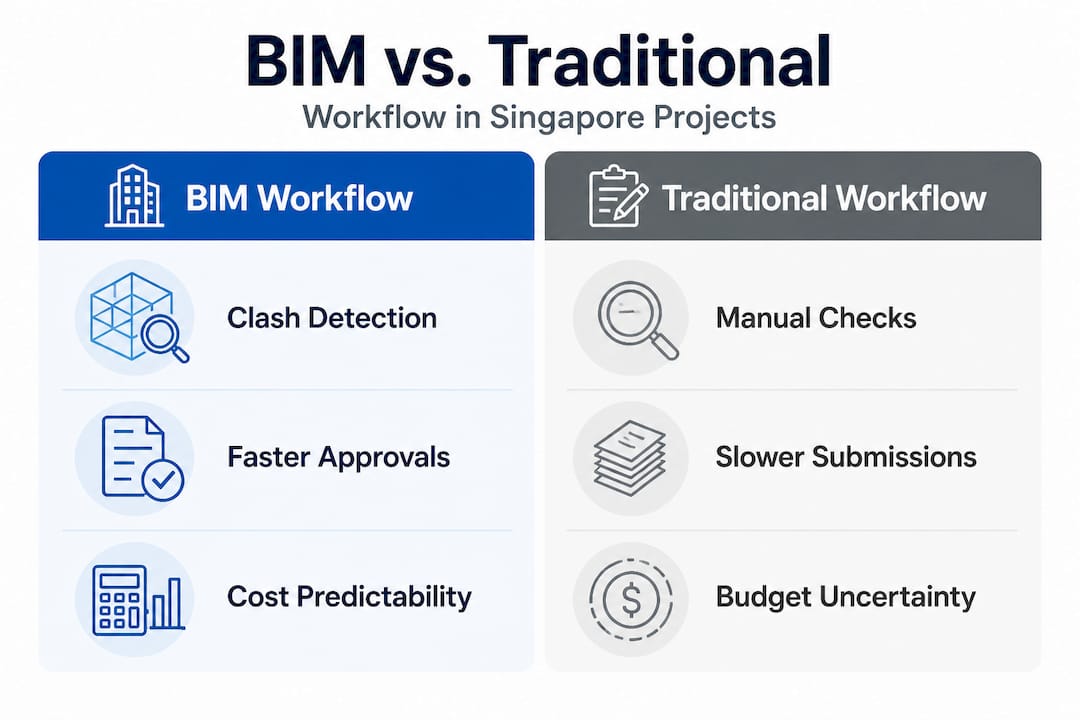
A direct comparison between BIM-enabled and traditional non-BIM workflows shows measurable differences in project outcomes.

| Project attribute | BIM-enabled workflow | Traditional non-BIM workflow |
|---|---|---|
| Clash detection | Resolved pre-construction | Identified on-site, costly to fix |
| Regulatory submission | Standardized IFC+SG model | Manual drawing packages, slower review |
| Cost predictability | 5D model provides real-time estimates | Estimates based on manual quantity take-off |
| Design changes | Propagated automatically across model | Manual updates across multiple drawings |
| Tender accuracy | Model-derived quantities, fewer gaps | Higher risk of discrepancies |
Research into BIM adoption patterns in Singapore reveals an important pattern: while quantity surveyors recognize BIM’s high usefulness for cost management, actual adoption for quantity surveying tasks remains below its potential. This gap signals that advanced BIM applications, particularly 4D, 5D, and 6D dimensions, require deliberate capability-building rather than passive exposure. Design-Build procurement models further intensify this demand, requiring MEP BIM models to be completed before contract award.
Pro Tip: For firms entering Design-Build contracts, begin MEP BIM coordination during the pre-award phase, not after. Pre-award BIM reduces scope ambiguity and strengthens your tender submission’s technical credibility with assessors evaluating digital engineering transformation readiness.
Major advantages of BIM for Singapore developers
Having examined typical BIM workflows, let’s focus on the tangible benefits this digital transformation brings to developers and construction firms in Singapore.
The business case for BIM in Singapore is supported by both quantitative project data and the structural requirements of the public procurement market. The following advantages are not theoretical; they are documented outcomes from BIM adoption within Singapore’s built environment.
Reduced rework through clash detection. Construction rework is one of the largest avoidable costs on any project. Clash detection in BIM identifies conflicts between structural, architectural, and MEP elements during design, before any physical work begins. Resolving a clash at design stage costs a fraction of the cost to fix it on-site. For complex developments such as integrated mixed-use schemes or hospital facilities, the number of detected clashes in BIM coordination sessions routinely runs into the hundreds, each one a prevented site disruption.
Faster regulatory approvals via IFC+SG. Singapore’s agencies, including BCA, URA, JTC, and HDB, increasingly accept and in some cases require IFC+SG-compliant model submissions. Standardized parameter sets reduce the back-and-forth associated with manual drawing reviews and allow agencies to perform automated compliance checks. This shortens the approval cycle and gives developers greater schedule certainty.
Improved cost and time predictability. 5D BIM links cost data directly to model elements. When a design change is made, cost implications are recalculated automatically rather than requiring a separate quantity surveying exercise. 4D scheduling allows project managers to identify sequencing conflicts and optimize resource allocation weeks before work begins on-site. Combined, these capabilities reduce the frequency of budget overruns and schedule slippages.
Competitive advantage in public and large private tenders. Singapore’s public sector, led by BCA’s Construction Industry Transformation Map, mandates BIM for qualifying projects. As noted in assessments of Singapore’s BIM policy direction, firms without demonstrated BIM capability face direct disqualification from certain procurement categories. For developers, this means that the development pipeline for major projects, including government land sales, HDB projects, and JTC industrial facilities, requires BIM-capable contractors and consultants.
Key advantages of BIM adoption for Singapore developers include:
- Elimination of coordination conflicts before construction commences
- Shorter regulatory review cycles through compliant IFC+SG submissions
- Accurate cost modeling that supports more reliable project financing
- Stronger tender positions for public sector and large private works
- Reduced insurance and contingency requirements due to lower project risk
- Better asset data at handover, supporting efficient facilities management
Pro Tip: Engage specialized BIM modeling services early in the project lifecycle, not just for submission purposes. BIM models built from the design stage, rather than retrofitted from completed drawings, provide the full range of coordination and predictability benefits. Late-stage BIM creation limits the return on your investment.
Navigating BIM challenges and integration best practices
Despite its many benefits, BIM implementation comes with real-world hurdles. This section offers practical solutions and best practices drawn from local project experience.
BIM adoption in Singapore is not without friction. Firms of all sizes encounter obstacles ranging from internal skill gaps to coordination failures between project parties. Recognizing these challenges and addressing them systematically is what separates successful BIM adopters from firms that invest in the technology without realizing its value.
Challenge 1: Skill gaps and learning curve. BIM software platforms, including Autodesk Revit, Bentley AECOsim, and ArchiCAD, require substantial training before teams can operate at production level. Advanced functions such as 4D scheduling integration and 5D cost modeling demand dedicated specialist expertise. Organizations that attempt to deploy these capabilities without structured training programs typically see productivity losses that deter further adoption.
Challenge 2: Inconsistent adoption across disciplines. BIM delivers its greatest value when all project disciplines contribute accurate, timely, and IFC+SG-compliant models to the CDE. When one discipline lags, the federated model is incomplete, clash detection results are unreliable, and submission schedules slip. Developers and main contractors must contractually specify BIM deliverables and timelines for all parties.
Challenge 3: Pre-submission model validation. Many firms discover compliance deficiencies only at the point of regulatory submission. Validation tools such as the Bimeco Validator are essential for checking IFC+SG parameter completeness before models are submitted to BCA or other agencies. Building this validation step into the project program, at least two to three weeks before each submission gateway, allows time to resolve deficiencies without impacting the overall schedule.
“The discipline is not in building the BIM model. It is in maintaining the quality of the data inside it throughout every project stage.”
The following steps represent best practice for firms building or improving their BIM capability:
- Establish a BIM Execution Plan (BEP) at the start of every project, defining deliverables, responsible parties, software platforms, and CDE protocols.
- Align all consultants and subcontractors on IFC+SG requirements from the outset, specifying the parameter sets required at each project gateway.
- Schedule regular coordination meetings around federated model reviews rather than 2D drawing reviews, to keep BIM central to the project communication structure.
- Integrate pre-submission validation into the project program as a formal milestone, not an afterthought.
- Leverage expert support for complex submissions to agencies; streamlining the structural approval process requires a working knowledge of both BIM and regulatory expectations simultaneously.
- Use each project as a capability-building exercise. Firms that assign BIM responsibilities to junior staff without mentoring do not accumulate the organizational expertise needed to advance to higher BIM dimensions.
Addressing design compliance obligations in parallel with BIM coordination, rather than treating them as sequential activities, reduces the risk of compliance-driven rework late in the project.
What most guides miss about BIM’s strategic value in Singapore
Most articles about BIM frame it as a technical tool, a software platform for engineers and architects. That framing is accurate but dangerously incomplete for property developers and construction firms making capital allocation decisions. The more precise framing is this: BIM capability is a prerequisite for organizational access to Singapore’s most valuable construction opportunities.
Singapore’s public procurement system, which funds hospitals, transport infrastructure, institutional buildings, and large public housing programs, is progressively restricting contract eligibility to firms with demonstrated BIM capability. A contractor or developer that lacks this capability is not competing on a level playing field; in many tender categories, they are not competing at all. The financial consequence of BIM non-adoption is not measured in project inefficiencies. It is measured in the contracts your firm will never win.
The second dimension that mainstream guides overlook is organizational resilience. Firms that treat BIM as a top-down business priority build internal processes, team structures, and data management capabilities that make them more agile across all project types. Firms that treat it as an IT upgrade, purchased and delegated to a technical team, rarely see the full value and often revert to traditional workflows under deadline pressure.
Strategic BIM adoption means that senior leadership, not just technical staff, understands BIM’s role in bid development and client relationships. It means that BIM deliverables are built into contracts and fee structures from day one, rather than absorbed as overhead. It means investing in tender document preparation processes that demonstrate BIM maturity to sophisticated public sector and private developer clients.
The firms that will lead Singapore’s built environment over the next decade are not necessarily the largest. They are the ones that recognized BIM’s strategic dimension early and built their operations around it.
Take your Singapore projects further with expert BIM support
Property developers and construction firms navigating Singapore’s regulatory and procurement landscape need more than software. They need structured expertise in BIM implementation, coordination standards, and statutory submissions that translate model data into approved project outcomes.

Aman Engineering Consultancy provides end-to-end 3D BIM services tailored to Singapore’s regulatory requirements, covering model creation, coordination, IFC+SG compliance, and pre-submission validation. For projects requiring full lifecycle support, our specialized BIM modeling services are designed to integrate with your existing project team structures and align with BCA, URA, JTC, HDB, and SCDF submission requirements. Whether you are establishing BIM capability for the first time or improving coordination on a complex development, our team offers the technical depth and regulatory knowledge to move your project forward with confidence.
Frequently asked questions
Is BIM mandatory for all construction projects in Singapore?
BIM is increasingly required for public sector projects and large private developments in Singapore, as the country’s BIM policy framework continues to expand under BCA’s Construction Industry Transformation Map, but smaller projects may not yet be subject to mandatory BIM requirements.
What is IFC+SG, and why does it matter for BIM?
IFC+SG is Singapore’s national extension of the IFC open standard, specifying the parameter sets and data formats that BIM models must meet for regulatory submissions, ensuring that all project disciplines produce interoperable, compliant models across agencies.
What is the main advantage of BIM over traditional construction methods?
BIM significantly reduces costly on-site rework by enabling clash detection during design, and it supports faster regulatory approvals through standardized IFC+SG model submissions that replace manual drawing packages.
Can smaller firms successfully implement BIM, or is it just for big players?
Smaller firms can implement BIM effectively by starting with core 3D coordination before progressing to advanced 4D and 5D applications, and by leveraging expert consultancy support rather than attempting to build all capabilities in-house, as Singapore-specific research confirms that even incremental BIM adoption delivers measurable project benefits.