
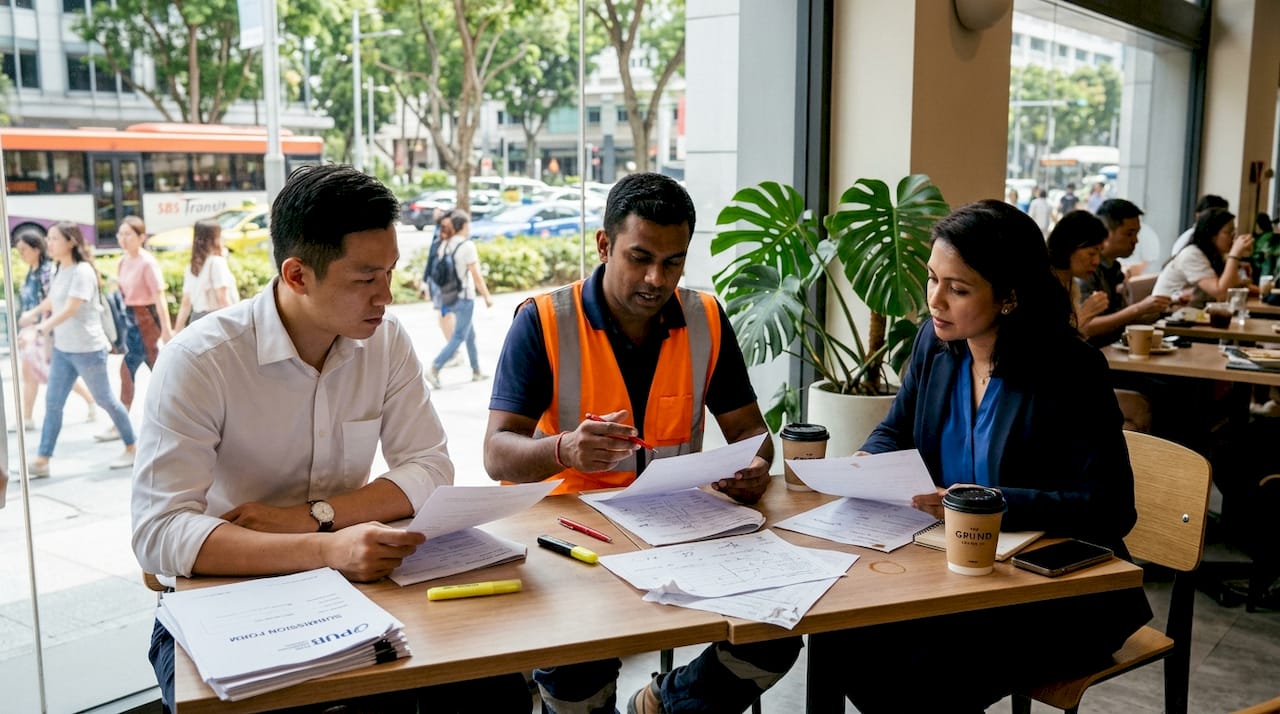
Meeting PUB approval requirements is one of the most technically demanding aspects of construction compliance in Singapore, yet many developers and engineers underestimate the complexity involved. PUB, Singapore’s National Water Agency, regulates all matters relating to water supply, sewerage, and drainage in the built environment. The approval process encompasses multiple mandatory forms, coordinated agency submissions, and strict technical standards that apply from the earliest stages of project design. This guide breaks down every critical layer of the process so that project teams can plan submissions accurately and avoid costly delays.
Table of Contents
- Key Takeaways
- PUB approval requirements every project team must know
- The step-by-step PUB submission process
- Comparing PUB to other Singapore regulatory agencies
- Practical strategies for a smooth approval experience
- Renewals, monitoring, and ongoing compliance
- My perspective on PUB compliance in practice
- How Aman Engineering Consultancy supports PUB compliance
- FAQ
Key Takeaways
| Point | Details |
|---|---|
| QP submissions are mandatory | Qualified Persons must submit building plans to PUB for water and sewerage works clearance before construction proceeds. |
| Multiple forms govern different works | Form B, Form E, Form F, Form H, and Form J each apply to distinct categories of water, sewerage, and trade effluent works. |
| Earth Control Measures apply near drainage reserves | Projects near PUB infrastructure or drainage reserves must submit Earth Control Measures as part of the approval package. |
| Multi-agency coordination is unavoidable | PUB approvals frequently overlap with BCA, URA, SCDF, and JTC submissions, requiring structured workflow management. |
| Renewals carry formal obligations | Trade effluent discharge licenses require timely resubmission and notification to PUB to remain legally compliant. |
PUB approval requirements every project team must know
PUB’s regulatory authority over construction projects extends across three principal categories: water supply installations, sewerage connections, and trade effluent discharge. Each category carries distinct submission requirements, and conflating them is one of the most common sources of application errors.
For water supply works, QP submissions for water compliance are mandatory before any installation proceeds. The Qualified Person (QP), typically a registered Professional Engineer or Licensed Architect, is responsible for ensuring that all plans conform to the Public Utilities Act and associated Codes of Practice. Alongside the QP, a Licensed Plumber must be appointed for all sanctioned water-related installation works. The Licensed Plumber carries direct responsibility for on-site execution and must hold current PUB registration.
The required documentation includes several mandatory forms. Form B applies to water service installation works, Form E covers sewerage construction submissions, Form F relates to drainage works, Form H addresses trade effluent applications, and Form J governs notifications of completion. Completion certificates for water works must be submitted post-construction to confirm that installations meet all specified standards before occupation.
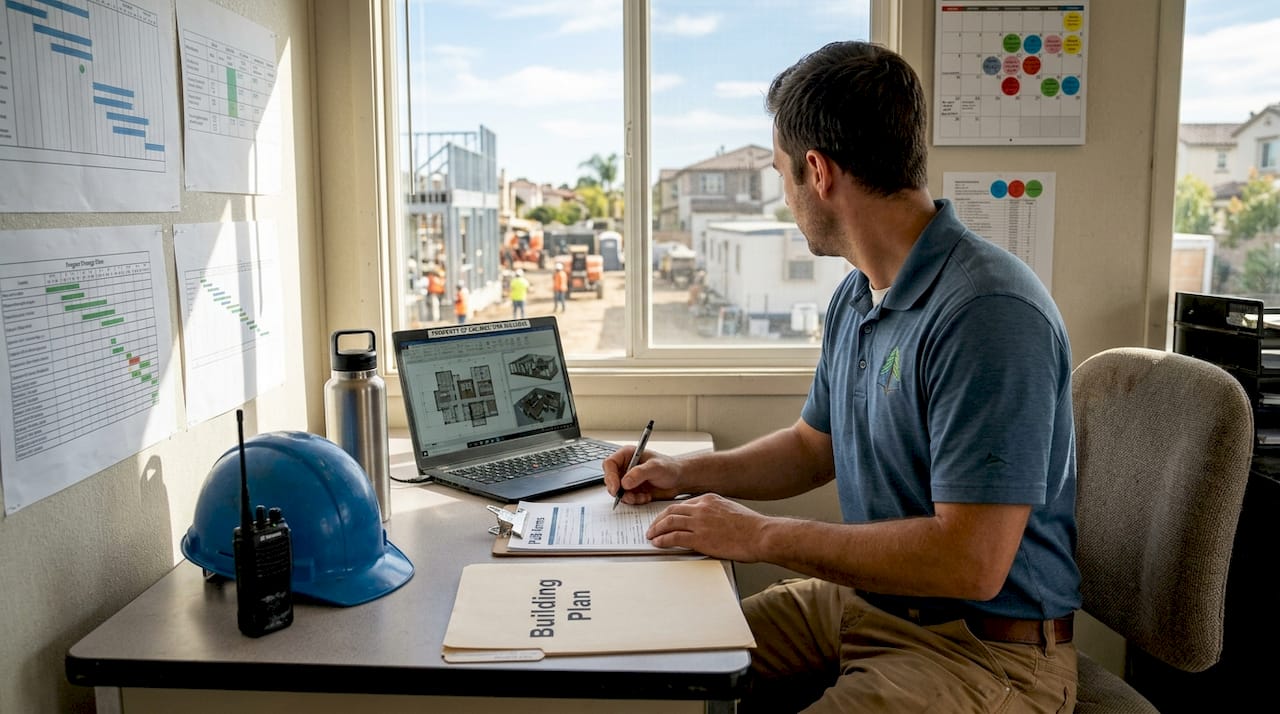
Earth Control Measures (ECM) submissions are required for construction activities near PUB drainage reserves or infrastructure. ECMs govern how excavation, earthworks, and sediment runoff are managed to protect existing drainage infrastructure. Projects that fail to account for ECM requirements during planning routinely encounter late-stage queries that delay approval by weeks.
Water efficiency measures also form part of the mandatory compliance scope. PUB’s Water Efficient Buildings framework requires developers to install water-efficient fittings rated under the Water Efficiency Labelling Scheme (WELS) and to meet minimum performance benchmarks for new commercial, industrial, and residential developments.
Pro Tip: Review PUB’s Code of Practice on Sewerage and Sanitary Works alongside the Code of Practice on Surface Water Drainage before completing the design stage. Identifying conflicts early reduces the number of clarification rounds with the agency.
Common compliance pitfalls at this stage include incomplete QP declarations, incorrect form selection for the type of work, and failure to align water supply and sewerage submissions with each other when both are required for the same project.
The step-by-step PUB submission process
Understanding the sequence of the PUB licensing process prevents workflow bottlenecks and helps project teams assign responsibilities accurately. The following steps reflect the standard path for a new building development requiring both water supply and sewerage approvals.
-
Engage a Qualified Person and Licensed Plumber. Appoint the QP at the design stage, well before submission. The QP is responsible for preparing all technical drawings and declarations. The Licensed Plumber must be confirmed before any physical works begin.
-
Prepare technical drawings and documentation. The QP prepares layout plans, schematic drawings, and technical specifications that comply with PUB Codes of Practice. All documentation must identify pipe routes, materials, connection points, and system capacities.
-
Submit via PUB’s e-services portal. Application submission via PUB e-services requires a CorpPass or SingPass account linked to the project entity. Forms are submitted digitally, and supporting documents are uploaded as part of the same package. Paper submissions are no longer accepted for most application types.
-
Coordinate with parallel agency submissions. PUB reviews often proceed concurrently with BCA, URA, and SCDF submissions. Project teams should use a coordinated planning approval process to track all outstanding approvals in parallel rather than sequentially, which reduces total lead time significantly.
-
Respond to PUB queries promptly. PUB’s reviewing officers may issue technical queries during the assessment period. These must be addressed within the specified response window. Delayed responses are the single most common reason applications extend beyond standard processing timelines.
-
Display public notices where required. Certain applications, particularly those involving connection to public sewers or drainage reserves, require the display of site notices for a statutory period before approval can be granted.
-
Receive in-principle approval and proceed to construction. Once PUB grants written approval, construction may commence under QP and Licensed Plumber supervision. Any deviation from approved plans requires a formal amendment submission before implementation.
-
Submit completion notifications and obtain clearance. Upon completion of all water and sewerage works, the QP and Licensed Plumber submit the relevant completion forms. PUB issues formal clearance, which is required before the building can be connected to the public water and sewage network.
Comparing PUB to other Singapore regulatory agencies
Construction projects in Singapore operate within a multi-agency regulatory environment. Understanding which requirements belong to which authority prevents duplication, missed submissions, and conflicting designs.
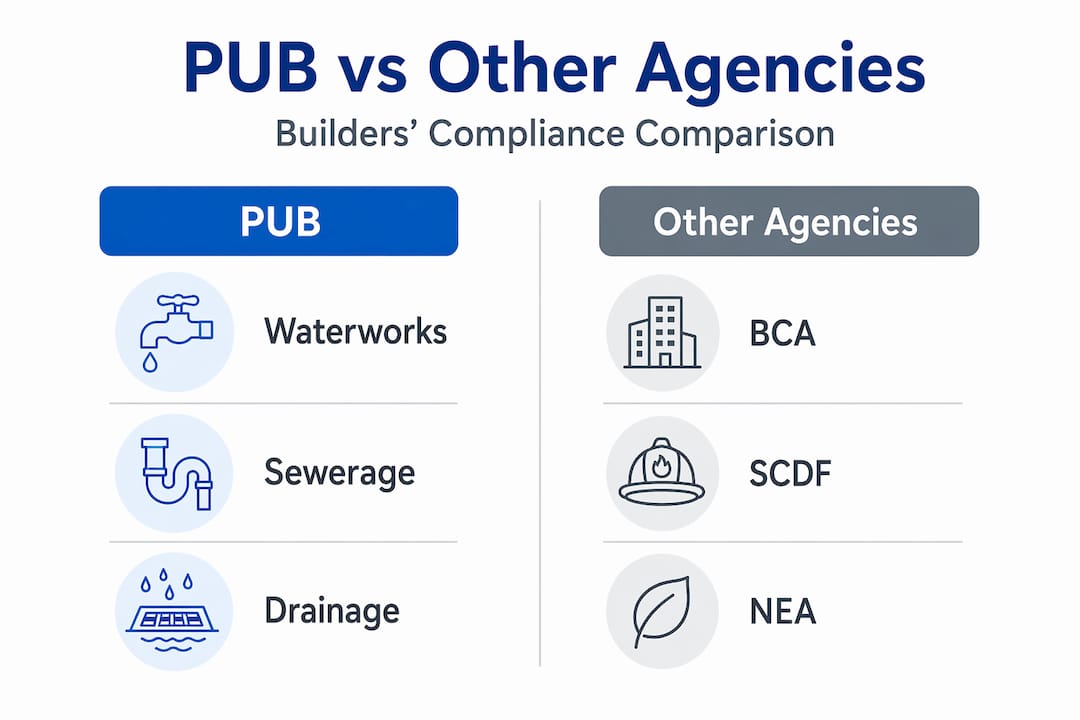
| Approval Type | Responsible Agency | Primary Forms / Instruments | Unique Mandate |
|---|---|---|---|
| Water supply and sewerage | PUB | Form B, Form E, Form F, Form H, Form J | WELS compliance, ECM, Licensed Plumber appointment |
| Structural plan approval | BCA | Building Plan submission, PE-endorsed drawings | Structural safety, geotechnical assessment |
| Planning permission | URA | Development Application (DA) | Land use, gross floor area, setbacks |
| Fire safety | SCDF | Fire Safety Plan, Fire Certificate | Escape routes, suppression systems, compartmentation |
| Industrial estate compliance | JTC | JTC Clearance, tenancy conditions | Industrial use compliance, estate-specific requirements |
Multi-agency coordination requirements are effectively mandatory for any development of meaningful scale in Singapore. Where PUB’s requirements differ most significantly from those of other agencies is in their focus on service connections rather than structural compliance. PUB governs what happens inside the pipes and how those pipes connect to public infrastructure. BCA governs what happens to the structure around them.
The interaction between PUB and SCDF is particularly relevant in projects with fire sprinkler systems or suppression networks, since water supply design must account for fire demand flow rates alongside domestic and trade use. Project teams that do not model these interdependencies during design frequently encounter conflicting pressure requirements during the PUB review stage.
Practical strategies for a smooth approval experience
Securing PUB approval without delays requires more than accurate form completion. The following practices reflect the standards applied by experienced project teams working across Singapore’s construction sector.
-
Appoint the QP and Licensed Plumber before the design is finalized. Late appointments mean that technical requirements are often retrofitted into a design that was not originally structured to meet them, generating unnecessary rework.
-
Use a master submission register. Track every required form, its status, the responsible party, and the target submission date in a single document. This is especially important when PUB submissions are running in parallel with BCA and URA applications.
-
Verify form versions before submission. PUB updates its application forms periodically, and submitting an outdated version results in automatic rejection. Always download forms directly from PUB’s website immediately before preparing the submission package.
-
Document all PUB correspondence. Retain written records of all queries, responses, and approvals. Regulatory compliance documentation is not just good practice. It is a legal requirement that protects the project team in the event of disputes or enforcement action.
-
Conduct a pre-submission internal review. Before formally submitting to PUB, the QP should review all drawings, forms, and supporting documents against PUB’s published checklist. Identify missing items before they become queries.
Pro Tip: Engage PUB through a pre-application consultation for complex projects involving trade effluent discharge or works near drainage reserves. This informal channel allows project teams to clarify interpretive issues before formal submission, reducing the risk of rejection.
The construction compliance checklist developed by Aman Engineering Consultancy provides a structured reference for confirming submission readiness across all major regulatory agencies, including PUB.
Renewals, monitoring, and ongoing compliance
PUB approval obligations do not end when a project receives its initial clearance. Several categories of approval carry ongoing compliance requirements that must be managed throughout the operational life of the building.
-
Trade effluent discharge license renewals follow a formal resubmission and notification process with PUB. License periods are fixed, and renewals must be initiated before expiry to avoid operating without a valid permit.
-
Annual reporting for certain categories of discharge requires submission of monitoring data to PUB, including effluent quality measurements against approved parameters.
-
Water usage monitoring applies to buildings enrolled under PUB’s water efficiency programs. Consumption data must be tracked and, for mandatory reporters, submitted to PUB on the prescribed schedule.
-
Penalties for non-compliance include fines, suspension of the discharge license, and in cases of serious breach, revocation of the permit alongside potential prosecution under the Sewerage and Drainage Act.
-
Record retention covering all approved plans, completion certificates, and PUB correspondence must be maintained for the duration of the building’s operational period and made available for inspection upon request.
My perspective on PUB compliance in practice
In my experience working across Singapore’s construction sector, the projects that encounter the most severe PUB-related delays are rarely those with technical errors. They are the ones where the QP was engaged too late, where project managers assumed that PUB worked like other agencies, or where form submissions were treated as an administrative formality rather than a technical exercise.
I’ve seen developments where the failure to account for Earth Control Measures during planning required design changes to drainage infrastructure at a stage when construction had already commenced. The cost implications were significant, and all of it was avoidable with earlier coordination.
What I’ve also observed is that PUB’s regulatory environment has become more precise over time. The agency’s expectations around water efficiency, trade effluent monitoring, and drainage reserve protection are more exacting in 2026 than they were five years ago. Project teams that rely on older precedents without checking current requirements expose themselves to unnecessary compliance risk.
Qualified Person supervision is not just a regulatory checkbox. It is the primary mechanism through which a project team sustains accurate, defensible compliance from design to completion. The QP’s value lies in their ability to interpret PUB’s codes in the context of a specific project’s parameters and to manage the agency relationship through every submission stage.
My consistent advice to developers and contractors: treat PUB engagement as a design input, not a post-design hurdle.
— Aman
How Aman Engineering Consultancy supports PUB compliance
Aman Engineering Consultancy provides end-to-end support for all aspects of PUB regulatory compliance, from initial design review through to completion notifications and permit renewals. The firm’s team includes registered QPs and Licensed Plumber coordinators with direct experience across water supply, sewerage, and trade effluent applications in Singapore’s commercial, industrial, and residential sectors. Aman Engineering also integrates BIM-supported civil design services into the compliance workflow, allowing design conflicts to be identified before formal submission. For developers and contractors who require structured, professionally managed QP supervision services, Aman Engineering delivers the technical depth and regulatory familiarity needed to keep projects on schedule. Contact the team via amanengineering.com.sg to discuss your project’s PUB approval requirements.
FAQ
What forms are required for PUB approval in Singapore?
PUB requires specific forms depending on the type of work involved. Form B applies to water service installations, Form E to sewerage works, Form H to trade effluent discharge applications, and Form J to completion notifications.
Who is responsible for submitting plans to PUB?
A Qualified Person must submit all building plans to PUB for water and sewerage works clearance. A Licensed Plumber must also be appointed for the physical installation works.
How long does PUB take to approve an application?
Processing times vary by application type and complexity. Straightforward water service applications may be approved within a few weeks, while trade effluent and drainage reserve-related submissions can take considerably longer, particularly if PUB issues technical queries that require resubmission.
What happens if PUB approval is not obtained before construction?
Non-compliance with PUB requirements risks project delays, financial penalties, and potential revocation of operating permits under the Sewerage and Drainage Act and the Public Utilities Act.
Are trade effluent discharge approvals permanent?
No. Trade effluent discharge licenses are issued for fixed periods and must be formally renewed through PUB before expiry. License renewal requires resubmission of the relevant forms and satisfaction of current discharge standards.