
Deep Excavation in Soft Clay: Managing Kallang Member Soil Challenges in Singapore
1. Introduction: The Underground Frontier of the Lion City
Singapore represents a unique paradox in the world of civil engineering. It is a metropolis defined by its verticality, yet its future lies increasingly in the depths below.
As one of the most densely populated nations on Earth, with a land area of roughly 730 square kilometers, the pressure to optimize space has driven urban planners and engineers to look downward.
The Urban Redevelopment Authority (URA) Master Plan has explicitly earmarked the subterranean realm—the “Greater Underground”—as a strategic asset for the nation’s resilience and growth.
From the sprawling Mass Rapid Transit (MRT) network to the Deep Tunnel Sewerage System (DTSS) and underground ammunition facilities, the scale of underground construction in Singapore is unprecedented.
However, this ambition collides with a formidable geological adversary: the Kallang Formation. Specifically, the Marine Clay Member of this formation creates some of the most treacherous ground conditions found anywhere in the tropical belt.
Geotechnical engineers in Singapore often joke, with a hint of grim seriousness, about the soil’s consistency resembling “toothpaste” or “peanut butter.”
This is not merely hyperbole; it is a tactile description of a material that possesses negligible shear strength, high sensitivity, and an immense capacity for deformation.
The challenge of deep excavation in Singapore is not simply a matter of removing earth. It is a high-stakes discipline of managing equilibrium in a chaotic medium.
It involves retaining walls that must withstand immense lateral pressures, ground improvement techniques that turn mud into stone, and a regulatory framework forged in the fires of past tragedies like the Nicoll Highway collapse.
As we move through the mid-2020s, the industry is also undergoing a digital transformation, where Artificial Intelligence (AI) and Digital Twins are becoming as essential as concrete and steel.
This report provides an exhaustive analysis of the state of practice for deep excavations in Singapore’s soft clay.
It synthesizes geological insights, engineering solutions, regulatory requirements, and case histories to offer a comprehensive roadmap for navigating the complexities of the Kallang Formation.
It is designed for the professional engineer, the developer, and the academic who seeks to understand not just the what, but the how and why of building deep in soft ground.
2. The Geological Adversary: Anatomy of the Kallang Formation
To engineer a solution, one must first respect the material. The geology of Singapore is a complex tapestry of ancient rock and young, soft deposits.
The engineering challenges are concentrated in the coastal and riverine areas where the deep valleys cut into the ancient bedrock have been filled with soft quaternary deposits.
2.1 Geological Origins and Stratigraphy
During the Pleistocene epoch, global sea levels were significantly lower than they are today.
These glacial maxima, river systems incised deep valleys into Singapore’s older geological formations—primarily the competent Old Alluvium (OA), the sedimentary Jurong Formation, and the Bukit Timah Granite.
When the ice caps melted and sea levels rose during the Holocene (approximately 10,000 years ago), the sea inundated these valleys.
In the tranquil, low-energy environments of these drowned valleys, fine-grained sediments settled out of suspension, forming what we now know as the Marine Clay.
This deposition occurred in two distinct phases, separated by a period of sea-level regression.
This geological history gives rise to the characteristic stratigraphy encountered in investigations 1:
- The Fill Layer: The uppermost stratum in many coastal areas (Marina Bay, Changi, Tuas) is man-made reclamation fill, typically sand or earth, ranging from 5m to 15m thick. This material is often loose and permeable.
- Upper Marine Clay (UMC): The younger of the two clay layers. It is typically normally consolidated, very soft, and dark grey. It contains shells and organic matter, indicating its marine origin.
- The Intermediate Layer (The Crust): This layer marks the period of lower sea level between the two depositions. The exposed clay surface desiccated and oxidized, forming a stiffer, often reddish-brown “crust.”
- Engineering Insight: The continuity and permeability of this layer are critical. If permeable, it acts as a drainage path that accelerates consolidation. If it is stiff, it can provide temporary support for shallow sheet piles, but it can also mislead site investigations into believing a competent stratum has been reached.1
- Lower Marine Clay (LMC): The older deposit. While similar in composition to the UMC, it is often slightly over-consolidated due to the historical overburden of the UMC and the intermediate crust.
- Fluvial Sands and Clays: At the base of the Kallang Formation, overlying the bedrock, lie fluvial deposits. These sands are often confined aquifers containing water under pressure.
- Engineering Insight: This layer is the primary culprit in hydraulic uplift failures. Excavating the clay reduces the overburden weight, and if the pressure in the fluvial sand is not relieved, the floor of the excavation can burst.3
- Old Alluvium (OA): The “bedrock” for many foundations. It is a dense, cemented, silty sand that provides excellent bearing capacity and passive resistance for wall toes.4
2.2 Geotechnical Parameters of Marine Clay
The engineering behavior of Singapore Marine Clay is dominated by its high water content and low strength.
Understanding specific parameters is essential for the Rigorous Approach required by BCA regulations.
Table 1: Typical Geotechnical Parameters for Singapore Marine Clay 1
| Parameter | Symbol | Typical Range | Engineering Implication |
| Bulk Unit Weight | 15 – 16 kN/m³ | Low density due to high void ratio and water content. | |
| Undrained Shear Strength | 10 – 40 kPa (UMC)
30 – 60 kPa (LMC) |
Increases linearly with depth. Extremely low near the surface (“toothpaste”). | |
| Strength Ratio | 0.25 – 0.32 | Critical for validating site investigation data. Values > 0.32 suggest over-consolidation or errors. | |
| Plasticity Index | 50% – 90% | High plasticity indicates high potential for shrink/swell and creep. | |
| Liquid Limit | 70% – 100% | Correlates with compressibility. | |
| Compression Index | Highly compressible. Small stress changes cause large settlements. | ||
| Permeability | m/s | Very low. Drainage is slow, meaning excess pore pressures persist for years. | |
| Sensitivity | 4 – 8 | Loses significant strength upon disturbance (remolding). |
2.3 The Phenomenon of Sensitivity
One of the most dangerous characteristics of the Kallang Marine Clay is its sensitivity. Sensitivity () is the ratio of the undisturbed undrained shear strength to the remolded undrained shear strength.
Singapore Marine Clay is classified as sensitive to extra-sensitive.
In practical terms, this means that the method of construction can fundamentally alter the soil properties.
If a sheet pile is vibrated aggressively into the clay, or if a bored pile auger churns the soil excessively without proper support, the clay structure collapses.
The material transforms from a semi-solid to a viscous fluid. This thixotropic behavior has led to incidents where piles have lost their skin friction capacity or where slopes that appeared stable suddenly liquefied under dynamic loading from construction plant machinery.7
3. Site Investigation: The First Line of Defense
In the era of Eurocode 7 and the BCA’s strict regulatory regime, the quality of Site Investigation (SI) has moved from a procedural necessity to a critical design component.
The days of relying on sparse boreholes and empirical correlations are over.
3.1 Advanced In-Situ Testing
Standard Penetration Tests (SPT) are often unreliable in very soft clays where the “N-value” is zero or near zero.
The weight of the rod alone can push the sampler into the ground. Therefore, Singapore practice relies heavily on advanced in-situ testing methods 1:
- Field Vane Shear Test (FVT): This remains the gold standard for determining the undrained shear strength () profile. It measures the torque required to shear the clay in-situ. The sensitivity is also measured by rotating the vane rapidly to remold the soil and testing again.
- Cone Penetration Test (CPT / Piezocone CPTu): The CPTu provides a continuous profile of tip resistance (), sleeve friction (), and pore water pressure (). It is invaluable for detecting thin lenses of sand within the clay that might be missed by conventional sampling. These lenses can act as drainage layers that accelerate consolidation settlement, a phenomenon that can be both a risk (unexpected settlement) and a benefit (faster strength gain if managed).6
- Dilatometer Test (DMT): Increasingly used to derive the at-rest earth pressure coefficient () and stiffness moduli (), which are critical inputs for Finite Element Analysis (FEA) software like Plaxis.
3.2 The Digital Turn: AGS(SG) and 3D Modelling
A significant development in recent years (post-2013, refined through 2025) is the standardization of SI data.
The Building and Construction Authority (BCA) now mandates that all SI data be submitted in the AGS(SG) format—a localized version of the Association of Geotechnical and Geoenvironmental Specialists data format.
This standardization serves a dual purpose. First, it ensures data integrity and reduces transcription errors.
Second, it feeds into the Singapore Geological Office (SGO) database. This centralized repository allows for the creation of a national 3D geological model.
For a new project, engineers can now access a “digital twin” of the underground geology, leveraging data from past projects to predict the depth of the Marine Clay valleys.
This macro-level view prevents the “blind spots” that occur when a site investigation misses a deep channel or a fault line.10
4. Earth Retaining or Stabilizing Structures (ERSS): The Wall Systems
In deep excavations within soft clay, the “Net Active Pressure”—the difference between the soil pressure driving the wall inward and the passive resistance holding it back—is immense.
The ERSS must be rigid enough to limit ground movement and watertight enough to prevent hydraulic failure.
4.1 Diaphragm Walls (D-Walls): The Gold Standard
For deep excavations in the Central Business District (CBD) and for MRT stations, Diaphragm Walls are the default choice.
- Mechanism: D-Walls are reinforced concrete walls constructed in panels (typically 2.8m to 6m wide). The trench is excavated under a supporting fluid (bentonite or polymer slurry) to prevent the soft clay from collapsing before the concrete is poured.
- Stiffness: The thickness of D-Walls in Singapore typically ranges from 0.8m to 1.5m. This immense thickness provides the high flexural stiffness () required to resist bending moments and limit lateral deflection to strict regulatory limits (often < 0.5% of excavation depth).12
- Water Tightness: D-Walls have fewer joints than pile walls, reducing the risk of leakage. Water stops are installed between panels to ensure a seal.
- Toe Embedment: In the Kallang Formation, the wall acts as a cantilever in the early stages and a propped beam later. Crucially, the toe of the wall must be embedded deep into the stiff Old Alluvium (OA) to provide “fixity” and prevent “kick-out” failure.
4.2 Secant Bored Piles (SBP)
Secant pile walls are constructed by drilling intersecting reinforced (male) and unreinforced (female) concrete piles.
- Application: SBP walls are often used for medium-depth excavations or where site logistics make D-Wall grabs difficult to operate.
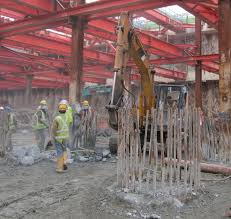
- The Verticality Risk: A major challenge in deep soft clay excavations is maintaining pile verticality. If a pile deviates from the vertical axis by even 1% at a depth of 30m, the overlap between piles can be lost. This creates a “window” in the wall.
- Consequence: In the water-saturated Marine Clay, a gap in the wall leads to ground loss. Water and soil flow through the gap into the excavation, creating a void behind the wall that migrates upward, eventually causing a sinkhole at the surface. Recent BCA circulars (2025) have highlighted this risk, mandating rigorous verticality checks and grouting behind pile walls to seal potential gaps.14
4.3 Sheet Piles: Limitations and Risks
Steel sheet piles are generally flexible and rely on interlocks for water tightness.
- Suitability: They are typically limited to shallower excavations (<15m) or temporary works in Singapore’s soft clay.
- Deflection: Due to their low bending stiffness compared to concrete walls, sheet piles in soft clay experience large deflections, which can damage adjacent structures.
- Vibration Damage: Installing sheet piles using vibratory hammers can liquefy sensitive marine clay (thixotropy) or densify loose sands, causing settlement in neighboring buildings even before excavation begins. The “Silent Piler” (press-in method) is often required to mitigate this risk.15
4.4 Soldier Piles: A Warning
Soldier piles with timber lagging are generally prohibited or heavily restricted in Singapore’s soft marine clay for deep excavations.
The “arching effect” required for the soil to hold itself up between the piles does not develop in soft, flowing clay. The risk of soil flowing through the lagging is unacceptably high.17
5. The Support Framework: Strutting and Top-Down Construction
A wall in soft clay cannot stand alone. It requires bracing to transfer the massive lateral loads.
5.1 Bottom-Up Construction with Steel Struts
The traditional method involves excavating the pit fully while installing temporary steel struts, then building the permanent structure from the bottom up.
- The Pre-Load Imperative: In stiff soils, the wall moves slightly to mobilize passive resistance. In Marine Clay, allowing the wall to move mobilizes active pressure, which worsens the load. Therefore, struts in Singapore are pre-loaded using hydraulic jacks to 50-70% of their design load immediately upon installation. This pushes the wall back against the soil, “locking in” the deformation.18
- Temperature Effects: Singapore’s tropical climate poses a unique challenge. Long steel struts exposed to the sun expand significantly during the day and contract at night. This thermal cycle induces cyclic loading on the waler beams and the wall. In wide excavations (like the 60m wide MCE), the thermal load can add hundreds of tonnes of force, necessitating the use of “thermal relief” design or water-cooling systems for struts.19
5.2 Top-Down Construction
For the deepest and most sensitive excavations (like MRT stations in the city center), Top-Down construction is the preferred methodology.
- Mechanism: Permanent floor slabs are cast as the excavation proceeds downwards. The ground floor slab is cast first, then miners excavate underneath it to cast the B1 slab, and so on.
- The “Infinite Stiffness” Strut: The concrete slabs act as permanent struts with immense axial stiffness. Unlike steel struts, they do not buckle or deflect significantly. This effectively freezes the wall movement at each stage.
- Benefits: This method minimizes ground movement, protecting adjacent buildings. It also allows the superstructure (the building above ground) to be built simultaneously with the basement, speeding up the project.
- Logistics: It is slower and more expensive underground due to limited headroom for machinery and complex ventilation requirements.20
5.3 The Connection Failure Lesson
The strut-to-waler connection is the Achilles’ heel of the support system.
The Nicoll Highway collapse (2004) was triggered not by the failure of the wall or the strut itself, but by the buckling of the stiffeners on the waler beam.
The connection was under-designed, creating a weak link. When one connection failed, the load shed to adjacent struts, which were then overloaded, causing a progressive “zipper” collapse.
Today, connections are robustly detailed, often avoiding simple C-channel stiffeners in favor of full-depth plate stiffeners.22
6. Ground Improvement: Creating Artificial Rock
When the Marine Clay is too soft to support the wall or prevent basal heave, engineers do not just design around the soil; they change the soil. Ground Improvement (GI) has evolved from a remedial measure to a primary design element in Singapore.
6.1 Deep Cement Mixing (DCM) / Deep Soil Mixing (DSM)
DSM involves mechanically mixing the in-situ soil with a cementitious binder using rotating augers to create columns or blocks of soil-cement.
- Application: DSM is used to create massive “buried slabs” below the excavation level. At the Marina Coastal Expressway (MCE), a 60m wide excavation required a stable base. Engineers used DSM to treat the Marine Clay to depths of 30-40m, effectively creating a solid block of artificial rock at the base.
- Mechanism: This treated block does two things:
- It acts as a strut below the excavation level, preventing the walls from moving inward.
- It acts as a gravity weight and a shear key to prevent basal heave.
- Types: Singapore uses both Wet (slurry) and Dry (powder) mixing. The Wet method is preferred for better homogeneity and quality control.
- Challenges: The large augers can disturb the sensitive clay if not managed correctly. Furthermore, the variability of the soil means that cores must be taken to verify the Unconfined Compressive Strength (UCS), typically targeting 1.5 to 3.0 MPa.7
6.2 Jet Grouting (JGP)
Jet grouting uses high-pressure fluids to erode the soil and mix it with grout.
- Triple Fluid System: The most common method in Singapore uses three fluids: compressed air (to shroud the jet), water (high pressure to erode soil), and grout (to mix). This creates large diameter columns (up to 2.5m).
- Precision and Risk: JGP is used for “surgical” improvement, such as sealing gaps between piles or underpinning existing structures (like the Benjamin Sheares Bridge). However, the high pressure (400 bars) involves a risk. If the spoil (waste slurry) cannot escape the hole, the pressure builds up underground and can heave the ground surface or damage nearby utilities.
- Slime Management: JGP produces massive amounts of waste slurry (“slime”). Managing this waste in a congested urban site is a major logistical challenge.24
6.3 The “Strut-Free” Revolution
Advanced ground improvement has enabled a new class of excavation design: the strut-free circular shaft.
By constructing a circular D-wall and treating the base with a massive JGP/DSM plug, the structure relies on hoop stresses and the base plug for stability.
This eliminates the need for cross-lot strutting, providing a clear open space for excavation and construction.
This technique was successfully used at the Marina Bay Sands integrated resort.25
Table 2: Comparison of Ground Improvement Techniques in Singapore 7
| Feature | Deep Soil Mixing (DSM) | Jet Grouting (JGP) |
| Principle | Mechanical mixing of binder | Hydraulic erosion and replacement |
| Consistency | Uniform mixing, lower strength variability | Variable, depends on soil erosion |
| Spoil Generation | Low (soil remains in place) | High (significant “slime” to dispose) |
| Vibration | Low | Low to Moderate |
| Heave Risk | Low | Moderate (pressure buildup) |
| Typical UCS | 0.5 – 3.0 MPa | 1.0 – 5.0 MPa |
| Primary Use | Mass stabilization (Base slabs) | Sealing, Underpinning, Complex geometries |
7. Groundwater Control: Preventing the Hydraulic Burst
In the tropics, water is everywhere. In deep excavations, it is the enemy.
Two specific failure modes defined in Eurocode 7—UPL (Uplift) and HYD (Heave/Piping)—are critical in the Singapore context.
7.1 Hydraulic Uplift (UPL)
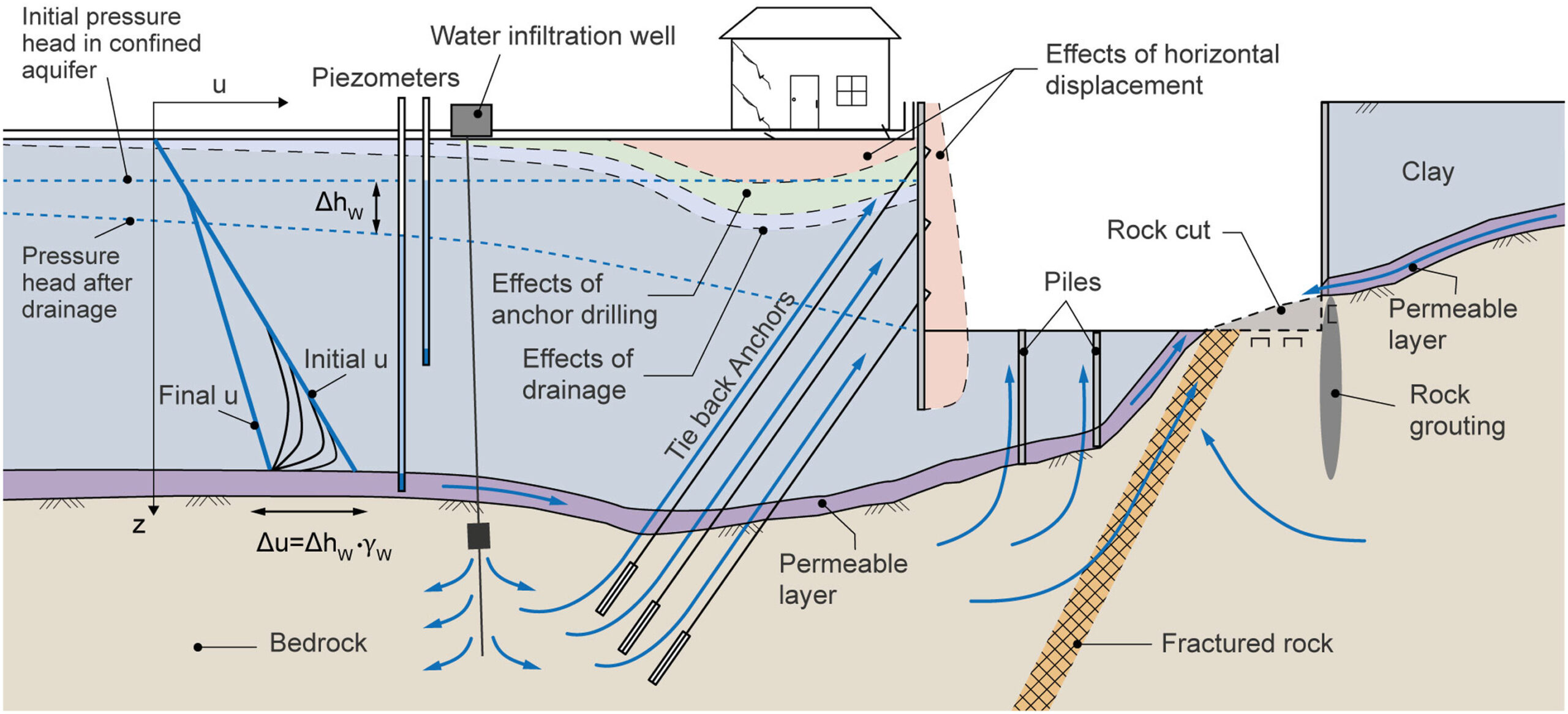
This occurs when the excavation removes the weight of the soil (the overburden), but the water pressure in the underlying permeable layer (Fluvial Sand or OA) remains high.
- The Mechanism: Consider an excavation 20m deep in 30m of Marine Clay. There is a 10m “plug” of clay left at the bottom. The water pressure in the aquifer below pushes up with a force of, say, 250 kPa. The weight of the 10m clay plug is only . The pressure exceeds the weight (), and the floor of the excavation bursts upwards.
- Mitigation:
- Pressure Relief Wells: Wells are drilled into the aquifer inside the excavation to bleed off the pressure, ensuring stability.
- Thicker Plug: Excavating less or improving the soil density (unlikely to be sufficient alone).
7.2 Piping and Heave (HYD)
This occurs when water flows around the toe of the retaining wall and up into the excavation. If the velocity of the water is high enough, it carries soil particles with it (“piping”), creating a void that leads to collapse.
- Mitigation: Extending the D-Wall deeper into the impermeable clay or Old Alluvium to cut off the flow, or increasing the embedment depth to lengthen the flow path and reduce the hydraulic gradient.12
7.3 Far-Field Settlement and Recharge Wells
A subtle but damaging effect of dewatering is “far-field settlement.”
- The Problem: When pressure relief wells pump water out of the OA to save the excavation, they lower the water head in the aquifer for hundreds of meters around the site. This reduction in pore pressure increases the effective stress on the Marine Clay layers under neighboring buildings. The clay consolidates (squeezes) under this new stress, causing settlements in buildings that are far away from the excavation.
- The Solution (DTSS2 Case Study): For the Deep Tunnel Sewerage System Phase 2, engineers implemented a Groundwater Recharge system. Water pumped out of the excavation was treated and re-injected into the aquifer through wells located outside the excavation walls. This maintained the hydraulic head under the neighbors, effectively creating a hydraulic “firewall” that prevented consolidation settlement. This active management is now a hallmark of sophisticated urban projects.27
8. Regulatory Framework: The BCA and Eurocode 7
Post-2004, Singapore’s building control regulations became some of the most rigorous in the world.
The Building and Construction Authority (BCA) enforces a strict regime of checks and balances.
8.1 The “Four Eyes” Principle
For any Geotechnical Building Work (GBW) deeper than 6m, the law requires multiple layers of oversight:
- Qualified Person (Design): The Professional Engineer (PE) who designs the works.
- Qualified Person (Supervision): The PE responsible for site supervision. Crucially, on large projects, this cannot be the same person as the QP(D), ensuring independent checks.29
- Accredited Checker (AC) and AC(Geo): An independent third-party PE who must re-calculate the entire design from scratch to verify its safety. For deep excavations, a specialized AC(Geo) is mandatory.30
8.2 Eurocode 7 in Singapore (SS EN 1997-1)
Singapore migrated from British Standards (BS 8002) to Eurocode 7, adopting Design Approach 1 (DA1). This requires checking two combinations:
- Combination 1 (Structural Focus): Factors are applied to loads (Actions). . This usually governs the structural strength of the struts and walers.
- Combination 2 (Geotechnical Focus): Factors are applied to soil parameters (Material). . This reduces the soil strength parameters ( and ) by a factor (usually 1.25). Insight: In soft Marine Clay, Combination 2 is almost always the critical case for stability and wall embedment depth because reducing the already low strength of the clay drastically reduces the passive resistance holding the wall up.31
8.3 Impact Assessment: Visual vs. Rigorous
BCA Circulars (2024 update) require a formal impact assessment for all surrounding structures:
- Deemed-to-Satisfy Approach: Can be used if the excavation is standard and predicted settlements are negligible.
- Rigorous Approach: Mandatory for complex works. It requires Finite Element Analysis (FEA) to predict specific settlement contours. It sets strict limits:
- Work Suspension Level (WSL): The movement limit at which work must stop to prevent damage.
- Action Level (ACL): A buffer level (typically 70% of WSL) to trigger mitigation.33
9. Case Histories: Lessons from Failure and Success
The history of geotechnical engineering in Singapore is bifurcated by a single date: April 20, 2004.
9.1 The Nicoll Highway Collapse (2004)
A cut-and-cover tunnel excavation for the MRT Circle Line collapsed, killing four people and causing a section of the highway to cave in.
- The Cause: A confluence of design and construction errors.
- Modeling Error: The designers used PLAXIS Method A (Effective Stress) to model undrained behavior. This overestimated the soil strength and underestimated the wall bending moments by nearly 50%.
- Detailing Error: The connection between the steel struts and the waler beams was stiffened with C-channels. These stiffeners were under-designed and buckled under load.
- Organizational Error: When strain gauges showed strut loads exceeding limits, the “Alarm” levels were arbitrarily raised based on faulty back-analysis, rather than stopping work to investigate.
- The Legacy: This disaster directly led to the creation of the AC(Geo) role, the mandate for independent instrumentation monitoring contracts (IIC), and the strict “AAA” trigger level system.22
9.2 The Marina Coastal Expressway (MCE) (2013)
The MCE is the antithesis of the Nicoll Highway—a project of immense complexity delivered safely.
- The Challenge: Excavating a trench 60m wide and 25m deep through 40m of soft Marine Clay, partially under the sea and partially under the historic Benjamin Sheares Bridge.
- The Solution:
- Mass Stabilization: Instead of relying on struts alone, engineers used DSM to treat the entire block of soil below the excavation. This converted the “peanut butter” clay into a rigid base, reducing the effective excavation depth.
- Bridge Protection: To protect the Benjamin Sheares Bridge piles, Jet Grouting was used to underpin and stiffen the soil around them, ensuring that the bridge moved less than 15mm despite the massive excavation happening meters away.
- Robust Verification: Real-time monitoring was linked to automated alerts, ensuring that any deviation from the design prediction was caught instantly.23
10. Instrumentation and Monitoring: The Observational Method
Given the uncertainties in Marine Clay, design is never “finished” when construction starts. It is verified daily through the Observational Method.
10.1 The AAA System
Singapore uses a standardized trigger framework:
- Alert Level (50% of Design Limit): “Something is happening.” Increase monitoring frequency. The site team meets to review trends.
- Alarm Level (75% of Design Limit): “Deviation is significant.” Mobilize contingency measures (e.g., have extra struts or grout plants ready). Notify the authorities.
- Action Level (100% of Design Limit): “Critical Threshold.” STOP WORK. Immediate mitigation (e.g., flood the excavation, install emergency berms). A full review is required before work can resume.18
10.2 Key Instruments
- Inclinometers: Installed in the wall and the soil. They measure the lateral deflection profile. Insight: A “cantilever” shape at the top indicates strut issues; a “belly” deep down indicates soft clay yielding; a “kick” at the toe indicates basal failure stability issues.37
- Strain Gauges: Welded to struts. They measure the actual load. Anomaly: In soft clay, top struts sometimes show tension (negative load). This is not an error; it happens when the wall rotates around a lower pivot point, pulling away from the top strut. Engineers must recognize this behavior.19
- Piezometers: Critical for detecting groundwater drawdown. If a piezometer outside the site drops, it means the cut-off wall is leaking or the relief wells are drawing from too far away.
11. Future Trends: Digital Twins and Sustainability (2026 Outlook)
As we look toward 2026, the industry is pivoting from purely mechanical solutions to digital integration and sustainability.
11.1 The Geotechnical Digital Twin
The future is the Digital Twin. Major projects like the Cross Island Line are piloting systems where the FEM model is live.
- Real-Time Back Analysis: AI algorithms feed live inclinometer data into the Plaxis/2D model. The system automatically adjusts the soil stiffness parameters () to match the observed deflection.
- Predictive Power: The updated model then forecasts the next excavation stage. If the prediction breaches the AAA limits, the engineer gets a warning before the excavation happens. This shifts safety from “reactive” to “predictive”.38
11.2 BIM for Geotechnics (BIM-GE)
BIM is no longer just for architects. Geotechnical BIM involves modeling the stratigraphy in 3D.
The BCA’s push for standardized data allows engineers to visualize the “valleys” of Marine Clay in 3D space, optimizing the length of piles and D-walls to match the undulating bedrock, saving concrete and carbon.39
11.3 Sustainable Ground Improvement
With carbon taxes rising, the heavy use of cement in JGP and DSM is under scrutiny. The industry is moving towards:
- Green Binders: Using Ground Granulated Blast-furnace Slag (GGBS) or bio-polymers to replace Ordinary Portland Cement (OPC).
- Optimized Patterns: Using lattice or grid patterns for ground improvement rather than full block treatment, relying on the arching effect (where feasible) to reduce material use.40
12. Conclusion
Managing deep excavations in Singapore’s Kallang Formation is a testament to the evolution of geotechnical engineering.
It is a discipline that has matured from the empirical methods of the past to a highly sophisticated synthesis of mechanics, technology, and regulation.
The “Singapore Method” is characterized by a refusal to underestimate the soil. It employs robust stiffness (D-Walls), aggressive improvement (DSM/JGP), and redundant safety systems (Top-Down, AAA monitoring).
The lessons of the Nicoll Highway collapse are etched into every regulation and every design calculation.
For the practicing engineer in 2026, the challenge is to integrate these traditional strengths with the new tools of the digital age.
By leveraging Digital Twins and AI, we can peer into the “peanut butter” clay with greater clarity than ever before, ensuring that Singapore’s journey into the underground remains safe, sustainable, and successful.
Tables and Data Summary
Table 3: Common Wall Types and Suitability for Singapore Marine Clay 13
| Wall Type | Stiffness | Water Tightness | Marine Clay Suitability | Key Risk |
| Sheet Pile | Low | Low (Interlocks) | Poor (Shallow only) | Excessive deflection, vibration damage, declutching. |
| Secant Bored Pile | Medium/High | Moderate | Moderate (Medium depth) | Verticality deviation causing gaps (ground loss). |
| Diaphragm Wall | Very High | High | Excellent (Deep) | High cost, bentonite handling logistics. |
| Soldier Pile | Low | Low (Lagging) | Prohibited | Soil flowing through lagging (arching failure). |
Table 4: Regulatory Trigger Levels (AAA) for Instrumentation 18
| Level | Value (Typical) | Action Required |
| Alert | 50% of Design Limit | Increase monitoring frequency. Internal review by site team. |
| Alarm | 75% of Design Limit | Implement contingency plan (e.g., grouting). Notify authorities. |
| Action | 100% of Design Limit | STOP WORK. Stabilize site. Full investigation and re-analysis required. |
This report synthesizes best practices, regulatory requirements, and technical data current as of early 2026, tailored for the Singapore built environment context.
Works cited
- Undrained shear strength of the Singapore marine clay at Changi from in-situ tests, accessed February 12, 2026, https://www.researchgate.net/publication/273886644_Undrained_shear_strength_of_the_Singapore_marine_clay_at_Changi_from_in-situ_tests
- Marine Clay Data | PDF | Pleistocene | Soil Mechanics – Scribd, accessed February 12, 2026, https://www.scribd.com/document/307284877/Marine-Clay-Data
- (PDF) Deep excavations in Singapore Marine Clay – ResearchGate, accessed February 12, 2026, https://www.researchgate.net/publication/275951519_Deep_excavations_in_Singapore_Marine_Clay
- Soil Parameters of Kallang Formation and Old Alluvium in …, accessed February 12, 2026, https://ascelibrary.com/doi/10.1061/%28ASCE%29SC.1943-5576.0000665
- SOME GEOTECHNICAL PROPERTIES OF KLANG CLAY, accessed February 12, 2026, https://gnpgroup.com.my/wp-content/uploads/2017/03/2004_01.pdf
- Range of physical and consolidation characteristics of Singapore marine clay, accessed February 12, 2026, https://www.researchgate.net/figure/Range-of-physical-and-consolidation-characteristics-of-Singapore-marine-clay_tbl1_226910411
- Use of Ground Improvement to control soft clay in urban excavations in Singapore – reviews from past experiences and considerations moving forward – ResearchGate, accessed February 12, 2026, https://www.researchgate.net/publication/359710448_Use_of_Ground_Improvement_to_control_soft_clay_in_urban_excavations_in_Singapore_-_reviews_from_past_experiences_and_considerations_moving_forward
- Shear Strength of Singapore Marine Clay | PDF | Soil Mechanics – Scribd, accessed February 12, 2026, https://www.scribd.com/document/458388003/Evaluation-of-Shear-Strength-Parameters-of-Singapore-Marine-Clay-2001-pdf
- Full article: Characterisation of the spatial variability of underconsolidated Singapore Marine Clay using random field theory – Taylor & Francis, accessed February 12, 2026, https://www.tandfonline.com/doi/full/10.1080/17499518.2024.2422487
- 3D geological modeling and management system for Singapore, accessed February 12, 2026, https://ngmdb.usgs.gov/Info/dmt/docs/DMT18_Chu.pdf
- circular-on-guidelines-on-requirements-for-site-investigation-reports.pdf – Building and Construction Authority (BCA), accessed February 12, 2026, https://www1.bca.gov.sg/docs/default-source/docs-corp-news-and-publications/circulars/circular-on-guidelines-on-requirements-for-site-investigation-reports.pdf
- Deep excavations in singapore marine clay – INTERNATIONAL SOCIETY FOR SOIL MECHANICS AND GEOTECHNICAL ENGINEERING, accessed February 12, 2026, https://www.issmge.org/uploads/publications/6/11/2005_002.pdf
- Dear Sir/Madam UPDATES TO THE APPROVED DOCUMENT (1 MARCH 2025) This circular is to inform the industry on the update to the Appr – Building and Construction Authority (BCA), accessed February 12, 2026, https://www1.bca.gov.sg/docs/default-source/docs-corp-news-and-publications/circulars/circular-on-updates-to-the-approved-document.pdf
- Diaphragm Walls vs. Secant Piles: Choosing the Right Retaining Solution for Your Project, accessed February 12, 2026, https://hindustanrmc.com/diaphragm-walls-vs-secant-piles/
- guideline-on-ensuring-integrity-of-sheet-pile-wall-to-prevent-ground-loss-20251127.pdf – CORENET X, accessed February 12, 2026, https://info.corenet.gov.sg/docs/default-source/bca-circulars/guideline-on-ensuring-integrity-of-sheet-pile-wall-to-prevent-ground-loss-20251127.pdf?sfvrsn=cc019de_1
- Sheet Piles vs. Bored Secant Piles: Structural Insights with ESC Steel, accessed February 12, 2026, https://www.escpile.com/single-post/sheet-piles-vs-bored-secant-piles-structural-insights-with-esc-steel
- Parametric Sensitivity Study of Deep Excavation in Singapore Old Alluvium Formation, accessed February 12, 2026, https://www.researchgate.net/publication/357171912_Parametric_Sensitivity_Study_of_Deep_Excavation_in_Singapore_Old_Alluvium_Formation
- Deep Excavation Design and Construction – CEDD, accessed February 12, 2026, https://www.cedd.gov.hk/filemanager/eng/content_1024/ep1_2023.pdf
- Maximising the potential of strain gauges: A Singapore perspective – ISSMGE, accessed February 12, 2026, https://www.issmge.org/uploads/publications/6/12/2008_079.pdf
- Underground construction: the ‘top-down’ technique | Volteco, accessed February 12, 2026, https://volteco.com/en/underground-construction-the-top-down-technique
- Top-down construction method – discription and construction sequence – Geotech Rijeka, accessed February 12, 2026, https://www.geotech.hr/en/top-down-construction-method/
- Case Histories of Failure of Deep Excavation. Examination of Where …, accessed February 12, 2026, https://scholarsmine.mst.edu/icchge/7icchge/session03/7/
- Marina Coastal Expressway, Singapore | Mott MacDonald, accessed February 12, 2026, https://www.mottmac.com/en-us/projects/marina-coastal-expressway-singapore/
- Soil Improvement for Singapore’s Challenging Ground – Stellar Structures, accessed February 12, 2026, https://structures.com.sg/soil-improvement-singapore-challenging-ground/
- The Design and Construction of a Fast Track 16 Hectare, 18 m Deep Basement in Soft Clay in Singapore – Scholars’ Mine, accessed February 12, 2026, https://scholarsmine.mst.edu/cgi/viewcontent.cgi?article=3249&context=icchge
- Eurocode 7: Geotechnical Design Worked examples, accessed February 12, 2026, https://www.ngm2016.com/uploads/2/1/7/9/21790806/eurocode_7_geotechnical_design_worked_examples_-_2013_06_ws_geo.pdf
- Groundwater control measures implemented in Singapore’s deep …, accessed February 12, 2026, https://www.taylorfrancis.com/chapters/oa-edit/10.1201/9781003348030-273/groundwater-control-measures-implemented-singapore-deep-tunnel-sewerage-system-phase-2-dtss2-project-aung-ko-ko-soe-woo-lai-lynn-benedict-chionh-kyi-khin
- (PDF) Groundwater control measures implemented in Singapore’s deep tunnel sewerage system phase 2 (DTSS2) project – ResearchGate, accessed February 12, 2026, https://www.researchgate.net/publication/370540197_Groundwater_control_measures_implemented_in_Singapore’s_deep_tunnel_sewerage_system_phase_2_DTSS2_project
- BCA Structural Design Approvals in Singapore (2025 Edition), accessed February 12, 2026, https://structures.com.sg/bca-structural-design-approvals-singapore-2025/
- ERSS – Submission Requirements – Building and Construction Authority (BCA), accessed February 12, 2026, https://www1.bca.gov.sg/docs/default-source/docs-corp-regulatory/building-control/erss—submission-requirements-march-2024.pdf?sfvrsn=591ca8cd_0
- Eurocode 7 – Partial Factors of Safety and Design Approaches – Civils.ai, accessed February 12, 2026, https://civils.ai/blog/eurocode-7-partial-factors-of-safety-and-design-ap/
- Eurocode 7 analysis methods – DEEPEX, accessed February 12, 2026, https://www.deepex.com/post/eurocode-7-analysis-methods
- 1 Dear Sir/Madam FRAMEWORK ON PERFORMANCE BASED …, accessed February 12, 2026, https://www1.bca.gov.sg/docs/default-source/docs-corp-regulatory/building-control/circular—building-assessment–20240306.pdf?sfvrsn=1f1af505_0
- Case Histories of Failure of Deep Excavation. Examination of Where Things Went Wrong: Nicoll Highway Collapse, Singapore – Scholars’ Mine, accessed February 12, 2026, https://scholarsmine.mst.edu/cgi/viewcontent.cgi?article=3091&context=icchge
- Robust ground improvement – Tunnels, accessed February 12, 2026, https://www.tunnelsandtunnelling.com/analysis/robust-ground-improvement/
- Marina Coastal Expressway, Singapore | Mott MacDonald, accessed February 12, 2026, https://www.mottmac.com/en/projects/marina-coastal-expressway-singapore/
- Use of Inclinometers for Geotechnical Instrumentation on Transportation Projects, accessed February 12, 2026, https://onlinepubs.trb.org/onlinepubs/circulars/ec129.pdf
- Digital Twins’ Application for Geotechnical Engineering: A Review of Current Status and Future Directions in China – MDPI, accessed February 12, 2026, https://www.mdpi.com/2076-3417/15/15/8229
- The role of the 3D Geological Model in Geotechnical BIM – GeoStudio – Seequent, accessed February 12, 2026, https://www.seequent.com/the-role-of-the-3d-geological-model-in-geotechnical-bim/
The Future of Geotechnical Engineering: Key Trends to Watch in 2025, accessed February 12, 2026, https://www.enginuityadvantage.com/the-future-of-geotechnical-engineering-key-trends-to-watch-in-2025/