

An LTA submission is the formal process by which developers and contractors submit transport infrastructure and street works plans to Singapore’s Land Transport Authority for regulatory approval. Any construction project that affects public roads, footpaths, or transport networks requires this process before work can proceed. Compliance with the Code of Practice for Street Work Proposals Relating to Development Works is mandatory, and failure to meet LTA standards delays final Written Permission from URA. For developers and contractors operating in Singapore’s tightly regulated construction sector, understanding the LTA submission process is not optional. It is a prerequisite for project authorization.
What is LTA submission and why does it matter?
An LTA submission is defined as the structured set of transport and street works documentation that a developer or contractor must present to the Land Transport Authority at specified stages of a construction project. The process exists to protect the integrity of Singapore’s public road network and to confirm that new developments do not compromise road safety or traffic flow.
LTA regulatory compliance is a mandatory prerequisite for construction authorization in Singapore. This means no project affecting a public street can proceed to the construction phase without LTA clearance at each required gateway. The authority evaluates submissions against detailed design requirements, and incomplete submissions are rejected outright.

The process also connects directly to the broader approval chain. LTA submissions feed into URA’s Written Permission process, BCA’s building plan approvals, and other statutory clearances. A gap in the LTA submission can stall the entire project approval timeline, not just the transport component.
Key types of LTA submissions required during construction
Street Works submissions are required at three distinct project stages, each with its own documentation scope and purpose:
- Design Gateway: The developer submits a Street Works Proposal covering the layout of proposed roads, footpaths, and related infrastructure. LTA reviews the design to confirm it meets safety and network standards before detailed engineering begins.
- Construction Gateway: Before physical works commence, the contractor submits construction drawings and method statements. LTA confirms that the approved design is being executed correctly and that site safety measures are in place.
- Completion Gateway: Upon finishing the works, the developer submits as-built drawings and inspection records. LTA verifies that the completed infrastructure matches the approved design before the road is handed over or the project receives its Temporary Occupation Permit.
Beyond street works, separate submission categories cover mechanical and electrical (M&E) systems and civil infrastructure. M&E submissions address elements such as traffic signals, street lighting, and drainage pump systems. Civil submissions cover earthworks, retaining structures, and road pavement design. Each category requires distinct documentation sets, and they must be submitted independently through the correct channels.
All permit applications for public street works must be made through the LTA.PROMPT portal. This is the single authorized platform for submission, fee payment, and status tracking. Developers who attempt to submit outside this portal will not receive valid approvals.
How LTA submissions integrate with other regulatory approvals
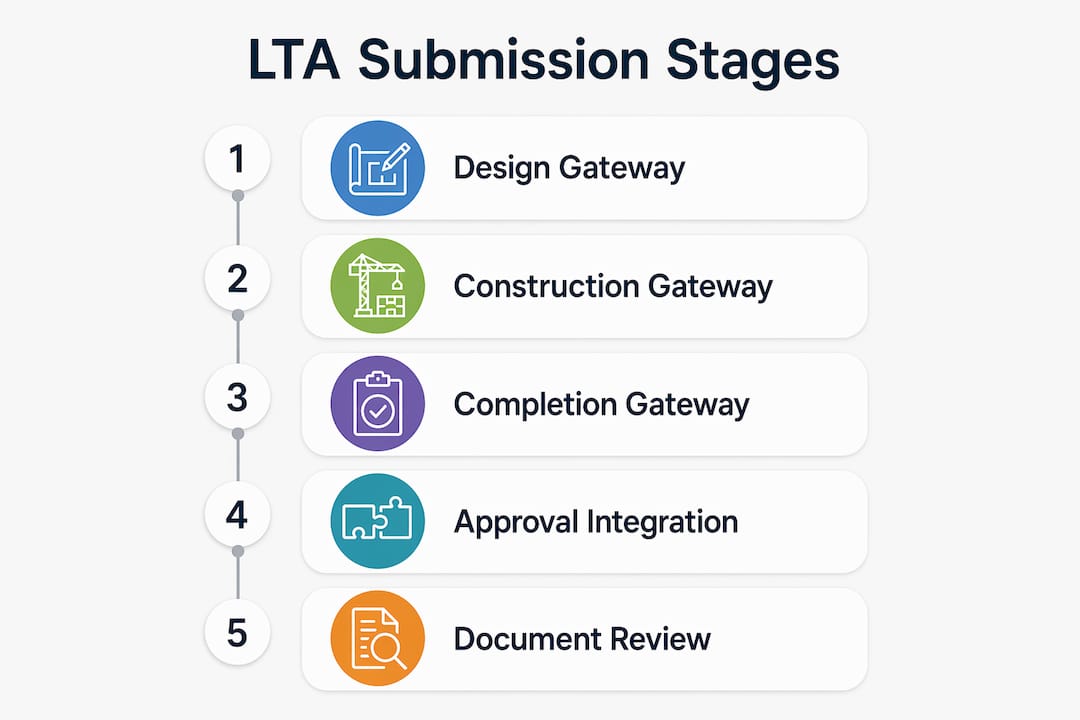
LTA submissions do not operate in isolation. They must be coordinated with Walking and Cycling Plans (WCP), which URA requires as part of the development control process. The WCP details how pedestrian and cycling connectivity will be maintained or improved around the development site. LTA reviews the WCP in conjunction with street works proposals to confirm that the transport network remains accessible and safe.
Pro Tip: Submit the WCP and the Street Works Proposal concurrently wherever possible. Staggered submissions between LTA and URA are one of the most common causes of avoidable delays in the approval timeline.
The relationship between LTA and BCA approvals is equally direct. BCA’s building plan clearance depends on structural and architectural designs that align with LTA’s approved road reserve lines and setback requirements. A developer who finalizes the building design before confirming LTA’s road reserve position risks costly redesigns at the BCA stage. Coordinating both agencies from the Design Gateway stage prevents this outcome.
LTA also issues technical circulars that update design standards for road geometry, drainage, and pedestrian infrastructure. Developers must check for the latest circulars before finalizing submission drawings. A drawing prepared against an outdated standard will fail LTA’s technical review, even if it was acceptable under previous guidelines. Staying current with LTA circular updates is a non-negotiable part of submission preparation. Reviewing the engineering compliance workflow for 2026 provides a structured reference for tracking these updates across all relevant agencies.
What documents are required for a successful LTA submission?
Essential documentation for LTA submissions includes the following plan types, each serving a specific technical purpose:
- Site Plan: Shows the overall development footprint, road reserve boundaries, and the relationship between the proposed works and existing infrastructure.
- Traffic Plan: Details traffic management measures during construction, including temporary diversions, signage, and lane closures.
- Topographical Plan: Provides existing ground levels and features, forming the baseline for all earthwork and drainage calculations.
- Longitudinal and Cross Section Plans: Illustrate the vertical alignment and cross-sectional geometry of proposed roads and footpaths.
- Utility Services Plan: Maps existing and proposed underground utilities to confirm that street works do not conflict with water, gas, or telecommunications infrastructure.
Beyond these core plans, M&E submissions require additional technical details at each gateway stage, including load calculations for street lighting, signal timing plans for traffic junctions, and drainage flow calculations for pump systems.
Naming and endorsement protocols are strictly enforced. Every document must identify the Qualified Person (QP) responsible for the submission using their full name or a sufficiently unique shortened form. Ambiguous abbreviations are not acceptable and will trigger a rejection. The QP’s professional registration number and endorsement signature must appear on every drawing sheet.
The table below summarizes the primary document requirements by submission category:
| Submission Category | Core Documents Required | Gateway Stage |
|---|---|---|
| Street Works (Civil) | Site Plan, Topographical Plan, Cross Section Plans | Design, Construction, Completion |
| Street Works (M&E) | Utility Services Plan, Load Calculations, Signal Plans | Design, Construction, Completion |
| Traffic Management | Traffic Plan, Signage Layout, Diversion Routes | Construction |
| As-Built Records | Completed drawings, Inspection Reports | Completion |
Completeness is the single most critical factor in avoiding rejection. LTA’s submission requirements checklist exists precisely to help QPs verify that no mandatory element is missing before the package is uploaded to LTA.PROMPT.
How to submit to LTA: a step-by-step process guide
The LTA submission process follows a defined sequence. Deviating from this sequence or skipping steps creates delays that are difficult to recover from mid-project.
- Step 1: Pre-submission preparation. The QP compiles all required drawings, calculations, and supporting documents. The LTA submission requirements checklist is used internally to verify completeness. The checklist itself is not submitted to LTA, but using it during preparation significantly reduces the risk of rejection.
- Step 2: Portal registration and account setup. The developer or their appointed QP registers on LTA.PROMPT and links the project to the relevant development application number from URA.
- Step 3: Document upload and fee payment. All submission documents are uploaded in the required file formats. Fees are calculated based on the scope of works and paid through the portal. LTA publishes a service standard and fees schedule that applicants should review before submission to avoid surprises.
- Step 4: LTA technical review. LTA officers assess the submission against current design standards and codes of practice. If queries arise, LTA issues a Request for Information (RFI). The QP must respond within the timeframe specified in the RFI or the submission may lapse.
- Step 5: Approval and permit issuance. Once LTA is satisfied with the submission, a permit or approval letter is issued. This document must be retained on site and presented during inspections.
Pro Tip: Assign a dedicated point of contact within your project team to monitor LTA.PROMPT for RFI notifications. Missed RFIs are one of the most common reasons submissions lapse and must be restarted from the beginning.
Proactive communication with the assigned LTA officer before submission reduces the likelihood of RFIs. A pre-submission meeting or email exchange to clarify any ambiguous design elements is time well spent. Reviewing the LTA project approval guide provides additional context on managing the approval timeline effectively.
Key Takeaways
LTA submission is the mandatory regulatory process for all Singapore construction projects affecting public roads, and completeness of documentation at each gateway stage is the primary determinant of approval speed.
| Point | Details |
|---|---|
| Three gateway stages | Street Works submissions are required at Design, Construction, and Completion Gateway stages. |
| LTA.PROMPT is mandatory | All permit applications for public street works must be submitted through the LTA.PROMPT portal. |
| Document completeness is critical | Incomplete submissions are rejected; use LTA’s checklist internally before every upload. |
| Coordinate with URA and BCA | LTA submissions must align with WCP requirements and BCA road reserve positions from the start. |
| QP endorsement is non-negotiable | Every drawing must carry the QP’s full name, registration number, and endorsement signature. |
What I’ve learned from years of LTA submission work
The most consistent pattern I observe across failed or delayed LTA submissions is not a lack of technical knowledge. It is a failure to treat the submission as a coordinated regulatory process rather than a documentation exercise. Teams that focus only on producing drawings, without verifying that those drawings align with the latest LTA circulars and the WCP requirements simultaneously, almost always receive RFIs that set the project back by weeks.
The second pattern is underestimating the naming and endorsement requirements. I have seen submissions rejected at the technical review stage solely because the QP’s name on the drawing did not match the registered format in LTA’s system. These are not minor administrative issues. LTA treats them as compliance failures, and correctly so, because the endorsement is the legal basis for the QP’s professional accountability.
My strongest recommendation is to build a submission readiness review into the project program at least three weeks before each gateway deadline. This review should cross-check drawings against the current LTA checklist, confirm QP endorsements, and verify that the WCP submission to URA is at the same stage of approval. Projects that treat LTA submission as a last-minute task consistently face the most painful delays.
— Aman
How Com supports your LTA submission process
Navigating the LTA submission process requires technical precision, regulatory knowledge, and tight coordination across multiple agencies. Com, Aman Engineering Consultancy, provides end-to-end support for developers and contractors managing LTA and statutory submissions in Singapore.
Com’s team of Qualified Persons and engineering consultants handles Street Works Proposals, M&E submissions, WCP coordination, and LTA.PROMPT portal management across all three gateway stages. The firm’s experience spans residential, commercial, and industrial projects, giving clients a single point of accountability for regulatory approvals involving LTA, URA, BCA, and related agencies. Developers who need structured support for engaging engineering consultants effectively will find Com’s process-driven approach well suited to complex, multi-agency projects.
FAQ
What is an LTA submission in Singapore?
An LTA submission is the formal process of submitting transport infrastructure and street works plans to Singapore’s Land Transport Authority for regulatory approval. It is mandatory for any construction project affecting public roads or transport networks.
What are the three gateway stages for LTA street works submissions?
LTA requires Street Works submissions at the Design Gateway, Construction Gateway, and Completion Gateway stages. Each stage has distinct documentation requirements covering design plans, construction drawings, and as-built records respectively.
Which portal is used for LTA submission online?
All permit applications for public street works in Singapore must be submitted through the LTA.PROMPT portal. This is the only authorized platform for submission, fee payment, and approval tracking.
What documents are needed for an LTA submission?
Core documents include Site Plans, Traffic Plans, Topographical Plans, Longitudinal and Cross Section Plans, and Utility Services Plans. M&E submissions require additional technical details such as load calculations and signal timing plans.
How can developers reduce delays in the LTA submission process?
Using LTA’s submission requirements checklist internally before uploading, coordinating WCP submissions with URA concurrently, and assigning a dedicated team member to monitor LTA.PROMPT for RFI notifications are the most effective measures for reducing delays.