
Accurate property valuation is the professional process of determining a property’s true market worth, and it underpins nearly every consequential real estate decision. Whether the context is a mortgage application, an insurance policy renewal, a tax filing, or an estate settlement, the valuation report serves as the authoritative basis for financial and legal determinations. A flawed or outdated figure does not merely create inconvenience; it exposes owners, buyers, and lenders to measurable financial loss. The core reasons why property valuation is important can be summarized as follows:
- Fair market value confirmation: Valuation establishes whether a purchase price reflects actual market conditions, protecting buyers from overpaying.
- Mortgage and loan-to-value (LTV) compliance: Lenders use the appraised value to calculate LTV ratios, determine interest rates, and set down payment requirements.
- Insurance adequacy: Coverage limits tied to an outdated or inaccurate value can leave owners severely underinsured after a loss.
- Tax assessment accuracy: Property tax liabilities, capital gains calculations, and estate tax obligations all depend on defensible, documented valuations.
- Legal and dispute resolution: Courts, arbitrators, and regulatory bodies require certified appraisals in divorce proceedings, inheritance disputes, and litigation involving property.
How accurate valuation protects your insurance coverage
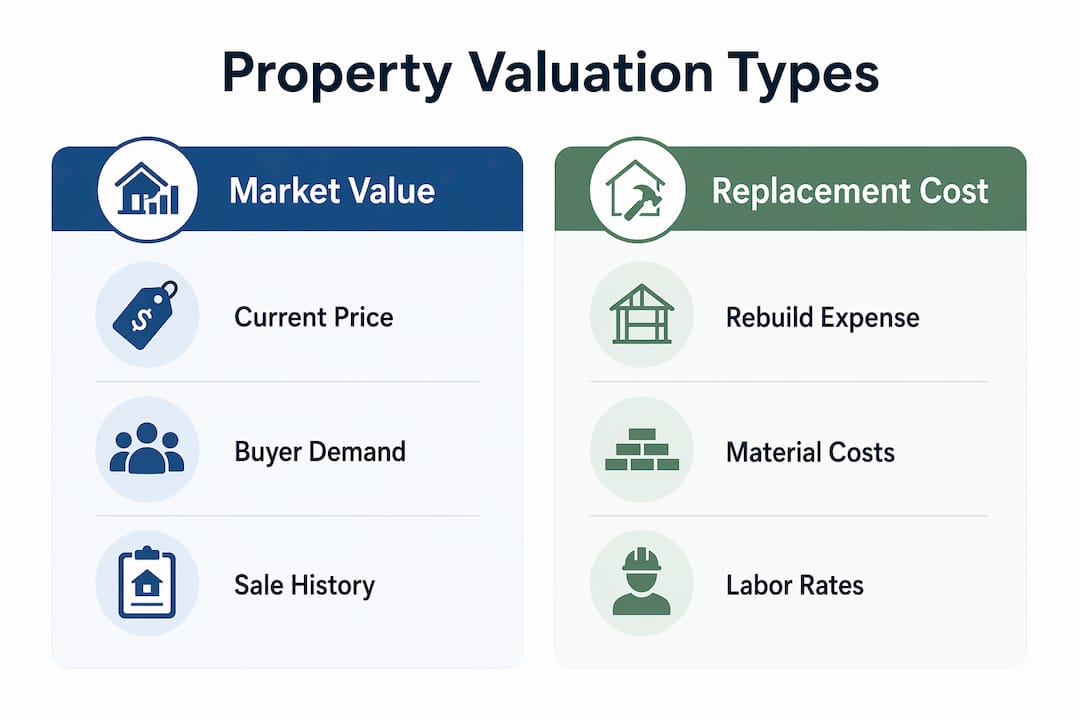
Insurance underwriting for real property depends on two distinct value concepts: market value and replacement cost. Market value reflects what a buyer would pay for the property in current conditions. Replacement cost, by contrast, represents what it would cost to rebuild the structure from the ground up at today’s material and labor prices, without accounting for depreciation. For insurance purposes, replacement cost valuation is the more relevant figure, and it is the one most frequently allowed to fall out of date.
The consequences of that gap are well documented. About 75% of commercial insured properties are undervalued, leaving owners exposed to significant financial loss when disaster strikes. Inflation and labor shortages have accelerated replacement costs faster than traditional valuation cycles can track, widening the gap between insured amounts and actual rebuild costs.
Key risks associated with outdated insurance valuations include:
- Underinsurance at claim time: If the insured value is lower than the actual replacement cost, the insurer may only pay a proportional share of the loss.
- Premium miscalculation: Premiums set against an understated value appear lower but provide inadequate protection.
- Dispute exposure: Insurers can contest claims when the declared value diverges materially from independently assessed replacement costs.
- Natural disaster amplification: Events such as hurricanes or wildfires simultaneously destroy properties and drive up local labor and material costs, compounding the underinsurance problem.
Regular valuation updates, conducted by certified appraisers who apply current cost indices, are the direct remedy. Property owners who commission replacement cost assessments on a defined cycle maintain coverage limits that reflect real rebuild exposure rather than historical figures.
Why property valuation matters for financial planning and asset management
A professional appraisal does more than confirm a price. It identifies the highest and best use of a property, meaning the legally permissible, physically possible, and financially productive use that generates the greatest return. That determination directly shapes investment strategy, particularly for owners considering redevelopment, rezoning, or portfolio repositioning.
Mortgage lenders rely on certified valuations to calculate LTV ratios and set loan terms. As of 2026, an LTV of 80% or lower is the standard threshold lenders use to avoid requiring private mortgage insurance, making the appraised value a direct factor in borrowing costs. An inflated or deflated appraisal shifts that ratio and alters the financing terms accordingly.
The practical benefits of valuation for financial and asset management purposes include:
- Equity assessment: Owners refinancing or drawing on home equity lines need a current valuation to establish available equity accurately.
- Portfolio scaling: Investors acquiring multiple properties use appraisals to benchmark returns and identify underperforming assets.
- Negotiation leverage: A certified appraisal report provides documented evidence to support price reductions or counter-offers during purchase negotiations.
- Lender confidence: Credible, independent valuations give lenders the assurance needed to approve financing, particularly for complex or high-value transactions.
For investors, understanding building valuation methods is a prerequisite for making defensible acquisition decisions. The income approach, sales comparison approach, and cost approach each yield different figures depending on property type and intended use, and selecting the appropriate method requires professional judgment.

Compliance and tax implications of property valuation
Property valuation intersects with tax law at multiple points, and errors in the assessed value carry direct financial and legal consequences. Ad valorem property taxes, which local governments levy annually, are calculated as a percentage of assessed value. An inflated assessment increases tax liability; an understated one may trigger a reassessment, penalties, or back-tax obligations if the discrepancy is discovered during an audit or sale.
Beyond annual property taxes, valuation plays a determinative role in the following regulatory and legal contexts:
- Capital gains tax: The difference between the original purchase price (or stepped-up basis at inheritance) and the sale price determines taxable gain. An accurate valuation at the time of acquisition or inheritance establishes the cost basis that limits tax exposure.
- Estate and inheritance planning: Valuations are required to distribute estate assets equitably among heirs and to calculate federal and state estate tax obligations. Courts and tax authorities require appraisals that comply with the Uniform Standards of Professional Appraisal Practice (USPAP).
- Family law proceedings: Divorce settlements involving real property require independent appraisals to establish equitable distribution. Contested valuations are a common source of litigation cost and delay.
- Legal disputes and litigation: Courts require certified appraisals as evidence in condemnation proceedings, boundary disputes, and breach-of-contract cases involving property.
Incorrect or non-compliant valuations expose property owners to penalties, reassessments, and legal challenges that a properly documented appraisal would have prevented. The FDIC notes that an inaccurate appraisal can affect the amount of equity available to a borrower and the terms of loan approval, underscoring the regulatory weight that valuation reports carry across both private and institutional transactions.
Expert insights and data on property valuation
The National Association of Realtors identifies credible, independent valuations as a structural requirement for healthy capital markets. Credible valuations sustain confidence in mortgage-backed securities markets by giving secondary market investors reliable data on the collateral underlying loan pools. Without that confidence, capital flow into real estate contracts, raising borrowing costs across the sector.
A distinction that property owners frequently overlook is the difference between automated online estimates and certified professional appraisals. Online tools generate figures from public records and algorithmic comparisons, but they cannot account for interior condition, unpermitted modifications, zoning encumbrances, or structural defects. Certified appraisals involve physical inspection and rigorous data analysis, producing legally defensible valuations required in complex transactions and formal disputes. For tax filings, insurance claims, and mortgage applications, an automated estimate carries no legal standing.
When a property’s appraised value falls below the agreed purchase price, buyers have defined options. They can pay the difference out of pocket, renegotiate the sale price with the seller, or formally request a reconsideration of value from the appraiser if supporting comparable sales data exists. An appraisal gap does not automatically terminate a transaction, but it requires deliberate action from both parties to resolve.
Buyers also benefit from using the appraisal report as a negotiation instrument. If the appraisal reveals defects or a value below the asking price, the buyer holds documented grounds to request a price reduction, a repair credit, or revised contract terms. That leverage is only available when a professional appraisal has been commissioned.
Pro Tip: Commission a valuation before listing or making an offer, not after. An independent appraisal obtained before entering negotiations gives you a defensible price anchor and prevents the transaction from being driven by the other party’s assumptions about value.
Key Takeaways
Accurate property valuation is the single most consequential input across real estate investment, insurance, taxation, mortgage approval, and legal dispute resolution, and no other document substitutes for a certified appraisal in formal proceedings.
| Point | Details |
|---|---|
| Insurance coverage accuracy | About 75% of commercial insured properties are undervalued, creating underinsurance risk when replacement costs rise. |
| Mortgage LTV compliance | Lenders require an LTV of 80% or lower based on the appraised value to avoid mandatory mortgage insurance. |
| Tax and legal defensibility | USPAP-compliant appraisals are required for estate tax, capital gains, and court proceedings involving property. |
| Negotiation leverage | A certified appraisal report provides documented grounds to renegotiate price or request seller concessions. |
| Online estimates are insufficient | Automated tools lack physical inspection data and carry no legal standing for tax, insurance, or mortgage purposes. |
Com provides professional valuation, engineering, and compliance consultancy services for property developers, investors, and building owners across Singapore and international markets. For projects requiring defensible valuations aligned with regulatory requirements, visit Aman Engineering Consultancy to engage a qualified team with direct experience in statutory submissions, risk assessment, and property valuation services.