Introduction
Professional Engineer endorsement for works near an MRT line in Singapore is one of the most common bottlenecks in infrastructure and building projects – and the delays it causes are almost always avoidable. If your temporary works fall within or close to LTA’s Railway Protection Zone, understanding why endorsements get rejected is the first step toward keeping your project on schedule.
This article focuses specifically on temporary works – shoring, scaffolding, piling platforms, crane operations, excavation support and utility diversions – executed within or adjacent to MRT protection zones in Singapore. It is not a generic guide to PE endorsement for all project types. The target readers are contractors, developers, project managers and architects planning construction or renovation near MRT viaducts, tunnels or stations, particularly for projects running between 2024 and 2026.
The short answer: PE endorsement for works near MRT lines is mainly delayed due to incomplete design information, non-compliance with LTA railway protection requirements, late engagement of a qualified PE, unclear construction methodology and inadequate geotechnical information, and weak monitoring plans. Rigorous upfront planning combined with experienced consultants like AMAN Engineering Consultancy can prevent most of these issues.
Here is what you will take away from this article:
-
The key regulatory and technical requirements governing PE endorsement near MRT lines, including LTA’s Code of Practice for Railway Protection.
-
The most common rejection reasons from PEs and authorities (LTA, BCA, SCDF where relevant).
-
How to structure your design and documentation to pass PE review the first time.
-
Checklists and workflows to minimise endorsement and submission delays.
-
When and how to engage AMAN Engineering Consultancy for smoother approvals.
Throughout the article, suggested locations for photos and diagrams are noted to help visualise MRT protection zones, typical temporary works layouts and monitoring setups.
Understanding PE Endorsement for Works Near MRT Lines
A Professional Engineer endorsement in Singapore means a PE holding a valid practising certificate under the Professional Engineers Act signs off on engineering designs, taking full professional liability for their safety and compliance. For temporary works near MRT infrastructure, PE endorsement is not optional – it is a legal prerequisite before LTA will even consider your authority submission. Professional Engineer endorsement is required for construction near MRT lines, and without it, no permit to commence works will be granted.
The relationship between PE endorsement, authority submissions and site execution is sequential and rigid. The PE’s signed technical drawings, engineering evaluation report, instrumentation and monitoring plan and method statements are compiled and submitted to LTA – and potentially to BCA, URA and other agencies. Only after LTA grants its Railway Protection clearance and issues a permit to commence engineering works can construction start on site. The PE is therefore not merely a design checker but a regulatory gatekeeper whose endorsement unlocks the entire approval chain. Authority submissions include BCA, URA, JTC, SCDF, PUB, LTA, and compliance with authority submissions prevents project delays.
What makes endorsement near MRT lines especially demanding is the railway protection framework. LTA requires adherence to the Code of Practice for Railway Protection (CPRP), which sets technical, instrumentation and monitoring requirements far stricter than those for standard building works. These railway protection requirements raise the bar above generic temporary works endorsement and are the primary reason endorsements near MRT lines may face stricter scrutiny.
Regulatory Framework Around MRT Protection Zones
Any works near existing MRT structures must comply with LTA’s Code of Practice for Railway Protection (CPRP, 2024 edition) and the Rapid Transit Systems (Railway Protection, Restricted Activities) Regulations under Cap 263A. The September 2026 addendum to the CPRP introduced enhanced requirements for projects near compressible soils affecting RTS tunnels, tightening settlement controls and ground movement analyses – referring to outdated codes or failing to comply with LTA’s latest guidelines can trigger rejections.
Key terms every project team must understand:
-
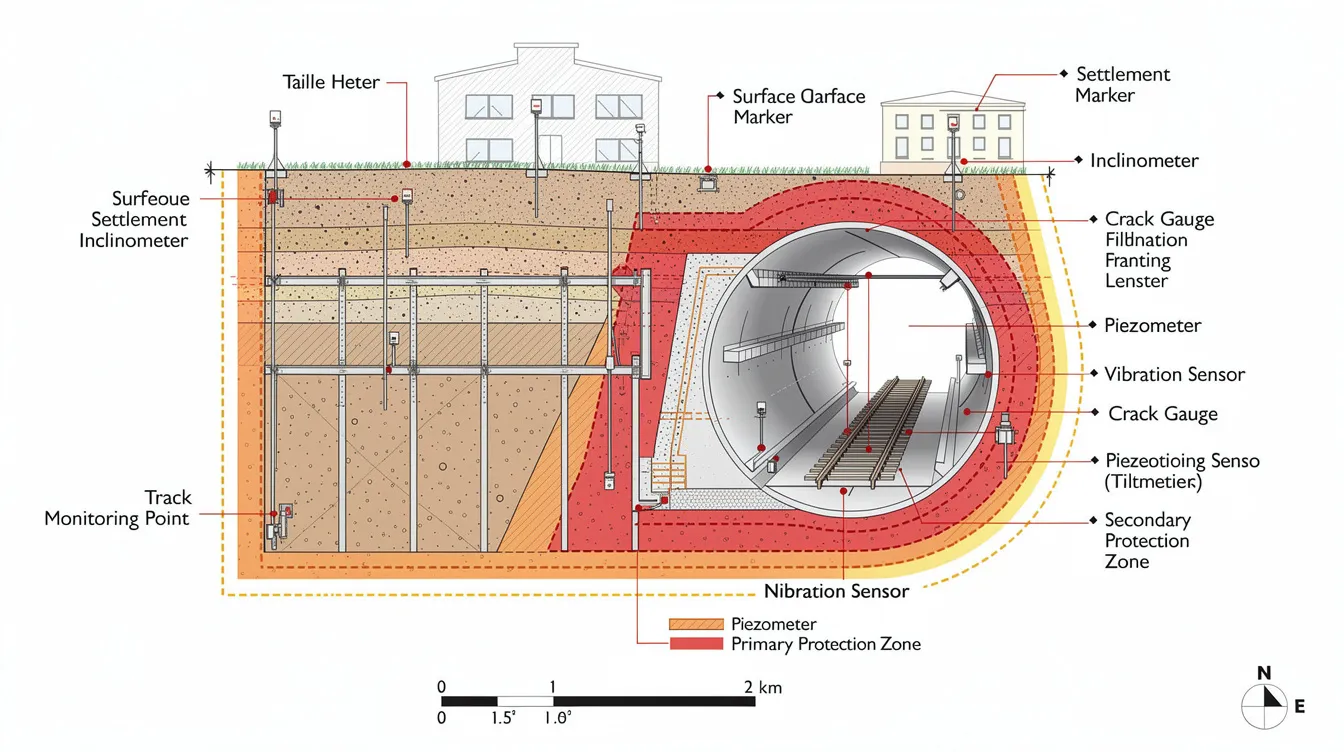
Railway Protection Zone (RPZ): The Railway Protection Zone typically extends 40 metres from MRT lines – specifically from the outermost edge of MRT structures, tunnels or viaducts. Works within this zone automatically require LTA Railway Protection clearance.
-
Railway Safety Zone: A closer buffer, often around 6 metres from MRT structures, where only highly restricted and controlled activities are permitted.
-
Reserve Lines (First, Second, Third Reserve): Delineated within the CPRP to define levels of control, instrumentation density and permissible activities at progressive distances from the MRT asset. Piling works are typically not allowed within the First Reserve of all types of RTS structures, except under special approval with stringent design and monitoring.
While BCA regulates building works and ERSS permits, and SCDF, PUB and NEA may be involved for fire safety, drainage and environmental matters, LTA’s engineering evaluation and monitoring requirements dominate wherever MRT safety is affected. LTA requires extensive cross-agency coordination during the submission and approval processes, so teams must plan for multi-agency interfaces from the start. LTA’s requirements may also include obtaining a Certified Survey Plan for site boundaries, prepared by a registered land surveyor.
Role of the Professional Engineer (PE) in Temporary Works Near MRT
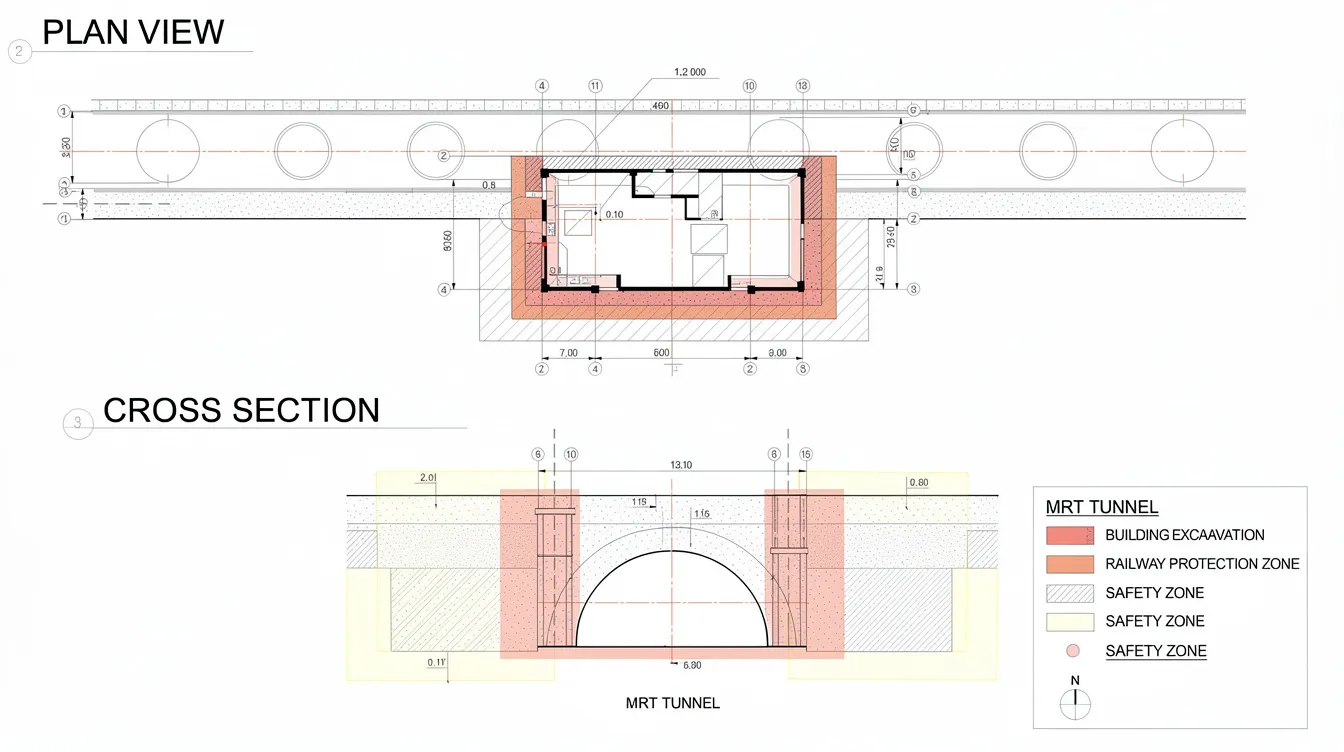
Only Singapore-registered PEs – typically Civil/Structural or Geotechnical specialists, and sometimes M&E engineers for crane systems or vibration – can endorse designs for temporary works near MRT. Under the RTS Regulations, a Qualified Person (PE) must supervise engineering works within the RPZ. Understanding when PE endorsement is needed is essential for every project team working near rail infrastructure.
The PE’s responsibilities are extensive. They must verify soil investigation data, as-built drawings of MRT infrastructure, clearance geometry, foundation design, bracing and strutting systems, structural stability, vibration impacts, method statements, emergency procedures and instrumentation plans. Ground movement and structural impact assessments are critical for PE submissions. Critically, the PE must ensure compliance not only with the final state of the design but with every intermediate construction stage – from first excavation cut to final backfill.
Because the PE is professionally liable for safety, they tend to reject or require revision whenever information is unclear, assumptions are undocumented or risks are not properly mitigated. Insufficient assessment of risks to railway structures can cause PE endorsement delays. This conservatism is not obstructive – it reflects the gravity of working near live MRT infrastructure and the legal consequences of design failure. Contractors who underestimate the documentation burden often discover this reality too late in their programme.
Why MRT-Adjoining Temporary Works Must Meet the Highest Standards and Face Higher Scrutiny
MRT infrastructure is critical, live and operational. Even millimetres of track movement or minor settlement of a tunnel segment can disrupt train operations or compromise passenger safety. The Circle Line tunnel squatting issue – where soft marine clay compressed beyond design tolerance, requiring strengthening works over approximately 450-metre stretches – illustrates how seriously long-term ground movements are treated. The Nicoll Highway collapse of 2004, where an under-designed diaphragm wall ERSS failed adjacent to MRT infrastructure, remains a grave precedent that continues to influence how PEs and regulators approach design conservatism.
The main risk categories PEs and LTA scrutinise include:
-
Ground settlement and tunnel/viaduct movement – even small differential movements can misalign tracks.
-
Vibration from piling, excavation and equipment – LTA mandates comprehensive monitoring of ground vibrations from construction activities.
-
Impact or collision risk from cranes and tall equipment – especially near elevated viaducts and depot tracks.
-
Drainage and water table changes – dewatering or utility diversions near MRT structures can cause unexpected ground consolidation.
-
Fire, life safety and evacuation access – temporary works must not obstruct emergency routes during MRT operations.
-
Environmental assessments – projects near MRT lines require additional environmental assessments to address noise, vibration and ecological concerns.
Because scrutiny is this high, even small submission gaps – a missing sensitivity study, an unclear propping sequence, a vague emergency procedure – can trigger rejection. The next section details the specific temporary works scenarios that most frequently encounter endorsement issues.
Typical Temporary Works Near MRT Lines That Need PE Endorsement
Having understood the regulatory framework and the PE’s role, it is worth examining the common types of temporary works that repeatedly run into endorsement problems. These examples reflect typical project scenarios around Singapore’s MRT network, including interfaces with the Thomson-East Coast Line and Downtown Line corridors.
Excavation Support, Earth Retaining Structures and Deep Basements
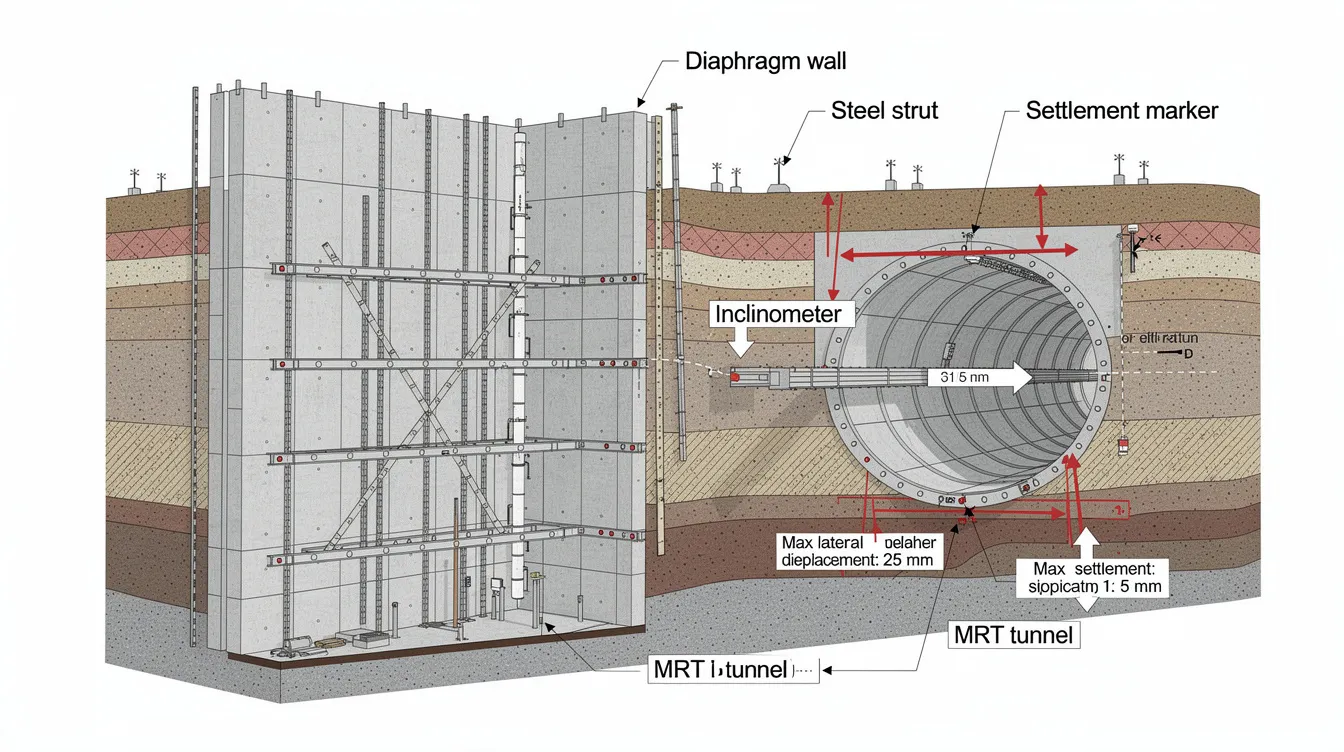
Deep excavations adjacent to MRT tunnels – involving diaphragm walls, contiguous bored piles, sheet piles, steel strutting and basement construction – are among the highest-risk temporary works scenarios. The proximity of live tunnel segments or station boxes means that every millimetre of wall deflection, ground settlement or tilt must be predicted, controlled and monitored.
PEs commonly flag the following issues in ERSS submissions near MRT:
-
Insufficient ground investigation data in the vicinity of MRT structures – using generic or historical soil values without nearby boreholes is routinely rejected.
-
Inadequate numerical analyses (e.g. PLAXIS or similar finite-element models) or missing calibration to actual monitoring data from similar ground conditions.
-
Predicted settlements or lateral movements that breach LTA’s prescribed limits for track and tunnel structures.
-
No stage-by-stage method statement showing how structural stability is maintained during each excavation phase, including temporary ground anchors or strutting transitions.
Cranes, Gantries and Heavy Lifting Near Viaducts and Tracks
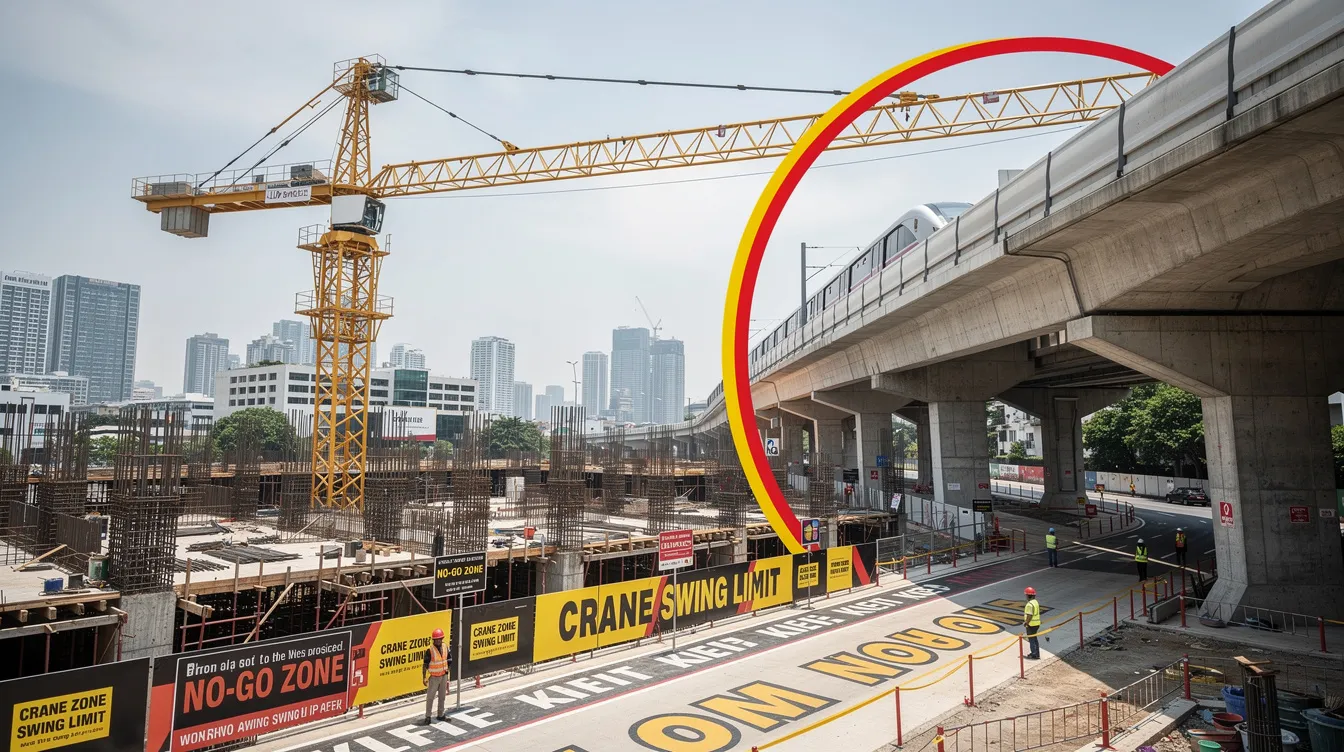
Tower cranes, mobile cranes and gantry systems operating near elevated MRT viaducts or depot tracks present a distinct set of risks. Dynamic loadings, potential over-slewing towards live tracks and foundation settlement under crane bases all require detailed engineering evaluation.
Concerns that commonly cause endorsement delay include:
-
Inadequate crane foundation or slab design that does not account for differential settlement, especially over flat or compressible ground conditions.
-
Missing collision and over-slewing prevention measures – jib swing envelopes must respect clearly defined no-go zones around MRT structures.
-
No detailed lifting plans for critical heavy lifts above or near protection zones, including load paths, wind loading scenarios and contingency procedures.
Utility Diversions, Micro-tunnelling and Ground Improvement
Utility diversions, pipe jacking, micro-tunnelling, jet grouting and soil mixing near MRT assets are high-risk activities because they can cause ground loss, water table changes and uncontrolled settlement. Construction methodology must demonstrate no adverse effects on MRT infrastructure for these works to receive endorsement.
PEs and LTA commonly push back on:
-
Insufficient assessment of ground loss, face stability and settlement propagation towards MRT structures.
-
Construction staging that conflicts with MRT operating hours – particularly where vibration or ground disturbance could affect track alignment during service.
-
Missing contingency plans and emergency shutdown procedures in the event of unexpected ground movements or utility strikes.
Each of these work types shares common rejection patterns rooted in incomplete information, poor compliance with LTA criteria and inadequate risk planning. The next section unpacks these root causes in detail.
Why PE Endorsement Gets Rejected or Delayed: Root Causes
Rejections rarely hinge on a single issue. In practice, several technical and procedural gaps combine to stall PE sign-off and LTA clearances. Delays in endorsement often arise from incomplete technical submissions, and adherence to technical standards significantly reduces the risk of rejection. Understanding these root causes is key to eliminating them from your project workflow.
Incomplete or Poor-Quality Technical Information
Lacking essential inputs is one of the most frequent blockers. Submissions must include documented engineering evaluations assessing construction impact, and PEs cannot ethically endorse designs where base data is unreliable.
Typical missing or weak items include:
-
Outdated or incomplete as-built information of MRT structures and adjacent utilities – many teams rely on records that pre-date recent MRT modifications.
-
Insufficient soil investigation data near tunnels or viaduct piles, without site-specific boreholes covering the full depth and lateral extent of the influence zone.
-
Absence of 3D coordination (BIM) showing spatial relationships and potential clashes with existing MRT assets.
-
Discrepancies between architectural and structural drawings commonly delay approvals – calculation reports with undocumented assumptions or no independent verification compound the problem.
-
Calculation reports that fail to include sensitivity studies for worst-case soil parameters, water table variations or loading combinations.
When base data is unreliable, PEs either request major revisions or refuse endorsement entirely. This is where proper planning is essential for successful authority submissions – front-loading information gathering saves weeks of iteration later.
Non-Compliance with LTA Railway Protection Criteria
PE checks are ultimately measured against LTA’s prescribed limits and technical guidelines. If designs exceed or ignore them, endorsement is impossible. Endorsements may be rejected if safety standards are not met.
Concrete examples include:
-
Predicted settlements or lateral ground movements breaching LTA’s specified limits for track alignment and tunnel deformation. Under the CPRP (2024), if cumulative movement of an underground or at-grade RTS structure is expected to exceed 5 mm, automatic remote-controlled monitoring is required with at least four data cycles in 24 hours and continuous mode in critical localised areas.
-
Excavation depths and offsets that encroach into no-go envelopes without adequate mitigation measures.
-
Vibration levels from piling or demolition exceeding permitted peak particle velocity (PPV) thresholds.
Redesign and re-analysis after such findings inevitably prolong endorsement timelines by weeks or months. Approval timelines can extend beyond standard processing periods when fundamental non-compliance must be resolved.
Late Engagement of PE and Railway Protection Specialist
Many contractors attempt to “design first, get PE later” – developing their temporary works schemes without specialist MRT input and only engaging the PE at submission stage. Late engagement of specialised Professional Engineers leads to project delays, often severe ones.
The effects are predictable:
-
Iterative redesign cycles that collide with construction start dates.
-
Programme slippage because authority submissions must wait for PE-signed documents – and PEs will not sign until fundamental issues are resolved.
-
Re-tendering of temporary works subcontracts due to major method changes mandated by the PE’s review.
Early consultation with AMAN’s PEs during bid or concept stage – or even early consultations with LTA – can resolve potential submission issues before formal applications and radically reduce rejection risk.
Unclear Construction Sequences and Method Statements
Even sound final-state designs are rejected when buildability and construction sequence are not properly described. Typical reasons for delay include unclear construction methodology and inadequate geotechnical information.
Missing content that triggers PE queries includes:
-
Step-by-step construction sequence diagrams showing how stability is maintained at each stage – from first cut to completion.
-
Temporary support, propping and back-propping details for intermediate stages, including load transfer mechanisms during prop removal.
-
Contingency and stop-work criteria if monitoring alarms are triggered, with defined reactions and escalation paths.
PEs need confidence not just in the end state but in every transitional stage of works near MRT assets. Without this, endorsement will be withheld.
Weak Monitoring and Risk Management Plans
For works within MRT influence zones, robust monitoring is mandatory – not a nice-to-have. Instrumentation and Monitoring Plans must include real-time monitoring systems and trigger levels. Detailed instrumentation and monitoring plans are a cornerstone of every successful submission.
Common shortcomings include:
-
No clear link between predicted movements and alarm thresholds – trigger levels appear arbitrary rather than derived from design analyses.
-
Insufficient instrumentation coverage: missing inclinometers, too few settlement markers, absent vibration sensors, or inadequate monitoring frequency.
-
Ambiguous responsibilities for data review, intervention decisions and LTA notification when readings exceed thresholds.
PEs and LTA routinely withhold endorsement and consent until these plans are strengthened to their satisfaction. Delays can occur due to compliance with safety regulations, but these delays are avoidable with proper upfront planning.
How to Avoid Rejections and Delays: Practical Strategies
While requirements are stringent, proactive planning and structured workflows can ensure both PE and LTA reviews proceed smoothly. The strategies below guide project teams from feasibility through to construction, addressing each root cause identified above.
Engage Your PE and MRT Specialist Early in the Project
The single most effective action is to involve a Civil/Structural PE with MRT experience at the tender or concept design stage – not just before submission. Early consultations with LTA can resolve potential submission issues before formal applications.
Key actions:
-
Hold early risk workshops with your PE, contractor and AMAN’s multidisciplinary team (structural, geotechnical, M&E, BIM) to map all MRT-related constraints before finalising your scheme.
-
Use preliminary ground movement analyses to steer scheme selection before committing to a construction method.
-
Agree endorsement and submission milestones within the master programme, with realistic buffers for LTA review cycles.
Early PE input allows realistic cost estimation, fewer redesigns and a programme that reflects actual approval durations. For future projects, this single step will save the most time.
Build a Complete, PE-Ready Technical Package
Use the following checklist to ensure your submission package is complete before sending it to the PE for endorsement:
-
☐ Up-to-date survey and as-built drawings of MRT and adjacent structures, validated with site verifications where possible.
-
☐ Geotechnical investigation reports covering the full influence zone, with interpreted soil parameters including compressible soil layers.
-
☐ 3D BIM or Tekla models showing proximity of temporary works to MRT assets and utilities, with clash detection completed.
-
☐ Design calculations clearly referenced to codes (Eurocode, local standards) and LTA criteria, including sensitivity studies for worst-case scenarios.
-
☐ Clear drawings for all stages of temporary works, properly annotated and to scale, with movement predictions at each stage.
-
☐ Documented engineering evaluations assessing construction impact on MRT structures.
-
☐ Certified Survey Plan prepared by a registered land surveyor where required by LTA.
Detailed impact assessments prevent rework and expedite approval processes. AMAN can support with BIM modelling, value engineering and independent checks to close gaps before PE review.
Align Your Design to LTA Railway Protection Requirements from Day One
Design “to the limits” rather than designing first and checking compliance later. This approach addresses the most common source of rejection and ensures your design meets the highest standards from the outset.
Key actions:
-
Obtain and study the latest LTA Code of Practice for Railway Protection (2024 edition) and the September 2026 addendum at project outset.
-
Incorporate movement and vibration criteria directly into your design models and spreadsheets – do not treat LTA limits as an afterthought.
-
Use staged finite-element analyses for complex cases (e.g. deep excavation in soft clay adjacent to tunnels) to demonstrate compliance and build a defensible narrative for the PE and LTA reviewers.
This front-loaded approach reduces back-and-forth and keeps your approval timeline predictable.
Develop Clear Construction, Monitoring and Contingency Plans
Construction sequence:
-
Produce stage-by-stage diagrams or 4D BIM simulations showing excavation, propping, lifting and backfill sequences.
-
Identify critical transitions – removal of key props, switching of load paths, dewatering phases – and demonstrate stability at each.
Monitoring:
-
Define instrumentation types (inclinometers, piezometers, settlement markers, vibration sensors), locations, trigger levels and alarm protocols aligned with predicted behaviour.
-
Set clear responsibilities: who reviews data daily, who decides on intervention, who informs LTA. Instrumentation and Monitoring Plans must include real-time monitoring systems and trigger levels.
Contingency:
-
Detail pre-agreed mitigation measures (additional props, grouting, slower excavation, work stoppage) for each trigger level.
-
Show escalation paths and communication procedures with LTA and the rail operator, including defined reactions and time-bound response protocols.
Use Digital Tools and BIM to Coordinate Near-MRT Works
BIM and Tekla models reduce clash risks and help visualise exactly how close temporary works are to MRT structures and utilities. Practical applications include:
-
4D simulations to validate construction sequences and crane swing movements against time.
-
Automated clash detection to avoid accidental encroachment into no-go zones.
-
A centralised model used by architect, structural and M&E teams to align on authority requirements and eliminate discrepancies between architectural and structural drawings.
AMAN offers BIM modelling specifically tailored for LTA and BCA authority submissions and MRT-adjacent projects, ensuring models meet the latest digital submission expectations.
Step-by-Step Workflow to Secure PE Endorsement Efficiently
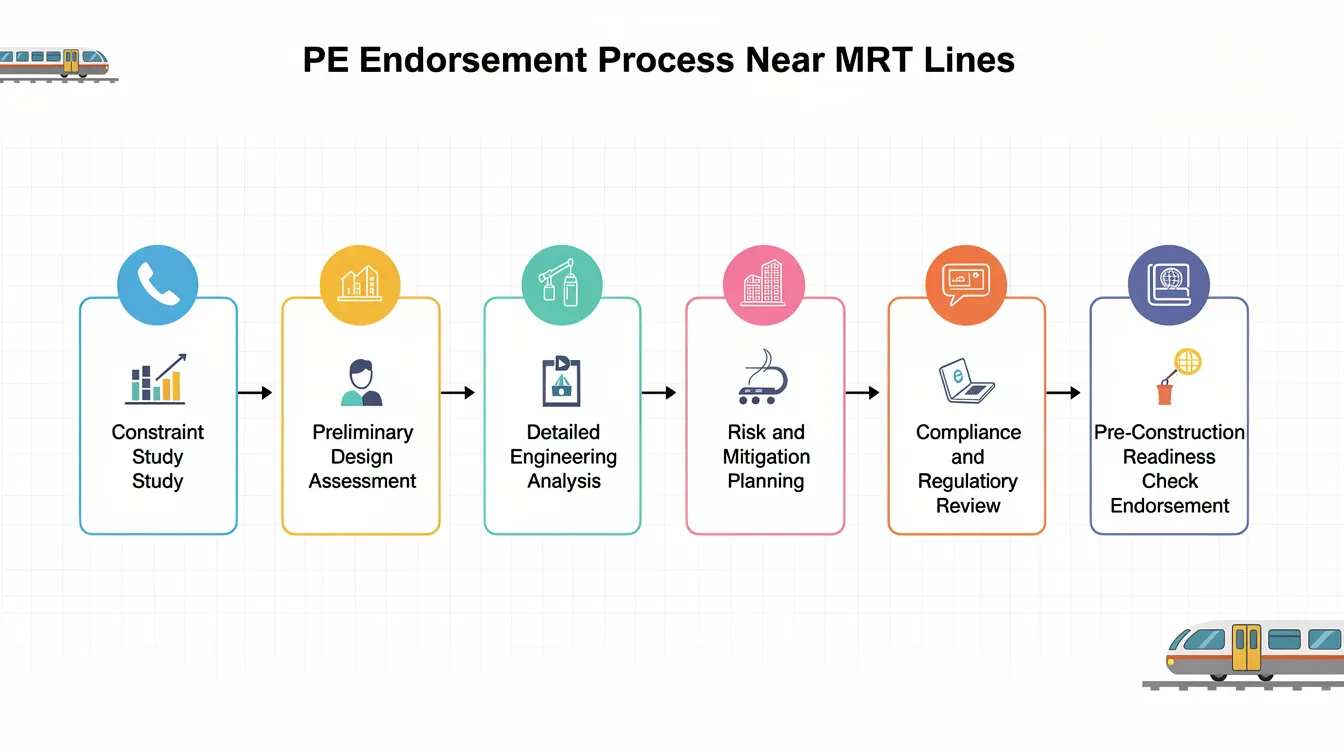
The following process blueprint consolidates the strategies above into a chronological workflow. Treating endorsement as an integrated process – not a last-minute signature – cuts rejection risk drastically.
Recommended Endorsement Process
-
Early Constraint Study – Map MRT assets, protection zones, utilities and site constraints using survey data, LTA Railway Protection Plans and existing records. Confirm whether your site falls within the RPZ, Safety Zone or any Reserve line.
-
Preliminary Scheme and Risk Workshop – Generate and compare temporary works options with input from your PE and AMAN’s geotechnical and structural specialists. Evaluate risk, cost and programme implications of each option.
-
Detailed Design and BIM Coordination – Develop full calculations, drawings and 3D models. Resolve clashes and buildability issues. Prepare Certified Survey Plans and pre-condition survey reports.
-
Internal Technical Review – Conduct an internal peer review or independent check (AMAN can provide this) before submitting to the PE for endorsement. Verify completeness against the checklist above.
-
PE Review and Iterations – Address the PE’s technical comments systematically, recording all design decisions and risk mitigations. Expect at least one to two comment cycles.
-
LTA/BCA/Other Authority Submission – Compile PE-signed documents, method statements, monitoring plans, emergency procedures and required forms for submission to LTA and other agencies. Failure to submit required documents can incur fines up to $5,000.
-
Pre-Construction Readiness Check – Before starting work on site, verify that all monitoring equipment is installed and operational, contingency plans are communicated to all parties, and permits are formally in hand.
Build buffer time into your programme for LTA’s review cycles – these often require weeks and sometimes months depending on proximity to MRT structures and complexity of the works. A smooth endorsement process is the result of disciplined preparation at every preceding step.
Common Challenges and How to Resolve Them
Even well-run projects face hurdles. The following matches frequent real-world issues with practical solutions drawn from AMAN’s experience on MRT-adjacent projects.
“Our PE Keeps Asking for More Information and We’re Running Out of Time”
Solution:
-
Set up an early technical clarification meeting with the PE to align expectations and agree a definitive information checklist before formal submission.
-
Assign a single coordinator – from AMAN or the main contractor – to manage all PE queries and track responses in a structured log.
-
Prioritise critical safety-related information first (soil data, movement analyses, construction sequence), then address secondary refinements.
“LTA Has Raised Comments That Require Major Redesign”
Solution:
-
Hold a joint review session (contractor–PE–AMAN–LTA) to clarify concerns face-to-face instead of relying on email exchanges, which often extend timelines unnecessarily.
-
Use value engineering to explore alternative sequences or support systems that lower impact on MRT structures while controlling cost and programme.
-
Phase implementation: agree interim measures to allow limited works to proceed while final redesign is completed – this avoids a flat programme stoppage.
“Monitoring Readings Are Approaching Alarm Levels”
Solution:
-
Immediately verify instrument reliability and re-survey critical points to rule out measurement errors before escalating.
-
Implement pre-planned mitigation measures (additional props, slower excavation, temporary load reductions) agreed with the PE at the date the monitoring plan was finalised.
-
Escalate to LTA according to the communication protocol, documenting all steps taken and reactions observed. Delays in response at this stage can have serious safety and regulatory consequences.
“We Underestimated the Time Needed for Endorsement and Approvals”
Solution:
-
Re-baseline the programme with realistic durations for PE review and LTA approval, including buffer for one to two comment cycles. Approval timelines can extend beyond standard processing periods for MRT-adjacent works.
-
Fast-track by parallelising tasks where possible – for example, developing method statements while design calculations are being finalised.
-
For future projects, involve AMAN during bid stage to input realistic authority approval durations based on recent project experience. This addresses the root cause: most underestimation comes from teams unfamiliar with MRT-specific approval timelines.
Overcoming these issues is significantly easier with experienced advisors who understand LTA’s expectations and can anticipate the questions before they arise.
Conclusion and Next Steps
PE endorsement near MRT lines is strict – but it is entirely manageable when you engage early, design to LTA criteria from the start, and prepare complete, well-coordinated documentation. The projects that experience the fewest delays are those where the PE, contractor and specialist consultant work as an integrated team from concept through to construction.
Your immediate next steps:
-
Map whether your upcoming works fall within any MRT protection or influence zones – check against LTA’s Railway Protection Plans and the 40-metre RPZ boundary.
-
Audit your current temporary works designs against the checklist provided in this article to identify gaps before they become rejections.
-
Schedule an early consultation with a qualified PE and AMAN Engineering Consultancy to review your strategy and align on endorsement milestones.
-
Integrate endorsement and authority submission milestones into your project schedule with realistic buffers – at minimum two review cycles for LTA submissions.
AMAN Engineering Consultancy supports clients across the full spectrum of MRT-adjacent works: PE endorsement for temporary works near MRT lines, BIM modelling and coordination for LTA/BCA submissions, impact assessments, structural and façade inspections, and fire safety certification where relevant to rail-adjacent projects. Whether you are a developer, homeowners’ representative overseeing estate works, or a contractor managing infrastructure delivery, AMAN can help you navigate approvals efficiently. Contact AMAN for a project-specific review – particularly for infrastructure and MRT corridor works where early specialist input makes the greatest difference.
Additional Resources
The following resources support the guidance provided in this article without repeating its full detail:
-
Key reference documents: LTA Code of Practice for Railway Protection (2024 edition and September 2026 addendum); Rapid Transit Systems (Railway Protection, Restricted Activities) Regulations (Cap 263A); relevant Singapore Standards and Eurocodes for temporary works design.
-
Internal tools and checklists: Sample PE endorsement checklist for MRT-adjacent temporary works, available through AMAN’s project consultations.
-
Related AMAN guides:
-
Suggested visual resources: Example monitoring dashboards, BIM screenshots demonstrating clash detection around MRT corridors, and 4D sequence simulations – available on request from AMAN’s project delivery team.