

An SCDF inspection is the mandatory fire safety verification process conducted by the Singapore Civil Defence Force to confirm that buildings comply with the Fire Safety Act and the Fire Code. Property owners, developers, and builders in Singapore must understand what is SCDF inspection before they can occupy, operate, or certify a building. The process involves staged site assessments, documentation reviews, and testing of fire protection systems. Two distinct certifications govern compliance: the Fire Safety Certificate (FSC) for new buildings before occupancy, and the Fire Certificate (FC) for ongoing operational premises. Getting both right requires early planning, qualified professionals, and a clear understanding of SCDF building regulations.
What is SCDF inspection and who must comply?
An SCDF inspection is a formal, multi-stage site audit that verifies whether a building’s fire protection systems meet the requirements of Singapore’s Fire Code. The inspection is not optional. It is a legal prerequisite for obtaining either a Fire Safety Certificate or a Fire Certificate, depending on the building type and its stage of development.
The Fire Safety Certificate is required before a new building can be occupied. The Fire Certificate applies to operational premises that must demonstrate ongoing compliance through periodic renewal. Both certifications are distinct, with the FSC confirming that fire safety measures were built correctly, and the FC confirming that those measures are properly maintained over time.

Understanding SCDF requirements begins with identifying whether your premises fall under the FC regime. The thresholds are specific and non-negotiable.
Premises that require a Fire Certificate include:
- Industrial buildings exceeding 24 meters in height
- Commercial buildings with a floor area greater than 5,000 m²
- Hospitals and healthcare facilities
- Hotels and serviced residences
- Large assembly venues such as convention centers and sports halls
Owners of these premises must engage Professional Engineers and licensed contractors to inspect and certify all fire safety systems before SCDF conducts its own audit. Annual maintenance inspections are also mandatory for premises holding a Fire Certificate. Failure to maintain this cycle puts the certificate at risk and exposes the owner to regulatory penalties.
How is the SCDF inspection process conducted?
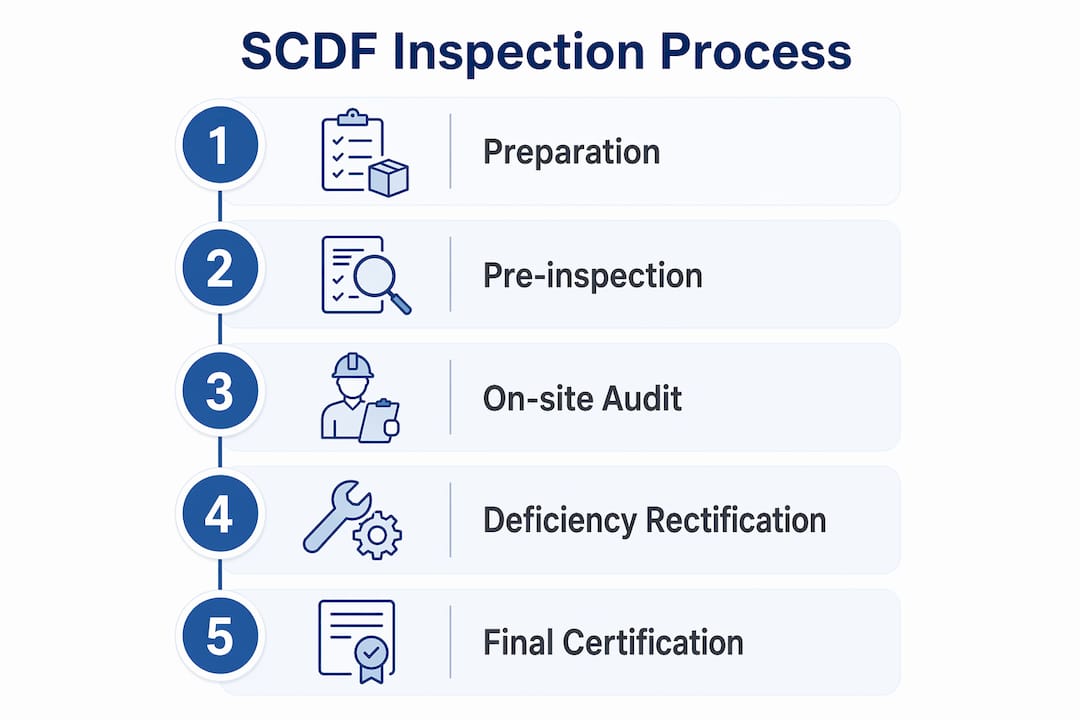
The SCDF inspection process follows three defined stages. Each stage tests a different aspect of the building’s fire protection capability. SCDF site inspections for Fire Certificates begin with a system operation test during a simulated fire alarm activation. This is not a paper review. Officers physically observe whether systems respond correctly when an alarm is triggered.
The three stages proceed as follows:
-
Stage 1: Simulated fire alarm activation. SCDF officers trigger a fire alarm and observe whether all connected systems respond correctly. This includes sprinkler activation signals, door release mechanisms, smoke dampers, and evacuation alerts. Every system must respond within the required time parameters.
-
Stage 2: Secondary power supply testing. The building’s main power is cut, and all fire safety systems must continue to operate on backup power, typically a generator. Fire protection systems testing under secondary power confirms that operational readiness is not dependent on the primary electrical supply. This stage is critical for high-rise and large-footprint buildings where power failure during an emergency is a realistic scenario.
-
Stage 3: Individual system testing. Officers test each fire protection installation independently across the building. This includes wet and dry risers, sprinkler heads, smoke extraction fans, emergency lighting, and voice communication systems. Every installation must meet the specifications documented in the approved fire safety plans.
Registered Inspectors play a central role throughout this process. Their inspections and certifications are required before SCDF conducts its final site audit. They verify that fire safety works were completed correctly and that all systems are ready for the official inspection.
Pro Tip: Schedule your Registered Inspector’s pre-inspection at least four weeks before the SCDF site visit. Any deficiencies identified by the RI give you time to rectify and retest without delaying your certificate application.
Documentation requirements during the SCDF inspection include approved fire safety plans, test certificates from contractors, maintenance records, and the RI’s certification report. SCDF officers cross-reference physical observations against these documents. Gaps in documentation are treated as non-compliance, even when the physical systems are functioning correctly.
Common fire safety systems checked during SCDF inspections
SCDF fire safety checks cover every major fire protection system in a building. The scope is broad, and no system is exempt from scrutiny. Buildings must have all critical systems verified, including emergency power supply, dry and wet risers, pressurization systems, and mechanical ventilation.
The following systems are assessed during every SCDF inspection:
- Emergency power supply and backup generators: Confirmed to activate automatically and sustain all fire safety systems during a power failure.
- Pressurization systems: Stairwells and escape routes must maintain positive air pressure to prevent smoke ingress during a fire event.
- Smoke control systems: Atriums, basements, and large open spaces require mechanical smoke extraction to maintain tenable conditions for evacuation.
- Sprinkler systems: Coverage, water pressure, and activation response are all tested against Fire Code specifications.
- Fire alarm systems: Detection devices, control panels, and alarm outputs are verified for correct zoning and response times.
- Wet and dry risers: Water supply infrastructure for firefighting operations must be accessible, pressurized, and functional.
- Voice communication systems and fire command centers: Officers test whether building-wide announcements can be made from the fire command center and whether communication is clear across all zones.
- Mechanical ventilation and air-conditioning systems: Dampers and fans linked to fire safety must respond correctly to alarm signals.
- Emergency exits and evacuation routes: All exits must be unobstructed, correctly signed, and equipped with functional emergency lighting.
The table below summarizes the key systems and their primary compliance criteria:
| Fire Safety System | Primary Compliance Criteria |
|---|---|
| Emergency power supply | Auto-activation within required time; sustained output |
| Sprinkler system | Correct pressure, coverage, and activation response |
| Fire alarm system | Correct zoning, detection sensitivity, and alarm output |
| Wet and dry risers | Accessible, pressurized, and operational |
| Smoke control | Adequate extraction rate for the protected space |
| Voice communication | Clear, building-wide broadcast from fire command center |
| Emergency exits | Unobstructed, signed, and lit at all times |
Understanding code compliance in architecture is the foundation for getting these systems right from the design stage. Buildings that integrate fire safety requirements during design consistently perform better during SCDF inspections than those where compliance is addressed as an afterthought.
What happens after the SCDF inspection?
The outcome of an SCDF inspection determines whether a Fire Certificate is issued, deferred, or withheld. Non-compliance detected during inspections requires rectification before the Fire Certificate can be issued. SCDF does not issue partial certificates. Every system must pass before the certificate is granted.
Post-inspection outcomes fall into three categories:
- Full compliance: SCDF issues the Fire Certificate. The premises may operate, and the owner must maintain all systems and schedule the next renewal inspection.
- Conditional compliance: Specific deficiencies are identified. The owner must rectify these items and submit evidence of correction. SCDF may conduct a follow-up audit before issuing the certificate.
- Non-compliance: Significant failures across multiple systems result in a failed inspection. The owner must address all deficiencies, engage the Registered Inspector for re-certification, and reapply for the SCDF site inspection.
Pro Tip: Keep a live deficiency log during your pre-inspection phase. Document every issue found, the corrective action taken, and the date of rectification. This log becomes your primary evidence during any SCDF follow-up audit.
Renewal cycles are a critical ongoing obligation. SCDF conducts audits and randomly inspects properties annually to verify that fire safety systems remain in working order. Starting from april 2026, SCDF will introduce three-year validity periods for Fire Certificate renewals, reducing the frequency of full renewal submissions and lowering regulatory compliance costs for building owners.
Applications and submissions are processed through the GoBusiness portal. Owners must submit inspection schedules, test results, and RI certification reports as part of the SCDF submission requirements. Penalties for non-compliance include fines, prohibition orders, and in serious cases, forced closure of the premises. The financial and reputational consequences of a failed inspection far exceed the cost of proper preparation.
Key Takeaways
SCDF inspection is the mandatory, multi-stage fire safety audit that Singapore building owners, developers, and builders must pass to obtain a Fire Safety Certificate or Fire Certificate under the Fire Safety Act.
| Point | Details |
|---|---|
| Two distinct certifications | The FSC applies before occupancy; the FC governs ongoing operational compliance and requires periodic renewal. |
| Three-stage inspection process | SCDF tests systems under simulated alarm, backup power, and individual component conditions before issuing any certificate. |
| Registered Inspectors are required | Owners must engage a Registered Inspector to certify all fire safety works before SCDF conducts its final site audit. |
| Non-compliance delays certification | Any deficiency found during inspection must be fully rectified and re-certified before SCDF issues the Fire Certificate. |
| Three-year FC validity from April 2026 | SCDF’s updated renewal cycle reduces compliance costs while maintaining annual audit obligations for high-risk premises. |
What I’ve learned from years of SCDF inspection preparation
The most consistent mistake I see from developers and building owners is treating SCDF inspection preparation as a final-stage activity. By the time a project reaches the inspection phase, the window to fix fundamental design or installation errors is extremely narrow. Every rectification at that stage costs more time and money than it would have during construction.
Early engagement with a Registered Inspector changes the outcome. Owners who bring in qualified RI professionals during the M&E installation phase catch deficiencies before they become inspection failures. The common failures in fire compartmentation that I see most often, such as unsealed penetrations and incorrectly installed dampers, are entirely preventable with proper site supervision.
Regular maintenance is not just a compliance obligation. Buildings that maintain their fire safety systems properly perform better under the random annual audits that SCDF conducts. A system that has been tested and serviced quarterly will respond correctly during an unannounced inspection. A system that has only been checked at renewal time will not.
Proactive engagement with SCDF through the GoBusiness portal and clear documentation practices also reduce inspection friction significantly. Officers respond well to organized submissions and complete documentation packages. Incomplete records create delays that are entirely within the owner’s control to prevent.
— Aman
How Com supports your SCDF inspection readiness
Property owners and developers who need expert guidance on fire safety compliance can rely on Aman Engineering Consultancy for end-to-end support across every stage of the SCDF inspection process.
Com provides Registered Inspector services for both architectural and mechanical fire safety works, manages SCDF submission documentation, and coordinates directly with SCDF on behalf of clients. The team’s experience spans commercial, industrial, and institutional projects across Singapore, covering fire safety system design, pre-inspection audits, and certification management. Com also applies value engineering principles to fire safety compliance, identifying cost-effective solutions that meet Fire Code requirements without over-specifying systems. For developers and building owners who need a reliable partner from design through certification, Com delivers the technical depth and regulatory knowledge the process demands.
FAQ
What is an SCDF inspection?
An SCDF inspection is a mandatory fire safety audit conducted by the Singapore Civil Defence Force to verify that a building’s fire protection systems comply with the Fire Safety Act and Fire Code. It is required before a Fire Safety Certificate or Fire Certificate can be issued.
Which buildings need a Fire Certificate?
Industrial buildings over 24 meters in height and commercial buildings exceeding 5,000 m² in floor area require a Fire Certificate. Hospitals, hotels, and large assembly venues also fall under this requirement.
What are the three stages of an SCDF site inspection?
The three stages test fire systems under a simulated alarm activation, under secondary backup power, and then individually across all installed fire protection equipment throughout the building.
What happens if a building fails the SCDF inspection?
Non-compliance requires full rectification of all identified deficiencies before SCDF will issue a Fire Certificate. A follow-up audit or re-inspection may be required depending on the severity of the failures.
When does the three-year Fire Certificate renewal take effect?
SCDF will introduce three-year validity periods for Fire Certificate renewals starting april 2026, reducing the frequency of full renewal submissions while maintaining annual audit obligations.