

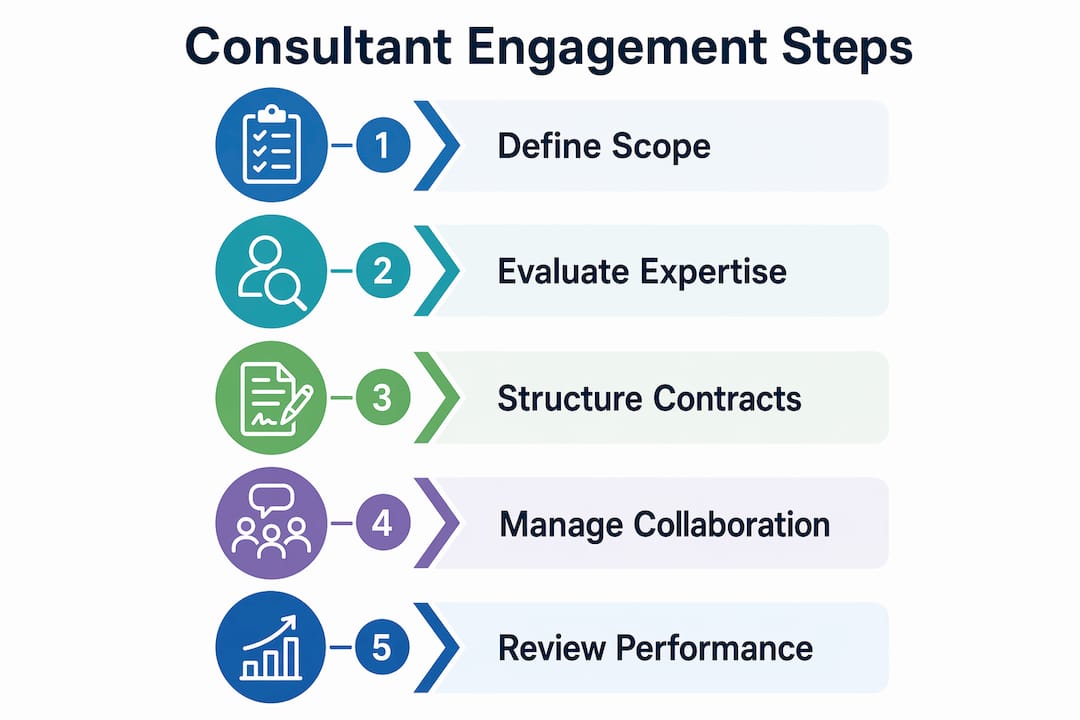
Engaging engineering consultants is defined as the structured process of selecting, contracting, and collaborating with licensed technical specialists to deliver defined project outcomes within scope, schedule, and budget. Property developers, construction firms, and project managers who understand how to engage engineering consultants correctly reduce rework, avoid regulatory delays, and protect project value. The process requires more than issuing a brief and waiting for drawings. It demands clear communication, rigorous evaluation, disciplined contract structures, and active collaboration throughout the project lifecycle. This article covers each of those steps with the specificity that complex construction projects in Singapore and beyond require.
How to engage engineering consultants: speaking their language first
The foundation of any successful consultant engagement is communication that matches the consultant’s technical frame of reference. Engineers respond to data, defined parameters, and documented constraints. Vague requests such as “we need a structural solution for the podium” produce vague responses. Specific requests that include site dimensions, load assumptions, regulatory references such as BCA or URA requirements, and desired outcomes produce precise proposals.
Effective communication with engineering consultants follows three principles:
- Precision over approximation. State exact floor-to-floor heights, load categories, soil investigation results, and applicable codes. Consultants price and scope based on what you give them.
- Documentation before dialogue. Bring a written project brief, existing drawings, and any prior consultant reports to every initial meeting. Consultants treat undocumented requests as preliminary and unbillable.
- Consultative dialogue, not sales pressure. Ask the consultant to identify risks and constraints before you discuss fees. This signals that you value technical judgment, not just cost.
Avoid the common mistake of presenting a project as simpler than it is to attract lower fees. Consultants who discover hidden complexity mid-project will issue variation orders, and the total cost will exceed what a fully disclosed brief would have produced.
Pro Tip: Prepare a one-page project data sheet before your first meeting. Include site area, zoning classification, intended use, applicable authority submissions required (BCA, SCDF, PUB, LTA), and your target program. This single document signals competence and saves 30 minutes of back-and-forth in every introductory call.
Good project planning practices for construction professionals reinforce this point: consultants allocate their best resources to clients who demonstrate organized, well-documented project management from the first interaction.

What are the best practices for evaluating and selecting engineering consultants?
Selecting the right consultant is a structured evaluation process, not a gut-feel decision. The following numbered sequence reflects current best practice for property developers and construction firms managing complex engagements.
- Define the scope before shortlisting. Write a draft scope of services before approaching any consultant. This prevents consultants from defining the scope for you, which creates conflicts of interest.
- Conduct structured fit calls. Run a 30-minute fit call using six consistent scripted questions, scoring each response on a three-point scale. This produces an objective comparison across candidates.
- Verify credentials and documented methodologies. Confirm professional registration (PE, ASEAN Engineer, or equivalent), check for relevant project references, and request redacted design history files to confirm process rigor on past projects.
- Commission a paid discovery sprint. For complex projects, best practice is a 2–4 week discovery sprint costing $5,000–$25,000. The sprint produces a problem statement, technical architecture, work breakdown, and a fixed-price proposal for the main engagement.
- Score on total value, not hourly rate. Selecting the cheapest hourly rate consistently produces higher total costs through rework, delays, and poor knowledge transfer.
The table below summarizes the key evaluation criteria and the method for assessing each one.
| Evaluation criterion | Assessment method |
|---|---|
| Technical expertise and registration | Verify PE or ASEAN Engineer credentials; review project portfolio |
| Communication and responsiveness | Score structured fit call responses on a three-point scale |
| Documented methodology | Request redacted design history files or process documentation |
| Scope and fee transparency | Assess clarity of proposal and assumptions stated |
| Discovery sprint output quality | Evaluate problem statement, architecture, and backlog from paid sprint |
Pro Tip: Never select a consultant based solely on the lowest fee. Optimizing for hourly rate rather than total project value is the single most common cause of budget overruns in consultant-led construction projects.
How should you structure contracts and project scopes?
Contract structure is the mechanism that converts verbal agreements into enforceable obligations. The most effective structure for working with engineering consultants uses two documents: a Master Services Agreement (MSA) and modular Statements of Work (SOW).
The MSA plus SOW structure separates immutable terms (liability caps, intellectual property ownership, dispute resolution, confidentiality) from project-specific terms (scope, deliverables, fees, program). This means you negotiate the MSA once and issue new SOWs for each project phase or variation without reopening the core legal terms. The practical benefit is speed: a new SOW can be executed in days rather than weeks.
Scope definition within each SOW must be absolute. Every deliverable should be named, formatted, and dated. “Structural drawings” is not a deliverable. “BCA-compliant structural drawings for the proposed 12-storey residential development at [address], issued for permit submission by [date]” is a deliverable. The difference between these two phrasings is the difference between a clean project and a dispute.
The table below outlines the key contract components and how risk is allocated between client and consultant.
| Contract component | Purpose | Risk allocation |
|---|---|---|
| Master Services Agreement | Governs liability, IP, and dispute resolution | Shared; negotiated once |
| Statement of Work | Defines scope, deliverables, fees, and program | Client defines scope; consultant prices risk |
| Technical risk mitigation plan | Documents identified risks and mitigation measures | Consultant-led; client-approved |
| KPI review schedule | Tracks CPI and SPI weekly | Joint accountability |
| Variation order protocol | Manages scope changes formally | Client approval required before work proceeds |
Tracking project performance requires weekly review of the Cost Performance Index (CPI) and Schedule Performance Index (SPI). CPI and SPI values below 1.0 signal budget overrun or schedule slippage, respectively. Catching these signals in week three is recoverable. Catching them in week twelve is not.
The American Society of Civil Engineers (ASCE) confirms that formal risk governance with delegated accountability for technical risk assessments is a fundamental requirement for reducing engineering claims. Embedding this governance into the SOW at the start of each engagement is the correct approach.
Pro Tip: Include a risk assessment framework clause in every SOW that requires the consultant to submit a written technical risk register within the first two weeks of engagement. This document becomes the baseline for all subsequent variation order assessments.
What are effective strategies for managing collaboration during the engagement?
Active collaboration management is what separates projects that finish on time from those that drift. The most common failure mode is treating the consultant as an external vendor who submits drawings on request. Failing to integrate consultants into team workflows creates knowledge silos and alignment drift that compound over time.
Effective collaboration practices include the following:
- Include consultants in weekly project stand-ups. Even a 15-minute slot keeps the consultant aligned with site conditions, procurement decisions, and authority feedback that affects their work.
- Use shared document management platforms. All drawings, reports, and correspondence should live in one location accessible to all parties. Emailed attachments create version control failures.
- Document every handoff formally. When the structural engineer hands drawings to the M&E consultant, a written transmittal record must accompany the transfer. Undocumented handoffs are the origin of most coordination disputes.
- Schedule monthly technical alignment reviews. These are separate from progress meetings. Their purpose is to identify technical conflicts between disciplines before they reach the construction stage.
- Conduct post-project debriefs. A structured debrief within 30 days of project completion captures lessons learned and forms the basis for the next engagement brief.
Long-term consultant relationships require post-project follow-ups and progress updates to build the trust that converts a one-time engagement into a preferred-supplier relationship. Property developers who maintain active communication with their consultant network between projects receive priority resourcing and faster mobilization when the next project starts. Bid accuracy also improves when consultants understand your project typology, which is where tools that support contractor bid strategies can complement the consultant’s technical input.
What common mistakes should be avoided when working with engineering consultants?
The following mistakes appear consistently across failed or overbudget consultant engagements. Each one is preventable with the practices described in this article.
- Undefined scope at engagement start. A brief that lacks specificity forces the consultant to make assumptions. Those assumptions become the basis for the fee, and any deviation from them becomes a variation order.
- Selecting on lowest hourly rate. The total cost of a consultant engagement includes rework, delay costs, and the time your project team spends managing poor quality output. The cheapest option rarely produces the lowest total cost.
- Isolating consultants from the project team. Consultants who do not attend project meetings and do not receive timely information produce drawings that do not reflect current site or design conditions.
- Skipping technical risk documentation. Projects without a formal risk register have no baseline for assessing whether a variation order is legitimate or a consequence of the consultant’s own error.
- Ignoring the design-to-construction transition. The transition from design to construction is a common failure point that requires disciplined documentation and early methodology verification. Confirm the consultant’s construction-stage inspection and certification obligations before the contract is signed.
Pro Tip: Verify that your engineering consultant holds a valid Professional Engineer (PE) license registered with the relevant authority before executing any contract. In Singapore, this means registration with the Professional Engineers Board (PEB). Unlicensed consultants cannot certify statutory submissions to BCA, SCDF, or LTA, and any work they produce cannot be used for permit applications.
Civil and structural design services require licensed practitioners for statutory submissions. Confirming this credential at the shortlisting stage, not after contract execution, eliminates a category of risk entirely.
Key Takeaways
Effective engagement of engineering consultants requires a structured process covering communication, evaluation, contracting, and active collaboration management throughout the project lifecycle.
| Point | Details |
|---|---|
| Communicate with precision | Provide a written project brief with site data, codes, and program before the first consultant meeting. |
| Evaluate with a structured protocol | Use a scored fit call and a paid discovery sprint to objectively assess consultant capability before committing. |
| Use MSA plus SOW contracts | Separate immutable legal terms from project-specific scope to speed up execution and control variation orders. |
| Track CPI and SPI weekly | Values below 1.0 signal budget or schedule risk; catch them early when recovery is still possible. |
| Integrate consultants into workflows | Include consultants in stand-ups, shared platforms, and formal handoffs to prevent knowledge silos. |
What I have learned about engaging engineering consultants
After working across structural, civil, M&E, and fire safety projects in Singapore and the region, the pattern that separates successful engagements from costly ones is almost always visible in the first two weeks. Clients who arrive with a documented brief, a clear authority submission roadmap, and a realistic program attract consultants who price accurately and resource properly. Clients who arrive with a verbal description and a request for a ballpark fee attract the opposite.
The discovery sprint concept is the most underused tool in the property developer’s toolkit. Paying $5,000–$25,000 to produce a fixed-scope proposal before committing to a full engagement feels counterintuitive when you are under pressure to move fast. The reality is that it saves multiples of that cost by eliminating scope ambiguity before the main contract is signed.
The other lesson that took time to internalize is that the consultant relationship does not end at practical completion. The developers who call after the project to share what worked and what did not, and who send the next brief before it is formally tendered, consistently get better pricing, faster mobilization, and more candid technical advice. Transactional relationships produce transactional results. Partnerships produce better buildings.
— Aman
Engineering consultancy support from Aman
Property developers and construction firms that apply the practices in this article will reduce variation orders, avoid regulatory delays, and deliver projects that meet their original brief. Executing those practices consistently requires access to consultants who operate with the same level of rigor.
Com, Aman Engineering Consultancy, provides structural, civil, M&E, fire safety, and BIM services across Singapore and international markets. The firm manages statutory submissions to BCA, URA, JTC, HDB, SCDF, PUB, and LTA, and holds the professional registrations required for certified permit applications. Developers and project managers who want a consulting partner with documented methodologies and active compliance expertise can review Com’s full service range at Aman Engineering Consultancy. Com also offers value engineering assessments that identify cost savings without compromising structural or regulatory compliance.
FAQ
How do you engage an engineering consultant for the first time?
Prepare a written project brief covering site data, zoning, applicable authority submissions, and program before the first meeting. Conduct a structured fit call using consistent scored questions to compare candidates objectively.
What is a discovery sprint in engineering consultant engagement?
A discovery sprint is a paid 2–4 week phase costing $5,000–$25,000 that produces a problem statement, technical architecture, and fixed-price proposal before the main engagement begins. It eliminates scope ambiguity and reduces variation orders on the main contract.
What contract structure works best when hiring engineering consultants?
A Master Services Agreement covering liability, IP, and dispute resolution, combined with modular Statements of Work for each project phase, is the most effective structure. This approach separates immutable legal terms from project-specific scope and fees.
How do you track engineering consultant performance during a project?
Track the Cost Performance Index (CPI) and Schedule Performance Index (SPI) on a weekly basis. Both values below 1.0 indicate budget overrun or schedule slippage and require immediate corrective action.
What credentials should an engineering consultant hold in Singapore?
Engineering consultants certifying statutory submissions in Singapore must hold a valid Professional Engineer (PE) license registered with the Professional Engineers Board (PEB). Confirm this credential before executing any contract, as unlicensed practitioners cannot certify BCA, SCDF, or LTA submissions.