

A Qualified Person (QP) in Singapore is a registered architect or licensed professional engineer who holds direct legal responsibility for certifying building designs, managing statutory submissions, and ensuring full adherence to the Building Control Act. The role of QP in Singapore is not advisory. It is a legally defined function under Singapore law, and no regulated construction or development project can proceed without one. For property developers, building owners, and construction firms, understanding what a QP does, what qualifications they must hold, and what risks arise from inadequate QP engagement is not optional knowledge. It is a prerequisite for project success.
What qualifications must a QP hold in singapore?
Only registered architects or licensed professional engineers with valid practicing certificates qualify as QPs in Singapore. This is not a matter of experience or seniority alone. The legal QP designation requires active registration with the Board of Architects (BOA) or the Professional Engineers Board (PEB), plus a current practicing certificate issued for the relevant year. Lapsed certificates disqualify a professional from acting as QP, regardless of their credentials or track record.
The qualifications framework in Singapore for construction professionals is structured and multi-tiered. Architects must complete an accredited degree program, fulfill a practical training period, and pass the Professional Practice Examination administered by BOA. Professional engineers follow a parallel path through PEB, with discipline-specific requirements covering civil, structural, mechanical, and electrical engineering, among others.

The WSQ (Workforce Skills Qualification) framework, administered through the Institute of Technical Education (ITE) and SkillsFuture Singapore, provides accredited skill certifications aligned with real job roles and industry requirements. While WSQ courses do not confer QP status on their own, they support the continuing professional development that regulatory bodies expect from practicing QPs. Professionals who pursue WSQ-aligned training in areas such as building inspection, project management, and regulatory compliance strengthen their technical foundation and demonstrate commitment to industry standards.
The career benefits of QP certification are substantial. A QP designation positions a professional as a legally accountable figure in high-value projects, commands higher professional fees, and opens access to a broader range of project types including government infrastructure, private developments, and industrial facilities.
- Valid practicing certificate from BOA or PEB (renewed annually)
- Accredited degree in architecture or relevant engineering discipline
- Completion of structured practical training under a supervising professional
- Passing of the relevant Professional Practice Examination
- Ongoing continuing professional development to maintain registration
Pro Tip: Verify a QP’s registration status directly on the BOA or PEB online registry before signing any engagement letter. Both registries are publicly accessible and updated regularly.
What are the key duties of a QP on a construction project?
The QP prepares detailed architectural and structural plans adhering strictly to Singapore’s Building Control Act and relevant codes. This is the foundational duty, but it represents only the starting point of a QP’s involvement across the full project lifecycle. The responsibilities extend from initial design through statutory submissions, construction supervision, and final certification.
Singapore’s regulatory framework distinguishes between two primary QP functions: QP(Plan) and QP(Supervision). QP(Plan) refers to the professional responsible for preparing and submitting building plans for regulatory approval. QP(Supervision) refers to the professional who oversees construction works on site and certifies that they conform to approved plans and applicable regulations. In some projects, one individual holds both roles. In larger or more complex developments, separate professionals may be appointed for each function.
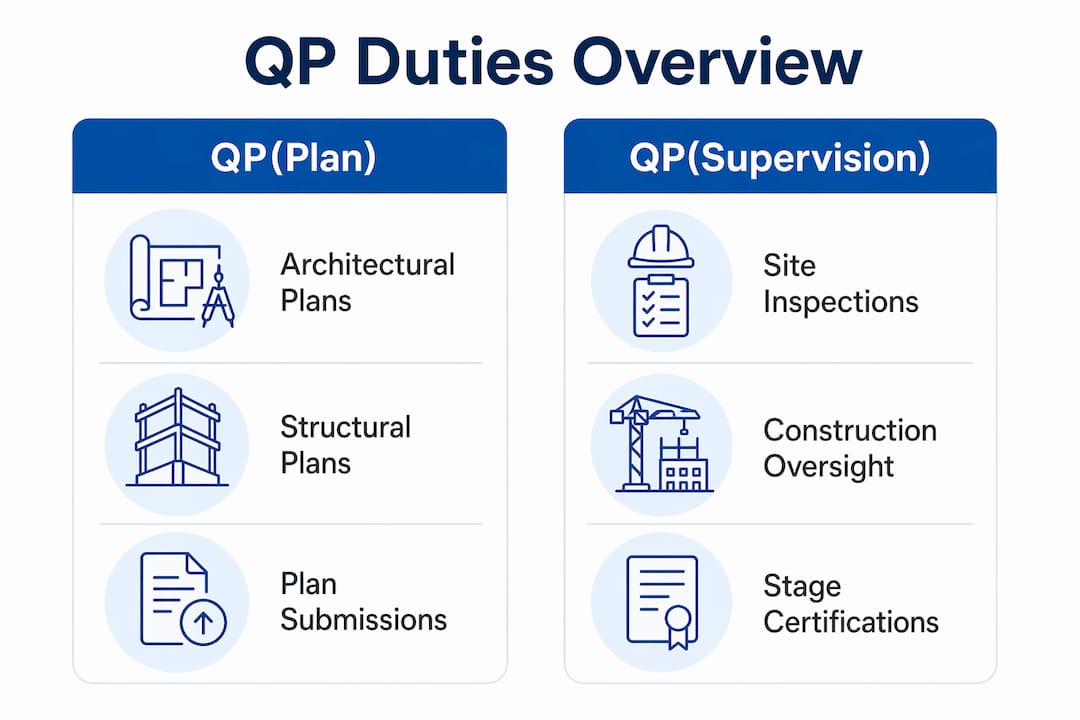
The supervisory duties of a QP extend throughout construction, with certification required at defined stages according to Building Control regulations. This ongoing oversight mitigates structural and regulatory risks that would otherwise go undetected until costly remediation becomes necessary.
A statutory obligation of a QP is non-delegable. Even when a QP engages assistants or sub-consultants to prepare drawings or coordinate submissions, the legal responsibility for accuracy and compliance remains solely with the named QP. This principle has significant implications for project governance and professional liability.
The key duties of a QP across a typical project proceed in the following sequence:
- Review project scope and confirm regulatory requirements under the Building Control Act and relevant codes
- Prepare or review architectural and structural plans for accuracy and code compliance
- Submit plans to the Building and Construction Authority (BCA) and respond to queries from the authority
- Coordinate with other statutory bodies including URA, SCDF, PUB, and LTA where required
- Conduct site inspections at prescribed construction stages and certify compliance
- Issue the Certificate of Statutory Completion (CSC) or relevant certification upon project completion
Pro Tip: Engage your QP at the pre-design stage, not after plans are already drawn. Early QP involvement prevents costly redesigns triggered by regulatory non-compliance discovered late in the process.
How does the QP role affect project approval and compliance?
The QP is the linchpin between project stakeholders and regulatory authorities, ensuring that communication and compliance flow correctly through every stage of a project. Without an authorized QP, submissions and approvals become legally untenable or are delayed significantly. This is not a procedural formality. It is a structural feature of Singapore’s construction regulatory system.
BCA requires QP-endorsed submissions for all regulated building works. URA requires QP involvement for development applications involving changes to use, gross floor area, or building height. SCDF mandates QP certification for fire safety plans. Each of these agencies treats the QP’s endorsement as a condition of processing, not merely as supporting documentation.
Projects with clear QP engagement experience smoother regulatory approvals and fewer compliance issues. The inverse is equally true: projects where QP responsibilities are ambiguous or where the named QP is not actively involved face higher rates of plan rejection, resubmission cycles, and enforcement action.
The legal liability carried by a QP is direct and personal. If certified works are found to be non-compliant, the QP faces disciplinary proceedings before BOA or PEB, potential deregistration, civil liability, and in serious cases, criminal prosecution under the Building Control Act. This accountability structure is what gives QP certification its regulatory weight.
“Clients must verify the identity and registration status of the QP before project commencement. Engaging a firm without a clearly identified QP may risk non-compliance, approval delays, and legal repercussions.” — Wci Bay Homes
Key compliance functions the QP performs throughout the approval process include:
- Endorsing building plan submissions to BCA and other statutory authorities
- Certifying that structural and architectural designs meet code requirements
- Responding formally to authority queries and resubmitting revised plans when required
- Issuing staged compliance certifications during construction
- Confirming that completed works match approved plans before occupation is permitted
For a detailed breakdown of building plan submission requirements in Singapore, the documentation requirements and QP endorsement obligations are clearly defined by BCA.
What are the red flags when engaging a QP in singapore?
Firms that do not disclose their registered architect or QP, or that suggest statutory submissions can be handled later, expose clients to serious legal risks. This is the most common and most costly mistake made by developers and building owners engaging professional services for the first time. The warning signs of unlicensed or unregistered professionals acting as QP are specific and identifiable.
The following comparison table outlines the difference between a properly engaged QP and a high-risk engagement:
| Indicator | Properly Engaged QP | High-Risk Engagement |
|---|---|---|
| QP identity disclosed | Named and verifiable on BOA/PEB registry | Unnamed or vague reference to “in-house team” |
| Practicing certificate | Current and valid for the project year | Not provided or expired |
| Professional indemnity insurance | Confirmed and documented | Not mentioned or refused |
| Submission timeline | Defined in engagement scope | Deferred or described as flexible |
| Statutory duties | Acknowledged as non-delegable | Described as manageable by assistants |
Additional red flags that warrant immediate scrutiny include:
- Refusal to name the QP responsible for the project
- Suggesting that plan submissions can be deferred until construction begins
- Inability to produce a current practicing certificate upon request
- Absence of professional indemnity insurance documentation
- Offering to manage regulatory submissions through non-registered staff
Pro Tip: Request a copy of the QP’s practicing certificate and professional indemnity insurance certificate at the start of any engagement. A legitimate QP will provide both without hesitation.
The planning approval process in Singapore is sequential and time-sensitive. Delays caused by unqualified or improperly engaged professionals compound at every stage, generating costs that far exceed the fee savings from choosing a cheaper, less credentialed firm.
Key takeaways
The QP is the legally accountable professional who makes regulated construction in Singapore possible, and no project should proceed without confirming the QP’s identity, registration status, and active practicing certificate.
| Point | Details |
|---|---|
| Legal accountability is personal | A QP’s statutory duties are non-delegable; legal liability rests solely with the named registered professional. |
| Qualifications are strictly defined | Only BOA-registered architects or PEB-licensed engineers with valid practicing certificates qualify as QPs. |
| QP roles are project-wide | QP responsibilities span plan preparation, statutory submissions, site supervision, and final certification. |
| Early engagement reduces risk | Appointing a QP at the pre-design stage prevents costly redesigns and regulatory rejections later. |
| Verification is mandatory | Clients must confirm QP identity, registration status, and insurance before project commencement. |
Why the QP role is more critical than most developers realize
Having worked across numerous construction and engineering projects in Singapore, I have observed a consistent pattern: developers and building owners who treat QP engagement as a procurement checkbox rather than a strategic appointment consistently encounter the most expensive problems. The QP is not simply a signatory. The QP is the professional whose judgment, registration, and legal standing make every regulatory submission valid.
The regulatory environment in Singapore has tightened considerably over recent years. BCA has increased scrutiny of plan submissions, and the consequences of non-compliance have become more severe. Professionals who pursue QP status today are entering a role with greater accountability than their predecessors held a decade ago. That accountability, however, also carries greater professional value.
My strongest advice to developers is this: engage your QP before you engage your contractor. The QP’s input on design feasibility, regulatory constraints, and submission sequencing will shape the project timeline more than any other single factor. Treating the QP as an afterthought is the single most reliable way to generate delays, cost overruns, and enforcement exposure.
For professionals considering the QP certification path, the career benefits are real and growing. Singapore’s construction pipeline remains substantial, and the demand for registered QPs with active practicing certificates consistently exceeds supply in several engineering disciplines.
— Aman
How aman engineering consultancy supports your QP requirements
Aman Engineering Consultancy provides expert QP services across Singapore’s construction and real estate sectors, covering statutory submissions, plan preparation, site supervision, and multi-agency regulatory coordination. The firm’s team includes registered architects and licensed professional engineers with current practicing certificates, supported by deep experience across BCA, URA, SCDF, PUB, JTC, HDB, and LTA submissions.
Whether you are managing a landed residential project, a commercial development, or an industrial facility, Aman Engineering’s QP professionals deliver the regulatory expertise and direct accountability your project requires. The firm’s civil and structural design services integrate QP oversight from the earliest design stage through to final certification, reducing approval risk and keeping your project on schedule. Contact Aman Engineering today to confirm your QP requirements and begin your compliance process with confidence.
FAQ
What is a qualified person (QP) in singapore?
A Qualified Person in Singapore is a registered architect or licensed professional engineer with a valid practicing certificate who holds legal responsibility for certifying building plans and supervising construction works under the Building Control Act.
What are the QP requirements in singapore?
A QP must hold active registration with the Board of Architects or the Professional Engineers Board and maintain a current practicing certificate. Registration must be renewed annually, and lapsed certificates disqualify a professional from performing QP functions.
What is the difference between qp(plan) and qp(supervision)?
QP(Plan) refers to the professional responsible for preparing and submitting building plans to regulatory authorities. QP(Supervision) refers to the professional who oversees construction on site and certifies that works conform to approved plans and applicable regulations.
Can a QP delegate statutory duties to an assistant?
No. A QP’s statutory obligations are non-delegable under Singapore law. While assistants may support administrative tasks, the legal responsibility for all submissions and certifications remains solely with the named registered QP.
What happens if a project proceeds without a properly engaged QP?
Projects without a clearly identified and registered QP face plan rejection, approval delays, enforcement action by BCA, and potential legal liability for the developer or building owner. In serious cases, stop-work orders may be issued.