
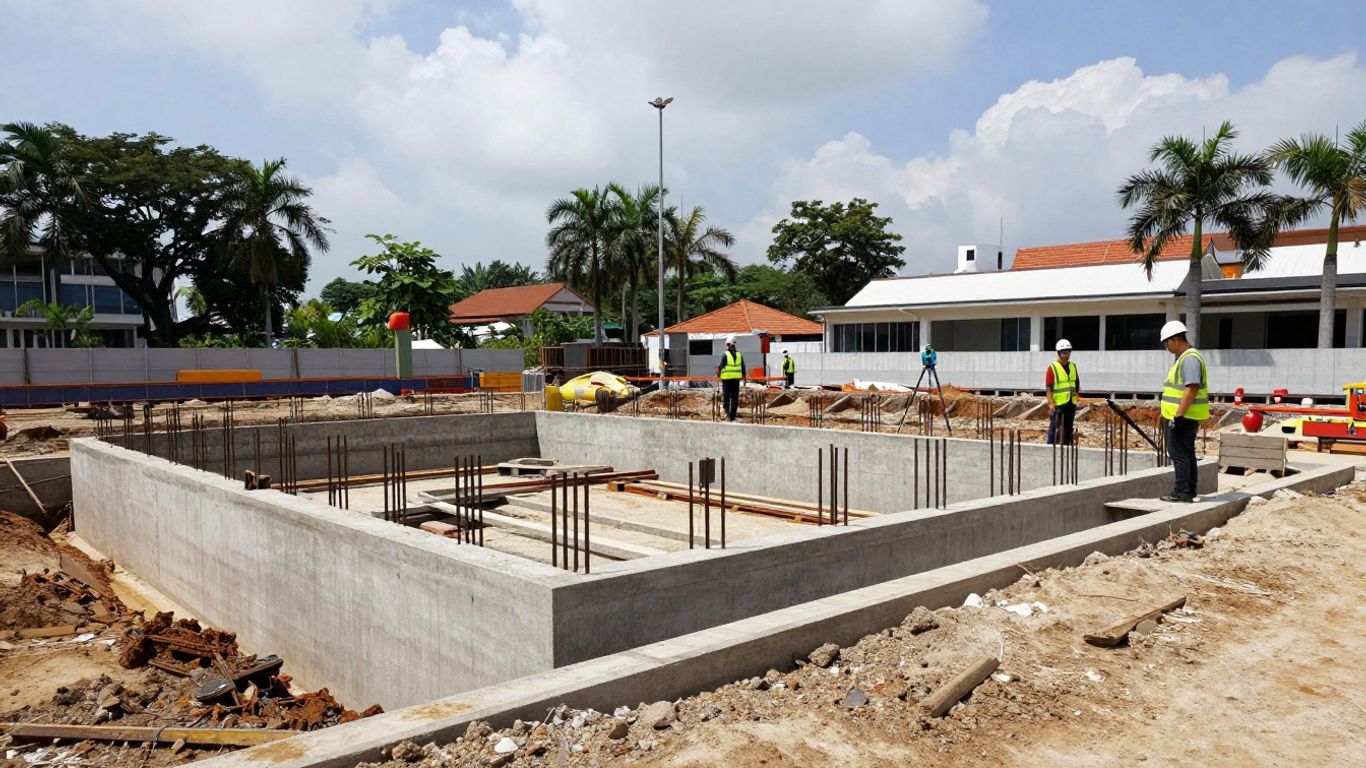
Key Takeaways
ERSS projects depend on clearly separated professional duties and disciplined coordination. The distinctions matter most to Developers, Main Contractors, Foreign Engineering Firms entering Singapore.
- QP(ST) focuses on structural temporary works and their interfaces.
- QP(Geo) leads geotechnical assessment, analysis, and design decisions.
- AC(Geo) independently reviews geotechnical safety and design adequacy.
- Developers and contractors retain their own project and execution duties.
- Monitoring, records, and controlled responses are as important as design.
Singapore ERSS explained: Scope, purpose, and regulatory context
Earth Retaining Stabilising Systems support excavations where open ground cannot safely stand on its own. In Singapore, dense urban development means that excavation work often takes place close to buildings, roads, utilities, and groundwater-sensitive areas. Understanding the system is only half the task; the project team must also understand who is accountable for each decision.
A useful overview of the Singapore building sector provides wider context for firms assessing local work, but ERSS appointments require project-specific professional judgment. The following distinctions are practical working boundaries, not a substitute for reviewing the applicable Building Control requirements and approved documents.
What Earth Retaining Stabilising Systems protect against
ERSS are temporary works intended to provide lateral support to vertical or near-vertical excavated faces. Their design considers soil strength, groundwater, excavation depth, nearby structures, and the construction method. The aim is not simply to prevent a visible collapse; it is also to manage deformation, seepage, and the effects of ground movement on surrounding assets.
A retaining arrangement may include walls, struts, anchors, walers, capping beams, or related support components. Each element works within a wider soil–structure system, so a change to one component can affect stability elsewhere.
When ERSS design and supervision requirements apply
ERSS requirements become especially significant for deep excavations, basement construction, underground infrastructure, and works near sensitive neighbouring assets. The precise submission, checking, and supervision obligations depend on the project, its geometry, site conditions, and regulatory classification. They should be established before tendering rather than discovered after excavation begins.
For a project team, the practical question is whether the proposed works could affect ground stability or adjacent property. If so, the professional appointments, investigations, design verification, monitoring, and construction controls should be planned as one package.
How Singapore’s Building Control framework allocates accountability
Singapore’s Building Control framework uses Qualified Persons and other appointed professionals to place technical design and checking responsibilities with appropriately qualified individuals. The appointment does not make every person responsible for every part of the project. Instead, responsibility follows the defined scope, the documents prepared, the professional judgment exercised, and the work actually carried out.
That distinction should appear clearly in appointment letters, design submissions, method statements, and site records. A contractor cannot treat a design endorsement as permission to ignore an unsafe method, while an engineer cannot assume that professional appointment replaces site management.
Why excavation depth, ground conditions, and neighbouring assets affect the professional team
Excavation depth is only one indicator of risk. Variable soil, a high or changing groundwater level, limited working space, old foundations, buried services, and sensitive structures can all increase the need for investigation and specialist review. The team should therefore assess the physical context before deciding that a standard detail is appropriate.
The closer an excavation is to a consequential asset, the more important it becomes to define movement criteria, monitoring points, trigger levels, and response actions. These controls connect design assumptions to what happens on site.
QP(ST): The structural temporary works specialist
The QP(ST) is concerned with the structural adequacy of the temporary support arrangement and its connection to the construction process. That work sits beside, but is not identical to, geotechnical design. Clear communication between structural and geotechnical professionals prevents gaps where each assumes that the other has checked a critical interface.
Temporary works also interact with permanent structures, access routes, lifting operations, and the sequence of excavation. A good appointment therefore describes both the technical scope and the points requiring coordination.
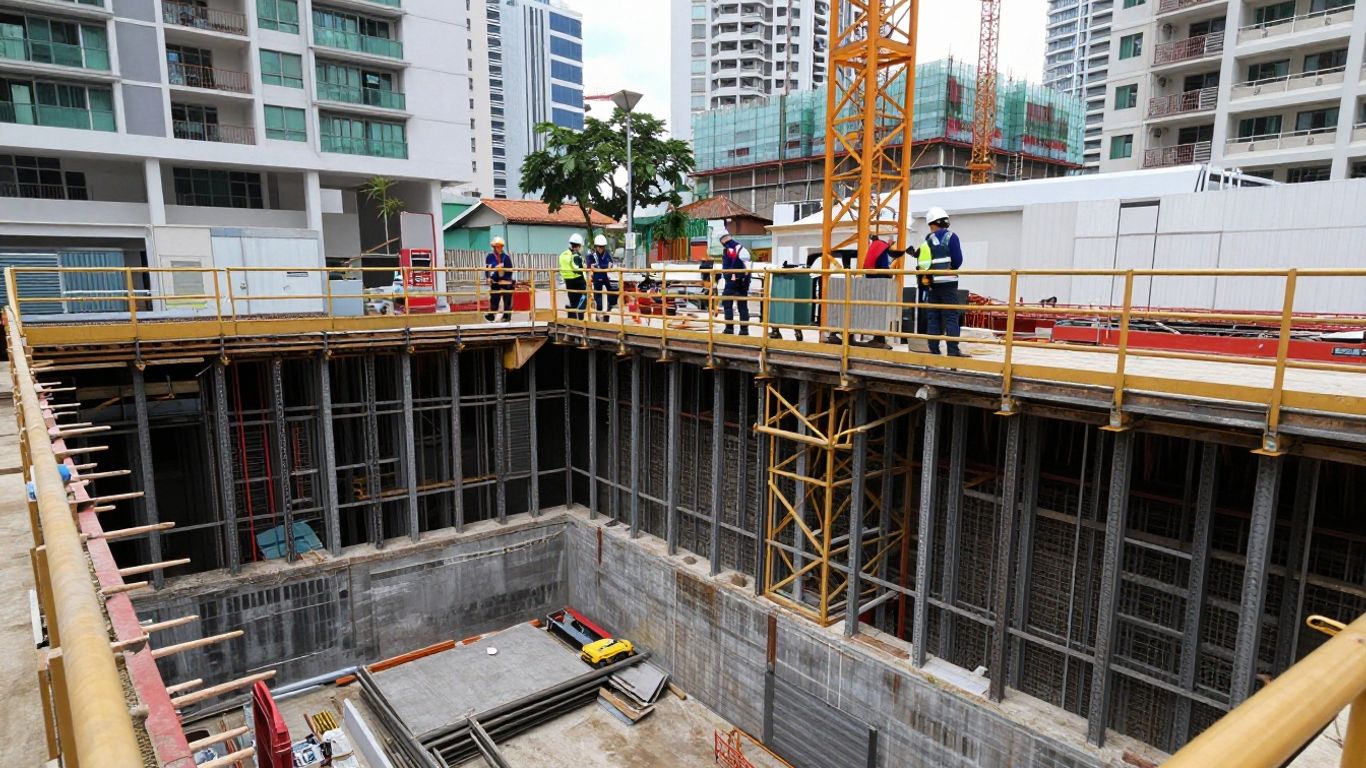
Scope of responsibility for structural design and temporary support systems
The QP(ST) typically addresses the structural components of the temporary system, including the strength, stiffness, connections, and temporary load paths of support members. This may involve steel struts, walers, capping beams, brackets, or other structural elements used to restrain a retaining system.
The scope must be read with the appointment and submission documents. Where a component depends on soil behaviour, anchorage, or foundation interaction, the structural check should be coordinated with the geotechnical design rather than treated in isolation.
Key deliverables, calculations, drawings, and design assumptions
A workable package normally records the design basis, loading, material properties, connection details, construction stages, and assumptions about support conditions. Drawings should show dimensions, levels, member arrangements, temporary restraints, access limitations, and interfaces with adjacent work.
The documents become more useful when assumptions are visible. They allow the contractor and checking professionals to identify whether actual site conditions remain within the design envelope, rather than relying on a drawing that appears complete but hides important dependencies.
Coordination with the permanent works, construction sequence, and site constraints
Temporary supports can impose forces on partially completed permanent works, and permanent elements may later become part of the restraint sequence. The QP(ST) must therefore coordinate cast-in items, embedments, brackets, openings, and removal stages with the permanent works designer and site team.
The sequence should reflect real access, plant, delivery, lifting, and installation constraints. If a strut cannot be installed as shown, or if a permanent slab is not ready when assumed, the design and method must be reviewed before the work proceeds.
Limits of the QP(ST)’s role in geotechnical design and ground assessment
Structural competence does not by itself establish soil parameters, groundwater behaviour, overall stability, or ground movement predictions. Those matters require geotechnical assessment and should be assigned to the QP(Geo), with appropriate coordination at the interface.
This boundary is not a formality. Treating a structural temporary works design as a complete ERSS design can leave major failure modes unexamined and can make later changes difficult to control.
QP(Geo): The geotechnical design authority
The QP(Geo) interprets the ground and translates that interpretation into geotechnical design criteria. The work can include investigation, soil and groundwater assessment, stability checks, deformation assessment, seepage considerations, and construction-stage verification. It is inherently site-specific.
Geotechnical conclusions should remain connected to the quality and coverage of the available information. Where uncertainty is material, the design should identify it and provide a way to confirm or manage it during construction.
Ground investigation, soil parameters, groundwater, and site-specific risks
The QP(Geo) reviews available boreholes, field tests, laboratory results, groundwater observations, previous records, and relevant foundation information. The resulting ground model should explain variability rather than reduce a complex site to one convenient soil value.
Foundation types, depths, and conditions may also require review through as-built drawings and selective excavation where necessary. Utility mapping and assessment can involve detection equipment, agency coordination, condition assessment, and risk categorisation when buried services could be affected.
Design of excavation support, stability, seepage control, and ground movement measures
The QP(Geo) develops the geotechnical basis for the retaining and stabilising system, including checks for overall stability, structural interaction, hydraulic conditions, and acceptable deformation. The design may consider walls, anchors, struts, dewatering controls, staged excavation, and measures to limit movement.
The selected arrangement must be buildable. A theoretically adequate system may still be unsuitable if installation damages nearby assets, requires unavailable access, or depends on groundwater conditions that cannot be maintained.
Geotechnical analysis, monitoring requirements, and design verification
Analysis should reflect the proposed excavation stages and the assumptions that matter to ground response. Monitoring requirements then provide a way to compare observed behaviour with the design expectation and to identify when escalation is needed.
A useful verification plan states what will be measured, where, how often, by whom, and what action follows a trigger. Monitoring is most effective when it is treated as part of the design rather than as an isolated instrumentation purchase.
Coordination with the QP(ST), contractor, instrumentation team, and authorities
The QP(Geo) must communicate design assumptions and geotechnical hold points to the QP(ST), contractor, instrumentation team, and relevant authorities. The contractor’s proposed method can expose practical issues that require a design clarification or a revised sequence.
For complex analysis, a firm such as Aman Engineering Consultancy may be considered where its documented consultancy scope and professional appointments match the project need. Any appointment should still define the specific ERSS responsibility and local submission role in writing.
AC(Geo): Independent checking of geotechnical safety
The Accredited Checker (Geotechnical) provides an independent technical review of the geotechnical aspects assigned to the checking appointment. The checker is not simply another designer and is not a replacement for the QP(Geo), contractor, or site supervisor. The value of the role lies in a separate professional assessment of whether the design basis and conclusions are adequately supported.
Independence works best when the checker is engaged early enough to review meaningful design information, while the design team still has time to respond to material comments.
What an Accredited Checker (Geotechnical) reviews
The AC(Geo) reviews the relevant design assumptions, ground model, parameters, analysis, stability considerations, movement criteria, drawings, and construction staging. The review should be sufficiently detailed to test the reasoning, not merely confirm that a calculation file exists.
The scope may also include interfaces with groundwater control, adjacent structures, monitoring, and temporary support. The precise extent remains governed by the appointment and applicable requirements.
Independence, professional judgment, and the limits of an checking appointment
An AC(Geo) must exercise independent professional judgment and should not be directed to accept a conclusion simply because it is convenient for the programme. At the same time, an checking appointment does not transfer the QP(Geo)’s design responsibility or make the checker responsible for construction execution.
The wording “an checking appointment” is commonly seen in informal discussions, but the underlying principle is straightforward: the checker reviews, records, and communicates professional observations within the appointed scope.
Review of design assumptions, analysis methods, drawings, and construction staging
A meaningful check traces the relationship between the ground model, analysis method, design values, drawings, and proposed sequence. If the calculation assumes a support stage that the drawings do not show, or if the drawings rely on a condition not established by investigation, the inconsistency should be raised.
The review should also consider whether changes in groundwater, excavation level, or support installation could invalidate the original assessment. Design verification is strongest when it follows the construction logic from one stage to the next.
How AC(Geo) comments, unresolved issues, and acceptance affect project progress
AC(Geo) comments should be logged, answered by the responsible professional, and closed with a clear record of the agreed resolution. Unresolved technical issues can affect submissions, hold points, and the authority to proceed with the next excavation stage.
Programme pressure does not remove the need for resolution. A concise comment register with owners, response dates, and status gives the developer and contractor a practical view of what remains open.
How QP(ST), QP(Geo), and AC(Geo) work together
These three roles are complementary. The QP(ST) addresses structural temporary works, the QP(Geo) addresses geotechnical design, and the AC(Geo) independently checks geotechnical safety within the appointment. Their collaboration should be visible in coordinated drawings, design submissions, technical queries, and site instructions.
The best arrangements establish interfaces before the first excavation stage. They also define who can approve a change and how urgent site observations are escalated.
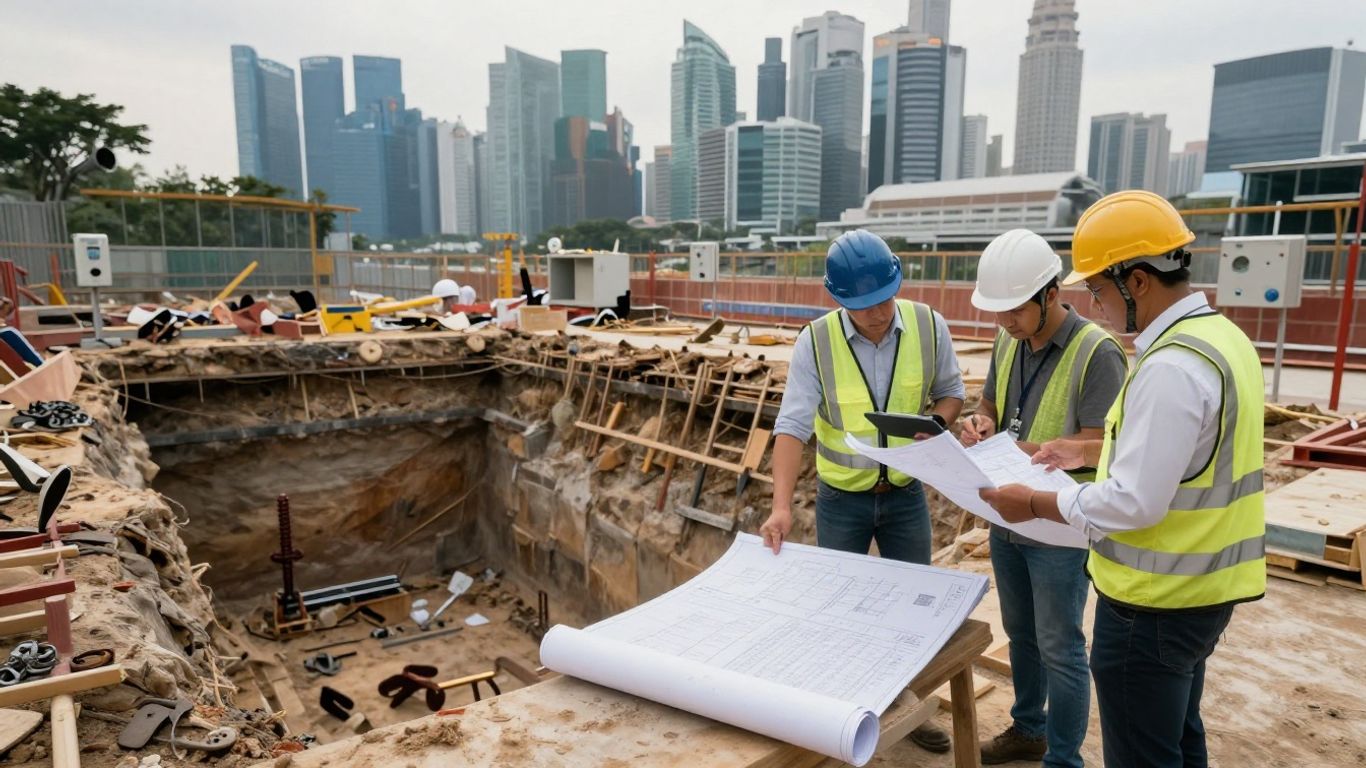
Responsibility boundaries across structural and geotechnical design
A responsibility matrix should identify the lead professional for each design question and the person responsible for checking or accepting the resulting document. The QP(ST) should not silently absorb geotechnical decisions, and the QP(Geo) should not leave structural adequacy implied.
The AC(Geo) provides an independent check, not a third design team that automatically owns unresolved decisions. Clear boundaries reduce duplicated work while making omissions easier to detect.
Design interfaces involving struts, anchors, capping beams, walers, and retaining walls
Interfaces are often where risk concentrates. A retaining wall may rely on geotechnical embedment and stability, while its waler or strut connection depends on structural detailing; an anchor may require both ground capacity assessment and structural connection design.
The team should coordinate levels, tolerances, loads, installation sequence, access, and removal requirements. These details should be checked against the actual temporary and permanent works drawings, not just discussed in meetings.
Managing changes to soil conditions, excavation sequence, and temporary works
A change in soil, groundwater, obstruction, support location, or excavation sequence should trigger a documented technical review. The reviewer may determine that the existing design remains valid, requires a local revision, or needs a broader reassessment.
The contractor should not treat a field adjustment as a minor matter simply because it appears practical. The change can alter load paths, deformation, stability, or monitoring assumptions.
Communication protocols for design submissions, clarifications, and site instructions
Use controlled channels for submissions, responses, revisions, and instructions. Each document should identify its status, revision, author, reviewer, affected stage, and relationship to earlier information.
A short clarification can be valuable when it is specific and traceable. Verbal direction should be confirmed in writing, especially where it changes sequence, support, monitoring, or acceptance criteria.
Why professional appointments do not transfer the developer’s or contractor’s duties
The developer remains responsible for arranging suitable appointments, providing relevant project information, and maintaining proper governance. The contractor remains responsible for method statements, resources, competent supervision, and safe execution within the approved design.
Professional review does not make an unsafe construction method safe by default. Everyone must act within the limits of their role and respond when actual conditions differ from the design basis.
ERSS responsibilities across the project lifecycle
ERSS risk management begins before the design package is issued and continues through excavation, support installation, monitoring, and completion. Different parties hold different duties at each stage, but the handover between them must be deliberate. A project can have competent individuals and still fail if information does not move reliably between design and site.
The lifecycle should therefore be planned around decisions and hold points, not only around submission dates.
Developer and owner responsibilities before professional appointments
The developer or owner should provide accurate site, property, title, survey, utility, and project information as far as available. It should appoint professionals whose experience and registration match the work, establish a realistic programme, and allow time for investigation, checking, approvals, and responses.
Early decisions about adjacent assets, access, land rights, and monitoring responsibilities can materially affect the ERSS option. These are governance matters, not details to leave solely to the contractor.
Main contractor responsibilities for method statements, resources, and safe execution
The main contractor converts the approved design into a practical method statement and execution plan. It must provide competent personnel, suitable plant, materials, temporary facilities, inspection arrangements, and coordination with subcontractors.
The contractor should confirm that the planned sequence matches the design. If it does not, work should pause at the relevant point while the change is reviewed and authorised.
QP responsibilities during design, submission, construction, and design changes
The QP responsibilities extend beyond producing drawings. They include responding to technical queries within scope, attending to relevant site observations, reviewing proposed changes, and maintaining appropriate records of design decisions and revisions.
The level and form of construction involvement depend on the appointment and project requirements. In every case, a design change should be assessed by the professional responsible for the affected technical issue.
Site supervision, instrumentation, trigger levels, and emergency response
Site supervision should connect observations with predetermined actions. Instruments, survey points, visual inspections, and records of excavation stages can reveal trends before a serious event occurs.
A response plan should identify who receives an alert, who can stop work, who assesses the condition, and how neighbouring stakeholders and authorities are contacted where necessary. The plan must be understood by the site team before an emergency arises.
Records required for inspections, approvals, deviations, and completion
The record set should include approved drawings, calculations, submissions, checker comments, method statements, inspection reports, monitoring data, site instructions, nonconformance records, and approved deviations. It should also preserve the revision history so that the team can reconstruct which information governed each stage.
These records support completion and future maintenance, but they also provide immediate evidence when a dispute or unexpected movement requires a rapid technical review.
Practical appointment and compliance guide for project stakeholders
Appointment decisions should be made by matching the project’s technical risk to the professional’s actual scope and local authority responsibilities. This is particularly important for international teams, where overseas experience may be strong but Singapore submission and registration requirements still apply.
A broader cross-border due diligence approach is useful for foreign firms entering regional markets, while ERSS appointments need an additional technical review of local roles, authority processes, and site obligations.
What developers should verify before appointing Singapore-based professionals
Developers should verify the proposed professional’s registration, relevant ERSS experience, availability through the required stages, checking arrangements, insurance, and conflicts of interest. They should ask for a scope that distinguishes structural temporary works, geotechnical design, checking, submission, and site involvement.
A clear appointment is usually more valuable than a broad but ambiguous description. It gives the project team a reliable basis for tender documents and accountability.
What main contractors should confirm before tendering and mobilization
Before pricing, the contractor should understand the design status, outstanding approvals, ground investigation coverage, assumed sequence, monitoring scope, temporary works interfaces, and responsibility for design development. Mobilization should not proceed on the assumption that unresolved technical matters will be settled informally on site.
The tender should also identify exclusions and provisional items that could affect the ERSS method. This reduces later pressure to substitute materials or alter supports without adequate review.
How foreign engineering firms can participate through local professional support
Foreign engineering firms can contribute specialist knowledge while arranging appropriate Singapore-based professional support for local design, endorsement, submission, and coordination requirements. The arrangement should state who is exercising professional judgment and who is accountable for each document.
A globally minded consultancy such as Aman Engineering Consultancy describes work involving Singapore and international standards including ACI, BS, SS, and Eurocode. That positioning may suit cross-border teams, but the project-specific appointment must still identify the applicable Singapore role and deliverables.
Checking registration, accreditation, experience, insurance, and conflicts of interest
Verification should be documentary and current. Ask for registration details, relevant accreditation where required, comparable project experience, professional indemnity arrangements, availability, and disclosure of conflicts.
Experience should be tested against the actual conditions: deep excavation, groundwater, neighbouring structures, utilities, movement control, and the intended support system. A generic list of past projects is less useful than evidence of closely related decisions.
Building a responsibility matrix and approval tracker for the ERSS package
A responsibility matrix turns the appointment structure into a working management tool. It should show who prepares, reviews, submits, approves, implements, monitors, and closes each item.
A compact tracker can be organised as follows:
| ERSS item | Primary owner | Independent or coordinating role | Evidence of closure |
|---|---|---|---|
| Ground model and parameters | QP(Geo) | AC(Geo) review | Approved report and comments |
| Structural support details | QP(ST) | QP(Geo) interface review | Calculations and drawings |
| Excavation method statement | Main contractor | QP review within scope | Approved method and briefing record |
| Monitoring and trigger plan | QP(Geo) and instrumentation team | Contractor implementation | Baseline and monitoring records |
The tracker should be updated as the design develops and should identify the approval needed before each hold point. Used properly, it makes responsibility visible without pretending that technical judgment can be reduced to administration.
Common ERSS failure points and risk controls
ERSS problems often arise from ordinary project pressures: incomplete information, compressed programmes, unclear interfaces, or a field change that is not escalated. The technical design may be sound on paper while the implementation drifts away from its assumptions. Risk controls must therefore address both engineering and management.
The following failure points are especially relevant to developers, contractors, and incoming international firms.
Confusing design responsibility with construction responsibility
The professional team designs or checks within its appointment, while the contractor plans and executes the work safely. Confusing those duties can produce gaps in temporary works planning, supervision, plant selection, or inspection.
The control is a written responsibility matrix supported by briefings and document control. Everyone should know which decisions require professional input and which remain part of the contractor’s means and methods.
Proceeding with excavation before approvals, temporary works, or monitoring are ready
Starting excavation before the relevant design, checking, approvals, support installation, and monitoring arrangements are ready removes the project’s ability to respond safely to uncertainty. It can also create pressure to accept incomplete information after the work has begun.
Use formal hold points before excavation stages. Release should depend on evidence, not on a verbal assurance that documents are nearly complete.
Failing to control design changes and as-built deviations
A support installed at a different level, a strut omitted for access, or an anchor altered in the field can change the system response. As-built deviations should be surveyed, recorded, and referred to the responsible professional for assessment.
Revision control, technical queries, and inspection sign-offs provide a simple chain of evidence. They also prevent superseded drawings from returning to the workface.
Ignoring adjacent buildings, roads, utilities, and groundwater impacts
An excavation can affect assets beyond the site boundary through settlement, vibration, loss of ground, seepage, or drawdown. Utility mapping and assessment may require detection, agency coordination, condition checks, and consequence-based risk categorisation.
The control is to include neighbouring assets in the ground model, movement assessment, monitoring plan, and emergency response. Site boundaries should not become risk boundaries.
Escalating movement or distress observations through a documented response plan
Movement, cracking, unexpected seepage, distress in supports, or instrument trends should be reported promptly and assessed against trigger levels. The response must be proportionate but decisive; waiting for certainty can allow a manageable condition to worsen.
A documented plan should name the notification chain, work-stoppage authority, inspection process, temporary measures, professional review, and restart criteria. Regular rehearsals and clear records make the plan usable under pressure.
Conclusion
QP(ST), QP(Geo), and AC(Geo) perform different but connected functions in Singapore ERSS work. Projects are safer and easier to govern when those boundaries are defined early, supported by suitable local professional appointments, and carried through design, construction, monitoring, and completion records. For international firms and local stakeholders alike, disciplined coordination is the practical bridge between technical design and responsible execution.
Frequently Asked Questions
What does ERSS mean in Singapore construction?
ERSS means Earth Retaining Stabilising Systems. These temporary systems support excavations and help control collapse, groundwater effects, and ground movement near surrounding assets.
What is the main difference between QP(ST) and QP(Geo)?
QP(ST) focuses on structural temporary works and their structural interfaces, while QP(Geo) leads the assessment and design of ground behaviour, stability, groundwater, and geotechnical movement.
What does an AC(Geo) do?
An AC(Geo) independently reviews the relevant geotechnical design basis, analysis, drawings, staging, and safety conclusions within the checking appointment.
Does appointing a QP remove the contractor’s responsibility?
No. The contractor remains responsible for method statements, resources, competent supervision, and safe execution. Professional appointments do not automatically transfer construction duties.
When should ERSS professionals be appointed?
They should be appointed early enough to review site information, establish the design approach, coordinate interfaces, plan checking, and support the required submissions before excavation begins.
Why is monitoring part of ERSS risk management?
Monitoring compares actual ground and structural behaviour with design expectations. Trigger levels and response procedures allow the team to investigate and act before movement or distress becomes more serious.
What should foreign engineering firms check before entering Singapore work?
They should confirm the required local professional roles, registration and accreditation requirements, submission responsibilities, insurance, conflicts, technical scope, and the division of accountability with local consultants and contractors.