
Introduction
Office buildings in Singapore classified as non-residential must undergo a Periodic Structural Inspection (PSI) every 5 years, starting from the building’s 13th year after obtaining its Temporary Occupation Permit (TOP) or Certificate of Statutory Completion (CSC). This mandatory regime is enforced by the Building and Construction Authority (BCA) under Singapore’s Building Control Act, which was passed in 1989 and continues to govern how existing structures are structurally inspected throughout their lifespan.
This article focuses specifically on commercial office buildings-Grade A CBD towers, suburban offices, business park campuses, and strata-titled office developments. It does not cover detached houses (which are exempt from periodic structural inspections), HDB blocks, or industrial buildings in detail. If you manage or own an office asset in Singapore, this guide will walk you through the exact PSI cycle, what triggers it, and how to stay compliant without disrupting tenant operations.
PSI frequency matters for reasons that go beyond ticking a regulatory box. Non-compliance with the Building Control Act can result in fines up to S$20,000 and even criminal liability. Beyond penalties, a well-timed periodic inspection protects public safety, preserves long-term structural integrity, avoids insurance complications, and maintains the value of your commercial assets.
By the end of this article, you will:
-
Know the exact PSI intervals and age threshold for office buildings in Singapore
-
Understand how BCA calculates your building’s PSI due date and issues its BCA PSI notice
-
Be able to work out your next PSI cycle date step by step
-
Recognise common challenges office buildings face during inspections and how to solve them
-
Know how AMAN Engineering Consultancy can support your PSI compliance from planning through submission
Understanding Periodic Structural Inspection (PSI) in Singapore
A periodic structural inspection is essentially a structural “health check” mandated by BCA at fixed intervals. It is not a one-off survey or an ad-hoc building audit-it is a recurring, statutory requirement that applies to virtually all building types (except certain exempt categories like detached, semi-detached, and linked houses used solely for residential purposes, as well as temporary buildings).
The legal basis for BCA periodic structural inspection sits in Section 28 of the Building Control Act. This section mandates periodic inspections for older buildings, requiring building owners to appoint a registered Professional Engineer to evaluate whether their structure remains safe for continued occupancy. The Building Control Regulations provide further detail on submission timelines, report preparation standards, and enforcement procedures.
Singapore’s PSI regime grew out of a broader commitment to building safety following high-profile structural failures-most notably the 1986 Hotel New World collapse. That disaster catalysed a culture of preventive, evidence-based periodic building inspections. The Periodic Structural Inspection aims to ensure buildings remain structurally safe for occupants, catching early detection of problems like spalling concrete, reinforcement corrosion, and unauthorised structural modifications before they escalate into safety risks.
What Exactly Does PSI Cover for an Office Building?
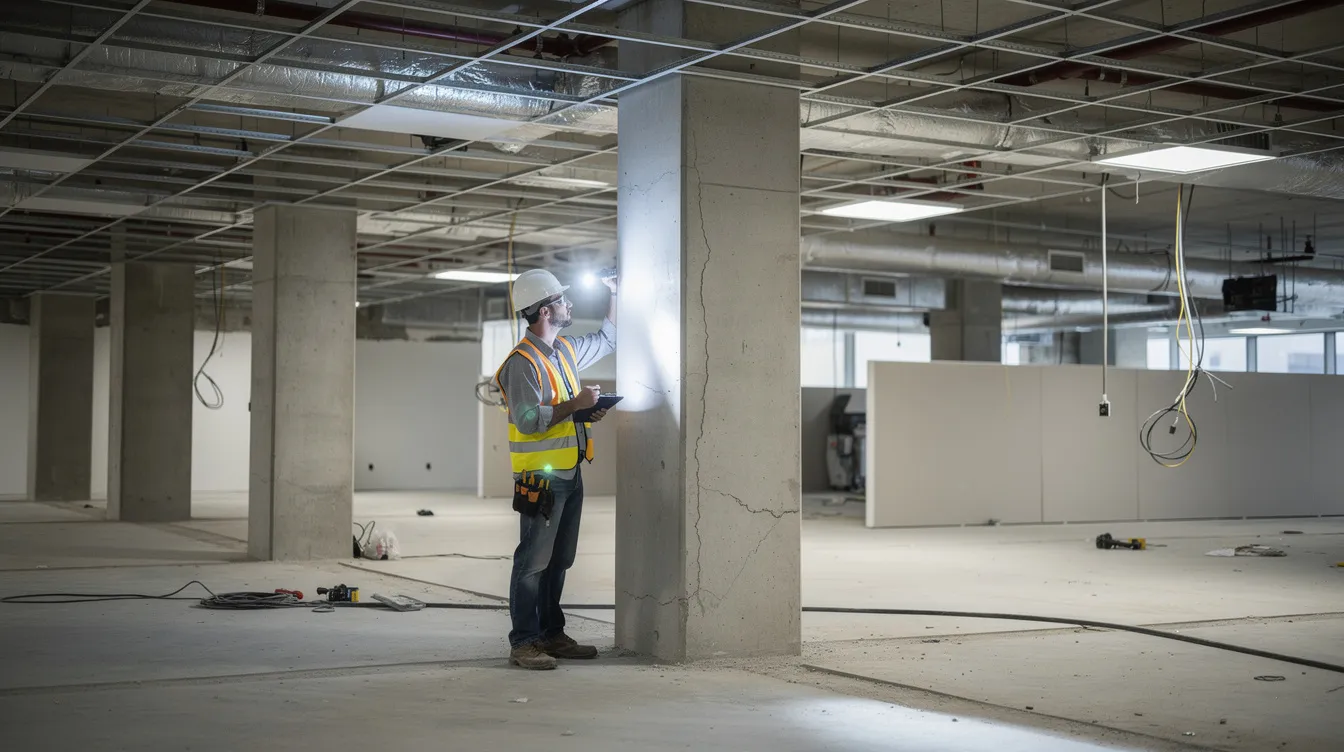
PSI focuses on the load-bearing skeleton of the building: columns, beams, slabs, transfer girders, core walls, roof structures, load-bearing walls, and critical connections. Stage 1 involves a visual inspection of accessible structural elements-the structural engineer walks the building, examines visible structural elements, reviews as-built structural drawings, and documents any signs of distress. Stage 2 requires non-destructive testing if defects are found during the initial assessment, and may include concrete core sampling, reinforcement cover surveys, and other non-destructive testing methodologies.
What PSI does not typically cover in depth includes M&E systems, lifts, fire protection performance, or facade condition-each of these has separate mandatory inspection regimes. However, for office buildings, the PSI process often involves checking concealed areas above suspended ceilings and behind decorative cladding, because modern office fit-outs routinely hide structural elements from plain view.
How PSI Is Different from Other Mandatory Inspections (e.g. PFI, Fire Safety)
PSI examines structural integrity; Periodic Facade Inspection (PFI) examines external facade safety. Periodic facade inspections are mandatory every 7 years for buildings over 13 metres tall, on a completely separate cycle from PSI. PSI focuses on structural integrity while PFI examines external facade safety-different scopes, different timelines, different specialist competencies.
Fire safety certifications are administered by SCDF, and lift inspections fall under MOM regulations. Each runs on its own cycle and none replaces the need for a building to undergo PSI under BCA’s mandatory regime.
That said, many office building owners coordinate PSI and PFI scheduling where cycles overlap. Sharing access equipment (rope-access rigs, scaffolding, boom lifts) and consolidating tenant disruption windows can yield meaningful cost and time savings-especially for tall CBD towers. Understanding what PSI is and what it covers sets the stage to answer the central question: how often does an office building actually need it?
How Often Is PSI Required for Office Buildings in Singapore?
Office buildings in Singapore are classified as non-residential buildings under BCA’s PSI regime. Periodic Structural Inspections occur every 5 years for non-residential buildings, and the first PSI cycle begins once the building reaches its 13th year of existence. This applies across all office sub-types: CBD office towers, business park offices, strata-titled office floors, and mixed-use developments where commercial use exceeds the residential threshold.
Official PSI Interval for Non-Residential / Office Buildings
The rule is clear: non-residential buildings, including offices, must undergo PSI once every 5 years after the building’s 13th year. PSI notices are issued starting from a building’s 13th year, and the cycle continues for the life of the building-regardless of any change of ownership, tenancy, or management.
For comparison, residential buildings require PSI every 10 years. Office buildings face the more frequent 5-year cycle because of their higher occupant density, more complex structural configurations, and greater exposure to fit-out alterations.
Here is a concrete example: an office building that obtained its TOP on 15 June 2010 reaches its 13th year on 15 June 2023. That is when the first PSI would be due. Subsequent cycles then fall every five years-mid-2028, mid-2033, mid-2038, and so on, indefinitely.
How BCA Determines When Your Office PSI Is Due
The Building and Construction Authority issues a formal notice before the inspection-typically about 12 months ahead of the statutory deadline. BCA tracks building age using TOP and CSC records in its databases, so the process is largely automated. When a BCA notice arrives, it does not mean BCA has identified a known structural defect; it is simply an age-based, cyclical trigger under the mandatory regime.
That said, building owners should not wait for the BCA PSI notice to begin planning. Best practice is to anticipate the notice 12–18 months before the 13th year (or the next 5-year cycle) and begin PE engagement early. BCA may also adjust timelines for certain higher-risk structures under the Differentiated PSI Approach introduced on 1 February 2023, but standard office buildings follow the 5-year pattern.
Special Office Configurations: Mixed-Use, Business Parks, and Campus Offices
Mixed-use towers-common in Singapore, where retail, office, and residential components share a single structure-are usually treated as non-residential for PSI purposes if more than approximately 10% of the gross floor area is non-residential. In practice, a tower with ground-floor retail, mid-level offices, and upper residential floors would typically follow the more stringent 5-year PSI cycle.
Business park offices and tech campus buildings are classified as non-residential and follow the same 5-year interval. There is no separate PSI category for these building types.
For strata-titled developments, the management corporation (MCST) is legally responsible for common structural elements. Individual strata unit owners are still affected by PSI timing-they must provide access to their units and cooperate with the structural engineer-but the MCST bears the compliance burden. Strata-titled developments have specific PSI responsibilities that require careful coordination among multiple stakeholders.
Example: A mixed-use development in the CBD with 3 floors of retail, 15 floors of office, and 10 floors of serviced apartments that obtained TOP in 2012 would have its first PSI due in 2025 (13th year), then 2030, 2035, etc., on the non-residential 5-year cycle.
From Law to Calendar: Applying PSI Frequency to Your Specific Office Asset
Knowing the regulation is one thing; translating it into a concrete inspection timetable for your specific office building is another. This section provides a practical walkthrough so you can map your PSI cycle onto your asset management calendar.
Step-by-Step: Work Out Your Office’s Next PSI Due Date
Follow these steps to determine when your office building must next be structurally inspected:
-
Locate your TOP or CSC date. Check your building’s Temporary Occupation Permit or Certificate of Statutory Completion. If you do not have a copy, BCA or your original developer should be able to confirm the date.
-
Calculate the 13th anniversary. This is when your first PSI cycle starts. If your building TOP-ed on 1 March 2015, the 13th year falls on 1 March 2028.
-
Add 5-year increments for future cycles. For the 2015 example: first PSI in 2028, then 2033, 2038, 2043, and so on (the 13th, 18th, 23rd, 28th years, etc.).
-
Build in buffer time. Building owners must appoint a structural engineer within 1–2 months of receiving notice, but best practice is to begin PE engagement at least 6–9 months before the official BCA due date to allow for scheduling, access coordination, and any Stage 2 investigations.
-
Record the schedule. Enter all future PSI dates into your asset management system, MCST calendar, or portfolio maintenance tracker.
Sample timeline for an office that TOP-ed in 2015:
-
2027: Begin PE procurement and tenant coordination
-
March 2028: First PSI due; Stage 1 visual inspection conducted
-
Mid-2028: The PSI report must be submitted to BCA within 3 to 6 months of the notice deadline
-
2033: Second PSI cycle
-
2038: Third PSI cycle
Differences Between Single-Owner and Strata-Titled Office Buildings
For single-owner office towers (e.g., a REIT-held Grade A building), the legal owner or holding company carries full responsibility for appointing the PE, funding the inspection, and ensuring the inspection report is submitted. Budgeting is straightforward corporate capex planning.
For strata-titled offices, the management corporation represents all owners for common property matters, including PSI. The PSI frequency remains the same 5-year cycle, but coordination is more complex: MCST management levies fund the inspection, multiple owners must grant access to their units, and early communication is essential. The MCST council should table PSI planning at AGMs at least one year before the due date.
Edge Cases: Temporary Offices, Fitted-Out Space and Change of Use
Temporary buildings-such as construction site offices permitted for limited durations-are generally exempt from standard PSI cycles under BCA rules, though they must still meet basic structural safety standards during their operational life.
Change of use (e.g., converting an office floor into a data centre or heavy-storage facility) does not change the PSI frequency, but it can significantly affect the depth of the inspection and the structural risk assessment. Added loads, vibration from equipment, or altered floor openings may prompt the licensed structural engineer to recommend additional assessments outside the normal 5-year cycle. Owners should consult a PE and BCA when planning any major change-of-use to understand whether additional structural assessments may be triggered.
Implementing PSI for an Office Building: Practical Process and Timeline
Once a building owner receives a BCA PSI notice-or ideally, well before-there is a defined sequence of activities that leads to a compliant submission. For office buildings, tenant operations, elaborate fit-outs, and complex M&E installations around structural elements add layers of logistical planning that do not exist for simpler building types.
The Typical PSI Process for an Office Building
The PSI process for office buildings follows the same regulatory steps as other non-residential buildings, but office fit-outs materially affect access and scheduling. Here is the typical sequence:
-
Review the BCA PSI notice and confirm the statutory due date. Verify the building’s PSI status and the exact deadline for report submission.
-
Appoint a registered Professional Engineer (Civil/Structural) with a current practising certificate and PSI experience in commercial buildings. A registered Professional Engineer conducts the PSI inspection-this is a statutory requirement, not optional. PE fees typically range from S$3,000 to S$5,000 for medium-sized buildings, while large commercial buildings often exceed S$8,000 for PSI. Stage 2 investigations can cost S$1,500 to S$20,000 depending on tests required.
-
Pre-inspection planning: Gather as-built drawings, previous PSI reports, records of any alterations or additions, and tenant layout plans. Confirm access constraints for all floors.
-
Stage 1 on-site visual inspection: The structural engineer inspects cores, beams, slabs, plant rooms, car parks, and typical office floors-including above ceilings where necessary. Concrete spalling is a common sign of structural distress identified during inspections, alongside cracking, corrosion, and deflection.
-
Determine if Stage 2 is needed. If Stage 1 reveals structural defects that may compromise structural integrity, Stage 2 detailed testing is triggered. This can include material sampling, rebar surveys, and load analysis.
-
Report preparation and submission. Prepare and submit the inspection report to BCA through CORENET / CORENET-X. Owners must submit the inspection report to BCA within 3–6 months. Respond to any BCA requests for information (RFIs).
Timelines for office towers need to factor in night or weekend access and permit-to-work rules typical of multi-tenant commercial buildings.
Comparing PSI Planning for CBD Grade A Offices vs Older Suburban Offices
While both building types share the same 5-year PSI frequency, the planning effort and commercial fees can differ significantly:
-
Access: CBD Grade A towers have higher security protocols, more complex M&E zones, and often require after-hours scheduling. Older suburban offices may have simpler access but potentially more visible structural elements with minor defects from age.
-
Coverage: Newer CBD offices tend to have extensive suspended ceilings and decorative cladding concealing structural members. Older buildings often have more exposed structure, reducing the need for invasive opening-up works.
-
Timing: CBD inspections are frequently scheduled during off-peak hours (evenings, weekends) to reduce tenant disruption. Suburban offices may allow daytime inspections with less resistance.
-
Building size and complexity: A 40-storey CBD tower with transfer structures and a large basement will demand far more inspection coverage than a 6-storey suburban office block-even though both operate on the same 5-year mandatory cycle.
Mis-planning these logistics is one of the most common reasons office building owners struggle to meet their deadlines. The next section addresses these challenges directly.

Common Office-Building PSI Challenges and How to Manage Them
Office environments introduce unique coordination and access challenges on top of the baseline statutory requirements for periodic inspection. Proactive maintenance planning and early engagement with your PE can prevent most of these from becoming compliance risks.
Coordinating PSI Around Tenant Operations
The biggest practical hurdle for office PSI is working around tenants. Inspections may require ladder access to ceiling voids, opening suspended ceiling tiles (creating noise and dust), or accessing secure server rooms and data centre areas. Tenants understandably push back on disruption during business hours.
Solutions:
-
Communicate the upcoming PSI to all tenants at least 2–3 months in advance, explaining the statutory basis and estimated duration per floor.
-
Schedule intrusive access work (ceiling opening, cladding removal) during evenings or weekends.
-
Use phased, floor-by-floor scheduling so that only one or two floors are affected at a time.
-
AMAN Engineering commonly works with managing agents to produce a PSI schedule aligned with tenant peak hours, minimising operational disruption.
Gaining Access to Concealed Structural Elements
Modern office buildings hide a large proportion of their structural elements behind false ceilings, feature walls, and in equipment rooms. BCA’s enhanced guidelines (September 2024) explicitly require adequate sampling of concealed areas-poor access planning can delay submission and risk non-compliance.
Solutions:
-
Pre-identify key sampling points on structural drawings before the on-site inspection begins.
-
Coordinate with M&E teams to safely isolate systems before opening ceiling panels or removing cladding.
-
Use access platforms or mobile scaffolding where high-level inspection is needed.
-
Ensure the building owner or MCST authorises the SE to open finishes as required-this is an owner obligation under BCA’s guidelines.
Meeting BCA Deadlines and Avoiding Non-Compliance
Failure to comply can result in fines up to S$20,000 and potential criminal liability under the Building Control Act. Common reasons for missing deadlines include appointing the PE too late, underestimating the time needed for a large building, or unexpected Stage 2 findings that extend the inspection schedule.
Actionable tips:
-
Appoint your PE 6–9 months before the due date-do not wait until the BCA notice arrives.
-
Lock in inspection windows with tenants and reserve lift lobbies and loading bays for access equipment well in advance.
-
The building owner is legally responsible for carrying out the recommended repairs after the inspection-structural defects and safety hazards identified require mandatory remedial works, so budget for potential remedial actions.
-
Building owners must implement recommended rectifications promptly to maintain PSI compliance and avoid legal liabilities.
Firms like AMAN can help compress timelines, but very large or complex office buildings still need several months of lead time. An early start is always the safest strategy.
Conclusion and Next Steps for Office Building Owners
Office buildings in Singapore, classified as non-residential, require PSI every 5 years starting from year 13. PSI is mandatory for buildings from their 13th year, and this cycle continues for the entire life of the structure. Timely, well-planned inspections are essential-not just for avoiding fines and criminal liability, but as a practical tool to manage long-term structural health, protect occupants, and preserve asset value.
PSI is not a paper exercise. It is the primary mechanism for early detection of structural deterioration in ageing commercial buildings. Concrete spalling, reinforcement corrosion, and unauthorised structural modifications caught during a periodic inspection can prevent far more expensive-and dangerous-failures later.
Your next steps:
-
Confirm your office building’s TOP/CSC date and calculate the next PSI cycle.
-
Check whether you have received (or are likely to soon receive) a BCA PSI notice by reviewing your building age against the 13-year and 5-year milestones.
-
Compile existing drawings, past PSI reports, and tenant layout plans so your PE can hit the ground running.
-
Engage a registered PE experienced in office PSI early in the cycle-ideally 6–12 months before the due date.
-
Integrate PSI timelines into your asset or portfolio maintenance strategy, alongside periodic facade inspections and other statutory obligations.
Related topics worth exploring include Periodic Facade Inspection (PFI) requirements for tall offices, BIM-based record-keeping for complex structures, and value engineering options if recurring defects are found across PSI cycles.
How AMAN Engineering Consultancy Supports Office PSI in Singapore
AMAN Engineering Consultancy Pte Ltd is a Singapore-based engineering and architectural consultancy specialising in statutory inspections and authority submissions for commercial buildings across the island.
For office buildings specifically, AMAN provides:
-
PSI and PFI services for Grade A CBD towers, suburban offices, business park campuses, and strata-titled developments-covering the full spectrum of building types subject to BCA periodic structural inspection.
-
Authority submissions via CORENET-X and direct liaison with BCA, SCDF, URA, JTC, and other agencies, ensuring report preparation and submission meet current regulatory standards.
-
BIM and Tekla 3D structural modelling to understand complex office structures, coordinate with M&E systems, and document inspection findings with precision.
-
Value engineering and structural strengthening design when PSI reveals recurring issues or when remedial works must be designed for cost-effectiveness.
AMAN collaborates closely with developers, MCSTs, facilities teams, and managing agents to plan inspections that minimise disruption to tenant operations. Whether your immediate need is a fixed fee quote for an upcoming PSI cycle or long-term portfolio-level PSI planning, engaging early gives AMAN the runway to scope the work properly, coordinate access, and deliver a compliant report well ahead of the BCA deadline.
FAQ: PSI Frequency for Office Buildings in Singapore
Below are direct answers to the most common questions building owners and facility managers ask about PSI frequency for office properties.
How often must a typical office building in Singapore undergo PSI?
Office buildings in Singapore require a Periodic Structural Inspection every 5 years. The first PSI is due in the building’s 13th year after TOP or CSC, and the cycle continues at 5-year intervals for the life of the building. This applies regardless of ownership changes-every subsequent owner inherits the same PSI cycle.
Does the PSI frequency change if my office building is very tall or very old?
The standard 5-year cycle applies to all non-residential buildings, whether 5 storeys or 50. However, BCA’s Differentiated PSI Approach (introduced February 2023) means that older buildings and those with complex structural systems may face more detailed investigations during each cycle. The inspection depth increases for higher-risk structures, but the interval itself typically remains 5 years unless BCA issues a special directive.
What if my building is mixed-use with both offices and serviced apartments?
If more than approximately 10% of the gross floor area is non-residential (office, retail, commercial), the development generally follows the non-residential 5-year PSI interval rather than the 10-year residential cycle. If you are unsure of your building’s classification, confirm with BCA or a registered Professional Engineer.
Is PSI still required if I regularly do internal maintenance checks?
Yes. In-house facility audits and proactive maintenance programmes do not replace statutory PSI conducted and certified by a registered Professional Engineer with a current practising certificate. Good maintenance can reduce the severity of structural defects found during PSI-and may simplify Stage 1 inspection findings-but it does not waive the legal requirement to comply with the 5-year cycle. Owners must provide site access for the structural engineer’s assessment as required by the Building Control Act.
Can I combine PSI with Periodic Facade Inspection (PFI) for my office tower?
Many office owners do align PSI and PFI schedules, particularly for towers above 20 years old and taller than 13 metres. Since PFI is mandatory every 7 years and PSI every 5 years, the two cycles overlap periodically. Combining them where possible reduces access costs, shared scaffolding or rope-access mobilisation, and tenant disruption. AMAN Engineering can help plan combined PSI + PFI strategies that satisfy both sets of statutory requirements efficiently.