
The Paramount Importance of Comprehensive Structural Audits
Navigating the incredibly complex landscape of modern structural engineering requires a profoundly nuanced understanding of exactly how environmental degradation, continuous mechanical loading, and subtle chemical alterations progressively compromise the long-term integrity of aging reinforced concrete structures1.
Across the rapidly developing global landscape, structural engineers, regulatory authorities, and extensive property management consortiums are perpetually confronted with the monumental challenge of accurately diagnosing the underlying health of massive building inventories that are steadily approaching their critical designed lifespan milestones2.
This intensive diagnostic requirement necessitates the deployment of highly sophisticated structural audits that must carefully balance the pressing need for absolute empirical accuracy with the equally critical mandate to minimize localized physical damage to the very structural elements undergoing forensic evaluation4.
The fundamental methodological dichotomy at the absolute heart of these comprehensive structural investigations lies squarely in the strategic selection between non-destructive testing (NDT) methodologies, which offer immensely rapid, non-invasive volumetric insights, and the highly invasive destructive sampling techniques, prominently featuring diamond-tipped concrete core drilling, which provide laboratory-verified, definitive quantitative data regarding absolute compressive strength4.
Understanding precisely when a purely non-destructive assessment provides sufficient statistical confidence versus when the extraction of physical concrete cores becomes an absolute, legally mandated necessity constitutes the most critical decision-making process for any professional engineer undertaking a statutory building inspection4.
Historical Catalysts and the Evolution of Strict Regulatory Frameworks
The modern paradigms governing periodic structural inspections and the mandatory deployment of advanced diagnostic testing did not emerge within a vacuum; rather, they were forged through the incredibly tragic lessons learned from catastrophic historical infrastructure failures that profoundly shocked the engineering community and forced sweeping legislative overhauls1.
Within the specific context of Singapore, which currently boasts one of the most stringent and technologically advanced building control regimes in the world, the catastrophic progressive collapse of the Hotel New World in 1986 served as the primary historical genesis for the modern structural auditing framework1.
This devastating event, alongside subsequent highly destructive incidents such as the tragic Nicoll Highway excavation cave-in, actively forced the governmental authorities to fundamentally transition their primary operational philosophy from reactive disaster mitigation toward highly aggressive, proactive, and legally mandatory periodic structural inspections designed specifically to identify early-stage environmental damage long before catastrophic structural failure becomes mathematically imminent1.
Consequently, the regulatory authorities strictly mandated the independent checking of all temporary works designs, demanded the deployment of independent contractors for rigorous ground monitoring instrumentation, and permanently upgraded the mandatory factors of safety applied to deep excavations and aging building assessments1.
These profound legislative transformations successfully established the robust structural safety baseline utilized today, severely curbing historical corruption within the construction industry while forcing building owners to adopt exceptionally stringent and highly formalized long-term maintenance standards10.
The Intricate Physics and Chemistry of Concrete Degradation
To fully comprehend why structural auditors must frequently transition from non-destructive scanning to highly invasive core drilling, one must possess a deeply technical understanding of the complex, microscopic chemical mechanisms that actively drive the inevitable deterioration of reinforced concrete over extended atmospheric exposure horizons1.
Hardened concrete is fundamentally a highly porous, heterogeneous composite material that continuously interacts with its surrounding environment, systematically absorbing ambient moisture, reacting aggressively with atmospheric gases, and slowly shifting its internal chemical equilibrium in ways that directly and profoundly impact its macroscopic load-bearing capabilities1.
The Insidious Mechanics of Concrete Carbonation
Concrete carbonation represents the most pervasive, naturally occurring, and arguably the most dangerous environmental degradation mechanism continuously threatening the structural integrity of reinforced concrete buildings, particularly those structures unfortunately situated in highly demanding tropical environments characterized by consistently elevated ambient temperatures and perpetually fluctuating atmospheric humidity levels1.
When standard Portland cement mixtures undergo their initial hydration reactions during the primary construction phase, the resulting hardened concrete matrix is inherently highly alkaline, possessing a strongly protective pH value that typically ranges between 12.5 and 13.0 under optimal curing conditions1.
This immensely alkaline internal environment is absolutely crucial for long-term durability because it naturally facilitates the spontaneous formation of a microscopic, highly stable passivating oxide layer completely surrounding the embedded steel reinforcement, effectively immunizing the structural rebar against oxidative corrosion even when significant levels of environmental oxygen and internal moisture are simultaneously present1.
However, as the building ages over several decades, atmospheric carbon dioxide gas slowly but continuously diffuses through the complex, interconnected capillary pore network of the hardened concrete, reacting aggressively and irreversibly with the available calcium hydroxide produced during the original cement hydration process to form stable calcium carbonate and free liquid water1.
This continuous, progressive chemical reaction systematically and ruthlessly consumes the protective alkaline reserves stored within the cement paste, eventually dropping the localized internal pH level below the critical passivating threshold of 9.0, at which specific point the microscopic oxide layer surrounding the steel reinforcement completely breaks down and leaves the internal rebar entirely vulnerable to massively accelerated rusting and destructive volumetric expansion1.
Extensive scientific research conclusively demonstrates that the overall penetration rate of this destructive carbonation process depends heavily upon both the ambient temperature and the localized relative humidity, with the maximum rate of chemical degradation occurring precisely when the environmental relative humidity is maintained at roughly seventy percent1.
In fully saturated environmental conditions where the concrete is submerged or perpetually wet, liquid water completely blocks the necessary diffusion of carbon dioxide gas, while in excessively dry desert conditions, the underlying chemical reaction simply lacks the necessary moisture to proceed efficiently1.
Consequently, tropical climates, such as the environment found in Singapore, consistently provide the absolute optimal atmospheric conditions for maximizing the carbonation speed, generating phenomenally high carbonation coefficients that drastically exceed those routinely recorded in temperate European or North American zones1.
The depth of this carbonation front is generally modeled by structural engineers utilizing a standard mathematical diffusion equation, which explicitly states that the carbonation penetration depth equals the localized environmental coefficient multiplied by the square root of the total exposure time1.
| Climate Zone | Mean Daily Temperature | Estimated Carbonation Coefficient Range | Environmental Impact on Concrete Degradation Rate |
| Temperate (Europe/North America) | 8°C – 9°C | 1.0 – 3.0 | Slower degradation due to lower baseline temperatures and varied seasonal humidity. |
| Tropical (Singapore/Equatorial) | 27°C | 5.5 – 8.6 | Massively accelerated degradation maximizing the speed of atmospheric carbon dioxide diffusion. |
Evaluating Carbonation Depth Through Chemical Diagnostics
When structural engineers are tasked with evaluating the exact depth of this insidious carbonation front during a comprehensive building audit, they historically rely upon a highly sensitive chemical diagnostic procedure utilizing a simple phenolphthalein indicator reagent1.
A specialized one percent phenolphthalein solution is meticulously prepared under controlled laboratory conditions utilizing high-purity ethyl alcohol as the primary solvent vehicle1. During the invasive stage of the structural inspection, the investigating engineers spray this highly sensitive chemical solution directly onto the freshly fractured surfaces of physically extracted concrete core samples1.
Upon contact, the highly alkaline, entirely uncarbonated interior regions of the concrete matrix instantly react with the indicator to turn a remarkably bright pink or deep purple color, immediately signaling that the protective passivation environment remains fully intact1.
Conversely, the heavily carbonated exterior layers of the concrete, which possess a dangerously lowered pH level, remain completely colorless after the chemical application, providing the structural engineer with a highly visible, instantly measurable boundary indicating exactly how close the degradation front has advanced toward the highly vulnerable embedded steel reinforcement1.
Alkali-Silica Reactivity and Internal Chemical Attacks
Beyond the ubiquitous threat of atmospheric carbonation, highly trained structural auditors must also frequently investigate the potential presence of severely deleterious internal chemical reactions, most notably the highly destructive Alkali-Silica Reaction (ASR) and complex external chemical mechanisms such as aggressive sulfate attack11.
The Alkali-Silica Reaction occurs when the highly alkaline cement pore solution reacts continuously with specific amorphous or poorly crystallized reactive silica minerals unexpectedly present within the coarse or fine aggregates, subsequently forming an expansive, highly hygroscopic gel that relentlessly absorbs available moisture and generates massive internal tensile stresses capable of ripping the matrix apart11.
Because unreinforced concrete inherently possesses a relatively low tensile strength capacity, these accumulating internal pressures inevitably cause extensive microcracking, highly visible macroscopic map-pattern surface cracking, and the eventual catastrophic mechanical disintegration of the affected structural element11.
Similarly, aggressive sulfate attack involves the insidious penetration of external sulfate ions sourced from contaminated groundwater, adjacent agricultural soils, or highly caustic industrial effluent directly into the porous concrete matrix, where they react aggressively with the vulnerable aluminate phases of the hydrated cement paste to rapidly form secondary ettringite and complex thaumasite compounds11.
The continuous formation of these complex crystalline compounds involves a massively significant volumetric expansion, which severely disrupts the cohesive binding properties of the cement paste and inevitably leads to severe surface spalling, deep scaling, and eventual total structural failure if left unmitigated11.
Definitively identifying these specific, complex degradation mechanisms through purely non-destructive surface means is exceedingly difficult and often completely impossible, inevitably necessitating the physical extraction of intact core samples for highly detailed microscopic analysis under controlled laboratory conditions14.
The Comprehensive Modalities of Non-Destructive Testing (NDT)
The expansive field of non-destructive testing encompasses a diverse and highly technologically advanced array of diagnostic techniques that actively empower structural engineers to thoroughly assess the internal characteristics, verify material uniformity, and map hidden defects within concrete structural elements without causing any lasting physical damage to the valuable building fabric2.
These sophisticated screening methods are particularly invaluable during the critical initial phases of a comprehensive structural audit, where the primary objective is to rapidly survey massive surface areas, meticulously map the exact extent of visible anomalies, and precisely identify specific, highly localized regions of interest that will subsequently require significantly more invasive verification techniques3.
Rebound Hammer Assessments and Surface Hardness Limitations
The rebound hammer, widely recognized throughout the international engineering community as the Schmidt hammer, represents one of the most historically prevalent, highly accessible, and easily deployable non-destructive testing tools utilized during routine structural inspections and mandatory periodic audits6.
This specialized mechanical device evaluates the localized surface hardness of the hardened concrete by precisely discharging a carefully calibrated spring-loaded mass against the structural element and meticulously measuring the corresponding physical rebound distance, which is subsequently expressed as a standardized, dimensionless rebound number6.
While the rebound hammer undoubtedly provides an extremely rapid and highly economical method for verifying the general baseline uniformity of concrete across massive, continuous structural elements, its absolute mathematical reliability for accurately estimating the true internal compressive strength remains highly controversial and deeply contested within the professional structural engineering community6.
The absolute primary limitation of the mechanical rebound hammer lies in the undeniable physical fact that it only assesses the material properties of the extreme outer superficial layer of the concrete, typically penetrating no deeper than thirty millimeters into the exposed surface matrix18.
Consequently, the resulting diagnostic measurement is disproportionately and heavily influenced by superficial environmental factors that absolutely do not reflect the actual internal load-bearing strength of the structural core, such as advanced surface carbonation, extreme localized surface drying, uneven variations in aggregate distribution, and the specific geometric orientation of the testing instrument during operation8.
An older, heavily carbonated concrete surface, for instance, will consistently register an artificially elevated surface hardness and a correspondingly higher rebound number, which can unfortunately lead inexperienced or unprepared engineers to erroneously and dangerously overestimate the underlying structural capacity of the critical load-bearing element8.
Ultrasonic Pulse Velocity (UPV) and Volumetric Integrity
To overcome the superficial limitations of the rebound hammer, structural auditors frequently deploy Ultrason
ic Pulse Velocity testing, which provides a significantly more sophisticated and deeply volumetric assessment of the concrete by transmitting high-frequency acoustic waves entirely through the structural element and precisely measuring the required transit time between an active transmitting transducer and a highly sensitive receiving transducer2.
Because the transmission velocity of an acoustic wave traveling through a solid elastic medium is directly and inextricably mathematically related to the dynamic modulus of elasticity and the overall density of the material, UPV testing serves as an absolutely excellent diagnostic indicator for determining overall concrete quality, mapping internal voidage, detecting severe honeycombing, and evaluating the severity of internal microcracking networks6.
When the transmitted acoustic wave unexpectedly encounters an internal physical discontinuity, such as a severe structural delamination, an air-filled void, or an extensive internal crack network, the wave must physically diffract and travel around the impenetrable obstacle, which substantially increases the required transit time and correspondingly lowers the final calculated ultrasonic pulse velocity8.
However, incredibly similar to the inherent limitations of the rebound hammer, attempting to establish a direct, entirely uncalibrated mathematical correlation between the raw ultrasonic pulse velocity and the actual structural compressive strength is fraught with massive statistical uncertainties8.
The acoustic transmission velocity is heavily influenced by numerous non-strength-related parameters that can severely skew the data, such as the specific geological type of coarse aggregate utilized, the fluctuating internal moisture content of the concrete matrix, and the highly problematic presence of embedded continuous steel reinforcement located directly parallel to the intended wave propagation path8.
The SonReb Method: Synthesizing Advanced Multivariate Data
To effectively mitigate the inherent individual diagnostic limitations associated with both the surface-level rebound hammer and the volumetric ultrasonic pulse velocity techniques, highly advanced structural audits frequently employ the sophisticated SonReb method, which mathematically combines both distinct diagnostic measurements into a single, robust multivariate correlation model designed specifically to provide a substantially more accurate estimation of the true in-situ compressive strength18.
By intelligently integrating the superficial surface hardness assessment provided by the rebound number (R) with the deep volumetric integrity assessment provided by the ultrasonic pulse velocity (V), the comprehensive SonReb method successfully compensates for the highly variable influences of fluctuating moisture content and advanced concrete age that typically confound single-method evaluations18.
The typical mathematical formulation utilized for constructing the SonReb model relies heavily upon an exponential equation taking the specific form , where the critical specific coefficients (a, b, and c) absolutely require careful, rigorous empirical calibration against a localized, precisely extracted set of physical concrete cores to ensure acceptable statistical validity across the assessment area18.
Even when utilizing these highly advanced, combined multi-parameter models, international benchmarking studies utilizing incredibly sophisticated Monte Carlo statistical simulations strongly emphasize that the ultimate predictive ability of the mathematical model heavily depends upon the absolute precision of the initial physical measurement techniques, the aggressive minimization of equipment noise, and the rigorous statistical calibration of the underlying empirical parameters18.
Ground Penetrating Radar and Cover Mapping Technologies
Accurately assessing the physical configuration, specific depth, and general condition of the embedded steel reinforcement constitutes another absolutely critical objective of the comprehensive non-destructive structural audit, as the precise geometric location of the load-bearing rebar fundamentally and immutably dictates the ultimate structural bending capacity of the analyzed element2.
Ground Penetrating Radar (GPR) utilizes a highly portable radar unit to emit high-frequency electromagnetic pulses deeply into the subsurface geometry of the concrete matrix, effectively and rapidly detecting the specific depth, exact spacing, and complex arrangement of embedded reinforcing bars, highly stressed post-tensioning cables, and internal metallic electrical conduits2.
When the emitted electromagnetic pulse physically encounters an internal interface possessing a vastly contrasting dielectric constant, such as the distinct physical boundary existing between the surrounding concrete matrix and a dense steel reinforcing bar, a significant portion of the radar signal immediately reflects back to the receiving antenna, generating a highly distinctive, easily recognizable hyperbolic signature on the resulting digital radargram2.
While Ground Penetrating Radar operates as an absolutely indispensable non-destructive technology for strictly verifying structural as-built drawings and aggressively preventing catastrophic, highly expensive damage to embedded utilities during subsequent invasive core drilling operations, it inherently cannot actively determine the mechanical compressive strength of the concrete or chemically analyze the specific extent of active rebar corrosion14.
To evaluate the presence of highly destructive active corrosion, engineers typically require the deployment of complementary electrochemical assessment techniques, such as comprehensive half-cell potential mapping, which meticulously measures the thermodynamic potential difference existing between a specialized reference electrode placed upon the wetted concrete surface and the embedded steel reinforcement network to determine the exact statistical probability of active anodic dissolution occurring within the structural element17.
Furthermore, modern engineers frequently utilize advanced electromagnetic induction devices like the Hilti Ferroscan to map rebar locations with incredible precision, while deploying highly specialized equipment like the Windsor Pin or conducting drop hammer testing on floor screeds to estimate localized surface strengths and verify the slip/skid resistance of highly trafficked public surfaces17.
The Absolute Gold Standard: Destructive Testing via Core Drilling
While advanced non-destructive scanning methods truly excel at providing incredibly rapid, wide-scale spatial mapping of massively large structural elements, the absolute, unquestionable gold standard for definitive structural verification invariably and ultimately relies upon the physical extraction of intact concrete core samples for highly controlled, extremely rigorous laboratory crushing and analysis4.
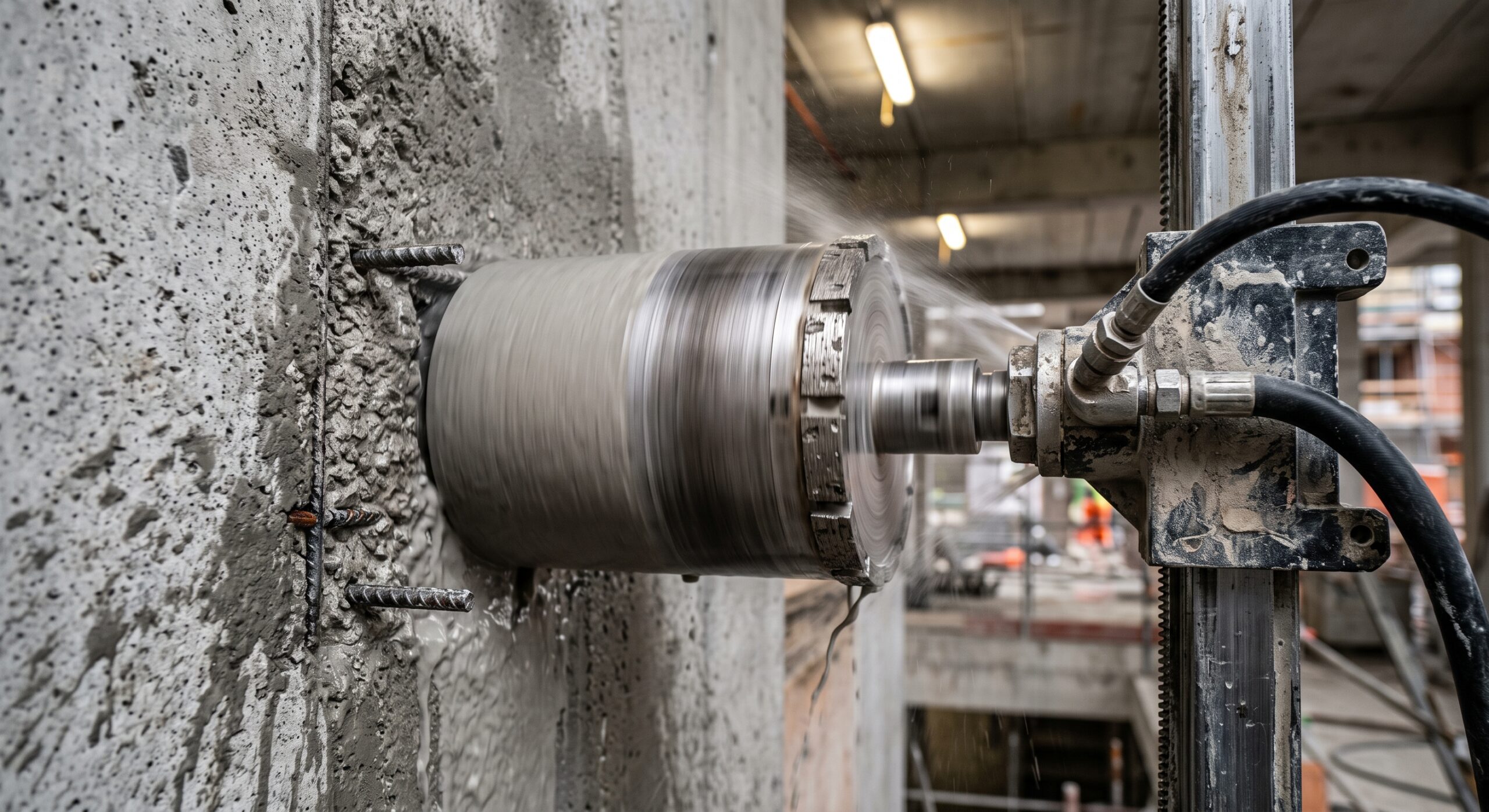
Concrete core drilling represents a highly invasive, distinctly localized, and physically destructive sampling technique where a specialized, water-cooled diamond-tipped annular drill bit is forcefully utilized to cut a pristine, perfectly cylindrical specimen directly from the hardened, load-bearing concrete structure4.
This meticulously extracted geological specimen provides an entirely unadulterated, perfectly preserved cross-sectional representation of the actual in-situ construction material, completely encompassing the dispersed coarse aggregates, the highly complex cementitious mortar matrix, and the specific, localized consolidation characteristics actually achieved by the contractor during the original construction placement decades earlier8.
The Complex Mechanics and Variables of Core Extraction
The absolute technical validity and mathematical reliability of the compressive strength results ultimately obtained from these forcefully extracted concrete cores are heavily influenced by a multitude of geometric, environmental, and highly specific procedural variables that must be rigorously and obsessively controlled by the testing laboratory during both the physical extraction process and the subsequent specimen preparation8.
The specific dimensional geometry of the extracted core specimen plays a disproportionately critical and heavily researched role in definitively determining the ultimate mechanical failure mechanism during the subsequent hydraulic compressive load testing8.
Stringent international engineering standards strongly and repeatedly advocate for rigorously maintaining a specific length-to-diameter ratio () of exactly either 2.0 or 1.0, because deviating from these highly standardized geometrical proportions significantly and unpredictably alters the complex internal stress distributions within the sample due to the immense frictional platen restraint effects generated directly by the heavy steel testing machine8.
When the specific length-to-diameter ratio unavoidably deviates from the strictly standardized norm due to the physical thickness limitations of the structural element being sampled, structural engineers must mathematically apply highly specific empirical strength correction factors to statistically normalize the measured raw compressive strength back to an equivalent standard cylinder strength for proper code compliance20.
Furthermore, the absolute physical diameter of the extracted core must be incredibly carefully considered relative to the known maximum nominal size of the coarse aggregate physically utilized within the original concrete mixture design8. Utilizing extremely narrow cores possessing a diameter of less than fifty millimeters is heavily discouraged and frequently explicitly forbidden by testing standards, because the unfortunate presence of a single, abnormally large aggregate particle traversing the primary intended failure plane can substantially and artificially misrepresent the true macroscopic load-bearing strength of the highly heterogeneous material matrix8.
Mitigating Severe Extraction Damage and Moisture Variables
The sheer mechanical violence and intense vibration inherent within the high-speed diamond core drilling process unavoidably introduces a significant degree of microscopic structural damage directly to the extracted specimen, frequently generating complex micro-fissures along the freshly cut cylindrical boundaries and partially severing the vital, delicate chemical bond existing between the large coarse aggregates and the surrounding hydrated cement paste8.
This highly localized, unavoidable extraction damage virtually ensures that the laboratory-measured compressive strength of an in-situ extracted core will almost universally test significantly lower than the theoretical design strength of a standard molded testing cylinder manufactured directly from the exact same fresh concrete batch and subsequently cured under perfectly identical, highly controlled laboratory conditions8.
Additionally, the highly specific moisture conditioning environment applied to the core sample immediately prior to destructive hydraulic compressive testing profoundly and irrevocably impacts the final measured load capacity recorded by the laboratory8.
Concrete core samples subjected to complete, prolonged environmental water saturation prior to immense load testing will consistently exhibit a markedly lower ultimate compressive strength than completely air-dried samples, primarily due to the complex, incredibly powerful internal pore pressures rapidly generated by the incompressible liquid water when the porous matrix is violently compressed by the testing apparatus8.
To effectively combat this massive testing variable, standardized evaluation frameworks mandate rigorous, highly specific environmental conditioning protocols designed to ensure that all extracted core samples reach a perfectly consistent, mathematically predictable internal moisture equilibrium, thereby systematically eliminating environmental moisture as a massively confounding variable during the final sophisticated structural analysis8.
| Testing Methodology | Primary Objective | Assessment Nature | Key Technical Limitations and Constraints |
| Rebound Hammer | Surface Hardness | Non-Destructive | Strictly limited to top 30mm; heavily skewed by advanced surface carbonation and aggregate proximity. |
| Ultrasonic Pulse Velocity | Internal Uniformity | Non-Destructive | Highly dependent on internal moisture content and severely affected by parallel reinforcement bars. |
| SonReb Method | Combined Correlation | Non-Destructive | Demands extremely precise, highly localized calibration directly against physically extracted core samples. |
| Ground Penetrating Radar | Rebar Cover Mapping | Non-Destructive | Provides absolutely zero quantitative data regarding the actual compressive strength of the surrounding concrete. |
| Core Drilling & Crushing | Absolute Strength | Destructive | Highly invasive; creates significant structural damage risks; exceptionally expensive and deeply time-consuming. |
| Petrographic Examination | Microstructural Health | Destructive | Absolutely requires highly specialized laboratory equipment and incredibly experienced forensic geologists. |
The Rigorous Statistical Framework of BS EN 13791:2019
The incredibly intricate and mathematically demanding process of accurately translating the raw, highly variable mechanical failure loads obtained directly from destructive core testing into mathematically reliable, highly conservative design values suitable for modern structural engineering applications is comprehensively governed by incredibly stringent international testing standards6.
The incredibly important British Standard BS EN 13791:2019, which serves globally as the premier European technical framework explicitly designed for the highly precise assessment of in-situ compressive strength within existing concrete structures and complex precast components, establishes highly rigorous, mathematically demanding statistical protocols specifically for determining the characteristic compressive strength based heavily upon inherently limited, highly constrained sample populations6.
The highly anticipated publication of the comprehensive 2019 revision introduced massive, sweeping conceptual overhauls compared directly to its outdated 2007 predecessor, fundamentally redefining exactly how professional engineers must calculate the statistical variability of aged concrete structures while drastically altering the specific minimum sampling requirements absolutely necessary for achieving strict regulatory compliance6.
The Functional Division: Clause 8 vs. Clause 9 Assessments
To successfully eliminate widespread, highly problematic industry confusion regarding the appropriate mathematical application of complex statistical methodologies, the rigorous BS EN 13791:2019 standard clearly and unequivocally bifurcates the entire assessment procedure into two entirely distinct, logically separated conceptual pathways, characterized completely by the specific engineering purpose and underlying legal intent of the structural investigation20.
Clause 8 specifically and exclusively governs the immensely complex estimation of compressive strength specifically intended for the structural assessment of existing, highly aged structures, focusing intensely on definitively defining the characteristic in-situ compressive strength absolutely necessary for direct mathematical application within modern structural design codes, most notably EN 1990 and EN 1992-1-16.
This highly specific scenario assumes absolutely zero prior, reliable knowledge regarding the original specified design strength of the construction materials, essentially forcing the investigating structural engineer to meticulously construct a completely empirical, highly conservative understanding of the building’s structural capacity derived entirely from the newly extracted core samples and widespread, highly calibrated non-destructive evaluations6.
Conversely, Clause 9 is exclusively and strictly designed for the highly specific assessment of the compressive strength class of concrete freshly supplied to a structure currently and actively under construction, primarily triggered when standardized molded test cubes unexpectedly indicate severe doubt regarding contractual conformity or when the general overall quality of the contractor’s site execution is severely questioned by the project managers20.
In these highly contentious Clause 9 scenarios, the evaluating engineer operates under the exceedingly strong statistical presumption that the provided concrete generally conforms to the initially specified characteristic strength, and the subsequent complex statistical tests are specifically designed to either rigorously validate or firmly and legally reject this predefined hypothesis based on the gathered evidence20.
Inappropriately applying the highly conservative Clause 8 methodologies to a rapidly escalating Clause 9 contractual dispute, or conversely applying Clause 9 to an ancient structure, inevitably leads to significantly flawed statistical outcomes and massively profound legal liabilities that can ruin engineering careers20.
Evaluating Existing Structures: Approach A and Approach B
When actively and aggressively evaluating the residual strength of existing, degraded concrete elements under the strict, uncompromising guidelines of Clause 8, BS EN 13791:2019 explicitly provides two distinct, highly formalized statistical methodologies depending entirely upon the total volume of empirical data successfully collected by the engineers during the highly invasive extraction phase8.
Approach A is strictly mandated when the investigating engineer miraculously manages to successfully extract a massive minimum of fifteen highly valid concrete cores from the carefully defined test region, thereby providing a sufficiently robust, highly reliable statistical population capable of accurately calculating both a highly reliable mathematical mean value and an accurate standard deviation representing the true inherent variability of the heterogeneous material8.
However, because physically extracting fifteen massive cores from a single continuous structural member is frequently physically impossible, geometrically prohibitive, or deeply structurally irresponsible due to the immense damage inflicted, Approach B provides an absolutely vital statistical alternative designed specifically and intentionally for significantly smaller sample populations comprising between eight and fourteen highly valid test results8.
When forced to deploy Approach B due to extraction limitations, the calculating engineer must determine the characteristic in-situ strength utilizing deeply conservative, highly penalizing mathematical safety margins, intentionally compensating heavily for the massively increased statistical uncertainty directly generated by the unfortunately limited sample size22.
Furthermore, if the specific investigated test region is exceptionally small—specifically and legally defined by the standard as encompassing significantly less than ten total cubic meters of concrete and comprising fewer than four entirely independent structural elements—the standard exceptionally allows for an absolute minimum baseline of only three successfully extracted cores, provided that the engineer applies incredibly severe penalization factors to the final calculated structural strength to ensure absolute public safety24.
The Mandatory, Unbreakable Integration of Destructive and NDT Methods
Perhaps the single most revolutionary, industry-altering aspect of the comprehensive BS EN 13791:2019 framework is its incredibly rigorous formalization dictating exactly how non-destructive testing methodologies must be mathematically calibrated against destructive core sampling data6.
The stringent standard explicitly and aggressively forbids engineers from utilizing default manufacturer conversion curves typically provided with commercial rebound hammers or ultrasonic testing devices, because these overly generic curves universally and catastrophically fail to account for the highly specific local aggregate types, massive internal moisture gradients, and entirely unique curing histories characterizing the specific localized structure under investigation6.
Instead, if a structural engineer genuinely wishes to accurately estimate the compressive strength across a massive test region utilizing rapid non-destructive techniques, they are strictly and legally required to meticulously construct a completely bespoke, highly localized mathematical conversion model18.
For test regions measuring smaller than thirty cubic meters, the standard mandates successfully extracting a minimum of three specific concrete cores precisely located at the exact coordinates carefully selected based directly upon the extreme high and low values identified during the preliminary non-destructive testing phase24. For significantly larger structural volumes, the rigorous statistical requirements demand extracting a massive minimum of ten completely distinct pairs of non-destructive measurements and immediately adjacent physical core extractions to accurately and reliably identify the complex parameters of the underlying mathematical conversion model24.
This incredibly strict regulatory requirement effectively and permanently institutionalizes the critical engineering concept that non-destructive testing can absolutely never entirely replace destructive sampling; rather, the two dramatically different modalities must operate in a strictly symbiotic, highly integrated relationship where the invasive destructive tests provide the absolute empirical mathematical anchor required to validate the vast spatial data generated by the non-destructive surveys6.
Forensic Petrography: Peering Deeply into the Microscopic Matrix
While compressive strength testing undoubtedly provides absolutely essential, life-saving data regarding the macroscopic mechanical capacity of the overall structure, it comprehensively fails to explain or even identify the fundamental, microscopic underlying causes of the observed severe material degradation13.
When highly expensive structural concrete unexpectedly fails prematurely, experiences catastrophic widespread internal cracking, or exhibits highly bizarre, unexpected expansion characteristics, simply knowing its severely reduced residual load capacity is entirely insufficient for engineering purposes; professional investigators must definitively and conclusively understand exactly what went wrong during construction and exactly why the chemical failure occurred to prevent disastrous reoccurrences19.
This profound, highly complex analytical requirement immediately elevates the structural audit from simple mechanical crushing tests to the highly specialized, incredibly complex realm of forensic petrographic analysis, heavily utilizing the intricate diagnostic methodologies formally and meticulously outlined in the globally recognized ASTM C856 standard for the detailed petrographic examination of hardened concrete14.
The Meticulous Microscopic Dissection of Concrete Cores
Petrography fundamentally represents the highly advanced, incredibly specialized geological science dedicated to meticulously describing, identifying, and systematically classifying the specific constituent minerals and complex microscopic structures that compose solid rocks, which has been seamlessly and brilliantly adapted by engineers to investigate the heterogeneous, highly rock-like nature of hardened Portland cement concrete11.
When a highly experienced structural engineer heavily suspects the insidious presence of complex chemical deterioration, such as rampant alkali-silica reactivity or severe, highly destructive delayed ettringite formation, absolutely pristine concrete cores are carefully extracted from the damaged structure, immediately stabilized with highly specialized low-viscosity fluorescent epoxies, delicately sliced into incredibly thin, translucent sections, and finally polished to an absolute, flawless mirror finish designed specifically for intense microscopic observation11.
Under the incredibly stringent, highly detailed guidelines of ASTM C856 and supplementary investigative standards like ASTM C457 for determining comprehensive air-void analysis, highly trained, exceptionally experienced forensic geologists utilize advanced polarized light microscopy (PLM) to actively and definitively identify potentially deleterious reactive aggregates, map the exact branching morphology of internal microcracking networks, and precisely quantify the true extent of external chemical penetration11.
Comprehensive petrographic examination provides the absolute maximum level of diagnostic clarity physically possible, easily capable of definitively identifying highly subtle, long-forgotten quality control issues that undoubtedly occurred during the original concrete placement, such as the negligent use of unwashed, highly contaminated aggregates, the application of extremely high, out-of-specification initial water-cement ratios, or the catastrophic failure by the contractor to provide adequate environmental curing conditions11.
Furthermore, highly specific material analysis for construction aggregates is governed by extremely precise standards including ASTM D75 for proper sampling, ASTM C136 for detailed sieve analysis, ASTM C117 for identifying exceptionally fine materials, ASTM C127 and C128 for measuring precise specific gravity, ASTM D2419 for determining the critical sand equivalent, and ASTM C88 for assessing the ultimate soundness of the aggregates utilizing aggressive sodium sulfate exposure30.
Advanced Forensic Imaging: SEM, EDS, and Vibrant Fluorescence
Modern forensic concrete analysis frequently and necessarily extends far beyond the inherent physical limitations of traditional optical microscopy, heavily leveraging the immense, almost unimaginable resolving power provided by Scanning Electron Microscopy (SEM) combined seamlessly and powerfully with highly precise Energy-Dispersive X-ray Spectroscopy (EDS) capabilities11. While a standard optical microscope fundamentally manipulates visible light photons to generate an image, the highly advanced SEM actively bombards the prepared concrete sample with a highly focused, intensely powerful beam of high-energy electrons, allowing dedicated investigators to clearly examine the incredibly complex hydration products of the cement paste and the intricate, needle-like crystalline structures of expansive degradation compounds at magnifications vastly exceeding tens of thousands of times normal vision11.
When the powerful SEM is efficiently equipped with a highly sensitive EDS detector, the forensic engineering team can instantly, reliably analyze the exact elemental composition of microscopic structural anomalies in-situ, rapidly confirming the highly specific chemical presence of invasive marine chlorides, highly destructive groundwater sulfates, or expansive internal alkali gels without ever requiring massive, time-consuming bulk chemical laboratory analysis11.
Furthermore, highly advanced fluorescent microscopy techniques utilize specialized, incredibly powerful ultraviolet light sources to intensely illuminate highly prepared concrete sections that have been meticulously, painstakingly vacuum-impregnated with a highly luminous, vibrantly fluorescent dyed epoxy resin11.
Because the brightly glowing fluorescent epoxy selectively and deeply penetrates the complex interconnected capillary pores and completely fills any available stress-induced micro-fractures, the final fluorescent intensity of the examined matrix directly and proportionately correlates with its overall inherent porosity, thereby providing a highly robust, deeply scientifically validated technique for accurately estimating the original, critical water-to-cementitious materials ratio (w/cm) of severely degraded structures literally decades after their initial construction11.
| Advanced Analytical Methodology | Primary Governing Standard | Primary Diagnostic Application | Destructive Nature |
| Compressive Strength Assessment | BS EN 13791:2019 | In-situ load-bearing capacity calculation | Highly Destructive |
| Comprehensive Petrographic Examination | ASTM C856 | Detailed microstructural health and deterioration identification | Highly Destructive (Requires Core Extraction) |
| Air-Void System Analysis | ASTM C457 | Microscopic determination of freeze-thaw resistance | Highly Destructive (Requires Core Extraction) |
| Aggregate Soundness Testing | ASTM C88 | Determining aggregate resilience to severe chemical weathering | Laboratory Testing (Requires Bulk Samples) |
| Aggregate Sieve Analysis | ASTM C136 | Analyzing the precise particle size distribution of the mixture | Laboratory Testing (Requires Bulk Samples) |
The Regulatory Frameworks: The Singapore BCA PSI Paradigm
Theoretical structural engineering principles and highly advanced non-destructive testing methodologies remain largely academic, profoundly ineffective exercises unless they are strictly, universally enforced by highly comprehensive, mandatory legal governmental frameworks designed specifically to perpetually safeguard overriding public safety1.
The highly respected Building and Construction Authority (BCA) operating within Singapore actively maintains one of the most impressively proactive, incredibly stringent, and highly organized property maintenance and structural auditing regimes currently functioning globally, which is primarily and relentlessly enforced through the immense legal powers granted by Section 28 of the comprehensive Building Control Act1.
The Inflexible Statutory Trigger and Complex Inspection Intervals
Under the highly stringent, entirely uncompromising regulations dictating the BCA Periodic Structural Inspection (PSI) regime, the absolute statutory obligation placed upon property owners activates with phenomenal precision the exact moment a qualified building successfully reaches its thirteenth year of age, at which critical point the BCA aggressively issues a highly formal, legally binding inspection notice strictly demanding immediate regulatory compliance1.
This carefully, highly scientifically chosen thirteen-year timeline threshold is absolutely not arbitrary; massive scientific studies definitively and repeatedly indicate that within the extremely harsh, incredibly high-humidity tropical climate characterizing Singapore, the rapidly advancing, highly destructive concrete carbonation front very often reaches and severely compromises the internal steel reinforcement precisely around the thirteenth year of continuous atmospheric exposure1.
Following this critical, highly consequential initial assessment, the mandatory structural inspection frequency strictly bifurcates based entirely and rigidly upon the primary usage classification and the highly specific presumed public risk profile inherently associated with the structure1. Highly stressed commercial office structures, bustling industrial factories, heavily modified mixed-use shophouses, and massive institutional buildings face highly accelerated, incredibly rigorous inspection cycles, legally mandating comprehensive, highly detailed structural audits exactly once every five years3. This highly frequent, entirely unrelenting interval actively and aggressively addresses the massively elevated structural risk profile inherently associated with continuous industrial overloading, heavy machinery vibrations, constantly shifting structural loads, and incredibly massive public occupancy rates10.
Conversely, large-scale residential buildings, such as massive private condominiums spanning multiple high-rise towers, surprisingly benefit from a slightly more relaxed, heavily modified regulatory timeline, specifically requiring mandatory structural inspection exactly once every ten years, provided that a highly strict minimum of ninety percent of the total gross floor area is dedicated strictly and exclusively to residential usage1.
Highly interestingly, fully detached, semi-detached, and highly popular terraced landed houses utilized strictly and exclusively for pure residential dwelling purposes are generally explicitly exempt from this highly burdensome specific cyclical statutory obligation, although they may certainly still require highly detailed professional engineering assessments during any significant structural alteration works or pending high-value property sales1.
It is also highly critical to note that purely temporary buildings, strictly legally defined as structures permitted for a maximum absolute lifespan of exactly 36 months—such as temporary workers’ quarters and highly active site offices—are also explicitly granted full exemptions from these rigorous structural inspection requirements1.
Furthermore, the BCA PSI regime imposes highly specific, mathematically rigorous minimum unit coverage requirements depending entirely upon the exact age bracket of the massive residential building being audited10.
For massive condominium structures aged strictly between 31 and 40 years, the structural engineer must physically access and completely inspect a minimum of 30% of the total units10. This coverage requirement massively increases to 40% for aging buildings located within the 41 to 60-year bracket, and incredibly escalates to a massive 60% mandatory inspection rate for highly aged heritage structures exceeding 60 years of existence10.
Additionally, specific attention is aggressively directed toward heavily hidden structural column elements; the law strictly mandates that at least 30% of fully cladded columns must be physically and forcefully exposed by the inspecting engineer to completely prevent highly aesthetic architectural finishes from dangerously hiding severe, life-threatening internal structural deterioration7.
To properly facilitate these highly complex operations, inspecting structural engineers charge highly structured, clearly transparent fees based heavily upon the massive scale of the structural asset9. Standard Stage 1 structural inspection fees typically begin around S5,500 for a medium-sized condominium containing up to 300 units, and drastically peaking around S$15,000 or substantially more for incredibly massive mega-developments exceeding 600 units or stretching beyond 30 soaring storeys9.
The Staged Inspection Methodology: Visual Triage vs. Deep Forensic Investigation
To effectively and successfully balance the immense economic and logistical burden placed heavily upon building owners with the overriding, absolute necessity of ensuring unquestionable public safety, the BCA PSI framework explicitly and rigidly dictates a highly structured, distinctly two-staged inspection methodology that heavily prioritizes non-destructive methods initially before aggressively escalating to highly destructive techniques4.
Stage 1: The Comprehensive Visual Triage The legally mandated inspection universally and always commences strictly with Stage 1, a highly comprehensive, incredibly systematic, and entirely non-destructive visual assessment conducted personally, physically on-site by a Professional Engineer (PE) strictly registered specifically in the Civil discipline with the highly demanding Professional Engineers Board4.
During this highly critical preliminary phase, the highly trained engineer meticulously and exhaustively surveys all safely accessible load-bearing structural elements, carefully and methodically documenting crucial visual indicators of severe distress, such as advanced and widespread concrete spalling, highly active internal reinforcement corrosion, continuous and damaging water seepage, unexplained massive structural deflections, and the highly dangerous, frequently discovered presence of completely unauthorized structural modifications executed by misguided, poorly informed commercial tenants3.
In highly complex, densely populated residential condominiums, this strictly requires incredibly extensive, highly sensitive logistical coordination with management to ensure the engineer reliably gains physical entry not only to highly public common elements like bustling lift lobbies and massive basement car parks but also to a statistically highly significant percentage of entirely private residential units to safely assess internal primary column integrity7.
If the investigating engineer ultimately concludes that the aging building exhibits only minor, highly superficial, entirely cosmetic wear and tear lacking any profound structural significance, they formally submit a highly detailed, PE-certified clearance report directly to the BCA, effectively and successfully fulfilling the massive statutory obligation for that specific inspection cycle without ever deploying highly invasive destructive testing equipment3.
Stage 2: The Detailed Structural Escalation However, the incredibly invasive Stage 2 investigation is immediately and decisively triggered by the authorities when the initial Stage 1 visual triage unexpectedly identifies profound, highly alarming structural defects that absolutely cannot be accurately diagnosed, safely evaluated, or effectively quantified through purely visual observation alone4.
The sudden, terrifying appearance of massive, expanding shear cracks located in highly loaded primary support columns, the widespread occurrence of extremely deep concrete carbonation reaching the rebar, clear physical evidence of substantial, ongoing differential foundation settlement, or the frightening discovery of highly compromised load paths immediately and irrevocably elevates the regulatory safety requirement4.
The investigating engineer is then strictly required to submit a formal Form D4 to the BCA, legally recommending massive further structural testing and immediately triggering the highly expensive escalation to a massive Stage 2 investigation7.
Stage 2 fundamentally represents a complete, massive escalation to deep forensic structural investigation, fundamentally shifting the entire diagnostic paradigm away from non-destructive observation directly to highly invasive, technologically advanced, and deeply destructive diagnostic procedures3.
Under a strict Stage 2 legal mandate, the aggressive deployment of destructive diamond concrete coring, the highly invasive physical extraction of steel coupons directly from the rebar for tensile strength testing, highly extensive NDT scanning methods, precise carbonation depth analysis utilizing the aforementioned phenolphthalein reagents, and incredibly complex computer-aided structural load calculations become strictly legally required to precisely and mathematically quantify the final residual capacity of the highly compromised asset1.
Ignoring this massive statutory escalation or attempting to evade the rigorous requirements is extraordinarily dangerous and entirely legally indefensible; non-compliance with strictly issued BCA enforcement notices and severely crippling Stop Work Orders can incredibly result in massive, life-altering financial penalties reaching up to $500,000, compounding additional daily fines reaching $10,000 per day for continuing violations, and highly severe custodial prison sentences extending up to two full years for the worst structural negligence offenders1.
Furthermore, this strict BCA regulatory framework must frequently be tightly integrated with complex Urban Redevelopment Authority (URA) architectural requirements, ensuring that highly complex exterior facade designs and heavy architectural features satisfy both extreme aesthetic demands and highly rigorous structural loading calculations simultaneously, while strictly adhering to incredibly detailed BCA accessibility codes mandating highly specific gradient ramps and tactile guidance systems31.
Finding the Exact Balance: When to Core and When to Scan
The ultimate, overriding objective of any highly comprehensive, deeply forensic structural audit is absolutely not simply to indiscriminately collect vast, unmanageable quantities of disconnected material data, but rather to highly intelligently synthesize a highly accurate, incredibly economically viable, and minimally physically disruptive holistic assessment of overall building health2.
Finding the absolute optimal, perfect balance between the widespread deployment of rapid non-destructive screening methods and the highly invasive, physically destructive extraction of concrete cores relies entirely upon the highly specific structural risks identified by the incredibly experienced investigating engineer and the absolute required statistical confidence level necessary for the final building safety certification5.
Scenarios Heavily Justifying Purely Non-Destructive Methodologies
Non-destructive testing methods are overwhelmingly, undeniably sufficient, and highly preferred by building owners, during the early diagnostic phases of routine periodic maintenance inspections where the massive structure exhibits absolutely no overt, visible signs of massive mechanical distress, prolonged heavy overloading, or severe environmental deterioration2.
When conducting a completely standard, legally mandated Stage 1 BCA Periodic Structural Inspection on a highly well-maintained, relatively young fifteen-year-old commercial office tower that has remarkably experienced absolutely zero fundamental change in its primary occupancy usage, forcefully deploying highly invasive, noisy core drilling equipment is universally considered an incredibly unnecessary, highly disruptive, and financially unjustifiable massive overreaction3.
In these incredibly stable, highly predictable structural scenarios, the highly strategic, carefully calibrated application of the standard mechanical rebound hammer and sophisticated ultrasonic pulse velocity equipment provides entirely sufficient qualitative assurance that the internal concrete matrix remains highly continuous, structurally uniform, and largely completely unaffected by massive internal voidage or dangerous honeycombing3.
Similarly, when the absolutely primary objective of the structural audit is strictly and exclusively to verify the precise as-built geometric location of highly embedded steel reinforcement grids prior to a massive planned renovation involving floor penetrations, ground-penetrating radar and highly advanced electromagnetic Hilti Ferroscan devices provide the exact necessary geometric safety data without inflicting absolutely any collateral physical damage to the highly valuable existing structural element2.
Scenarios Absolutely Demanding Highly Destructive Core Extraction
Conversely, the deployment of highly destructive core sampling rapidly transitions from an optional, interesting verification tool into an absolutely mandatory, legally unavoidable investigative requirement the exact moment that highly significant, completely unexplained structural anomalies are confidently detected, or whenever highly advanced mathematical retrofitting structural designs require incredibly precise, laboratory-verified strength parameters to ensure absolute safety4.
Firstly, when initial non-destructive scanning methods unexpectedly identify massive, highly alarming variations in acoustic pulse velocity or incredibly highly irregular, unexplainable surface rebound numbers that strongly and undeniably suggest highly localized structural failure, physical diagnostic cores must be rapidly and decisively extracted directly from the highly anomalous zones to definitively, microscopically identify the exact root cause of the severe discontinuity, whether it ultimately proves to be severe construction honeycombing, highly active alkali-silica reaction, or deeply destructive chemical sulfate attack14.
Secondly, as strictly, inflexibly dictated by the highly rigorous mathematical statistical framework of BS EN 13791:2019, any serious engineering attempt to accurately map and mathematically verify the comprehensive compressive strength of an entire, massive building utilizing primarily non-destructive testing absolutely and undeniably demands the physical extraction of highly specific calibration cores6.
The highly complex statistical validity of the advanced SonReb mathematical model completely and totally collapses without these physically crushed, laboratory-tested specimens effectively anchoring the highly localized mathematical conversion curves utilized by the evaluating engineer18.
Finally, when incredibly aging structures are being fundamentally, completely repurposed to actively accommodate massively, dangerously increased vertical or lateral loads—such as highly controversially transforming a standard light industrial warehouse directly into an incredibly high-density, heavily loaded server rack data facility—the investigating structural engineer simply cannot legally, morally, or ethically rely upon the highly inherent statistical uncertainties perpetually surrounding entirely uncalibrated non-destructive strength estimates2.
The utterly catastrophic, life-threatening legal liability inherently associated with the horrifying possibility of progressive structural collapse demands the absolute, unquestionable empirical certainty that only physically extracted, violently laboratory-crushed concrete cores and highly advanced ASTM C856 forensic petrographic microscopy can comprehensively and undeniably provide1.
Once this massive diagnostic phase identifies the specific failures, structural owners must immediately deploy proper rectification techniques, including aggressively hacking away all loose flaking concrete, thoroughly cleaning exposed rebar and applying anti-rust paints, applying powerful chemical bonding agents, and seamlessly patching the massive voids utilizing highly advanced polymer-modified cement mortars to fully restore the compromised structural capacity1.
Conclusion
The comprehensive structural audit represents a highly critical, deeply legally binding, and incredibly scientifically complex endeavor designed exclusively and specifically to preserve massive societal capital investments and, most importantly, completely protect fragile human life from the utterly catastrophic consequences of completely unforeseen structural building collapse.
Within this incredibly high-stakes, intensely scrutinized engineering environment, the fierce ongoing debate between extensively utilizing highly rapid non-destructive scanning methods versus employing highly invasive, physically damaging core drilling is completely and successfully resolved not by arbitrarily choosing one isolated methodology over the other, but rather by highly intelligently synthesizing their highly respective diagnostic strengths into a singular, highly unified, deeply cohesive investigative structural strategy.
Non-destructive testing unequivocally provides an incredibly rapid, highly cost-effective, and deeply valuable wide-scale assessment of overall structural uniformity without ever significantly compromising the physical integrity of the incredibly valuable building components, but it inherently, undeniably lacks the incredibly precise, highly empirical analytical capabilities absolutely required to definitively quantify true in-situ compressive strength or actively identify the incredibly complex, highly microscopic chemical deterioration mechanisms lurking silently deep within the aging concrete matrix.
Conversely, incredibly highly destructive core testing and highly advanced forensic petrography consistently deliver the absolute pinnacle of scientific diagnostic certainty, directly providing the highly precise statistical strength parameters demanded by international codes like BS EN 13791 and the incredible microscopic visual clarity explicitly required by ASTM C856, yet doing so at a significantly, massively elevated financial cost while unavoidably inflicting highly localized physical damage directly upon the highly stressed structure itself.
Ultimately, the most incredibly successful, deeply rigorous, and entirely legally compliant structural audits—such as those strictly, uncompromisingly mandated by the highly stringent, extremely structured multi-stage regulatory framework of the highly respected Singapore Building and Construction Authority—masterfully and intelligently leverage highly advanced non-destructive technologies to broadly and safely illuminate the deeply hidden landscape of the internal structure, precisely guiding the deeply experienced engineer’s hand to confidently determine exactly when and where the highly invasive scalpel of destructive core sampling must absolutely be applied.
By successfully achieving this incredibly delicate, highly statistically rigorous engineering balance, structural engineers can incredibly confidently certify the enduring, long-term safety of our rapidly aging global infrastructure, aggressively mitigating hidden deterioration risks while drastically and safely extending the highly functional operational lifespan of the built environment for generations to come.
Works cited
- BCA Periodic Structural Inspection PSI Cycle: Why BCA Requires 5, https://structures.com.sg/bca-periodic-structural-inspection-psi-cycle-why-bca-requires-5-or-10-year-building-inspections/
- Periodic Structural Inspections in Singapore: What Engineers Want, https://periodicstructuralinspection.wordpress.com/2024/12/30/periodic-structural-inspections-in-singapore-what-engineers-want-you-to-know/
- Building Safety Inspection Services in Singapore, https://gqssingapore.com/building-safety-inspection-services-in-singapore/
- BCA PSI Singapore: Complete Owner’s Guide 2026, https://bca-psi.sg/guide-psi-complete.html
- Your Guide to Periodic Structural Inspection (PSI), https://www.mlfacadeinspection.com.sg/our-articles/your-guide-to-periodic-structural-inspection-psi/
- BS EN 13791:2019 | 31 Jan 2020 – BSI Knowledge, https://knowledge.bsigroup.com/products/assessment-of-in-situ-compressive-strength-in-structures-and-precast-concrete-components
- How to Read Your BCA Inspection Notice: Ultimate Compliance Guide, https://structures.com.sg/how-to-read-your-bca-inspection-notice-ultimate-compliance-guide/
- Buy BS EN 13791:2007 | Intertek Inform, https://www.intertekinform.com/en-gb/standards/bs-en-13791-2007-234953_saig_bsi_bsi_549642/
- BCA Periodic Structural Inspection (PSI) Singapore 2026 | PE, https://bca-psi.sg/
- Residential vs. Commercial PSI: Singapore Building Inspection, https://structures.com.sg/residential-vs-commercial-psi-singapore-building-inspection-differences/
- Concrete Testing and Twining’s “Concrete Insight” Group | Twining Inc, https://www.twininginc.com/services/concrete-testing
- The Influence of the Rebound Hammer Test Location on the … – MDPI, https://www.mdpi.com/2673-6497/4/1/5
- Hardened Concrete Testing BS 1881-124 UK | The Testing Lab, https://www.thetestinglab.eu/insights/hardened-concrete-testing-bs-1881-124-uk
- Common Methods for Forensic Evaluation of Concrete Structures, https://www.atlantictesting.com/common-methods-for-forensic-evaluation-of-concrete-structures/
- Petrographic Examination & Concrete Petrography, https://www.twiningconsulting.com/services/petrographic-examination-specialized-analytical-services
- Sulfate Attack on Dam Concrete: A Practitioner Guide – PCCI, https://pcciglobal.com/insights/sulfate-attack-dam-concrete-mechanisms-mitigation/
- Concrete Failure Analysis and Forensic Investigations – Lucideon, https://www.lucideon.com/testing-characterisation/concrete-mortar-testing/concrete-failure-analysis-forensic-investigations
- comparing investigation approaches and ndt methodologies for, https://www.researchgate.net/publication/282811495_COMPARING_INVESTIGATION_APPROACHES_AND_NDT_METHODOLOGIES_FOR_CONCRETE_STRENGTH_ESTIMATION_AN_INTERNATIONAL_BENCHMARK
- Forensic Concrete Analysis – Scope Geo, https://scopegeo.com/forensic-concrete-analysis/
- BSI Standards Publication – pdfcoffee.com, https://pdfcoffee.com/download/bsen-13791-2019-pdf-free.html
- 214.4-21 Preview | PDF | Concrete | Standard Deviation – Scribd, https://www.scribd.com/document/785501796/214-4-21-preview
- EN 13791:2019 Compressive Strength Assessment | PDF – Scribd, https://www.scribd.com/document/847675328/BS-EN-13791
- SBS05235 01 | PDF – Scribd, https://www.scribd.com/document/689872741/SBS05235-01
- Brasil – Predictive models for concrete strength estimation of existing, https://www.scielo.br/j/riem/a/b3mF7pDH86JxFtkC9ND6TTB/?lang=en
- Bsen 13791-2019 – pdfcoffee.com, https://pdfcoffee.com/bsen-13791-2019-pdf-free.html
- Concrete Advice 68 | PDF – Scribd, https://www.scribd.com/document/597253993/Concrete-Advice-68
- Concrete Advice 68 – PDFCOFFEE.COM, https://pdfcoffee.com/concrete-advice-68-pdf-free.html
- Petrographic Examination & Analytical Concrete Services, https://www.twiningconsulting.com/concrete-insight-services/petrographic-examination-specialized-analytical-services
- The Effect of Petrographic Characteristics and Physico-Mechanical, https://www.mdpi.com/2075-163X/8/12/577
- Civil Testing – TCR Arabia, https://www.tcr-arabia.com/civil-testing
- Understanding BCA Guidelines: A 2026 Developer’s Guide, https://www.amanengineering.com.sg/understanding-bca-guidelines-a-2026-developers-guide/
- Engineering Articles – AEC Technical Advisory Singapore, https://www.aectechnicalsg.com/engineering-articles/