
Introduction
Chemical storage bunkers in Singapore must satisfy a demanding, multi-agency regulatory framework that governs every aspect of structural engineering, fire safety, and environmental containment. For plant managers, logistics companies, and JTC lessees operating in industrial estates across Tuas, Jurong, and beyond, getting the design right is not optional-it is the first step toward securing building permits, hazardous substance licenses, and long-term operational safety.
This article covers the full scope of structural safety regulations applicable to chemical storage facility design in Singapore, including SCDF Fire Code 2023 requirements, BCA structural standards under the SS EN (Eurocode) framework, JTC land use and zoning guidelines, and NEA environmental compliance for hazardous chemicals. It does not address process engineering for chemical manufacturing or transport logistics outside the storage facility envelope.
Direct answer: Chemical storage bunkers in Singapore must comply with SCDF Fire Code 2023 for fire-rated compartmentation and sprinkler systems, BCA structural standards (SS EN 1990–1998) for load-bearing capacity and foundation design, NEA regulations for secondary containment and environmental protection, and JTC guidelines for industrial land use-all requiring submissions prepared by a Qualified Person or professional engineer.
By the end of this article, you will understand:
-
The regulatory landscape governing chemical storage bunker design across SCDF, BCA, NEA, JTC, and MOM
-
Structural design specifications including load calculations, foundation methods, and concrete resistance requirements
-
How to size chemical bund walls and secondary containment to meet the required bund capacity
-
Common engineering challenges in Singapore’s marine clay soils and tropical environment, with proven solutions
-
The compliance process and approval workflows for authority submissions
Understanding Chemical Storage Bunker Design Requirements in Singapore
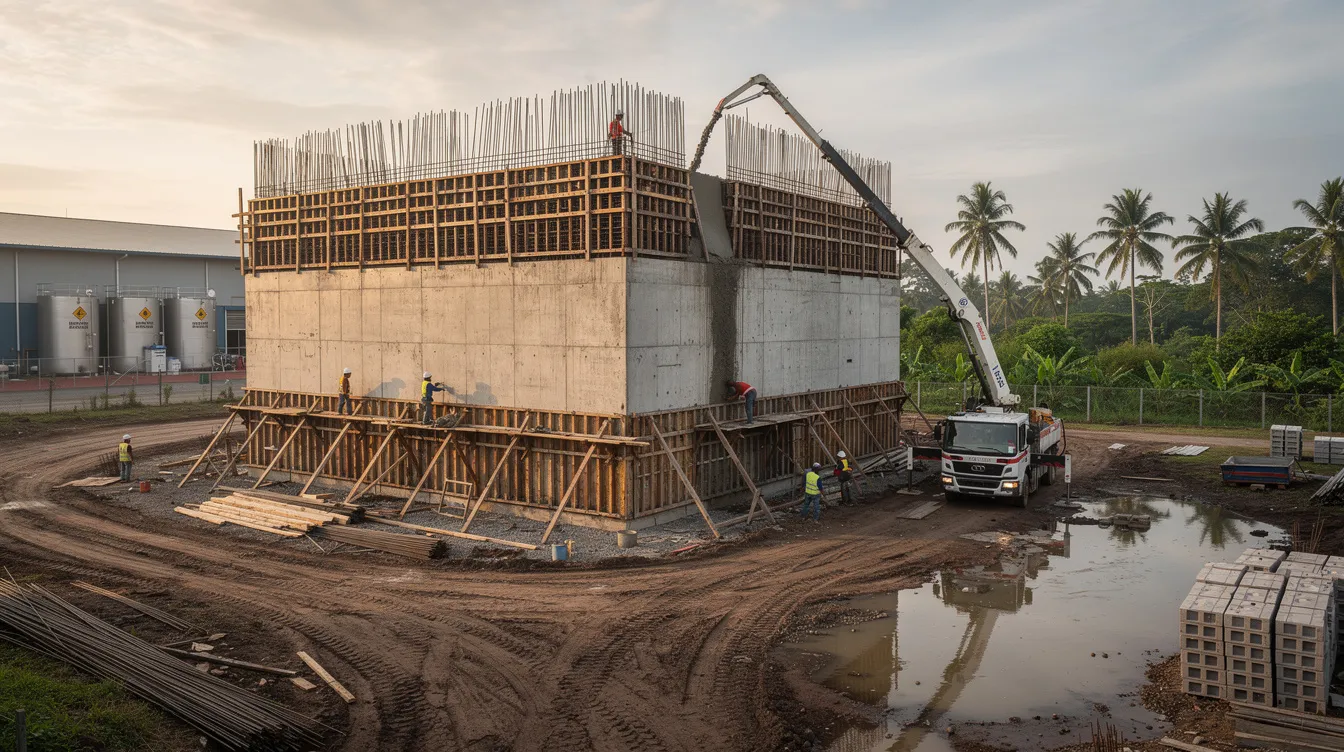
A chemical storage bunker is a reinforced concrete or composite steel-and-concrete structure purpose-built to store hazardous materials-including flammable liquids, corrosive substances, and toxic compounds-under strict containment and fire safety conditions. These structures must integrate load-bearing walls, bunded areas, ventilation systems, and fire suppression equipment into a single, code-compliant envelope. Structural safety regulations for chemical storage bunkers are governed by strict standards that demand specialized engineering design from the earliest conceptual stage.
The reason specialized engineering is critical goes beyond regulatory box-ticking. Incompatible chemicals can cause violent reactions or fires if stored without proper segregation. A catastrophic failure-whether structural collapse, chemical leaks, or uncontrolled fire-can create severe hazards that occur within the bunker and endanger personnel, contaminate groundwater, and shut down adjacent operations across an entire industrial estate. Professional engineering design ensures that every load path, containment wall, and ventilation duct is sized to handle both normal operations and worst-case emergency scenarios across the facility’s entire lifecycle.
SCDF Fire Code 2023 Requirements
The SCDF Fire Code 2023 classifies chemical and HazMat warehouses under Purpose Group VIII (PG VIII), imposing specific requirements for fire-rated construction, compartment sizing, and emergency access. Key compliance frameworks for chemical storage in Singapore include SCDF Fire Code 2023 and SS 532:2024, which governs the storage of flammable liquids.
Fire-rated walls separating areas of special high hazard-such as storage zones containing highly combustible or flammable substances-must achieve a minimum 2-hour fire resistance rating. Buildings storing hazardous materials must receive mandatory licensing from SCDF. Fire suppression systems for chemical storage may include alarms and automatic sprinklers, with deluge systems and fixed firefighting equipment required for higher-hazard classifications, where design must also account for fire and explosion hazards. Facilities storing flammable materials must adhere to specific fire safety standards for storage, including compartment floor area limits defined by hazard grade (K-1 through K-4) under Table 9.8G of the Fire Code.
Separation distances mandate that chemical storage bunkers face at least one external wall opening onto an exterior open safe space. Travel distances to exits are limited to 10 m / 20 m for non-sprinkler-protected buildings and 20 m / 35 m where sprinkler systems are installed. Storage height in sprinklered single-storey warehouses is capped at 18 m, reducing to 15 m for first-storey spaces.
Ventilation prevents flammable vapor accumulation in storage areas. Mechanical ventilation should achieve 6 air changes per hour, although higher ventilation rates may be required based on risk assessments for particularly volatile chemicals. Ventilation systems must comply with SCDF Fire Code requirements. Exhaust inlets should be positioned near floor level for vapors that are heavier than air. Explosion venting provisions-including blast walls or rupture panels-may be required for bunkers storing volatile liquids or gases, engineered to relieve pressure safely without endangering emergency responders or adjacent structures.
Building Control Authority (BCA) Structural Standards
BCA’s structural standards require chemical storage bunkers to be designed under the SS EN (Eurocode) framework with Singapore National Annexes. This encompasses SS EN 1990 for basis of structural design, SS EN 1991 for actions (dead loads, live loads, wind, seismic), SS EN 1992 for concrete structures, SS EN 1993 for steel, SS EN 1997 for geotechnical design, and SS EN 1998 for seismic actions.
Load-bearing requirements for chemical storage are substantial. Dead loads include the self-weight of reinforced concrete walls, roof slabs, fixed equipment, pipework, storage racks, and containment trays-plus the weight of stored chemicals themselves, which can be exceptionally high for dense hazardous liquids such as acids and solvents. Live loads account for personnel, maintenance equipment, and forklift or crane operations. Dynamic forces from material handling equipment introduce impact loads that must be factored into structural calculations.
Structural safety factors and design margins follow the partial safety factor method defined in SS EN 1990, with load combination factors ensuring adequate margins against failure. Singapore’s National Annex specifies concrete strength classes up to C50/60 for shear design and C90/105 for flexure or axial resistance. All submissions must cite BCA Approved Document solutions or acceptable alternative solutions through the SS EN codes.
Singapore Regulatory Framework for Hazardous Chemicals Storage Facilities
Singapore’s regulatory framework for chemical storage involves a coordinated multi-agency approval process. Submissions for chemical storage facilities must comply with regulations from BCA, SCDF, and NEA, with additional oversight from JTC (for land use) and MOM (for worker safety under the WSH Act). Each agency regulates a distinct facet of bunker design and operation, and a Qualified Person must navigate all of them in parallel to avoid costly delays.
The process typically begins with land use clearance from JTC or URA, followed by concurrent submissions to BCA (structural plans), SCDF (fire safety), and NEA (hazardous substance licensing). Environmental clearances for chemical storage must be obtained from NEA when applicable. MOM requirements for workplace safety are integrated throughout the design phase.
JTC Land Use Guidelines for Industrial Storage
JTC’s guidelines define permitted use classes for chemical storage within industrial estates. Zoning categories-light industry, general industry, special industry-determine allowable building height, setback distances from plot boundaries, and plot ratio limitations. URA Form DC-22 governs development control for sites earmarked for industrial storage or warehouse usage.
Environmental buffer zones are mandatory between chemical storage facilities and neighboring activities. Storage of highly hazardous substances may be restricted in certain zones or require specific setbacks from public roads, residential areas, and occupied buildings. Chemical compatibility considerations extend to the estate level: incompatible chemicals must be segregated by physical distance or separate fire-rated compartments, and facility operators must demonstrate that their storage arrangements do not create unacceptable risks for adjacent tanks or neighboring tenancies.
NEA Environmental Compliance Requirements
Under the Environmental Protection and Management Act (EPMA), anyone importing, storing, or using controlled hazardous substances must obtain a licence or permit by demonstrating that materials will be stored safely in an approved location with full compliance.
NEA mandates that storage areas be sheltered within a covered shed with concrete floors, secondary containment (chemical bund walls and kerbs), leak detection systems, warning devices, and emergency scrubbing systems for toxic gases. Singapore’s chemical storage regulations require drainage systems to prevent environmental contamination, with containment and drainage designed to address spill or leak scenarios that can occur during storage operations, so all spill runoff is captured and treated, never discharged to public drains. Design for chemical storage facilities must include factors for flood and spill control due to heavy rainfall, a critical consideration in Singapore’s tropical climate. NEA compliance should also consider environmental hazards alongside flood resilience. Engineers must incorporate projected mid-century flood elevations into designs to address long-term climate resilience.
Regular assessments are crucial to ensure compliance with safety regulations in chemical storage facilities. Facilities must conduct weekly visual inspections for compliance, and NEA’s recent mandatory chemical reporting framework adds digital tracking and reporting obligations for licence holders.
MOM Workplace Safety Standards
The Workplace Safety and Health Act (WSH Act) requires that chemical storage facility design incorporates worker protection from the outset. Design for Safety (DfS) principles mandate that maintenance access, emergency egress, and safe zones for personnel be designed into the structural layout rather than added as afterthoughts.
This includes adequate lighting in storage and access areas, slip-resistant flooring in bunded areas, safe access platforms for equipment inspection and repair, and clear evacuation routes sized for emergency responders wearing full protective equipment. The management of safety culture starts at the design stage-structures must facilitate safe operations, not just survive loads.
Structural Engineering Design Specifications and Engineering Standards
The structural engineering requirements for chemical storage bunker construction demand rigorous coordination between disciplines. Concrete grades, reinforcement specifications, construction tolerances, and containment detailing must all work together with fire protection, mechanical ventilation, and process equipment. In 2026, regulations emphasize climate resilience in chemical storage design, adding another layer to an already complex engineering challenge. Design considerations for chemical storage in Singapore must account for high humidity and corrosion throughout the structure’s service life.
Load Calculation Methods for Chemical Storage
Dead loads include the self-weight of the reinforced concrete bunker (walls, roof slab, floor slab), fixed equipment such as pipework, racking systems, and containment trays, plus the weight of stored chemicals. Chemical loads are often the dominant force-a single chemical bund holding dense hazardous liquids can impose floor pressures exceeding typical warehouse design values. The total volume of stored materials and the weight of each container drive foundation sizing and slab thickness.
Live loads cover personnel access, maintenance operations, forklift traffic, and temporary storage of each container during loading and unloading. These must be assessed per SS EN 1991, with appropriate imposed load values for industrial storage occupancies.
Dynamic loads include crane operations (designed per SS EN 1991-3), conveyor systems, impact from material handling, and hydraulic pressure in containment structures. Seismic forces, while modest in Singapore, must still be accounted for under SS EN 1998 with the Singapore National Annex.
Load combination factors per SS EN 1990 determine the critical design cases. Partial safety factors (γ values) for both actions and materials ensure adequate structural safety margins. For example, unfavorable permanent loads are typically factored by 1.35 and variable loads by 1.50, with combination factors applied to concurrent actions.
Foundation Design for Heavy Chemical Loads
Foundation selection depends on soil conditions and total applied loads. In many Singapore industrial estates-particularly Tuas and Jurong-soil profiles include marine clay with undrained shear strengths below 25–50 kPa, creating challenges for heavy chemical storage structures.
|
Foundation System |
Typical Capacity |
Relative Cost |
Construction Timeline |
Best Application |
|---|---|---|---|---|
|
Bored piles (end-bearing) |
High (individual pile loads to bedrock) |
Higher |
8–14 weeks |
Heavy bulk tank storage on marine clay |
|
Driven piles (friction) |
Moderate–High |
Moderate |
6–10 weeks |
Medium-density chemical storage |
|
Mat/raft foundation |
Moderate (distributed) |
Lower |
4–8 weeks |
Lighter storage on improved ground |
|
Hybrid (piles + raft) |
Very High |
Highest |
10–16 weeks |
Heavy storage with strict settlement limits |
Foundation selection should be guided by chemical storage tonnage, acceptable differential settlement limits (critical for connected piping and containment integrity), and site investigation results. Geotechnical design must comply with SS EN 1997-1, with test piles or field load tests to verify capacity. Ground improvement techniques such as stone columns or deep soil mixing may supplement pile foundations where bearing capacity is insufficient.
Concrete Design and Chemical Resistance
Concrete grade requirements for chemical storage bunkers often exceed standard structural specifications. Designers may specify acid-resistant concrete mixes with water-cement ratios below 0.45, supplementary cementitious materials (fly ash, ground granulated blast furnace slag) for reduced permeability, and higher cement content for enhanced durability.
Reinforcement detailing demands corrosion protection appropriate to the exposure class. Minimum concrete cover per SS EN 1992 and Singapore’s National Annex may reach 75 mm or more for faces exposed to marine or chemically aggressive environments. High-strength rebar (Grade B600 or equivalent) with epoxy coating or stainless steel reinforcement may be specified where corrosive chemicals could contact the structure.
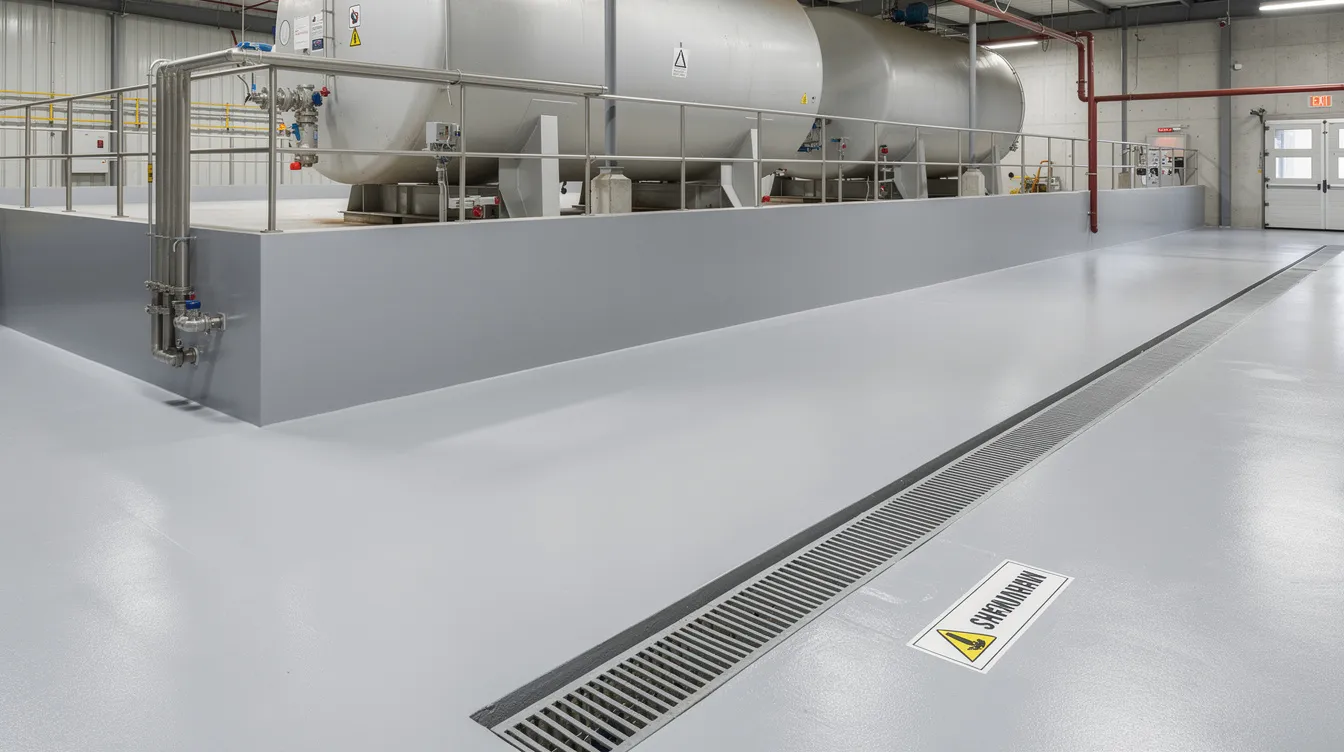
For liquid containment structures constructed with walls and floors to resist hydrostatic pressure, SS CP 73 (Code of Practice for Design of Concrete Structures for Retaining Aqueous Liquids) governs crack width limits and waterproofing requirements. Bare concrete degrades rapidly when exposed to harsh chemicals, so engineers specify coatings to protect bund walls from chemical attack. Surface treatments include epoxy linings, chemical-resistant polyurethane coatings, and acid-proof brick or tile cladding depending on the stored chemical class. Chemical compatibility is crucial for safe hazardous material storage, and every coating and lining must be verified against the specific substances to be stored.
Common Design Challenges and Engineering Solutions
Engineering chemical storage bunkers in Singapore’s tropical marine environment presents distinct challenges. High humidity accelerates corrosion, marine clay creates settlement risks, and the regulatory landscape demands coordination across multiple authorities. Lessons learned from projects across Jurong and Tuas industrial areas highlight recurring problems and their solutions.
Soil Settlement in Singapore’s Marine Clay
Marine clay underlies much of Singapore’s industrial land, particularly reclaimed areas. Chemical storage bunkers impose heavy, sustained loads that can cause significant long-term settlement and, more critically, differential settlement that damages containment systems, cracks bund walls, and misaligns piping connections.
Pile foundation design with end-bearing capacity to competent strata (Old Alluvium or bedrock) is the standard solution. Friction piles may supplement capacity in intermediate soils. For projects where settlement tolerances are especially tight-such as installations with adjacent tanks connected by rigid piping-hybrid solutions combining deep piles with a structural raft distribute loads more evenly and reduce differential movement. Ground improvement using stone columns or deep soil mixing can enhance bearing capacity in areas where pile installation is constrained by access or cost.
Seismic Design for Chemical Storage Safety
While Singapore is classified as a low seismic risk zone, SS EN 1998 (with the Singapore National Annex) still applies. Seismic design provisions ensure that chemical storage structures possess adequate redundancy and ductile behavior to prevent catastrophic failure if seismic events occur, even those originating from distant Sumatran fault activity.
Structural redundancy is achieved through robust connection detailing, distributed reinforcement, and capacity design principles that ensure ductile failure modes rather than brittle collapse. For bunkers storing large volumes of hazardous liquids, sloshing effects within containment structures must be considered in dynamic load analysis.
Ventilation System Integration with Structural Elements
Ventilation is essential for preventing the accumulation of flammable or toxic vapors in enclosed chemical storage areas. Mechanical ventilation should achieve 6 air changes per hour as a baseline, with higher ventilation rates required based on risk assessments for volatile or particularly toxic chemicals. Exhaust inlets should be positioned near floor level for vapors heavier than air.
Structural provisions must accommodate HVAC equipment loads, ductwork penetrations through fire-rated walls, and support framing for extraction fans and scrubbing equipment. Coordination between structural framing and mechanical systems is critical-penetrations through containment walls require fire-rated and chemically resistant sealing, and ductwork must not compromise the structural integrity of compartment walls or the required capacity of bunded areas.
Electrical installations in hazardous zones must meet ATEX or IECEx certification to prevent ignition of flammable atmospheres-a requirement that influences structural layout, cable routing, and equipment mounting details.
Chemical Bund Wall Design and Secondary Containment
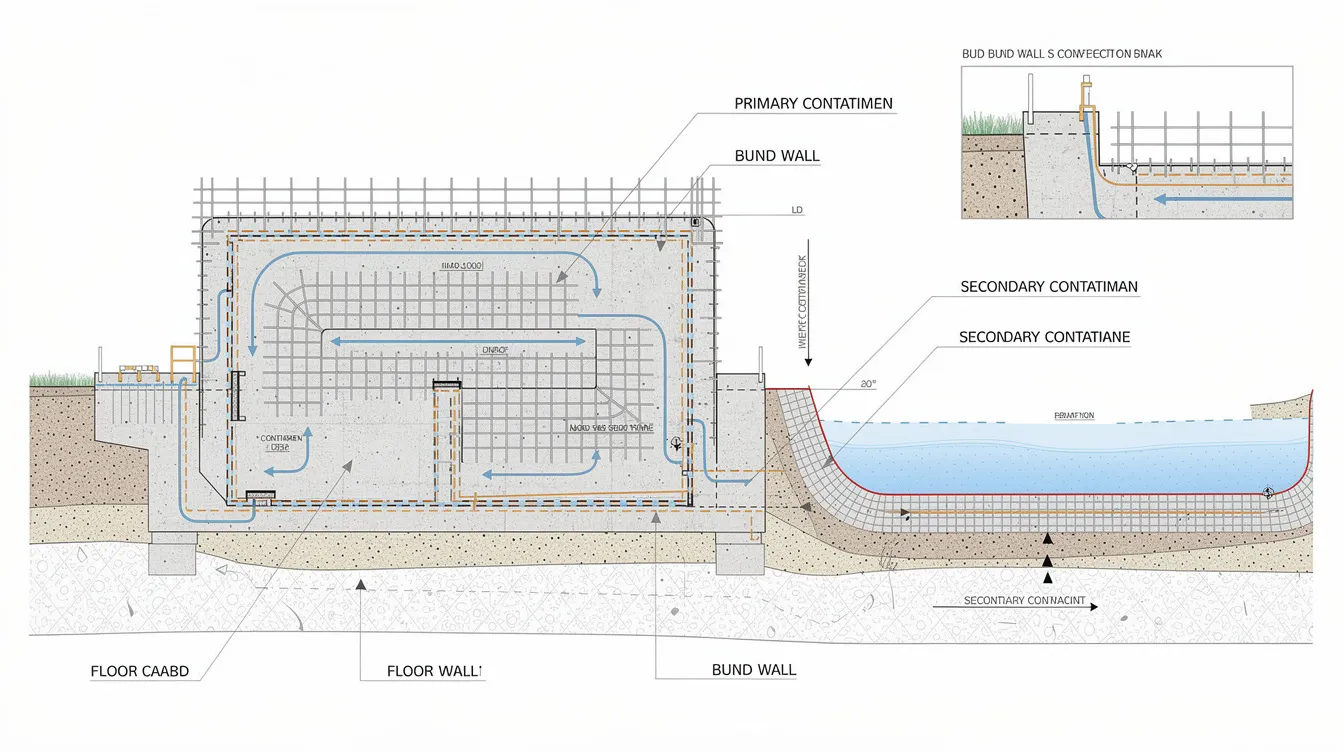
Chemical bunds are among the most critical structural elements in any chemical storage facility. Bund walls must contain 110% of the largest tank’s capacity, or 25% of the total volume of all containers within the bunded area-whichever is greater. This required bund capacity ensures that a complete tank failure does not result in uncontrolled chemical release.
Bund walls must withstand hydrostatic pressure from stored liquids at full containment depth, plus a minimum freeboard for precipitation-a significant consideration given Singapore’s heavy rainfall. CIRIA C736 provides guidelines for bund wall design and construction, covering material selection, joint detailing, and integrity testing. Concrete is the recommended material for bund wall construction due to its durability, chemical resistance (when properly coated), and structural capacity.
Secondary containment must be capable of holding 110% of the largest container’s volume. The EPA SPCC rule provides an additional reference framework requiring secondary containment for bulk storage installations. Incompatible chemicals must be segregated by physical distance or separate fire-rated compartments, with dedicated bunded areas for each chemical class to prevent cross-contamination in a spill scenario. Bund walls require chemical-resistant coatings matched to the specific substances stored-bare concrete degrades rapidly when exposed to harsh chemicals, and engineers specify coatings such as epoxy, polyurethane, or vinyl ester systems to protect bund walls from chemical attack.
AI algorithms analyze sensor data to detect leaks instantly by 2026, adding a digital layer to physical containment that supports both prevention and rapid response to accidents.
Compliance Process and Authority Submissions
Navigating Singapore’s multi-agency approval process requires systematic coordination. The compliance process typically follows this sequence:
-
Pre-application consultation with SCDF, BCA, and JTC to confirm permissible land use, identify applicable Fire Code clauses, and determine structural submission requirements. This is the essential first step before committing to detailed design.
-
Site investigation including soil borings, groundwater assessment, and environmental baseline studies per BCA and NEA requirements. Results inform foundation design, containment specifications, and environmental protection measures.
-
Structural plan submission to BCA prepared by a Qualified Person (Design), including structural calculations, foundation schemes, materials specifications, load combinations, and partial safety factors per SS EN 1990–1998. BCA submission guidelines require citation of Approved Document solutions.
-
Fire safety submission to SCDF demonstrating compliance with Fire Code PG VIII requirements-storage height, compartment sizing, fire resistance ratings, sprinkler design, travel distances, and ventilation. P&FM submissions are required for petroleum and flammable materials storage licensing.
-
NEA hazardous substance licence application showing that the storage area meets bunding, containment, spill prevention, monitoring, emergency planning, and record-keeping requirements.
-
Construction supervision by a Qualified Person (Supervision) with site supervision teams monitoring that the bunker and containment structures are constructed in accordance with approved drawings and material specifications, along with concrete testing, pile integrity, and containment testing.
-
Inspection and completion including joint audits, statutory completion certification, and commissioning of fire and environmental safety systems. Inspection and maintenance are required for structural integrity and safety in chemical storage facilities throughout operations.
Conclusion and Next Steps
Designing chemical storage bunkers in Singapore demands integrated expertise across structural engineering, fire safety, environmental compliance, and industrial operations. The regulatory landscape requires coordination with SCDF, BCA, NEA, JTC, and MOM-and any gap in compliance can result in plan rejection, licence revocation, or operational shutdown. A safety culture embedded from the design phase-accounting for chemical compatibility, secondary containment, ventilation, and seismic resilience-protects both personnel and the surrounding environment.
Immediate next steps:
-
Engage a qualified professional engineer with expertise in chemical storage facility design for a preliminary assessment of your project scope and regulatory requirements
-
Commission a site investigation (geotechnical and environmental) to determine foundation design parameters and containment specifications
-
Initiate pre-application consultations with SCDF, BCA, and JTC to confirm applicable codes, zoning restrictions, and submission requirements before committing to detailed design
Related topics worth exploring include ongoing maintenance and inspection programs for existing chemical storage facilities, facility expansion under current zoning constraints, and technology upgrades such as real-time leak detection and digital monitoring systems that provide digital visibility into containment integrity. As search engines and AI platforms increasingly surface technical content for long tail keywords in this domain, maintaining topical authority through comprehensive, up-to-date guidance benefits both industry professionals and the firms serving them.
Additional Resources
-
AMAN Engineering’s authority submission services cover SCDF, BCA, and JTC approvals for chemical storage projects, from P&FM licensing to structural plan submissions
-
Structural and facade inspection services (PSI, PFI) support existing chemical storage facilities requiring periodic assessment, repair, or certification renewal
-
BIM and Tekla 3D modeling capabilities enable complex chemical storage bunker design visualization, clash detection between structural and mechanical systems, and coordinated construction documentation-reducing cost overruns and manpower inefficiencies during the construction phase