

Infrastructure compliance is defined as the mandatory adherence to building codes, safety standards, environmental regulations, and operational requirements that govern every phase of a construction or infrastructure project in Singapore. Property developers, construction professionals, and regulatory bodies must satisfy obligations set by authorities including the Building and Construction Authority (BCA), the Urban Redevelopment Authority (URA), the Singapore Civil Defence Force (SCDF), and the Public Utilities Board (PUB). Non-compliance carries serious consequences: project delays, financial penalties, reputational damage, and disqualification from government land sales. Singapore’s regulatory environment is tightening in 2026, with new enforcement mechanisms targeting both physical construction safety and digital infrastructure operations. Understanding infrastructure compliance regulations is no longer optional. It is a prerequisite for project approval, market access, and long-term operational viability.
What are the core regulatory standards for infrastructure compliance?
Singapore’s infrastructure compliance framework spans structural safety, energy efficiency, fire protection, environmental management, and digital infrastructure security. Each domain carries its own authority, code set, and audit cycle. Developers who treat these as separate silos consistently face coordination failures during statutory submissions.
The BCA Green Mark scheme anchors Singapore’s sustainability compliance requirements. Its Mandatory Energy Improvement (MEI) regime requires building owners to commission energy audits, submit improvement plans, implement approved measures, and maintain performance records. Penalties for MEI non-compliance commenced from september 30, 2025. The regime applies to existing commercial and industrial buildings above defined gross floor area thresholds, making it directly relevant to most large-scale development portfolios.

The proposed Digital Infrastructure Bill extends compliance obligations to data centers and cloud facilities embedded within construction projects. Fines up to SGD 1 million or 10% of annual turnover apply to major operators failing cybersecurity and operational standards. That scale of financial exposure makes digital infrastructure compliance a board-level risk, not a technical afterthought.
Pro Tip: Review the Singapore construction compliance checklist before submitting any development application. Identifying gaps at the pre-application stage costs far less than remediation after statutory review.
The table below summarizes the primary compliance areas, governing authorities, and key instruments:
| Compliance Area | Governing Authority | Key Instrument |
|---|---|---|
| Structural safety | BCA | Building Control Act |
| Energy efficiency | BCA | Green Mark MEI Regime |
| Fire safety | SCDF | Fire Safety Act |
| Urban planning and land use | URA | Master Plan and Development Control |
| Digital infrastructure security | IMDA / CSA | Digital Infrastructure Bill |
| Water and drainage | PUB | Code of Practice on Surface Water Drainage |
How do procedural compliance workflows and digital tools support compliance?
Singapore is moving from a punitive model to a procedural compliance approach that embeds regulatory checks into project workflows before violations occur. That shift changes how developers and engineers must structure their project delivery processes. Waiting for a statutory inspection to identify a non-compliant condition is no longer an acceptable risk management strategy.
Building Information Modeling (BIM) is the primary digital tool enabling this shift in Singapore. BIM integration at the design stage allows compliance parameters, such as structural load limits, fire compartmentalization requirements, and energy performance targets, to be embedded directly into the project model. Any design change that breaches a parameter triggers an automatic flag before the drawing reaches a statutory submission. This is a fundamentally different workflow from manual plan checking.
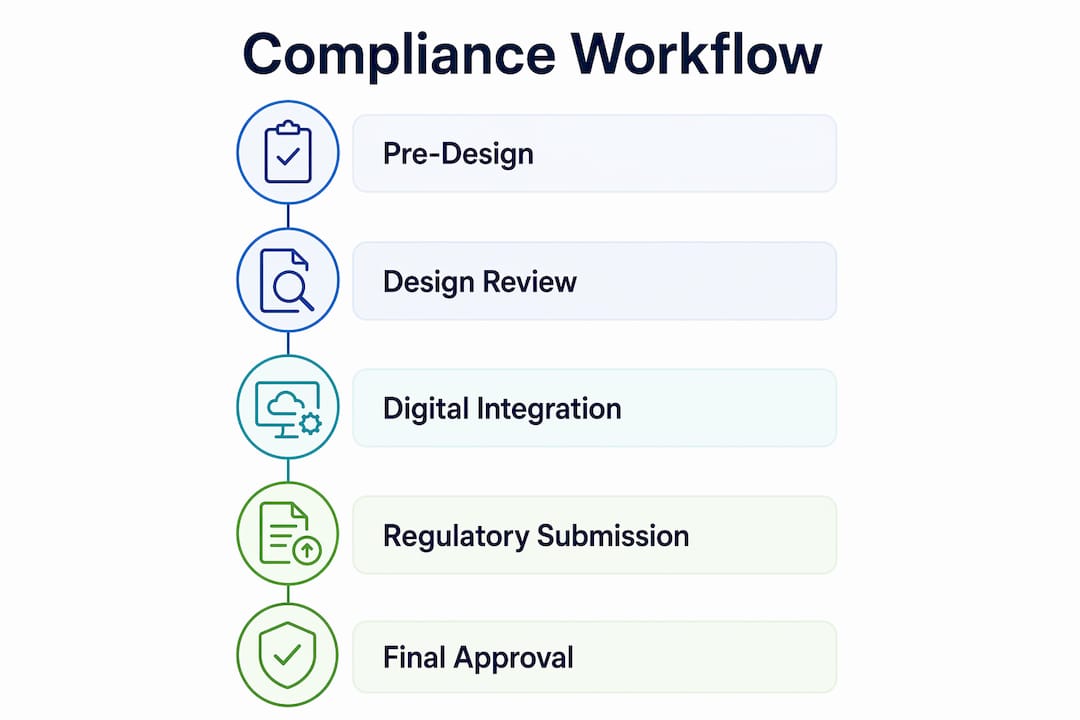
Embedding regulatory guardrails with automation integrates compliance checks into provisioning workflows and documentation pipelines. For digital infrastructure projects, this means policy-as-code approaches that validate configurations against IMDA and CSA requirements at every deployment stage. The result is continuous compliance monitoring rather than periodic audit snapshots.
Common pitfalls in manual compliance workflows include:
- Incomplete documentation at the point of statutory submission, causing rejection and resubmission cycles
- Version control failures where design changes are not reflected in compliance records
- Siloed discipline teams that do not cross-check structural, M&E, and fire safety requirements against each other
- Late-stage discovery of energy performance shortfalls that require costly redesign
- Inadequate audit trails for post-occupancy MEI reporting
Pro Tip: When selecting digital tools for compliance workflow support, prioritize platforms that produce audit-ready output formats accepted by BCA’s CORENET X system. A tool that generates compliant documentation natively eliminates a significant manual conversion step.
The engineering compliance workflow guide published by Com details how early-stage digital integration reduces statutory submission cycles and lowers the risk of enforcement action across BCA, URA, and SCDF submissions.
What are the consequences of infrastructure compliance failures?
Enforcement in Singapore is no longer limited to after-the-fact fines. Effective may 22, 2026, developers with severe safety breaches face no-sale license conditions and disqualification from Government Land Sales (GLS). That means a developer with an active safety enforcement action cannot sell units in an existing project or bid for new government land parcels simultaneously. The financial and reputational consequences compound rapidly.
Under the MEI regime, fines reach SGD 150,000 per event, with continuing penalties for persistent failures. A developer managing a portfolio of commercial buildings who misses multiple MEI audit deadlines faces cumulative exposure that can exceed the cost of the required energy retrofits. The penalty structure is designed to make non-compliance more expensive than compliance.
The enforcement mechanisms developers must account for include:
- No-sale license conditions: BCA can restrict a developer’s license to prevent new unit sales until safety defects are rectified.
- GLS disqualification: Developers with unresolved safety or defect issues are barred from participating in government land tenders.
- MEI financial penalties: Fines of up to SGD 150,000 per non-compliant event, with continuing daily penalties for unresolved breaches.
- Digital infrastructure fines: Proposed penalties of up to SGD 1 million or 10% of annual turnover for data center and cloud operators.
- Project stop-work orders: BCA and SCDF retain authority to halt construction activity for serious safety violations.
- Mandatory rectification orders: Authorities can require developers to fund and complete remediation works within specified timeframes.
The structural compliance checklist for 2026 provides a practical reference for developers assessing their current exposure across these enforcement categories.
Which digital standards and certifications are critical for Singapore compliance?
Singapore’s certification requirements for digital infrastructure exceed the baseline set by international frameworks. The Multi-Tier Cloud Security (MTCS) Tier 3 standard requires 535 prescriptive control points, quarterly reviews, and mandatory on-site vendor data center visits. That level of prescriptive detail surpasses SOC 2 requirements, which rely on principles-based criteria and annual audits. Developers integrating data center or cloud facilities into mixed-use or commercial projects must plan for MTCS Tier 3 certification timelines from the earliest project stages.
Singapore’s MTCS Tier 3 standard exceeds SOC 2 in both audit frequency and physical inspection requirements. That gap matters for project planning because MTCS certification cannot be obtained through documentation alone. It requires physical site access, vendor coordination, and quarterly audit cycles that must be built into the project schedule and operational budget.
Pro Tip: Engage a qualified certifying body for MTCS Tier 3 assessment during the design development stage, not after construction completion. Retrofitting physical security controls and access management systems post-construction is significantly more costly than designing them in from the start.
The table below compares the key certification frameworks relevant to Singapore infrastructure projects:
| Certification | Scope | Control Points | Audit Frequency |
|---|---|---|---|
| BCA Green Mark (MEI) | Building energy performance | Performance-based targets | Annual audit, ongoing reporting |
| MTCS Tier 3 | Cloud and data center security | 535 prescriptive controls | Quarterly reviews, on-site visits |
| SOC 2 | Cloud service operations | Principles-based criteria | Annual |
| ISO 27001 | Information security management | Risk-based controls | Annual surveillance, triennial recertification |
The building certification requirements for Singapore projects cover both physical and digital compliance domains. Developers who treat these as separate certification tracks risk creating gaps that neither track fully addresses. Integrated certification planning, coordinated across BCA, IMDA, and CSA requirements, produces a more defensible compliance position.
Singapore’s ambition to become a regulatory connectivity hub in the Asia-Pacific region means its compliance frameworks will increasingly serve as reference points for cross-border infrastructure projects. Developers with Singapore compliance experience carry a credential that transfers to other APAC markets.
Key Takeaways
Infrastructure compliance in Singapore requires simultaneous adherence to BCA, URA, SCDF, and IMDA standards, with enforcement mechanisms in 2026 that make non-compliance more costly than proactive compliance investment.
| Point | Details |
|---|---|
| Compliance is multi-authority | BCA, URA, SCDF, PUB, and IMDA each impose distinct obligations that must be coordinated across the project lifecycle. |
| MEI regime is active | BCA’s Mandatory Energy Improvement regime carries fines up to SGD 150,000 per event for non-compliant buildings. |
| Digital infrastructure is regulated | The proposed Digital Infrastructure Bill imposes fines up to SGD 1 million on data center and cloud operators failing cybersecurity standards. |
| Procedural compliance reduces risk | Embedding BIM and automated checks into design workflows prevents violations before statutory submission, not after. |
| Enforcement escalated in 2026 | Developers with safety breaches now face GLS disqualification and no-sale license conditions, not just financial penalties. |
Singapore’s compliance shift: what I’ve observed on the ground
From my experience working across BCA, URA, and SCDF submissions in Singapore, the most significant change in 2026 is not the penalty amounts. It is the structural shift from reactive enforcement to proactive disqualification. A developer who previously managed a safety breach through a fine and a rectification order now faces the possibility of losing access to the entire government land market. That changes the risk calculus at the board level, not just the project level.
The developers who handle this environment well are those who integrated BIM visualization and digital compliance workflows into their standard project delivery process before the regulatory pressure arrived. They did not adopt BIM because regulators required it. They adopted it because it reduced their coordination costs and submission rejection rates. The compliance benefit was a secondary gain that has now become a primary competitive advantage.
The area I see most underestimated is digital infrastructure compliance within mixed-use and commercial developments. Most developers focus on structural and fire safety compliance because those are the most visible enforcement domains. MTCS Tier 3 certification requirements for embedded data center facilities are less familiar, but the penalty exposure under the proposed Digital Infrastructure Bill is comparable to the most serious physical safety breaches. Developers who do not account for this in their project planning will face costly surprises during the operational phase.
Singapore’s position as a regulatory reference point for the Asia-Pacific region means that compliance standards here will only become more demanding over time. The developers and construction professionals who build genuine compliance capability now, rather than managing it as a project-by-project cost, will be better positioned as those standards evolve.
— Aman
How Com supports infrastructure compliance in Singapore
Com, operating as Aman Engineering Consultancy, provides end-to-end compliance support for property developers and construction professionals across Singapore’s full regulatory spectrum. The firm handles statutory submissions to BCA, URA, SCDF, PUB, and LTA, and integrates BIM modeling services directly into compliance documentation workflows.

Com’s engineering and architectural teams manage regulatory documentation, energy audit coordination under the MEI regime, and digital infrastructure compliance planning for mixed-use and commercial projects. For developers seeking a single point of accountability across multiple statutory authorities, Com’s consultancy model covers structural, facade, M&E, and fire safety compliance within one coordinated engagement. Contact Aman Engineering Consultancy to discuss your project’s compliance requirements and statutory submission timeline.
FAQ
What is infrastructure compliance in Singapore?
Infrastructure compliance is the process of meeting all regulatory requirements set by authorities including BCA, URA, SCDF, and PUB across the design, construction, and operational phases of a building or infrastructure project.
What penalties apply for non-compliance with BCA’s MEI regime?
Fines reach SGD 150,000 per non-compliant event, with continuing penalties for persistent failures under the Mandatory Energy Improvement regime.
How does BIM support infrastructure compliance workflows?
BIM embeds compliance parameters directly into the project model, flagging regulatory breaches automatically before statutory submission and reducing rejection rates during plan checking.
What is MTCS Tier 3 and why does it matter for developers?
MTCS Tier 3 is Singapore’s cloud security certification standard requiring 535 prescriptive control points, quarterly reviews, and mandatory on-site inspections. It applies to data center and cloud facilities within commercial and mixed-use developments.
What enforcement actions took effect in 2026 for Singapore developers?
Effective may 22, 2026, developers with severe safety breaches face no-sale license conditions and disqualification from Government Land Sales, in addition to existing financial penalty mechanisms.