
Project risk assessment is the systematic process of identifying, evaluating, and prioritizing potential threats to a project’s cost, schedule, scope, and quality before those threats become costly problems. For project managers, real estate developers, and construction professionals, understanding why project risk assessment is non-negotiable separates projects that deliver on time and within budget from those that spiral into disputes and write-offs. The standard industry term is project risk management, of which risk assessment forms the foundational analytical phase. Tools such as PMI risk registers, ISO 31000 frameworks, and probability-impact matrices give structure to what would otherwise be guesswork. This article explains the importance of project risk assessment, how to conduct it effectively, and how to avoid the pitfalls that undermine even well-resourced projects.
What are the main benefits of project risk assessment?
Project risk assessment converts vague uncertainty into specific, actionable intelligence for better planning and control. That shift from reactive to proactive management is the single greatest advantage it delivers.
Improved Predictability Across Cost, Schedule, and Scope

Proactive risk analysis improves predictability and delivery confidence by turning passive threats into tasks with owners, timelines, and mitigation budgets. A construction project that has modeled its top ten risks enters each phase with a defensible contingency figure rather than an arbitrary percentage added to the estimate.
Regulatory Compliance and Audit Readiness
Risk assessment is directly tied to compliance with standards such as ISO 27001:2022 and Singapore’s BCA regulatory framework. Automating and standardizing risk management workflows can reduce monthly reporting time by 30–50% and cut ISO 27001:2022 audit preparation from weeks to hours. For developers managing multiple statutory submissions across agencies such as URA, JTC, and SCDF, that time saving is operationally significant.
Resource Allocation and Cost Control
The benefits of risk assessment extend directly into resource planning. When risks are quantified, project managers can allocate contingency budgets to the threats most likely to materialize rather than spreading resources thin across every conceivable scenario. This precision reduces waste and protects project margins.
Key operational benefits include:
- Earlier identification of design conflicts, site constraints, and supply chain vulnerabilities
- Reduced frequency of expensive variation orders caused by unmanaged surprises
- Stronger stakeholder confidence through transparent, evidence-based reporting
- Faster regulatory submissions backed by documented risk controls
- Improved subcontractor and procurement planning aligned to risk-adjusted schedules
How is project risk assessment conducted effectively?
Effective risk assessment follows a structured sequence. Skipping steps or compressing the process to meet schedule pressure is the most common cause of incomplete risk registers.
The Core Process
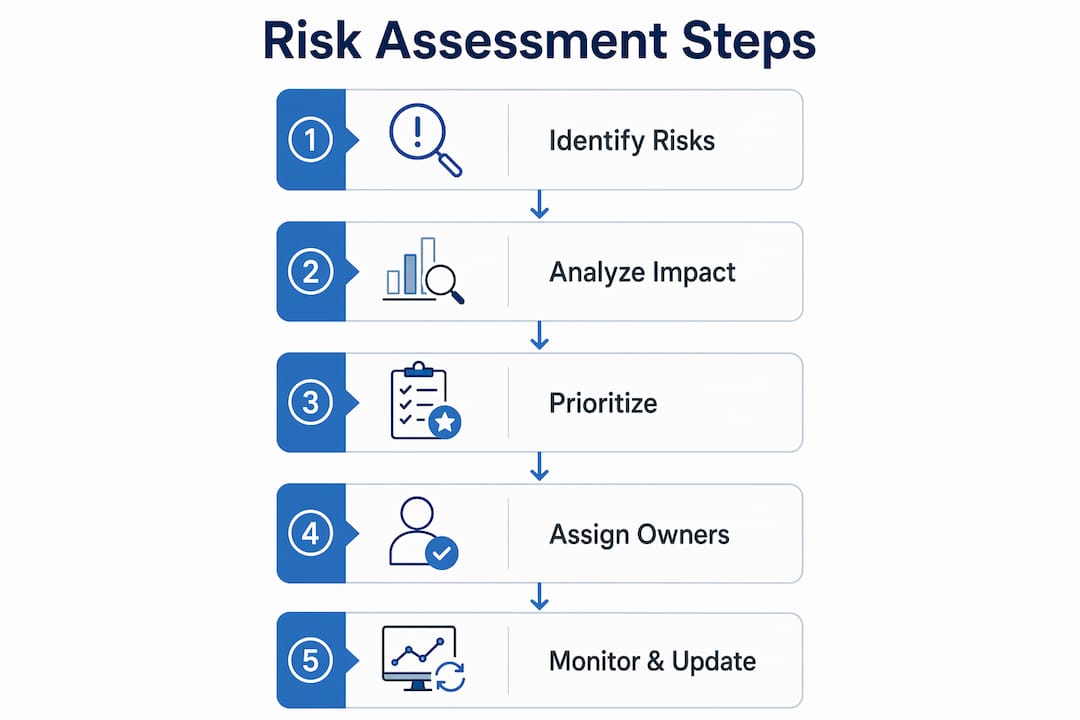
- Risk Identification: Gather input from the project team, subcontractors, and subject matter experts. Use structured workshops, checklists aligned to project type, and historical data from comparable projects. For construction and real estate, common categories include geotechnical conditions, regulatory approval timelines, material price escalation, and labor availability.
- Qualitative Analysis: Score each identified risk using a probability-impact matrix. Assign likelihood ratings (low, medium, high) and consequence ratings across cost, schedule, and safety dimensions. This step prioritizes which risks warrant deeper analysis.
- Quantitative Analysis: Apply numerical methods to high-priority risks. Monte Carlo simulation, for example, runs thousands of scenario iterations to produce a probability distribution of project outcomes. Quantitative methods like Monte Carlo provide data-backed likelihood and impact assessments that support defensible mitigation planning.
- Risk Prioritization and Response Planning: Assign a risk owner to each significant risk. Define the response strategy: avoid, transfer, mitigate, or accept. Document trigger conditions and escalation paths.
- Continuous Monitoring and Updating: Review the risk register at every project milestone. Risks change as design progresses, site conditions are confirmed, and procurement commitments are made.
| Method | Best Use Case | Output |
|---|---|---|
| Probability-Impact Matrix | Early-stage qualitative screening | Prioritized risk list |
| Monte Carlo Simulation | Schedule and cost quantification | Probability distribution of outcomes |
| Sensitivity Analysis | Identifying which variables drive the most risk | Tornado chart ranking key drivers |
| Bow-Tie Analysis | Safety and regulatory risk mapping | Cause-consequence-control diagram |
Pro Tip: Register risks with a unique ID, a named owner, a review date, and a defined trigger condition. A risk entry without an owner and a trigger is a note, not a managed risk.
For construction professionals, Com’s guidance on risk assessment in construction provides a practical 2026 framework aligned to Singapore’s regulatory environment.
What are the common pitfalls in project risk assessment?
The most damaging failure in project risk management is not the absence of a risk register. It is the presence of a risk register that no one updates.
Static risk registers that are not updated become practically useless, causing project failure by missing evolving risks. A register completed during the design phase and never revisited will not capture the geotechnical surprises discovered during excavation or the regulatory change issued mid-construction.
Psychological and Organizational Barriers
Optimism bias and organizational pressure lead to systematic underestimation of risk severity. Project teams under commercial pressure to win bids or meet internal targets will unconsciously discount threats that complicate their narrative. This is not dishonesty. It is a documented cognitive pattern that requires deliberate structural countermeasures.
Common pitfalls to address include:
- Treating risk assessment as a one-time deliverable rather than a continuous monitoring process
- Confusing risks (future uncertainties) with issues (problems already occurring), which distorts response planning
- Assigning risks without defined owners, leaving accountability unclear when escalation is needed
- Allowing senior stakeholder pressure to suppress realistic probability ratings
- Failing to distinguish between inherent risk (before controls) and residual risk (after controls)
Pro Tip: Create a psychologically safe environment for risk identification. Hold anonymous pre-mortem sessions where team members write down what they believe will go wrong before the project begins. The results consistently surface risks that formal workshops miss.
For property professionals managing compliance across multiple agencies, Com’s resource on building risk assessment addresses how structured risk processes support audit readiness.
How does risk assessment integrate with portfolio and compliance management?
Project risk assessment delivers compounding value when applied consistently across a portfolio of projects rather than in isolation. Integrating risk information at project and portfolio levels significantly increases overall project success rates. That integration allows leadership to see where risks cluster, which projects share common threats, and where mitigation resources should be concentrated.
Organizations that standardize their risk management frameworks gain a measurable efficiency advantage. Standardized frameworks build organizational maturity and enable management of portfolio-wide risks. For a developer running five concurrent construction projects across Singapore, a standardized risk taxonomy means that lessons from one project transfer directly to the next.
The control reuse benefit is equally significant. Organizations using effective risk assessment can reuse 70–80% of mapped controls across projects, avoiding costly duplication. This means a compliance control developed for a BCA submission on one project can be adapted for a structurally similar project without rebuilding the documentation from scratch.
| Integration Level | Primary Benefit | Relevant Standard |
|---|---|---|
| Single Project | Improved cost and schedule predictability | ISO 31000, PMI PMBOK |
| Multi-Project Portfolio | Shared risk intelligence and control reuse | Gartner ERM Framework |
| Regulatory Compliance | Audit readiness and statutory submission support | ISO 27001:2022, BCA Guidelines |
| Organizational Maturity | Reduced duplication, faster onboarding of new projects | PRINCE2, Singapore BCA Code |
Com’s risk assessment registers service provides standardized documentation aligned to Singapore’s statutory requirements, supporting both single-project and portfolio-level risk management.
Practical applications in real estate and construction projects
Construction and real estate projects carry risk profiles that differ materially from software or service projects. Physical site conditions, regulatory approval sequences, and multi-party contract structures create interdependencies that amplify the consequences of unmanaged risk.
The importance of project risk assessment in construction is most visible in three areas: timeline protection, budget integrity, and contractor coordination. A developer who has assessed the risk of delayed URA approval can build a realistic buffer into the construction program rather than discovering the delay after the main contractor has mobilized.
Specific risk categories that construction and real estate professionals must address include:
- Geotechnical and ground condition risks: Unexpected soil conditions are among the most expensive construction risks. Early geotechnical investigation and risk scoring reduce the probability of costly design changes during excavation.
- Regulatory approval timeline risks: Submissions to BCA, LTA, PUB, and SCDF each carry their own review timelines. Risk assessment maps these dependencies and identifies which approval delays have the greatest schedule impact.
- Material and supply chain risks: Price escalation clauses and lead time variability for structural steel, precast elements, and M&E equipment require explicit risk modeling, particularly for projects with fixed-price contracts.
- Contractor performance risks: Subcontractor financial stability, labor availability, and quality management capability are assessable risks that affect both schedule and defect liability exposure.
- Safety and environmental risks: Demolition hazards and climate considerations in groundworks require dedicated risk assessment to protect workers, adjacent properties, and project timelines.
For project managers implementing risk assessment for the first time, Com’s project planning tips for 2026 provide a structured starting point aligned to current Singapore construction practice.
Key takeaways
Effective project risk assessment transforms uncertainty into structured, manageable data that protects cost, schedule, and compliance outcomes across every phase of a construction or real estate project.
| Point | Details |
|---|---|
| Risk assessment is a continuous process | Update the risk register at every project milestone, not only at project initiation. |
| Quantitative methods improve defensibility | Monte Carlo simulation and sensitivity analysis produce probability-backed contingency figures. |
| Portfolio integration multiplies value | Standardized frameworks allow 70–80% control reuse across projects, reducing duplication costs. |
| Psychological bias must be managed | Structured pre-mortem sessions and anonymous input counter optimism bias in risk scoring. |
| Compliance and audit readiness depend on it | Automated risk workflows can cut ISO 27001:2022 audit preparation from weeks to hours. |
Risk assessment is not a checkbox. it is a management discipline.
After working across construction and infrastructure projects in Singapore and the wider ASEAN region, the pattern I observe most consistently is this: teams that treat risk assessment as a document to produce at project kick-off and file away are the same teams that face the most expensive surprises at construction stage.
The shift that changes outcomes is treating the risk register as a living management tool. That means assigning named owners, setting review dates, and creating a team culture where raising a risk is recognized as professional competence rather than pessimism. The projects I have seen deliver on time and within budget are not the ones with the fewest risks. They are the ones where risks were identified early, quantified honestly, and tracked actively.
Technology accelerates this discipline. BIM-integrated risk modeling, digital risk registers, and automated reporting tools reduce the administrative burden that causes teams to let registers go stale. The goal is not to eliminate uncertainty. It is to ensure that no significant uncertainty goes unexamined.
My advice to project managers and developers is direct: invest in the risk assessment process before the contract is signed, not after the first problem surfaces. The cost of a thorough risk assessment is a fraction of the cost of a single unmanaged risk event on a live construction site.
— Aman
How Com supports project risk assessment and management
Com (Aman Engineering Consultancy) provides integrated engineering and project management services that embed risk assessment at every stage of the project lifecycle, from feasibility study through statutory submission and construction oversight.

Com’s team supports developers and construction professionals with structured risk assessment registers, BIM-integrated risk modeling, and compliance documentation aligned to BCA, URA, JTC, SCDF, and LTA requirements. Whether you are managing a single development or a multi-project portfolio in Singapore, Com delivers the technical depth and regulatory knowledge needed to protect your project outcomes. Visit Aman Engineering Consultancy to discuss how a structured risk assessment program can be built into your next project from day one.
FAQ
What is project risk assessment?
Project risk assessment is the structured process of identifying, analyzing, and prioritizing potential threats to a project’s cost, schedule, scope, and quality. It forms the analytical foundation of project risk management and uses tools such as probability-impact matrices, risk registers, and Monte Carlo simulation.
Why does risk assessment matter in construction projects?
Construction projects face geotechnical, regulatory, supply chain, and contractor performance risks that can materially affect budgets and timelines. Proactive risk assessment identifies these threats early, widening the response window and reducing mitigation costs compared to reactive approaches.
How often should a project risk register be updated?
A risk register should be reviewed and updated at every major project milestone, including design completion, procurement award, and construction stage transitions. Static registers that are not updated become practically useless and risk missing evolving threats.
What is the difference between qualitative and quantitative risk analysis?
Qualitative analysis scores risks by probability and impact using descriptive ratings to prioritize which risks require further attention. Quantitative analysis applies numerical methods such as Monte Carlo simulation to produce probability distributions of project outcomes, supporting defensible contingency planning.
How does risk assessment support regulatory compliance in singapore?
Structured risk assessment documents the controls applied to regulatory risks across agencies such as BCA, URA, and SCDF, supporting audit readiness and statutory submission accuracy. Standardized workflows can reduce audit preparation time significantly, aligning with requirements under frameworks such as ISO 31000 and BCA guidelines.