

Building valuation is defined as the professional estimation of a building’s monetary value at a specified date, using recognized valuation approaches and professional judgment rather than guesswork. For property developers, real estate investors, and building owners in Singapore and beyond, understanding this process is not optional. It determines whether a financing application succeeds, whether an acquisition price is defensible, and whether a development project will generate the returns projected. The industry standard frameworks governing this process are set by RICS (Royal Institution of Chartered Surveyors) and IVS (International Valuation Standards), both of which define the scope, basis, and methodology requirements that a credible valuation must satisfy.
What is building valuation and why does it matter?
Building valuation is the structured process of determining a property’s monetary worth at a defined point in time, applying one or more recognized approaches to produce a defensible, professional opinion of value. The term is often used interchangeably with “property appraisal” or “building appraisal,” though in professional practice the RICS Red Book and IVS frameworks use “valuation” as the precise standard term.
The importance of building valuation extends across every stage of a property’s lifecycle. Lenders require a formal valuation before approving mortgage or construction finance. Investors rely on it to assess acquisition pricing and projected returns. Developers use it to determine residual land value and project feasibility before committing capital. Building owners need it for insurance replacement cost assessments, asset disposal, or portfolio reporting.

Without a properly scoped valuation, each of these decisions rests on assumptions that may not withstand scrutiny. The RICS Red Book requires that any figure presented as a valuation must include a defined scope, a stated basis of value, appropriate inquiry and analysis, and professional judgment. A number produced without these elements is an estimate, not a valuation, and carries no professional liability protection for the client relying on it.
What are the primary approaches to building valuation?
Three core valuation approaches exist in professional practice: the market approach, the income approach, and the cost approach. Each provides a distinct analytical framework, and the selection of which to apply depends on the property type, available data, and the purpose of the valuation.
Market approach
The market approach determines value by analyzing comparable sales or listings in the open market. Valuers identify transactions involving similar properties, then adjust for differences in location, size, condition, age, and specification. This approach is most reliable when a sufficient volume of comparable transactions exists, as is typical for standard residential or commercial office buildings in active markets.
Income approach
The income approach converts a property’s projected income stream into a present value. The most widely applied method within this approach is direct capitalization, where value equals Net Operating Income (NOI) divided by the market capitalization rate. For commercial property valuation, this is the dominant approach because it directly reflects the investment rationale of the buyer.
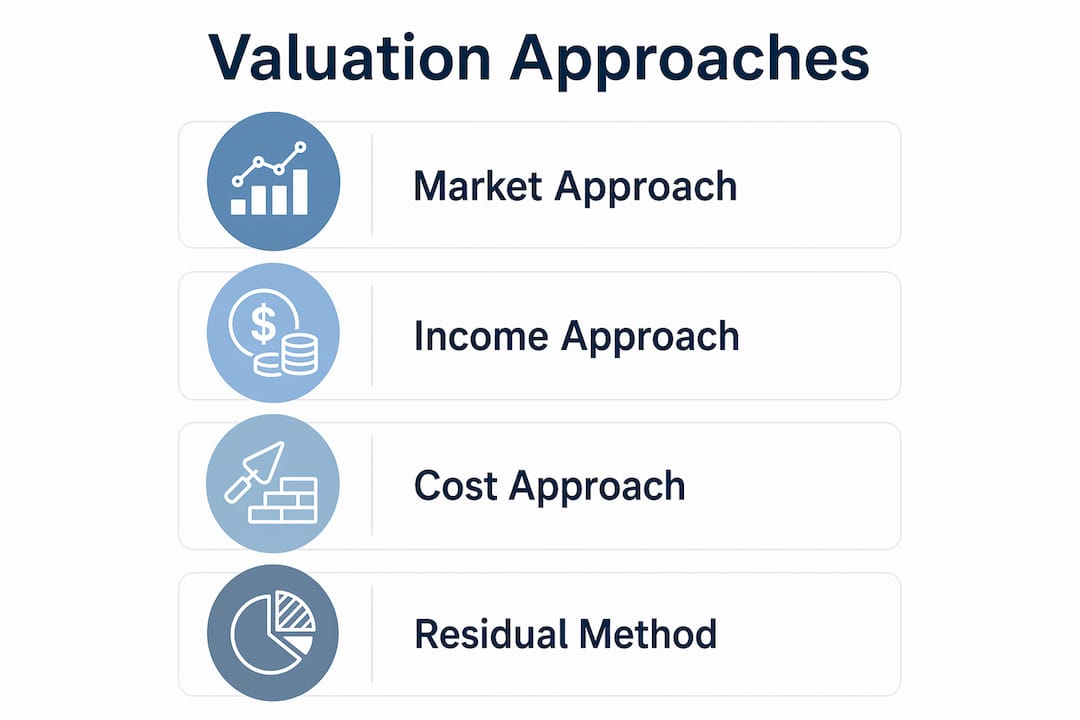
Cost approach
The cost approach estimates value by calculating the cost to replace or reproduce the building at current prices, then deducting depreciation for physical deterioration, functional obsolescence, and economic obsolescence, before adding land value. This approach is most applicable to specialized or owner-occupied buildings where comparable market transactions are scarce.
The table below summarizes the three approaches and their primary applications:
| Approach | Core Method | Best Applied When |
|---|---|---|
| Market | Comparable sales analysis | Active market with sufficient transaction data |
| Income | NOI capitalization or DCF | Income-producing commercial or investment properties |
| Cost | Depreciated replacement cost | Specialized buildings, limited market comparables |
Pro Tip: When the purpose of valuation is financing a commercial asset, lenders typically require the income approach as the primary method, with the market approach used as a cross-check. Confirm the lender’s requirements before commissioning the valuation.
How do valuation methods and models support building valuation?
Understanding the distinction between approaches, methods, and models is critical for developers and investors who commission or review valuations. Distinguishing these three levels clarifies how valuers derive and justify their value opinions within professional standards.
- Valuation approaches are the three broad frameworks described above: market, income, and cost. They define the conceptual basis for the analysis.
- Valuation methods are the specific techniques applied within each approach. Within the income approach, for example, the investment method and the discounted cash flow (DCF) method are two distinct methods. The investment method applies a single capitalization rate to a stabilized income figure. The DCF method projects income and expenses over a defined holding period and discounts them to present value using a target rate of return.
- Valuation models are the mathematical or computational tools used to execute a method. A capitalization model, a DCF spreadsheet, or a residual development appraisal model are all examples.
The RICS Valuation Professional Standards (VPS) and IVS frameworks require valuers to select methods and models appropriate to the property type, the available data, and the purpose of the valuation. A valuer applying the DCF method to a stabilized retail asset must justify the discount rate, the projected rental growth, and the exit yield assumptions. Each of these inputs requires professional judgment grounded in market evidence, not arbitrary selection.
Sound income property valuation requires aligning the capitalization rate with the asset’s risk profile and carefully classifying income and expense items to avoid misvaluation. A gross income figure that includes non-recurring items, or an expense figure that omits management costs, will produce a distorted NOI and therefore a distorted value conclusion.
Pro Tip: Request that your valuer provide a written explanation of the method and model selected, including the key assumptions. This is standard practice under RICS VPS and gives you a basis to challenge inputs that appear inconsistent with market conditions.
What role does the valuation purpose and report play in the process?
The purpose of a valuation determines which approach and methods are most suitable, and it must be defined before the valuation commences. RICS requires valuers to select approaches aligned with the stated purpose, whether that purpose is secured lending, sale, acquisition, development appraisal, or financial reporting.
A valuation report produced for a bank financing a commercial acquisition will differ materially from one produced for a developer assessing land purchase feasibility. The basis of value, the scope of inquiry, and the methods applied will all reflect the specific purpose. Presenting a report prepared for one purpose in a different context creates significant misinterpretation risk and potential professional liability.
The building appraisal process under the RICS Red Book requires the following elements to be clearly stated in every report:
- Basis of value: The definition of value being reported, such as Market Value, Market Rent, or Fair Value, each of which carries a precise RICS/IVS definition.
- Valuation date: The specific date on which the value opinion applies. Market conditions change, and a valuation is only valid as of its stated date.
- Scope of work: The extent of inquiry, inspections, and data sources used. This defines what the valuer did and did not investigate.
- Assumptions and special assumptions: Any conditions assumed to be true that may differ from actual facts, such as assuming planning permission has been granted.
- Approach and method disclosure: A statement of which approaches and methods were applied and why.
When any of these elements is absent or ambiguous, the report’s reliability is compromised. Clients who rely on incomplete reports for financing or acquisition decisions expose themselves to material financial risk. A real estate engineering inspection conducted as part of the valuation process provides the physical condition data that underpins accurate depreciation assessments and scope compliance.
How do valuation approaches apply in practical scenarios?
The following examples illustrate how developers and investors apply the three approaches in practice.
Income approach: NOI capitalization example
A commercial office building generates an annual NOI of $1.5 million. Applying a market cap rate of 7.0%, the indicated value is $21.43 million. If market evidence supports a lower cap rate of 6.5%, reflecting stronger investor demand, the indicated value rises to $23.08 million. This $1.65 million swing from a single 50-basis-point cap rate adjustment illustrates the sensitivity of income approach valuations to input assumptions. Selecting the correct cap rate requires analysis of recent comparable investment transactions, not estimation.
Cost approach: depreciated replacement cost
For a specialized industrial facility or a purpose-built data center with few comparable sales, the cost approach provides the most defensible value indication. The valuer estimates the modern equivalent building cost at current construction rates, then deducts physical deterioration based on age and condition, functional obsolescence where the building’s design no longer meets current operational standards, and economic obsolescence where external market factors reduce value. Land value is then added to produce the depreciated replacement cost. Accurate cost data from quantity surveying records significantly improves the reliability of this calculation.
Residual method for development projects
Developers acquiring land for construction use the residual method to determine the maximum supportable land price. The valuer estimates the Gross Development Value (GDV) of the completed scheme by capitalizing projected market rents at an appropriate yield, or by reference to comparable sales. Development costs, finance costs, professional fees, and developer’s profit are then deducted from the GDV. The residual figure represents the land market value. Residual method valuations are highly sensitive to assumptions on costs, timing, and GDV, requiring expert judgment to accurately assess feasibility. A 5% increase in construction costs or a 10-basis-point shift in exit yield can materially alter the residual land value and therefore the viability of the project.
The table below illustrates a simplified residual calculation:
| Component | Amount (SGD) |
|---|---|
| Gross Development Value (GDV) | $18,000,000 |
| Less: Construction costs | ($9,500,000) |
| Less: Professional fees (8% of construction) | ($760,000) |
| Less: Finance costs | ($600,000) |
| Less: Developer’s profit (15% of GDV) | ($2,700,000) |
| Residual land value | $4,440,000 |
Pro Tip: Always triangulate across at least two approaches when the valuation will support a major financing or acquisition decision. Professional valuers reconcile evidence from market, income, and cost approaches, weighting each based on data quality and asset type. A single-method valuation carries higher uncertainty, particularly in thin or volatile markets.
Key takeaways
Accurate building valuation requires selecting the correct approach, defining the purpose clearly, and applying professional judgment to every input assumption.
| Point | Details |
|---|---|
| Three core approaches | Market, income, and cost approaches each serve distinct property types and valuation purposes. |
| Purpose determines method | The valuation purpose, whether financing, sale, or development, dictates which approach and method the valuer applies. |
| Income approach sensitivity | A 50-basis-point cap rate change can shift a $21M valuation by over $1.6M, making input precision critical. |
| Report scope requirements | RICS Red Book mandates basis of value, valuation date, scope, assumptions, and method disclosure in every report. |
| Triangulation improves reliability | Reconciling multiple approaches weighted by data quality produces more defensible value conclusions. |
Valuation as a strategic tool, not a compliance exercise
From my experience working with developers and investors across Singapore and the region, the most costly valuation errors do not arise from incorrect calculations. They arise from a failure to define the purpose and scope before the valuation commences. A developer who commissions a valuation for internal feasibility review and then presents it to a lender as a financing valuation is operating outside the scope of that report. The RICS Red Book exists precisely to prevent this kind of misapplication, and yet it remains one of the most common sources of dispute in property transactions.
The income approach is particularly vulnerable to optimistic assumptions. I have reviewed development appraisals where projected market rents were based on a single comparable transaction from a different submarket, and where the exit yield was set 50 basis points below the current market consensus. The resulting GDV was materially overstated, and the residual land value was therefore unreliable as a basis for acquisition. Triangulating with the cost approach and a conservative market approach cross-check would have identified the discrepancy before the developer committed capital.
The practical value of understanding valuation methods for investors lies not in replacing the professional valuer but in equipping you to interrogate the assumptions in the report you receive. Ask why the cap rate was selected. Ask what comparable transactions support the GDV estimate. Ask what depreciation rate was applied and on what basis. These questions do not undermine the valuer’s authority. They demonstrate that you are using the valuation as the strategic decision-making tool it is designed to be, rather than treating it as a formality to satisfy a lender’s checklist.
— Aman
How Aman Engineering Consultancy supports your valuation needs

Aman Engineering Consultancy provides integrated building valuation and engineering consultancy services for property developers, real estate investors, and building owners across Singapore and international markets. The firm’s expertise spans the full valuation process, from physical condition assessments and quantity surveying services that underpin cost approach calculations, to value engineering solutions that optimize development feasibility. Every engagement is conducted in accordance with RICS and IVS professional standards, with clear scope definition, stated basis of value, and full methodology disclosure. Contact Aman Engineering Consultancy to commission a standards-compliant valuation or to discuss how integrated engineering and valuation consultancy can support your next development or investment decision.
FAQ
What is building valuation in simple terms?
Building valuation is the professional process of estimating a building’s monetary value at a specific date using recognized approaches such as the market, income, or cost method. The result is a formal opinion of value supported by data, analysis, and professional judgment under RICS or IVS standards.
What are the three main methods of building valuation?
The three primary approaches are the market approach, which uses comparable sales data; the income approach, which converts NOI to value using a capitalization rate; and the cost approach, which estimates depreciated replacement cost plus land value.
How does valuation purpose affect the building appraisal process?
The stated purpose of the valuation, whether for secured lending, sale, or development appraisal, determines which approach and methods the valuer applies. A report prepared for one purpose cannot be reliably used for a different purpose without a revised scope and methodology.
Why is the income approach sensitive to small assumption changes?
Changing the capitalization rate from 7.0% to 6.5% on a property with $1.5 million NOI increases the indicated value from $21.43 million to $23.08 million. This sensitivity means that cap rate selection must be grounded in verified comparable investment transactions, not approximation.
What must a compliant valuation report include?
Under the RICS Red Book, a compliant report must state the basis of value, valuation date, scope of work, all assumptions and special assumptions, and the approaches and methods applied. Omitting any of these elements reduces the report’s reliability and exposes the client to misinterpretation risk.