
Temporary Works PE Endorsement for Temporary Access Bridges: Scope, Requirements and Practice Guide
Introduction
Temporary works PE endorsement for temporary access bridges is a formal certification by a registered Professional Engineer confirming that a temporary bridge design is structurally safe, compliant with Singapore’s regulatory requirements, and fit for its intended construction use. Without this endorsement, contractors face serious legal liability, potential stop-work orders, and the risk of catastrophic structural failures on active construction sites.
This guide focuses specifically on temporary vehicular and pedestrian access bridges used during construction-haul bridges, plant access crossings, and temporary diversions-regulated under MOM’s WSH framework and BCA’s Building Control regime. It does not cover permanent bridge design, long-term asset management, or non-bridge temporary structures such as hoardings or access scaffolds. The target audience includes main contractors, infrastructure project managers, method engineers, safety officers, and developers working on LTA, JTC, JRL/CRL/MRT, and industrial or logistics projects across Singapore and the ASEAN region.
Why does this matter? Temporary access bridges carry heavy dynamic loads over waterways, live roads, drains, and live rail corridors during the most hazardous stages of construction. Over 60 major catastrophic failures in construction have been reported since 2012, many traceable to design errors in temporary works. PE endorsement defines a clear, safe operating envelope-specifying loading limits, vehicle types, speed restrictions, and maintenance obligations-that protects workers, the public, and the contractor’s programme from avoidable failures and project delays.
By the end of this guide, you will:
- Understand what counts as a temporary access bridge and when PE endorsement is mandatory
- Know the typical technical checks a PE will perform before endorsing drawings and calculations
- See how scope, complexity, and authority requirements affect cost, programme, and documentation
- Follow a clear process to plan, budget, and engage AMAN Engineering Consultancy Pte Ltd for endorsement
- Learn common pitfalls-such as incomplete load data, alignment changes on site, and budget misalignment-and how to pre-empt them
Understanding Temporary Works PE Endorsement for Temporary Access Bridges
“Temporary works” in the context of access bridges refers to any structure erected solely during the construction stage-decks, abutments, supports, approach ramps-that will be removed once the permanent works are complete. These temporary structures may remain on site for 6 to 36 months, carrying construction traffic loads far heavier than what many permanent roads experience, yet they are not part of the finished infrastructure. Because temporary works failures can lead to catastrophic structural failures, temporary works must be endorsed by a Professional Engineer before erection.
The regulatory landscape governing these bridges involves multiple overlapping frameworks. MOM’s Workplace Safety and Health (Construction) Regulations assign statutory duties for design, checking, and supervision of temporary works to professional engineers and contractors. BCA’s Building Control Act defines obligations for structures-including bridges and deckings-while asset-owner specifications from agencies such as LTA, PUB, JTC, and NParks impose additional clearance, loading, and drainage requirements. AMAN Engineering Consultancy Pte Ltd operates within this regulatory ecosystem as a structural engineer and civil PE consultancy, providing design, independent review, and endorsement for temporary bridge solutions across Singapore’s infrastructure sector.
What Is a Temporary Access Bridge in Infrastructure Projects?
A temporary access bridge is a short- to medium-span structure built for a limited period-typically 6 to 36 months-to enable plant, trucks, mobile cranes, or pedestrians to cross drains, canals, live traffic corridors, rail corridors, culverts, or soft ground during construction. Unlike permanent works designed for 50–100 year service life, these bridges are engineered specifically for construction traffic loads, staged loading sequences, and sometimes seasonal flooding conditions unique to the construction site.
Specific examples common in Singapore include:
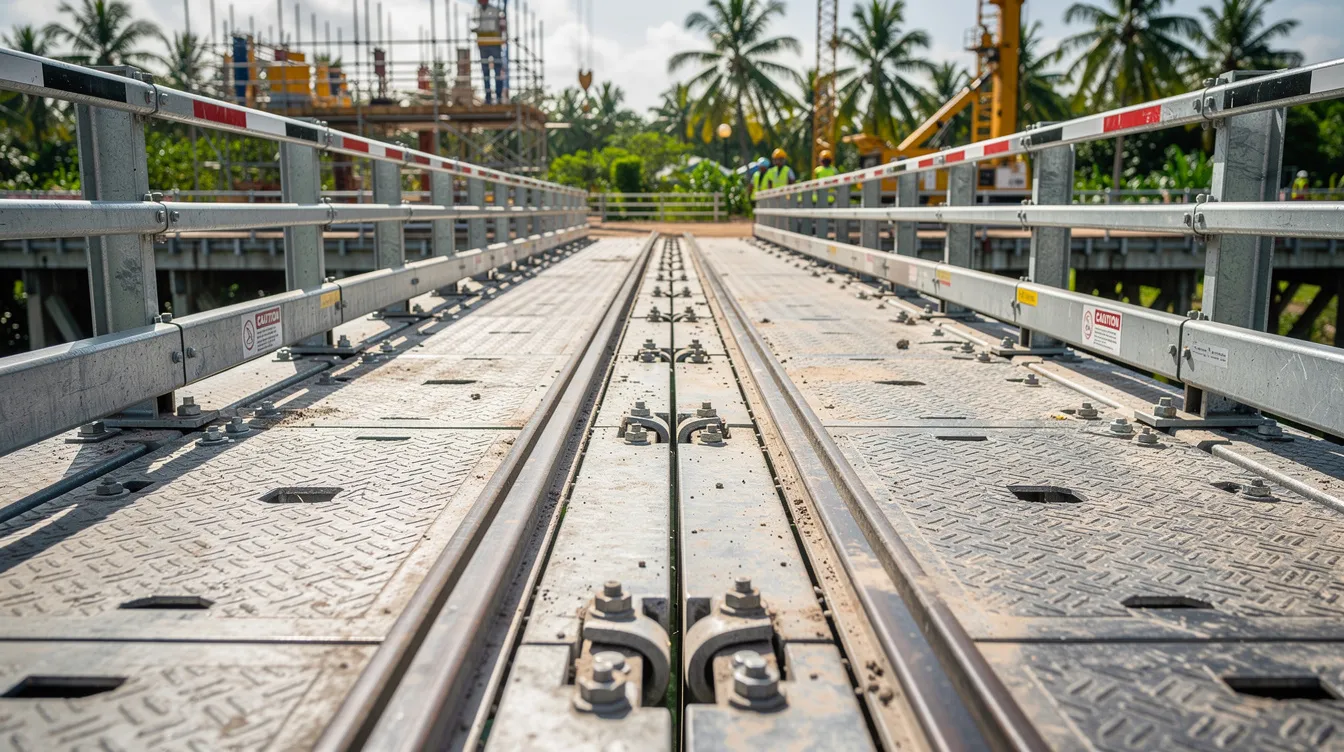
- Steel modular panel bridges spanning drains for tipper truck and concrete mixer access on canal-side developments
- Bailey-type bridges providing site access over new MRT cut-and-cover excavations on the Cross Rail Line or Jurong Region Line
- Timber or steel footbridges maintaining public pedestrian access during NParks park connector works
- Temporary vehicular diversions over canals for LTA road-widening projects or flyover construction
- Heavy-duty haul bridges rated for 60-tonne low loaders carrying precast segments to launch positions
These should not be confused with other temporary works such as scaffolding, shoring, formwork, excavation support, or working platforms for cranes, which have fundamentally different loading and detailing priorities. Nor should they be confused with permanent bridges subject to full authority submission and long-term durability requirements.
What Does PE Endorsement Actually Mean for Temporary Bridges?
PE endorsement means that a registered Professional Engineer-holding PE(Civil) or PE(Struct) registration in Singapore-signs and stamps design calculations and drawings, certifying that the temporary access bridge is structurally adequate and fit for its stated purpose. This is not a rubber stamp; it carries personal legal liability and professional responsibility for the safety of the design.
A comprehensive submission package for PE endorsement should include design calculations and structural drawings. Typical endorsed documents for a temporary access bridge include:
- General arrangement (GA) drawings showing spans, bearings, support conditions, abutments, and approach ramp geometry
- Member sizing and detail drawings for beams, decks, bracing, parapets/handrails, and bearing connections
- Design calculations covering global stability, bending, shear, deflection, and fatigue assessment where relevant
- Foundation design with bearing pressure, settlement, and scour or erosion checks
- Construction sequence sketches, temporary bracing layouts, and load restriction notes
The legal and contractual significance is substantial. Authorities and asset owners typically require endorsed drawings before issuing access approvals or permits. Endorsement documents specify loading limits and configuration constraints, forming an integral part of the contractor’s WSH documentation and risk assessments. Critically, a PE endorsement does not replace routine operational checks or separate statutory approvals-it establishes the design basis within which the bridge may safely operate. Any change to that basis triggers re-assessment, as discussed in the following section on scope definition.
Regulatory and Contractual Context in Singapore
Several overlapping Singapore frameworks affect temporary access bridges, and understanding them is essential for compliance:
MOM Workplace Safety and Health (Construction) Regulations – These regulations assign statutory duties for temporary works design and supervision. Higher-risk temporary works require PE design before erection. Under this law, any person who designs temporary works without reasonable care may be held liable for negligence if failure causes injury or property damage, but that statutory duty is distinct from liability for torts committed by workers in the course of employment.
BCA Building Control Act and Regulations – Under the Building Control Act 1989, “temporary building” explicitly excludes bridges and deckings. This means temporary access bridges do not follow the simplified temporary building permit regime but instead fall under the full building works framework, potentially requiring a Qualified Person (QP) and sometimes an Accredited Checker (AC) for submissions. The PE endorsement for temporary access bridges must comply with relevant building authority standards.
Asset-owner and authority guidelines – LTA’s Civil Standards document E/GD/09/104/A2 requires the contractor to have a PE check and certify designs, calculations, and method statements for temporary works. PUB, NParks, JTC, and SCDF each impose additional requirements-flood freeboard, utility protection, tree preservation-that shape the scope of endorsement.
Typical contract forms in Singapore infrastructure, such as PSSCOC and design-and-build contracts, shift responsibility for temporary works design and PE endorsement onto the contractor. This contractual allocation under contract law means the contractor bears both the duty and the cost of engaging a qualified PE, and these project risks remain separate from employment-based liability doctrines. Understanding this regulatory and contractual context informs the scope definition for PE endorsement, covered in more detail in the following section.
Major liability principles in this area have also been shaped by supreme court reasoning.
Defining the Scope of PE Endorsement for Temporary Access Bridges
Clear scoping at the outset avoids disputes, rework, and safety gaps. When scope is poorly defined, parties on both sides face the risk of incomplete coverage-where critical checks are assumed to be someone else’s responsibility-or unnecessary duplication. AMAN typically issues a written scope of services clarifying design responsibilities, interfaces, and exclusions before starting work, ensuring all parties share a common understanding of what the PE endorsement covers.
Typical Elements Included in PE Endorsement Scope
The PE’s endorsed scope for a temporary access bridge typically encompasses the following technical elements:
- Global stability and structural capacity of the bridge superstructure-steel girders, modular panels, trusses, and deck systems
- Substructure and temporary foundations-abutments, piers, piles, pad footings, and slope stability where the bridge interfaces with existing embankments
- Deck design-plate thickness, anti-skid surfaces, wheel load distribution, impact factors, and deflection limits
- Barriers and parapets-structural adequacy, anchorage details, and minimum heights per applicable guidelines; safety features for temporary access bridges include edge protection and signage for load limits
- Approach ramps-geometry, transition slabs, bearing on existing ground or fill, and settlement compatibility
- Hydraulic or clearance checks-freeboard above design flood levels, or clearance above existing roads and rail corridors
Endorsement normally covers both design and checking of these elements against stated load models. Proper load assessments include dead loads, live loads, and environmental loads-for example, specified construction truck loads of 45–60 tonne gross vehicle weight, mobile cranes, and pedestrian flows. Dynamic and fatigue considerations are integral to the structural design of temporary access bridges where heavy repetitive traffic is anticipated.
Interfaces and Items Usually Excluded (Unless Specifically Added)
Interfaces that need clarification at the outset include:
- Temporary traffic management and signage design (typically handled by a traffic consultant or the contractor’s site team)
- Geotechnical investigation scope and interpretation (may sit with a geotechnical PE or the client’s ground consultant)
- Utilities diversion or protection design under or adjacent to the bridge
- Environmental protection measures such as silt curtains, erosion control, and NParks tree protection
- Mechanical and electrical items including lighting, instrumentation, and monitoring systems
Typical exclusions from AMAN’s base scope unless expressly requested:
- Temporary traffic diversion scheme approvals from LTA or Traffic Police
- Detailed fabrication drawings produced by third-party modular bridge vendors (review-only is the common arrangement)
- Long-term maintenance manuals beyond the agreed temporary service period
- Full construction supervision beyond erection verification
Written confirmation of scope in the fee proposal is essential. Without it, questions of responsibility can arise, potentially exposing both the contractor and the PE to liability that neither anticipated.
Loadings, Use Cases and Duration Assumptions
PE endorsement is always linked to explicit assumptions that form the design basis. Bridge designs must specify clear loading criteria, including vehicle classifications and dynamic amplification factors. Key assumptions include:
- Traffic types: construction trucks, concrete mixers, low loaders, mobile cranes, pedestrians, and cyclists where applicable
- Maximum gross vehicle weight (e.g. 45 t, 60 t, or 80 t) and axle spacing used in load modeling
- Operating rules: one-way or two-way traffic, passing restrictions, speed limits, and convoy rules
- Design life: 6 months, 1 year, or up to 3 years-affecting fatigue, durability, and corrosion protection decisions
Load modeling is essential for verifying dead loads and live loads in temporary bridge design. Any change in intended use-such as introducing crawler cranes, increasing vehicle weights, or extending the operational duration, with sensitivity checks carried out with respect to duration, vehicle mix, or loading assumptions where these materially affect the design basis-will require re-assessment and possibly re-endorsement. Clear assumptions allow AMAN’s engineers to design efficiently and help clients manage risk and costs, as explored in more detail in the following section on technical design.
Technical Considerations in PE-Endorsed Design of Temporary Access Bridges
Scope definition feeds directly into the engineering checks the PE performs. While these bridges are temporary, they often carry heavier concentrated loads and present higher operational risk than the eventual permanent works. Temporary works must be designed with safety margins to prevent failures, and the PE’s detailed analysis must demonstrate adequacy across all relevant limit states and loading scenarios.
Structural Systems and Materials Commonly Used
The main structural systems seen in Singapore infrastructure projects include:
- Modular steel panel bridges (Bailey-type trusses) with bolted connections and standard panel modules-ideal for rapid deployment and reuse across multiple sites
- Steel girder bridges using rolled I-beams or plate girders with timber or steel deck planking, suited to medium spans with heavy vehicular traffic
- Reinforced concrete slab bridges cast on precast culverts or steel beams for short spans where headroom is limited
- Hybrid solutions combining steel trusses with precast concrete deck panels for optimised load distribution and durability
Materials must withstand Singapore’s tropical climate for the intended 1–3 year service period. Typical corrosion protection strategies include hot-dip galvanising, protective coatings, sacrificial thickness allowances, or periodic repainting regimes-approaches that balance cost against the limited design life. Temporary supports are essential for precast girders in bridge construction, particularly during erection sequences where the structure is most vulnerable.
For modular systems intended for disassembly and reuse, design considers standard bolt grades, dimensional tolerances, and designated lifting points to facilitate safe handling by lifting equipment during erection and demolition.
Key Structural Checks Required for Endorsement
PE endorsements include structural design calculations and load analysis. The primary structural checks AMAN’s engineers carry out include:
- Ultimate limit state (ULS): bending, shear, axial, and combined actions per Eurocodes or BS standards adopted locally (SS EN 1990, SS EN 1991-2 for traffic loads)
- Serviceability limit state (SLS): deflection limits, vibration under traffic or crane movement, and crack width control for concrete deck elements
- Global stability: overturning, sliding, lateral torsional buckling of beams and trusses, and resistance to accidental impact loads
- Fatigue assessment: essential where heavy repetitive traffic or crane travel is anticipated-particularly relevant for bridges serving as haul routes over months of continuous use
- Local effects: wheel load punching through deck plates, bending between stringers, bearing seat stresses, and connection adequacy
Load models are derived from the client’s specified construction vehicles and loadout diagrams, referenced against relevant design codes such as LTA’s E/GD/09/106/A3 for traffic loading on temporary deck structures, or the Singapore National Annex to EN 1991-2. Where standard code models do not adequately represent actual construction fleet loads, bespoke load cases may require finite element analysis to verify local stress concentrations and global behaviour.
Ground Conditions, Foundations and Hydraulic Considerations
Substructure design drives much of the risk-and therefore much of the PE endorsement effort-on temporary access bridge projects. Ground conditions significantly influence PE endorsement costs and programme.
Accurate site investigation and data gathering are crucial for temporary bridge design. On soft marine clay or reclaimed land common in Jurong and Changi, piles or ground improvement may be needed to limit settlement. When bridging over existing culverts, drains, or quay walls, checks on allowable surcharge loading and the structural capacity of the existing structure are critical.
Specific checks AMAN typically performs include:
- Bearing capacity and settlement of foundations under maximum traffic loads, referenced against available geotechnical data
- Scour depth and erosion zones in drains and canals, using historical water level data from PUB where available
- Stability of approach embankments and retaining structures under surcharge from construction traffic
- Impact of surcharge on buried services-water mains, sewers, gas, fibre-beneath or near abutments
Temporary bridges should be designed considering soil conditions and site-specific challenges, including groundwater and erosion. Limited or outdated ground investigation data often leads to conservative design assumptions or a recommendation for targeted boreholes and CPTs, adding cost but reducing risk of failure during the bridge’s operational life.
Safety Features, Access and Operational Controls
Non-structural but safety-critical aspects interact directly with the structural design and form part of the endorsed documents:
- Minimum parapet and handrail heights, designed for vehicle impact or pedestrian crowd loading per applicable guidelines
- Anti-skid surfacing, fall protection, kerbs, and wheel guides for narrow decks
- Clear marking of width restrictions, tonnage limits, one-way controls, and speed limits on endorsed drawings
- Safety provisions must ensure pedestrian safety when designing temporary bridges that allow mixed traffic
The PE endorsement will typically reference these operational controls in drawing notes and the endorsement letter. Detailed signage location and layout, however, may sit with the contractor or traffic consultant as part of the broader traffic management scheme. Inspection and maintenance plans should include monitoring of structural integrity throughout the lifespan of the bridge-a responsibility that rests with the contractor but is informed by the PE’s design assumptions.
Implementing a PE-Endorsed Temporary Access Bridge: Process and Deliverables
AMAN typically works with main contractors from early planning through to site verification, following a structured step-by-step temporary works design process. Early engagement is critical-engaging the PE after the bridge is half-built is a recipe for rework, compressed review periods, and premium fees. The process below reflects how AMAN approaches a typical temporary access bridge engagement.
Step-by-Step Process from Concept to Endorsement
- Initial enquiry: The contractor shares a location plan, identifies the intended crossing (drain, road, rail, or void), specifies expected loads and vehicle types, names the project authority (e.g. LTA contract reference), and provides target commissioning dates.
- Scope and fee proposal: AMAN defines the endorsement scope, lists required inputs from the contractor, estimates the timeline, and provides a fee range based on the assessed complexity. PE endorsement fees range from SGD 2,000 to 25,000, with simple crane platform endorsements costing about SGD 2,000 to 4,000, while complex endorsements can exceed SGD 25,000 due to multiple factors including span count, ground conditions, and authority requirements.
- Data gathering: Collection of ground investigation reports, as-built drawings of existing assets, utilities plans, hydraulic data, and vendor catalogues where proprietary modular systems are proposed. Non-destructive testing (NDT) may be required for structural components during construction verification, particularly for re-used steel elements.
- Preliminary concept: Selection of span arrangement, girder system, foundation type, and ramp layout. Clear statement of design assumptions and constraints for client review and buy-in before committing to detailed analysis.
- Detailed analysis and design: Full structural modelling, member sizing, foundation design, deck, parapets, and stability checks, including iteration with the contractor for constructability. Wind loading and dynamic loads from construction vehicles are assessed at this stage.
- Documentation and endorsement: Preparation of drawings, calculations, and design notes. The PE signs and stamps the package and issues an endorsement letter summarising key conditions of use-vehicle weight limits, duration, maintenance obligations-and any monitoring requirements.
- Construction support and as-built confirmation: Optional but often required-site visits for pre-opening inspection, verification that built work matches the endorsed design, and issuance of supplementary memos if minor deviations arise. Temporary access bridges require inspections at critical holding points during construction and maintenance.
For simple cases, endorsements typically take 3–7 working days to complete, assuming complete data and no third-party review. Complex multi-span or high-risk crossings generally require 3–5 weeks or more to allow for modelling, coordination with authorities, and incorporation of external feedback.
What AMAN’s Deliverables Typically Include
Clients should expect the following deliverables from an AMAN engagement:
- Endorsed GA drawings (plan, sections, elevations) showing spans, support conditions, clearances, and approach geometry
- Detailed steelwork or reinforcement drawings for main load-bearing elements, bearings, and connections
- Bridge deck detailing: cross-fall, surfacing notes, drainage paths, and expansion gaps where needed
- Foundation and abutment details including bearing levels, founding strata assumptions, and allowable settlement notes
- Design calculation report with summary table of critical checks and governing load cases
- Written limitations: vehicle weight limits, construction sequence constraints, monitoring requirements, and maintenance inspection frequency
For projects involving third-party review by LTA, PUB, NParks, or other asset owners, AMAN can provide responses to technical queries and attend coordination meetings as part of an extended scope arrangement.
Comparison of Simple vs Complex Temporary Access Bridge Engagements
| Criterion | Simple Drain Crossing | Complex Multi-Span Crossing over Live Road/Canal |
|---|---|---|
| Span and geometry | Single span, under 15 m, straightforward alignment | Multi-span, 30 m+, curved or skewed alignment |
| Ground conditions | Firm ground, no significant utilities | Soft marine clay, existing buried services, existing culvert loading constraints |
| Authorities involved | Single landlord (e.g. PUB for drain crossing) | Multiple parties-LTA, PUB, NParks, SCDF |
| Level of analysis | Hand calculations, standard load tables | Finite element analysis, staged construction modelling, monitoring plans |
| Lead time | 1–2 weeks | 3–5+ weeks |
| Indicative cost band | Lower five-figure SGD | Mid to upper five-figure SGD or more |
Increased risk and complexity drive additional PE hours, stakeholder coordination, and documentation depth, which together explain the variation in fee levels. Crane capacity affects the complexity and cost of endorsements where bridges must accommodate crane crossings. Urgent endorsements may incur premium fees, up to 1.5x standard rates-a cost that proactive planning can avoid entirely. These factors also explain many of the common issues that arise during endorsement, discussed next.
Common Challenges in PE Endorsement for Temporary Access Bridges – and How to Address Them
Many endorsement delays and cost overruns stem from avoidable planning and coordination issues rather than pure engineering difficulty. The common questions and common issues below reflect patterns AMAN encounters repeatedly across Singapore infrastructure projects, along with proven solutions.
Incomplete or Late Technical Information
Missing inputs are the single most frequent cause of delay. Typical gaps include:
- Vehicle load data and axle configurations for the actual construction fleet and cranes
- Current utilities layout and as-built drawings of the existing culvert, drain, or road structure being crossed
- Recent ground investigation data at or near proposed abutment locations
Solutions: Prepare a standard information checklist for each new bridge location. Engage AMAN early during method statement development to identify data gaps before they become critical. Use conservative provisional load cases only as a last resort; prioritise targeted surveys that enable efficient, right-sized design rather than blanket conservatism that inflates material costs.
Alignment Changes and Scope Creep During Construction
Shifting access routes, relocating crossing points, or widening construction tracks mid-project can invalidate an endorsed design. When an independent contractor on site changes the bridge loading regime-by routing heavier vehicles across without notification-the original design basis is compromised, with serious safety and legal liability implications.
Mitigation:
- Freeze the access alignment and bridge position through internal review before formal design starts
- Use modular design layouts that can tolerate limited shifts in abutment location or deck length
- Agree in advance with AMAN the conditions for minor versus major design changes and how additional fees will be handled under the contract
Authority and Third-Party Asset Owner Requirements
Real-world challenges frequently arise from asset-owner requirements that the contractor did not anticipate:
- Stringent deflection and settlement criteria when crossing over or near LTA roads or rail assets
- Load and settlement limits for PUB drains, sewers, and water mains, defined in their own guidelines
- NParks requirements for works in park connectors or near conserved trees, including root protection zones that constrain foundation placement
Solutions: Initiate early dialogue with asset owners using concept sketches endorsed by a PE in principle. Allow sufficient time in the programme for Q&A and revisions after third-party comments. Where required, incorporate monitoring-settlement markers, vibration limits-and reflect these in endorsement notes and the method statements submitted to authorities.
Budget and Programme Misalignment
A persistent issue in the construction industry is underestimation of the engineering effort required for “just a temporary bridge.” This leads to squeezed fees, unrealistic timelines, and-worst of all-late engagement of the PE days before the scheduled opening, forcing compressed design and review periods that increase risk.
Actionable guidance:
- Include PE endorsement as a defined line item in tender budgets and method statements for all anticipated temporary access bridges
- Set realistic lead times: 10–15 working days for standard cases, more for complex crossings with external reviews
- Consider framework agreements with AMAN for multi-bridge or multi-site projects to stabilise unit costs and response times
Contractors are responsible for maintaining temporary works as per design, and budgeting appropriately for PE endorsement is part of exercising reasonable care in that responsibility, with exposure potentially extending beyond contract issues where defective proprietary bridge components or deck systems create product liability concerns.
Planning, Budgeting and Working with AMAN for Temporary Access Bridge Endorsement
Proactive planning with a trusted consultancy simplifies approvals, minimises rework, and enhances safety outcomes across the project. AMAN’s extensive experience with infrastructure contractors in Singapore means the firm understands what authorities expect and how to structure submissions efficiently.
Information to Prepare Before Requesting a Fee Proposal
Use this pre-flight checklist before contacting AMAN for a quotation:
Project context:
- Contract reference (e.g. LTA Contract T###), site location, and target bridge commissioning date
- Whether the bridge crosses public road, private land, drains/canals, or rail/utilities corridors
- Identity of the asset owner or landlord with authority over the crossing location
Technical data:
- Preliminary alignment drawing and indicative span(s)
- Expected traffic types, gross vehicle weights, axle arrangements, and frequency of use
- Existing ground and utilities information, including GI reports and as-built drawings
- Vendor information for proprietary modular bridge systems, if applicable
Client/authority requirements:
- Known design standards or asset-owner guidelines to be followed
- Requirements for independent checking or third-party review, if any
- Whether construction supervision and pre-opening inspection are needed
Indicative Cost and Time Considerations (Without Quoting Fixed Prices)
Several factors affect fee levels for Singapore and ASEAN projects:
- Span length and number of spans
- Complexity of support conditions-over existing structures, in waterways, on soft ground
- Number of design iterations expected (e.g. multiple alignment options to study at concept stage)
- Extent of involvement in authority and asset-owner submissions and meetings
A small single-span truck bridge over a minor drain may fall in a lower five-figure SGD range. Multi-span crossings over live expressways or rail may require more substantial budgets, particularly where finite element analysis, staged construction modelling, and multiple rounds of authority review are involved. Simple crane platform endorsements cost about SGD 2,000 to 4,000, providing a reference point for simpler temporary works. PE endorsement fees for temporary access bridges typically range from SGD 2,000 to 25,000, though complex projects can exceed this.
Typical design durations-1–2 weeks for simple cases, 3–5+ weeks for complex ones-sit on the critical path of the construction programme. This reinforces the importance of early engagement, ideally during tender or second stage planning, to avoid programme compression.
How AMAN Integrates PE Endorsement with Broader Consultancy Support
AMAN’s role can extend well beyond structural endorsement for a single bridge:
- Use of BIM and Tekla 3D modelling to coordinate bridge geometry with surrounding works, utilities, and permanent structures-reducing clashes and rework
- Value engineering of temporary access arrangements to reduce steel tonnage, simplify foundations, or facilitate reuse on other sites
- Authority submission management where temporary access bridges interface with BCA, LTA, PUB, NParks, or JTC requirements
- Integration with other temporary works scopes-working platforms, shoring, excavation support, crane foundations, and falsework-for a consistent overall scheme
Based in Singapore, AMAN supports projects across the ASEAN region with local adaptations to regulations and design codes, bringing knowledge of both Eurocode-based and BS-based design traditions commonly encountered in the region’s infrastructure sector.
Conclusion and Next Steps
Temporary access bridges carry high-risk loads during critical construction stages and must be treated with the same engineering rigour as permanent works. Temporary works must comply with BCA and MOM regulations, and PE endorsement defines a clear, safe operating envelope that is an integral part of regulatory compliance, contractual fulfilment, and risk management on every infrastructure project. Design errors in temporary works can cause severe accidents-a reality that over 60 reported catastrophic failures since 2012 have made painfully clear.
Your next steps:
- Identify all anticipated temporary access bridge locations in your project’s construction sequence, including crossings over drains, roads, rail, and utilities corridors
- Compile the core technical data and constraints using the checklist from the planning section above
- Engage AMAN early to define endorsement scope, timeline, and budget before finalising method statements-ideally at first stage tender planning
- Build internal procedures to ensure any changes in loads, location, or duration trigger re-assessment by the PE before work proceeds
- Integrate PE endorsement requirements into your project programme as a defined milestone, not an afterthought
Related topics worth exploring next include temporary retaining structures and ERSS design, working platforms for cranes and heavy lifting equipment, certifying temporary structures for public use, and BCA submissions for pedestrian bridges and covered linkways.
Frequently Asked Questions on Temporary Works PE Endorsement for Temporary Access Bridges
The following section addresses recurring questions from Singapore contractors and project managers about the scope, process, and implications of PE endorsement for temporary access bridges.
When is PE endorsement legally required for a temporary access bridge in Singapore?
PE endorsement is required for higher-risk temporary works-and virtually every temporary access bridge carrying vehicles, spanning public infrastructure, or crossing waterways qualifies. Under MOM’s WSH (Construction) Regulations, higher-risk temporary works require PE design before erection. Beyond statutory requirements, many landlords and asset owners-including LTA, JTC, PUB, and NParks-explicitly require endorsed designs as part of their permit process. Even where the law does not mandate endorsement for a specific low-risk case, failing to obtain one when failure could endanger workers or the public exposes the contractor to negligence claims and significant legal liability. The claimant in such cases-whether an injured person or a property owner-would argue that reasonable care demanded professional engineering review.
Can I reuse a previously endorsed temporary bridge design on another project?
Previous designs may form a useful basis, but they cannot simply be copied to a new site. A PE must review the suitability of the design for the new site’s specific spans, ground conditions, clearances, load cases, and authority requirements, then issue a fresh endorsement for that context. Site-specific factors-soil conditions, flood levels, utility locations, and traffic patterns-vary between locations. Endorsing a design means the PE is personally responsible and liable for its adequacy at that particular site, which requires project-specific verification regardless of similarity to past work.
How long does it typically take to obtain PE endorsement for a temporary access bridge?
Indicative durations depend on complexity:
- Simple single-span drain crossings: approximately 1–2 weeks, assuming complete data and no third-party review-endorsements typically take 3–7 working days to complete at the design stage
- Complex multi-span or high-risk crossings (over live roads, rail, or deep canals with multiple authorities): 3–5 weeks or more to allow for modelling, coordination, and incorporation of external feedback
Urgent cases may be accommodated by prior agreement with AMAN, but compressed timelines can attract premium fees-up to 1.5x standard rates. Planning ahead eliminates this cost entirely.
Does the PE endorsement cover construction supervision and inspection?
There is an important distinction between design endorsement and site supervision. The base PE endorsement covers design adequacy and documentation-confirming that the bridge, as drawn and specified, is structurally sound. Construction supervision, periodic site visits, and pre-opening inspections are separate services that can be added to the scope. Many asset owners, particularly LTA, require the PE to verify that the built bridge matches the endorsed design before it is opened to traffic. AMAN can provide inspection and certification that works are built as designed when this is included within the agreed scope of engagement.
What happens if the actual loads or duration exceed what was assumed in the endorsed design?
This invalidates the original design basis and may compromise safety. Endorsements define loading limits and configuration constraints-operating outside those limits means the PE’s certification no longer applies. Contractors must notify the PE (in this case, AMAN) to re-check and, if necessary, upgrade the design, impose new operating restrictions, or recommend decommissioning the bridge. There are potential regulatory implications under MOM’s WSH framework if changes are made without updated endorsement, including potential stop-work orders and personal liability for the responsible person on site.
Can AMAN assist with other related temporary works or authority submissions on the same project?
Yes. AMAN’s capabilities extend across the full range of temporary works design and PE endorsement services:
- Design and endorsement for other temporary works including working platforms, access scaffolds, retaining systems, and falsework
- Temporary works can include excavation support and falsework, both of which AMAN regularly designs for infrastructure projects
- Authority submissions to BCA, LTA, NParks, SCDF, PUB, JTC, URA, and other agencies for both temporary and permanent works
- Integration of temporary access bridges into broader BIM models and construction phasing simulations, ensuring coordination with the contractor’s overall temporary works scheme