
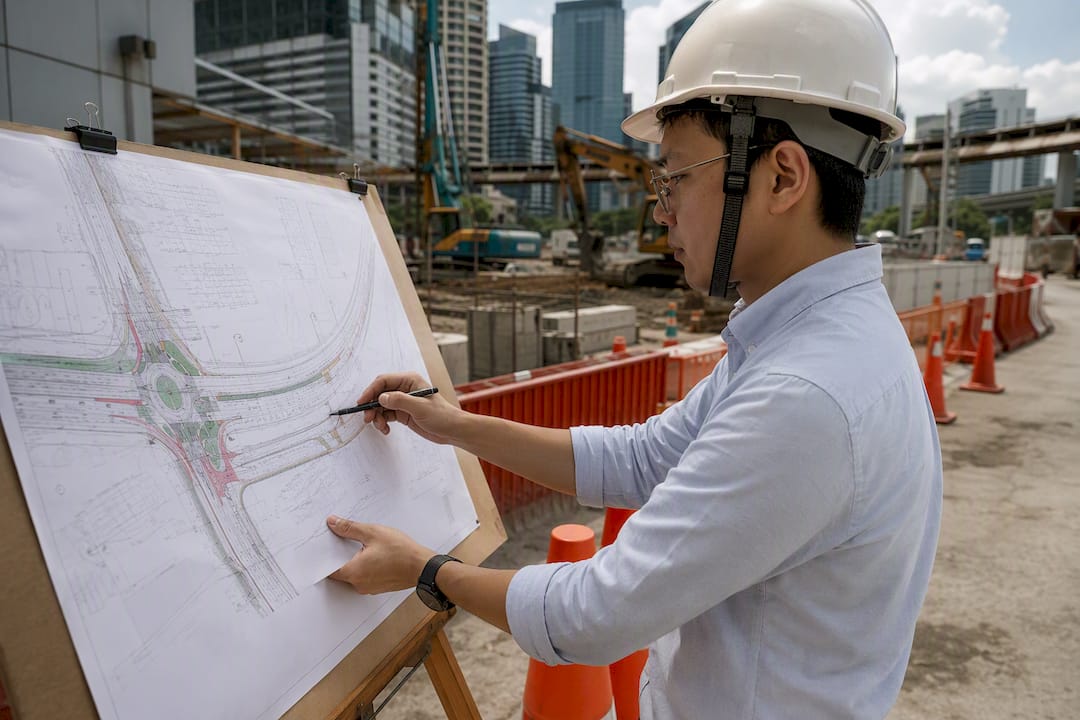
If your proposed development exceeds the trip-generation thresholds in the Land Transport Authority’s Annex A, you will need a Traffic Impact Assessment. The next step is straightforward: request a scoping or pre-consultation meeting with LTA before your design is locked in. LTA’s Walk Cycle Ride priorities shape how mitigation proposals are judged, and engaging an LTA-registered consultant at this stage materially lowers the risk of a rejected submission.
TL;DR:
- Developments near MRT stations, schools, or high-pedestrian areas may require additional pedestrian, cyclist, or site access assessments even if trip generation thresholds are not exceeded.
- Larger projects, especially Type 2 and 3 assessments, need early planning for micro-simulation modeling and longer review cycles, often six months or more.
- A complete TIA report must include survey data, public transport accessibility, pedestrian plans, and mitigation measures supported by actual data; incomplete reports risk rejection.
- Engaging a registered TIA consultancy early in the process and ensuring comprehensive public transport and pedestrian data collection before modeling reduces the risk of delays.
- The scoping meeting with LTA is a critical phase to define project classification, study boundaries, and modeling standards, which heavily influences approval timelines.
Table of Contents
- What Triggers a Traffic Impact Assessment in Singapore?
- TIA Classification, Phases, and Realistic Timelines
- What Should a Traffic Impact Assessment Report Include?
- How Do You Engage LTA and Choose a TIA Consultant?
- What Causes LTA to Reject or Resubmit a TIA Model?
- How Aman Approaches TIA Scoping and LTA Submissions
- Where Conventional TIA Advice Falls Short
- Get Your TIA Scoped and Submitted Without the Guesswork
- Sources
What Triggers a Traffic Impact Assessment in Singapore?
A Traffic Impact Assessment becomes mandatory once a proposed development’s trip generation or land use intensity crosses the thresholds set out in Annex A of LTA’s TIA Guidelines. These thresholds vary by land use category. Large residential schemes, commercial developments above a certain gross floor area, industrial sites with heavy vehicle traffic, and mixed-use projects near constrained road networks all commonly fall within scope.
The path to classification depends on how the site was acquired. Government Land Sales (GLS) and Tender for the Concurrent Operation (TCOT) sites often come with a TIA classification pre-stated in the tender conditions, which gives developers an early planning anchor. Redevelopment projects on privately held land rarely enjoy that clarity, and the developer must request scoping advice directly from LTA to determine whether a full TIA, a lighter assessment, or no formal study at all applies.
Even projects that fall below the full TIA threshold are not automatically exempt from transport review. Several triggers still apply:
- Developments near schools, MRT stations, or high-pedestrian corridors may require a standalone Pedestrian and Cyclist Assessment.
- Sites with independent walkway or crossing needs typically require a Walk Cycle Plan (WCP) regardless of overall trip volume.
- Any project introducing new vehicular access points onto a public road usually needs a site access review, even at small scale.
TIA Classification, Phases, and Realistic Timelines
LTA sorts assessments into three tiers under the Addendum to the 2017 TIA Guidelines, and the tier determines both the toolset and the schedule your project team should budget for.
- Type 1 covers smaller developments touching up to five junctions. SIDRA Intersection is the accepted analysis tool, and Phase 1 scoping typically targets completion in around three months.
- Type 2 applies to developments with wider network effects, where junction interactions and queuing spill back across multiple intersections. LTA generally expects micro-simulation modeling here rather than isolated junction analysis.
- Type 3 covers the most complex sites, often near major transport nodes, requiring detailed micro-simulation with fuller public transport interaction modeling and longer Phase 2 review cycles.
Phase 1 is the scoping and survey stage: confirming study area boundaries, agreeing on the model approach, and collecting traffic and pedestrian counts. Phase 2 is where the calibrated model, mitigation measures, and full report go through LTA’s technical review. After the development is built, LTA may also require a Post Implementation Review (PIR) to confirm that the assumptions and mitigation measures in the approved TIA held up against actual operating conditions. PIR triggers commonly include developments near sensitive junctions or projects where LTA flagged marginal capacity at approval.
What Should a Traffic Impact Assessment Report Include?
A complete TIA report is built around evidence, not assertions. LTA reviewers scrutinize whether every claim in the narrative is backed by a survey, a model output, or a data table, and incomplete submissions are one of the most common reasons a report gets sent back for revision.
Practitioners preparing a submission should expect to cover:
- Executive summary stating the development scale, classification, and key findings up front.
- Traffic and pedestrian surveys covering weekday and peak-period counts, turning movements, and pedestrian volumes at affected junctions.
- Public Transport Accessibility Level (PTAL) assessment showing how well the site connects to bus and rail services.
- Walk Cycle Plan (WCP) detailing pedestrian and cyclist routes, crossing points, and connections to the surrounding network, a requirement since WCP was folded into TIA submissions in 2016.
- Pick-up/drop-off (PUDO) analysis examining how vehicles will queue, load, and clear without spilling onto the public road.
- Site access and internal circulation review, including sight lines and swept-path checks for larger vehicles.
- Mitigation measures, ranging from signal retiming to physical road works, sized to the actual predicted impact.
- Appendices with raw survey data, model files, and calculation sheets in the format LTA’s reviewers expect.
Pro Tip: Build your PTAL and WCP sections around actual walking distances measured on-site, not straight-line estimates. LTA reviewers routinely check pedestrian catchment against real footpath geometry, and straight-line assumptions are an easy way to lose credibility on an otherwise solid submission.
Developments close to a major bus or rail interchange face a higher bar. LTA’s guidance notes that projects near MRT interchange connectivity points can be asked for stricter public transport performance criteria and more granular modeling of bus movements, so budget extra survey time if your site sits near one.
How Do You Engage LTA and Choose a TIA Consultant?
Requesting a scoping meeting is the first formal step, and it pays to arrive prepared. Bring a site plan, the proposed gross floor area and land use mix, any GLS or TCOT conditions already assigned, and a preliminary view of the surrounding road network. LTA uses this meeting to confirm classification, study area boundaries, and the modeling standard your project will be held to.

Who you hire for that work matters. The Registration Scheme for TIA Consultancy Firms, launched in June 2022, sets a minimum bar for principal consultants: a bachelor’s degree in transport or traffic engineering (or equivalent) plus at least seven years of relevant experience, alongside a track record of submitting acceptable TIA reports. Registration is not mandatory, but engaging a firm on that list is a practical way to reduce submission risk before the project timeline is exposed to review delays.
A few points worth planning around:
- Type 1 projects should budget a few months for Phase 1 scoping and survey work alone.
- Type 2 and Type 3 projects need longer Phase 2 windows to account for micro-simulation calibration and iterative review.
- Booking traffic and pedestrian surveys early, before the scoping meeting, shortens the overall cycle because LTA can review real data rather than projections.
Guidance on the broader LTA submission process and typical project approval timelines is worth reviewing alongside your TIA scope, since transport approval rarely moves in isolation from the rest of your statutory submission package.
What Causes LTA to Reject or Resubmit a TIA Model?
Most resubmissions trace back to the same handful of technical gaps, and nearly all of them are avoidable with better upfront planning rather than better modeling software.
Public transport detail is the single biggest weak point. Models that omit bus route alignments, service frequencies, or dwell times at stops routinely fail LTA’s review, because bus performance is treated as a core network output, not a footnote. Calibration is the second recurring issue: reviewers expect count data collected on typical weekdays, a clearly defined peak period, and evidence that modeled speeds and travel times were validated against observed conditions on-site.
Operational gaps round out the list:
- PUDO interactions left out of the junction model, which understates queuing at the site frontage.
- Study area boundaries drawn too tightly, missing a junction that actually absorbs redistributed traffic.
- Insufficient lane and phasing detail at junctions close to the site, which skews delay and capacity outputs.
Scheduling public transport observations at the same time as your traffic counts, rather than as an afterthought, is one of the more reliable ways to close these gaps before LTA ever sees the model.
How Aman Approaches TIA Scoping and LTA Submissions
Aman’s process starts at the scoping table: confirming classification, study boundaries, and modeling standard with LTA before survey work begins, then building the calibration evidence base early, including turning-movement counts, public transport timetables, and access geometry. That sequencing is what keeps model files defensible when LTA’s technical reviewers ask questions. Our related work on impact assessments for building and utility conditions follows the same evidence-first logic.
Where Conventional TIA Advice Falls Short
Most guidance on Traffic Impact Assessments treats the report as a compliance document. It isn’t. It’s a negotiation with LTA over how much transport risk your development is allowed to introduce into a corridor that already has other users, and the paperwork just formalizes the outcome.
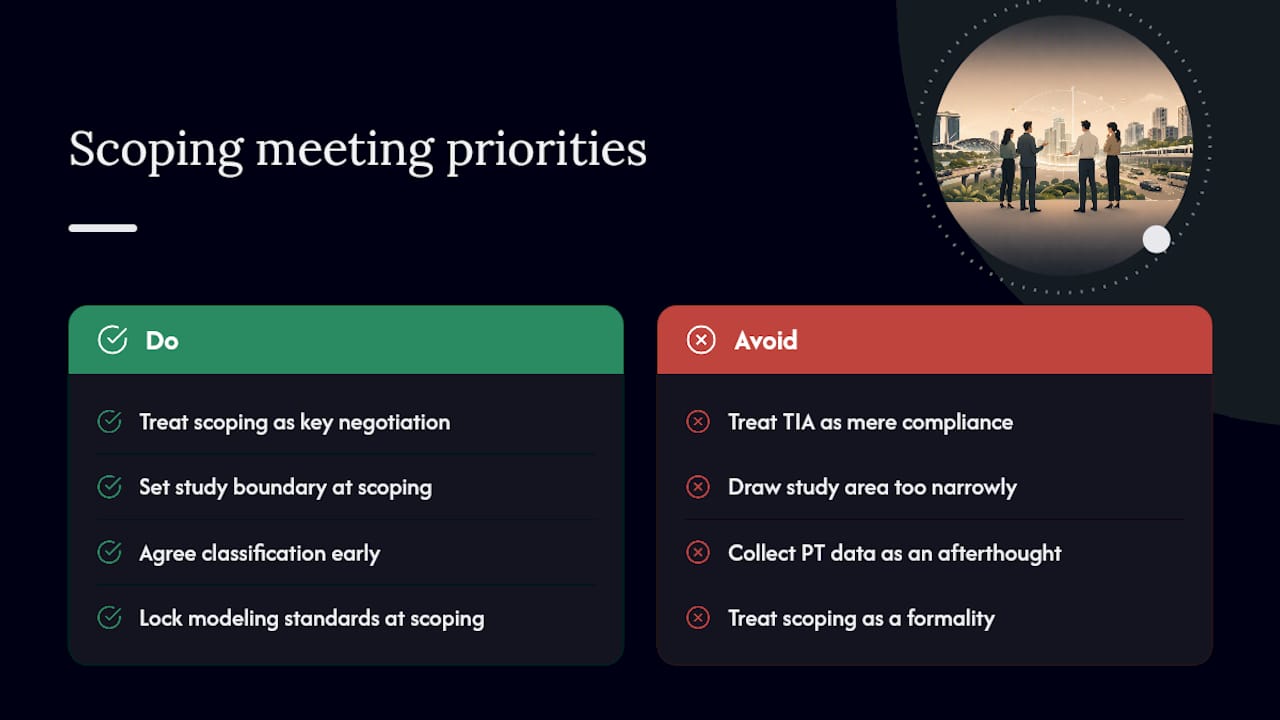
The conventional advice, get a consultant, run the model, submit the report, undersells how much the outcome depends on decisions made before a single traffic count is taken. Study area boundaries drawn too narrowly, public transport data collected as an afterthought, and scoping meetings treated as a formality rather than a negotiation are what turn a straightforward Type 1 assessment into a multi-cycle review. The Addendum’s own emphasis on calibration standards exists precisely because LTA sees the same gaps project after project.
If there’s one priority for developers to take from this: treat the scoping meeting as the most consequential hour of the entire TIA process, not the report drafting. Get the study boundary, the classification, and the modeling standard right at that stage, and the rest of the process becomes execution rather than negotiation. Get it wrong, and no amount of modeling polish downstream will save the timeline.
— Aman
Get Your TIA Scoped and Submitted Without the Guesswork
Aman Engineering Consultancy handles Traffic Impact Assessments from scoping through Post Implementation Review, so you’re not coordinating LTA liaison, survey vendors, and modeling separately across three firms.
Our team manages the scoping meeting request, survey scheduling, SIDRA and micro-simulation modeling, and the full LTA submission package, then carries the project through PIR if your approval terms require one. For developers still assembling their broader statutory approval strategy, our guide on how to engage engineering consultants effectively walks through what a well-structured consultancy engagement should look like before you sign anything. If your project is at the pre-tender or early design stage and you need a realistic read on classification and timeline, request a scoping-support consultation with our transport team this week.