

For event driven temporary road closures in Singapore, apply for the Traffic Police Road Closure Permit through the GoBusiness dashboard, submitted at least 30 days before the event date. Applications are assessed case by case, not automatically approved. If the activity involves construction or roadworks rather than an event, the correct channel is LTA.PROMPT, not the Traffic Police process.
TL;DR:
- Applicants must submit the traffic police road closure permit application at least 30 days before the event through the GoBusiness dashboard, with complete documentation.
- Events involving public gatherings must use the Traffic Police route, while construction or roadworks require applications through LTA.PROMPT, with different timelines and requirements.
- A detailed, layered PowerPoint schematic plan in approved formats and a stakeholder engagement list are critical to avoid delays or rejection.
- Early engagement with relevant government agencies, ideally six weeks before, helps confirm route capacity and expedite approval, saving time and cost.
- Deviating from approved signage, barricades, or conditions on the event day risks permit revocation and enforcement action.
Table of Contents
- Quick Checklist: Who Must Apply and the Top Steps
- Which Application Route to Use: Traffic Police vs LTA.PROMPT
- Application Timeline and Key Deadlines
- Required Documents and the Road Closure Schematic Plan
- Fees, Processing Times, and Common Reasons for Delay
- How Inter Agency Coordination Works
- What Approval Looks Like and Applicant Responsibilities
- When You Do Not Need a Road Closure Permit
- Practical Tips From Aman Engineering Consultancy
- Why Early Agency Engagement Saves Time and Cost
- How Aman Engineering Consultancy Supports Your Permit Submission
- Sources
Quick Checklist: Who Must Apply and the Top Steps
Before opening any portal, confirm which category your activity falls under. An event, such as a charity run, street festival, or wedding procession, falls under Traffic Police jurisdiction. Roadworks, utility trenching, or construction site occupation of a public road falls under the Land Transport Authority instead. Mixing these up is the single most common reason applicants waste weeks on the wrong form.
Once you know your category, work through this pre-application sequence:
- Lock your event date and venue first. Permit assessment depends heavily on which roads, junctions, and time windows you name, so changing these later restarts parts of the review.
- Gather your stakeholder list early, including grassroots organizations, affected businesses, and residents’ committees along the closure route.
- Draft your road closure schematic plan in editable PowerPoint format. Traffic Police will not accept a flattened image or PDF as the working file.
- Request preliminary feedback from Traffic Police or the Land Transport Authority if your event involves an unusual route, a major arterial road, or overlapping closures with other organizers.
- Confirm you have Singpass access for the applicant or corporate representative, since the GoBusiness dashboard requires it to log in and prefill applicant details through MyInfo.
- Verify you are dealing with an official government channel. The Traffic Police site notes that officers will never ask applicants for bank transfers or login credentials during the application process.
Pro Tip: Draft your stakeholder list before you touch the schematic plan. Half the redraws Aman Engineering Consultancy sees happen because a route was finalized before checking who actually needed to sign off on it.
Which Application Route to Use: Traffic Police vs LTA.PROMPT
Singapore splits road closure authority between two agencies, and the split is based on purpose, not on how disruptive the activity looks on paper. Traffic Police governs temporary closures for organized events under the Road Traffic Act. The Land Transport Authority governs road occupation for construction, utility works, and ongoing site activity under Section 115 of the same act.
The application entry points differ accordingly. For an event, you start at the GoBusiness dashboard’s Road Closure Permit task, which now serves as the primary submission channel for Traffic Police applications. For construction or works related road occupation, you register and apply through LTA.PROMPT, the portal contractors use to notify or apply for permits tied to specific road segments.
Use this quick decision check before you file:
- If the public will gather, march, run, or watch something on the road, it is an event: apply through GoBusiness.
- If a contractor, crane, hoarding, or excavation will occupy the road surface, it is works: apply through LTA.PROMPT.
- If both apply, such as an event that also needs temporary hoarding for stage setup, you may need coordinated submissions to both agencies.
- Certain roads require an advance Road Works Planner (RWP) submission before LTA will even accept your occupation permit application.
Getting this categorization wrong at the outset is the fastest way to lose your 30 day buffer to resubmission.
Application Timeline and Key Deadlines
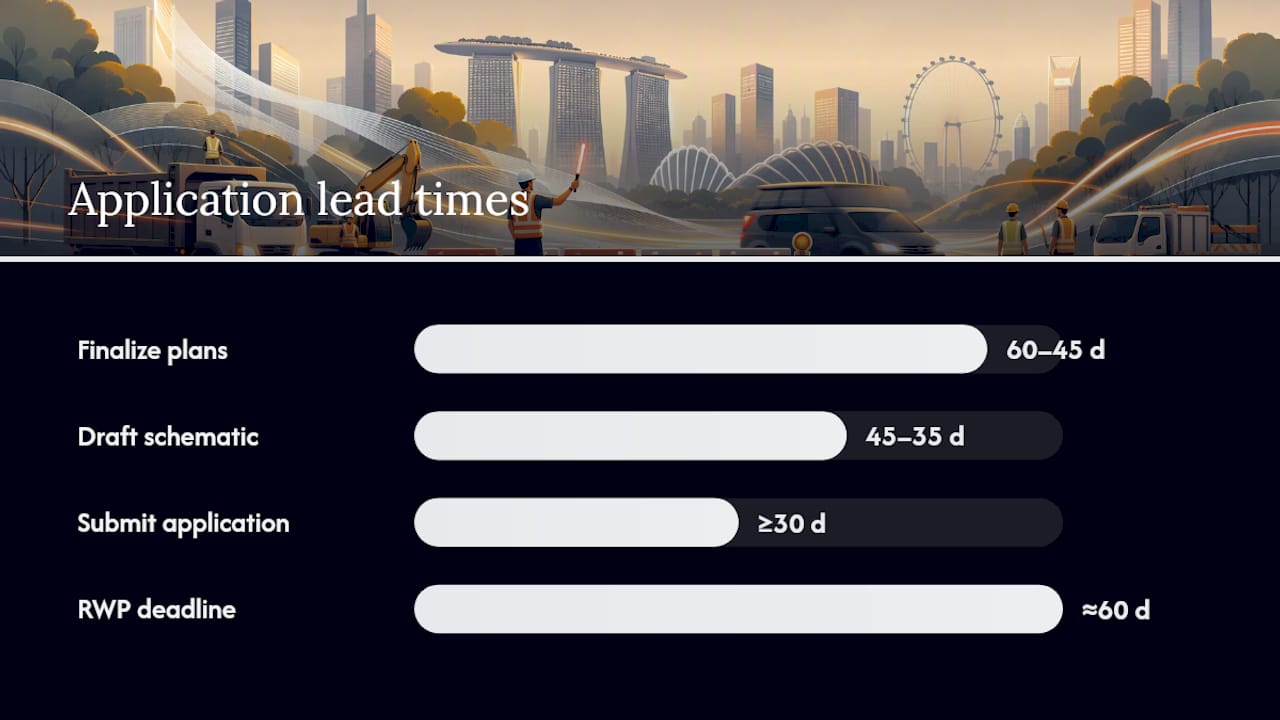
The Traffic Police User Guide sets a firm floor: applicants must submit required documents at least 30 days before the event. That is a minimum, not a target, and it assumes your documents are complete on first submission.
A realistic internal schedule looks like this:
- 60 to 45 days out: Finalize the event date, route, and stakeholder list; request any preliminary feedback from Traffic Police or the Land Transport Authority on unusual road segments.
- 45 to 35 days out: Draft the road closure schematic plan, confirm marshal and barricade counts, and secure any government agency support letters you will need to attach.
- At least 30 days out: Submit the complete application through the GoBusiness dashboard. The portal itself is designed to take roughly 30 minutes to complete once your documents are ready.
- Following submission: Monitor the dashboard for review comments or requests for revised attachments, and respond quickly since delayed replies push your review further out.
Construction related applications run on a separate clock. Certain roads under LTA’s Road Works Planner require submission up to two months ahead of the relevant quarter, well before you ever touch the permit application itself. If your project sits on one of those roads, that RWP deadline, not the 30 day Traffic Police minimum, becomes your real constraint.
Required Documents and the Road Closure Schematic Plan
Traffic Police standardizes the paperwork so reviewers can compare applications quickly, which means deviating from the expected format is one of the fastest ways to trigger a resubmission request. The User Guide lists four core attachments.
- Event Data Sheet: covers the event name, organizer details, date, time window, and expected attendance.
- Stakeholders Engagement List: names every party consulted, from grassroots organizations to affected shopfronts along the route.
- Road Closure Schematic Plan: submitted as an editable PowerPoint file, not a static image or PDF export.
- Government Agencies Support Letter: documentation showing relevant agencies have been informed or have signed off where their interests are affected.
The schematic plan itself carries the most technical weight and the most common errors. A complete plan needs an overview map showing the full closure area in context, a detailed map with named junctions and closure boundaries, specifications for temporary traffic signage and any variable message signs, a marked layout of marshal positions and physical barricades, and clearly drawn alternate routes for vehicles displaced by the closure.
On format, the Traffic Police apply page sets hard limits: accepted file types are .xls, .xlsx, .pdf, .doc, and .docx, with a maximum file size of 7 MB per attachment. Files that exceed this or arrive in the wrong format get bounced back automatically, costing you days you do not have inside a 30 day window.
Pro Tip: Keep the schematic plan in layers inside the PowerPoint file rather than flattening it into a single image. Reviewers frequently ask for a specific layer, such as marshal positions alone, and a layered file lets you export just that view without redrawing the whole plan.
Most resubmission requests trace back to one of three issues: a stakeholder list missing a directly affected party, a schematic plan with unclear alternate routes, or a support letter that was requested too late to arrive before submission.
Fees, Processing Times, and Common Reasons for Delay
Statutory fees for road closure permits are confirmed directly on the relevant agency pages rather than published as a single flat schedule, since costs vary with closure duration, road classification, and the scale of the event. What consistently drives up total cost is not the permit fee itself , but the operational requirements attached to it: auxiliary police deployment, variable message sign rental, and specialized barricading for larger closures all add up quickly.
Processing time depends heavily on how complete your first submission is. A clean application, filed early with all four required documents and a correctly formatted schematic plan, tends to move through review faster than one that arrives with gaps. Traffic Police guidance itself flags this: the 30 day minimum lead time exists precisely because case by case assessment takes time, and that clock resets meaningfully whenever a resubmission is required.
The most frequent causes of delay or rejection include:
- An incomplete stakeholder list that omits a business or resident group directly on the closure route.
- A schematic plan submitted as a flattened PDF instead of the required editable PowerPoint format.
- Missing or late government agency support letters, particularly from the Land Transport Authority on traffic impact.
- File attachments exceeding the 7 MB limit or arriving in an unsupported format.
Applicants are also expected to actively track their application status on the portal rather than waiting passively, since a fast response to a reviewer’s request can be the difference between staying inside your 30 day window and missing your event date entirely.
How Inter Agency Coordination Works
Traffic Police rarely reviews an application in isolation. Depending on your event’s footprint, it consults the Land Transport Authority on traffic impact, the Singapore Civil Defence Force on fire and emergency access, the Singapore Land Authority on temporary occupation of state land, the Singapore Food Agency where food is sold, and the Urban Redevelopment Authority where parking or URA managed facilities are affected.
Practical outreach works best when you approach each agency with a specific, answerable question rather than a general notification. Ask the Land Transport Authority to confirm whether your proposed diversion route has adequate capacity. Ask the Singapore Civil Defence Force to confirm emergency vehicle access widths along your barricade layout. Ask the Singapore Food Agency to confirm licensing requirements if your event includes food stalls.
- Start agency outreach at least six weeks before your event, well ahead of the 30 day permit deadline.
- Request written confirmation or a support letter, not just a verbal go ahead, since Traffic Police wants documented evidence.
- Build in a buffer for agencies that take longer to respond, particularly during peak event seasons.
Government agency support letters matter because they shift review burden away from Traffic Police having to chase confirmations itself, which speeds up your case.
What Approval Looks Like and Applicant Responsibilities
Section 143 of the Road Traffic Act gives the Deputy Commissioner of Police authority to attach conditions to any approved permit, and those conditions typically cover publication of the closure, signage placement, physical barrier positioning, and the engagement of auxiliary police where crowd or traffic volume warrants it.
On the day itself, responsibilities typically include:
- Displaying signage and public notices exactly as specified in the approved schematic plan, not a modified version.
- Positioning barricades and marshals at the approved locations, since deviating from the plan without prior approval can void compliance.
- Deploying auxiliary police or trained marshals where the permit requires them.
- Removing barricades and signage promptly once the event window closes, restoring normal road access.
Noncompliance carries real consequences. Permits issued under Section 143 can be revoked, and organizers who close roads without authorization, or who deviate materially from approved conditions, expose themselves to enforcement action under the Road Traffic Act.
When You Do Not Need a Road Closure Permit
Not every activity on or near a public road requires a Traffic Police permit. Unforeseen, small scale gatherings, such as an impromptu roadside vigil, generally fall outside the formal permit framework, though organizers should still confirm this directly with Traffic Police rather than assume an exemption applies.
Private roads sit under a different regime entirely. If the road in question is privately owned and not gazetted as a public road, a Traffic Police permit typically is not the right instrument, though notifying the Land Transport Authority may still be necessary depending on connectivity to the public road network.
- Small, unplanned gatherings with no organized structure often fall outside formal permit requirements.
- Activities confined entirely to private road or estate land use a different approval pathway.
- When in doubt, a direct query to Traffic Police or LTA.PROMPT support resolves the classification faster than guessing.
Confirming exemption status before you build a full application saves weeks you would otherwise spend preparing documents you never needed.
Practical Tips From Aman Engineering Consultancy
Reviewing a road closure schematic plan properly means checking it against the Traffic Police Code of Practice line by line, not just visually scanning for obvious gaps. Aman Engineering Consultancy applies a structured quality assurance pass before any plan goes into a client’s submission: confirming every marshal position has sightline to the nearest barricade, verifying variable message sign specifications match what Traffic Police expects for the road classification involved, and cross checking the stakeholder list against actual site photos taken along the proposed route.
Stakeholder engagement sequencing matters more than most applicants realize. Consulting grassroots organizations and affected businesses after the schematic plan is finalized almost guarantees rework, because their feedback often changes barricade placement or route timing. Sequencing outreach before the plan is locked, drawing on the documentation and submission discipline applied across statutory submissions generally, avoids that cycle.
Preliminary agency engagement follows a similar logic. Rather than submitting cold and waiting for Traffic Police to raise questions, Aman typically requests informal feedback from the Land Transport Authority or relevant agencies on unusual routing before the formal application goes in, then builds government agency support letters around whatever concerns surface early.
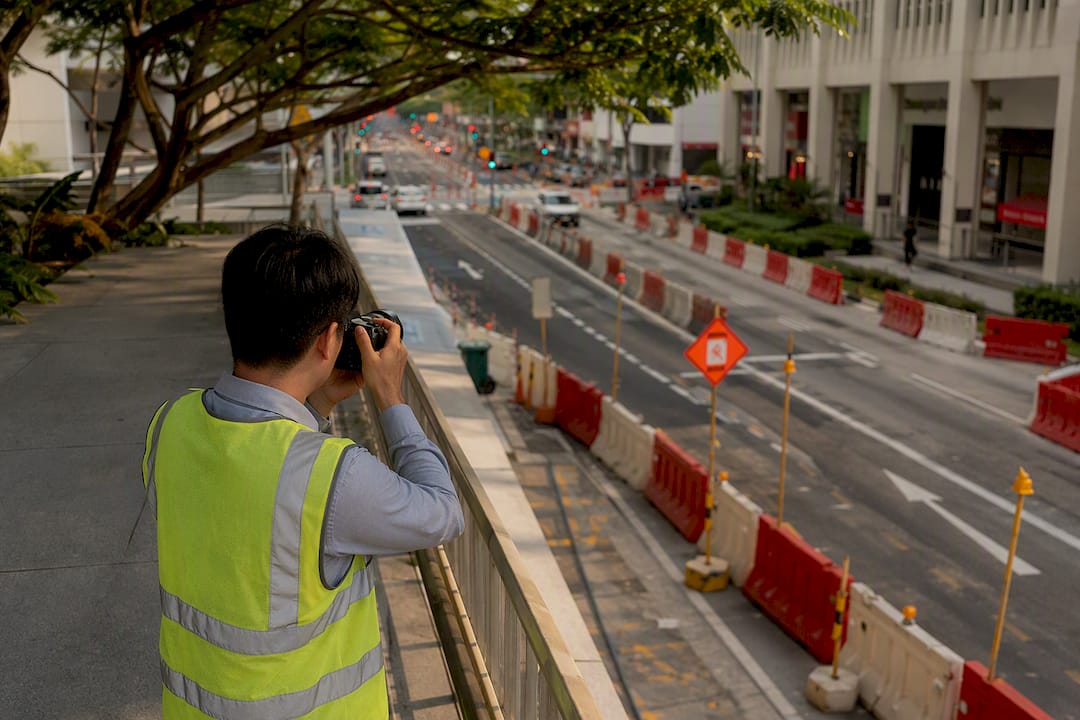
Pro Tip: Photograph the entire proposed route on foot before finalizing the schematic plan. Site photos catch obstructions, gradient issues, and sightline problems that a desktop map review will miss every time.
Internal quality checks that consistently catch problems before submission include walking the marshal rota against the actual barricade count, confirming variable message sign specifications against the road’s speed classification, and verifying that every alternate route drawn on the plan is actually passable for the vehicle types expected to use it.
Why Early Agency Engagement Saves Time and Cost
The mistake compounds quietly: an organizer finalizes a route, books vendors, and only then discovers the Land Transport Authority has concerns about traffic capacity on the proposed diversion. By that point, changing the route means redrawing the schematic plan, re-engaging stakeholders, and potentially missing the 30 day submission window entirely.
Self-filing works fine for straightforward, small footprint events with a simple route and no unusual road classifications involved. It stops working once the event touches an arterial road, requires multiple agency sign offs, or involves construction adjacent to the closure. At that point, the cost of a rejected or delayed application, measured in postponed events and re-booked vendors, usually exceeds the cost of professional coordination.
What consistently pays off is treating agency engagement as the first step, not the last one. Applicants who confirm feasibility with Traffic Police or LTA before locking their event details spend less time redrawing plans and more time actually preparing for the event itself.
— Aman
How Aman Engineering Consultancy Supports Your Permit Submission
Aman Engineering Consultancy is the option for organizers and contractors who want their road closure or road occupation submission handled correctly the first time, rather than learning the Traffic Police Code of Practice through a string of resubmission requests. Where a self-filed application often costs weeks in back and forth once a schematic plan or stakeholder list falls short, Aman builds the submission to the standard reviewers expect before it ever reaches the portal.
The engagement path is straightforward: an initial scoping call to confirm whether your activity is event driven or works driven, document and schematic plan preparation to the Traffic Police or LTA.PROMPT standard, agency liaison to secure the support letters your case needs, and follow up through to permit issuance. This mirrors the same regulatory compliance and documentation discipline Aman applies across statutory submissions for structural, facade, and M&E approvals with agencies including BCA, URA, and LTA.
If your event or project needs a road closure or road occupation permit and you want the schematic plan, stakeholder documentation, and agency coordination handled by consultants who work with these submissions regularly, contact Aman Engineering Consultancy to scope your application before your 30 day window starts ticking.
Sources
- Traffic Police Road Closure Permit | Licence & Accreditation – GoBusiness
- SPF | Apply for Road Closure Permit
- Welcome to LTA.PROMPT