
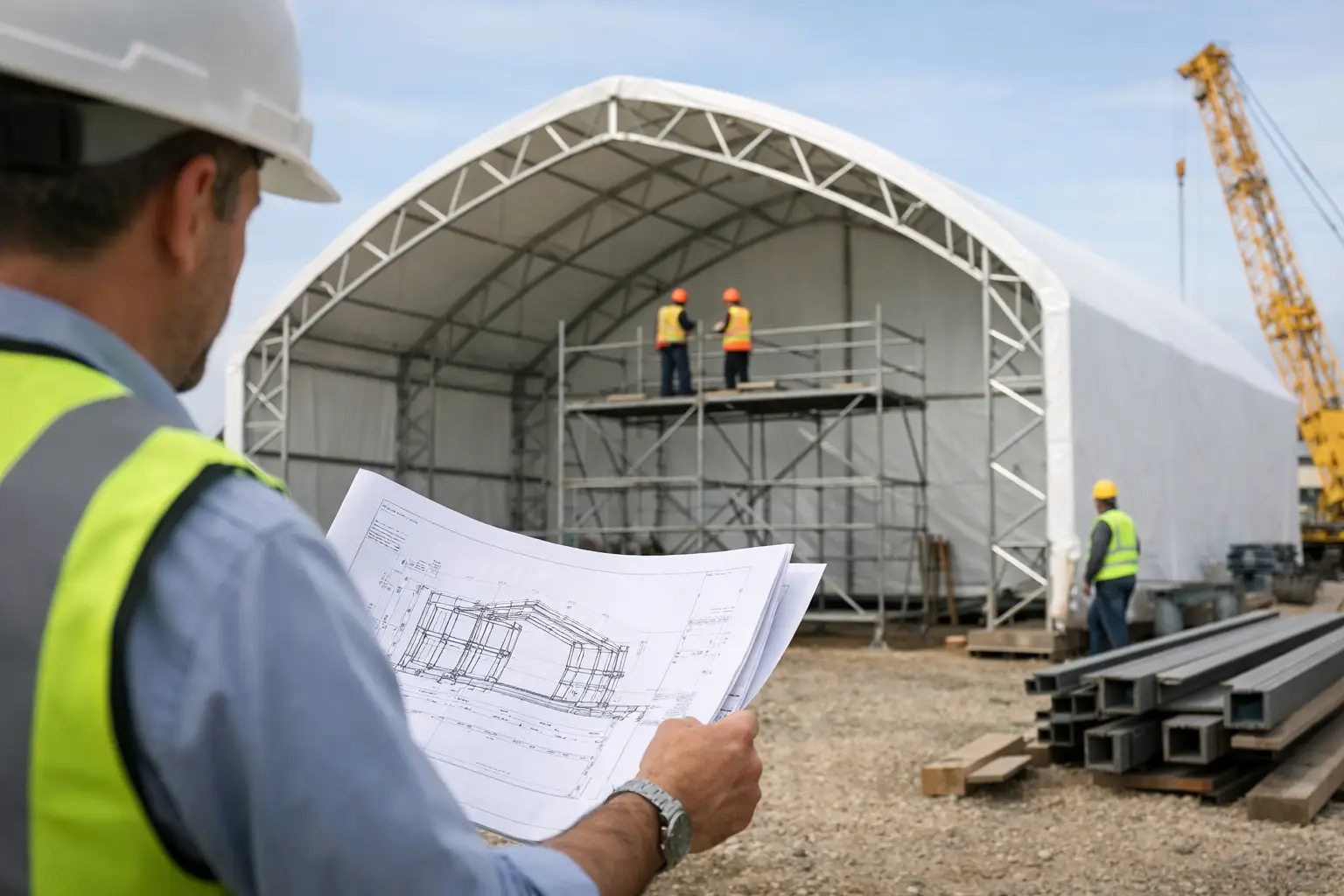
A temporary structure PE endorsement is not a paperwork exercise completed after a structure has been installed. It is the professional engineering review that confirms whether a temporary works design can safely carry its intended loads, remain stable in its site conditions, and be erected in accordance with approved details. For contractors, property owners, and event organizers, getting this scope right early can prevent rejected submissions, site stoppages, costly redesign, and avoidable safety exposure.
Temporary structures are often treated as low-risk because they will be removed after a short period. In practice, their limited lifespan does not reduce the need for sound engineering. Temporary stages, tents, grandstands, access platforms, retaining systems, hoardings, temporary roofs, falsework, formwork, shoring, and protective canopies can all create significant risks when loading, wind, ground conditions, public access, or adjacent buildings are not properly considered.
What a Temporary Structure PE Endorsement Covers
A Professional Engineer endorsement generally confirms that the proposed temporary structure has been designed and checked by a qualified professional within the relevant engineering discipline. The exact endorsement requirements depend on the project location, structure type, authority conditions, and permit pathway. There is no single certificate that applies to every temporary installation.
The engineering review normally starts with the intended use. A covered walkway serving pedestrians has different loading and safety requirements from a concert stage carrying lighting equipment, a temporary earth-retaining system supporting an excavation, or a formwork system supporting wet concrete. The PE must understand how the structure will be used, who may access it, what equipment it will carry, how long it will remain in place, and what could happen if a component fails.
The endorsement package may include structural calculations, design drawings, connection details, foundation or anchorage information, material specifications, erection requirements, and inspection provisions. Where relevant, it may also address wind actions, rainwater ponding, crowd loading, vehicle impact, vibration, lifting activities, excavation effects, and interfaces with existing structures.
For projects in Singapore, the submission route may involve requirements from the Building and Construction Authority, relevant Qualified Persons, Professional Engineers, developers, landowners, or other agencies depending on the site and work scope. A PE endorsement should therefore be coordinated with the wider approval strategy rather than prepared in isolation.
The Design Questions That Cannot Be Assumed
A temporary structure can look straightforward while hiding critical design variables. The most common issues arise when the contractor’s initial concept is developed around available materials rather than verified loads and site conditions. A standard modular system may be suitable for one location but inadequate for another because the supporting ground, exposure, height, span, or imposed load has changed.
Loads and Stability
The PE evaluates the loads acting on the temporary works and the load path through every primary member, connection, support, and foundation. This includes self-weight, construction loads, equipment loads, storage loads, workers, public occupancy, and environmental actions. Wind is particularly relevant for temporary tents, signage frames, scaffold enclosures, canopies, and elevated structures with large exposed surfaces.
Stability is more than the strength of individual beams or posts. A structure can have adequately sized members and still fail through overturning, sliding, buckling, inadequate bracing, weak anchors, or insufficient bearing capacity. The design needs to show how horizontal and uplift forces are resisted, especially where ballast, ground anchors, base plates, tie-backs, or existing building elements are used.
Ground and Existing Building Interfaces
Support conditions should never be assumed. Soft ground, filled land, uneven paving, underground services, suspended slabs, basement roofs, and drainage structures can affect whether a temporary structure can be safely supported at a particular location. Where a crane outrigger, scaffold base, tent ballast, platform leg, or shoring prop bears on an existing surface, the supporting element may require separate verification.
Interfaces with occupied buildings also require careful review. A temporary canopy may impose loads onto a façade. A shoring system may influence a neighboring foundation. A temporary roof may obstruct fire access or alter smoke movement. These are coordination issues as much as structural issues, and they should be identified before work begins.
Erection, Alteration, and Removal
The approved design must be buildable in the sequence proposed. Many temporary works incidents occur during erection or dismantling, when the completed bracing system is not yet in place or supports are removed too early. The PE’s scope may need to address construction stages, temporary bracing, lifting points, permissible material stacking, inspection hold points, and the sequence for removal.
Any site alteration should be controlled. Adding a banner to a tent frame, moving a scaffold tie, extending a platform, replacing specified members, or placing additional equipment on a stage can change the engineering basis of the endorsement. If the installation differs from the endorsed drawings, the contractor should seek engineering review before proceeding rather than relying on a visual judgment.
Documents Needed for an Efficient PE Review
A complete brief allows the PE to focus on engineering decisions instead of reconstructing missing information. Early engagement is particularly valuable where the structure is unusual, located near public areas, supported on an existing building, or subject to a tight authority submission schedule.
The review team will typically need the proposed layout, dimensions, elevations, system supplier information, material data, connection details, installation method, site photographs, and the duration of use. The proposed location should identify nearby structures, services, access routes, excavations, roads, and site constraints. For event structures, the brief should state expected occupancy, equipment loads, suspended loads, and operating arrangements.
Where the temporary works are part of a broader construction project, the PE should also receive the relevant architectural, structural, civil, and MEP information. This helps identify conflicts such as blocked exits, fire appliance access restrictions, façade attachment concerns, or clashes with existing services. A submission that is structurally correct but poorly coordinated can still create approval delays and site rework.
When an Endorsement Is Commonly Required
The need for a PE endorsement depends on local law, permit conditions, client requirements, and risk level. However, engineering endorsement is commonly requested for temporary works that support substantial loads, affect public safety, alter site access, interface with existing structures, or could affect adjoining properties.
Examples include temporary stages and grandstands, large tents and event pavilions, protective covered walkways, scaffold systems with special loading or enclosure conditions, temporary retaining and excavation support, formwork and falsework, temporary platforms, and hoardings exposed to wind or public areas. Work near rail corridors, roads, utilities, conserved buildings, or active facilities may also require additional stakeholder coordination.
Not every small temporary item requires the same level of design documentation. The correct approach depends on the structure’s scale, consequence of failure, location, duration, and applicable authority requirements. A competent engineering assessment distinguishes a simple low-risk installation from a system that requires detailed calculations, formal inspection, or revised submission drawings.
From Endorsement to Site Compliance
An endorsed design only provides value when it is implemented correctly on site. The contractor should verify that materials, member sizes, bracing, anchors, foundations, and connection details match the issued drawings. Substitutions should be documented and reviewed. Site teams should also maintain clear control over later modifications, weather-related restrictions, loading limits, and inspection records.
Depending on the project scope, the process may include a pre-installation review, inspection during erection, final inspection before use, and periodic checks throughout the temporary works period. This is especially relevant where structures remain in service through severe weather, repeated public use, ongoing construction activities, or changing ground conditions.
Aman Engineering Consultancy can support temporary works requirements through structural design review, PE endorsement coordination, authority submission support, site inspections, rectification advice, and multidisciplinary coordination. Bringing these functions together is often more efficient than treating structural calculations, regulatory submissions, and site verification as separate tasks.
The most effective time to address a temporary structure is before materials are mobilized and the installation sequence is fixed. A clear engineering brief, an accurate site assessment, and timely PE involvement give the project team a practical basis to build safely, satisfy applicable approval conditions, and keep work moving.