

Key Takeaways
Sustainable ERSS design treats temporary steelwork as a recoverable engineering asset, not disposable site material.
- Set carbon boundaries and performance targets before selecting the retaining system.
- Reduce steel quantities through coordinated structural, geotechnical, and construction-stage design.
- Specify verified material data, including recycled content and environmental product declarations.
- Design for inspection, demounting, repeated deployment, and eventual recycling.
- Track sustainability decisions alongside safety, compliance, programme, and cost.
Why sustainability matters in ERSS design
Earth Retaining Structural Systems (ERSS) sit at the intersection of structural engineering, geotechnics, groundwater control, and construction methodology. Although many systems are temporary, their steel, fabrication, transport, installation, and removal can make a meaningful contribution to a project’s embodied carbon. Treating these impacts as part of the design brief gives project teams more choices before the system is fixed.
Sustainability also has to remain subordinate to ground stability and public safety. A lower-carbon proposal is not a good proposal if it increases movement, introduces uncertain connections, or cannot be built and removed safely. The most useful approach is therefore practical: reduce unnecessary material, preserve components for reuse, and document the decisions that make the system dependable.
The embodied-carbon impact of temporary steelwork
Sheet piles, walers, struts, king posts, and connection components require raw materials and energy before they reach site. Their impact includes steel production, fabrication losses, protective treatments, transport, handling, installation equipment, and any damage incurred during extraction. A system used for only a few months may still have a long material history.
The assessment should distinguish between steel purchased for one project and steel that can be deployed repeatedly. A recoverable sheet pile that returns to service has a different whole-life profile from a damaged component sent directly for scrap, even though both began as the same product. That distinction makes inspection, records, and careful removal part of carbon management rather than administrative housekeeping.
How temporary works influence whole-project sustainability
ERSS affects excavation sequence, basement construction, crane access, dewatering, spoil movements, and the timing of permanent works. A retaining arrangement that simplifies installation may shorten the programme or reduce plant movements, while a poorly coordinated arrangement can create rework, additional propping, or difficult removal. Sustainability should therefore be considered at project level, not only as a material-selection exercise.
The temporary system can also interface with permanent structures. Anchors, brackets, cast-in items, and embedments may impose loads on partially completed works, so the temporary condition must be coordinated with the permanent design. Early coordination can avoid duplicate steelwork and reduce the likelihood that a temporary arrangement becomes an expensive obstruction later.
Balancing carbon reduction with safety, reliability, and constructability
ERSS design in Singapore must address soil conditions, groundwater levels, excavation depth, adjacent structures, and construction methodology. Movement control remains central, particularly where existing buildings and utilities are close to the excavation. Carbon reductions should come from better system selection, efficient load paths, and reuse—not from reducing factors of safety or overlooking difficult construction stages.
A useful design review asks whether the proposal can be installed, monitored, adjusted, and removed using realistic site resources. It should also examine temporary weather conditions, drainage, equipment loads, connection tolerances, and the consequences of a delayed excavation stage. Safety remains the design boundary within which sustainability decisions are made.
The role of Sustainability Leads and C&S Innovation Teams
Sustainability Leads, C&S Innovation Teams, designers, contractors, and fabricators each hold different pieces of the decision. Sustainability Leads can define carbon boundaries and reporting expectations, while C&S Innovation Teams can test repeatable details, digital records, and alternative construction methods. The engineer then translates those ambitions into verifiable design requirements.
That collaboration benefits from a clear distinction between an idea and an adopted solution. A proposal should show its structural performance, geotechnical assumptions, programme implications, procurement route, and recovery plan. The broader principles of sustainable innovation are useful here: constraints, context, and commitment have to be considered together.
Establishing a low-carbon ERSS design strategy
A low-carbon ERSS strategy starts before the retaining wall type is selected. The project team needs a shared definition of what is being measured, which temporary components are included, and how reuse will be credited. It should then compare technically viable systems on both performance and whole-life impact.
This is not a separate sustainability exercise appended to design calculations. It is a coordinated process involving the geotechnical model, structural analysis, construction sequence, procurement information, and removal method. Early decisions generally offer more carbon benefit than late substitutions made after drawings and fabrication have begun.
Setting project carbon targets and system boundaries
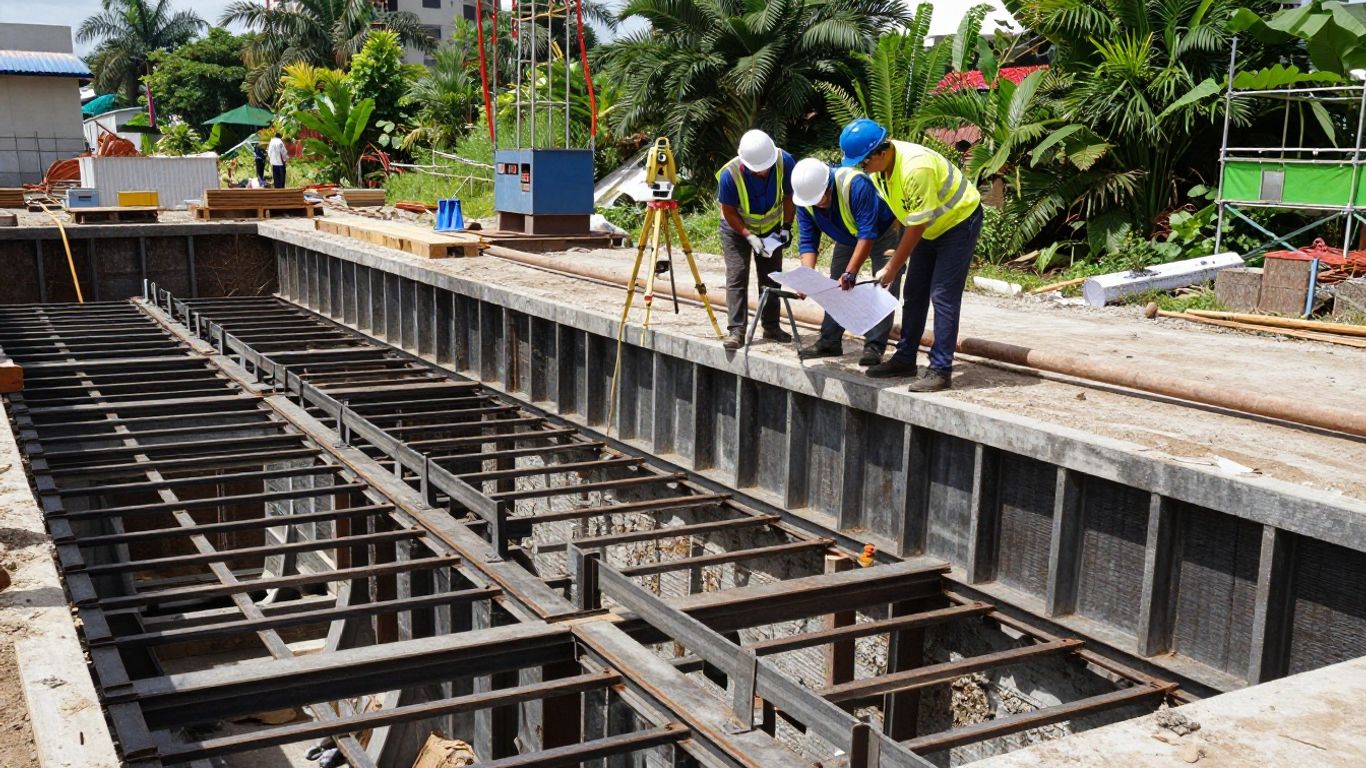
Project targets should state whether they cover steel production only or also fabrication, delivery, installation, extraction, refurbishment, and disposal. The boundary should identify temporary works that are often missed, such as bracing, walers, connection plates, access platforms, and sacrificial items. Assumptions about service life and future reuse should be written down rather than implied.
A practical target may combine a maximum steel intensity with a recovery or reuse objective. It should also identify the evidence needed at each stage: design quantities, mill documentation, delivery records, inspection reports, and final disposition. This gives the Sustainability Lead a measurable framework without turning the design into a purely numerical exercise.
Comparing ERSS solutions through whole-life carbon assessment
Whole-life comparison should consider systems that meet the same excavation and movement-control requirements. The assessment can compare steel mass, concrete content, plant duration, groundwater measures, transport distance, installation energy, removal risk, and the likelihood of repeated deployment. Where data is uncertain, ranges are more honest than false precision.
A heavier system may still perform better overall if it can be installed quickly, extracted intact, and reused many times. Conversely, a lighter system may lose its advantage when it requires more bracing, complex fabrication, or extensive remedial work. The comparison should therefore follow the construction sequence and not stop at the material schedule.
Optimizing steel quantities without compromising performance
Material efficiency comes from understanding load paths and stage-specific demands. Engineers can review strut spacing, waler continuity, connection arrangements, pile section selection, and the interaction between the ERSS and permanent works. Any reduction must be checked for ultimate limit states, serviceability, installation tolerances, and the less obvious load cases created during excavation.
Design optimization is most effective when structural and geotechnical models are updated together. A change to excavation depth, groundwater level, or propping sequence can alter both forces and movements. It is better to optimize a coordinated system than to remove steel from an isolated drawing.
Coordinating structural, geotechnical, and construction-stage requirements
The design team should map each excavation stage, including installation, excavation, propping, slab construction, groundwater events, and dismantling. The map should identify who owns each assumption and what must be verified before the next stage begins. This prevents a low-carbon concept from depending on an undocumented site condition.
Coordination also covers the interface with permanent works. Partially completed slabs may act as props, but only when their strength, connection details, and construction timing support that role. Clear responsibility matrices and staged design reviews help preserve both constructability and the intended material savings.
Selecting and specifying low-carbon steel
Steel selection is more nuanced than choosing the lowest declared carbon value. Recycled content, furnace route, electricity mix, product form, transport, fabrication, strength, weldability, and availability all influence the result. The selected material must also be compatible with the design assumptions and the project’s delivery programme.
For temporary works, the procurement decision should distinguish new steel from previously deployed components. Reused steel can be valuable, but only when its section properties, damage history, coatings, and connection condition are known. A transparent specification makes those conditions visible to suppliers and contractors.
Understanding recycled content and lower-carbon steelmaking routes
Recycled content describes the proportion of recovered steel in a product, but it does not by itself provide a complete carbon assessment. Lower-carbon production routes may have different energy sources, scrap inputs, and product availability. Engineers should compare like with like and avoid treating one headline percentage as the whole environmental story.
For sheet piles and temporary steel members, the design team should confirm that the proposed grade and section are actually available in the required lengths and quantities. A theoretical alternative that cannot be delivered may create programme pressure and lead to an unplanned substitution. Procurement realism is part of responsible carbon reduction.
Using environmental product declarations and verified carbon data
Environmental Product Declarations (EPDs) can provide product-specific or product-group information under stated assessment rules. Their boundaries, declared unit, validity period, and assumptions need to be checked before values are compared. Where an EPD is unavailable, supplier data should be labelled as an estimate and its source recorded.
Carbon data should flow into the design comparison with the same discipline applied to structural parameters. Record the material quantity, data source, transport assumption, allocation method, and reuse treatment. That record allows later reviewers to understand what was known at the time and what remains uncertain.
Evaluating strength, weldability, durability, and availability
A lower-impact steel grade is suitable only if it performs in the intended environment and construction sequence. The review should cover yield strength, toughness, weldability, section tolerances, corrosion exposure, handling damage, and the need for repairs. Temporary does not mean free from durability concerns, especially where groundwater or repeated deployment is involved.
Availability also affects carbon. Long-distance sourcing, urgent freight, partial loads, and replacement fabrication can erode the benefit of a preferred material. The engineer should discuss alternatives with the fabricator early and confirm that the proposed grade can be processed without unusual waste or specialist restrictions.
Writing procurement specifications that support carbon reduction
Tender documents can ask for verified carbon data without prescribing a material that the market cannot provide. They should state the required grade, performance criteria, documentation, recycled-content information where relevant, and rules for proposing an equivalent. They can also require identification of reused components and evidence of inspection before installation.
A good specification rewards credible evidence rather than attractive language. It can request mill certificates, EPDs, delivery records, fabrication waste information, and a recovery statement. This gives commercial teams a basis for comparison while protecting the engineer’s responsibility for safety and compliance.
Designing ERSS for circularity and reuse
Circularity begins with the assumption that components have a future after excavation works finish. That assumption changes the design conversation: extraction access, lifting points, connection reversibility, inspection zones, and component identification become design matters. It also encourages details that are repeatable across projects.
Reuse is not automatic. Components can be bent, gouged, corroded, contaminated, or cut during installation. A circular ERSS strategy must therefore include condition assessment and a decision process for repair, redeployment, remanufacture, or recycling.
Planning for recovery, inspection, and repeated deployment
Recovery should be planned before installation, with attention to extraction forces, access for equipment, temporary stability during removal, and the risk to nearby structures. The method statement should identify how components will be lifted, protected, cleaned, and stored. Inspection criteria should be agreed before the steel is needed again.
Repeated deployment is easier when the project records section sizes, lengths, connection details, coatings, repairs, and observed damage. Photographs and inspection notes can supplement formal certificates, particularly for components that move between sites. The result is a more dependable inventory and fewer avoidable replacements.
Standardizing sheet piles, struts, walers, and connection details
Standardization reduces fabrication variety and makes components easier to catalogue. Common lengths, section families, bolt patterns, splice details, and lifting arrangements can improve interchangeability, provided the design still responds to the site’s geotechnical and structural demands.
The objective is not to force every excavation into one template. It is to create a family of proven details that can be adapted without starting from zero. Standard details also make inspections faster because recurring defects and acceptable tolerances are easier to recognize.
Designing demountable and reversible temporary works
Bolted connections, accessible splices, and removable brackets can support recovery where they are structurally appropriate. Welded details may still be necessary, but they should be located and specified with future separation and repair in mind. Reversibility must be balanced against fatigue, buckling, installation loads, and the need for secure temporary stability.
Designers should show the dismantling sequence as clearly as the installation sequence. A connection that is technically removable may be practically inaccessible after slabs, services, or backfill are in place. Early review with the contractor can expose those conflicts before they become permanent.
Managing reuse, refurbishment, and end-of-life recycling
Recovered components should pass through a defined hierarchy: reuse without alteration where suitable, refurbishment where the condition can be verified, repurposing where the original role is no longer appropriate, and recycling when structural reuse is not responsible. Each route needs an owner and a record.
Refurbishment can include cleaning, straightening, repair, repainting, replacement of bolts, and rechecking dimensions. The work should not conceal defects or remove information about the component’s history. When recycling is necessary, segregation and controlled handling can preserve material value.
Applying circular principles across the project lifecycle
Circular ERSS design works only when information survives the project stages. Design teams define the components, fabricators produce them, contractors handle and install them, and asset or materials managers decide what happens next. If the record is lost between those stages, the opportunity for reuse is weakened.
The lifecycle approach also connects carbon decisions with ordinary project controls. Procurement schedules, lifting plans, inspection records, BIM models, and handover documents can all carry useful information without creating a parallel bureaucracy. The key is to decide early which data will matter later.
Early-stage material passports and component traceability
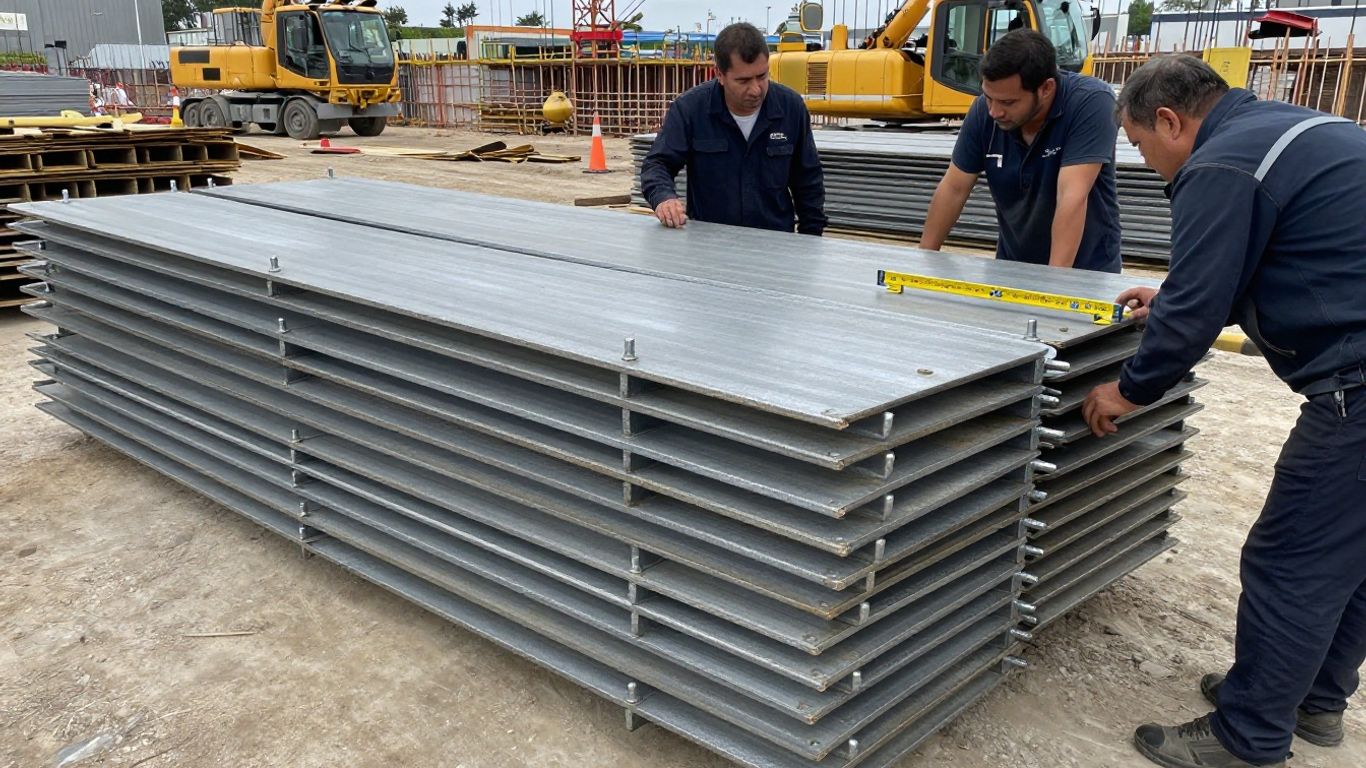
A material passport can record a component’s identifier, section, grade, dimensions, weight, coating, connection type, supplier, fabrication date, and inspection status. For a temporary system, it should also capture where the component was used and whether it was repaired or modified. These details support future engineering review rather than merely describing ownership.
Traceability is especially useful when similar sheet piles or struts are stored together. Durable marks, photographs, and model references reduce confusion at the next deployment. The information should be proportionate to the component’s value and risk, not so complicated that site teams stop maintaining it.
Logistics planning to reduce transport, handling, and storage impacts
Transport planning should consider delivery sequence, storage duration, lifting requirements, return journeys, and the possibility of direct transfer to another project. Components that are moved several times or stored in poor conditions may suffer damage that cancels their reuse value. A simple logistics review can prevent that waste.
The plan should also coordinate fabrication with excavation milestones. Delivering steel too early increases storage and handling, while delivering too late can trigger urgent transport or programme disruption. Where practical, packaging and stacking should protect connection surfaces and identification marks.
Construction methods that minimize damage and material loss
Installation methods have a direct effect on future reuse. Excessive driving energy, uncontrolled lifting, cutting, ad hoc welding, and poor stacking can shorten the life of otherwise reusable components. Method statements should identify prohibited modifications and the checks required after installation and extraction.
Site teams need clear authority to record damage rather than conceal it. A damaged component can then be assessed and either repaired or removed from the reuse pool. That honest feedback improves future design assumptions and reduces the chance of relying on compromised steel.
Handover data for future reuse and asset management
Handover should include an inventory of recovered components, inspection findings, repairs, photographs, certificates, and recommended storage conditions. It should state which elements remain suitable for reuse and which have been downgraded or recycled. This is more useful than handing over a generic statement that materials were managed sustainably.
The record can sit within the project’s ordinary digital information environment, provided the data remains accessible and clearly owned. Future engineers still need to verify suitability for a new excavation, but reliable history makes that review faster and more defensible.
Integrating sustainability with ERSS engineering and compliance
Sustainability cannot be separated from engineering verification. An ERSS must satisfy the relevant ultimate and serviceability limit states while controlling hydraulic failure, overall instability, structural failure, and excessive deformation. The lower-carbon option is credible only when those checks remain complete.
Singapore projects also require close attention to site investigation, groundwater monitoring, adjacent structures, and authority expectations. Sustainability assumptions should sit beside—not underneath—the design basis. This makes review more efficient and makes residual risks visible to the client and contractor.
Accounting for excavation sequence, groundwater, and adjacent structures
The engineering model should reflect the actual stages of excavation and support installation. Soil variability, groundwater levels, drawdown, surcharge, nearby foundations, utilities, and weather-related water accumulation can all affect the required system. A change in sequence may increase forces or movements even when the final geometry looks unchanged.
The geotechnical investigation provides the foundation for these decisions. Boreholes, in-situ tests, laboratory results, and groundwater observations should be connected to the design assumptions. Where uncertainty remains, the team should state how monitoring, contingency measures, or conservative parameters will manage it.
Verifying temporary works through monitoring and performance data
Instrumentation can track ground movement, groundwater levels, wall deflection, strut loads, and structural response during excavation. Monitoring does not replace design, but it provides evidence that the temporary system is behaving within the expected envelope. It can also identify when an assumption needs review before the next excavation stage.
Trigger levels should have clear actions and responsible persons. The project team should define what happens after an alert, how readings are checked, and when work pauses. Reliable performance data can support future optimization, but only when the records include the construction stage and site conditions at the time.
Aligning designs with Singapore regulations, standards, and authority requirements
ERSS design in Singapore follows the limit state philosophy of SS EN 1997-1, with checks for ultimate and serviceability conditions. The wider temporary works process may also involve SS EN 1991-1-6 for actions during execution, SS EN 1991-1-4 for wind actions, and BS 5975:2019 for temporary works procedures, depending on the project brief and adopted standards.
Requirements from Building Control Regulations, authorities, the appointed Qualified Person, and the client must be coordinated with the design basis. Aman Engineering Consultancy provides design consulting services for temporary works including scaffolding, falsework, and propping systems, with designs prioritizing safety, stability, and ease of assembly and disassembly. That documented capability is relevant to the broader discipline of controlled temporary works, while each ERSS proposal still requires project-specific verification.
Documenting design changes, sustainability assumptions, and residual risks
Design changes should record what changed, why it changed, and which calculations, drawings, quantities, and carbon assumptions are affected. A substitution in steel grade or section can alter availability, embodied carbon, weld procedures, connection capacity, and future reuse. Keeping those links together prevents sustainability claims from drifting away from the approved design.
The final design record should also identify residual risks. These may include uncertain ground conditions, limited recovery access, damaged components, unverified supplier data, or a reuse plan dependent on another project. Clear disclosure is more valuable than an impressive but incomplete carbon total.
Implementing low-carbon and circular ERSS on live projects
Implementation succeeds when sustainability is written into normal project controls. The brief, tender, design review, procurement, site execution, monitoring, and handover stages should each contain a small number of clear requirements. This makes performance visible without creating a separate process that the delivery team cannot maintain.
Decision gates are particularly useful for temporary works because design changes often accelerate as excavation approaches. A gate can confirm that the system remains structurally adequate, buildable, procurable, and consistent with its carbon and recovery objectives. It also gives the project a defined point for approving departures.
Building sustainability requirements into the brief and tender documents
The brief should define the ERSS scope, performance criteria, project carbon boundary, expected material evidence, and recovery objectives. Tenderers can then explain their proposed system, steel source, construction sequence, reuse assumptions, monitoring approach, and end-of-use plan. Requirements should be specific enough to compare bids but open enough to permit sound engineering alternatives.
Tender documents should also state who verifies carbon information and who owns recovered components. If those responsibilities are unclear, material passports and reuse targets often disappear during commercial negotiations. Early clarity helps Sustainability Leads and C&S Innovation Teams work with contractors rather than after them.
Creating decision gates for design, procurement, and construction
A practical gate structure may include concept selection, design freeze, material procurement, pre-installation, excavation-stage review, and removal or handover. Each gate should have entry information, an accountable reviewer, and a defined decision. The process should not be so heavy that it delays urgent safety decisions.
At each gate, the team can revisit four questions:
- Does the system still meet structural and geotechnical performance requirements?
- Are the specified materials available with credible environmental data?
- Can the components be installed, monitored, and recovered as planned?
- Have changes introduced new cost, programme, or residual-risk issues?
These questions keep sustainability connected to delivery. They also make it easier to explain why a proposed carbon reduction was accepted, modified, or rejected.
Using BIM and digital workflows to track materials and carbon metrics
A coordinated model can link component identifiers, dimensions, weights, connection details, and installation stages. Model integration across disciplines supports clash checking and helps teams understand where temporary works interact with permanent structures. The model should not be treated as a carbon calculator by default; its value depends on the quality and ownership of the underlying information.
Aman Engineering Consultancy prepares detailed shop drawings using Tekla Structures for structural steel, precast concrete, and other construction elements. Its documented BIM-related services also include model integration into a federated model and LOD management across project phases. Used appropriately, these workflows can support traceability and fabrication coordination without changing the underlying engineering responsibility.
Measuring KPIs such as steel intensity, reuse rate, and avoided emissions
Useful indicators should be measurable from project records. Steel intensity can be reported against excavation area, retained perimeter, or supported volume, provided the basis stays consistent. Reuse rate should define whether it measures mass, component count, or value, while avoided emissions should state the reference case and treatment of uncertainty.
A simple project dashboard might distinguish design quantities, purchased quantities, installed quantities, recovered quantities, and recycled quantities. It should also record rejected or damaged components so that the result does not hide material loss. Metrics are most helpful when they prompt corrective action during the project, not only when they appear in a final report.
Capturing lessons learned for future C&S innovation
Lessons learned should capture technical and operational findings: which details survived removal, which components were difficult to inspect, where logistics caused damage, and how monitoring affected decisions. Commercial lessons matter too, including which tender requirements produced useful data and which were too ambiguous to price.
The record should be specific enough to influence the next design brief. Over time, repeated projects can build a library of standard components, connection details, inspection criteria, and verified assumptions. That is how C&S innovation becomes ordinary engineering practice rather than a series of isolated pilots.
Overcoming common barriers to sustainable temporary works
Low-carbon and circular ERSS proposals often encounter familiar barriers: uncertain supply, short procurement windows, limited storage, additional inspection, and concern about cost. These barriers are real, but they become easier to manage when recognized at concept stage. The response should be a controlled trade-off, not an unsupported promise.
The project team should also be honest about what sustainability can and cannot achieve. A system may reduce material use but require more fabrication; another may cost more initially but return to service several times. Transparent comparisons help clients choose on evidence while preserving safety and programme certainty.
Managing cost, programme, and supply-chain constraints
The lowest-carbon material may not be the lowest-cost option, and a reused component may need inspection or refurbishment before it is ready. The commercial assessment should include purchase, fabrication, transport, installation, removal, storage, repair, and disposal. It should also consider the cost of delay if a proposed source cannot meet the programme.
Early engagement with suppliers can identify available section ranges and practical alternatives. Where a preferred material is uncertain, the design can define acceptable equivalents with clear performance criteria. This keeps the tender competitive without leaving sustainability to an uncontrolled substitution process.
Addressing uncertainty in carbon data and reuse availability
Carbon data varies in quality, boundary, and date. Reuse availability may also change between design and construction. Teams should use data hierarchies, record assumptions, and show sensitivity where a conclusion depends heavily on one uncertain value.
A conservative approach may exclude unconfirmed reuse from the formal target while reporting it as a potential benefit. That avoids claiming avoided emissions before the component has been recovered and accepted. Once the evidence is available, the project can update the record without rewriting the design history.
Securing contractor and specialist-fabricator participation
Contractors and fabricators understand installation tolerances, handling limitations, repair practices, and the realities of extraction. Their participation should begin while alternatives are still open. Workshops can test whether connection details are accessible, whether identification marks will survive, and whether the recovery plan fits the site.
Participation works best when requirements are priced and responsibilities are explicit. The tender should identify inspection points, reporting formats, acceptable repairs, and handover information. Contractors are more likely to support circular outcomes when those tasks are treated as planned work rather than unpaid extras.
Avoiding greenwashing through transparent assumptions and verification
Green claims should be tied to a stated baseline, a defined boundary, and evidence that can be reviewed. Avoided emissions should not be presented as certain when future reuse is only aspirational. Similarly, recycled content should not be used as a proxy for total project performance.
A credible report can include limitations, exclusions, data quality, and unresolved risks. Independent review, supplier documentation, quantity reconciliation, and site records strengthen the result. Transparency builds engineering confidence because it lets others test the conclusion rather than simply accept it.
Turning pilot ERSS applications into repeatable practice
A pilot becomes useful when its learning is captured in details, specifications, calculations, and workflows that another team can apply. The review should identify what was genuinely repeatable and what depended on unusual site conditions. It should also distinguish a successful outcome from a promising but unverified idea.
Future briefs can then include a small catalogue of approved approaches, standard data fields, and decision gates. Repetition improves procurement confidence and makes circularity easier to budget. The long-term objective is not one showcase excavation, but a dependable method for designing temporary works with lower material impact and clear engineering control.
Conclusion
Sustainable ERSS design is a disciplined combination of efficient engineering, verified material choices, careful construction planning, and recovery-minded information management. When carbon targets are set early and tested against structural, geotechnical, regulatory, and programme requirements, temporary steelwork can support both project safety and more circular use of resources. The strongest results come from making these decisions part of ordinary engineering practice.
Frequently Asked Questions
What is sustainable ERSS design?
It is the design of an earth retaining and stabilising system that meets safety and performance requirements while reducing material, energy, waste, and whole-life environmental impacts.
Why does temporary steelwork matter for embodied carbon?
Temporary steelwork carries impacts from production, fabrication, transport, installation, removal, repair, and disposal, even when it is used for only part of a project.
How can ERSS components be reused?
Reuse requires planned recovery, inspection, traceability, suitable storage, and confirmation that sections, connections, coatings, and condition remain appropriate for a future application.
Does recycled steel always provide the lowest-carbon option?
No. Recycled content is one factor among production route, energy source, transport, product availability, fabrication, service life, and the possibility of repeated deployment.
What should a project carbon boundary include?
It should state which temporary components and lifecycle stages are counted, including production, fabrication, delivery, installation, removal, refurbishment, recycling, and any treatment of future reuse.
How can safety and carbon reduction be balanced?
Carbon reduction should occur through system selection, efficient load paths, coordinated sequencing, and reuse, while all required structural, geotechnical, hydraulic, movement, and construction-stage checks remain satisfied.
What information should be handed over for future reuse?
Useful records include component identifiers, grades, dimensions, weights, connection details, inspection findings, repairs, photographs, certificates, storage conditions, and the recommended future-use status of each component.