
Structural Steel Fireproofing: Intumescent vs. Vermiculite for SCDF Compliance
Strategic Digital Architecture and SEO Framework
The digital visibility of specialized construction and fire safety engineering services requires a highly calibrated search engine optimization (SEO) architecture. The targeted deployment of authoritative content ensures that building owners, architects, and Qualified Persons (QPs) can readily access critical compliance data regarding the Singapore Civil Defence Force (SCDF) regulations. To establish domain authority and capture high-intent organic traffic, the following SEO framework has been formulated to serve as the foundation for the subsequent technical analysis.
The integration of high-volume, niche-specific keywords such as “commercial steel structure contractor” and “industrial steel fabrication services” captures transactional search intent from critical industry stakeholders.1
By addressing both broad informational queries and localized transactional keywords, such as “construction companies near me” or “passive fire protection Singapore,” the content architecture systematically builds digital authority, establishes unparalleled industry trust, and maximizes lead generation potential across the highly competitive engineering sector.2
Introduction to Structural Steel Fire Dynamics and Passive Fire Protection
In the densely urbanized and vertically ambitious architectural landscape of Singapore, structural fire safety is an uncompromising pillar of national resilience.
While modern global trends in commercial and industrial construction increasingly favor structural steel due to its exceptional strength-to-weight ratio, rapid assembly capabilities, and near-total recyclability, the material possesses inherent thermodynamic vulnerabilities that must be rigorously engineered against.5
Although classified strictly as a non-combustible material under standardized testing protocols, structural steel is highly sensitive to the extreme thermal loads generated during a fire.
During a standard cellulosic fire event—which is typical of commercial office environments or multidwelling residential buildings—ambient temperatures within an enclosed compartment can reach () within a mere five minutes of ignition, eventually escalating to () over a four-hour duration.6 As the extreme thermal energy transfers from the surrounding atmosphere into the steel matrix, the material undergoes severe metallurgical degradation. Research indicates that at approximately (), carbon steel loses exactly fifty percent of its initial yield strength and stiffness.7
Without adequate thermal insulation, this rapid loss of load-bearing capacity inevitably leads to severe structural deformation, the buckling of primary columns and beams, and ultimately, catastrophic building collapse.5
To mitigate this extreme risk, passive fire protection (PFP) systems are engineered to prevent or significantly delay the transfer of thermal energy to the structural steel.7
Unlike active fire protection systems such as automated sprinklers, deluge valves, or mechanical smoke extraction fans, PFP systems require absolutely no mechanical, electrical, or human intervention to function effectively during an emergency.7
In the sophisticated regulatory environment of Singapore, the selection between the two dominant PFP systems—intumescent reactive coatings and cementitious vermiculite spray—is dictated by a complex matrix of architectural aesthetics, environmental exposure factors, structural loading constraints, and unwavering compliance with the SCDF Fire Code 2023.
The Legislative Mandate: The Fire Safety Act and SCDF Fire Code 2023
The legislative foundation governing all fire safety parameters, enforcement protocols, and compliance requirements in the jurisdiction is the Fire Safety Act (FSA) 1993.
The FSA establishes a comprehensive legal mandate for fire prevention, imposing severe punitive measures against any contravention of its statutes.8
The Act places a binding legal and moral obligation on every stakeholder involved in a building’s lifecycle, from the initial developer and principal contractor to the eventual owners and daily occupants.9
The consequences of contravening the FSA are exceedingly severe, reflecting the gravity with which Singapore treats fire safety; penalties for non-compliance can include substantial fines of up to ten thousand Singapore dollars, imprisonment for up to six months, mandatory business closure orders, and criminal liability in cases of severe negligence leading to harm.9
The primary technical instrument through which the SCDF enforces the provisions of the FSA is the Code of Practice for Fire Precautions in Buildings 2023, universally referred to as the Fire Code 2023.
This exhaustive technical manual dictates the minimum Fire Resistance Rating (FRR) required for various structural elements to ensure safe evacuation pathways are maintained and to allow emergency responders sufficient time to conduct critical rescue and firefighting operations without the threat of structural collapse.9
Purpose Groups and Table 3.3A Prescriptive Requirements
Under Clause 3.3 of the Fire Code 2023, which governs the Fire Resistance of Elements of Structure, it is mandated that elements of structure must be constructed of non-combustible materials and possess a fire resistance period not less than the specific duration outlined in Table 3.3A.12
The required FRR—typically ranging from thirty minutes to four hours—is meticulously determined by the building’s designated Purpose Group (PG), its overall cubical extent, and the floor area of individual compartments.13
The Purpose Group categorization is fundamental to the Fire Code’s logic, as buildings are classified by their primary usage.
For instance, Purpose Group I encompasses residential occupancies, Purpose Group VI covers high-risk factory environments, and Purpose Group VIII applies to storage and general facilities.13
Different Purpose Groups inherently dictate varying levels of fire load, combustible material storage, and occupant density, which in turn directly influence the required fire rating.13
The Fire Code 2023 places intense focus on the integrity of compartmentation. Any compartment wall or floor that separates different purpose groups—with the specific exception of PG II or III—must possess at least a one-hour fire resistance rating.15
Furthermore, any separating wall bridging distinct compartments must similarly possess at least a one-hour rating to prevent the horizontal or vertical spread of flames.15
For complex, mixed-use developments that characterize modern Singaporean architecture, such as a towering commercial office block situated atop a retail shopping podium, the structural elements located at the interface must strictly adopt the higher fire resistance rating of the two respective purpose groups.15
This applies critically to the compartment floor dividing the zones, as well as the structural steel columns traversing through the retail podium to support the structural frame of the office tower above.15
Suspended Ceilings versus Direct Structural Protection
The Fire Code 2023 also draws a definitive technical distinction between the provision of suspended ceilings used for the protection of compartment floors and those used for the protection of structural steel works concealed within the ceiling space.15
Table 3.3B outlines the specific limitations and requirements where a suspended ceiling is relied upon to contribute directly to the fire resistance rating of a floor.15
When a ceiling is engineered specifically as a fire-protecting membrane, the concealed ceiling space above it is strictly prohibited from being utilized for recessed lighting, air-conditioning ducts, electrical cables, or plumbing pipes, even if those respective services are housed within their own fire-rated enclosures.15
This ensures the thermal integrity of the membrane remains entirely uncompromised.
Conversely, structural steel beams protected directly with intumescent paint or vermiculite spray operate independently of the architectural ceiling below them, offering far greater flexibility for mechanical, electrical, and plumbing (MEP) routing within the interstitial void.15
The Product Listing Scheme (PLS) and Certification of Conformity
A critical aspect of SCDF compliance is the verification of the actual materials utilized in the fireproofing process.
The SCDF does not directly test, manufacture, or approve individual fireproofing products in isolation. Instead, the authority relies heavily on the Product Listing Scheme (PLS), operated in strict conjunction with accredited Certification Bodies (CBs) such as TÜV SÜD and SGS.11
These bodies are formally accredited by the Singapore Accreditation Council (SAC) and oversee the rigorous type-testing, batch testing, factory quality audits, and ongoing market and factory surveillance of all regulated fire safety products.18
For a fireproofing material—whether an advanced intumescent reactive coating or a cementitious vermiculite spray—to be utilized legally in a Singaporean construction project, it must possess a valid Certificate of Conformity (CoC) issued by an accredited CB.17
The SCDF’s role in this highly regulated ecosystem is to set the baseline safety requirements and enforce compliance, while the CBs handle the meticulous scientific product control.11
During the active construction phase, Qualified Persons (QPs) are legally mandated by the SCDF to carry out exhaustive inspections of the applied fire safety products.20
The QP must rigorously verify that the applied products are fully compliant, possess a currently valid CoC, match the tested prototype design exactly without unauthorized site modifications, and possess the required representations of compliance, such as designated serial labels or Declarations of Compliance specified in Table 11A of the Fire Code.20
The strict adherence to the PLS guarantees that the passive fire protection materials will perform in a real-world disaster exactly as they did during the controlled laboratory furnace tests dictated by standards such as SS 498 or ANSI/UL 263.6
Thermodynamic Section Factor (Hp/A) Analysis and Engineering Calculations
Before a structural engineer or specialist contractor can specify the required volume or thickness of a chosen fireproofing medium, they must calculate the precise thermodynamic vulnerability of the specific steel profiles utilized in the building’s framework.
This inherent vulnerability is mathematically quantified by the Section Factor, historically denoted as and occasionally referenced in modern guidance as .22
The Section Factor is an expression of the ratio between the heated surface perimeter ( or , measured in meters) that is directly exposed to the fire, divided by the total cross-sectional area of the steel profile ( or , measured in square meters).24
The resulting value is expressed in units of inverse meters ().24
The Implications of the Section Factor
The Section Factor dictates precisely how rapidly a piece of structural steel will absorb thermal energy and reach its critical failure temperature. A high ratio—for example, values exceeding or reaching over —indicates a very small, slender, and thin-walled section.24
Because this profile has a massive surface area relative to its minuscule mass, it behaves as a highly efficient thermal radiator in reverse, absorbing heat extremely quickly.
Consequently, slender sections require exponentially thicker layers of intumescent paint or vermiculite to achieve the required Fire Resistance Rating.23
Conversely, a massive, thick-walled universal column with a very low ratio (for example, to ) possesses immense thermal inertia; its sheer mass absorbs the heat slowly, meaning it requires significantly thinner fire protection coatings to survive the same duration in a fire.24
Mathematical Derivations: Profile versus Box Protection
The exact calculation methodologies vary significantly based on the geometry of the steel and whether the fireproofing material follows the exact contours of the steel (defined as Profile Protection, typical of intumescent paint) or encases the steel entirely in a square or rectangular block (defined as Box Protection, typical of thick board materials or squared vermiculite encasements).22
Furthermore, the calculation must account for how many sides of the steel are actually exposed to the flames.
If a steel beam supports a dense concrete floor slab that completely shields the top flange, the surface area in contact with the concrete is ignored in the heated perimeter calculation.24
Consider a precise mathematical example utilizing a Universal Beam exposed to fire on three sides (i.e., supporting a concrete floor slab).
The exact dimensions for this calculation rely on the height (), the width of the flange (), the radius of the root fillets (), and the thickness of the web ().
For true Profile Protection, the intricate heated perimeter () is calculated using the formula: .24
If we apply specific metric dimensions to a designated beam (for example, an of , of , of , and of ), the calculation unfolds as follows: .24 This complex summation yields a heated perimeter of , or . Dividing this perimeter by the specific cross-sectional area of the beam () results in a Section Factor of (commonly rounded to in standard structural engineering tables).24
However, if the exact same beam is protected using a three-sided Box Protection method, the heated perimeter drastically simplifies to the external dimensions of the square encasement, completely ignoring the complex internal web and root radii.25
The formula simplifies to: .24 Applying the identical dimensions: , or .24
Dividing this reduced perimeter by the exact same cross-sectional area yields a significantly lower Section Factor of .24
The fundamental engineering insight derived from exhaustive Section Factor analysis is that fireproofing can never be specified as a generic, uniform thickness across a building.
The required Dry Film Thickness (DFT) for intumescent paint, or the wet applied thickness for cementitious vermiculite, must be rigorously engineered on a piece-by-piece basis, directly correlating to the calculated value of every individual beam, column, and joist within the structural framework.23
Technical Deep Dive: Intumescent Reactive Coatings
Intumescent reactive coatings represent the vanguard of modern passive fire protection, currently commanding approximately seventy percent of the market share for structural steel fire protection globally.5
These highly advanced, specialized coatings are applied as ultra-thin films—often ranging from a mere 100 microns to 5000 microns in thickness—and closely resemble standard architectural paint in their unactivated state.5
Under normal ambient environmental conditions, the coating remains entirely dormant, allowing the sleek, industrial lines of the structural steel to be prominently featured in the building’s interior architectural design, rather than being hidden behind thick, unsightly boxing.27
Because the thin film closely traces the contours of the steel, it maximizes the available spatial volume within the building, allowing for higher architectural ceilings and significantly more room for the complex routing of MEP service pipes and wiring trays.28
The Endothermic Chemistry of Intumescence
The extraordinary efficacy of intumescent paint relies entirely on a highly choreographed, endothermic chemical reaction that is triggered automatically when ambient temperatures exceed a specific critical threshold (typically ranging between and ).29
The sophisticated coating formulation relies on the seamless interaction of four highly calibrated primary chemical components, which react in a specific sequential order as the fire’s intensity grows 30:
- The Acid Source (Ammonium Polyphosphate): As the ambient temperature escalates and approaches approximately (), the ammonium polyphosphate undergoes severe thermal degradation. This breakdown process splits the compound into two critical substances: ammonia gas and highly reactive polyphosphoric acid.30 This acid is the crucial catalyst for the subsequent stages of the reaction.31
- The Carbon Source (Polyol or Pentaerythritol): Immediately following the release of the polyphosphoric acid, the acid chemically attacks the carbon-rich polyol compounds suspended within the paint matrix.31 This attack initiates a rapid dehydration process, forcing the carbon source to char aggressively and form a dense, pliable carbonaceous foam structure.31
- The Blowing Agent (Melamine): Simultaneously, as the localized temperatures surpass (), the melamine components begin to aggressively decompose. This decomposition releases massive volumes of expanding, non-flammable gases, specifically carbon dioxide, ammonia, and water vapor.30 This rapid, high-pressure outgassing physically forces the pliable, newly formed carbon char to expand violently outward, away from the steel substrate.30
- The Stabilizer (Titanium Dioxide): While typically utilized in the paint industry purely as a white pigment for aesthetic opacity, titanium dioxide plays a vital structural role in the intumescent process.30 It remains chemically inert at room temperature and during the initial stages of the fire. However, when exposed to extreme, sustained temperatures usually exceeding (), the titanium dioxide undergoes a profound phase change and actually melts.30 This molten titanium dioxide then binds securely with the remaining polyphosphate compounds, drastically enhancing the overall effectiveness, rigidity, and stability of the expanded insulating coating.30
The ultimate culmination of this rapid, multi-stage chemical reaction is the generation of an insulating, spongy carbonaceous char that expands up to fifty to one hundred times its original dry film thickness.5
A coating that was originally a mere one millimeter thick can violently expand into a fifty-millimeter thick blanket of carbon foam.5
This massive char layer acts as a highly effective thermal barrier, absorbing the extreme energy of the flames and drastically slowing the transmission of heat into the vulnerable steel substrate, thereby granting occupants critical additional time for safe evacuation.29
SCDF Regulatory Constraints and Industrial Waivers for Intumescent Systems
While intumescent reactive coatings provide exceptional architectural aesthetics, significant weight reductions, and unparalleled space-saving advantages, their highly sensitive chemical composition necessitates incredibly strict regulatory oversight by the SCDF.
According to the specific mandates of SCDF Fire Code 2023 Clause 3.15, the use of intumescent paints is strictly regulated, and in some cases expressly forbidden without extensive waivers, in specific industrial environments.35
Specifically, in buildings designated as Purpose Group VI (Factories) and Purpose Group VIII (Storage Facilities), the ambient presence of harsh, corrosive atmospheric chemicals, extreme humidity, or industrial off-gassing can prematurely degrade the complex polyol and melamine chemical matrices over time.35
If the chemistry degrades, the paint will fail to react during a fire, rendering the steel completely unprotected.
Consequently, the SCDF mandates that any proposal by a Qualified Person to utilize intumescent paint in these corrosive environments must be subjected to a rigorous, individual evaluation and a formal waiver application process.35
Furthermore, SCDF circulars have historically limited the automatic, prescriptive use of intumescent paints to structural steel in buildings up to 28 meters in height; structures exceeding this vertical threshold require the submission of a comprehensive, custom fire safety report alongside the building plans if intumescent paints are specified.37
To prevent the accidental degradation of the reactive chemistry by uninformed maintenance personnel, the SCDF strictly mandates that conspicuous, permanent signage be affixed to the protected structural steel.35
This warning signage must explicitly declare the name of the chemical supplier, the required Fire Resistance Rating of the applied paint, the exact date of the original painting, and the expected date required for repainting.35
Crucially, the signage must bear a stark caution note explicitly forbidding the application of any unauthorized topcoats, decorative paints, or secondary chemical coatings over the intumescent system, as unapproved layers can physically trap the expanding gases and cause the system to fail catastrophically during a fire.35
Technical Deep Dive: Cementitious Vermiculite Spray
In stark contrast to the highly complex, thin-film reactive nature of intumescent paints, cementitious vermiculite spray operates purely on the fundamental, brute-force physical principles of extreme mass, low density, and unparalleled thermal insulation.38
This robust system accounts for a smaller but highly critical segment of the passive fire protection market, favored overwhelmingly for its extreme physical durability in hidden spaces, its resilience against mechanical damage, and its unparalleled cost-effectiveness when deployed in massive, large-scale industrial applications.33
Material Science, Exfoliation, and Insulation Mechanics
Vermiculite is a naturally occurring, highly complex aluminum-iron-magnesium silicate mineral that shares significant molecular and structural similarities with mica.40
In its raw, natural state, the mineral consists of dense, flat flakes.
However, when subjected to extreme, rapid heat during the commercial manufacturing process, the moisture trapped between the microscopic layers of the raw vermiculite flashes into steam, causing the mineral to undergo a process known as exfoliation.41
This exfoliation causes the mineral to expand violently into a lightweight, highly porous, accordion-like aggregate.41
For structural fireproofing applications, this lightweight, exfoliated vermiculite aggregate is meticulously blended with potent Portland cement or heavy-duty gypsum binders to create a thick, highly viscous, slurry-like coating.33
The resultant cementitious material exhibits extraordinary thermodynamic and physical properties:
- Thermal Conductivity: Vermiculite is highly resistant to thermal transfer, boasting an incredibly low thermal conductivity rating of .41
- Absolute Non-Combustibility: The expanded mineral aggregate is completely non-combustible, emitting zero toxic smoke and remaining chemically stable even when subjected to prolonged, direct impingement by intense flame.42
- Acoustic and Vibrational Properties: In addition to its primary role in fire resistance, the thick, highly porous nature of the spray provides highly effective acoustic sound absorption, making it highly desirable in noisy plant rooms or subterranean environments.5
- Density and Weight: Despite its immense volume, the specialized aeration and the lightweight nature of the aggregate result in a highly manageable density of approximately .41
When a catastrophic fire event occurs, the vermiculite system does not change phase or undergo a chemical reaction.
Instead, the incredibly thick cementitious barrier simply absorbs the massive thermal energy, utilizing its low thermal conductivity to drastically slow the progression of heat into the vulnerable structural steel.38
Furthermore, the residual hydration trapped within the complex crystalline structure of the cementitious binders provides a critical secondary cooling effect; as the trapped moisture slowly evaporates and turns to steam under the extreme heat, it absorbs vast amounts of thermal energy from the fire, further delaying the heating of the steel substrate.
Application Logistics and Aesthetic Impact
Vermiculite fireproofing is applied directly on-site using heavy-duty, industrial pneumatic spray machines in relatively thick, continuous layers, typically ranging from a minimum of 10 millimeters up to 70 millimeters, depending entirely on the required Fire Resistance Rating and the specific Section Factor of the steel being coated.5
For exceptionally thick applications required to achieve the most stringent ratings, such as a four-hour rating (R 240) on a high-Hp/A section, an additional secondary steel binding wire, measuring not less than in thickness, or a specialized lightweight reinforcing steel mesh weighing not less than , must be securely wrapped around the beam before spraying.43
This reinforcement is absolutely critical to prevent the massive, heavy wet coating from delaminating, cracking, or slumping under its own immense weight during the extended seven-day full curing process.41
The primary, often prohibitive drawback of cementitious vermiculite spray is its highly unrefined aesthetic profile.
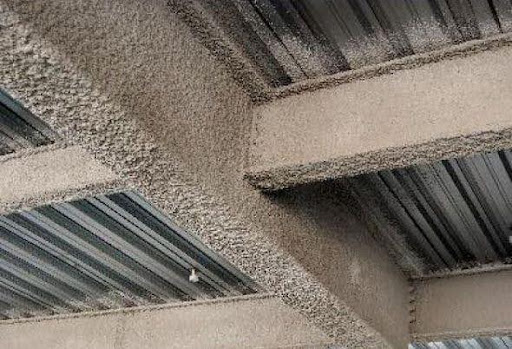
The finished surface possesses a very rough, lumpy, uneven, “popcorn-like” texture that is typically left in its natural, unfinished concrete grey or light beige coloration.27
Because of this aggressively unrefined and industrial appearance, the application of vermiculite is predominantly relegated to architectural areas where the structural steel is completely hidden from public view.28
It is the undisputed material of choice for subterranean parking garages, massive data centers, hidden mechanical plant rooms, enclosed elevator shafts, heavy industrial mechanical risers, and the vast, hidden structural steel networks located high above acoustic ceiling tiles in massive commercial warehouses.28
Economic Analysis and Cost Benchmarking in the Singapore Market
For commercial building developers, structural engineers, and estimating Quantity Surveyors (QS) operating within the highly competitive Singaporean market, the choice between intumescent reactive coatings and cementitious vermiculite spray requires a highly nuanced balancing of initial capital expenditure, tight construction scheduling, architectural intent, and long-term lifecycle maintenance costs.28
Material Pricing and Application Cost Dynamics
When analyzing the raw cost-per-square-meter, cementitious vermiculite is almost universally the more affordable option.28
Vermiculite utilizes inexpensive raw minerals and bulk cement binders, allowing it to be purchased and applied incredibly cheaply on a massive scale.33
The application process is highly rapid; it goes on thick in one or two aggressive passes with an industrial sprayer, drastically saving on costly skilled labor hours.28
Intumescent coatings, conversely, are universally considered a highly expensive, premium building material due to the immense complexity of their reactive chemical manufacturing.44
High-quality intumescent products generally retail in the exorbitant range of $350 to $550 USD equivalent per standard 5-gallon pail.44
Furthermore, intumescent coatings cannot be costed by a simple, flat square-meter rate.26
The required volume of paint is inextricably linked to the size and weight of the steel members and the designated Fire Rating Limit (FRL).26
When examining specific applied cost estimates, applying intumescent paint to structural steel typically ranges between $2 and $4 USD per square foot (roughly equating to $21 to $43 USD per square meter), heavily inclusive of both the expensive chemical materials and the intensive skilled labor required for the meticulous application.45
The labor costs for intumescent paints are exceptionally high because the application requires immense patience and precision; the paint must achieve a highly specific Dry Film Thickness (DFT) measured in microscopic mils, often forcing workers to apply several distinct, ultra-thin layers, waiting for each individual layer to fully dry and cure before applying the next.28
This painstaking process can severely slow down an aggressive, fast-track construction schedule.28
Furthermore, while large scopes of work can benefit marginally from bulk material order pricing, small, localized scopes of intumescent work suffer from severe reverse economies of scale, leading to seemingly outrageous unit prices for minor touch-ups or small structural additions.44
Second-Order Economic Insights and Structural Dead-Loads
The true economic analysis, however, extends far beyond the simplistic comparison of raw material cost per square meter.
While vermiculite presents a substantially lower initial application cost, it imposes a massive physical penalty on the building in the form of structural dead-load.27
The sheer weight of thousands of square meters of thick, heavy cementitious spray must be supported by the building’s primary structural columns and the deep foundation system.
This requires the structural engineer to over-engineer the foundation and the primary steel framework to safely carry the immense weight of the fireproofing itself.27
Conversely, while intumescent paint features a remarkably steep upfront capital premium, its ultra-lightweight, thin-film nature delivers a vastly reduced dead-load to the overall structure.33
This massive reduction in weight allows structural engineers to specify a lighter overall steel frame and utilize a less intensive foundation system, generating immense, cascading capital savings in bulk steel procurement and concrete pouring that often completely offset the initial premium paid for the expensive paint.46
In modern, sophisticated commercial projects across Singapore, a strategic hybrid approach is almost universally adopted to maximize economic efficiency: architects specify the expensive, aesthetically pleasing intumescent paint exclusively for highly visible, exposed structural columns in grand lobbies, sweeping atria, and modern architectural spaces to preserve the design vision, while the vast network of hidden floor beams, enclosed shafts, and subterranean structures are heavily coated in the highly cost-effective, durable vermiculite spray.33
Passive Fire Protection Market Trends and the Future of the Industry
The strategic deployment of these fireproofing materials is driving massive growth within the broader industrial market.
The global passive fire protection market was estimated at a staggering 4,536.0 million USD in 2024 and is projected to surge to 7,630.4 million USD by 2033, expanding at a robust Compound Annual Growth Rate (CAGR) of 6.1%.47
This massive global growth is driven primarily by the rapid urbanization, vertical infrastructure development, and the implementation of increasingly stringent, uncompromising regulatory frameworks across emerging economies.47
The Asia Pacific region absolutely dominates this global market, commanding the largest revenue share at 38.7% in 2024.47
Within this localized powerhouse, the specific Singapore Passive Fire Protection Coatings Market reflects this aggressive upward trajectory.
Valued at 8.58 million USD in 2024, the Singaporean market is projected to reach 12.49 million USD by 2032, sustaining a strong CAGR of 6.12%.4
Crucially, the intumescent coatings sector is projected to be the absolute fastest-growing product segment, anticipated to account for 36.8% of total passive fire protection market revenue by 2025.48
Within Singapore specifically, intumescent coatings are the fastest-growing segment, boasting a growth rate of 6.76% through the 2025-2032 forecast period.4
Furthermore, there is a massive, industry-wide shift toward environmentally sustainable formulations; water-based protection coatings currently account for the absolute largest share of the Singapore market, commanding 5.41 million USD in revenue in 2024, as the industry moves rapidly away from highly toxic, solvent-based paints in pursuit of stringent environmental certifications and safer interior air quality.4
Advanced Fire Engineering: The Performance-Based Design (PBD) Approach
Historically, the structural fire safety of buildings in Singapore relied entirely and exclusively on a rigid, prescriptive approach—meaning architects and engineers had no choice but to adhere strictly to the predetermined Fire Resistance Rating hours, dimensions, and material restrictions set out explicitly in Table 3.3A of the Fire Code.9
However, as modern architectural ambition continually pushes the absolute boundaries of spatial design, creating massive, interconnected mega-structures, purely prescriptive compliance often becomes physically impossible, structurally untenable, or economically unviable.9
In a monumental shift toward advanced engineering, the SCDF officially launched the Performance-Based Design (PBD) regulatory framework on July 1, 2004.9
Under this revolutionary paradigm, Qualified Persons and highly specialized Fire Safety Engineers (FSEs) are permitted to deviate entirely from the rigid prescriptive constraints, provided they can scientifically substantiate, through rigorous mathematical modeling, that their alternative, custom design achieves a level of life safety that is equivalent to, or strictly superior to, the prescriptive baseline.9
Sophisticated Engineering Substantiation Methodologies
The PBD approach abandons the simplistic assumption of a standard, uniform cellulosic time-temperature curve.
Instead, it utilizes the absolute bleeding-edge of advanced computational fire modeling and structural fire engineering to assess exactly how a specific, unique building geometry will react to highly realistic, dynamic fire loads.50
Fire Safety Engineers employ an arsenal of advanced techniques:
- Computational Fluid Dynamics (CFD): Utilizing massive computing power to accurately model the complex, three-dimensional movement and propagation of smoke, toxic gases, and localized heat transfer within highly complex architectural geometries, predicting exact tenability conditions to ensure survivability during evacuation.9
- Traveling Fire Models: Abandoning the outdated assumption that an entire massive compartment flashes over simultaneously, engineers simulate highly realistic “traveling fires” that move slowly across a vast fuel bed, exposing different sections of the structural steel framework to localized, intense heat at different times.52
- Finite Element Structural Analysis: To evaluate the precise thermal response, massive load redistribution, and large-deflection plasticity of the entire structural steel framework under elevated, localized temperatures, proving that the building will not collapse even as specific individual beams yield.51
Landmark PBD Case Studies in Singapore
The true efficacy and necessity of the PBD approach are best demonstrated in Singapore’s most iconic, world-renowned mega-structures.
The Marina Bay Sands (MBS) integrated resort stands as a landmark testament to the raw power of performance-based fire engineering.9
The project’s most iconic and daring feature—the massive 340-meter-long SkyPark, perched precariously atop three 55-storey hotel towers—would have been absolutely impossible to realize under a purely prescriptive fire code.9
Arup, the project’s multidisciplinary engineering consultant, employed a comprehensive, unprecedented PBD approach.
They conducted some of the most complex fire engineering analyses ever attempted globally, allowing them to mathematically justify several critical design features that were absolute firsts in Singapore.9
Crucially, this included the use of a completely unprotected, bare steel structure for the vast hotel atria and the SkyPark itself.9
By utilizing advanced CFD to prove that the immense volume of the atria, combined with monumental horizontal exits and massive smoke extraction, would keep the steel well below its critical failure temperature, they eliminated the need for thousands of tons of heavy intumescent or vermiculite coatings on the exposed architectural steel.9
Similarly, the South Beach Tower development, renowned for its two sweeping, curving towers and its distinctive, undulating microclimatic canopy, utilized PBD to seamlessly integrate its complex fire engineering with aggressive environmental and structural design constraints.9
Advanced parametric modeling ensured that the passive environmental strategies of the canopy did not inadvertently trap smoke or compromise the localized structural fire safety of the steel framework.9
The industry continues to push these boundaries. Looking forward to the SFPE Fire Safety Conference in Singapore in 2026, leading engineers will tackle cutting-edge PBD case studies, such as integrating massive Electric Vehicle (EV) charging infrastructure into aging, multi-story structural steel car parks, evaluating the extreme, unique fire risks of lithium-ion battery fires against the constraints of existing, historical structural steel frameworks.53
The fundamental underlying insight is that PBD completely shifts structural fireproofing from a simplistic, binary “applied or not applied” compliance checklist into a highly holistic, deeply integrated facet of the building’s fundamental structural physics.
Lifecycle Management, Auditing, and SCDF Enforcement
The successful physical application of intumescent paint or vermiculite structural fireproofing on a construction site does not represent the final step in SCDF compliance; rather, it marks the absolute beginning of a highly strict, legally mandated, decades-long lifecycle management and enforcement regime.54
Passive fire protection systems, despite their name, require intense, vigilant maintenance to ensure their life-saving performance remains utterly uncompromised decades after the building is commissioned.54
The Fire Safety Instruction Manual (FSIM)
Upon the physical completion of a construction project, the Qualified Person is legally mandated by the SCDF to painstakingly compile and formally handover a comprehensive Fire Safety Instruction Manual (FSIM) directly to the building owner.56
Detailed extensively in Appendix 2 of the Fire Code 2023, this critical manual must meticulously document the exact locations, proprietary product specifications, active CoC details, and the strictly required maintenance schedules of all active and passive fire protection systems installed within the structure.58
The building owner is legally bound to safely maintain and keep the FSIM on the premises at all times.59
Crucially, whenever any subsequent Addition & Alteration (A&A) works occur—such as a new tenant running HVAC ducts that penetrate a vermiculite-coated beam—the building owner must ensure that the FSIM is formally updated by a QP, and that any damage to the passive coatings is immediately and perfectly rectified.56
The newly updated FSIM must then be officially submitted to the SCDF for permanent recording.56
Registered Inspectors and Stringent Periodic Structural Inspection
Before a newly constructed or heavily renovated building can be legally occupied by the public, a highly qualified Registered Inspector (RI) must visually and technically audit the entirety of the applied fire safety works.
If the systems are proven to be fully compliant with the approved plans and the Fire Code, the RI formally issues a Certificate of Inspection Form 1, which leads directly to the issuance of a permanent Fire Safety Certificate (FSC) by the SCDF.60
If minor, strictly non-critical deviations exist that do not render the building immediately unsafe, the RI may issue a Form 2, allowing the SCDF to grant a Temporary Fire Permit (TFP) for a strictly limited period while the contractor rectifies the faults.60
Throughout the building’s operational lifecycle, strict, legally enforced auditing continues relentlessly. Under the authority of the Building Control Act, the fundamental structural safety of the building—which heavily includes the integrity of the applied structural fireproofing—is subjected to a mandatory Periodic Structural Inspection (PSI).61
Non-residential buildings (commercial, industrial) must be exhaustively inspected by an independent Professional Engineer exactly once every five years.61
Residential buildings require this deep structural inspection once every ten years.61
Furthermore, to maintain compliance with international best practices such as NFPA 25 and NFPA 72, which govern the inspection frequencies of highly integrated fire systems (ranging from daily visual checks to intensive 5-year tear-downs), the SCDF conducts targeted, highly selective audits for the mandatory renewal of the building’s overarching Fire Certificate.10
Owners must continuously engage a Professional Engineer to verify that the fire protection systems remain fully operational.10
In specific environments where intumescent paint has been conditionally permitted (such as localized industrial waivers under Purpose Groups VI and VIII), the building management must maintain highly detailed, continuous inspection logs to prove conclusively to SCDF auditors that the reactive coating has not chemically degraded from corrosive atmospheres or suffered mechanical scraping.37
Failure to maintain these critical systems to the highest possible standard can result in the immediate revocation of the Fire Certificate, the halting of business operations, and severe punitive actions under the Fire Safety Act.10
Conclusion
The structural integrity and absolute survivability of steel-framed buildings during a catastrophic fire event rely entirely and unequivocally on the successful, engineered deployment of passive fire protection systems.
As dictated by the rigorous, unyielding parameters of the SCDF Fire Code 2023, the selection between intumescent reactive coatings and cementitious vermiculite spray is not merely a superficial budgetary decision left to a contractor, but a highly complex, multi-layered technical engineering calculation.
Vermiculite spray continues to dominate the industry as the incredibly robust, cost-effective industrial powerhouse for concealing massive structural volumes, delivering exceptional thermal insulation through pure, brute-force physical mass and incredibly low thermal conductivity.
Conversely, intumescent paint represents an absolute marvel of reactive chemical engineering, preserving architectural aesthetics, maximizing usable spatial volume, and drastically reducing structural dead-loads through its dramatic, four-stage endothermic expansion, albeit at a significantly higher initial capital cost and with much stricter environmental and regulatory sensitivities.
Ultimately, strict, uncompromising adherence to the SCDF Product Listing Scheme, precise mathematical calculations of thermodynamic Section Factors, and unwavering, decades-long lifecycle maintenance are absolutely imperative.
By bridging the critical gap between rigorous prescriptive compliance and innovative, cutting-edge Performance-Based Design, structural engineers, Qualified Persons, and developers in Singapore can ensure that their towering mega-structures remain not only legally compliant but unequivocally resilient and safe in the face of catastrophic fire.
Works cited
- SEO For Steel Structure Manufacturing Companies And Business, accessed March 12, 2026, https://manufacturing-seo.com/steel-structure-manufacturing-seo/
- Free SEO Keyword Research – 50 Most Popular Keywords for Construction Companies & Where to Use Them – Digital Success Blog, accessed March 12, 2026, https://www.digitalsuccess.us/blog/free-seo-keyword-research-50-most-popular-keywords-for-construction-companies-where-to-use-them.html
- The Best SEO Keywords for Construction – SEOpital, accessed March 12, 2026, https://www.seopital.co/blog/seo-keywords-for-construction
- Singapore Passive Fire Protection Coatings Market Size, Trends and Forecast to 2032, accessed March 12, 2026, https://www.databridgemarketresearch.com/nucleus/singapore-passive-fire-protection-coatings-market
- Deciding what type of fire protection to use with steel structures …, accessed March 12, 2026, https://www.promat.com/en-sg/construction/projects/expert-area/39721/deciding-what-type-of-fire-protection-to-use-with-steel-structures/
- Structural Steel Fire Protection Testing and Certification – UL Solutions, accessed March 12, 2026, https://www.ul.com/services/structural-steel-fire-protection-testing-and-certification
- Part 1 of 3: A beginner’s guide to passive fire protection – Carboline, accessed March 12, 2026, https://www.carboline.com/solution-spot/posts/a-beginners-guide-to-passive-fire-protection/
- Fire Safety Act 1993 – Singapore Statutes Online – Attorney-General’s Chambers, accessed March 12, 2026, https://sso.agc.gov.sg/Act/FSA1993
- Fire Engineering Design & SCDF Compliance in Singapore, accessed March 12, 2026, https://structures.com.sg/fire-engineering-design-scdf-compliance-sg/
- Fire Certificate – SCDF, accessed March 12, 2026, https://www.scdf.gov.sg/fire-safety-services-listing/permits-and-certifications/fire-certificate
- Product Requirements | TÜV SÜD PSB Singapore, accessed March 12, 2026, https://www.tuvsud.com/en-sg/resource/certificate-finder/product-listing-scheme/product-requirements
- BuiltSearch Code • Fire Code, accessed March 12, 2026, https://code.builtsearch.com/codes/fire-code?chapter=3
- Singapore Fire Code 2023 Overview | PDF | Fire Safety | Firefighting – Scribd, accessed March 12, 2026, https://www.scribd.com/document/736891674/0-Fire-Code-2023-Binder-Including-Appendix
- SCDF – Singapore, accessed March 12, 2026, https://info.corenet.gov.sg/docs/default-source/scdf-circulars/20250901_circular-amendments-to-fire-code-2023—4th-batch-of-amendments.pdf?sfvrsn=ffc2b8db_1
- Clause 3.3 Fire Resistance of Elements of Structure – SCDF, accessed March 12, 2026, https://www.scdf.gov.sg/fire-safety-services-listing/fire-code-2023/table-of-content/chapter-3-structural-fire-precautions/clause-3.3-fire-resistance-of-elements-of-structure
- Related Tables and Diagrams of Chapter 3 – SCDF, accessed March 12, 2026, https://www.scdf.gov.sg/fire-safety-services-listing/fire-code-2023/table-of-content/chapter-3-structural-fire-precautions/related-tables-of-chapter-3
- Empowering Clients with SCDF-Recognized Fire Safety Certification | SGS USA, accessed March 12, 2026, https://www.sgs.com/en-us/news/2025/03/empowering-clients-with-scdf-recognized-fire-safety-certification
- Clause 3.4 Tests of Fire Resistance – SCDF, accessed March 12, 2026, https://www.scdf.gov.sg/fire-safety-services-listing/fire-code-2023/table-of-content/chapter-3-structural-fire-precautions/clause-3.4-tests-of-fire-resistance
- Certification Requirements for CODIMI Product Listing Scheme (PLS), accessed March 12, 2026, https://codimiglobal.com/certification-requirements-for-codimi-product-listing-scheme-pls/
- Regulated Fire Safety Products – Singapore – SCDF, accessed March 12, 2026, https://www.scdf.gov.sg/fire-safety-services-listing/plans-submission-process/regulated-fire-safety-products
- Product Requirements | TÜV SÜD PSB Singapore, accessed March 12, 2026, https://www.tuvsud.com/en-my/resource/certificate-finder/product-listing-scheme/product-requirements
- Structural Steel Fire Protection – Promat, accessed March 12, 2026, https://media.promat.com/pi10301/original/288272370/promat-paph-02-steelwork-en.pdf
- Passive Fire Protection – Structural Steel Protection – Promat, accessed March 12, 2026, https://media.promat.com/pi665944/original/260291005/promat-passive-fire-protection-structural-steel-handbook-en-hk-2023-05.pdf
- Calculating section factors – SteelConstruction.info, accessed March 12, 2026, https://www.steelconstruction.info/Calculating_section_factors
- STRUCTURAL STEEL SECTION FACTOR General Guidelines, accessed March 12, 2026, https://cdn.prod.website-files.com/5eba0483f897f9efd845e083/5ee860fd3df55c50bf823ff6_Structural%20steel%20section%20factor%20guidelines.pdf
- Intumescent paint coating FAQs for architects, accessed March 12, 2026, https://www.intumescentcoatingsystems.com.au/faqs/architectural-faq
- Intumescent vs Cementitious Vermiculite Fireproofing – BFT, accessed March 12, 2026, https://www.bftech.com.sg/intumescent-vs-cementatious-vermiculite-fireproofing/
- Choosing Between Vermiculite vs. Intumescent Coatings – Fire Rated Systems, accessed March 12, 2026, https://www.fireratedsystems.com.au/blog/vermiculite-vs-intumescent-coatings/
- How Do Intumescent Paints Work and Why Are They Key in Fire Protection? – Sylpyl, accessed March 12, 2026, https://sylpyl.com/blog/2025/03/10/how-do-intumescent-paints-work-and-why-are-they-key-in-fire-protection/
- Intumescent Coatings: What Are They & How Are They Used – Firefree Coatings, accessed March 12, 2026, https://www.firefree.com/blog/intumescent-coatings-what-are-they-and-how-are-they-used/
- How Intumescent Fire Protection Coatings Save Buildings During Fires – H&H Painting Co., accessed March 12, 2026, https://hhpaintingco.com/blog/intumescent-fire-protection-coatings/
- The Ins and Outs of Intumescent Paint: How It Works, Where to Install… – Kaloutas, accessed March 12, 2026, https://www.kaloutas.com/blog/the-ins-and-outs-of-intumescent-paint-how-it-works-where-to-install-it-and-why-it-matters
- Vermiculite vs Intumescent Coatings | Ceasefire PFP, accessed March 12, 2026, https://ceasefire.com.au/vermiculite-vs-intumescent-coatings/
- The Science Behind Fire-Resistant Intumescent Coatings, accessed March 12, 2026, https://flameseal.com/2024/02/01/the-science-behind-fire-resistant-intumescent-coatings/
- Clause 3.15 Materials for Construction – SCDF, accessed March 12, 2026, https://www.scdf.gov.sg/fire-safety-services-listing/fire-code-2023/table-of-content/chapter-3-structural-fire-precautions/clause-3.15-materials-for-construction
- Clause 3.15 Materials for construction – SCDF, accessed March 12, 2026, https://www.scdf.gov.sg/fire-safety-services-listing/cpfprts-2022/table-of-content/chapter-3-station-structural-fire-precautions/clause-3.15-materials-for-construction
- QCDFSS-3.15.1 – Intumescent Paints | PDF | Fire Safety | Structural Steel – Scribd, accessed March 12, 2026, https://www.scribd.com/document/445150118/QCDFSS-3-15-1-Intumescent-Paints
- Cost vs. Performance: Vermiculite Spray vs. Intumescent Coatings for Steel Protection by 2026 – Fire Rated Systems, accessed March 12, 2026, https://www.fireratedsystems.com.au/blog/cost-vs-performance-vermiculite-spray-vs-intumescent-coatings-for-steel-protection-by-2026/
- Vermiculate Coating vs Intumescent Paint: Which offers better fire protection?, accessed March 12, 2026, https://www.jpscsolutions.com/blog/vermiculate-coating-vs-intumescent-paint-which-offers-better-fire-protection/
- Vermiculite Spray vs Intumescent Coating – Progressive Materials, accessed March 12, 2026, https://www.progressivematerials.com.au/vermiculite-spray-vs-intumescent-coating/
- Vermiculite Fireproof Coating – ugam technology, accessed March 12, 2026, https://www.albiontech.net/vermiculite-fireproof-coating-6254701.html
- Why Vermiculite Coatings Are Essential for Fire Safety – Mid-Mountain, accessed March 12, 2026, https://mid-mountain.com/why-vermiculite-coatings-are-essential-for-fire-safety/
- Annex 3A – Singapore – SCDF, accessed March 12, 2026, https://www.scdf.gov.sg/fire-safety-services-listing/fire-code-2023/table-of-content/chapter-3-structural-fire-precautions/annex-3a
- Intumescent Paint : Explanation of Cost — United Spray, accessed March 12, 2026, https://www.unitedspray.com/blog/intumescent-paint-explanation-of-cost/
- How Much Does Intumescent Paint Cost? – Fire Retardant Sprays, Paints and Coatings, accessed March 12, 2026, https://rdrtechnologies.com/blog/much-intumescent-paint-cost
- Madam, BCA/ FSSD Joint Circular- Fire Protection Requirements in Design of Steel Str – Singapore Structural Steel Society, accessed March 12, 2026, http://www.ssss.org.sg/~ssssorgs/images/stories/docs/BCA_1.pdf
- Passive Fire Protection Market Size | Industry Report, 2033 – Grand View Research, accessed March 12, 2026, https://www.grandviewresearch.com/industry-analysis/passive-fire-protection-market
- Passive Fire Protection Market | Global Market Analysis Report – 2035, accessed March 12, 2026, https://www.futuremarketinsights.com/reports/passive-fire-protection-market
- Performance-Based Approach to Fire Safety Design – SCDF, accessed March 12, 2026, https://www.scdf.gov.sg/fire-safety-services-listing/plans-submission-process/performance-based-approach-to-fire-safety-design
- Performance-Based Structural Fire Design – Charles Pankow Foundation, accessed March 12, 2026, https://www.pankowfoundation.org/site/assets/files/2067/final_report-pbsfd_-_oct_5_2020.pdf
- Performance based fire safety design of structures – A multi-dimensional integration, accessed March 12, 2026, https://scholarbank.nus.edu.sg/entities/publication/12394d21-1b17-41b9-a19a-88d750a9508f
- Performance-Based Structural Fire Engineering of Steel Building Structures: Traveling Fires, accessed March 12, 2026, https://www.frontiersin.org/journals/built-environment/articles/10.3389/fbuil.2022.907237/full
- Call for Case Studies – 2026 SFPE PBD Conference, accessed March 12, 2026, https://www.sfpe.org/pbd2026/cfcs
- Best Practice Guide for Passive Fire Protection for Structural Steelwork – UL Solutions, accessed March 12, 2026, https://www.ul.com/sites/g/files/qbfpbp251/files/2019-04/Best-Practice-Guide-for-Passive-Fire-Protection-for-Structural-Steelwork.pdf
- How Often Should Fire Protection Systems Be Serviced? – Fortis Fire & Safety, accessed March 12, 2026, https://fortisfire.com/how-often-should-fire-protection-systems-be-serviced/
- CODE OF PRACTICE FOR FIRE PRECAUTIONS IN BUILDINGS 2023 – SCDF, accessed March 12, 2026, https://www.scdf.gov.sg/docs/default-source/fire-safety-docs/firecode-2023-111220241013.pdf?sfvrsn=b3dc3c15_3
- CODE OF PRACTICE FOR FIRE PRECAUTIONS IN RAPID TRANSIT SYSTEMS 2022 – SCDF, accessed March 12, 2026, https://www.scdf.gov.sg/docs/default-source/fire-safety-docs/(master-copy)1-sep-2022-new-cpfprts-2022-(13-june-23).pdf?sfvrsn=943f8a94_2
- 1.0 General – SCDF, accessed March 12, 2026, https://www.scdf.gov.sg/fire-safety-services-listing/fire-code-2023/table-of-content/appendix-02-fire-safety-instruction-manual/1.0-general
- 4.0 – relevant information to be included in the fire safety instruction manual – BuiltSearch Code, accessed March 12, 2026, https://code.builtsearch.com/codes/fire-code?chapter=appendix_2
- Registered Inspector – Singapore – SCDF, accessed March 12, 2026, https://www.scdf.gov.sg/fire-safety-services-listing/permits-and-certifications/registered-inspector
- Periodic Structural Inspection (PSI) | Building and Construction Authority (BCA), accessed March 12, 2026, https://www1.bca.gov.sg/regulatory-info/building-control/periodic-structural-inspection
NFPA 25 & NFPA 72 Inspection Frequencies, accessed March 12, 2026, https://www.inspectpoint.com/nfpa-25-nfpa-72-inspection-frequencies/