
Structural Integrity for Solar Retrofitting: The MAA Assessment
Focus Keyphrase: Structural Integrity for Solar Retrofitting
SEO Title: Structural Integrity for Solar Retrofitting: The MAA Assessment
Meta Description: Discover why an MAA requires a formal weight-load assessment of existing slabs for solar retrofitting. Read expert structural engineering guidelines now.
Tags: solar panels, solar energy, solar installation near me, commercial solar solutions, residential solar installation, solar panel cost.
Introduction to Solar Retrofitting
The global transition toward renewable energy accelerates rapidly. Consequently, property owners increasingly adopt rooftop solar panel systems. Commercial solar solutions offer excellent long-term financial returns.1
However, retrofitting older buildings presents significant structural engineering challenges.2 Existing concrete slabs must safely support substantial additional weights.3
Therefore, a formal weight-load assessment is strictly necessary.3 This critical assessment occurs during the formal MAA application process.4
An MAA submission prevents catastrophic structural and roofing failures.4 Many older roofs completely lack the required structural capacity.2 Adding solar panel cost to failing roofs is highly dangerous.2
Regulatory bodies mandate these complex technical engineering assessments strictly. Consumers searching for “solar installation near me” require professional engineering.1
Without formal assessments, building owners invite severe legal liabilities.5 Structural engineers evaluate dead loads, live loads, and wind uplift.6 This exhaustive report explores the rigorous mechanics of weight-load assessments.
Regulatory Frameworks in Singapore
Singapore enforces strict regulations for commercial solar PV systems.7 Installing solar panels involves navigating complex structural and grid requirements.7
The Singapore Civil Defence Force strictly governs fire safety.4 Meanwhile, the Building and Construction Authority governs structural integrity.4
The SCDF MAA Lodgement Scheme
The Minor Additions and Alterations scheme governs rooftop retrofits.4 An MAA lodgement is typically required for existing commercial buildings.4
A Qualified Person must oversee the entire retrofitting project.4 This professional is typically a Registered Architect or Professional Engineer.4
The Qualified Person bears full legal liability for the design.4 They must submit plans through the CORENET X digital platform.4
This direct submission process bypasses previously complex design gateways.4 Building owners must provide formal authorization for these MAA submissions.4
Furthermore, independent Registered Inspectors must physically audit the completed works.4 The design professional cannot be the same inspecting person.4
Successful inspections generate a Form 1 for the building owner.4 This updates the critical Fire Safety Certificate automatically.4
| Fee Category | Cost Range | Technical Context |
| MAA Lodgement Fee | $90 to $160 | Paid via CORENET based on scope category.4 |
| Plan Amendment Fee | $90 per storey | Charged if approved plans require subsequent revisions.4 |
| QP Professional Fee | $2,500 to $8,000 | Market rate depending on complexity and roof size.4 |
| RI Inspection Fee | $1,500 to $3,000 | Requires separate engagement from the initial design QP.4 |
Fire Code 2023 Tactical Clearances
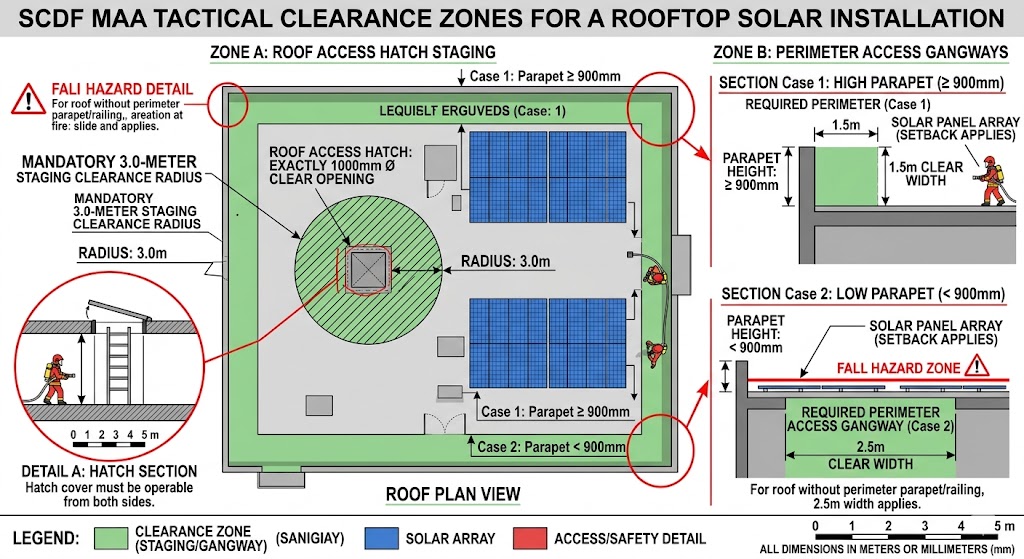
Specific fire safety clearances are strictly enforced in Singapore. Fire Code 2023 Clause 10.2 defines these essential tactical dimensions.4
Roof access hatches must measure exactly 1000mm in diameter.4 Older buildings often have non-compliant 600mm access hatches.4 Solar retrofitting frequently triggers mandatory hatch size upgrades.4
Additionally, a 3.0-meter staging clearance is completely mandatory.4 This clearance surrounds the access hatch or roof exit door.4 It ensures safe equipment deployment space for responding firefighters.4
Perimeter access gangways are also legally mandated for safety. Roofs with parapets over 900mm require a 1.5-meter perimeter gangway.4
Roofs without parapets require a wider 2.5-meter perimeter gangway.4 This wider gangway provides a crucial fall prevention buffer.4
Sub-array sizes are strictly limited by SCDF regulations. The maximum allowed sub-array size is 40m by 40m.4
This precise dimension ensures fire hoses reach the array center.4 Furthermore, a 500mm clearance around all smoke vents is required.4 This prevents dangerous obstruction of toxic smoke plumes.4
| SCDF Feature | Condition | Compliance Requirement |
| Access Hatch | All existing roofs | 1000mm clear diameter.4 |
| Staging Area | Near hatch or door | 3.0 meters clearance radius.4 |
| Gangway Route | Parapet ≥ 900mm | 1.5 meters clear width.4 |
| Gangway Route | Parapet < 900mm | 2.5 meters clear width.4 |
| Solar Array | All installations | 40m x 40m maximum size.4 |
| Smoke Vents | Near solar modules | 500mm horizontal clearance.4 |
Fire Resistance and Electrical Safety
Solar installations require rigorous electrical safety measures.7 Photovoltaic modules must meet Class C fire resistance standards.4
This standard covers both spread of flame and burning brands.4 Installations require an emergency fireman shut-off switch.4
This switch must isolate the AC side of the system.4 It is located at the building’s Fire Command Centre.4 Additionally, all DC cables require protective metal trunking containment.4 This specific containment protects against dangerous electrical arc faults.4
Furthermore, SME PEO guidelines provide specific fire separation alternatives. Installations typically require a 1-hour fire-rated separation structure.8
However, specific exemptions apply for metal-roofed commercial buildings.8 Raising solar panels 20cm above the roof provides an exemption.8 This simplifies processes and reduces total construction costs significantly.8
BCA Structural Verification and Exemptions
The Building and Construction Authority governs mechanical structural integrity.4 Structural engineers verify that existing roofs handle additional dead loads.4 They must also verify resistance to severe wind uplift forces.4
Explicit BCA plan approval is sometimes strictly required.4 Plan approval triggers if panels exceed 2.5 meters in height.4
It also triggers if arrays form shelters exceeding 10 square meters.4 Furthermore, structural roof strengthening automatically requires formal plan approval.4
Some residential properties enjoy specific exemptions from MAA submission.4 Detached, semi-detached, and terrace houses are generally exempted.4 However, they must not exceed three storeys in total height.4 Additionally, they cannot share common facilities like basement car parks.4 Cluster housing developments must always submit MAA lodgements.4
Regulatory Frameworks in Hong Kong
Hong Kong regulates solar panel installations meticulously.9 The Buildings Department oversees these specific structural safety regulations.9
They utilize the Minor Works Control System for categorizing projects.9 Weight, height, and location define the specific regulatory category.9
Minor Works Control System Categories
The MWCS categorizes solar projects into specific designated items.9 Minor Works Item 3.50 covers standard small-scale solar structures.9
It restricts installations to a 200kg absolute maximum weight.9 Furthermore, the average system weight cannot exceed 100kg per square meter.9
However, heavier systems fall under Minor Works Item 1.50.9 This category applies if total weight exceeds 200kg.9
It also applies if average weight exceeds 100kg per square meter.9 This item requires a Prescribed Building Professional for supervision.9
A Notice of Commencement must be filed 7 days prior.9 Following completion, a Certificate of Completion is strictly required.9
This ensures documented compliance with all local structural codes.9 Inaccessible roofs trigger Item 1.50 automatically, regardless of weight.9
Height Limits and Structural Prohibitions
Height limits are strictly enforced under the MWCS framework. The structure height must never exceed 1.5 meters.9
Installations exceeding this limit require formal A&A approval.9 Consequently, an Authorized Person must submit formal architectural plans.9
Cantilevered slabs are strictly prohibited for any solar mountings.9 Adding additional weight to cantilevered slabs is highly dangerous.10
Works must never alter the building’s main structural elements.9 Furthermore, systems must not project beyond the external walls.9
| MWCS Item | Weight Limit | Height Limit | Key Restriction |
| Item 3.50 | ≤ 200kg total | ≤ 1.5 meters | Prohibited on inaccessible roofs entirely.9 |
| Item 1.50 | > 200kg total | ≤ 1.5 meters | Requires Prescribed Building Professional supervision.9 |
| A&A Works | No limit | > 1.5 meters | Requires formal Buildings Department approval.9 |
Village House Specific Regulations
Village houses follow specialized regulations within Hong Kong.9 Solar panels are considered acceptable green and amenity facilities.9 However, strict height and coverage limitations apply here.9
On main roofs, structures must not exceed 2.5 meters high.9 If exceeding 1.5 meters, an Authorized Person must certify them.9 On stairhoods, heights must not exceed 1.5 meters.9
The average imposed load must not exceed 150kg per square meter.11 Stairhoods have a lower limit of 75kg per square meter.9
Continuous spread coverings cannot exceed half the total roof area.11 Clustered systems must remain under 5 square meters each.11 Furthermore, clusters require a 1-meter separation distance.11
Formal Weight-Load Assessment Principles
A formal weight-load assessment calculates all complex structural forces.6 Engineers must mathematically ensure the building supports the array.6
This requires analyzing the existing concrete slab’s absolute ultimate capacity. Several different dynamic load types interact simultaneously on roofs.3
Permanent Dead Loads
Dead loads represent the permanent, static weight of materials.3 This includes solar panels, racking systems, and electrical wiring.3
High-performance lithium batteries also contribute significant dead weight.3 Standard solar modules weigh between 40 and 50 lbs.6
Typical residential solar installations add 2 to 4 psf.6 However, flat roof ballasted systems add significantly more weight.6
They frequently add 5 to 15 psf to the slab.6 Concrete blocks provide the necessary ballast mass for stability.12
Engineers calculate this surplus average dead load meticulously.13 However, the physical weight is rarely distributed perfectly evenly.13
Rear footprints inherently possess more extreme load concentrations.13 Perimeter modules also require heavier concrete ballasting weights.13
Dynamic Live Loads
Live loads represent temporary or highly variable physical forces.3 These forces change rapidly during the building’s lifespan.3
Live loads include maintenance personnel walking on the roof.3 Engineers calculate maintenance access loads at roughly 20 psf.6
Snow accumulation constitutes another massive and unpredictable live load.14 Engineers calculate ground snow load using regional climate data.15
They adjust this data for roof slope and thermal conditions.6 Snow drifting against raised panel edges creates extreme localized pressures.6
| Load Category | Definition | Solar System Context |
| Dead Load | Permanent static physical weight.3 | Weight of panels, metal racks, and concrete ballast.3 |
| Live Load | Temporary or moving physical forces.3 | Maintenance personnel walking on the concrete roof.3 |
| Snow Load | Accumulation of frozen winter precipitation.14 | Snow drifting heavily against raised solar panel edges.14 |
| Wind Load | Aerodynamic uplift and severe downward pressure.6 | Upward lift forces violently pulling panels off roofs.12 |
| Seismic Load | Lateral forces generated from ground movement.6 | Sideways shearing stress on the mechanical mounting anchors.6 |
Wind Uplift Dynamics and ASCE 7-22
Wind forces present massive structural challenges for rooftop solar retrofits. Wind creates severe upward aerodynamic lift on angled panels.3
Consequently, modules act similarly to airplane wings during storms.3 Engineers must utilize the ASCE 7-22 standard for calculations.16
The ASCE 7-22 Calculation Standard
The ASCE 7-22 standard dictates modern wind uplift calculation methodologies.16 It replaced previous tabular methods with complex pressure equations.17
Engineers determine velocity pressure using specific environmental hazard data.16 The ASCE Hazard Tool provides precise, location-specific wind speeds.16
ASCE 7-22 modified how the directionality factor is applied.18 The directionality factor moved directly to the pressure equations.18
It was removed entirely from the base velocity pressure equation.18 This structural change impacts wind calculations significantly across all designs.18
The standard incorporates building exposure categories and importance factors.16 Furthermore, partially open buildings receive new specialized classification criteria.18 Engineers must utilize the Envelope Procedure for highly accurate modeling.19
Pressure Equalization and Uplift Forces
Wind pressure pushes down while simultaneously pulling up violently.6 The formula integrates velocity pressure and external pressure coefficients.16 Edge modules experience exponentially higher wind uplift forces routinely.13
Therefore, perimeter panels require significantly heavier concrete ballast weights.13 Middle panels require much less ballast due to aerodynamic shielding.13
ASCE 7-22 provides specific pressure equalization reduction factors.17 These factors account for the tiny gaps between solar panels.17
Higher buildings inherently experience much greater wind loads.20 Therefore, taller structures necessitate heavier overall ballasting schemes.20 Contiguous layouts lower the overall average loading requirements slightly.20
Structural Assessment and PE Accountability
A formal weight-load assessment requires a licensed Professional Engineer.5 Professional Engineer approval verifies the structure can carry the array.5 They meticulously evaluate panel weight, wind uplift, and seismic movement.5
The Structural Engineering Report
The engineering report details the existing roof’s remaining ultimate capacity.6 Engineers determine original design loads from historical building plans.6 They verify the current condition of the structural members physically.6
A typical structural report contains precise mathematical design criteria.21 For instance, it documents the specific lag screw diameter.22
It records the required screw embedment depth into the rafters.22 Furthermore, it calculates the maximum bending moment and shear forces.23
The report establishes a definitive Demand-Capacity Ratio (DCR).24 DCR must remain safely below 1.0 to ensure absolute stability.23
Overloads yield dangerous Demand-Capacity Ratios exceeding structural design limits.24
| Reporting Parameter | Typical Value Example | Engineering Significance |
| Ground Snow Load | 30 psf | Determines regional winter structural loading stress.22 |
| Wind Speed | 110 mph | Sets the baseline for aerodynamic uplift calculations.22 |
| Frame Size | 2×8 @ 12 inches | Defines the existing roof’s structural carrying capacity.22 |
| Lag Screw Diameter | 3/8 inch | Determines the pull-out resistance of mechanical anchors.22 |
| Embedment Depth | 2.5 inches | Ensures screws bite sufficiently into the structural rafters.23 |
| Demand-Capacity Ratio | 0.78 | Proves the design utilizes only 78% of capacity.23 |
Permitting and Legal Liability
Professional Engineer stamped documents are legally required for MAA approvals.4 These documents create a clear legal record of professional accountability.5
This accountability is extremely valuable for corporate risk management.5
Without a PE stamp, developers face massive legal liability.5 Structural failures invite devastating lawsuits and insurance claim denials.15
Permit rejections cost developers thousands of dollars in scheduling delays.25 Rejections average between $2,000 and $5,000 per stalled commercial project.25
PE reports streamline the municipal permitting and approval process significantly.5 They eliminate guesswork and provide definitive mathematical proof.25
Ultimately, engineering oversight guarantees the long-term safety of the building.5
Concrete Slab Pathology and Degradation
Existing concrete roof slabs degrade significantly over decades of exposure. Structural assessments must evaluate this underlying material deterioration carefully.26
Adding heavy solar panels to failing roofs is inherently dangerous.2 Several complex chemical processes destroy concrete integrity over time.27
Carbonation and pH Reduction
Healthy concrete is naturally highly alkaline by chemical design.28 This specific alkalinity forms a protective passive film around steel.28
However, atmospheric carbon dioxide slowly penetrates the porous concrete matrix.28 This slow chemical process is known widely as concrete carbonation.27
Carbonation dramatically lowers the internal pH of the concrete structure.27 Consequently, the passive protective chemical film is completely destroyed.28 The internal steel reinforcement becomes highly vulnerable to rapid rusting.28
Rust expands forcefully, causing immense internal pressure within the slab.26 This intense pressure causes the protective concrete cover to spall.26
Spalling severely weakens the slab’s overall weight-load carrying capacity.26
Chloride Ingress in Coastal Environments
Chloride ingress is another devastating concrete pathology degradation mechanism.28 Coastal environments face extreme airborne chloride exposure risks daily.27
Chlorides aggressively break the passive chemical protective film immediately.28
Consequently, highly localized pitting corrosion initiates along the steel rebars.28 Microcracks accelerate the deep penetration of these harmful chlorides.29
Larger crack widths exponentially increase the depth of dangerous carbonation.29
Furthermore, structural loading stress exacerbates this chemical degradation process.30 Axial compression loads increase the permeability of destructive chloride ions.30
Slabs with advanced chloride corrosion cannot support heavy solar ballasts. Retrofitting such damaged structures invites catastrophic and sudden physical failure.2
Non-Destructive Testing (NDT) Methodologies
Engineers must assess existing slabs without causing further physical damage. Therefore, Non-Destructive Testing is absolutely crucial for older buildings.31
NDT provides critical data regarding hidden internal concrete slab health.31 Several advanced diagnostic technologies exist for this specific diagnostic purpose.
Ultrasonic Pulse Velocity (UPV)
Ultrasonic Pulse Velocity measures internal structural integrity effectively and quickly.26 The device sends high-frequency sound waves through the concrete slab.26
Engineers precisely measure the exact velocity of these sound pulses.26
Faster pulse velocities indicate dense, high-quality solid concrete structures.26 Conversely, slower velocities indicate internal voids or severe structural cracking.26
UPV correlates directly with the concrete’s underlying compressive structural strength.26 This data is absolutely vital for accurate weight-load capacity modeling.26
Ground Penetrating Radar (GPR)
Ground Penetrating Radar is highly effective for detailed structural assessments.32 GPR uses electromagnetic waves to image the unseen subsurface layers.31
It locates embedded steel reinforcement bars precisely and incredibly quickly.31
Furthermore, GPR detects hidden moisture and dangerous hidden subsurface voids.32 Accurate rebar mapping prevents accidental damage during mechanical anchor drilling.26
Drilling blindly into roof slabs easily severs critical structural rebars.26 Therefore, GPR mapping is standard professional practice before solar retrofitting.31
Rebound Hammer Testing
The Rebound Hammer assesses concrete surface hardness efficiently and non-destructively.33 It is also known commonly as the Schmidt Hammer device.31 The device impacts the concrete and measures the physical rebound.33
Higher rebound numbers indicate significantly greater concrete surface hardness values.33 However, structural engineers must interpret these specific results very carefully.31
Rough concrete surfaces can artificially lower the recorded rebound number.33
Conversely, severe surface carbonation can artificially increase the rebound number.33 Carbonation can increase the apparent rebound number by fifty percent.33
Therefore, rebound testing is generally combined with comprehensive UPV testing.26
| NDT Methodology | Primary Diagnostic Application | Key Technical Limitations |
| Visual Inspection | Identifying surface defects and severe physical spalling.32 | Cannot detect hidden internal structural damage or voids.32 |
| Rebound Hammer | Assessing concrete surface hardness quickly and cheaply.33 | Affected heavily by surface carbonation and surface roughness.33 |
| UPV Testing | Measuring internal concrete density and compressive strength.26 | Requires physical access to both sides of the slab.26 |
| Ground Penetrating Radar | Locating embedded steel rebars and void spaces precisely.31 | Interpretation requires highly specialized technical engineering expertise.31 |
| Infrared Thermography | Detecting subsurface moisture and delamination over large areas.32 | Relies heavily on specific ambient temperature environmental conditions.32 |
Comparative Structural Design Codes
Engineers use different structural design codes globally for capacity assessments. Code selection impacts the final calculated structural ultimate weight capacity.34
ACI 318 and Eurocode 2 are the dominant global structural standards.34 They approach concrete slab capacity evaluation very differently in practice.
ACI 318 Prescriptive Standards
The American Concrete Institute publishes the renowned ACI 318 code.35 It relies heavily on prescriptive minimum tables for structural design.36
For example, concrete cover requirements are strictly table-based and rigid.36
ACI requires 75mm of cover for earth-exposed structural concrete members.36 It requires 50mm for weather-exposed members using larger steel rebars.36
This approach provides a simple, granular method for structural engineers.36
Eurocode 2 Calculation Methods
Conversely, Eurocode 2 utilizes complex, specific situational mathematical calculations.36 Engineers calculate cover based on specific environmental exposure risk classes.36 They apply adjustments for design life and specific concrete strength.36
Furthermore, Eurocode enforces much stricter span-to-depth ratios generally than ACI.34 Load combination factors differ significantly between the two structural codes.34
Eurocode 2 generally results in slightly more conservative structural designs.34
However, life cycle sustainability outcomes between the codes remain similar.37 Embodied carbon differences are typically within a tiny two-percent margin.37
Engineers must rigorously apply the legally mandated code for MAA lodgements.4
Mounting Methods: Ballast vs. Mechanical Anchors
Engineers must carefully choose between ballasted and anchored mounting systems. This decision heavily influences the ultimate structural load analysis outcome.12
Both methods offer distinct advantages and severe structural engineering disadvantages.
Ballasted Mounting Systems
Ballasted systems rely purely on heavy mass for structural stability.12 Concrete blocks hold the expansive solar array securely pressed down.12
This method cleverly avoids penetrating the roof waterproofing membrane entirely.12
However, it adds immense dead load to the existing slab.12
Ballast systems add between 5 and 7 psf of weight.38 Concentrated point loads can easily cause devastating punching shear failures.38
Consequently, structural grid meshes help distribute concrete ballast weight safely.38 Engineers must calculate the surplus average dead load extremely carefully.13
They must verify distribution to strictly avoid dangerous point overloading.38
Mechanically Anchored Systems
Alternatively, mechanical anchors penetrate the roof membrane completely and directly.12 They attach firmly to the building’s internal load-bearing structural rafters.12
This creates superior resistance to extreme aerodynamic wind uplift forces.12
Furthermore, anchors do not add significant dead weight to roofs.12 However, every single penetration risks future severe water ingress leaks.12 Therefore, waterproofing details must be executed flawlessly by roofing installers.39 Combining both methods creates a highly secure, optimized hybrid installation.
Structural Failures and Degradation Case Studies
Skipping formal structural assessments causes devastating and incredibly costly consequences.40 Failures range from minor roof leaks to total building collapses.40
Mitigation requires strict adherence to professional engineering standards and practices.
Roof Deflection and Rafter Sagging
Adding unverified weight frequently causes severe roof deflections and sagging.40 A notable residential case study occurred recently in New England.40
The existing 2×6 rafters spanned approximately 13 feet without reinforcement.40
Multiple layers of heavy roof shingles exacerbated the total load.40 Following historic winter snowfalls, the unreinforced rafters sagged and cracked.40 The lack of a professional design engineer caused this failure.40
Sagging alters the designed drainage slopes of flat concrete roofs. Consequently, severe water ponding occurs around the installed solar array.2
Standing water rapidly degrades the underlying roofing waterproofing membrane severely.2 This ultimately causes severe leaks directly into the building interior.2
Wind Uplift Detachments
Wind uplift can tear solar panels entirely off weak roofs. This disaster happens when concrete ballast is calculated completely incorrectly.41 Extreme storms test the absolute mechanical limits of structural racking.
Failures also occur when mechanical anchors detach from rotten rafters. Consequently, panels become dangerous flying projectiles during severe hurricane events.
This poses massive life-safety risks to the surrounding general public. Therefore, utilizing the ASCE 7-22 wind calculations is absolutely non-negotiable.16
Micro-Cracks and Electrical Arc Failures
Structural instability also destroys the fragile solar panels themselves eventually. Roof sagging places uneven mechanical stress on the rigid modules.42
This stress causes microscopic cracks within the delicate silicon cells. Micro-cracks severely reduce the electrical power output of the system.
Furthermore, uneven loading exacerbates Potential Induced Degradation very significantly.43 PID occurs when high voltage leaks into the panel’s frame.43
This defect reduces system performance and long-term electrical reliability significantly.43
Solar panel discoloration often indicates underlying chemical and electrical failures.43 Additionally, structural vibrations can loosen critical MC4 electrical panel connectors.42
Loose connections create dangerous, high-resistance electrical arcing within the system.42 This arcing is a primary cause of massive rooftop fires.42
Polyamide Backsheet Degradation
Environmental factors also degrade structural integrity over a system’s lifetime. Solar panels utilize protective backsheets made from specialized plastic polymers.44
The National Institute of Standards and Technology researched this specific degradation.44
They found polyamide-based backsheets cracking after just four short years.44 Ultraviolet rays, high winds, and heavy rain accelerate this deterioration.44 Cracks appear near the grid spaces between the solar cells.44
These defects allow moisture and oxygen to infiltrate the panel.44 Consequently, the internal electrical components suffer from severe moisture corrosion.
This structural failure dramatically increases the risks of fatal electrocution.44 Therefore, structural rigidity directly influences long-term electrical safety and durability.
| Failure Mode | Root Cause | Preventive Engineering Action |
| Roof Sagging | Excessive dead load on weak unreinforced structural rafters.40 | Formal structural capacity analysis prior to any physical installation.6 |
| Wind Detachment | Insufficient concrete ballast or extremely weak mechanical anchor points.41 | Strict adherence to complex ASCE 7-22 wind uplift calculations.16 |
| Water Ingress | Unsealed membrane penetrations or fundamentally altered roof drainage slopes.2 | Flawless waterproofing details and proactive rafter sag prevention methods.39 |
| PV Micro-cracks | Uneven mechanical stress from a physically flexing roof structure.42 | Ensuring absolute rigidity of the underlying mechanical mounting substructure.45 |
| Backsheet Failure | Ultraviolet degradation and severe environmental weathering of polyamide plastics.44 | Utilizing highly durable module materials and implementing routine visual inspections.44 |
Insurance Claims and Complex Legal Liabilities
Incorrect installations frequently void expensive existing commercial roofing warranties entirely.39
Manufacturers deny claims if structural modifications were strictly unapproved previously.39 Therefore, owners must consult roofing manufacturers before initiating solar retrofitting.39
Navigating Insurance Adjustments
Furthermore, insurance claims face heavy scrutiny after catastrophic structural failures.46 Solar panels are highly vulnerable to hail, debris, and wind.46
Insurers often deny claims lacking prior formal engineering capacity assessments.47
Public adjusters note that companies frequently underestimate true damage costs.46 Hidden micro-cracks from hail or wind are often completely ignored.46
Comprehensive engineering reports protect owners during incredibly complex insurance disputes.15
Standard homeowner policies usually cover properly attached roof-mounted solar panels.48 They are typically considered an integral part of the home’s structure.48
However, ground-mounted systems fall under separate “other structures” insurance coverages.48 These secondary coverages often have significantly lower financial payout limits.48
Leased panels introduce further extreme complexities into the insurance process.48 The leasing company usually holds the primary insurance liability responsibility.48
Consequently, partial settlements are incredibly common in solar damage claims.46 Firms like Gavnat and LMR advocate strongly for policyholder compensation.46
Common MAA Administrative Rejections
MAA lodgements are frequently rejected due to incredibly simple administrative errors. These rejections cause highly frustrating delays for commercial solar solutions.25
Incomplete documentation is the primary cause of MAA application failure.49
Missing property ownership proofs instantly stall the entire regulatory process.49 Furthermore, name mismatches between utility bills and applications cause rejections.49 Uploading blurred documents or skipping mandatory application fields guarantees rejection.49
System capacity errors also lead to immediate application denials frequently.49 Applying for capacities higher than the sanctioned electrical load fails.49
Additionally, failing to obtain mandatory technical feasibility approvals stops everything.49 Therefore, meticulous administrative preparation is as vital as engineering design.
Strategic SEO for the Solar Industry
The solar industry relies heavily on digital visibility for growth. Companies utilizing targeted SEO keywords attract high-quality commercial leads efficiently.50 Understanding user search intent is critical for digital marketing success.51
High-Volume Search Keywords
Consumers frequently search for “solar installation near me” on Google.1 This indicates high transactional intent and immediate local customer demand.1 Furthermore, queries regarding “solar panel cost” dominate search engines globally.1
This specific keyword garners over 135,000 monthly searches in America.1 Commercial entities often search for “commercial solar solutions” specifically online.1
Meanwhile, “solar panels” remains the highest volume broad informational keyword.1
Long-tail keywords target very specific and highly qualified customer queries.50 Phrases like “how much do solar panels cost in Ireland” perform well.50
Companies must optimize their web architecture for these specific queries.52 Clean URL structures and logical internal linking improve SEO rankings.52
| SEO Keyword Target | Monthly Search Volume | Identified User Search Intent |
| Solar panels | 823,000 | Broad Informational learning and general industry interest.1 |
| Solar panel cost | 135,000 | Transactional research regarding pricing and affordability.1 |
| Solar installation near me | 3,600 | High Local Transactional connecting with nearby providers.1 |
| Residential solar installation | 2,400 | Homeowner Transactional focused on residential property installations.1 |
| Commercial solar solutions | 390 | B2B Transactional targeting large-scale commercial rooftop projects.1 |
SEO Tool Utilization
Using tools like SEMrush and Ahrefs improves keyword targeting strategies.53 SEMrush provides excellent comprehensive full-suite platform competitor analysis capabilities.53 Ahrefs possesses a famously robust backlink database for link building.53
Surfer SEO utilizes advanced AI algorithms for on-page content optimization.53 These platforms identify incredibly valuable local keyword gaps highly accurately.53 Consequently, companies can dominate regional search engine result pages effectively.53
Integrating terms like solar energy renewable enhances overall topical authority.54 However, digital marketing must reflect genuine technical engineering expertise truthfully.
High-ranking content must emphasize structural safety and strict engineering compliance.
Misleading marketing regarding structural requirements harms the entire solar industry. Therefore, promoting rigorous MAA compliance benefits both installers and consumers.
Concrete Repair and Retrofitting Interventions
When assessments reveal structural weaknesses, immediate retrofitting is strictly required. Concrete slabs require specialized repair methods to restore ultimate capacity.
Carbon Fiber Reinforced Polymers
Carbon Fiber Reinforced Polymers provide excellent structural strengthening solutions efficiently.26
CFRP offers an incredibly high structural strength-to-weight performance ratio.26 Furthermore, it adds minimal dead load to the existing roof.26
This makes it absolutely ideal for preparing roofs for solar. CFRP also provides exceptional resistance to environmental chloride corrosion damage.26
Therefore, it protects against future carbonation and severe chloride ingress.26 Engineers highly recommend CFRP for aging reinforced commercial concrete slabs.26
Comprehensive Moisture Management
Moisture management must actively accompany any structural retrofitting repair strategy.26 High-pressure epoxy injection efficiently seals existing dangerous concrete structural microcracks.26 This strictly prevents water from reaching the internal steel reinforcement.
Furthermore, high-quality waterproof elastomeric coatings extend the concrete’s service life.26 This integrated approach addresses both causes and effects of deterioration.26
Consequently, the roof becomes safely and permanently prepared for retrofitting.
Conclusion
The transition toward solar energy requires uncompromising structural engineering rigor. Therefore, solar retrofitting is fundamentally a complex structural engineering challenge.
An MAA submission strictly mandates a formal weight-load assessment process. This ensures that the existing roof can support the loads.
Dead loads, live loads, and severe wind uplift require calculations. ASCE 7-22 wind standards dictate the precise aerodynamic uplift pressures.
Furthermore, concrete slabs degrade significantly over their long service lifespan. Pathologies like aggressive carbonation and chloride ingress weaken structural capacities.
Consequently, non-destructive testing is crucial for evaluating actual slab health. Skipping these rigorous engineering assessments invites catastrophic structural building failures.
Roofs sag, water ponds, and panels become highly dangerous projectiles.
Furthermore, unauthorized installations void roofing warranties and complicate insurance claims.
A licensed Professional Engineer must explicitly oversee and stamp designs. Ultimately, rigorous engineering compliance protects the public, property, and investments. Adhering to these strict structural standards ensures sustainable and safe energy.
Works cited
- Top Keywords for Solar SEO in 2025 – EasySolar, accessed April 27, 2026, https://easysolar.app/top-keywords-for-solar-seo-in-2025/
- When Solar PV is Installed on End-of-Life Roofs – NFRC, accessed April 27, 2026, https://www.nfrc.co.uk/resource/case-study-solar-risks.html
- Structural Load Analysis Guide for Rooftop Solar – Anern, accessed April 27, 2026, https://www.anernstore.com/blogs/diy-solar-guides/structural-load-analysis
- SCDF MAA Application for Solar Panel Installatio – Stellar Structures, accessed April 27, 2026, https://structures.com.sg/scdf-maa-solar-pv-installation/
- AHJ Requirements for Solar Projects: Why PE Approval Is Critical, accessed April 27, 2026, https://www.greenworld-energy.com/blog/ahj-requirements-why-pe-approval-matters-for-solar-projects
- Solar Structural Design Calculations: Why 20% of Permits Stall, accessed April 27, 2026, https://www.solarpermitsolutions.com/blog/solar-structural-engineering-calculations
- Commercial Solar Regulations Singapore (2026 Guide) – Fomo Energy, accessed April 27, 2026, https://fomo.energy/commercial-solar-regulations-singapore
- Roof solar panel fire safety requirement – Enterprise Singapore, accessed April 27, 2026, https://www.enterprisesg.gov.sg/smepeo/roof-solar-panel-fire-safety-requirement
- Correct Installation of Photovoltaic (PV) System – Buildings Department, accessed April 27, 2026, https://www.bd.gov.hk/en/resources/codes-and-references/pv-panel/index.html
- Minor Works Control System for building owner/owners’ corporation – Buildings Department, accessed April 27, 2026, https://www.bd.gov.hk/doc/en/resources/pamphlets-and-videos/MWCS_owner_e.pdf
- Summary Table of Updates for Guidance Notes for Solar Photovoltaic (PV) System Installation (January 2019 Edition) (information, accessed April 27, 2026, https://re.emsd.gov.hk/english/files/Notice_(EN)_210412.pdf
- Do flat roofs need ballast or anchors? Engineer answers – Anern Store, accessed April 27, 2026, https://www.anernstore.com/blogs/diy-solar-guides/flat-roof-ballast-vs-anchors-qa
- PSF roof loading of ballasted flat-roof arrays – Mike Holt’s Forum, accessed April 27, 2026, https://forums.mikeholt.com/threads/psf-roof-loading-of-ballasted-flat-roof-arrays.134153/
- Structural Design Requirements for Solar Installations – Portland.gov, accessed April 27, 2026, https://www.portland.gov/ppd/solar-development/structural-engineering/structural-design-requirements-solar-installations
- Solar Structural Engineer Report: Requirements And Essentials, accessed April 27, 2026, https://www.solarpermitsolutions.com/blog/solar-structural-engineer-report
- Design Storm-Resistant Solar: ASCE 7-22 Wind Load Standards – Solar Permit Solutions, accessed April 27, 2026, https://www.solarpermitsolutions.com/blog/asce-7-22-solar-wind-load-standards
- Wind Loads: What’s New in ASCE 7-22 – Structural Engineers Association of Georgia, accessed April 27, 2026, https://seaog.org/images/meeting/031825/seaog_asce_7_22_wind_changes.pdf
- ASCE 7-22 Wind Load Changes | Article – Meca Enterprises, accessed April 27, 2026, https://www.mecaenterprises.com/asce-7-22-wind-loads/
- Calculating Wind Loads on Buildings Using the Envelope Procedure of ASCE 7-22 Code – CEDengineering.com, accessed April 27, 2026, https://www.cedengineering.com/userfiles/S02-048%20-%20Calculating%20Wind%20Loads%20on%20Buildings%20Using%20the%20Envelope%20Procedure%20of%20ASCE%207-22%20Code%20-%20US.pdf
- Key Structural Considerations for Rooftop Solar on Commercial Buildings – SunPeak, accessed April 27, 2026, https://www.sunpeakpower.com/blog/structural-considerations-for-rooftop-solar
- S1.01 R O O F F R A M IN G P LA N SHEET INDEX GENERAL NOTES X## KEYNOTES – City of Madison, accessed April 27, 2026, https://www.cityofmadison.com/Business/PW/contracts/documents/9178%20EXHIBIT%20C%20%E2%80%93%20ROOF%20STRUCTURAL%20PLANS%20AND%20CALCULATIONS%20(1).pdf
- Roof Structural Assessment Report, JobId, accessed April 27, 2026, https://solar-roof-check.com/AssessmentReport.pdf
- SOLAR SYSTEM STRUCTURAL CALCULATION REPORT – City of New Orleans | One-Stop Shop Permitting & Licensing, accessed April 27, 2026, https://onestopapp.nola.gov/GetDocument.aspx?DocID=6448714
- Detailed Structural Commentary for Rooftop PV Arrays for the National Simplified Residential PV and Energy Storage Permit Guidelines – SolSmart, accessed April 27, 2026, https://solsmart.org/wp-content/uploads/2021/09/Step_6_Detailed_Simplified_Permit_PV_ESS_Commentary_9.16.21.pdf
- Structural Engineering Report For Solar: Guide For 2026 – Energyscape Renewables, accessed April 27, 2026, https://energyscaperenewables.com/post/structural-engineering-report-for-solar/
- (PDF) Assessment for retrofitting concrete slabs using non …, accessed April 27, 2026, https://www.researchgate.net/publication/396990458_Assessment_for_retrofitting_concrete_slabs_using_non-destructive_testing_and_destructive_testing
- Review on Durability Deterioration and Mitigation of Concrete Structures – MDPI, accessed April 27, 2026, https://www.mdpi.com/2079-6412/15/9/982
- The Improvement of Durability of Reinforced Concretes for Sustainable Structures: A Review on Different Approaches – ResearchGate, accessed April 27, 2026, https://www.researchgate.net/publication/359825901_The_Improvement_of_Durability_of_Reinforced_Concretes_for_Sustainable_Structures_A_Review_on_Different_Approaches
- Influence of carbonation on the resistance of concrete structures to chloride penetration and corrosion | MATEC Web of Conferences, accessed April 27, 2026, https://www.matec-conferences.org/articles/matecconf/abs/2019/38/matecconf_cs18_08001/matecconf_cs18_08001.html
- Coupling Effects of Stress and Carbonation on Concrete Durability: A Review – MDPI, accessed April 27, 2026, https://www.mdpi.com/1996-1944/17/22/5438
- What Is Non-Destructive Testing of Concrete? – Format NDT, accessed April 27, 2026, https://www.formatndt.co.uk/what-is-non-destructive-testing-of-concrete/
- Nondestructive Testing (NDT) for Damage Detection in Concrete Elements with Externally Bonded Fiber-Reinforced Polymer – MDPI, accessed April 27, 2026, https://www.mdpi.com/2075-5309/14/1/246
- Guide to Non-Destructive Concrete Testing – Voliro, accessed April 27, 2026, https://voliro.com/blog/non-destructive-concrete-testing/
- Comparision of Design Codes ACI 318-11, IS 456 2000 and Eurocode II – Slideshare, accessed April 27, 2026, https://www.slideshare.net/slideshow/comparision-of-design-codes-aci-31811-is-456-2000-and-eurocode-ii/140420567
- Comparison of the design of composite prestressed concrete hollow-core floor units between Eurocode 2 and ACI 318, accessed April 27, 2026, https://www.pci.org/PCI_Docs/Publications/PCI%20Journal/2022/July-August/18-0022_Elliot_JA22.pdf
- Concrete cover requirements — IS 456, ACI 318, and Eurocode 2 take three completely different approaches. Which one actually correlates with durability? – Reddit, accessed April 27, 2026, https://www.reddit.com/r/civilengineering/comments/1srhbie/concrete_cover_requirements_is_456_aci_318_and/
- sign based on American Concrete Institute (ACI-318) and Eurocode 2 (EC2) – Aaltodoc, accessed April 27, 2026, https://aaltodoc.aalto.fi/bitstreams/eaf9b427-1ffa-470d-bdeb-44a6c608a982/download
- How Much Ballast For Flat Roof Solar?, accessed April 27, 2026, https://www.sic-solar.com/blog/how-much-ballast-for-flat-roof-solar_b335
- Can solar panels damage my roof? – Solarif, accessed April 27, 2026, https://solarif.com/academy-article/can-solar-panels-damage-my-roof/
- Roof-Mounted Solar PV Panels – Part 2: Common Structural Issues – The Vertex Companies, accessed April 27, 2026, https://vertexeng.com/insights/roof-mounted-solar-pv-panels-2-common-structural-issues/
- Ballast calculation for flat roof, angled panels : r/SolarDIY – Reddit, accessed April 27, 2026, https://www.reddit.com/r/SolarDIY/comments/1fv52vg/ballast_calculation_for_flat_roof_angled_panels/
- Comprehensive Analysis of Failures in Photovoltaic Installations—A Survey-Based Study, accessed April 27, 2026, https://www.mdpi.com/1996-1073/17/23/5986
- Common Solar Panel Defects – GreenLancer, accessed April 27, 2026, https://www.greenlancer.com/post/common-solar-panel-defects
- NIST Study Uncovers a Potential Driver of Premature Solar Panel Failures, accessed April 27, 2026, https://www.nist.gov/news-events/news/2020/03/nist-study-uncovers-potential-driver-premature-solar-panel-failures
- Photovoltaic Failure Fact Sheets (PVFS) 2025 – IEA-PVPS, accessed April 27, 2026, https://iea-pvps.org/wp-content/uploads/2025/02/IEA-PVPS-T13-30-2025-PVFS-ANNEX-Degradation-and-Failure.pdf
- Gavnat Solar Panel Insurance Claim Help, accessed April 27, 2026, https://www.gavnat.com/types-of-claims/solar-damage/
- Solar Energy Panels: Blind Spots & Risks for Insurers and Owners – J.S. Held, accessed April 27, 2026, https://www.jsheld.com/insights/articles/solar-energy-panels-blind-spots-risks-for-insurers-and-owners
- What to Know About Insurance for Solar Panel Damage – LMR Public Adjusters, accessed April 27, 2026, https://lmrpublicadjusters.com/what-to-know-about-insurance-for-solar-panel-damage/
- Solar Subsidy Rejected? Reasons, Mistakes & Approval Solutions – Sunboost Energy, accessed April 27, 2026, https://www.sunboostenergy.com/blog/solar-subsidy-rejection-reasons-and-solutions/
- 2025 SEO Guide for Solar Companies by New Era Digital, accessed April 27, 2026, https://neweradigital.ie/seo-for-solar-energy-companies-2025/
- Solar-Related Keywords: Understanding What Solar Customers Want, accessed April 27, 2026, https://aurorasolar.com/blog/solar-related-keywords-understanding-what-solar-customers-want/
- Solar Companies SEO Tips to Rank Higher & Generate More Leads | SolarGenix, accessed April 27, 2026, https://solargenix.ai/blog/seo-tips-for-solar-companies
- Top 5 Best SEO Tools Software for Solar Businesses in 2025, accessed April 27, 2026, https://times.solar/top-5-seo-tools-for-solar-businesses/
The Best Solar Energy Keywords for SEO 2025 – NisonCo, accessed April 27, 2026, https://nisonco.com/top-seo-keywords-solar-companies-2025/