
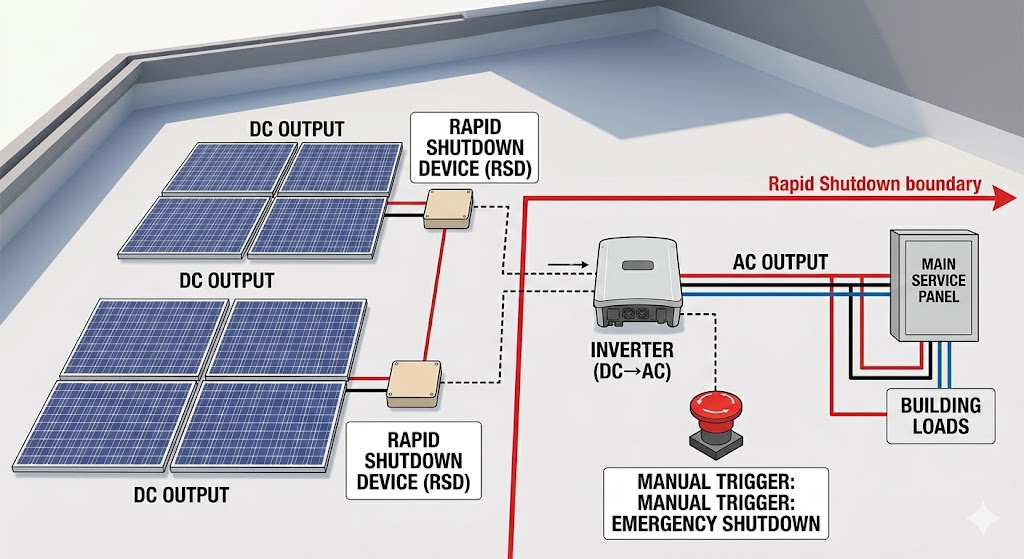
Fire Risk Mitigation for Rooftop Solar: Designing for Isolation Switches and Firefighter Clearance
Introduction to Solar Fire Hazards
Rooftop solar installations provide essential renewable energy to buildings. However, these energy systems introduce specific fire safety risks.
Consequently, comprehensive solar fire risk mitigation is strictly necessary. Solar arrays operate using high direct current voltages.
Furthermore, they remain constantly energized whenever sunlight is present.1 Therefore, simple system disconnection is rarely sufficient for safety.
Additionally, fires can originate from the solar equipment itself. Defective components often cause extreme localized overheating.2 Subsequently, this immense heat ignites surrounding combustible roof materials.
As a result, modern engineering must prioritize stringent safety measures. Installations must absolutely protect both property and emergency personnel. Importantly, firefighters require specific structural design considerations.
They face severe electrical shock hazards during emergency operations.3 Thus, robust isolation switches and rapid shutdown mechanisms are mandatory. Moreover, specific firefighter clearance pathways ensure safe roof access.4
This exhaustive report analyzes critical fire mitigation strategies thoroughly. It details isolation technologies, regulatory frameworks, and installation standards.
Primary Causes of Rooftop Solar Fires
Understanding fire origins is crucial for effective risk mitigation. Generally, solar panels do not spontaneously combust without cause.1 Instead, external factors or internal component failures initiate thermal events.
Primarily, DC arc faults represent a leading fire cause.2 These dangerous faults occur due to poor mechanical connections. Additionally, aging system components degrade significantly over time. Subsequently, electrical insulation fails, creating high-temperature electrical arcs.5
Furthermore, low-quality photovoltaic components introduce significant structural risks.2 Hot spots develop rapidly when solar cells are shaded.2 Consequently, localized overheating melts backsheets and ignites nearby materials. Alternatively, external building fires can spread to the roof. When this occurs, the solar array alters fire dynamics.6 Specifically, the gap between panels and roofs traps heat. As a result, flames spread faster across roofing membranes.6
| Fire Hazard Cause | Technical Mechanism | Mitigation Strategy |
| DC Arc Faults | Broken connections create high-temperature plasma. | Install UL 1699B arc fault detection devices. |
| Hot Spots | Localized resistance increases component temperature. | Utilize thermal imaging during routine maintenance. |
| Component Degradation | UV exposure and weather weaken insulation. | Specify high-durability, weather-rated cables. |
| Poor Installation | Loose terminals increase electrical resistance. | Enforce strict torque verification during setup. |
The Firefighter Perspective and Tactical Challenges
Firefighters face unique operational challenges during solar fire incidents. Primarily, solar photovoltaic systems remain constantly energized by light.7 Sunlight continuously generates hazardous direct current voltage.
Consequently, opening the main electrical disconnect is completely insufficient.7 The structure is not truly de-energized during daylight. Therefore, hazardous voltage exists throughout the entire DC system. Specifically, this hazard persists even if AC disconnects open.7
Subsequently, firefighting tactics must shift their focus dramatically. Operations must prioritize isolation rather than mere disconnection.7 Furthermore, standard operating procedures must address these constant hazards.
For instance, scene lighting can generate dangerous electrical currents.7 Additionally, exposure fires provide enough light to energize panels.7 Firefighters must wear proper personal protective equipment constantly.8 However, standard fire gloves provide limited electrical shock protection.7
Furthermore, standard hot sticks cannot sense DC voltage accurately.7 Consequently, they are entirely ineffective tools in these scenarios. Extinguishing agents also present distinct and dangerous operational challenges.
Dry chemical extinguishers are highly recommended for energized components.7 Conversely, applying water requires specific and specialized spray techniques. Firefighters must use a specific fog pattern consistently.
Testing shows a 30-degree fog pattern is highly effective.7 Furthermore, applying this specific pattern at 100 psi is safe.7
This specialized technique reduces electrical current below human perception.7 However, using Class A foam requires extreme operational caution.7 Foam possesses conductive properties very similar to water.7
Furthermore, foam cannot reliably block light from the panels.7 Using opaque tarps is also strongly discouraged by experts.7 Tarps are incredibly difficult to secure properly during fires.7 Wind easily dislodges tarps during frantic emergency operations.7
The Evolution of NEC 690.12 Rapid Shutdown
The National Electrical Code dictates strict electrical safety protocols. Specifically, NEC 690.12 mandates rapid shutdown functions for solar.9
This crucial rule exists primarily to protect first responders. It reduces severe shock hazards during essential rooftop operations.10 Consequently, the solar system must de-energize conductors extremely quickly.
The standard establishes specific voltage and time limits precisely. Inside the array boundary, voltage must drop below 80V.10 This critical reduction must occur within 30 seconds.10
Conversely, outside the boundary, voltage must drop below 30V.10 This stricter limit also applies within the 30-second timeframe.10 Therefore, firefighters can safely operate near the solar array.
Recent Updates to Rapid Shutdown Standards
Recent code cycles introduced important clarifications and structural exemptions. The 2023 NEC update added highly specific system exemptions.11 For example, non-enclosed detached structures are now completely exempt.11
Solar carports and parking shade structures skip rapid shutdown.11 Firefighters generally do not perform ventilation on these structures.11 Thus, the inherent shock hazard is significantly lower here.
Furthermore, the 2026 NEC draft refines initiation device requirements.12 Up to six interconnected PV systems can share devices.12
A single initiation device can trigger multiple system shutdowns.9 This reorganization creates a highly usable framework for installers.12 Meanwhile, it perfectly maintains the required safety performance goals.12
Module-Level Power Electronics (MLPE) Applications
Installers traditionally used Module-Level Power Electronics to achieve compliance. Microinverters and DC optimizers readily satisfy rapid shutdown requirements.10
However, MLPE devices introduce highly complex architectural challenges. They dramatically increase the total number of electronic components. Consequently, they add multiple potential points of system failure.13
Recent field data highlights these specific unintended negative consequences. Commercial arrays with rapid shutdown devices experience higher failures.14 Specifically, they face a 66 percent higher failure likelihood.15
These failures include critical safety issues and severe fires.15 Faulty devices melt, overheat, and ignite surrounding roof materials.13 Therefore, alternative code compliance pathways became highly desirable recently.
Unintended Consequences of Rapid Shutdown Devices
A detailed HelioVolta report examined 74 high-risk safety incidents.13 These incidents occurred strictly in installations utilizing rapid shutdown devices.13 Furthermore, the data included 40 incidents of melting components.13
Additionally, investigators documented 21 distinct rooftop fires caused directly.15 Consequently, experts argue these devices introduce unacceptable failure points.13
Unlike optimizers, basic shutdown devices provide no additional value.15 They merely reduce voltage to meet strict NEC requirements.15 However, as these specific devices age, massive failures increase.13
Worst-case scenario failures become significantly more likely over time.13 Thus, the solar industry desperately sought safer compliance alternatives.
The UL 3741 Hazard Control System Alternative
Subsequently, the industry developed the innovative UL 3741 standard. This standard addresses comprehensive Photovoltaic Hazard Control Systems directly.16
It provides compliance without requiring MLPE devices at every panel.17 Instead, it evaluates the entire solar array configuration holistically. This evaluation includes modules, racking, and precise wire management.18
UL 3741 relies on incredibly rigorous physical safety testing. Engineers simulate chaotic scenarios where firefighters fall onto arrays.16 They measure the actual electrical resistance of firefighter gear.18
They also account for standard firefighter boots and gloves.18 If resulting shock hazards remain low, the system passes.16 Consequently, installers can use standard string inverters completely safely.19
| Feature Comparison | Traditional MLPE Systems | UL 3741 Compliant Systems |
| Component Count | Very high (one device per module). | Significantly reduced component footprint. |
| Potential Failure Points | Numerous complex electrical connections. | Far fewer electrical connections required. |
| Long-term Maintenance | Labor-intensive individual module servicing. | Easier central string inverter servicing. |
| Initial Capital Cost | Higher upfront equipment and labor expenses. | Lower upfront capital and installation costs. |
This alternative approach offers multiple distinct engineering advantages. First, it eliminates thousands of unnecessary electronic roof components.19
As a result, long-term system reliability increases quite dramatically.19 Second, it reduces initial capital expenditures for project developers.19 Finally, it drastically minimizes harmful electronic waste over time.19
Designing for Physical Isolation Switches
Effective electrical isolation is a cornerstone of solar fire safety. First responders must safely sever connections to the grid. Consequently, isolation switches are critically important system components. They provide a visible, physical break in electrical circuits.20 Furthermore, they allow quick disconnection during acute emergency situations.20
Manual Disconnect Switches
Manual switches represent traditional, widely used fire safety devices. Firefighters physically actuate these specific switches upon initial arrival. Therefore, they must reside in readily accessible exterior locations.9
Typically, they sit near the main building utility meter.21 The NEC requires clear, highly visible warning labeling.9 Plaque wording must indicate the rapid shutdown feature explicitly.9
Motorized Firefighter Safety Switches
Alternatively, motorized firefighter safety switches offer advanced automated protection.22 These devices operate both manually and automatically during emergencies.22
They monitor the main AC power supply completely continuously.22 If the AC grid fails, they actuate absolutely automatically.22 Subsequently, they instantly disconnect the DC circuits from panels.22
Moreover, these modern switches include integrated temperature thermal sensors.23 For instance, advanced models detect ambient device shell temperatures.23 If internal temperatures exceed 70 degrees Celsius, they trigger.23 This automatic cut-off prevents catastrophic thermal runaways perfectly.23 Thus, they protect both the building and emergency personnel.24
Australian AS/NZS 5033 Isolation Standards
International regulatory standards offer varying perspectives on electrical isolation. In Australia, AS/NZS 5033 regulates PV array safety strictly.25
Historically, roof-mounted DC isolators were strictly mandatory everywhere. However, these exposed isolators frequently caused severe rooftop fires.26 Water ingress degraded the switch enclosures, causing internal arcing.26
Consequently, the 2021 standard update fundamentally changed these rules.27 Rooftop load break disconnectors are no longer universally required.28 Instead, a simple designated disconnection point is often sufficient.28
Furthermore, if isolators are used, they need weather protection.26 Installers must place protective physical shrouds over the devices.26 This absolutely prevents direct sunlight and rain exposure damage.26
Furthermore, the new standard emphasizes strict labeling and documentation.25 Positive and negative connectors require highly specific warning signs.28 These signs must warn that loads must be isolated.28 Additionally, they must warn workers to test for current.28 Consequently, these rigorous standards prevent accidental electrocution during maintenance.
NFPA 1 Firefighter Clearance and Access Pathways
Safe roof navigation is vital during active firefighting operations. Firefighters must access the roof to perform essential ventilation.
Therefore, the National Fire Protection Association established strict rules.4 NFPA 1 details mandatory clearances and physical access pathways.4 These rules ensure personnel can maneuver without electrocution risks.
Residential Roof Clearances
Residential solar installations require careful geometric layout planning beforehand. Installers absolutely cannot cover the entire roof with panels. Instead, they must leave specific geometric firefighter access pathways.4
Pathways must be at least 36 inches wide universally.4 They must extend directly from the roof gutter upward.4
Furthermore, pathways must exist on multiple distinct roof planes.4 At least one pathway must face the primary street.4 This allows ground ladders to reach the roof safely. Additionally, pathways must avoid all physical structural obstructions completely.4
Vent pipes and mechanical equipment cannot block emergency access.4 Similarly, pathways must sit over structurally supported framing members.29
Commercial Roof Clearances
Commercial buildings feature much larger, sprawling flat roof surfaces. Consequently, the clearance pathway requirements expand significantly in scope.
A minimum 48-inch perimeter pathway is absolutely required.30 This specific rule applies to buildings under 250 feet.30 However, larger buildings require a massive 72-inch wide perimeter.30
Moreover, massive solar arrays must be divided into sections. Ventilation pathways must exist strictly between these array blocks.30 These internal pathways must also measure 48 inches wide.30 Furthermore, clear zones must border all existing roof skylights.30
Smoke and heat vents require completely unobstructed perimeter access.30 Thus, firefighters can safely cut ventilation holes when needed.
| Building Category | Dimension Parameter | Required Pathway Width |
| Residential Roof | Gutter to Ridge line | 36 inches (914 mm) |
| Commercial Roof | Building Axis < 250 feet | 48 inches (1219 mm) |
| Commercial Roof | Building Axis > 250 feet | 72 inches (1829 mm) |
| All Building Types | Smoke/Heat Ventilation | 48 inches surrounding |
Fire Dynamics and Roof Material Interactions
The interaction between solar panels and roofing is critical. Installing solar panels fundamentally alters building fire dynamics entirely.6 The physical gap between the panel and roof is problematic.
Specifically, this narrow gap traps radiant heat during fires.6 Consequently, destructive flames accelerate rapidly across the roofing membrane.6
Researchers recorded extreme heat fluxes beneath burning solar arrays.6 These fluxes regularly exceeded during extensive testing.6 This vastly surpasses standard roofing material testing limit parameters.6 Therefore, integrated system-level fire classification testing became absolutely mandatory.
Historically, UL 1703 tested panels as isolated standalone products.31 However, testing standalone panels proved completely inadequate for safety.31
UL Standards for System-Level Fire Classification
Subsequently, safety standards evolved to require complete system-level evaluations. The updated UL 1703 and UL 2703 standards address this.32
Now, panels and mounting racks are tested rigorously together.32 This specific combination must achieve a specific fire classification rating. For instance, a Class A rating signifies high fire resistance.32
Installers must match the PV system rating to the roof.33 A Class A roof demands a Class A solar system.32 Furthermore, different racking designs influence the final safety rating.33
Sometimes, special metallic barriers or baffles are strictly required.33 These physical barriers prevent flame spread underneath the solar array.33
UK and European Fire Safety Directives
European safety standards similarly address combustible roof risks extensively. In the UK, the MCS scheme provides critical safety guidance.34 Installing solar arrays on combustible roofs is strongly discouraged.34 Consequently, comprehensive building fire risk assessments are required beforehand.34
Moreover, corporate insurers demand strict adherence to these guidelines. Risk documents like RC62 emphasize whole-system performance heavily.35 The physical distance between panel rows significantly affects flame spread.36
If rows sit too close, fires jump between them.36 Therefore, strict spacing guidelines prevent catastrophic building structural involvement.36
DC Arc Fault Detection and UL 1699B
Electrical arc faults represent the most dangerous solar failure. A series arc fault occurs when a conductor breaks.37 High-voltage direct current jumps across the physical wire gap.37
This action produces incredibly hot plasma, reaching thousands of degrees.37 Consequently, nearby combustible roofing materials ignite almost immediately.
Therefore, detecting and interrupting these dangerous arcs is paramount. The UL 1699B standard mandates specialized arc fault protection.5 These safety devices monitor electrical transmission lines completely continuously.38
They must detect arcing and shut down within 200 milliseconds.38 This incredibly rapid response extinguishes the arc before fires start.
Advanced Algorithms for Arc Fault Detection
Engineers utilize highly complex algorithms to identify dangerous arcs. Initially, they relied on simple time-domain signal analysis.37 This basic method tracks peak current and root mean square.37
However, inverter switching noise often causes frustrating false positives. Therefore, more sophisticated frequency-domain analytical methods emerged recently.39
Algorithms commonly employ the Fast Fourier Transform technique.40 This isolates high-frequency noise signatures unique to electrical arcing.40 Furthermore, the Discrete Wavelet Transform handles non-stationary signals effectively.40 Recently, advanced machine learning models have improved detection accuracy significantly.37 These AI-driven software systems filter out false alarms expertly.38
Commercial Racking Systems: Anchored vs. Ballasted
Commercial flat roofs utilize entirely different panel mounting architectures. The choice of racking directly impacts building structural safety. Installers generally choose between ballasted and anchored racking systems.41 Both distinct methods possess unique advantages and distinct risk profiles.
Anchored Racking Systems
Anchored systems penetrate the commercial roof membrane mechanically.41 Installers bolt the metal racks directly into structural members.42
Consequently, these rigid systems resist severe wind uplift effectively.42 However, roof penetrations inherently risk destructive water intrusion.41
Improperly sealed structural bolts cause slow, insidious roof leaks.42 Furthermore, penetrations must be appropriately fire-stopped using approved materials.43 Otherwise, fires can breach the roof envelope extremely easily.43
Ballasted Racking Systems
Conversely, ballasted systems rely entirely on heavy concrete weights.41 These concrete blocks hold the solar array securely down.41
Therefore, they eliminate dangerous roof penetrations entirely during installation.42 This protects the building’s waterproof integrity completely and flawlessly. However, heavy ballast weights add immense structural loads overall.42
Engineers must perform rigorous structural capacity audits beforehand absolutely.44 If neglected, complete roof collapse becomes a disastrous possibility.7 Additionally, extreme winds can shift ballasted systems dangerously sideways.45
Sometimes, entire solar arrays slide across the roof membrane.45 This sliding damages electrical cables and initiates arc faults.46 Therefore, hybrid systems combining both methods are frequently utilized.41
Battery Energy Storage Systems and NFPA 855
Rooftop solar systems increasingly incorporate massive battery energy storage. Batteries provide essential backup power during unexpected utility outages.
However, they introduce profound and terrifying new fire hazards. Lithium-ion batteries are highly susceptible to sudden thermal runaway.47
During thermal runaway, batteries release toxic, highly flammable gases.47 Subsequently, fierce explosions and stubborn, unquenchable fires can occur.
Consequently, the NFPA developed the strict 855 standard.48 NFPA 855 governs the safe installation of energy storage.47
It mandates highly specific spatial separations between battery units.49 Generally, units must sit at least three feet apart.49 Furthermore, they must sit three feet away from exits.47
Mitigation and UL 9540A Testing
This mandatory physical spacing prevents thermal runaway fire propagation.47 If one battery catches fire, the next remains safe. However, manufacturers can bypass this rule through rigorous testing.47
The UL 9540A standard evaluates large-scale destructive battery fires.47 If testing proves absolute safety, closer spacing is permitted.49
Additionally, NFPA 855 severely limits maximum individual unit capacities.49 Individual residential battery units cannot exceed 20 kWh total.49 The strict code also requires advanced gas detection systems.48 Finally, specialized explosion control exhaust ventilation is often mandatory.48 These combined safety rules significantly mitigate dangerous battery fires.
Real-World Case Studies: The Walmart-Tesla Fires
Theoretical engineering risks often manifest in real-world catastrophic failures. Analyzing past fire incidents provides invaluable technical safety lessons. The highly publicized Walmart versus Tesla lawsuit illustrates this beautifully.50
Between 2012 and 2018, seven Walmart rooftops caught fire.50 These severe fires originated strictly within their solar panel installations.50
Walmart alleged gross corporate negligence regarding installation and maintenance.51 The technical post-mortem revealed incredibly widespread systemic system failures.51
Defective wiring and poorly torqued electrical connectors were prevalent.51 Furthermore, one system ignited even after being deliberately de-energized.51 This proves that lingering DC voltage is highly dangerous.52
Additionally, critical digital warning systems were allegedly completely ignored.52 Ground fault alerts triggered months before actual fires erupted.52
A catastrophic failure to investigate these alerts caused immense damage.52 Consequently, this case underscores the vital importance of operational excellence. Strict quality control during installation is non-negotiable for safety.
Preventative Maintenance and Thermal Imaging
Comprehensive preventative maintenance is the ultimate fire mitigation strategy. Solar systems degrade over decades of harsh environmental exposure.53 Therefore, regular technical inspections identify electrical hazards before ignition.53
Operations providers execute highly detailed, comprehensive preventative maintenance checklists.53
Visual inspections look carefully for cracked glass and delamination.53 Furthermore, wire insulation is checked for severe UV degradation.53
Damaged electrical wires create immediate and lethal arc flash hazards.53 Additionally, technicians must verify the physical torque on bolts.53 Loose connections increase electrical resistance and generate extreme heat.
Thermal Imaging Applications
Thermal imaging represents a critically important diagnostic tool today.53 Technicians fly aerial drones equipped with specialized infrared cameras. These cameras scan the entire massive rooftop array quickly.
Consequently, they identify localized hot spots invisible to humans.53 A hot spot strongly indicates a failing solar cell.53 Replacing damaged modules immediately prevents subsequent dangerous thermal runaways.
Panel Cleaning Protocols
Accumulated dirt and debris also create distinct fire hazards. Severe soiling reduces solar energy output significantly over time.54
Moreover, uneven shading forces cells to inappropriately consume power. This dangerous reverse current generates localized heat extremely rapidly. Therefore, systematic panel cleaning is essential for fire prevention.54
| Preventative Maintenance Task | Recommended Frequency | Primary Safety Objective |
| Advanced Thermal Imaging | Annually | Detect dangerous hot spots and failing bypass diodes. |
| Comprehensive Visual Inspection | Bi-annually | Identify cracked panels and severe wire insulation damage. |
| Physical Torque Verification | Annually | Prevent loose connections and subsequent electrical arcing. |
| Panel Debris Removal | Quarterly | Prevent reverse current heating and localized hot spots. |
The 2026 Insurance Landscape and Policy Changes
Solar fire risk directly impacts the commercial insurance market. In 2026, building insurance policies changed dramatically and permanently. Historically, underwriters frequently ignored solar installations during risk assessments.
Now, the presence of rooftop PV alters fire ratings.44 Consequently, commercial property owners face severe annual premium spikes.44
In extreme cases, insurance companies deny coverage completely today.55 However, new state legislation attempts to stabilize this turbulent market.
California recently introduced several critical consumer protection insurance laws.55 Insurers must now offer discounts for verifiable wildfire mitigation.56 Proper solar fire safety design definitely qualifies for these discounts.
Regulatory Environments: California vs. Texas
Differing state regulatory environments influence solar deployment deeply today. California imposes incredibly strict safety codes and green mandates.57 Consequently, installation costs are higher, but safety is standardized.57 Conversely, Texas operates a deregulated, highly competitive energy market.57
Texas currently leads in massive utility-scale solar energy generation.58 However, rooftop solar lacks statewide supportive policy there completely.58
Differing electrical codes create varying safety benchmarks across regions. Nevertheless, a unified national safety standard remains the goal. Strict unified codes ultimately protect massive consumer investments flawlessly.
End-of-Life Management and EPA Regulations
Eventually, all solar panels reach their operational end of life. Consequently, managing this massive waste stream is highly critical.59
Improper disposal can lead to dangerous environmental contamination quickly. The Environmental Protection Agency heavily regulates solar panel disposal.59
By 2030, America will generate one million tons of waste.59 Therefore, strict Resource Conservation and Recovery Act rules apply.59
Facilities must recycle these hazardous materials safely and legally.59 Proper end-of-life management completely eliminates long-term fire and chemical risks.
Total Quality Solar and Future Industry Trends
The global solar industry is evolving rapidly toward greater safety. Looking ahead, several key trends completely dominate the landscape.60 First, the global alignment of safety standards is accelerating.60 International markets are adopting rapid shutdown rules very proactively.60 They increasingly model their codes after stringent US standards.60
Second, massive system repowering represents a huge emerging market.60 Early rooftop solar arrays are now reaching end of life.60
Outdated electrical components pose significant and unacceptable fire risks. Therefore, replacing them with modern, safer technology is necessary.60 This upgrade cycle eliminates obsolete, dangerous electrical gear entirely.
The Total Quality Solar Paradigm
Finally, the industry is fiercely embracing Total Quality Solar.60 TQS focuses heavily on reliability, transparency, and operational excellence.60
Installers prioritize robust system architecture over cheap, fast deployments.60 Small architectural design decisions profoundly impact long-term fire safety.60
For example, proper wire management eliminates abrasive cable wear.17 Utilizing highly reliable safety devices ensures safe rapid shutdown.60
Furthermore, advanced monitoring platforms provide critical fleet-level data insights.60 Installers receive automated alerts when safety parameters drift dangerously.60 Consequently, they resolve hidden issues long before fires ignite.
Conclusion
Mitigating fire risks in rooftop solar requires absolute engineering diligence. Solar energy systems deliver immense environmental and economic benefits continually. However, their inherent electrical hazards demand rigorous, uncompromising engineering solutions.
DC arc faults and localized overheating remain persistent, dangerous threats. Therefore, detecting these specific issues early is critically important.
Compliance with NEC 690.12 ensures firefighter safety directly and effectively. Rapid shutdown systems and physical isolation switches de-energize dangerous voltages. Furthermore, the UL 3741 standard provides highly reliable compliance alternatives.
It proves that comprehensive system-level safety design works exceptionally well. Meanwhile, NFPA 1 ensures clear, unobstructed roof access for emergencies.
Ultimately, flawless system installation quality is the absolute best defense. Employing thermal imaging and strict routine maintenance prevents catastrophic failures.
As global safety standards align permanently in 2026, the industry matures. By prioritizing Total Quality Solar, stakeholders protect lives and property. Consequently, the global transition to renewable energy remains safe.
Works cited
- A Guide to Fire Safety with Solar Systems | Department of Energy, accessed April 27, 2026, https://www.energy.gov/cmei/systems/guide-fire-safety-solar-systems
- INVESTIGATION OF THE EFFECTS OF PHOTOVOLTAIC (PV) SYSTEM COMPONENT AGING ON FIRE PROPERTIES FOR RESIDENTIAL ROOFTOP APPLICATIONS – SFPE, accessed April 27, 2026, https://www.sfpe.org/EuropeIssue21Feature5
- Understand the Impact of Photovoltaic Systems – Fire Safety Research Institute, accessed April 27, 2026, https://fsri.org/research/firefighter-safety-and-photovoltaic-systems
- NFPA 1 2021 Ed. 11.12.3 – The Hamilton Fire Department requests that roof mounted solar arrays are Installed with the following setbacks, accessed April 27, 2026, https://hamiltonma.gov/wp-content/uploads/2025/07/Solar-Fire-Code.pdf
- Implementing Arc Detection in Solar Applications: Achieving Compliance with the new UL 1699B Standard – Texas Instruments, accessed April 27, 2026, https://www.ti.com/lit/pdf/spry209
- Fire safety: Thermal exposure to roofs from fires involving photovoltaic panels (executive summary) – GOV.UK, accessed April 27, 2026, https://www.gov.uk/government/publications/fire-safety-solar-photovoltaic-panels-on-roofs/fire-safety-thermal-exposure-to-roofs-from-fires-involving-photovoltaic-panels-executive-summary
- Responding to Solar Fire Incidents – Firefighting – Fire Engineering, accessed April 27, 2026, https://www.fireengineering.com/firefighting/responding-to-solar-fire-incidents/
- A Review on Safety Practices for Firefighters During Photovoltaic (PV) Fire – PMC, accessed April 27, 2026, https://pmc.ncbi.nlm.nih.gov/articles/PMC9134713/
- Solar Rapid Shutdown Requirements NEC 690.12 for Installers, accessed April 27, 2026, https://www.greenlancer.com/post/solar-rapid-shutdown-requirements
- Meeting NEC 690.12 Rapid Shutdown Requirements for Solar – ExpertCE, accessed April 27, 2026, https://expertce.com/learn-articles/nec-690-12-rapid-shutdown-requirements/
- Understanding The 2023 NEC Changes To Rapid Shutdown Requirements, accessed April 27, 2026, https://www.solarpermitsolutions.com/blog/2023-nec-rapid-shutdown-requirements-690-12-exemptions
- 690.12 Rapid Shutdown of PV Systems on Buildings. – Electrical License Renewal, accessed April 27, 2026, https://www.electricallicenserenewal.com/Electrical-Continuing-Education-Courses/NEC-Content.php?sectionID=1984
- HelioVolta report outlines fire risk from module-level rapid shutdown devices, accessed April 27, 2026, https://pv-magazine-usa.com/2026/03/23/heliovolta-report-outlines-fire-risk-from-module-level-rapid-shutdown-devices/
- Rapid Shutdown Device Safety Report: Fire Risk in Commercial Solar (2026) – IndexBox, accessed April 27, 2026, https://www.indexbox.io/blog/report-rapid-shutdown-devices-linked-to-66-higher-safety-risk-in-commercial-solar/
- Rapid Shutdown Devices and Safety in Commercial Solar – HelioVolta, accessed April 27, 2026, https://www.heliovolta.com/resources/rapid-shutdown-devices-unintended-consequences
- UL 3741 PV Hazard Control Solution – SMA America, accessed April 27, 2026, https://www.sma-america.com/ul3741
- UL 3741 – EcoFasten Solar, accessed April 27, 2026, https://ecofastensolar.com/technical-information/ul3741/
- Definitive Guide to UL 3741: Every pathway for NEC compliance – Solar Builder, accessed April 27, 2026, https://solarbuildermag.com/featured/definitive-guide-to-ul-3741-every-pathway-for-nec-compliance/
- UL 3741 VS MLPEs – Unirac, accessed April 27, 2026, https://unirac.com/document/ul-3741-vs-mlpe-comparison-guide/
- Isolator Switch Safety Guide for Solar Energy Systems – Abn Electric, accessed April 27, 2026, https://abnelectric.com/isolator-switch-safety-in-renewable-energy-solar-installations/
- Rapid shutdown switch question | DIY Solar Power Forum, accessed April 27, 2026, https://diysolarforum.com/threads/rapid-shutdown-switch-question.77177/
- Firefighter Safety Switch. Rapid Shutdown and Remote Disconnection in Photovoltaic Installations. | Telergon, accessed April 27, 2026, https://telergon.gorlan.com/en/firefighter-safety-switch-rapid-shutdown-photovoltaic-installations/
- Solar DC Rapid Shutdown Switch RSD 26A 1500V Or 50A 1000V 3-5 Strings – YRO, accessed April 27, 2026, https://www.yroele.com/string-level-rapid-shutdown/solar-dc-rapid-shutdown-switch-rsd-26a-1500v-or-50a-1000v-3-5-strings
- Rapid Shut Down Fire-Fighter Switch for Solar Panels – PV Combiner – YouTube, accessed April 27, 2026, https://www.youtube.com/watch?v=6HqAnLuikCg
- Spotlight on: AS/NZS 5033:2021, Installation and safety requirements for photovoltaic (PV) arrays – Standards Australia, accessed April 27, 2026, https://www.standards.org.au/blog/spotlight-on-installation-and-safety-requirements-for-photovoltaic-pv-arrays
- IMPORTANT INFORMATION ON AS/NZS 5033:2021 Standards Australia published AS/NZS 5033:2021 – Installation and safety requirement, accessed April 27, 2026, https://assets.cleanenergycouncil.org.au/documents/accreditation/technical-information/Grid-Connect-Install-and-Supervise-Guidelines-Iss-13_Apr-2019_2021-Warning.pdf
- PV d.c. isolators and systems – Energy Safe Victoria, accessed April 27, 2026, https://www.energysafe.vic.gov.au/industry-guidance/electrical/installations-and-infrastructure/pv-dc-isolators-and-systems
- Deep dive on the new AS/NZS 5033:2021 Updates – GSES, accessed April 27, 2026, https://www.gses.com.au/deepdive-on-as-nzs-50332021-update/
- Solar Power Uses and Placement Requirements – Los Angeles Fire Department, accessed April 27, 2026, https://lafd.org/fire-prevention/fire-development-services/solar-power-uses-and-placement-requirements
- Roof-Mounted Solar Arrays- Access Requirements for Firefighting, accessed April 27, 2026, https://cdnsm5-hosted.civiclive.com/UserFiles/Servers/Server_4499283/File/Tender%20Documents/2023/Roof-Mounted%20Solar%20Arrays-Access%20Requirements%20for%20Firefighting.pdf
- Fire Class Rating of PV Systems – Solar ABCs: Current Issues, accessed April 27, 2026, http://www.solarabcs.org/current-issues/fire_class_rating.html
- H004 – Fire Classification for Roof Mounted PV Systems – LA County Public Works, accessed April 27, 2026, https://dpw.lacounty.gov/bsd/lib/fp/Building/Handouts/General%20Documents/H004%20-%20Fire%20Classification%20for%20Roof%20Mounted%20PV%20Systems.pdf
- Fire Rating for PV Modules and Roofs – Department of Energy, accessed April 27, 2026, https://www1.eere.energy.gov/solar/pdfs/pvmrw12_tuesam_solarabcs_sherwood.pdf
- Roof Mounted Photovoltaic Solar Panel Systems – Planning for Installation | Aviva, accessed April 27, 2026, https://static.aviva.io/content/dam/document-library/risk-solutions/roof_mounted_photovoltaic_solar_panel_systems_planning_for_installation_lps.pdf
- RC62: Recommendations for fire safety with PV panel installations – Green Roof Organisation, accessed April 27, 2026, https://www.greenrooforganisation.org/wp-content/uploads/2025/08/RC62-Recommendations-for-fire-safety-with-PV-panel-installations-241-1.pdf
- What We Can Learn From Fires On Industrial Flat Roofs With Solar Panels | Efectis, accessed April 27, 2026, https://efectis.com/en/what-we-can-learn-from-fires-on-industrial-flat-roofs-with-solar-panels/
- (PDF) DC Arc Fault Detection in Microgrids: A Comprehensive Review of Challenges, Advances, and Future Directions – ResearchGate, accessed April 27, 2026, https://www.researchgate.net/publication/400814842_DC_Arc_Fault_Detection_in_Microgrids_A_Comprehensive_Review_of_Challenges_Advances_and_Future_Directions
- Photovoltaic (PV) Arc Detection System – Renesas, accessed April 27, 2026, https://www.renesas.com/en/applications/industrial/metering/photovoltaic-pv-arc-detection-system
- Series AC Arc Fault Detection Method Based on High-Frequency Coupling Sensor and Convolution Neural Network – PMC, accessed April 27, 2026, https://pmc.ncbi.nlm.nih.gov/articles/PMC7506653/
- Why AI: A Comparative Study for Detection Methods in DC Series Arc Fault – IEEE Xplore, accessed April 27, 2026, https://ieeexplore.ieee.org/iel8/6287639/10820123/10910160.pdf
- Commercial Rooftop Solar, Frequently Asked Questions – Better Buildings Solution Center, accessed April 27, 2026, https://betterbuildingssolutioncenter.energy.gov/sites/default/files/attachments/BBA_Commercial_PV_Roofing_Guide_071715_508.pdf
- Ballasted vs Roof-Penetrating Racks: Risks, Costs, Use Cases, accessed April 27, 2026, https://www.anernstore.com/blogs/diy-solar-guides/ballasted-penetrating-roof-racks
- Understanding the risks of solar panel rooftop systems – Everywhen, accessed April 27, 2026, https://www.everywhen.co.uk/articles/home-and-property-insurance/understanding-the-risks-of-solar-panel-rooftop-systems
- Solar Panels for Commercial Buildings: 2026 Risk Management & ROI Guide – Sunchees, accessed April 27, 2026, https://www.sunchees.com/news/Industry-News/solar-panels-for-commercial-buildings-2026-risk-management-roi-guide.html
- Ballasting: Is It Safer Than Anchoring? – Graboski Roofing & Solar, accessed April 27, 2026, https://www.graboskiroofing.com/blog/2019/october/ballasting-is-it-safer-than-anchoring-/
- Understanding risks of roof-mounted PV systems – Allianz Commercial, accessed April 27, 2026, https://commercial.allianz.com/news-and-insights/expert-risk-articles/roof-mounted-pv-systems.html
- Demystifying NFPA 855: Fire Codes for Energy Storage Solutions, accessed April 27, 2026, https://www.anernstore.com/blogs/off-grid-solar-solutions/nfpa-855-energy-storage-fire-codes
- FAQ: Texas battery energy storage systems – Texas Department of Insurance, accessed April 27, 2026, https://www.tdi.texas.gov/fire/battery-energy-storage-systems.html
- Fire Codes and NFPA 855 for Energy Storage Systems – Mayfield Renewables, accessed April 27, 2026, https://www.mayfield.energy/technical-articles/fire-codes-and-nfpa-855-for-energy-storage-systems/
- Walmart vs Tesla – What It Means for the Solar Industry, accessed April 27, 2026, https://securesolarfutures.com/walmart-vs-tesla-what-this-means-for-the-solar-industry/
- Walmart accuses Tesla of gross negligence in fire lawsuit – pv magazine USA, accessed April 27, 2026, https://pv-magazine-usa.com/2019/08/21/walmart-accuses-tesla-of-gross-negligence-in-fire-lawsuit/
- Walmart vs. Tesla: Solar Panel Fires Case | PDF – Scribd, accessed April 27, 2026, https://www.scribd.com/document/422555099/654765-2019-Walmart-Inc-v-Tesla-Energy-Operations-Inc-Summons-Complaint-1
- Solar Panel Maintenance Checklist: What to Inspect & When – osapiens, accessed April 27, 2026, https://osapiens.com/maintenance/maintenance-checklist/solar-panel-maintenance-checklist/
- Solar Panel Maintenance Checklist: 8 Essential Steps for 2025 – 24 Pure Water, accessed April 27, 2026, https://24purewater.co.uk/solar-panel-maintenance-checklist/
- New California insurance laws taking effect in 2026: What policyholders need to know, accessed April 27, 2026, https://www.metroadjusters.com/new-california-insurance-laws-taking-effect-in-2026-what-policyholders-need-to-know/
- New California Wildlife Safety Regulations Impact Insurance Companies, accessed April 27, 2026, https://www.wshblaw.com/news-california-wildlife-safety-regulations
- Texas vs. California: Competition or Regulation in Energy?, accessed April 27, 2026, https://www.allianceforcompetitivepower.org/blog/texas-vs-california-competition-or-regulation-in-energy
- Why Texas Leads California in Wind, but Not Solar – Public Citizen, accessed April 27, 2026, https://www.citizen.org/news/why-texas-leads-california-in-wind-but-not-solar/
- End-of-Life Solar Panels: Regulations and Management | US EPA, accessed April 27, 2026, https://www.epa.gov/hw/end-life-solar-panels-regulations-and-management
2026: A Year of Reset, Repowering, and Global Safety Alignment, accessed April 27, 2026, https://www.tigoenergy.com/post/2026-a-year-of-reset-repowering-and-global-safety-alignment