

Structural engineering is not a background process completed to satisfy paperwork requirements. A near-miss incident in Singapore, where metal debris fell from a building in Bartley and narrowly missed a man on the ground floor, illustrates exactly what is at stake when structural integrity is not actively managed. For property developers, construction firms, and government agencies operating in Singapore’s tightly regulated built environment, understanding how structural engineering decisions translate into safety outcomes and compliance obligations is not optional. It is a fundamental requirement for protecting public welfare and sustaining project value.
Table of Contents
- What is structural engineering, and why does it matter?
- Technical performance: How structural decisions impact safety and outcomes
- Compliance and risk control: Singapore regulations and real-life failures
- Lessons from complex works: Deep excavation and the Nicoll Highway case
- Our take: What most stakeholders miss about structural engineering
- Bridge your project with expert structural engineering
- Frequently asked questions
Key Takeaways
| Point | Details |
|---|---|
| Critical for safety | Structural engineering prevents failures and protects public safety in Singapore construction projects. |
| Compliance ensures risk control | Professional engineering input is required to meet regulatory standards and avoid costly hazards. |
| Technical choices matter | Analysis methods and system selection directly shape structural performance and resilience. |
| Learn from local lessons | Major incidents like the Nicoll Highway collapse reveal the importance of safety leadership and engineering culture. |
| Strategic asset value | Early, informed engineering decisions drive long-term asset stability and developer success. |
What is structural engineering, and why does it matter?
Structural engineering is the discipline that plans, analyzes, and designs load-bearing systems within buildings and infrastructure. In Singapore’s context, it covers everything from foundation design and frame configuration to facade systems, temporary works, and deep excavation retaining structures. The scope is broader than many stakeholders assume, and this misunderstanding creates risk at every stage of a project.
Many developers treat structural engineering as a procedural step: engage the engineer, obtain the Building and Construction Authority (BCA) submission, proceed with construction. This view is incorrect and costly. Structural engineering governs the fundamental performance of a structure under gravity, wind, seismic, and operational loads throughout its entire service life.
Common misconceptions among key stakeholders include:
- Believing structural engineering ends at practical completion, when in fact ongoing inspection and maintenance obligations continue for the building’s lifespan
- Assuming that architectural drawings and structural drawings serve the same function, when they address entirely different technical requirements
- Treating facade and cladding systems as architectural features rather than structural components subject to load transfer and fixing integrity checks
- Underestimating the impact of structural system selection on cost, program, and risk exposure during construction
The correct framing is this: structural engineering is a continuous process of analysis, design, verification, and inspection that begins at feasibility and extends through occupation, modification, and eventual decommissioning.
“Structural engineers do not simply calculate numbers; they select systems, configure load paths, and make decisions that determine how a structure performs under real-world conditions. Every bracing configuration, connection detail, and foundation type is a deliberate engineering choice with measurable consequences for safety and compliance.”
Research confirms that structural system selection directly influences technical performance outcomes under real loads via analysis methods and structural choices, reinforcing that these decisions are not interchangeable. Reviewing an engineering compliance checklist early in a project allows developers to map engineering obligations before the design phase locks in critical parameters. A thorough structural assessment for compliance is equally important when evaluating existing buildings or taking over a development mid-project.
Technical performance: How structural decisions impact safety and outcomes
Understanding structural engineering’s scope, the next step is examining how specific engineering decisions directly affect real-world project outcomes. The selection of a structural system, the configuration of bracing, and the detailing of connections are not arbitrary; they produce measurable differences in how a building behaves under load.
A 2026 parametric study on X-cable bracing for planar steel frames under wind loading found that the X-cable system reduces axial forces, minimizes residual displacements, and improves energy dissipation compared to conventional cable cross-bracing. These results are not merely academic. In practical terms, better energy dissipation means less permanent deformation after a wind event, lower probability of progressive failure, and reduced repair costs after extreme loading conditions.
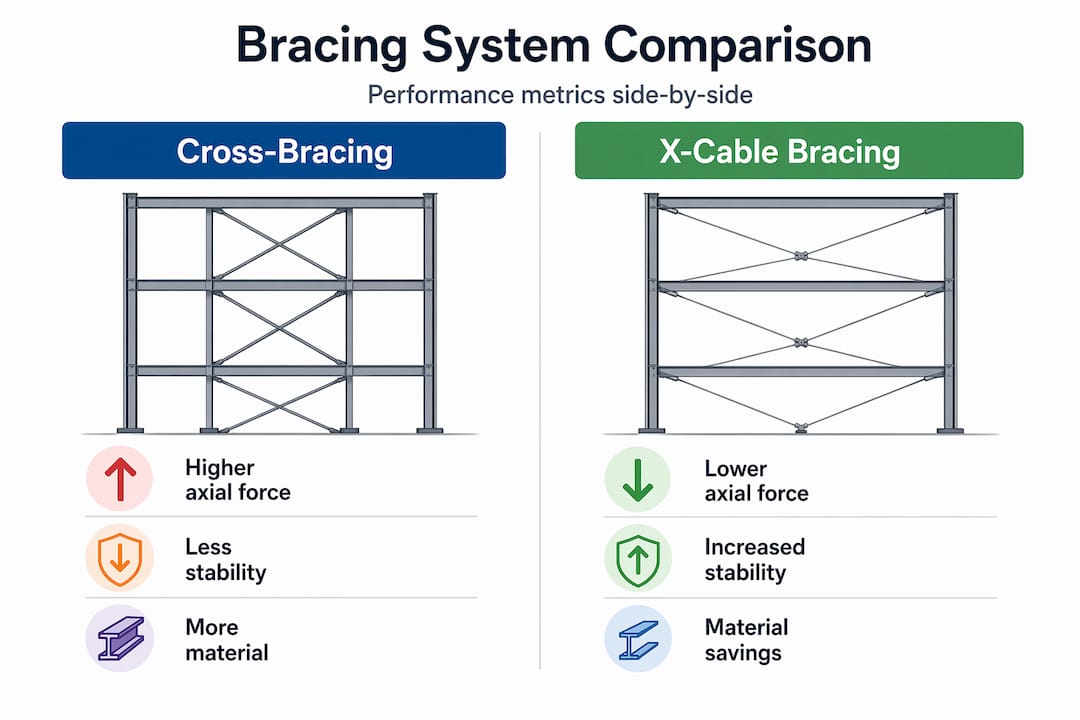
Comparison of bracing system performance characteristics
| Performance metric | Conventional cross-bracing | X-cable bracing |
|---|---|---|
| Axial force in members | Higher under lateral load | Reduced through geometry |
| Residual displacement | Greater after loading | Minimized |
| Energy dissipation | Lower efficiency | Improved |
| Suitability for wind-governed design | Adequate | Superior |
| Maintenance demand | Moderate | Lower due to reduced deformation |
The practical implications of this comparison extend to Singapore’s regulatory environment. BCA structural design requirements oblige engineers to demonstrate adequate performance under the Singapore Standard wind loading code. Selecting a more resilient bracing system from the outset is not over-engineering; it is risk management expressed through technical decision-making.
Key factors that structural engineers must evaluate in the design phase include:
- Load path continuity: Every load applied to the structure must have a clearly defined and verified path from the point of application to the foundation. Interruptions in load path continuity are among the most common causes of localized structural distress.
- Lateral load resistance strategy: Wind and, in some cases, seismic loading must be resisted by a system with adequate stiffness and ductility. This system must be selected and sized before architectural layouts are finalized.
- Connection design: Member design alone is insufficient if connection details cannot transfer the calculated forces. Connection failures account for a disproportionate share of structural incidents globally.
- Construction sequence loading: Temporary loads during erection, formwork striking, or excavation support removal frequently exceed operating loads. Structural engineers must analyze these stages explicitly.
- Serviceability limits: Deflection, vibration, and settlement must be controlled within code-mandated limits to protect finishes, services, and occupant comfort.
Pro Tip: Introduce lateral load analysis at the concept design stage, before structural grids and floor plates are fixed. Resolving the lateral load resistance strategy early prevents costly redesign when the structural engineer later discovers that the preferred architectural layout is incompatible with efficient bracing placement.
Supporting these design activities with rigorous structural modeling and analysis allows engineers to simulate performance under multiple load combinations, identify critical members and connections, and optimize the structural system before any material is ordered.
Compliance and risk control: Singapore regulations and real-life failures
Beyond technical performance, compliance and formal engineering processes are the primary mechanisms for controlling structural risk in Singapore’s built environment. The regulatory framework administered by BCA creates specific obligations for building owners, developers, and contractors that cannot be delegated or deferred without legal consequence.

The Bartley incident serves as a precise case study. Metal debris detached from a building facade, narrowly missing a member of the public. In direct response, BCA instructed the building owner to appoint a professional engineer to investigate the cause, inspect the condition of the remaining facade, and implement rectification works according to the engineer’s recommendations. This sequence of regulatory response illustrates several critical points about Singapore’s structural compliance environment.
Key observations from the Bartley incident and BCA’s response:
- Facade systems are regulated structural elements, not cosmetic finishes, and their failure triggers formal professional engineering investigation requirements
- Building owners carry ongoing statutory responsibility for the structural condition of their properties, which does not transfer to contractors or tenants after completion
- Non-compliance with BCA instructions following a structural incident carries legal and financial consequences beyond the cost of rectification
- Reactive compliance, acting only after an incident, is significantly more expensive and reputationally damaging than proactive inspection programs
Singapore structural compliance obligations: Key reference points
| Regulatory requirement | Governing body | Obligation |
|---|---|---|
| Structural plan submission and approval | BCA | Required before construction of any new structural works |
| Periodic structural inspection | BCA | Mandatory for buildings reaching inspection age thresholds |
| Facade inspection program | BCA | Five-yearly facade inspection for buildings over 13 meters |
| Professional engineer appointment for structural incidents | BCA | Mandatory upon identification of structural distress or failure |
| Temporary works design submission | BCA/MOM | Required for high-risk temporary structures |
Actionable steps for developers and contractors operating in Singapore:
- Register all structural works with BCA and maintain complete as-built records, including design calculations, inspection reports, and any approved modifications
- Implement a facade inspection schedule aligned with BCA’s five-yearly program requirements, using qualified inspectors and documented reporting protocols
- Appoint a professional engineer at the first indication of structural distress, whether in a facade, frame, or foundation system, rather than waiting for a BCA directive
- Integrate structural compliance obligations into project risk registers and development program schedules from the planning phase
Understanding the professional engineer compliance process is essential for any developer managing multiple assets. Regular real estate engineering inspections provide the documentation base required to demonstrate compliance and respond effectively to regulatory inquiries.
Lessons from complex works: Deep excavation and the Nicoll Highway case
To illustrate why structural engineering expertise is indispensable, Singapore’s most instructive construction failure warrants direct examination. The Nicoll Highway collapse occurred in April 2004 during Mass Rapid Transit construction works and resulted in four fatalities, extensive infrastructure damage, and a catastrophic excavation failure that affected a major arterial road. The case has since been studied internationally as a defining example of how engineering, management, and safety culture failures interact in complex underground works.
The collapse was not caused by a single error. It resulted from a combination of inadequate structural analysis of the temporary retaining system, insufficient monitoring response when warning signs appeared, and a safety culture that did not empower workers and supervisors to halt works when observations indicated risk. The structural engineering failures were significant, but the absence of effective risk escalation and safety leadership transformed a manageable problem into a catastrophe.
Critical lessons from the Nicoll Highway case for Singapore construction stakeholders:
- Temporary retaining structures for deep excavation carry structural risks that are fully comparable to permanent works, and their design must be treated with equivalent rigor
- Monitoring data from inclinometers, settlement markers, and load cells must be reviewed against clearly defined trigger levels, with defined responses that include work suspension
- Design assumptions made during temporary works planning, particularly regarding soil properties and prop load distribution, must be verified against actual site conditions as excavation progresses
- The engineer responsible for temporary works design must maintain direct communication with site management throughout the construction sequence, not only at the design and approval stages
- Safety leadership from project directors and senior engineers creates the organizational conditions that allow technical warning signs to be recognized and acted upon before failure occurs
Pro Tip: For any deep excavation project in Singapore, require the temporary works engineer to conduct staged design reviews tied to excavation levels, not only at the initial design submission. Each review should assess whether actual soil and load conditions remain within the design assumptions.
Applying systematic controls to deep excavation in soft clay is particularly important given Singapore’s prevalent marine clay geology. A structured approach based on the 2026 strategic deep excavation guide provides the framework for managing these risks systematically. Rigorous temporary works design with continuous design review protocols is not a cost item; it is the primary risk control for the most hazardous phase of most large-scale Singapore construction projects.
Our take: What most stakeholders miss about structural engineering
Having reviewed both evidence and lessons, a candid assessment of the persistent gaps in how the industry values structural engineering is warranted. The most significant gap is not technical. It is strategic.
Most stakeholders approach structural engineering as a compliance transaction. The engineer is engaged to produce drawings and calculations that satisfy BCA submission requirements. Once approval is granted, the engineer’s role is considered fulfilled. This view ignores the most consequential part of what structural engineering provides: the identification and mitigation of risks before they become incidents, delays, or liabilities.
The Nicoll Highway collapse did not occur because Singapore lacked competent structural engineers. It occurred because the structural engineering expertise that was present was not fully integrated into the project’s risk management and safety governance framework. This is a pattern that repeats in smaller forms across Singapore projects regularly. Engineers produce technically sound designs that are then modified during construction without proper structural review, or inspection findings that indicate emerging problems are not acted upon because the cost of intervention seems high relative to the perceived risk.
Research on structural analysis methods demonstrates that the choice of structural system and bracing configuration directly changes internal force distribution and performance under lateral loads. This means that decisions made early in design have lasting consequences for how a building performs under wind, differential settlement, or seismic activity throughout its service life. Developers who defer structural input until the design is largely fixed are effectively locking in risk parameters without proper engineering evaluation.
Long-term asset value is also directly affected by early structural engineering decisions. Buildings with well-designed structural systems, robust connection details, and documented inspection histories achieve better valuations, attract lower insurance premiums, and carry fewer latent defect liabilities than those where engineering input was minimized. The return on investment from thorough structural engineering is realized not only in the construction phase but over decades of building ownership and operation.
Bridge your project with expert structural engineering
Structural engineering expertise, when engaged strategically rather than procedurally, transforms compliance obligations into measurable project advantages.

Aman Engineering Consultancy provides specialized structural engineering consultancy services for property developers, construction firms, and government agencies across Singapore and beyond. From advanced structural modeling that simulates performance under multiple load scenarios, to facade rectification works that satisfy BCA inspection requirements and restore structural integrity, the firm’s technical services address the full spectrum of structural compliance and risk management needs. For projects where cost efficiency and structural performance must both be optimized, value engineering consultancy provides a systematic framework for evaluating alternatives without compromising safety or regulatory compliance. Reach out to discuss how a structured engineering partnership can reduce risk, support BCA approvals, and protect long-term asset value across your portfolio.
Frequently asked questions
How does structural engineering prevent building failures?
Structural engineers analyze loads and select systems that prevent excessive internal stresses, minimizing the risk of failure under real hazards such as wind or soil movement; analysis methods and system choices directly determine how internal forces are distributed across the structure.
Why are structural engineers required in Singapore for compliance?
Singapore regulations mandate professional engineering assessment for structural and facade issues to prevent public hazards and ensure proper rectification; following the Bartley incident, BCA directed the building owner to appoint a professional engineer to investigate and oversee all remedial works.
What lessons did the Nicoll Highway collapse teach Singapore’s construction industry?
The collapse demonstrated that safety leadership, structured risk escalation, and continuous monitoring are as critical as technical design quality; the Nicoll Highway case remains the definitive reference for managing safety culture and engineering governance in complex underground works.
What are common mistakes developers make in structural engineering?
Many developers treat structural engineering as a submission requirement rather than a preventive risk management function, which results in design decisions being locked in before structural input is received, higher construction costs from late-stage revisions, and latent liability exposure that affects long-term asset value.