

Inefficient building inspection workflows impose measurable costs on property developers and construction firms operating in Singapore, including project delays, failed regulatory submissions, and avoidable penalties that erode profit margins. The regulatory environment governing building inspections in Singapore involves multiple government agencies, layered approval requirements, and an accelerating shift toward digital submission platforms. Firms that treat inspection workflows as an administrative afterthought, rather than a structured compliance discipline, consistently encounter the same preventable obstacles. This guide addresses every stage of that workflow, from initial documentation and agency coordination through digital submission and audit readiness, providing a practical framework for optimizing compliance efficiency across your projects.
Table of Contents
- Understanding Singapore’s building inspection requirements
- Essential tools and technologies for optimal workflows
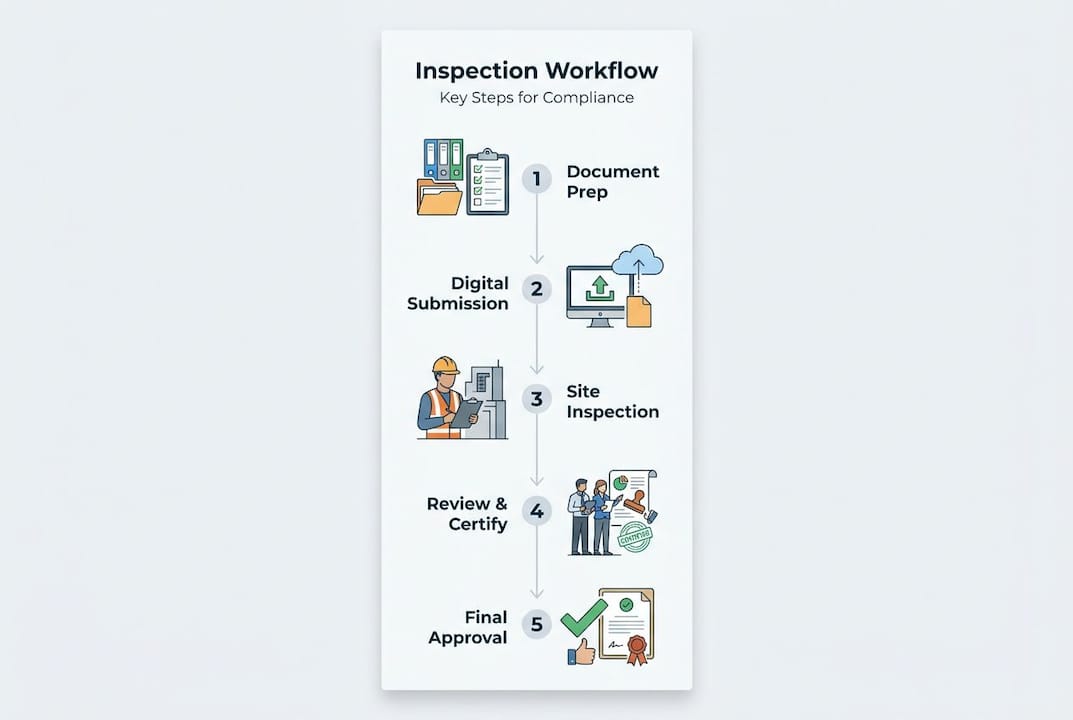
- Step-by-step: Creating an efficient building inspection workflow
- Common pitfalls and troubleshooting tips
- Verifying your workflow: What success looks like
- Why digital inspection workflows are the new standard in Singapore (and where most firms still lag)
- Optimize your inspection workflow with expert support
- Frequently asked questions
Key Takeaways
| Point | Details |
|---|---|
| Embrace digital platforms | Using tools like CORENET X dramatically improves inspection speed and regulatory compliance. |
| Standardize documentation | Consistently updated digital records and evidence are crucial for passing audits and avoiding delays. |
| Leverage virtual inspections | 360-degree and virtual assessment methods streamline site checks and reduce communication errors. |
| Stay ahead of licensing changes | Preparing early for firm-level licensing ensures continuity and competitiveness as new rules arrive. |
| Review and refine workflows regularly | Frequent evaluation of your inspection process helps maintain efficiency and compliance as regulations evolve. |
Understanding Singapore’s building inspection requirements
Before any workflow optimization can occur, project teams must have a precise understanding of the regulatory authorities involved and the documentation those authorities require. Building inspections in Singapore are governed by an interagency framework that coordinates requirements from the Building and Construction Authority (BCA), the Urban Redevelopment Authority (URA), the Land Transport Authority (LTA), the Public Utilities Board (PUB), the Singapore Civil Defence Force (SCDF), and the Housing and Development Board (HDB), among others.
Key regulatory milestones every project must address include:
- Temporary Occupation Permit (TOP): Required before any building or part of a building may be occupied; issued following successful joint agency inspections.
- Certificate of Statutory Completion (CSC): Confirms that the building has been fully completed in accordance with approved plans and all regulatory conditions.
- Certificate of Supervision (COS): Submitted by the Qualified Person (QP) to confirm ongoing supervision of building works throughout the project lifecycle.
Understanding building plan submission requirements is foundational to preparing for these milestone inspections. Documentation gaps at the submission stage are among the leading causes of inspection delays.
“Building inspections by different agencies harmonise standards, saving costs and time.” This principle, emphasized at the government level, underscores why the harmonized inspection standards across BCA, URA, LTA, PUB, and other bodies were adopted, consolidating what previously required multiple separate visits into coordinated joint site inspections.
The following table summarizes the primary regulatory documents required for building inspections in Singapore:
| Document | Authority | Purpose |
|---|---|---|
| Certificate of Supervision (COS) | BCA | Confirms QP’s ongoing supervision of works |
| Test reports | BCA, relevant agencies | Verifies materials and systems meet standards |
| As-built drawings | BCA, URA | Confirms works match approved construction plans |
| Temporary Occupation Permit (TOP) | BCA | Authorizes occupation before CSC is issued |
| Certificate of Statutory Completion (CSC) | BCA | Final completion confirmation |
| Fire Safety Certificate | SCDF | Required for fire protection systems compliance |
The QP submits TOP and CSC applications through the CORENET X portal, and joint site inspections are conducted with harmonized agency standards. Virtual and 360-degree inspections have been formally introduced into this framework, offering developers an opportunity to reduce the logistical burden of coordinating simultaneous physical site visits across multiple agencies. Reviewing design compliance essentials early in the project cycle further reduces the risk of late-stage compliance deficiencies that delay inspection scheduling.
Essential tools and technologies for optimal workflows
Once the regulatory requirements are clearly mapped, the next step is selecting and implementing the tools that reduce time, eliminate manual errors, and create a reliable audit trail. Singapore’s construction sector now benefits from a growing ecosystem of digital platforms specifically designed to support compliant inspection workflows.
CORENET X is the central government submission portal for regulatory communications, plan submissions, and inspection coordination. All TOP and CSC applications, along with supporting documentation, are submitted through this platform. Firms that invest time in staff training on CORENET X submission protocols consistently experience fewer rejection cycles.

Building Information Modeling (BIM) platforms, including IBIS (Integrated BIM for Inspection and Supervision), support documentation management, version control, and quality assurance throughout the project lifecycle. Effective use of BIM for inspections enables QPs and Professional Engineers (PEs) to cross-reference as-built conditions against approved models in real time, reducing discrepancies before the formal inspection stage.
| Tool | Function | Compliance Benefit |
|---|---|---|
| CORENET X | Regulatory submission portal | Centralized, traceable submission records |
| BIM (IBIS) | 3D modeling and documentation | Reduces as-built discrepancies and rework |
| 360-degree cameras | Virtual site inspection capture | Reduces need for repeated physical inspections |
| Digital evidence platforms | Photo, video, and lab report storage | Supports evidence-based compliance verification |
| Pre-ConQUAS audit tools | Pre-audit quality assessment | Identifies deficiencies before formal inspections |
| SMP (Site Management Plan) platforms | Supervision coordination | Enhances firm-level oversight consistency |
Evidence-based approaches, including systematic video documentation, photographic records, and laboratory test reports, reduce the number of physical inspections required by demonstrating compliance proactively. Firms that structure their construction compliance checklist around digital evidence collection from day one are substantially better positioned at the formal inspection stage.
Pro Tip: Implement pre-ConQUAS audit protocols at least 30 days before scheduling formal inspections. Early audits expose documentation gaps, material non-conformances, and supervision records issues that, if left unaddressed, create costly resubmission cycles.
BCA’s new licensing regime, which introduces firm-level licensing for supervision and certification functions from 2027 to 2028, will further incentivize firms to invest in structured digital platforms. Early adoption positions project teams to meet evolving standards without disruptive overhauls at the point of regulatory mandate.
Step-by-step: Creating an efficient building inspection workflow
Armed with the right tools and regulatory knowledge, firms can construct a disciplined, step-wise inspection workflow that minimizes delays and maximizes compliance certainty.
-
Project scoping and documentation initialization. At project kickoff, establish a complete documentation register that maps every required document to the relevant authority, submission stage, and responsible party. Assign specific ownership for each document category to prevent gaps at critical milestones.
-
QP and PE role assignment. Formally appoint the Qualified Person and Professional Engineer for each discipline. Define their responsibilities, supervision schedules, and certification obligations in writing. As emphasized in the TOP/CSC application requirements, PE and QP independence and detailed documentation are core mechanics of a compliant submission.
-
Digital evidence collection setup. Configure site documentation systems to capture photographs, videos, and test reports at defined construction stages. Establish naming conventions and storage protocols that align with CORENET X submission requirements.
-
Pre-audit review. Conduct internal pre-ConQUAS audits to verify that workmanship standards, supervision records, and material certifications are complete. Address all non-conformances before proceeding to agency notification.
-
Joint agency inspection booking. Use CORENET X to formally notify and schedule joint inspections with the relevant agencies. Prepare a consolidated site inspection package that includes all required documents and digital evidence.
-
Virtual or physical site inspection execution. Where applicable, deploy 360-degree inspection technology to supplement or replace physical inspections, reducing agency coordination burden. Ensure all inspection findings are recorded digitally and immediately.
-
Feedback loop management. After inspection, respond to agency queries or non-compliance notices within the stipulated timeframes. Maintain a running log of all feedback, corrective actions taken, and resubmission dates.
-
Final submission and record retention. Submit completed TOP or CSC applications via CORENET X with full supporting documentation. Retain all records in a structured digital archive for future audits, facility management, and any subsequent certification requirements.
| Workflow Stage | Key Action | Responsible Party |
|---|---|---|
| Project scoping | Documentation register creation | Project Manager |
| Role assignment | QP and PE appointment and briefing | Project Director |
| Evidence collection | Digital photo, video, lab report capture | Site Supervisor |
| Pre-audit review | Internal compliance verification | QP and PE |
| Inspection booking | CORENET X agency notification | QP |
| Inspection execution | Site walk or virtual inspection | QP, PE, Agency Officers |
| Feedback management | Query response and corrective action | QP and Project Manager |
| Final submission | TOP/CSC submission via CORENET X | QP |
Pro Tip: Maintain a single consolidated inspection dossier for each project stage, accessible to all team members in real time. When agencies request additional documentation or clarification, response time is dramatically reduced when all records are centrally organized rather than distributed across individual inboxes and file drives.
Reviewing the structural assessment process alongside this workflow ensures that structural certification requirements are integrated into the inspection timeline rather than treated as a separate, parallel track. Projects that align structural, facade, and M&E inspections under a single coordinated workflow consistently achieve faster TOP issuance.
Common pitfalls and troubleshooting tips
Even well-designed inspection workflows encounter problems. Understanding the most frequent failure points allows project teams to build in preventive measures before issues escalate into compliance breaches or project delays.
The most common pitfalls include:
- Incomplete documentation at inspection time. Missing COS submissions, unsigned test reports, or outdated as-built drawings are the most frequent causes of failed inspections. Document completeness must be verified systematically before any inspection is scheduled.
- Fragmented communication between agencies. Relying on informal email chains to coordinate multi-agency inspections creates version control problems and missed notifications. CORENET X provides the structured communication channel that eliminates this fragmentation.
- Underutilizing digital evidence. Firms that do not systematically capture and store site photographs and video records lose the ability to demonstrate compliance for works that have been covered or completed before formal inspection.
- Neglecting pre-audit protocols. Proceeding directly to formal agency inspection without an internal pre-audit review is a high-risk approach that consistently generates non-compliance findings and resubmission requirements.
- Inadequate firm-level supervision records. As firm-level licensing requirements take effect from 2027 to 2028, firms that have not established structured supervision documentation frameworks will face compounded compliance risks during the transition period.
“Documentation errors and compliance misses can delay TOP/CSC approvals,” representing not only direct project holding costs but also potential contractual penalties where completion dates are tied to regulatory milestone achievement.
Pro Tip: Establish a mandatory documentation lock-down protocol 14 days before any scheduled inspection. During this period, no documentation revisions should be made without formal change control approval, and the complete inspection dossier should be reviewed by the QP against the current regulatory checklist.
Seeking support from specialists in professional building inspections provides an independent verification layer that internal teams, under project delivery pressure, often cannot objectively perform for themselves.
Verifying your workflow: What success looks like
Once an optimized inspection workflow is in operation, project teams must establish clear metrics to confirm that the workflow is producing the intended compliance and efficiency outcomes. Success is measurable, not assumed.
Indicators of an effective inspection workflow include:
- Reduction in the number of agency queries or non-compliance notices received per inspection cycle.
- Decrease in the elapsed time between TOP application submission and approval issuance.
- Complete, uninterrupted digital audit trails with no missing documentation entries.
- Ability to respond to agency feedback within 48 to 72 hours across all project stages.
- Zero unscheduled physical inspection visits required outside the formal joint inspection program.
- Consistent pre-audit pass rates of greater than 90% before formal inspection scheduling.
The formal adoption of virtual and 360-degree inspections within Singapore’s regulatory framework provides developers with an objective indicator of workflow maturity. Firms that consistently leverage this technology report measurable improvements in both audit speed and approval timelines.
Benchmarking against comparable project types within your portfolio is also a practical method for identifying workflow inefficiencies. Comparing the number of inspection rounds, non-compliance notices, and days from TOP application to approval across similar projects reveals where process improvements are generating real gains and where further optimization is needed.
For specialized assets, reviewing periodic facade inspections requirements alongside the core inspection workflow ensures that post-completion compliance obligations are anticipated and built into long-term asset management plans.
Why digital inspection workflows are the new standard in Singapore (and where most firms still lag)
The technology and regulatory frameworks supporting digital inspection workflows are now sufficiently mature that there is no legitimate operational justification for firms to continue relying on predominantly manual processes. Yet a significant portion of the construction sector in Singapore continues to approach inspections reactively, treating digital tools as supplementary rather than foundational to their compliance operations.
The core problem is not awareness. Most project managers know that CORENET X exists and that BIM platforms support inspection workflows. The problem is integration. Firms that use digital tools in isolation, without embedding them into a structured, cross-agency workflow that assigns clear responsibilities to QPs and PEs at every stage, receive limited benefit from those tools. Partial digitization amplifies rather than reduces inconsistency, because it creates hybrid processes where some records are digital and others remain on paper, making comprehensive audit trail construction difficult.
The TOP/CSC application mechanics are explicit on the requirement for PE and QP independence and thorough documentation. Firms that treat these requirements as compliance checkboxes rather than genuine quality controls consistently produce inspection submissions that require multiple revision rounds. The cost of each additional round, in time, supervision fees, and agency processing delays, is directly traceable to inadequate process design.
Leading firms are proactively redesigning their inspection workflows ahead of the 2027 to 2028 firm-level licensing mandates, using this transition period to institutionalize digital evidence collection, pre-audit protocols, and BIM-integrated documentation as standard operating procedure. The digital transformation shaping Singapore’s construction sector is not a future state for these firms. It is the current operating standard.
The firms that will be most competitively positioned under the incoming licensing regime are those that have already built institutional knowledge around digital workflows, not those that will begin adapting in response to a compliance deadline.
Optimize your inspection workflow with expert support
Translating the frameworks described in this guide into operational practice requires expertise that spans regulatory knowledge, digital platform capability, and project coordination. For developers and construction firms managing complex project portfolios, the cost of building that expertise internally often exceeds the cost of engaging a specialist consultancy.
Aman Engineering Consultancy provides end-to-end inspection workflow support across structural, facade, M&E, fire safety, and digital engineering disciplines. From authority approval support for TOP and CSC submissions to value engineering services that reduce compliance costs without compromising regulatory standards, the firm’s team of registered QPs and PEs brings direct agency coordination experience to every project engagement. Aman Engineering Consultancy offers the technical depth and cross-agency knowledge that turns compliance requirements into structured, manageable workflows for property developers and construction firms operating across Singapore’s demanding regulatory environment.
Frequently asked questions
What is the role of CORENET X in building inspection workflows?
CORENET X is the central digital portal used in Singapore for submission, coordination, and approval processes, and QP submits TOP/CSC applications through this platform to engage multiple regulatory agencies simultaneously.
How do virtual or 360-degree inspections benefit developers?
Virtual inspections reduce physical site visits, saving significant coordination time and streamlining multi-agency compliance verification without compromising the regulatory validity of the inspection record.
What key documents are required for building inspections in Singapore?
The primary required documents include COS, test reports, and as-built drawings, in addition to the Certificate of Statutory Completion (CSC) and the Temporary Occupation Permit (TOP) application.
How will firm-level licensing in 2027/2028 impact the inspection process?
Firm-level licensing from 2027/2028 will impose formal accountability at the organizational level for supervision and certification quality, requiring firms to demonstrate documented, structured inspection processes rather than relying solely on individual QP and PE credentials.
What is the biggest mistake developers make with inspection workflows?
Failing to implement systematic digital documentation and evidence collection from project commencement, as emphasized in the TOP/CSC application requirements, consistently produces incomplete audit trails that delay final approval and create resubmission requirements.