
Singapore Seismic Risk Report 2026: Structural Resilience, Sumatran Tremors, and the Geothermal Awakening
1. Introduction: The Paradox of Stability
Singapore exists in a seismological paradox that frequently confounds both its residents and international observers.
Geographically, the island nation is situated in a region often described by geologists as “stable”—nestled centrally on the Sunda Plate, a southern extension of the massive Eurasian Plate.1
It is located approximately 400 kilometers away from the nearest major active plate boundary, the Sunda Trench, where the Indo-Australian Plate subducts beneath the Eurasian Plate.2
Consequently, Singapore does not experience the devastating ground ruptures, crustal fracturing, or catastrophic liquefaction associated with near-field earthquakes that plague its neighbors in Indonesia, the Philippines, or Japan.3
However, “stable” is a geological classification, not an experiential one. For the millions of residents living in high-rise dominance—over 80% of the population resides in apartments higher than 10 stories—the ground is far from static.4
The physical reality of Singapore is defined by a dynamic interactivity with regional tectonics. When the Sumatran megathrust ruptures, or when the Great Sumatran Fault slips, the resulting seismic energy does not simply vanish over the Malacca Strait.
It transforms. High-frequency waves dissipate, but long-period surface waves persist, traveling hundreds of kilometers to interact with Singapore’s specific geological architecture—deep quaternary marine clays and reclaimed land.5
This report serves as a definitive analysis of this phenomenon as of early 2026. It synthesizes the geological mechanisms of long-distance wave propagation, the specific site amplification risks of the Kallang Formation, and the engineering resilience mandated by the transition to Eurocode 8.
Furthermore, it integrates critical recent developments: the implications of the rare near-field earthquake sequence in Segamat, Malaysia, in late 2025 6, and the ground breaking 2025 study that uncovered high-temperature geothermal potential beneath Sembawang.8
By examining the intersection of tectonics, engineering, and human psychology, we demonstrate that Singapore’s safety is not a passive accident of geography, but an active achievement of structural design and monitoring.
2. The Tectonic Engine: Regional Source Mechanisms
To understand the tremors felt in a penthouse in Marine Parade or an office in the Central Business District (CBD), one must first analyze the engine generating the energy.
Singapore’s seismic hazard is dominated by far-field sources located to the west and south, primarily within the Indonesian archipelago.
2.1 The Sunda Megathrust: The Subduction Factory
The primary source of seismic energy in the region is the Sunda Megathrust, a subduction zone running parallel to the western coast of Sumatra and the southern coast of Java.
Here, the oceanic Indo-Australian Plate is moving northward at a rate of approximately 50 to 70 millimeters per year, diving beneath the continental Sunda Plate.9
This subduction process is not smooth. The plates lock together, accumulating immense elastic strain over decades or centuries.
When this strain exceeds the frictional strength of the fault, the plates slip, releasing energy in the form of earthquakes.
This zone is capable of generating “megathrust” events—earthquakes with Moment Magnitudes (Mw) exceeding 8.5 or even 9.0.11
- Historical Precedence: The devastating 2004 Aceh-Andaman earthquake (Mw 9.1–9.3) and the 2005 Nias-Simeulue earthquake (Mw 8.7) are prime examples of this mechanism.10
- Distance Factor: These events occur roughly 300 to 600 kilometers from Singapore. While this distance is sufficient to attenuate the violent, high-frequency “shuddering” motion that destroys low-rise masonry, it allows low-frequency (long-period) waves to propagate efficiently.5
2.2 The Great Sumatran Fault: The Strike-Slip Hazard
Parallel to the subduction trench lies the Great Sumatran Fault (GSF), a massive strike-slip fault system running approximately 1,900 kilometers along the spine of Sumatra.1
- Strain Partitioning: The convergence of the Indo-Australian and Sunda plates is oblique (angled). The subduction zone absorbs the perpendicular motion, while the GSF absorbs the parallel (lateral) motion. This phenomenon is known as “strain partitioning”.1
- Proximity vs. Magnitude: The GSF is closer to Singapore than the subduction trench (some segments are <400 km away). While the maximum magnitude of earthquakes here is typically lower (capped around Mw 7.8 due to fault segmentation) compared to the megathrust, the reduced distance means less attenuation of seismic energy.10 The 1994 Liwa earthquake (Mw 6.9) and the 2022 Pasaman Barat earthquake (Mw 6.2) were GSF events that caused significant felt tremors in Singapore.1
2.3 The “Sliver Plate” Dynamics
Recent geological models have refined the understanding of this region by identifying a “Sliver Plate”—a distinct block of crust wedged between the Sunda Trench and the Great Sumatran Fault.1
This sliver plate includes the forearc islands (like Nias and Mentawai) and the offshore basin. The internal deformation of this sliver plate is a subject of active research. It acts as a buffer but also a transmitter of stress.
Understanding the motion of this sliver is critical because it influences the recurrence intervals of Sumatran earthquakes.
If the sliver plate “stalls” or moves rapidly, it changes the stress loading rate on both the Megathrust and the GSF, directly impacting the frequency of tremors felt in Singapore.11
2.4 Wave Propagation Physics: The Low-Pass Filter
The journey of seismic waves from Sumatra to Singapore is governed by the physics of attenuation. The earth’s crust acts as a natural low-pass filter.
- Body Waves (P and S waves): These travel through the deep interior of the earth. High-frequency body waves lose energy rapidly due to scattering and intrinsic absorption. By the time they traverse the 400+ kilometers to Singapore, they are usually too weak to be felt.13
- Surface Waves (Rayleigh and Love waves): These waves are guided along the surface of the earth. They spread out in two dimensions rather than three, meaning their energy decays much more slowly with distance ( vs ). Crucially, these surface waves are characterized by long periods (low frequency). It is the arrival of these Rayleigh and Love waves—minutes after the earthquake occurs—that causes the slow, rhythmic swaying experienced in Singaporean high-rises.5
3. The Geological Amplifier: Marine Clay and Reclamation
If the Sumatran faults are the transmitter, Singapore’s local geology is the antenna. The intensity of tremors is not uniform across the island; it is highly site-dependent, governed by the presence of soft soil deposits.
3.1 The Kallang Formation
A significant portion of southern and eastern Singapore—including the Central Business District (CBD), Marine Parade, East Coast, and Kallang—is underlain by the Kallang Formation.15
This Quaternary geological unit consists of alternating layers of marine clay, alluvial muds, and sands deposited during the Holocene and Pleistocene epochs.
- Marine Clay Characteristics: The marine clay is soft, silty, kaolinite-rich, and contains shell fragments. It can reach thicknesses of up to 35 meters in areas like Katong Park.15
- Seismic Velocity: The key parameter is the Shear Wave Velocity (). In the bedrock (Bukit Timah Granite), is high (>700 m/s). In the soft marine clay, drops drastically to between 120 and 160 m/s.16
- Amplification Mechanism: When seismic waves pass from the hard bedrock into the soft clay, the conservation of energy flux dictates that as the velocity decreases, the amplitude (height) of the wave must increase. This results in site amplification. Research indicates that ground motion on Singapore’s soft soil sites can be amplified by a factor of 2.2 to 2.6 compared to bedrock sites.15
3.2 The 2025 Sediment Study Findings
In March 2025, a landmark study published in Seismological Research Letters by Yao et al. provided the first detailed high-resolution model of Singapore’s top-kilometer sediment depth.17
Using data from a nodal seismic array deployed in 2019, the researchers confirmed the extent and depth of the sediment basins.
- Key Finding: The study highlighted that approximately 20% of urban Singapore consists of reclaimed land or soft sediment areas prone to high amplification.
- Reclaimed Land Risk: Areas where sand has been added and pumped dry (reclamation) behave similarly to natural soft deposits. The study explicitly noted that the reclaimed land in eastern Singapore is likely to experience the highest seismic ground motion amplification.17
- Implication: This scientific validation underscores why residents in East Coast and Marine Parade often report stronger swaying than those in Bukit Timah (which sits on granite) during the same earthquake event.
3.3 The Phenomenon of Resonance
The interaction between the incoming waves and the soil column creates a condition known as resonance.
- Soil Period: The deep deposits of marine clay have a “natural period” of vibration, typically around 1.0 second (1 Hz).13
- Wave Period: The long-period surface waves arriving from Sumatra also have dominant periods in the range of 1 to 2 seconds.
- The Match: Because the soil’s natural period matches the incoming wave’s period, the soil column resonates, further amplifying the shaking intensity before it even reaches the building foundations.5
4. Structural Dynamics: The “Double Resonance” Threat
The amplification of ground motion is only half the equation. The other half is how the buildings themselves respond. This interaction leads to what engineers term “Double Resonance”.5
4.1 Building Natural Periods
Every building has a natural period of vibration—the time it takes to complete one full cycle of sway. A rule of thumb is that a building’s period is roughly 0.1 times its number of stories.
- Low-Rise (1-5 stories): Period ~0.1 to 0.5 seconds. These buildings are stiff.
- High-Rise (15-30+ stories): Period ~1.5 to 3.0+ seconds. These buildings are flexible.
4.2 The Mechanics of Double Resonance
- Stage 1 (Soil-Wave Resonance): The soft marine clay resonates with the incoming long-period waves from Sumatra, amplifying the ground motion.
- Stage 2 (Structure-Soil Resonance): High-rise buildings in Singapore (particularly those in the 15-25 story range) often have natural periods that match the amplified motion of the soft soil (approx 1.5 – 2.5 seconds).
- Result: The building sits on a resonating soil column that is vibrating at the building’s exact preferred frequency. This leads to significantly larger inter-story drifts and swaying amplitudes than would occur on firm soil.5 This phenomenon is physically similar to the mechanism that caused devastation in Mexico City in 1985 (where distant earthquakes resonated with the ancient lake bed), although the energy levels in Singapore are orders of magnitude lower.
4.3 Why Singapore Buildings Don’t Collapse
Despite this resonance, structural failure has never occurred. The reasons are rooted in engineering conservatism:
- Wind Loading: Before seismic codes were introduced, Singapore buildings were designed to withstand tropical wind gusts (up to 30 m/s). The lateral stiffness required to resist wind often exceeds the demand from distant earthquakes.18
- Shear Walls: The predominant construction method for residential blocks (HDB and condos) utilizes reinforced concrete shear walls. These provide immense stiffness and “overstrength,” often 4 to 12 times the design requirement.19
- Ductility: Even without specific seismic detailing in older buildings, the inherent redundancy of the concrete frames provides a safety margin against the relatively low-cycle fatigue imposed by long-distance waves.18
5. The Regulatory Framework: From BS 8110 to Eurocode 8
The governance of structural safety in Singapore has evolved from implicit resistance to explicit seismic design, driven by the Building and Construction Authority (BCA).
5.1 The Old Regime: BS 8110
For decades, Singapore followed the British Standard BS 8110 for structural concrete.
- No Seismic Provision: This code assumed Singapore was aseismic. It relied on a “notional horizontal load” (1.5% of dead weight) to ensure robustness.15
- Legacy Stock: Most buildings constructed before 2013 were designed under this regime. While they lack specific seismic detailing (like ductile beam-column joints), evaluations show they are sufficiently robust for the far-field hazard.20
5.2 The Transition to Eurocodes (2013-2015)
Recognizing the specific vulnerability of high-rises on soft soil, the BCA migrated to the Structural Eurocodes (SS EN). The critical document is SS EN 1998-1 (Eurocode 8): Design of structures for earthquake resistance.4
5.3 The National Annex and the “20m Rule”
Singapore adopted Eurocode 8 with a specific National Annex (NA) tailored to its low-seismicity environment.
- The 20-Meter Threshold: The NA stipulates that explicit seismic analysis is mandatory only for buildings exceeding 20 meters in height (approx. 7 storeys) that are located on soft soil sites (Ground Types C, D, or E).22
- Rationale: Buildings shorter than 20m are too stiff to resonate with the long-period Sumatran waves. Buildings on rock (Ground Type A) do not experience sufficient amplification to warrant specific design.
- Design Parameters:
- PGA (Bedrock): The reference Peak Ground Acceleration () is set relatively low, reflecting the distant source.
- Behavior Factor (): A minimum value of 1.5 is often adopted, allowing for limited ductility.24
- Return Period: The design is based on a 475-year return period event (10% probability of exceedance in 50 years).23
Table 1: Comparative Analysis of Seismic Codes
| Feature | BS 8110 (Old) | SS EN 1998-1 (Eurocode 8) |
| Philosophy | Gravity + Wind + Notional Horizontal Load | Capacity Design + Explicit Seismic Action |
| Seismic Check | None required | Mandatory for >20m on Soft Soil |
| Soil Classification | Generic geotechnical parameters | Specific Ground Types (A, B, C, D, E) |
| Analysis Method | Static Lateral Force | Modal Response Spectrum Analysis (for irregular/tall bldgs) |
| Detailing | Non-seismic detailing | Ductility Class (DCL, DCM, DCH) requirements |
6. The Segamat Anomaly: The 2025 Near-Field Event
In late 2025, the seismic narrative in Singapore shifted. For decades, the mantra was “the risk is 400km away.”
Then, the ground shook in Segamat, Johor—a mere 120 to 180 kilometers from Singapore.25
6.1 Event Chronology
Between August 24 and September 3, 2025, a sequence of intraplate earthquakes occurred in the Segamat district of Johor, Malaysia.6
- Magnitudes: These events were moderate, ranging from Mw 4.1 to 4.5.
- Proximity: At ~120 km distance, this was one of the three closest documented earthquake sequences to Singapore in history.6
6.2 Impact Assessment
The tremors were felt in Singapore, but the characteristics differed from the usual Sumatran rolls.
- Malaysia: 15 government buildings in Segamat suffered minor damage (cracks), with repair costs estimated at RM 550,500.7
- Singapore: Crucially, BCA and HDB tremor sensors recorded the ground motion but found no structural impact.25 The energy, while originating closer, was insufficient in magnitude to damage Singapore’s robust infrastructure.
- Significance: This event challenged the “aseismic” classification of the Malay Peninsula. It raised questions about the reactivation of ancient fault lines (like the Mersing Fault Zone).27 However, the Ministry of National Development (MND) confirmed in January 2026 that the current building codes remain adequate and there are no plans to lower the 20m height threshold, as the structures are already robust enough to handle these lower-magnitude, near-field vibrations.22
7. Engineering Case Studies: Icons of Resilience
Singapore’s skyline is a testament to engineering that balances aesthetics, wind comfort, and seismic safety.
7.1 Guoco Tower (Tanjong Pagar Centre)
Standing at 290 meters, Guoco Tower is Singapore’s tallest building. Its engineering is a masterclass in stiffness.
- Structural System: It utilizes a high-strength reinforced concrete core wall combined with a composite perimeter frame.
- Transfer Structures: A critical challenge was the transition between the wider office floor plates at the bottom and the narrower residential units (Wallich Residence) at the top. Engineers employed a massive belt-wall system and transfer trusses. These elements lock the building’s perimeter columns to the central core, creating a “megastructure” that behaves as a rigid vertical cantilever.4
- Foundation: Located directly above the Tanjong Pagar MRT station, the foundation required strict soil-structure interaction (SSI) analysis to ensure ground movements were limited to millimeters, protecting the rail lines from both the building’s weight and any seismic rocking.28
7.2 CapitaSpring
Completed in 2021, this 280-meter tower features a “Green Oasis”—a four-storey open-air garden carved out of the building’s mid-section (Levels 17-20).
- Structural Challenge: The void created by the garden interrupted the continuity of the structural columns.
- Solution: A complex steel transfer system and composite slabs were used to bridge the gap. While designed primarily for wind comfort and gravity loads, the high ductility of the steel frame elements provides excellent energy dissipation capacity during seismic events.29
- Digital Twin: CapitaSpring employs a Digital Twin integrated with IoT sensors to monitor structural health in real-time, allowing facility managers to visualize stress hotspots during tremors.30
7.3 Tuned Mass Dampers: The Reality
A common misconception is that all Singapore skyscrapers rely on Tuned Mass Dampers (TMDs) for seismic safety.
- Fact: Most buildings (HDBs, condos, standard offices) do not use TMDs. They rely on the stiffness of concrete shear walls.
- Exceptions: Super-slender towers or luxury high-rises may install TMDs (liquid or pendulum types) primarily for wind comfort—to prevent occupants from feeling nauseous during monsoon storms. Any seismic damping is a secondary benefit.4
8. The 2025 Geothermal Discovery: A New Geological Frontier
The 2025 seismic study did not just assess risk; it uncovered opportunity.
The same granitic bedrock that transmits seismic waves also holds heat.
8.1 The Sembawang Anomaly
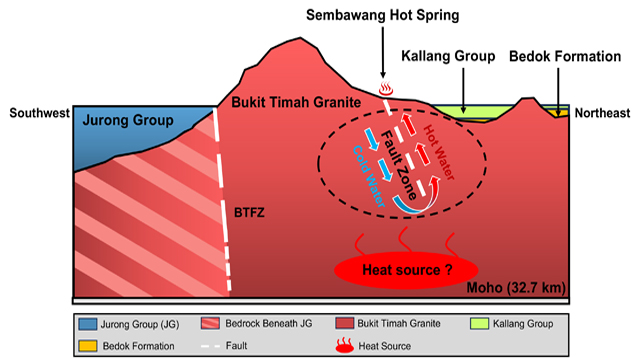
Seismic imaging beneath the Sembawang Hot Spring in northern Singapore revealed a low-velocity anomaly extending from the surface to 5 kilometers depth.17
- Temperature Record: Researchers measured subsurface temperatures of 122°C at 1.76 km depth—the highest ever recorded in Singapore.8 This shattered the previous record of 70°C at 1.1 km in Admiralty.
- Heat Source: The heat is believed to be radiogenic, generated by the decay of radioactive elements (uranium, thorium, potassium) within the Simpang Granite batholiths, rather than volcanic magma.32
8.2 Implications for Singapore
This discovery transforms Singapore’s geology from a passive foundation into an active energy asset.
- Geothermal Potential: The study suggests that “Hot Dry Rock” (HDR) or Closed-Loop Geothermal Systems could be viable. By drilling deep into the fractured granite and circulating water, Singapore could generate baseload renewable energy or support district cooling systems.33
- Seismic Link: The extraction of geothermal energy requires understanding the fracture networks in the granite. The 2025 seismic nodal array data is thus dual-purpose: defining seismic risk for the surface and mapping energy permeability in the subsurface.17
9. Structural Health Monitoring: The Digital Nervous System
As the infrastructure ages and the skyline grows denser, Singapore has moved from periodic visual inspection to continuous digital monitoring.
9.1 The “1,000 Buildings” Sensor Network
The HDB and BCA have implemented one of the world’s largest urban Structural Health Monitoring (SHM) programs.
- Scale: Over 1,000 high-rise buildings (mostly HDB blocks) are instrumented with accelerometers and strain gauges.34
- Technology: The network uses Fiber Bragg Grating (FBG) sensors embedded in columns and Wireless Sensor Nodes (WSN). FBG sensors are immune to electromagnetic interference and can detect micro-strains in concrete.35
- Operational Use: During the 2025 Segamat earthquake, this network was pivotal. Within minutes of the tremors, the centralized dashboard analyzed the Peak Ground Acceleration (PGA) and inter-story drift across the island. Seeing that values remained well below the damage threshold (), authorities could issue “Safe” notifications immediately, preventing unnecessary panic or mass evacuations.27
10. Human Factors: The Psychology of the Sway
While the engineering ensures structural survival, the human experience of a tremor is deeply unsettling.
10.1 Perception and Anxiety
The motion felt in Singapore high-rises is typically a slow, rhythmic swaying (0.1 Hz to 0.5 Hz).
- Sopite Syndrome: This low-frequency motion can induce “sopite syndrome,” a form of motion sickness manifesting as drowsiness, dizziness, or nausea, even if the occupant does not consciously realize the building is moving.14
- Fear Response: For residents on upper floors (e.g., Level 40+), seeing hanging lights swing or water slosh in fish tanks triggers acute anxiety. Studies in Singapore have correlated floor height with increased emotional strain during tremors; residents on higher floors often feel trapped and isolated.37
10.2 Managing the Narrative
The transparency of the BCA and HDB is a critical psychological dampener.
By creating a feedback loop—where residents report tremors via apps and receive almost immediate confirmation of structural safety based on sensor data—the “social amplification of risk” is minimized.
The message is consistent: “The building is designed to sway. Swaying is not failing; it is energy dissipation.”
11. 2026 SEO and Search Trends
For digital professionals and communicators, the topic of seismic safety in Singapore has evolved into a high-value niche in 2026.
- Hyper-Local Queries: Users are no longer just searching “Singapore earthquake.” They are searching for specific, data-rich queries like “Is Marine Parade reclaimed land safe?” or “HDB tremor sensor data Punggol”.39
- Voice Search: With the rise of voice-activated AI, queries have become conversational: “Why is my flat shaking if Singapore is not on a fault line?” Content strategies must pivot to answer these specific “Near Me” and “Why” questions directly to capture the “Position Zero” in AI overviews.39
12. Conclusion: The Managed Equilibrium
Singapore’s “stability” is not a static property of nature; it is a managed equilibrium. It is the result of a deliberate interplay between geological fortune and engineering foresight.
The 2025 seismic study and the Segamat earthquake sequence have refined the understanding of the risk: it is low, but it is not zero.
The deep marine clays of the Kallang Formation will always act as an amplifier for Sumatran energy. The proximity of faults in Peninsular Malaysia adds a new, albeit minor, variable to the equation.
However, the response mechanisms are robust. The transition to Eurocode 8 ensures new buildings are tuned to resist resonance.
The ubiquitous sensor networks turn the entire city into a smart seismograph, capable of diagnosing its own health in real-time. And the discovery of geothermal potential in Sembawang reminds us that the earth beneath Singapore is not just a foundation, but a resource.
Ultimately, “Stable” doesn’t mean “Static.” The ground moves, the buildings sway, and the technology responds. In Singapore, resilience is designed into the very code of the city.
Appendix: Historical Tremor Timeline (1833–2025)
| Year | Event Source | Magnitude (Mw) | Distance to SG | Impact in Singapore |
| 1833 | Sumatra Megathrust | ~8.8 – 9.2 | >400 km | Hanging lamps swung; first recorded perception.41 |
| 1994 | Liwa, S. Sumatra | 6.9 | ~350 km | Panic in CBD; evacuations; spurred initial academic research.12 |
| 2004 | Sumatra-Andaman | 9.1 – 9.3 | >500 km | Prolonged rolling motion felt widely; no damage.11 |
| 2005 | Nias-Simeulue | 8.7 | ~500 km | Strong tremors felt in >200 buildings.42 |
| 2007 | Bengkulu | 8.4 | ~600 km | Twin quakes caused CBD evacuations.11 |
| 2012 | Indian Ocean | 8.6 | >400 km | Significant resonance in East Coast due to marine clay.41 |
| 2022 | Pasaman Barat | 6.2 | ~400 km | Felt in Punggol, Bedok, CBD.1 |
| 2025 | Segamat, Malaysia | 4.5 | ~120 km | Near-field event; felt but no structural damage; sensors verified safety.7 |
Appendix: Geological Unit Velocities
| Geological Unit | Typical Location | Shear Wave Velocity (Vs) | Amplification Risk |
| Kallang Formation | East Coast, CBD, Reclaimed Land | 120 – 160 m/s | High (2x – 4x) |
| Old Alluvium | Bedok, Tampines | 250 – 400 m/s | Moderate |
| Bukit Timah Granite | Central Catchment, Mandai | > 700 m/s | Low (Reference) |
Data compiled from 16 and.15
Works cited
- Great Sumatran fault – Wikipedia, accessed February 16, 2026, https://en.wikipedia.org/wiki/Great_Sumatran_fault
- Subduction zone beneath Sumatra, Indonesia | Earth Observatory of Singapore, NTU, accessed February 16, 2026, https://earthobservatory.sg/earth-science-education/multimedia/graphics/subduction-zone-beneath-sumatra-indonesia
- Is Singapore threatened by earthquakes, accessed February 16, 2026, https://earthobservatory.sg/earth-science-education/earth-science-faqs/risk-and-society/is-singapore-threatened-by-earthquakes
- Skyward & Resilient: The Definitive Guide to High-Rise Design in Singapore for Wind and Seismic Forces – Stellar Structures, accessed February 16, 2026, https://structures.com.sg/skyward-resilient-high-rise-design-singapore-wind-seismic-forces/
- Performance-Based Seismic Design for Tall Buildings SG, accessed February 16, 2026, https://www.aectechnicalsg.com/performance-based-seismic-design-for-tall-building-in-singapore/
- Written Reply to Parliamentary Question on the Segamat …, accessed February 16, 2026, https://www.mse.gov.sg/latest-news/written-reply-to-parliamentary-question-on-the-segamat-earthquake/
- Segamat Earthquake: 15 Buildings Suffer Minor Damages, Repairs Estimated At Half A Million – Ahmad Maslan – bernama, accessed February 16, 2026, https://www.bernama.com/en/general/news.php?id=2465077
- Singapore’s Geothermal potential: NTU researchers record the highest subsurface temperature found in Sembawang, accessed February 16, 2026, https://www.ntu.edu.sg/erian/news-events/news/detail/record-122-c-subsurface-temperature-found-in-sembawang–suggesting-geothermal-energy-potential
- 1. eArthquAkes, PlAte teCtonICs And the IndIAn oCeAn tsunAmI – ResearchOnline@JCU, accessed February 16, 2026, https://researchonline.jcu.edu.au/24193/1/earthquakes.pdf
- M6.4 and 6.3 Indonesian Earthquakes of 6 March 2007, accessed February 16, 2026, https://earthquake.usgs.gov/product/poster/usp000f660/us/1538164164214/poster.pdf
- Tectonic setting of Sumatra. The red rectangle includes the study area,… – ResearchGate, accessed February 16, 2026, https://www.researchgate.net/figure/Tectonic-setting-of-Sumatra-The-red-rectangle-includes-the-study-area-the-global_fig1_347362589
- Today in Earthquake History, accessed February 16, 2026, https://earthquake.usgs.gov/learn/today/
- Site Response in Singapore to Long-Distance Sumatra Earthquakes – ResearchGate, accessed February 16, 2026, https://www.researchgate.net/publication/249872961_Site_Response_in_Singapore_to_Long-Distance_Sumatra_Earthquakes
- a The number of tremor events reportedly felt in Singapore; b the… – ResearchGate, accessed February 16, 2026, https://www.researchgate.net/figure/a-The-number-of-tremor-events-reportedly-felt-in-Singapore-b-the-percentage-of_fig1_311394397
- Site-Dependent Response of Singapore Buildings to Long-Distance …, accessed February 16, 2026, https://www.eri.u-tokyo.ac.jp/daidai/symposium2004/pan.pdf
- Response of High-Rise Buildings in Singapore due to a Potential Giant Earthquake in the Sumatran Megathrust | Request PDF – ResearchGate, accessed February 16, 2026, https://www.researchgate.net/publication/254304057_Response_of_High-Rise_Buildings_in_Singapore_due_to_a_Potential_Giant_Earthquake_in_the_Sumatran_Megathrust
- Seismic Study of Singapore Could Guide Urban Construction and …, accessed February 16, 2026, https://www.seismosoc.org/news/seismic-study-of-singapore-could-guide-urban-construction-and-renewable-energy-development/
- Seismic Capacity of Buildings in Singapore Designed Primarily for Gravity Loads, accessed February 16, 2026, https://www.iitk.ac.in/nicee/wcee/article/13_1920.pdf
- 28th June 2019 Seismic Design of RC Shear Wall-Frame Structures in Singapore DR. KONG KIAN HAU B.Eng (Civil) (1 st Class Hons, N, accessed February 16, 2026, https://www.civil.hku.hk/IRASD19/pdf/IRASD19_KONG_KH.pdf
- Question by Dr Lim Wee Kiak To ask the Minister for the Environment and Water Resources (a) what is the prospect of Singapore be, accessed February 16, 2026, https://www.nas.gov.sg/archivesonline/data/pdfdoc/MSE_20150714006.pdf
- Issued by the Commissioner of Building Control under Regulation 27 of the Building Control Regulations Version 7.08 October 2025 – Building and Construction Authority (BCA), accessed February 16, 2026, https://www1.bca.gov.sg/docs/default-source/docs-corp-regulatory/approved-document-v7-08.pdf
- Written answer by Ministry of National Development on adequacy of …, accessed February 16, 2026, https://www.mnd.gov.sg/newsroom/parliament-matters/q-as/view/written-answer-by-ministry-of-national-development-on-adequacy-of-the-construction-guidelines-and-building-codes-to-cater-for-the-impact-of-seismic-actions
- Singapore National Annexure To Eurocode 8 PDF – Scribd, accessed February 16, 2026, https://www.scribd.com/document/399101514/266309033-Singapore-National-Annexure-to-Eurocode-8-pdf
- Guidebook for Design of Buildings in Singapore to Requirements in SS EN 1998-1, accessed February 16, 2026, https://www1.bca.gov.sg/docs/default-source/docs-corp-regulatory/building-control/bc3-2013.pdf
- No impact on Singapore buildings from recent Johor earthquake: BCA | The Straits Times, accessed February 16, 2026, https://www.straitstimes.com/singapore/no-impact-on-singapore-buildings-from-recent-johor-earthquake-bca
- Minor damage to 15 govt buildings after Segamat quakes, says deputy minister | FMT, accessed February 16, 2026, https://www.freemalaysiatoday.com/category/nation/2025/09/08/minor-damage-to-15-buildings-after-segamat-quakes-says-deputy-minister
- Written answer by Ministry of National Development on updated risk analysis on impacts of Sumatran earthquakes and Mersing Fault Zone and enhancing structural safety of HDB buildings, accessed February 16, 2026, https://www.mnd.gov.sg/newsroom/speeches/view/written-answer-by-ministry-of-national-development-on-updated-risk-analysis-on-impacts-of-sumatran-earthquakes-and-mersing-fault-zone-and-enhancing-structural-safety-of-hdb-buildings
- Effective geotechnical solutions for Singapore’s tallest tower – Trade Link Media, accessed February 16, 2026, https://www.tradelinkmedia.biz/publications/7/news/1852
- Capitaspring Tower | PDF – Scribd, accessed February 16, 2026, https://www.scribd.com/document/829203681/capitaspring-tower
- Green Mark 2021 Intelligence – Building and Construction Authority (BCA), accessed February 16, 2026, https://www1.bca.gov.sg/docs/default-source/docs-corp-buildsg/sustainability/20240101_intelligence_simplified_r2.pdf?sfvrsn=2d82dc9_0
- (PDF) VISCOUS DAMPERS FOR HIGH-RISE BUILDINGS – ResearchGate, accessed February 16, 2026, https://www.researchgate.net/publication/248391320_VISCOUS_DAMPERS_FOR_HIGH-RISE_BUILDINGS
- Turning Up the Heat on Geothermal Energy | EMA, accessed February 16, 2026, https://www.ema.gov.sg/news-events/news/feature-stories/2024/turning-up-the-heat-on-geothermal-energy
- Geothermal Exploration Through Deep Exploratory Slimholes: Singapore’s Perspective – Stanford School of Earth, Energy & Environmental Sciences |, accessed February 16, 2026, https://pangea.stanford.edu/ERE/db/GeoConf/papers/SGW/2025/Romagnoli.pdf
- Fiber optic sensing in an integrated Structural Health … – Roctest, accessed February 16, 2026, https://roctest.com/wp-content/uploads/2017/01/blifosV3.pdf
- Securing Singapore’s Future with Structural Health Monitoring for …, accessed February 16, 2026, https://www.aectechnicalsg.com/securing-singapores-future-with-structural-health-monitoring-for-aging-infrastructure/
- MEDIA STATEMENT TREMOR INCIDENT: BUILDINGS IN SINGAPORE ARE SAFE, accessed February 16, 2026, https://www.nas.gov.sg/archivesonline/data/pdfdoc/20170813004/BCA%20media%20statement_Tremor%20incident-Buildings%20in%20Singapore%20are%20safe.pdf
- The built environment and mental health – PMC – NIH, accessed February 16, 2026, https://pmc.ncbi.nlm.nih.gov/articles/PMC3456225/
- High-Rise Apartments and Urban Mental Health—Historical and Contemporary Views, accessed February 16, 2026, https://www.mdpi.com/2078-1547/10/2/34
- Local SEO Trends 2026: 7 Strategies to Dominate Search, accessed February 16, 2026, https://digitalmarketingagency.sg/local-seo-trends-2026-strategies-singapore/
- SEO in 2026: What’s actually changing? (Looking for global insights) : r/Agentic_SEO, accessed February 16, 2026, https://www.reddit.com/r/Agentic_SEO/comments/1pqhn29/seo_in_2026_whats_actually_changing_looking_for/
- Earth tremors in Singapore – NLB, accessed February 16, 2026, https://www.nlb.gov.sg/main/article-detail?cmsuuid=faae6249-89e7-4903-af54-809278f37345
The Unseen Force: A Comprehensive Guide to Vibration Control in Singapore’s Buildings, accessed February 16, 2026, https://structures.com.sg/comprehensive-guide-to-vibration-control-in-singapores-buildings/