

The Singapore Civil Defence Force (SCDF) is defined as the primary regulatory authority and emergency response agency governing fire safety compliance for industrial projects in Singapore. The role of SCDF in industrial projects spans two distinct functions: enforcing fire safety legislation under the Fire Safety Act and Civil Defence Act, and providing 24-hour operational emergency response. Both functions directly affect how developers, builders, and consultants plan, design, and manage industrial developments. Understanding SCDF’s regulatory scope is not optional for construction professionals. It determines project approval timelines, design requirements, and long-term operational compliance.
What responsibilities does SCDF have in regulating fire safety for industrial projects?
SCDF’s regulatory authority derives from two pieces of legislation: the Fire Safety Act and Civil Defence Act. These laws empower SCDF to formulate fire safety codes, review building plans, conduct inspections, and take enforcement action against non-compliant premises. For industrial projects, this means every stage of development, from design to occupation, falls within SCDF’s oversight.
The Fire Safety and Shelter Department (FSSD) is the operational arm within SCDF that manages plan submissions and approvals. Developers and their appointed consultants must submit fire safety plans to FSSD before construction begins. SCDF reviews these plans against the Fire Code 2023, which sets out technical requirements for fire protection systems, means of escape, compartmentation, and structural fire precautions. Approval from FSSD is a prerequisite for obtaining a building permit.

SCDF’s enforcement powers are equally significant. The Fire Safety Act authorizes penalties and enforcement orders against owners, occupiers, and developers who fail to meet compliance standards. Penalties can include stop-work orders, fines, and prosecution. These consequences make early and accurate compliance planning non-negotiable for any industrial project.
Key regulatory responsibilities SCDF exercises over industrial projects include:
- Fire safety code formulation: SCDF develops and updates the Fire Code, which sets binding technical standards for all industrial building types.
- Plan submission review: FSSD evaluates fire safety drawings, system specifications, and shelter plans before construction approval is granted.
- Compliance inspections: SCDF conducts site inspections at key construction milestones and before occupation permits are issued.
- Enforcement action: SCDF issues notices, orders, and penalties for non-compliance under the Fire Safety Act.
- Coordination with other agencies: SCDF works alongside the Building and Construction Authority (BCA) and Urban Redevelopment Authority (URA) to align fire safety requirements with broader development approvals.
Pro Tip: Engage a registered Fire Safety Manager or a consultancy experienced in SCDF plan submissions at the design stage. Late-stage revisions to fire safety drawings are among the most common causes of project delays.
How does SCDF conduct inspections and audits on industrial projects?
SCDF’s inspection framework has evolved significantly with the adoption of data-driven tools. The agency now uses the Targeted Onsite Inspection Tool (TOIT), an AI-powered system that replaces manual scheduling with predictive risk assessments. TOIT analyzes building data, historical compliance records, and occupancy profiles to identify high-risk premises for priority inspection. This shift means industrial facilities with poor compliance histories or complex hazard profiles face more frequent scrutiny.
The practical implication for developers is clear. A facility that accumulates minor violations during construction or early occupation will be flagged by TOIT for targeted follow-up. Maintaining clean compliance records from the start reduces the likelihood of unscheduled inspections that can disrupt operations.
SCDF implemented a new three-year Fire Certificate validity period effective april 1, 2026. Previously, Fire Certificates required annual renewal. The extended cycle reduces administrative burden for building owners but does not reduce compliance obligations. Industrial facilities must maintain all fire safety systems in full working order throughout the three-year period, not just at renewal time.
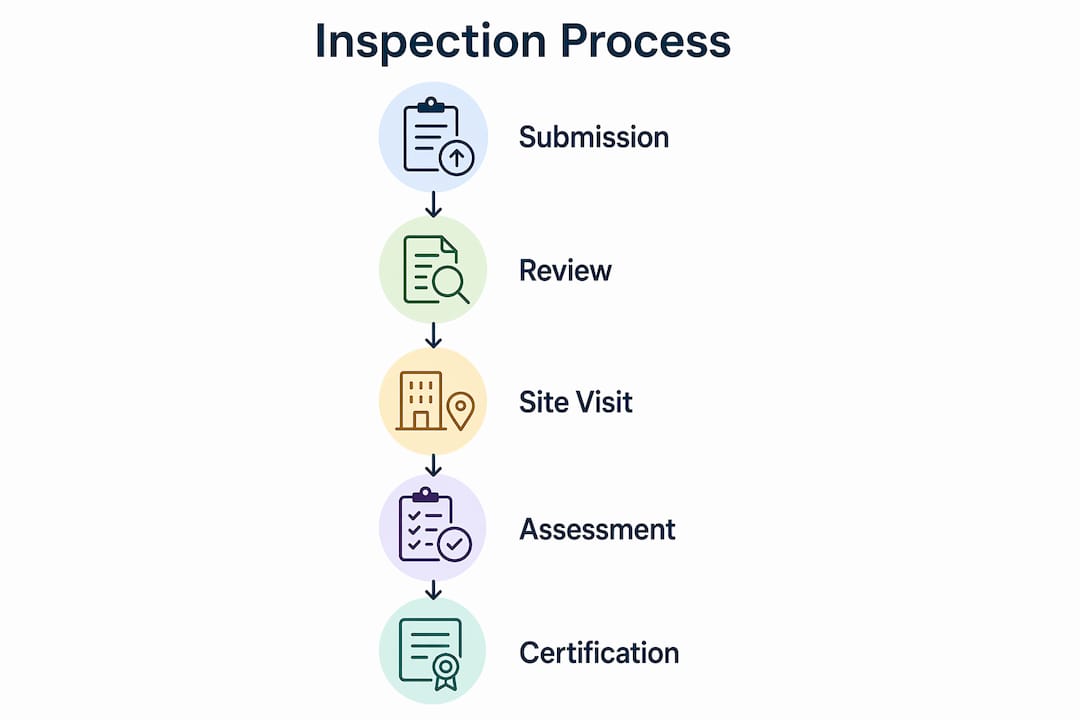
The typical inspection sequence for a new industrial project follows these stages:
- Plan approval stage: FSSD reviews submitted fire safety drawings and issues conditional or full approval before construction commences.
- Construction stage inspections: SCDF officers conduct site visits to verify that fire protection systems, compartmentation, and escape routes are installed per approved plans.
- Temporary occupation permit (TOP) inspection: A final inspection confirms all fire safety requirements are met before the building is occupied.
- Fire Certificate issuance: Upon satisfactory inspection, SCDF issues the Fire Certificate, which is now valid for three years under the 2026 framework.
- Periodic renewal inspections: Before each renewal, SCDF verifies that systems remain functional and compliant with current code requirements.
BIM platforms like CORENET X are becoming critical tools for supporting inspection readiness. BIM models allow SCDF reviewers to assess fire safety provisions digitally before site visits, reducing discrepancies between approved plans and actual construction. Developers who submit BIM-compliant documentation experience faster plan approvals and fewer inspection failures.
Pro Tip: Use BIM modeling services to create accurate as-built fire safety documentation. Discrepancies between approved drawings and physical installations are the leading cause of failed TOP inspections.
What operational support does SCDF provide during industrial emergencies?
SCDF provides 24-hour firefighting, rescue, hazardous materials mitigation, and emergency medical services across Singapore, including all industrial zones. This operational readiness is not separate from the regulatory function. It is the reason fire safety compliance requirements exist. Every design standard SCDF enforces is calibrated to support effective emergency intervention when incidents occur.
Industrial emergencies present risks that differ substantially from commercial or residential incidents. High fuel loads, flammable chemical storage, pressurized systems, and large floor plates create conditions that demand specialized response capabilities. SCDF maintains dedicated units to address these risks.
SCDF’s specialized rescue units include the Disaster Assistance and Rescue Team (DART) and the Special Rescue Unit (SRU). DART handles large-scale structural collapses and complex rescues, while SRU manages technical rescues involving confined spaces, heights, and industrial machinery. For facilities handling petroleum or flammable materials, SCDF’s hazardous materials response teams provide containment and mitigation capabilities that go beyond standard firefighting.
The design of industrial buildings directly affects how effectively SCDF can respond to emergencies. Key operational considerations include:
- Fire engine access roads: SCDF requires minimum road widths and turning radii to allow fire appliances to reach all parts of a building.
- Dry and wet riser systems: These built-in firefighting systems allow SCDF crews to connect hoses at upper floors without running lines from street level.
- Smoke control systems: Mechanical smoke extraction supports safe evacuation and improves visibility for rescue operations.
- Hazardous material storage compliance: Facilities storing petroleum or flammable materials must comply with SCDF’s P&FM regulatory requirements to limit ignition risks and support containment during incidents.
- Emergency access points: Clear, unobstructed access to fire command centers, sprinkler control valves, and electrical isolation points is mandatory.
What are practical steps for developers and builders to ensure SCDF compliance in industrial projects?
SCDF compliance in industrial projects requires deliberate planning from the earliest design phase. Building designs must facilitate SCDF’s emergency access and operations to satisfy both regulatory approval and operational effectiveness requirements. Treating fire safety as a late-stage add-on is the single most common mistake developers make, and it consistently results in costly redesigns and approval delays.
Coordinated submission and consultation between developers, consultants, and SCDF is the foundation of successful compliance. Incomplete or inaccurate documentation is the primary reason FSSD rejects or delays plan approvals. Every drawing, specification, and calculation submitted must align precisely with the Fire Code 2023 requirements for the specific industrial use class.
Practical steps for developers and builders include:
- Appoint a registered Fire Safety Engineer early: Engage a qualified professional during the schematic design phase to integrate fire safety requirements into the base building design, not after it is finalized.
- Submit complete and accurate fire safety plans: All drawings must include fire compartmentation layouts, sprinkler system designs, emergency lighting plans, and means-of-escape routes. Partial submissions trigger rejection.
- Coordinate with the structural and M&E teams: Fire stopping, penetration sealing, and smoke barrier installations require coordination across disciplines. Gaps in coordination create compliance failures during inspections.
- Track Fire Certificate renewal dates: Under the new three-year validity cycle effective april 2026, owners must schedule renewal inspections well in advance. Late renewals expose building owners to enforcement action.
- Maintain as-built documentation: SCDF inspectors verify installed systems against approved drawings. Maintaining updated as-built records prevents discrepancies that trigger non-compliance notices.
- Engage consultants experienced in regulatory compliance documentation: Accurate, well-organized submissions reduce back-and-forth with FSSD and accelerate approvals.
Pro Tip: For industrial facilities with complex hazard profiles, request a pre-application consultation with SCDF before formal plan submission. SCDF offers this channel to clarify requirements for non-standard designs, and it prevents costly revisions after submission.
Key Takeaways
SCDF’s regulatory and operational role in industrial projects makes fire safety compliance a core project management function, not a peripheral administrative task.
| Point | Details |
|---|---|
| Dual SCDF function | SCDF acts as both the fire safety regulator and the 24-hour emergency responder for all industrial projects. |
| Three-year Fire Certificate | The new validity period effective april 2026 reduces renewal frequency but does not reduce ongoing compliance obligations. |
| AI-driven inspections | The TOIT system targets high-risk premises using predictive analytics, making clean compliance records a practical priority. |
| Early design integration | Appointing a Fire Safety Engineer at the schematic design stage prevents costly late-stage revisions and approval delays. |
| BIM and documentation | BIM-compliant submissions and accurate as-built records are the most effective tools for passing SCDF inspections. |
Why early SCDF engagement changes project outcomes
From my experience working on industrial projects across Singapore, the single most consequential decision a developer makes is when to bring fire safety compliance into the design process. Most project teams treat SCDF requirements as a checklist item to address before submission. That approach produces the worst outcomes: rejected plans, redesigned compartmentation layouts, and delayed TOP inspections that push handover dates by months.
The teams that succeed engage SCDF requirements at the concept design stage. They appoint a Fire Safety Engineer before the structural grid is fixed. They run fire safety coordination meetings alongside architectural and M&E design reviews. When the building layout is still flexible, integrating fire compartmentation, riser locations, and access road geometry costs almost nothing. After the design is frozen, every change is expensive.
The emergence of AI-driven compliance tools like TOIT has raised the stakes further. Facilities that accumulate even minor violations during construction are flagged for more intensive scrutiny. That scrutiny does not end at TOP. It follows the building through its operational life. A clean compliance record during construction is an asset that pays dividends for years.
BIM integration is the other area where I see the clearest performance gap between project teams. Developers who submit BIM models through CORENET X experience faster plan reviews and fewer inspection discrepancies. Those who rely on 2D drawings alone face longer review cycles and higher rates of site-to-drawing mismatches. The investment in BIM for Singapore projects is not a technology preference. It is a compliance strategy.
The professionals who navigate SCDF requirements most effectively treat compliance as a design discipline, not a documentation exercise. That mindset shift is what separates projects that close on schedule from those that do not.
— Aman
How Com supports SCDF compliance for industrial developments
Com, operating as Aman Engineering Consultancy, provides end-to-end fire safety compliance services for industrial projects in Singapore, from initial FSSD plan submissions through Fire Certificate renewals.
The team at Aman Engineering Consultancy specializes in preparing accurate fire safety documentation, coordinating BIM-compliant submissions through CORENET X, and managing regulatory approvals across SCDF, BCA, and other statutory bodies. For developers managing complex industrial developments with hazardous material storage, specialized use classifications, or non-standard structural configurations, Com’s consultants provide the technical depth and submission accuracy that prevents costly delays. Contact Aman Engineering Consultancy to discuss your project’s SCDF compliance requirements and submission timeline.
FAQ
What is the role of SCDF in industrial projects?
SCDF regulates fire safety compliance and provides emergency response for all industrial projects in Singapore. Its authority derives from the Fire Safety Act and Civil Defence Act, covering plan approvals, inspections, and enforcement.
When did the new Fire Certificate validity period take effect?
SCDF implemented a three-year Fire Certificate validity period effective april 1, 2026, replacing the previous annual renewal requirement.
What is the TOIT and how does it affect industrial facilities?
The Targeted Onsite Inspection Tool (TOIT) is an AI-driven inspection system SCDF uses to prioritize high-risk premises for targeted inspections. Industrial facilities with compliance violations or complex hazard profiles face more frequent scrutiny under this system.
What documents are required for SCDF fire safety plan submission?
Submissions to FSSD must include fire compartmentation drawings, sprinkler and detection system designs, emergency lighting layouts, means-of-escape plans, and shelter provisions. Incomplete submissions are rejected and delay project timelines.
Does building design affect SCDF emergency response capability?
Yes. SCDF requires specific access road dimensions, riser systems, and smoke control provisions to support effective firefighting and rescue operations. Building designs must facilitate SCDF’s operational requirements as a condition of plan approval.