
Residential project planning in Singapore demands far more than sound architecture and a solid construction budget. From securing a Housing Developer’s Licence to managing multi-agency regulatory approvals across URA, BCA, SCDF, and PUB, every phase of a residential project planning guide must account for compliance obligations that carry legal consequences when missed. This guide provides property developers and real estate investors with a structured overview of the licensing requirements, planning permissions, approval workflows, and compliance protocols that define successful residential development in Singapore.
Table of Contents
- Understanding licensing and regulatory requirements
- Navigating planning permission and building plan approvals
- Special considerations for landed residential developments
- Project timeline overview and optimizing construction phases
- Ensuring compliance and buyer protection post-approval
- Why early multi-agency coordination transforms residential project outcomes
- Optimize your residential project with Aman Engineering Consultancy
- Frequently asked questions
Key Takeaways
| Point | Details |
|---|---|
| Housing Developer’s Licence | Obtaining the correct licence before sales or construction is mandatory for developments with more than four units. |
| CORENET X efficiency | Using the digital CORENET X system streamlines multi-agency approvals and reduces regulatory delays by up to 20 percent. |
| Landed property compliance | Form DC 17 lodgement and adherence to zoning and setback rules are crucial for landed residential projects. |
| Project timeline expectation | Large residential developments in Singapore typically span 6 to 7 years from site acquisition to obtaining TOP. |
| Buyer protection measures | Developers must maintain buyer deposits in dedicated accounts and provide showflat info that matches approved plans. |
Understanding licensing and regulatory requirements
Every residential project planning guide for Singapore must begin with a clear account of developer licensing. Under the Housing Developers (Control and Licensing) Act, any developer marketing or selling residential units in a project with more than four units must obtain a Housing Developer’s Licence from URA before accepting any booking fees. Projects over 4 units require a sale licence, and that licence cannot be issued until building plan approval from BCA has been granted.
There are two distinct licence categories developers must understand:
- Sale licence: Required when units are sold prior to or during construction. Building plan approval must be obtained first.
- No-sale licence: Applies to projects where units will only be sold after the Certificate of Statutory Completion (CSC) is issued. Building plan approval is not a prerequisite.
- Licence validity: Sale licences are typically tied to specific project completion milestones and can be renewed upon application.
- Booking fee restrictions: Developers are legally prohibited from accepting any booking fees before the sale licence is in place. Violations expose developers to criminal liability.
- Standard agreements: Licensed developers must use URA-prescribed standard Option to Purchase (OTP) and Sale & Purchase Agreement (S&P) forms. Unauthorized amendments to these agreements are not permitted.
| Licence type | Pre-condition | Sales permitted before completion |
|---|---|---|
| Sale licence | BCA building plan approval required | Yes |
| No-sale licence | No building plan approval required upfront | No (only after CSC) |
Pro Tip: Always verify that your Housing Developer’s Licence is active before any marketing materials are released or booking fees collected. Premature collection without a valid licence is a criminal offense under Singapore law, not merely an administrative oversight. For context on how recent BCA Building Control Act amendments affect your licensing obligations, review the 2025 updates carefully before project commencement.
With licensing clarified, next we examine planning through development applications and building approvals.
Navigating planning permission and building plan approvals
The development application (DA) process forms the backbone of house construction planning in Singapore. All residential projects require a DA submitted to URA via the CORENET system before BCA will process any building plans. Understanding this sequence prevents costly resubmissions and approval delays.
Steps for submitting a development application via CORENET:
- Appoint a Qualified Person (QP), typically an architect registered with the Board of Architects, to act as the Qualified Person for the DA submission.
- Prepare and compile all required documents: site plans, floor plans, elevations, planning calculations, and relevant technical reports.
- Submit the DA electronically through CORENET or CORENET X, Singapore’s updated single-workflow digital platform.
- Address any URA queries or requests for additional information within the stipulated response period.
- Upon URA grant of Written Permission (WP), proceed to BCA for building plan submission.
- BCA reviews structural and architectural drawings for compliance with the Building Control Act. Depending on project complexity, building plan approvals typically take 2-6 weeks for straightforward projects and longer for complex multi-agency developments.
- Obtain all clearances from technical agencies such as SCDF, PUB, LTA, and NParks as required.
Typical approval timeline by project complexity:
| Project type | Estimated DA processing time | BCA building plan approval |
|---|---|---|
| Landed residential (single plot) | 4-8 weeks | 2-4 weeks |
| Small condominium (under 100 units) | 8-16 weeks | 4-8 weeks |
| Large condominium (over 100 units) | 16-26 weeks | 6-12 weeks |
CORENET X, the enhanced iteration of Singapore’s building regulatory submission platform, consolidates multi-agency submissions into a single digital workflow. This integration helps multi-agency approvals move up to 20% faster than fragmented parallel submissions. For developers unfamiliar with the CORENET X submission process, reviewing the building renovations guide offers useful context on how Singapore’s submission framework is structured. Additionally, preparing a thorough BCA submission package from the outset significantly reduces back-and-forth with regulators.

Pro Tip: Engage your QP and structural engineer simultaneously during the design development stage, not after architectural drawings are finalized. Structural coordination issues discovered after DA submission are among the most common causes of resubmission and delay.
After securing planning and building permits, developers must consider specific procedures for landed properties.
Special considerations for landed residential developments
Landed residential projects operate under a separate set of planning control guidelines and require specific procedural steps distinct from condominium or flat developments. For qualifying projects, URA Form DC 17 provides a streamlined lodgement pathway for new erection or reconstruction of landed houses. Form DC 17 authorizes new erection or reconstruction for landed homes and carries a 2-year validity period, provided the project complies in full with all planning requirements.
Eligibility criteria for Form DC 17 lodgement:
- The proposed development must comply fully with all prevailing planning guidelines including envelope control parameters, setback requirements, and gross floor area (GFA) limits.
- The site must be zoned for landed residential use under the Master Plan.
- No planning conditions from a previous approval remain outstanding on the site.
- The proposed use must be for a single-family landed house, including detached, semi-detached, or terrace house typologies.
- No deviation from the Development Control guidelines is sought. Any non-conforming aspect triggers the requirement for a full Form DC 3 submission and standard DA process.
| Feature | Form DC 17 | Form DC 3 (Full DA) |
|---|---|---|
| Validity period | 2 years from lodgement | Subject to WP conditions |
| Processing speed | Faster (lodgement, not approval) | Longer (formal URA review) |
| Eligibility | Full compliance with planning guidelines required | Applies where deviations or complex conditions exist |
| Extensions | Available upon application before expiry | Subject to URA discretion |
For landed residential projects involving atypical lot configurations or boundary setback ambiguities, developers should obtain a pre-application consultation with URA before committing to a design scheme. The cost of a redesign after lodgement rejection far exceeds the time investment in early verification. Developers should also ensure their architectural design proposals are developed in full awareness of URA’s landed housing design guidelines, including roof form requirements and party wall conditions for terrace typologies.
Pro Tip: Where a project sits close to the boundary of Form DC 17 eligibility, whether due to plot shape, setback, or GFA calculations, submit a formal pre-application filing with URA’s Development Control group before lodging. A single non-compliant element invalidates the DC 17 pathway entirely.
With approvals underway, managing project timelines effectively is essential for success.
Project timeline overview and optimizing construction phases
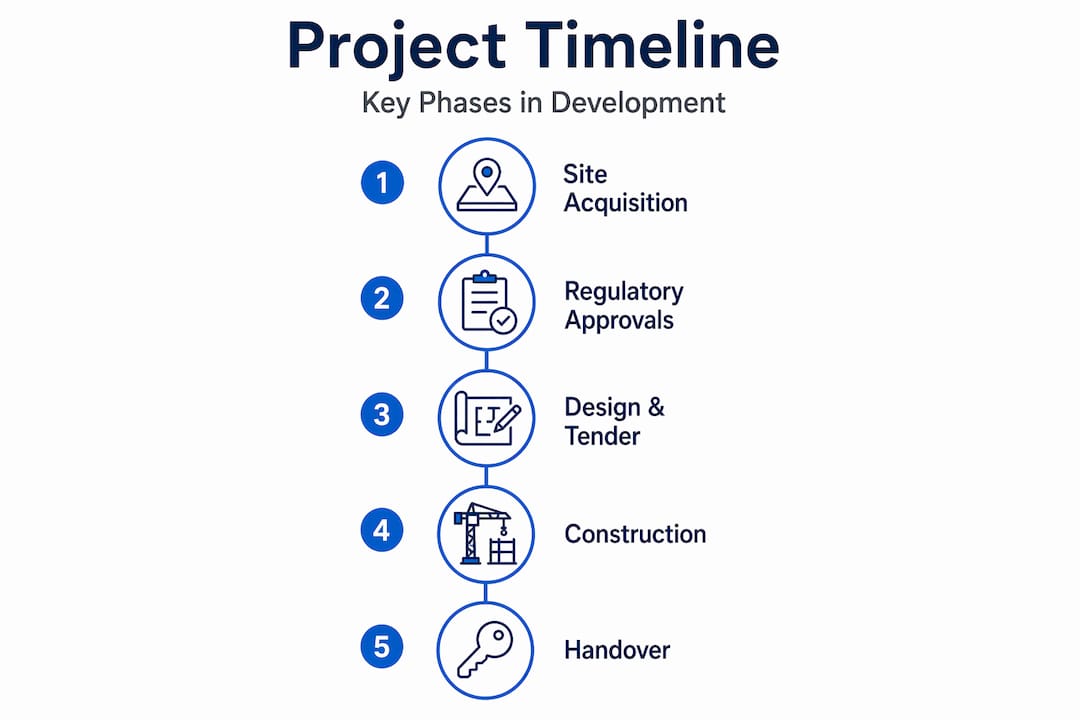
One of the most consistently underestimated aspects of residential development strategies in Singapore is the total time commitment from land acquisition to handover. For large residential projects, the full development cycle is significantly longer than developers often anticipate. Projects such as Thomson Reserve illustrate a realistic benchmark: approximately 6-7 years from site acquisition to Temporary Occupation Permit (TOP), accounting for all statutory submissions, regulatory approvals, construction, and inspections.
Typical phases in a large Singapore residential project:
- Site acquisition and due diligence (3-6 months): Includes title searches, geotechnical investigations, planning feasibility assessments, and preliminary design briefs.
- URA planning permission (4-6 months): DA preparation, submission, agency consultations, and Written Permission grant.
- BCA building plan approvals (2-4 months): Building plan submission, agency clearances, and approval grant.
- Construction (24-36 months for condominiums, 12-18 months for landed houses).
- TOP and handover (2-4 months): Inspections, defect rectification, TOP application, and unit handover.
“The Springleaf Residence project team demonstrated that thrice-weekly coordination meetings combined with CORENET X digital workflows produced measurable reductions in both approval time and rework risk, confirming that structured process discipline is as important as technical compliance.”
Key strategies for timeline optimization:
- Appoint all consultants, structural, civil, M&E, and fire safety, before DA submission to allow parallel design development.
- Schedule regular milestone coordination meetings with all QPs and agency representatives throughout the approval phase.
- Use Building Information Modeling (BIM) to identify design clashes before submission, reducing the likelihood of post-approval design revisions.
- Monitor agency query response deadlines closely. Missed response windows reset approval timelines.
- Maintain complete documentation of all submissions, approvals, and correspondence to prevent stop-work orders arising from record discrepancies.
For developers seeking structured guidance on managing the approval and construction process, the project management practices framework covers milestone scheduling, risk identification, and coordination protocols applicable to residential projects of all scales.
Finally, understanding post-approval compliance and buyer protection helps ensure smooth project completion.
Ensuring compliance and buyer protection post-approval
Receiving planning and building approvals does not conclude a developer’s regulatory obligations. Ongoing compliance during construction, combined with strict buyer protection protocols, is a legal requirement under Singapore’s housing developer framework. Developers must maintain Project Accounts for all buyer deposits and ensure that showflat models and floor plans accurately reflect approved drawings.
Key compliance and buyer protection requirements:
- Project Accounts: All deposits, progress payments, and booking fees received from buyers must be deposited into a dedicated Project Account. Funds may only be released to the developer in accordance with prescribed withdrawal conditions.
- Showflat accuracy: All showflat layouts, models, and marketing materials must correspond precisely with approved building plans. Discrepancies between showflat representations and approved plans are a common source of buyer disputes and regulatory action.
- Standard sale agreements: Developers must use the prescribed OTP and S&P Agreement formats without unauthorized modifications. Clauses that diminish buyer rights or contradict Housing Developer Rules are unenforceable.
- QP certification during construction: Qualified Persons must certify compliance at each stage of construction, with regular inspections and statutory reports submitted to BCA.
- Avoid premature construction: Commencing structural or foundation works before BCA building plan approval is a serious violation. Penalties include stop-work orders, demolition requirements, and prosecution.
Pro Tip: Developers should conduct an internal compliance audit against the construction compliance checklist at least once per quarter during construction. Regulatory queries or inspections will proceed far more smoothly when documentation is current and organized at all times.
Why early multi-agency coordination transforms residential project outcomes
The conventional approach to project planning for homes in Singapore too often treats regulatory approvals as a sequential checkbox exercise. Submit the DA. Wait. Submit to BCA. Wait again. Each agency queried in isolation, each response addressed reactively. This fragmented process is the single greatest source of avoidable delays and cost overruns in Singapore residential development.
The evidence is clear. CORENET X coordination meetings held three times per week during the Springleaf Residence project produced demonstrable reductions in approval time and rework risk, not because the regulations changed, but because the process discipline changed. When all QPs, engineers, and agency reviewers are working from the same digital model and meeting regularly, issues surface weeks earlier than in traditional workflows.
What most guides on tips for residential project planning fail to acknowledge is that the real return on investment in digital tools like BIM and CORENET X is not found in the submission itself. It is found in what you discover before submission, specifically the structural clashes, setback miscalculations, and M&E coordination conflicts that would otherwise reach agency reviewers and trigger formal queries. Each formal query costs time. A 3-week agency query response cycle, repeated three times for three separate issues, adds nearly two months to an approval timeline before a single brick is laid.
Developers who invest in establishing a shared BIM environment and scheduled multi-disciplinary coordination meetings from the design development stage consistently experience fewer surprises during construction. The BIM implementation guide for Singapore developers provides a practical entry point for teams building this capacity. The investment is not large. The cost of not making it, measured in delayed TOPs, extended financing periods, and buyer penalties, is substantial.
Optimize your residential project with Aman Engineering Consultancy
Navigating Singapore’s residential project planning requirements demands technical depth, regulatory knowledge, and process discipline across every project phase.
Aman Engineering Consultancy provides end-to-end support for property developers and real estate investors managing residential projects of all scales. From civil and structural design and statutory submissions to URA and BCA through to advanced BIM modeling services that reduce coordination errors and accelerate approvals, the firm brings proven expertise to every stage of the development process. With established workflows for managing multi-agency approvals, preparing compliant DA and building plan packages, and certifying construction at every statutory milestone, Aman Engineering Consultancy is positioned to help your project move from concept to TOP with the precision Singapore’s regulatory environment demands.
Frequently asked questions
What is a Housing Developer’s Licence and why is it important?
A Housing Developer’s Licence is a mandatory authorization from URA required for developers of residential projects with more than four units to legally commence sales or construction, ensuring regulatory compliance and buyer protection throughout the development cycle.
How does the CORENET X system benefit residential project approvals?
CORENET X consolidates multi-agency regulatory submissions into a single digital workflow, reducing approval times by up to 20% and enabling development teams to surface and resolve coordination issues before formal agency review, which significantly reduces resubmission risk.
What are the key compliance steps before starting construction on a landed house project?
Developers must lodge Form DC 17 confirming full compliance with URA planning guidelines including setbacks and plot size controls, obtain BCA building plan approval, and appoint Qualified Persons to secure all required technical agency clearances before any construction commences.
How long does it typically take from site acquisition to completion for large Singapore residential projects?
Large residential projects in Singapore typically require approximately 6-7 years from site acquisition through URA and BCA approvals, construction, and final inspections to achieve Temporary Occupation Permit and project completion, depending on project scale and regulatory complexity.