

A site inspection is a systematic, on-site verification process that confirms a construction project meets safety standards, regulatory requirements, and quality specifications. Knowing how to conduct site inspections correctly is not optional for project managers, site supervisors, or quality assurance personnel. A missed deficiency today becomes a structural failure, a regulatory rejection, or a costly dispute tomorrow. This guide covers the full site inspection process, from pre-inspection preparation through corrective action management, using current industry best practices and tools recognized across the construction sector.
What essential tools and documentation are needed before conducting site inspections?
Preparation determines whether an inspection succeeds or fails before the first step is taken on site. Missing mandatory documentation commonly causes inspection refusals, making pre-inspection document verification a non-negotiable step. The inspector must confirm that approved project plans, building permits, risk assessments, and trade-specific drawings are physically present and accessible on site before the inspection begins.
The following documents must be verified as present and accessible before any inspection commences:
- Approved project plans and drawings, including structural, architectural, and M&E layouts
- Building permit, visibly posted at the site entrance per regulatory requirements
- Risk assessments and method statements for all active work phases
- Previous inspection reports and any outstanding corrective action records
- Trade-specific compliance certificates, such as fire safety, electrical, and structural sign-offs
Beyond documentation, the inspector requires a defined set of physical tools. A calibrated measuring tape or laser distance meter, a camera or mobile device for photo documentation, personal protective equipment (PPE) including a hard hat, safety vest, and steel-capped boots, and a pre-prepared site inspection checklist are all standard requirements. Digital checklist applications on a tablet or smartphone significantly reduce transcription errors and allow real-time photo attachment.
Enforcing a pre-inspection checklist that verifies approved plans on site, a posted permit, and 100% completion of the relevant work phase reduces inspection failures by up to 80%. That figure reflects how preventable most first-attempt failures actually are.

Pro Tip: Assign a site administrator to complete a document readiness check at least 24 hours before any scheduled inspection. This single step eliminates the most common cause of inspection refusals.
How to perform the step-by-step site inspection process effectively?
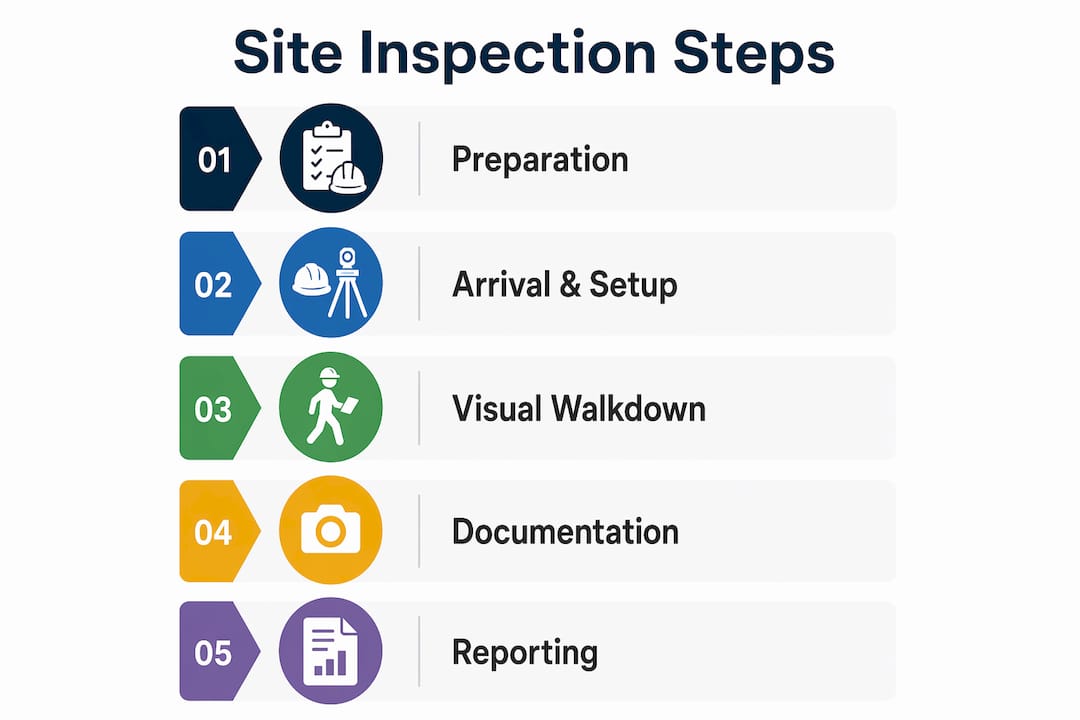
A logical, sequential inspection flow starting from site access and progressing through to trade-specific checks increases both efficiency and documentation quality. Skipping steps or conducting checks out of order creates gaps that are difficult to reconstruct after the fact. The following numbered sequence reflects current best practice for construction site walkthroughs.
-
Verify site access and perimeter controls. Confirm that site hoarding, signage, and access gates meet regulatory standards. Check that unauthorized personnel cannot enter active work zones.
-
Conduct silent observation before engaging site personnel. Observe work habits and housekeeping conditions quietly upon arrival. Workers who notice an inspector often alter their behavior, which skews the assessment.
-
Assess general site conditions. Check for clear walkways, proper waste segregation, adequate lighting, and the absence of trip or fall hazards. Note weather conditions, as these affect both safety and work quality.
-
Inspect structural and civil works. Verify that formwork, reinforcement, and concrete pours align with approved drawings. Cross-reference dimensions against the structural drawings on site.
-
Evaluate trade-specific installations. Inspect M&E rough-ins, facade elements, fire protection systems, and waterproofing in sequence. Each trade requires its own checklist section with location references tied to drawing numbers.
-
Assess high-risk activities. Hot-work operations require particular attention. Hot-work inspections require maintaining a minimum 11-meter (35-foot) separation from combustible materials or the installation of proper fire hazard screening. Verify compliance with fire safety approval requirements before permitting any hot-work continuation.
-
Document all observations in real time. Record each finding with its exact location, a reference to the relevant drawing or specification, and a photograph. Do not rely on memory for post-inspection write-ups.
Pro Tip: Use a mobile inspection app such as those integrated with project management platforms to attach geotagged photos directly to checklist items during the walkthrough. This eliminates location ambiguity in the final report.
Standard inspection cadences include daily walk-downs by supervisors, weekly HSE officer inspections, monthly internal audits, and quarterly third-party audits. Each cadence serves a different verification purpose and should not be treated as interchangeable.
What are best practices for documenting and reporting site inspection findings?
Documentation is the legal and operational backbone of any site inspection. Timestamps, photo evidence, and exact location referencing are critical for accountability and dispute prevention. A report that lacks these elements cannot be used to verify corrective actions or defend decisions in a contractual dispute.
Every inspection report must include the following metadata as a minimum standard:
- Date, time, and weather conditions at the time of inspection
- Names and roles of all inspection participants, including the inspector, site supervisor, and any specialist consultants
- Project name, contract number, and site address
- Drawing revision numbers referenced during the inspection
The body of the report must follow a standardized format for each observation. The table below illustrates the required structure for individual findings:
| Field | Required Content |
|---|---|
| Finding reference number | Sequential ID tied to the checklist item |
| Location description | Grid reference, floor level, and drawing number |
| Observation | Clear, factual description of the condition found |
| Severity classification | Critical, major, or minor, based on safety and compliance impact |
| Photographic evidence | Minimum one photo per finding, labeled with location and date |
| Responsible party | Named contractor or subcontractor accountable for the item |
| Recommended action | Specific corrective measure with a reference standard |
| Target resolution date | Agreed deadline for close-out |
Severity classification is not subjective. A finding that affects structural integrity or life safety is critical and requires immediate stop-work consideration. A finding that affects workmanship quality without immediate safety implications is classified as major or minor based on its scope. This distinction drives the urgency of the corrective action timeline.
Reports must be uploaded to the project management system within 24 hours of the inspection. Delayed reporting reduces the accuracy of observations and creates gaps in the project compliance record. For projects subject to BCA, SCDF, or other Singapore regulatory authority oversight, a compliance checklist aligned to the relevant submission requirements should accompany every formal inspection report.
How to manage corrective actions and follow-up after site inspections?
Corrective action management is where most inspection programs fail. Identifying deficiencies without assigning clear ownership and deadlines produces no improvement. Close-out meetings assign clear ownership and deadlines for corrections, which creates the transparency and accountability needed for effective resolution.
The corrective action process requires the following steps:
- Hold a close-out meeting with all relevant stakeholders immediately after the inspection walkthrough. Present findings, confirm severity classifications, and agree on corrective actions before personnel leave the site.
- Assign a named owner to each corrective action. Assigning a team or department rather than an individual reduces accountability and delays resolution.
- Set specific deadlines based on severity. Critical findings require resolution within 24–48 hours. Major findings require resolution before the next inspection cycle. Minor findings are tracked to the agreed project milestone.
- Use a tracking system to monitor progress. Project management platforms that support inspection modules allow real-time status updates and automatic escalation when deadlines are missed.
- Schedule follow-up inspections to verify that corrective actions have been completed to the required standard. Photographic evidence of the resolved condition must be attached to the original finding record.
- Close findings formally only after physical verification. Verbal confirmation from a contractor does not constitute close-out.
Inspections must be continuous, proactive activities throughout the project lifecycle, not just final quality checks before handover. Projects that treat inspections as periodic events rather than ongoing verification mechanisms accumulate deficiencies that are far more expensive to resolve at handover than at the point of occurrence.
Key Takeaways
Effective site inspections require systematic preparation, sequential execution, precise documentation, and structured corrective action management to achieve consistent compliance and safety outcomes.
| Point | Details |
|---|---|
| Pre-inspection preparation | Verify approved plans, posted permits, and risk assessments on site before the inspection begins. |
| Sequential walkthrough | Follow a logical flow from site access through trade-specific checks to maximize efficiency and coverage. |
| Silent observation first | Observe site conditions quietly upon arrival to capture accurate, unaltered work practices. |
| Standardized documentation | Record every finding with timestamps, location references, severity classification, and photographic evidence. |
| Formal corrective action close-out | Assign named owners and deadlines, then verify resolution physically before closing any finding. |
What I have learned from years of conducting site inspections
The most persistent misconception in construction quality management is that a site inspection is a single event. Project teams prepare intensively for scheduled inspections and then revert to unverified practices the moment the inspector leaves. That cycle produces compliance theater, not compliance. The real value of a structured inspection program is that it creates a continuous record of site conditions, which protects every party when disputes arise.
One practical observation: the silent observation step is consistently underused. Most inspectors announce their presence at the site office before walking the site. The first few minutes of an unannounced or quiet walkthrough reveal more about actual site culture than any formal checklist. Housekeeping, PPE compliance, and work sequencing all normalize quickly once workers recognize an inspector. Arriving quietly and observing first produces a far more accurate baseline.
Technology has changed the documentation side of inspections significantly. Digital checklists with photo attachment, geolocation, and automatic report generation reduce the administrative burden and improve the evidentiary quality of reports. Teams that still rely on paper-based inspection records are creating unnecessary risk in any jurisdiction where regulatory authorities require digital submission or audit trails.
The close-out meeting is not a formality. It is the mechanism that converts a list of deficiencies into a managed action plan. Inspectors who skip the close-out meeting or send findings by email without a structured discussion consistently see lower resolution rates and longer close-out timelines.
— Aman
How Aman Engineering Consultancy supports your inspection program
Construction teams managing complex compliance requirements across structural, facade, M&E, and fire safety disciplines need more than a generic checklist. Aman Engineering Consultancy provides expert inspection consulting tailored to Singapore’s regulatory framework, covering BCA, SCDF, URA, and LTA requirements across all project phases.

Aman Engineering’s inspection services include pre-inspection document reviews, trade-specific compliance assessments, and post-inspection corrective action tracking. The team’s experience with civil and structural design compliance means inspections are conducted against the same standards used in statutory submissions. For project managers seeking to reduce first-attempt inspection failures and maintain a defensible compliance record, Aman Engineering provides the technical depth and regulatory knowledge that generic inspection services do not.
FAQ
What is a site inspection in construction?
A site inspection is a formal, structured assessment of a construction site to verify that work complies with approved drawings, specifications, safety standards, and regulatory requirements. It is conducted at defined intervals throughout the project lifecycle, not only at practical completion.
What should a site inspection checklist include?
A site inspection checklist must cover site access controls, documentation availability, structural and civil works, trade-specific installations, high-risk activity compliance, housekeeping, and PPE adherence. Each item should reference the applicable standard or drawing number.
How often should site inspections be conducted?
Standard inspection cadences include daily supervisor walk-downs, weekly HSE officer inspections, monthly internal audits, and quarterly third-party audits. The appropriate frequency depends on project phase, risk level, and regulatory requirements.
What is the most common reason a site inspection fails?
Missing mandatory documentation, including approved plans, a visibly posted building permit, and risk assessments, is the most common cause of first-attempt inspection failures. A pre-inspection document readiness check eliminates this risk.
How should corrective actions from a site inspection be managed?
Each corrective action must be assigned to a named individual with a specific deadline, tracked through a project management system, and verified by physical re-inspection before the finding is formally closed. Verbal confirmation from a contractor does not constitute close-out.