

If your business purchases, stores, or uses hazardous substances from local suppliers, you must hold a Hazardous Substances (HS) Permit from the National Environment Agency. If you import, sell, or export those substances, you need an HS Licence instead. Confirm your chemical is listed under the Environmental Protection and Management Act schedules, assemble your safety data sheets and site documentation, and start your application on GoBusiness.
TL;DR:
- Most delays in obtaining an HS Permit stem from incomplete site documentation, such as missing development clearance or project-specific endorsements.
- Preparing clear, current Safety Data Sheets and an accurate Emergency Action Plan before applying can significantly reduce processing time.
- Correctly matching the physical site layout, bunding, and storage segregation with application details prevents costly revisions and long approval waits.
- The application process costs $450 for five years, with NEA processing most complete applications within 30 working days, longer if site inspections are needed.
- Starting January 1, 2026, HS permit and license holders must submit chemical data during renewal using FormSG if their substances meet certain toxicity or persistence criteria.
Table of Contents
- What Is an HS Permit and Who Actually Needs One?
- What Documents Do You Need Before You Apply?
- How Do You Apply for an HS Permit, and What Does It Cost?
- What Are the Storage and Transport Rules You Must Follow?
- How Often Does NEA Audit Permit Holders, and What Changes in 2026?
- How Should You Manage Records Once the Permit Is Active?
- How Do Engineering Reviews Speed Up Permit Approval?
- Where to Find the Official Forms and Guidance
- Prepare for Your Permit Application With Expert Engineering Support
- An Editorial Take on Where Applicants Waste the Most Time
- Sources
- FAQ
What Is an HS Permit and Who Actually Needs One?
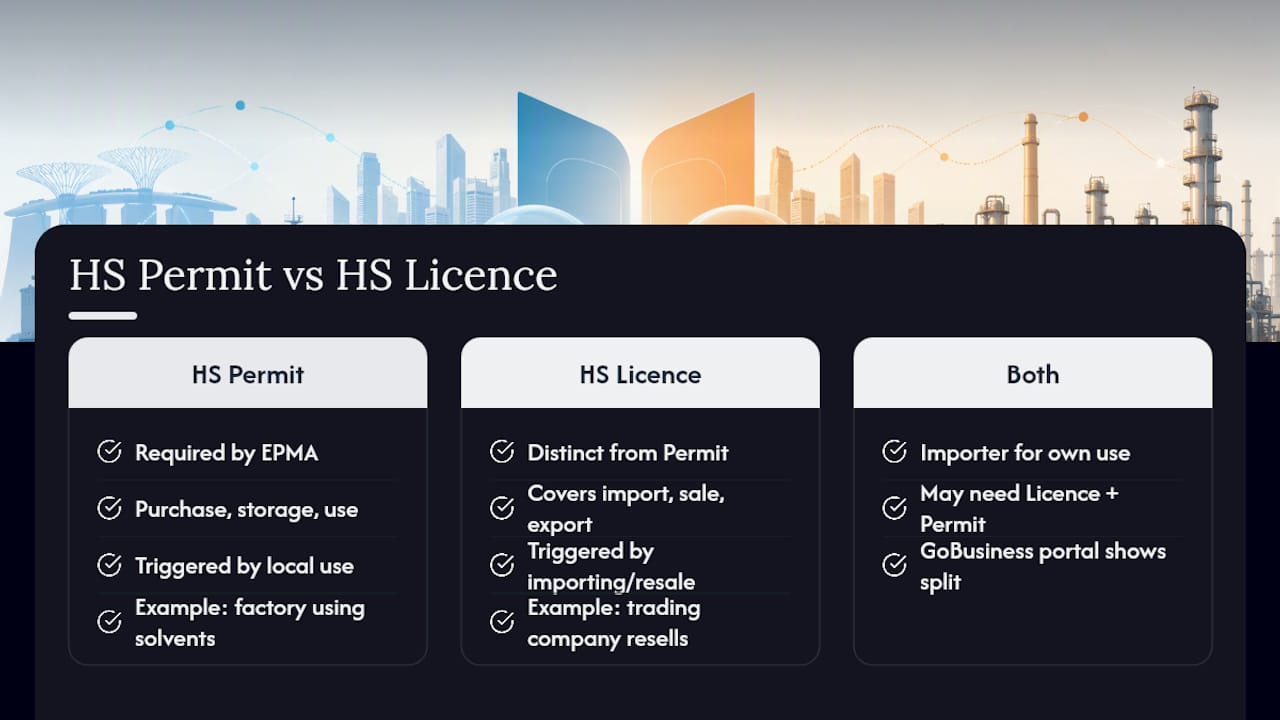
An HS Permit is the authorization the Environmental Protection and Management Act requires before a business purchases, stores, or uses a controlled hazardous substance in Singapore. It is not the same as an HS Licence, which governs import, sale, and export activity. This distinction trips up a lot of first-time applicants.
Think of it this way: a factory buying industrial solvents from a local supplier for use on its production line needs a Permit. A trading company bringing the same solvent into Singapore to resell needs a Licence. Many businesses need both, since importing a substance for your own use requires the Licence to bring it in and, in some cases, a Permit for the storage and use that follows. The GoBusiness licensing portal sets out this split clearly, and it is the starting reference point for classifying which authorization applies to your operation.
What Documents Do You Need Before You Apply?
NEA will not issue an HS Permit on the strength of an application form alone. The agency wants proof that storage is safe, that the intended use has clearance, and that the applicant understands the regulatory obligations under the EPMA. Prepare these before you open the online form:
- Industrial allocation letter or Development Control clearance, confirming the storage site is zoned and approved for that use
- Emergency Action Plan covering spill response, evacuation, and first-aid procedures
- Safety Data Sheets (SDS) for every substance named in the application
- Site layout or floor plan showing storage location, segregation, and containment
- CSC or PE endorsement for any bulk storage tank
- No-objection letter from the warehouse owner if you are storing at a third-party premises
The applicant must be a management-level staff member acting through the company’s UEN and Corppass account. A detailed engineering review of storage-site clearances can catch layout or bunding gaps before NEA does.
How Do You Apply for an HS Permit, and What Does It Cost?
The application runs entirely through GoBusiness, and the sequence matters more than most applicants expect.
- Gather all supporting documents, including the SDS, site layout, and Emergency Action Plan.
- Confirm the storage location has Development Control clearance and, where relevant, industrial allocation approval.
- Log in to GoBusiness with Corppass and complete the HS Permit application, entering each substance’s technical name, maximum purity, physical form, and the unit capacity and estimated maximum quantity of each storage container.
- Submit and monitor the application status through your GoBusiness dashboard.
GoBusiness lists a fee of $450 for a five-year Permit, payable through the portal’s supported payment methods. NEA processes complete applications within 30 working days; applications that trigger a site inspection take longer. Withdrawals and amendments are handled through the same GoBusiness case, so avoid submitting a fresh application to fix an error.
Pro Tip: The single biggest cause of delay is an incomplete Emergency Action Plan or missing Development Control clearance for a new storage site. Have your PE endorsement and any third-party no-objection letters ready before you touch the online form, not after NEA asks for them.
What Are the Storage and Transport Rules You Must Follow?
Storage compliance is not a one-time checkbox. NEA expects ongoing documentation of container sizes, maximum quantities held at any time, and physical segregation between incompatible substances.
- Record the unit capacity of every storage container and the maximum quantity stored at any given time.
- Keep incompatible hazardous substances segregated with adequate containment to prevent cross-contamination in a spill.
- Maintain records that match what was declared on the original Permit application, since discrepancies surface during audits.
- Trigger Transport Approval when quantities cross thresholds set in the EPM(HS) Regulations, coordinated through CCMD controls and TradeNet for cross-border movement.
- Fit in-vehicle tracking devices where NEA mandates them for specific higher-risk substances before transport approval is granted.
Businesses storing petroleum or other flammable materials often need to coordinate HS Permit conditions with a separate SCDF submission covering fire safety clearance for the same site.
How Often Does NEA Audit Permit Holders, and What Changes in 2026?
NEA runs its Safety Audit Guidelines on a two-year cycle for HS Permit and Licence holders, checking that the systems described on paper actually exist on the floor.
- Written safety policy and hazard identification procedures
- Staff training records and refresher schedules
- Emergency Action Plan currency and drill history
- Contractor vetting and management procedures for third-party workers on site
Beginning January 1, 2026, permit and licence holders whose substances meet GHS toxicity, CMR, persistence, or bioaccumulation criteria must complete Mandatory Chemical Reporting at the point of licence or permit renewal. The Chemical Reporting Form, submitted via FormSG, requires chemical identity, the current SDS, maximum annual quantity, and intended use. For facilities in specialized sectors like wafer fabrication or petrochemical processing, NEA audits sometimes overlap with MOM’s Safety and Health Management System requirements, so mapping both frameworks together avoids duplicate paperwork.
How Should You Manage Records Once the Permit Is Active?
Holding the Permit is only the start. NEA expects stock movement records in the format CCMD specifies, alongside SDS files kept current for every substance on site.
- Log every receiving delivery against the quantities declared in your Permit application.
- Restrict storage-area access to trained personnel and log entries where the substance risk warrants it.
- Vet contractors handling hazardous substances the same way you vet permanent staff.
- Calendar your renewal date and CRF submission window well ahead of the deadline, since FormSG reporting now sits inside the renewal process rather than beside it.
A general compliance checklist covering multi-agency approvals helps operations teams track renewal dates alongside other statutory obligations.
Pro Tip: Treat your SDS binder like a living document, not an archive. NEA auditors check whether the SDS on file matches the current manufacturer version, and an outdated sheet counts as a finding even if nothing physically changed on site.
How Do Engineering Reviews Speed Up Permit Approval?
Consultants preparing a site for HS Permit review typically check the storage layout, bunding adequacy, PE endorsements, and whether emergency response equipment matches what the Emergency Action Plan describes on paper. The most common corrections involve tank recertification, improved segregation between incompatible substances, and ventilation or fire compartmentation gaps that only surface once someone inspects the physical site against the submitted drawings.

[Author credentials and relevant project examples to be inserted.]
Where to Find the Official Forms and Guidance
Bookmark the NEA guidance notes for application detail, the GoBusiness HS Permit page for the live application, and the CRF PDF for FormSG reporting fields.
Prepare for Your Permit Application With Expert Engineering Support
The regulatory text is public, but knowing where an inspector will actually push back rarely comes from reading a PDF. Consultants review site layouts, bunding, PE endorsements, and emergency response arrangements against NEA’s audit checklist before an application goes in rather than after it stalls. That kind of pre-submission review is where most of the 30 working days gets lost or saved.
If your storage site involves bulk tanks needing CSC or PE endorsement, or if you are trying to coordinate an HS Permit with a parallel SCDF or fire safety submission, Aman’s authority approvals service covers exactly that overlap. The firm also handles PE endorsements for bulk storage installations directly, which removes a step that otherwise sits between your site documentation and a submittable application.
An Editorial Take on Where Applicants Waste the Most Time
Most guidance on hazardous substance permits treats the application form as the hard part. It is not. The form is mechanical; NEA’s own guidance notes spell out every field. The actual bottleneck is almost always a site condition that does not match what the paperwork claims, discovered only when an inspector walks the floor.
Businesses that treat the Permit application as a formality, rather than as the safety verification NEA actually intends it to be, are the ones stuck waiting past 30 working days. The 2026 Mandatory Chemical Reporting Framework raises the stakes further: renewal is no longer a rubber stamp but a data submission with its own accuracy burden. Firms that build CRF fields into their SDS tracking now will find renewal painless. Firms that wait until the deadline will scramble for maximum-quantity figures nobody has been logging consistently.
The single highest-leverage move for any operator reading this is not filling out the form correctly. It is confirming the physical site, the bunding, the segregation, the endorsements, actually matches what the form will say before submission.
— Aman
This article is general information, not a substitute for advice from a qualified lawyer. Consult a qualified legal professional about your own circumstances before acting on anything here.
Sources
- Hazardous Substances (HS) Permit | Licence & Accreditation – GoBusiness
- Management of Hazardous Substances – NEA
FAQ
What Is a Hazardous Substances Permit, and Who Needs One?
An HS Permit is NEA’s authorization for a business to purchase, store, or use hazardous substances controlled under the EPM Act. Any Singapore business handling a listed substance from a local supplier, from factories to warehouses, need one before the substance arrives on site.
What Is the Difference Between an HS Permit and an HS Licence?
The Permit covers purchase, storage, and use within Singapore, while the Licence covers import, sale, and export of the controlled substance. A business that imports a chemical and then stores it for its own use may need both authorizations.
What Substance Categories Fall Under HS Permit Control?
The Environmental Protection and Management (Hazardous Substances) Regulations schedule specific chemicals by name, classifying each by properties such as toxicity, corrosiveness, and flammability rather than a fixed set of universal categories. Check the substance-specific schedule on the NEA site rather than relying on a general category list, since coverage is chemical-specific.
How Long Does It Take to Get an HS Permit Approved?
NEA aims to process a complete application within 30 working days. Applications requiring a site inspection, or missing documentation like the Emergency Action Plan, routinely take longer.
What Is the Mandatory Chemical Reporting Framework?
Starting January 1, 2026, HS Permit and Licence holders whose substances meet specified toxicity, persistence, or bioaccumulation criteria must submit chemical identity, SDS, and quantity data through FormSG at renewal. It applies at the renewal stage, not as a separate standalone filing.