
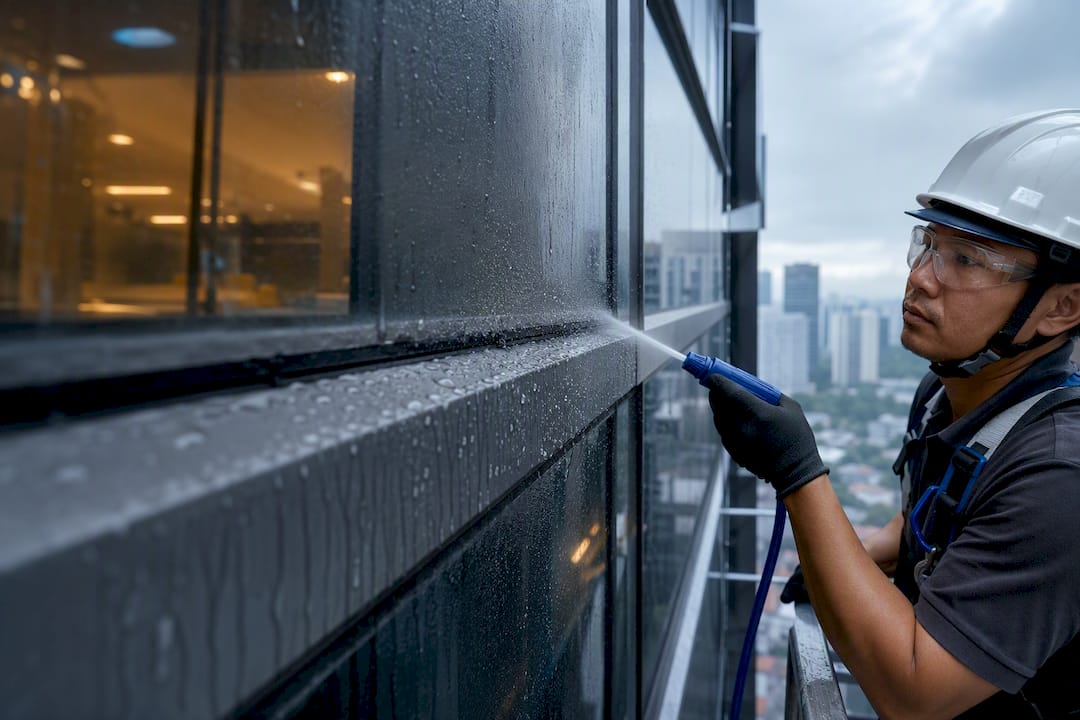
Facade water testing is the systematic process of locating uncontrolled water paths through a building’s exterior envelope, using visual, instrument-based, and active methods to confirm where and how water penetrates. Owners in Singapore typically need testing when a Periodic Facade Inspection (PFI) notice arrives, when visible leakage or staining appears, or when verifying that rectification works have actually solved the problem. The immediate step is to appoint a Competent Person, a Professional Engineer or Registered Architect, to scope and supervise the diagnostic program before any contractor begins work.
TL;DR:
- Water ingress often originates from sealant joints that have deteriorated or debonded, especially at movement joints and curtain wall interfaces.
- Singapore’s tropical climate accelerates sealant fatigue and membrane wear, necessitating targeted testing if staining, efflorescence, or odors indicate concealed leaks.
- A proper water test program includes visual surveys, thermal imaging, active hose or chamber tests, and possibly destructive sampling, scheduled after a dry period for accuracy.
- Inspection must be supervised by a registered Professional Engineer or Architect, who reviews all findings, ensures documentation compliance, and coordinates testing logistics.
- Costs and timelines depend on facade size, access method, and repair scope, with urgent safety issues requiring immediate appointment of a qualified inspection team.
Table of Contents
- PFI and Regulatory Context in Singapore
- Common Causes and Entry Paths for Water Ingress
- Diagnostic and Water-Testing Methods for Facades
- Interpreting Results and Documenting Findings for Compliance
- Remediation Approaches for Water Ingress in Facades
- Choosing a Competent Inspector and a Pre-Test Checklist
- How a Qualified CP Coordinates Facade Water Testing and PFI Workflows
- Timeline and Cost Factors for Testing and Rectification
- Preparing the Facade Before Water Testing Begins
- Standards Governing Facade Water Testing Methods
- Safety Protocols During High-Rise Facade Testing
- Material-Specific Challenges in Facade Water Testing
- Interpreting Results for Facade Performance and Durability
- Preventive Maintenance After Testing Confirms Facade Condition
- Why Timely Testing and the Right Appointment Matter
- How Aman Engineering Consultancy Supports Facade Testing and Compliance
- Sources
- FAQ
PFI and Regulatory Context in Singapore
Under the Building Control (Periodic Inspection of Buildings and Building Façades) Regulations 2021, buildings that are taller than 13 meters and at least 20 years old fall under mandatory PFI cycles, with reinspection required every seven years, as set out by the Building and Construction Authority. Owners cannot self-certify: a Competent Person must be appointed to carry out or directly supervise the inspection, and that CP remains accountable for reviewing every output before submission.
The inspection scope is fixed by regulation. Every elevation requires a full visual survey covering 100% of the facade, plus a close-range inspection of at least 10% of each elevation, with the intensity rising sharply if deterioration or concealed defects surface during the initial pass, according to the Building Control regulations. This structure means water testing is rarely a standalone exercise: it typically follows or accompanies the close-range portion of a statutory PFI cycle, our PFI compliance guide covers the broader statutory timeline in more detail.
A CP’s responsibilities extend well past fieldwork. They must:
- Personally review all inspection outputs, including any Facade Inspector’s findings, before signing off.
- Notify the Commissioner when unmanned aircraft systems are used and directly supervise UAS operations during the survey.
- Maintain documentation that satisfies BCA’s reporting format, including equipment logs, photographic records, and defect classifications.
- Escalate to a full investigation when the initial visual and close-range findings indicate hidden deterioration.
The PFI Guidelines V1.3 set out the recommended checklists and documentation formats CPs use to structure this work, giving owners a consistent basis for comparing proposals from different consultants.
Common Causes and Entry Paths for Water Ingress
Most facade leaks trace back to a small set of recurring failure points, and knowing them helps an owner brief a testing team accurately rather than leaving the scope open-ended. Sealant joints that have hardened, shrunk, or debonded from the substrate are the single most frequent culprit, particularly at movement joints between precast panels. Curtain wall interfaces, where glazing meets mullions or transoms, are another common weak point because thermal cycling gradually opens micro-gaps that are invisible at a distance.
Other typical entry paths include:
- Damaged or perished waterproofing membranes behind cladding or at parapet upturns.
- Flashing details at window heads, sills, and roof-to-wall junctions that were poorly lapped or sequenced during original construction.
- Penetrations for pipework, cables, or brackets where sealant was never properly tooled.
- Clogged or undersized drainage channels that force water back against the facade rather than away from it.
Singapore’s climate compounds these weaknesses. Wind-driven tropical rain forces water laterally into joints that would stay dry under vertical rainfall alone, accelerating sealant fatigue and membrane wear well before their expected service life ends. Owners should watch for staining below window sills, efflorescence on concrete surfaces, peeling paint near joints, and musty odors in units adjoining external walls: these are the visible symptoms of concealed leaks that a targeted test program is designed to confirm.
Diagnostic and Water-Testing Methods for Facades
Selecting the right test depends on what the visual inspection already suggests and how much certainty the owner needs before committing to repairs. The methods below run from least to most invasive, and a competent testing program often uses several in sequence.
- Visual and close-range inspection. Rope access, mobile elevated work platforms (MEWPs), and accredited UAS operators each satisfy the 100% visual requirement in different ways; UAS access reduces cost and scaffolding time but still requires CP supervision and notification to BCA, as confirmed in the PFI guidance. Rope access and MEWPs allow hands-on probing of joints that drone footage alone cannot replicate.
- Thermal imaging and acoustic leak detection. Thermal cameras pick up temperature differentials caused by trapped moisture, while acoustic detectors listen for the sound signatures of water movement behind cladding, both are commonly used in Singapore to narrow down hidden leak sources before committing to active testing, according to Allstar Waterproofing. False positives can arise from HVAC condensation or sun-warmed masonry, so thermal readings are usually cross-checked against a second method.
- Active water tests: hose testing and chamber-style tests. A calibrated hose is directed at a joint or interface under a defined pressure and duration, or a sealed chamber applies differential pressure to simulate wind-driven rain. A pass shows the assembly resists penetration under test conditions; a fail pinpoints the exact path, though neither result alone proves how the assembly will behave over years of weathering, per the same leak-detection reference.
- Tracer and dye tests, moisture probes, and core sampling. These escalate the investigation when active tests confirm a leak but the path through multiple wall layers remains unclear. Moisture probes quantify saturation inside a wall assembly, while core samples allow laboratory analysis of membrane condition and material degradation.
- Destructive testing. Cutting into cladding or removing a section of curtain wall is justified only when non-destructive and active tests have failed to isolate the defect, or when the CP suspects structural involvement. This step needs its own method statement, since it usually requires temporary weatherproofing until the section is reinstated.
Pro Tip: Schedule active water tests only after a dry spell of at least 48 hours, otherwise residual moisture from recent rain can produce a false fail.
Interpreting Results and Documenting Findings for Compliance
Raw instrument readings mean little on their own. A CP’s job is to correlate a thermal anomaly, an acoustic signature, and an active test result at the same location into a single, defensible leak-path finding, usually presented as annotated photographs overlaid with test coordinates. This correlation step is what distinguishes a compliant PFI report from a collection of disconnected sensor outputs.
BCA expects a documentation package that a reviewing officer can follow without needing to be on site. At minimum, this includes:
- Test protocols used for each method, including equipment models and calibration dates.
- Inspector and CP identification, with clear sign-off on every section reviewed.
- Photographic evidence keyed to a facade elevation map, showing both defect location and test conditions.
- A defect classification and severity rating consistent with the PFI Guidelines checklist format.
A full facade investigation is triggered when close-range findings reveal deterioration beyond isolated joint failure, such as widespread membrane breakdown, corrosion in embedded fixings, or spalling linked to water ingress rather than surface wear. Once rectification is complete, verification testing repeats the original active test at the same location under comparable conditions; the acceptance criterion is a clean pass with no measurable ingress, and the CP formally signs off before the section is closed out in the PFI record.
Remediation Approaches for Water Ingress in Facades
Repair strategy follows directly from what the testing identified, and the categories below map to the failure modes described earlier in this guide. Sealant and joint replacement addresses the most common finding: failed or degraded joints. Best practice sequencing removes the old sealant fully, primes the substrate, and installs a backer rod sized to the joint before applying new sealant, since skipping the backer rod is a frequent cause of premature failure.
Membrane systems address deeper penetration issues on curtain walls and cladding. EPDM-based membranes such as SikaMembran systems provide vapor control and are installed behind the cladding line, offering longer service life than surface sealants but requiring the cladding to be removed for installation, which raises both cost and downtime.
For masonry facades, cementitious and coating-based approaches are common. Vapor-permeable coatings such as Terraco’s Terraseal allow trapped moisture to escape while blocking new ingress, though the coating’s fire rating and application method need verification against local product approvals before use.
Other remediation categories include:
- Flashing replacement at window heads and parapets, corrected to proper lap sequence rather than simply resealed.
- Drainage repairs, including clearing or enlarging weep holes and channels that were forcing water back into the wall.
- Substrate replacement where core sampling confirms the original material has degraded beyond repair.
- Structural assessment, triggered when water ingress has reached embedded steel or caused visible spalling, since corrosion-driven expansion can compromise load paths.
Our PFI Stage 2 rectification page details how these repair categories are staged and managed once BCA has reviewed the Stage 1 findings.
Choosing a Competent Inspector and a Pre-Test Checklist
Selecting the right CP determines whether the entire testing program holds up to BCA scrutiny, so verification should happen before any contract is signed.
- Confirm the CP’s Professional Engineer or Registered Architect registration and request sample PFI reports to check documentation quality and defect classification consistency.
- Ask for the equipment list, including thermal camera specifications and whether any UAS operator holds the accreditation BCA requires for drone-based visual surveys.
- Review the proposed contract for a clearly defined scope, explicit pass and fail criteria for each active test, a site safety plan, insurance coverage, and confirmation of who handles BCA notification.
Before the testing team arrives, owners should prepare a short internal checklist: confirm access arrangements for rope access or MEWP deployment, gather records of any prior repairs or previous PFI reports, and be ready to authorize temporary containment if an active test requires it. Our guide on what building owners need from facade inspection expands on these preparation steps.
Pro Tip: Ask any CP proposing UAS inspection to confirm their drone operator’s accreditation status in writing before the survey date, not after.
How a Qualified CP Coordinates Facade Water Testing and PFI Workflows
A structured PFI workflow typically moves from Stage 1 inspection findings into Stage 2 rectification once defects are confirmed and classified. Consultancy services support this full sequence for building owners, coordinating the statutory submission alongside the technical inspection work.
- Statutory submission support spans both PFI Stage 1 inspection reporting and Stage 2 rectification project management.
- Multidisciplinary coordination brings together UAS survey data, thermal and acoustic findings, and core sampling results under a single reviewing Professional Engineer.
- PE endorsements are handled as part of the same engagement, avoiding a separate handoff between inspection and design sign-off.
- Reports are structured for direct BCA submission, keeping the defect record consistent from initial visual survey through to rectification close-out.
Timeline and Cost Factors for Testing and Rectification
Planning windows vary with building size and defect severity, but a general pattern holds across most Singapore PFI engagements. Stage 1 visual and close-range inspection typically takes several weeks depending on facade area and access method, while targeted active testing and any lab analysis of core samples add further time before a defect classification is finalized. Rectification procurement then follows, with timelines shaped by how much of the facade requires intervention.
Cost is driven by several factors:
- Access method: UAS surveys generally cost less than full scaffolding or rope access mobilization for close-range work.
- Testing intensity: the number of active water tests and whether destructive sampling is needed both add to the fee.
- Repair scope: material replacement, such as full membrane reinstallation, costs substantially more than localized sealant repair.
- Statutory submission fees and CP review time, which apply regardless of the physical repair scope.
When a defect poses an immediate public safety risk, such as spalling concrete with exposed reinforcement, procurement priorities shift: temporary protective measures and urgent rectification take precedence over the standard tender cycle.
Preparing the Facade Before Water Testing Begins
Accurate test results depend on proper preparation, and skipping this stage is a common reason active tests produce inconclusive or misleading readings. Surfaces at the test location should be cleaned of loose debris, algae, or surface dirt that could trap water and mimic a leak path, or conversely mask an existing gap in the sealant line.

Environmental conditions matter as much as surface condition. Testing immediately after rainfall risks a false fail from residual surface moisture, so a dry period is standard practice before active water tests proceed. Wind speed should also be checked, since strong gusts can distort the pressure applied during chamber-style tests or push spray away from the intended target area, undermining the reliability of the result.
Access equipment needs to be confirmed and positioned before the test window opens: rope access anchors, MEWP staging areas, or UAS flight clearances should all be arranged in advance, since delays on test day often push the entire schedule back by days rather than hours. Any recent repairs at or near the test location should be logged and shared with the testing team, since a joint resealed the previous week may behave differently under test pressure than one that has weathered for years. Finally, adjoining units or occupied spaces near the test location should be notified in case water ingress becomes visible internally during testing, which also protects the CP’s documentation trail if a dispute arises later.
Standards Governing Facade Water Testing Methods
Facade water testing in Singapore sits within a layered framework: statutory PFI regulation sets the mandatory inspection scope and frequency, while international testing standards such as ASTM and ISO provide the technical protocols many CPs reference when specifying hose tests, chamber tests, and air infiltration checks. These standards are not themselves Singapore law, but they are commonly adopted as the technical basis for test methodology because they define consistent pressure levels, spray patterns, and test durations that make results comparable across projects.
The statutory backbone remains the Building Control (Periodic Inspection of Buildings and Building Façades) Regulations 2021, which fixes the 100% visual and minimum 10% close-range inspection scope, and the PFI Guidelines V1.3, which set out the recommended checklist and documentation format CPs follow. When a CP references an international test standard for a specific active water test, that reference should be stated explicitly in the report so the owner and any future reviewer understands exactly what protocol was applied and can compare it against subsequent verification tests using the same method.

Safety Protocols During High-Rise Facade Testing
Testing on a high-rise facade carries fall risk, equipment risk, and public safety risk simultaneously, and a competent testing program addresses all three before work begins. Rope access technicians must hold current certification and work under a documented rescue plan, while MEWP operators need equipment inspected and certified for the specific height and reach required. Any UAS operation must be conducted by an accredited provider, with the CP directly supervising the flight and having notified BCA in advance, consistent with the PFI framework’s UAS provisions.
Ground-level safety matters as much as work-at-height precautions. Active water tests using pressurized hoses or spray chambers can send runoff onto pedestrian areas below, so exclusion zones and signage should be established before testing starts, particularly on facades facing public walkways or building entrances. Electrical isolation is another frequent oversight: testing near curtain wall interfaces sometimes requires temporary power shutdown to nearby lighting or signage circuits to prevent water contact with live wiring.
Weather monitoring should continue throughout the test window, since sudden wind gusts or approaching rain can turn a controlled test into an uncontrolled safety event at height. A documented safety plan, covering access method, exclusion zones, and abort criteria for adverse weather, should be part of every testing contract rather than an informal understanding between the CP and the contractor.
Material-Specific Challenges in Facade Water Testing
Glass, concrete, and metal panel facades each behave differently under testing, and a method that works well on one substrate can produce misleading results on another. Glazed curtain wall systems present multiple potential leak paths at a single location, gaskets, sealant joints, and drainage channels within the frame, so an active water test can confirm that water is entering without immediately revealing which of these three paths is responsible, often requiring sequential testing of each element in isolation.

Concrete facades introduce a different complication: the material itself absorbs and slowly releases moisture, which can produce ambiguous thermal imaging readings that persist for days after a genuine leak has been sealed, or conversely, mask a small active leak within normal moisture variation. Core sampling is often necessary on concrete facades specifically because surface-level methods cannot always distinguish absorbed moisture from an active ingress path.
Metal panel systems, particularly rainscreen cladding, are designed with a drainage cavity behind the panels, which means water reaching the cavity is not always a defect. Testing must confirm whether water is properly draining out through weep details or accumulating and finding a secondary path inward, a distinction that acoustic detection alone often cannot make without a follow-up moisture probe inside the cavity.
Interpreting Results for Facade Performance and Durability
A single test result answers a narrow question: did water penetrate at this location under these specific conditions. Interpreting what that means for the facade’s broader performance and remaining service life requires the CP to weigh the result against the material’s age, its exposure orientation, and the pattern of defects found across the wider survey.
An isolated joint failure on an otherwise sound facade suggests routine maintenance is sufficient. A cluster of failures concentrated on one elevation, particularly one facing Singapore’s prevailing wind-driven rain direction, points toward a systemic detailing issue rather than isolated wear, and that distinction changes the repair scope from spot sealant replacement to a full elevation review. Durability projections should also account for how long the current sealant or membrane has been in service relative to its expected lifespan, since a test that passes today on a joint nearing the end of its service life offers limited assurance for the following PFI cycle.
CPs typically translate these findings into a severity rating within the PFI report, distinguishing between defects requiring immediate rectification and those that can be monitored until the next inspection cycle. That rating, not the raw test result alone, is what actually informs the owner’s maintenance and capital planning decisions.
Preventive Maintenance After Testing Confirms Facade Condition
Testing results are only as useful as the maintenance program built around them. Once active tests confirm which joints, membranes, or details are approaching failure, a scheduled resealing program addresses those locations before they progress to active leaks, rather than waiting for the next PFI cycle to reveal the same defects at greater severity.
Routine drainage checks matter as much as sealant condition: weep holes and drainage channels should be inspected and cleared on a regular schedule, since blocked drainage is one of the most preventable causes of water forcing its way back into the wall assembly. Facades exposed to heavy wind-driven rain, typically upper floors on windward orientations, benefit from more frequent visual checks between statutory PFI cycles, since Singapore’s climate accelerates joint fatigue faster on these elevations than on sheltered faces.
Owners should also keep a defect log that carries forward from one PFI cycle to the next, tracking which locations were repaired, when, and with what material, so the next CP inspection can verify whether prior rectification is holding up rather than starting the diagnostic process from zero. Partner maintenance providers such as Clean Coat’s facade maintenance guidance outline practical scheduling intervals for seal and joint upkeep that complement the statutory inspection cycle.
Why Timely Testing and the Right Appointment Matter
Delaying facade water testing rarely makes the underlying defect smaller: it usually gives water more time to reach embedded steel or spread behind cladding where the eventual repair costs far more than early intervention would have. Owners carry statutory responsibility for PFI compliance regardless of who they hire, and an improperly scoped test program can leave that responsibility unmet even after money has been spent. When a PFI notice arrives or a leak becomes visible, appointing a properly credentialed Competent Person promptly is the single decision that protects both safety and liability exposure.
— Aman
How Aman Engineering Consultancy Supports Facade Testing and Compliance
Coordinating facade water testing across multiple specialists, thermal imaging technicians, active test contractors, and lab analysts, adds complexity that a single point of statutory oversight can resolve more efficiently than managing each vendor separately. Services include PFI Stage 1 inspection, targeted testing coordination, and Stage 2 rectification project management under one engagement, with a multidisciplinary Professional Engineer team reviewing findings before submission to authorities.

Engagements typically begin with a site survey and defect scoping session, followed by CP-led testing appropriate to what that survey reveals, and conclude with a report structured for direct authority submission. Owners facing a PFI notice or unresolved leak issues can review our authority approvals and PFI services or reach out through our main services page to discuss scope and timeline for their building.
Sources
- Periodic Facade Inspection (PFI) | Building and Construction Authority
- Building Control (Periodic Inspection of Buildings and Building Façades) Regulations 2021 – Singapore Statutes Online
- How a Water Leakage Specialist Identifies Hidden Sources of Leakage — Allstar Waterproofing
FAQ
How much does a facade inspection cost?
Facade inspection pricing in Singapore depends on building height, facade area, access method, and testing intensity, so no fixed figure applies across projects. Owners should request itemized quotes covering visual survey, close-range access, and any active testing, since these components vary independently. Pricing is typically provided on request after reviewing a building’s specific scope.
What are the guidelines for BCA facade inspections?
BCA requires periodic facade inspection for buildings taller than 13 meters and at least 20 years old, with reinspection every seven years, as set out on the BCA PFI page. The inspection must cover 100% of the facade visually and at least 10% of each elevation at close range, under the supervision of an appointed Competent Person, per the Building Control Regulations.
What is a facade inspection?
A facade inspection is a statutory survey of a building’s exterior envelope to identify deterioration, water ingress, or structural risk before it becomes a safety hazard. In Singapore, it combines a full visual review with targeted close-range checks, carried out or supervised by a Competent Person under the PFI framework.
Who is a reputable water leak specialist in Singapore?
A reputable facade water testing provider should employ a properly registered Competent Person, use accredited UAS operators where drones are involved, and document findings to BCA’s PFI reporting standard. Some consultancies coordinate PFI-compliant testing and rectification for building owners under this framework.