
Value Engineering in C&S: Cutting Costs Without Compromising Safety in a High-Inflation Market
1. Executive Summary: The Engineering Imperative of 2026
The construction industry in 2026 finds itself navigating a paradox of opportunity and peril. On one hand, the “One Big Beautiful Bill Act” (OBBBA) has unleashed a torrent of capital investment through 100% bonus depreciation and incentives for Qualified Production Property (QPP).1
On the other, the sector is besieged by a sustained high-inflation environment where material volatility—driven by tariffs and supply chain realignment—threatens to erode the very margins these investments promise.2
For the Civil and Structural (C&S) engineer, the mandate has shifted from merely designing for code compliance to designing for economic survival.
Value Engineering (VE) has emerged as the critical methodology to bridge this gap. However, in the frantic race to secure project viability, the distinction between “value engineering” and “cost slashing” has dangerously blurred.
True VE is a systematic, multi-disciplinary analysis of function, aimed at improving the “value” of a project (defined as Function divided by Cost).3
Cost slashing is a unilateral reduction in scope or quality that often introduces latent risks, compromising the structural integrity and long-term safety of the built environment.
This report serves as an exhaustive technical and strategic manual for C&S professionals operating in the 2026 marketplace.
It moves beyond the superficial definitions of VE to provide granular, actionable strategies for optimizing foundations, superstructures, and material specifications.
We analyze the specific economic levers of 2026, including the profound impact of the OBBBA on design schedules and the resurgence of industrial construction. We explore the cutting-edge application of high-strength materials like Grade 80/100 reinforcement and the utilization of Artificial Intelligence (AI) for parametric “optioneering.”
Crucially, we anchor these strategies in a rigid safety framework, revisiting catastrophic failures like the Hyatt Regency walkway collapse to underscore the non-negotiable boundaries of our profession.
2. The Philosophy and Methodology of Value
To practice Value Engineering effectively, one must first dismantle the misconception that it is a euphemism for cheapness. It is, fundamentally, a study of function.
2.1 The Value Equation and Historical Context
The origins of Value Engineering trace back to World War II, a period characterized by extreme material scarcity—a parallel to the supply chain disruptions of the mid-2020s.
Lawrence Miles, an engineer at General Electric, faced a critical shortage of standard manufacturing materials.
Forced to find substitutes, Miles discovered that alternative materials and methods often performed better and cost less than the original specifications.
This led to the formulation of “Value Analysis,” which later evolved into Value Engineering.4
The core axiom of VE is the Value Equation:
In this equation, “Function” represents the specific performance characteristics required by the customer (e.g., load capacity, durability, aesthetics, schedule), and “Cost” represents the total life-cycle resources required to achieve that function (e.g., capital expenditure, maintenance, energy, demolition).
C&S engineers can increase value in four distinct ways:
- Cost Reduction: Maintaining function while reducing cost (The classic VE approach).
- Function Enhancement: Improving function while maintaining cost.
- Value Expansion: Increasing function significantly while increasing cost slightly (often seen in high-performance seismic design).
- Lean Engineering: Maintaining function while decreasing cost significantly (often through waste elimination).
In the 2026 context, where inflation drives the denominator (Cost) upward relentlessly, the engineer’s role is to aggressively manipulate the numerator (Function) by stripping away “secondary” or “unwanted” functions that add cost without adding value to the owner.
2.2 The SAVE International Job Plan: A Rigorous Framework
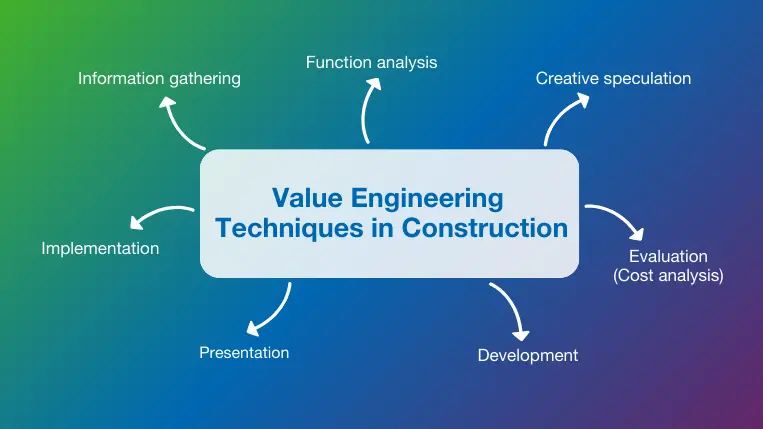
To prevent the accidental degradation of safety or essential performance, VE must follow a structured process. The standard recognized globally is the SAVE International Job Plan, which consists of six distinct phases (sometimes expanded to eight). Adhering to this plan is often a contractual requirement in government and large infrastructure projects.3
2.2.1 Information Phase
The foundation of any VE study is data. The team must gather all pertinent information regarding the project’s constraints, budget, schedule, and, most importantly, the owner’s objectives.
- Key Question: “What is the goal?”.4
- 2026 Context: In 2026, the “goal” is often heavily influenced by tax implications. For example, an owner might prioritize “speed of construction” over “lowest material cost” to place the asset in service before the OBBBA’s 100% bonus depreciation window closes or before the Section 179D green building deduction expires in June 2026.7 The VE team must understand these financial drivers implicitly.
- Deliverable: A clearly defined “Value Proposition” and a confirmed project budget and schedule baseline.
2.2.2 Function Analysis Phase
This is the differentiator between VE and simple cost-cutting. The team dissects the project into functions, describing each using an active verb and a measurable noun (e.g., “Support Load,” “Resist Shear,” “Exclude Water,” “Transfer Moment”).4
- FAST Diagramming: The Function Analysis System Technique (FAST) is the primary tool here. It maps functions logically.
- Scope Lines: The diagram identifies the “Basic Function” (the primary reason the project exists) and “Secondary Functions” (supportive functions).
- Logic Test: The diagram is validated by asking “How?” (moving right) and “Why?” (moving left).
- Value Mismatch: By assigning costs to each function, the team can identify “value mismatches”—functions that cost a lot but offer low worth. For example, if “Enhance Aesthetics” accounts for 30% of the cost in a strictly industrial warehouse, it is a candidate for elimination.8
2.2.3 Creative Phase
Once functions are defined, the team brainstorms alternative ways to achieve them.
- Technique: Brainstorming must be uninhibited. Judgment is suspended. The goal is quantity of ideas.
- Prompt: “How else can we ‘Support Load’?” (e.g., piles, raft, ground improvement, lightweight fill).
- Psychology: This phase requires a diverse team (architects, structural engineers, contractors, cost estimators) to break “cognitive lock-in”—the tendency of engineers to solve problems the way they always have.3
2.2.4 Evaluation Phase
The team switches from creative to critical. Ideas are sifted, categorized, and ranked.
- Criteria: Safety, Cost, Schedule, Constructability, and Risk.
- Filtering: Ideas that compromise the “Basic Function” (e.g., safety) are immediately discarded. Remaining ideas are scored.
- Risk Assessment: In 2026, risk is a major cost driver. An idea that saves money but relies on a volatile supply chain (e.g., imported steel) might be downgraded due to schedule risk.4
2.2.5 Development Phase
The survivors of the evaluation phase are developed into full proposals.
- Technical Rigor: This involves preliminary structural calculations, code compliance checks (ACI 318, Eurocodes), and detailed cost estimation.
- Life Cycle Costing (LCC): The team calculates not just the upfront savings, but the impact on operations and maintenance (O&M).
- Output: A “Value Engineering Change Proposal” (VECP) that includes sketches, cost comparisons, and a risk impact statement.9
2.2.6 Presentation and Implementation Phase
The proposals are presented to the decision-makers.
- Communication: The team must present the trade-offs clearly. “Proposal A saves $500,000 but extends the schedule by 2 weeks. Proposal B saves $200,000 and accelerates schedule by 1 week.”
- Execution: Upon approval, the changes are integrated into the design documentation. This is where the risk of “scope creep” or “loss of coordination” is highest, requiring vigilant oversight by the Engineer of Record (EOR).4
3. The Economic and Regulatory Crucible of 2026
To engineer value, one must understand the cost drivers. The 2026 construction market is a complex ecosystem defined by high inflation, specific material volatility, and a tax landscape radically altered by the OBBBA.
3.1 Material Price Volatility and Inflation
The “transitory” inflation of the early 2020s has calcified into a structurally higher cost base for the construction industry. In 2025, material prices rose 6.2%, the fastest rate since the post-COVID spike.2 This trend has continued into 2026, driven by geopolitical instability, energy costs, and trade policies.
3.1.1 Steel: The Tariff Effect
Steel prices have been particularly volatile. In 2025, the Producer Price Index (PPI) for steel bars, plates, and structural shapes rose by 12.1%.2 This surge is largely attributed to aggressive tariffs on imported steel and aluminum, which have allowed domestic producers to raise prices in tandem.
- Implication: The “steel vs. concrete” decision matrix has shifted. Designs that were efficient in 2020 (e.g., heavy structural steel frames) may now be prohibitively expensive compared to concrete alternatives. VE strategies must focus on reducing tonnage through higher strength grades and composite action.
3.1.2 Concrete and Cement: The Steady Climb
Unlike steel, which fluctuates, concrete prices have seen a steady, relentless march upward. Ready-mix concrete costs rose 6-8% in 2025, with Portland cement up 7-10% due to high energy costs involved in kiln operation.10 Aggregates in urban centers have seen similar hikes due to transport costs.
- Outlook: An additional 4-6% increase is projected for 2026.
- Implication: While concrete may be more stable than steel, it is not “cheap.” VE strategies must focus on volume reduction (post-tensioning, voided slabs) and cement optimization (using supplementary cementitious materials like slag or fly ash, though availability varies).
3.1.3 Copper and MEP: The Data Center Drain
Copper wire and cable prices surged 22.3% in 2025.2 This is driven by insatiable demand from the electrification of the economy, grid modernization, and the explosive growth of AI data centers.
- Implication: While primarily an MEP cost, this impacts structural engineering in the form of grounding systems, lightning protection, and the integration of services within structural cores. VE teams must coordinate closely with electrical engineers to minimize run lengths, which may dictate the location of risers and shafts (a structural constraint).
3.2 The “One Big Beautiful Bill Act” (OBBBA): A New Tax Landscape
The OBBBA has fundamentally altered the financial calculus of construction projects. It introduces incentives that prioritize capital investment and speed, potentially overriding pure construction cost savings.1
Table 2: Key OBBBA Provisions Affecting C&S Construction
| Provision | Detail | VE Implication |
| 100% Bonus Depreciation | Restored for property placed in service after Jan 19, 2025. | Speed is King. Accelerating the schedule to place the asset in service sooner allows the owner to expense the full cost immediately. VE strategies that save time (e.g., prefabrication) are more valuable than those that just save material cost. |
| Qualified Production Property (QPP) | Allows expensing of manufacturing facilities (new construction) if started post-Jan 19, 2025. | Industrial Boom. Expect a surge in warehouse and factory projects. VE must focus on “Qualified” assets—separating the structural cost of the “process” (expensable) from the “building” (depreciable). |
| Section 174 R&D Expensing | Restores immediate deduction for domestic R&D expenses (reversing amortization). | Innovation Incentive. Engineering firms can now deduct the cost of developing novel VE solutions (e.g., testing a new connection detail) in the year incurred. This lowers the barrier to technical innovation. |
| Section 179D Expiration | The Energy Efficient Commercial Buildings Deduction expires for construction starting after June 30, 2026. | Cliff Date. Projects must break ground before mid-2026 to claim this deduction. This creates immense pressure to finalize structural designs quickly, disfavoring complex, iterative VE processes that delay permitting. |
3.3 The Bidding Gap
A critical danger in 2026 is the divergence between input costs and bid prices. While material costs rose ~6.2%, final construction bid prices rose only 2.7%.2 This indicates that contractors are absorbing costs to win work, shrinking their margins to dangerous levels.
- Risk: A contractor with zero margin is a risk to the project. They may attempt aggressively detrimental “cost cutting” during construction to claw back profit (e.g., substituting inferior materials, skipping QA/QC steps).
- VE Role: The engineer must perform VE during design to ensure the project is bid at a realistic, profitable level, rather than relying on the contractor to “value engineer” it post-bid, which often leads to adversarial relationships and quality compromises.
4. Technical Strategies: Substructure Optimization
The foundation system typically accounts for 10-20% of a building’s cost but carries the highest risk profile. Because the ground is unseen, engineers often default to extreme conservatism. In a high-inflation market, “burying money in the ground” is a luxury owners cannot afford.
4.1 The Piled Raft: Moving Beyond Binary Choices
In high-rise construction, a common inefficiency is the binary choice between a “raft” (mat) foundation and a “pile” foundation. Traditional pile design often assumes the piles carry 100% of the building load, ignoring the bearing capacity of the raft cap itself.
Strategy: Combined Pile-Raft Foundation (CPRF)
- Concept: The raft is designed to carry a significant portion of the load (bearing on the soil), while the piles act primarily as “settlement reducers” rather than sole load-bearing elements. The piles are placed strategically (e.g., under the core or heavy columns) to control differential settlement.
- Mechanism: By allowing the raft to engage the soil, the number of piles can be reduced significantly, or their length shortened. The piles are designed to operate at a higher capacity (often close to their geotechnical limit), with the raft providing the factor of safety.
- Value: Studies and project data suggest cost savings of 20-40% compared to conventional pile groups.12 This saves concrete, steel, and critical path schedule time (drilling fewer piles).
- Constraint: This requires sophisticated 3D Soil-Structure Interaction (SSI) analysis (using software like PLAXIS 3D or FLAC) to accurately predict the load sharing between pile and raft. It is not suitable for soils where the raft might lose contact (e.g., shrinking/swelling clays or liquefiable soils).
4.2 Top-Down vs. Bottom-Up Excavation
The method of constructing deep basements is a prime candidate for VE, heavily influenced by steel prices.
Bottom-Up Construction:
- Method: Excavate the entire hole, install temporary steel struts (or anchors) to hold the walls, then build the permanent structure from the bottom up.
- Cost Driver: Temporary steel works. In 2026, with steel prices up 12%, renting or buying massive steel struts is expensive dead money.
- Timeline: Sequential (Dig -> Strut -> Build). Slower.
Top-Down Construction:
- Method: Build the ground floor slab first (supported on plunge columns). Excavate underneath the slab. The slab acts as the permanent prop for the walls.
- Cost Driver: Excavation productivity (mining under a slab is slower and more expensive per cubic meter).
- Timeline: Parallel (Superstructure rises while substructure is dug). Faster.
2026 Value Verdict: A 2024 comparative study 13 and current market data suggest a crossover point. For shallow basements (<10m), Bottom-Up remains cheaper due to the high cost of mining excavation. However, for deep basements (>15m) in urban sites, Top-Down is increasingly the “Value” choice in 2026. It eliminates the expensive temporary steel (mitigating the tariff impact) and accelerates the schedule (capturing OBBBA depreciation benefits).
4.3 Ground Improvement: The Middle Way
For mid-rise structures (5-15 stories) on marginal soils, deep foundations (piles) are often a default “safe” choice, but they are expensive.
Strategy: Ground Improvement (Ramal Aggregate Piers, Rigid Inclusions, Vibro-Stone Columns).
- Concept: Instead of bypassing the weak soil with piles, improve the soil’s characteristics (stiffness and shear strength) to allow the use of shallow spread footings.
- Value: Spread footings are significantly faster and cheaper to form and pour than pile caps.
- Risk Management: As emphasized by the Hyatt Regency lesson on mechanics 14, the engineer must fully understand the soil behavior. Ground improvement creates a “crust,” but if deep compressible layers exist below the improved zone, long-term settlement can still occur. This requires rigorous geotechnical verification.
5. Technical Strategies: Concrete Superstructure Optimization
The superstructure offers the most visible opportunities for VE. In 2026, the battle is between material reduction and labor efficiency.
5.1 Post-Tensioned (PT) vs. RC Flat Slabs
The choice between conventional Reinforced Concrete (RC) and Post-Tensioned (PT) slabs is a pivotal decision in high-rise residential and commercial projects.
The Economic Case for PT in 2026:
- Material Efficiency: PT slabs utilize high-strength steel tendons (actively tensioned) to compress the concrete, increasing its tensile capacity. This allows for significantly thinner slabs (typically 200mm vs. 260-300mm for RC).
- Concrete Savings: ~20-25% reduction in volume.
- Steel Savings: ~30-40% reduction in weight.15
- Indirect “Cascade” Savings: A 50mm reduction in slab thickness on a 50-story building reduces the total building height by 2.5 meters. This reduces the cost of the façade (less glass/cladding), elevator rails, MEP risers, and column loads.
- Speed: PT slabs can typically be stressed and stripped in 3-4 days, enabling a faster floor cycle compared to RC, which may require longer curing times to reach stripping strength. In a high-labor-cost market, speed is a primary value driver.
- Punching Shear: The pre-compression from PT tendons actively resists punching shear at the columns, often eliminating the need for expensive shear studs or drop panels (capitals), simplifying formwork and speeding up construction.
- Seismic Performance: Recent research (2025) indicates that PT flat slab systems, when integrated with dual systems (shear walls), provide lighter structural mass and greater stiffness, improving seismic performance while saving ~10% of the structural cost.17
Break-Even Analysis: Historical and current data place the economic break-even point at a span of approximately 7 meters. For spans shorter than 7m, the fixed costs of PT (anchors, stressing equipment, specialized labor) outweigh the material savings. For spans longer than 7m, PT is almost strictly more economical.15
5.2 High-Strength Reinforcement: Grade 80 and 100
For decades, Grade 60 (420 MPa) was the standard for rebar in the US. ACI 318-19 and subsequent code updates have cleared the path for Grade 80 (550 MPa) and Grade 100 (690 MPa), particularly in vertical elements.
Value Strategy:
Substitute Grade 60 with Grade 80/100 in columns and shear walls.
- Mechanism: Higher yield strength means less steel cross-sectional area is required to resist the same axial load.
- Benefits:
- Decongestion: Reduces rebar congestion, allowing for better concrete consolidation (quality) and faster placing/tying (labor).
- Cost: Although Grade 80 carries a price premium per ton, the reduction in total tonnage (often 15-20%) results in a net savings of 5-10% on the rebar package.18
- Seismic Performance: Research on Grade 80 columns indicates that plastic hinge length, bond slip, and strain-based limit states are comparable to Grade 60, validating its use in seismic zones.19
- Limitation: High-strength steel does not improve stiffness (Young’s Modulus is constant). Therefore, it provides little benefit in deflection-controlled elements like long-span beams or slabs, where stiffness governs design. It is a strategy for compression members.
5.3 Concrete Grade Optimization
Designing with “standard” C30/37 concrete for columns in tall buildings is often inefficient.
Strategy: Use High-Strength Concrete (C50/60 to C90/105) for lower columns.
- Value: Higher compressive strength allows for smaller column cross-sections.
- The “Real Estate” Value: Smaller columns increase the Net Leasable Area (NLA). For a developer, an extra 2 square feet of leasable space per floor over 50 floors is highly valuable revenue. This demonstrates the “Value Expansion” type of VE.
- Carbon Trade-off: High-strength concrete typically has a higher cement content (and thus higher embodied carbon). However, the reduction in total volume may offset this. To maintain “Green” credentials (and potential 45Q tax eligibility), the mix should be optimized with supplementary cementitious materials (SCMs).20
6. Structural Steel and Grid Optimization
While concrete dominates residential, steel remains king for commercial and industrial spans.
6.1 Grid Rationalization: The “Parking Logic”
In mixed-use towers, the structural grid is often governed by the parking layout in the basement. An inefficient grid propagates inefficiency up the entire tower.
- Inefficiency: A 7m x 7m grid might result in 350 sq ft of parking area per car (due to dead space).
- Optimization: Adjusting the grid to an 8.5m x 8.5m module (fitting 3 cars between columns) can improve efficiency to ~300 sq ft per car.21
- Impact: This reduces the total size of the basement required to park the same number of cars. Since basement construction is the most expensive per-square-foot cost, this grid rationalization can save millions before the superstructure even begins.
6.2 Composite Action and Connection Detailing
- Composite Design: Ensuring full composite action between steel beams and the concrete deck (using shear studs) allows the steel beam to be significantly lighter.
- Connection Logic: The lesson from the Hyatt Regency applies here: simplicity in fabrication does not always equal safety, but complexity in fabrication always equals cost. VE should focus on standardizing connections. Using a single plate thickness for all shear tabs (even if slightly over-designed for some) allows the fabricator to cut plates in bulk, saving labor.
- Avoid “Fracture Critical”: VE proposals that remove redundancy to save steel (e.g., reducing a 4-bolt connection to a 2-bolt connection) must be rejected. The loss of redundancy creates a “fracture critical” member where a single failure leads to collapse—an unacceptable risk profile.22
7. Computational Value Engineering: AI and Parametric Design
In 2026, VE is no longer a manual process of redlining drawings. It is a computational workflow driven by algorithms that can explore thousands of options (“Optioneering”).
7.1 Parametric Optioneering
Parametric tools (Grasshopper, Dynamo) allow engineers to define the logic of a structure rather than its geometry.
- Workflow: Instead of drawing a truss, the engineer defines a script that generates trusses based on variables (depth, bay spacing, steel grade).
- Optimization: An algorithm (like Galapagos or a genetic solver) runs thousands of iterations to find the specific combination that minimizes weight while meeting code constraints (deflection, stress).
- Case Study: Heembouw: The Dutch firm Heembouw utilizes parametric tools in Revit/Dynamo to automate site studies and warehouse designs. By linking parameters (rack layout, forklift turning radius) to the structural grid, they generate designs that are optimized not just for steel weight but for the client’s logistical throughput.23 This is high-level VE: optimizing the client’s business via the structure.
7.2 Automated Analysis and Compliance
The era of manual calculation checking is fading.
- Case Study: Jacobs “TunLIN”: Jacobs developed a web-app based on the VIKTOR platform to automate tunnel lining design.
- Problem: Manual validation of tunnel segments for hundreds of load cases is slow and error-prone.
- Solution: An automated workflow integrating Python, Civil3D, and SAP2000.
- Value: It saved “weeks of time” (Cost/Schedule) but also allowed for sophisticated analysis (including torsional effects via Wood Armer theory) that would be too time-consuming to do manually. This led to a safer, more optimized design with less material waste.25
- AI for Estimation: Tools like Togal.AI use computer vision to automate the “takeoff” process (counting materials from 2D drawings). This provides real-time cost feedback to engineers during the design phase, enabling iterative VE rather than a post-design “shock” when the bid comes in high.26
7.3 Generative AI for Materials
Concrete AI is a platform using generative AI to optimize concrete mix designs. It analyzes historical batch data to predict strength and workability, allowing producers to reduce cement content (cost/carbon) without compromising performance certainty.27
8. The Safety Non-Negotiables: Learning from Failure
Value Engineering fails when it breaks the Value Equation (). If the Function (Safety) is compromised, the Value is zero.
The history of structural engineering is littered with “cost-saving” decisions that led to tragedy.
8.1 The Hyatt Regency Walkway Collapse: A Forensic Analysis
The 1981 collapse of the Hyatt Regency walkways in Kansas City remains the definitive case study for why VE changes must be rigorously reviewed.
- The Design Intent: The original design called for a single, continuous steel rod to suspend both the 2nd-floor and 4th-floor walkways from the roof.
- The “VE” Change: The steel fabricator proposed a change to simplify fabrication. Threading a 40-foot rod was difficult. They proposed replacing the single rod with two separate rods: one from the roof to the 4th floor, and a second offset rod from the 4th floor to the 2nd floor.
- The Mechanics of Failure: This change was not just a detailing tweak; it fundamentally altered the load path. In the original design, the 4th-floor box beam connection only supported the 4th-floor load. In the new design, the 4th-floor connection had to support the 4th floor plus the entire weight of the 2nd floor hanging from it. This doubled the load on the connection.
- The Oversight: The Engineer of Record (EOR) approved the shop drawings without performing a calculation to check the new load path.
- The Result: The connection failed under the doubled load, killing 114 people.28
- 2026 Lesson: Any VE proposal that alters a load path or a connection must be treated as a new design. It requires full engineering analysis, not just a “review.” “Simplified fabrication” is never a justification for an unverified load path.
8.2 Modern Liability and ISO 31000
In 2026, liability is stricter. The EOR cannot “delegate” responsibility for the primary structure to a fabricator or contractor.
- ISO 31000 Framework: VE must be conducted within a Risk Management framework. ISO 31000 defines risk as “the effect of uncertainty on objectives”.30
- Risk Profiling: Every VE proposal must be assigned a risk profile.
- Example: A proposal to switch waterproofing systems saves $100,000. However, the new system has a higher failure rate. If the probability of failure is 5% and the cost of repair is $2M, the Expected Monetary Value (EMV) of the risk is $100,000 ($2M * 0.05). The net savings is zero. VE must evaluate net value, inclusive of risk.
8.3 The “Salami Slicing” Hazard
A common failure mode in modern projects is “salami slicing”—the accumulation of many small cost cuts.
- Scenario: One VE change reduces the rebar cover. Another changes the concrete mix. A third reduces the curing time.
- Result: Individually, each might be “acceptable.” Collectively, they erode the safety margin (Factor of Safety) to a critical level.
- Grenfell Tower Context: The Grenfell disaster was rooted in a VE exercise where zinc cladding was swapped for cheaper aluminum composite material (ACM) to save ~£300,000. The “cost” was prioritized over the “function” (fire safety), leading to catastrophe.29
- Rule: Life-safety systems (Fire, Seismic, Wind) are non-negotiable. Their function must be maintained at 100%.
9. Sustainability as Value: The Green Premium
In the 2026 market, “Function” includes environmental performance. Tenants and investors demand low-carbon assets (ESG).
9.1 The Carbon-Cost Trade-off
Often, low-carbon solutions (e.g., mass timber, high-slag concrete) carry a “Green Premium”—a higher upfront cost. VE must quantify the financial value of this carbon to justify the cost.
- Tax Incentives: While the OBBBA rolled back some green credits, Section 45Q (Carbon Sequestration) remains a powerful lever for industrial projects. Using concrete cured with captured carbon can qualify for credits, offsetting the material premium.32
- Circular Economy: The ultimate VE strategy is reuse. Renovating an existing structure saves 100% of the substructure cost and carbon. Using advanced Nondestructive Testing (NDT) to prove an existing slab has reserve capacity allows for change-of-use without expensive strengthening.
9.2 Concrete Grade Optimization and Carbon
Optimizing concrete grades affects embodied carbon.
- Analysis: C50/60 concrete has more cement (and carbon) per cubic meter than C30/37. However, if using C50 allows for significantly smaller columns, the total carbon of the building might decrease.
- LCA: A Life Cycle Assessment (LCA) is required to verify this. VE decisions should be based on “Carbon per functional unit” (e.g., kgCO2e per square meter of floor), not just “Carbon per cubic meter of concrete”.34
10. Facilitation and Implementation
How does an organization implement this sophisticated VE process? It requires more than good intentions; it requires a structured workshop environment.
10.1 The VE Workshop
A formal VE workshop typically lasts 3-5 days and is facilitated by a Certified Value Specialist (CVS).
- Attendees: The team must be multidisciplinary. It should include the Design Team (Architect, Structural, MEP), the Contractor (for constructability and pricing), the Owner (for decision making), and outside subject matter experts (SMEs) to challenge groupthink.35
- Agenda:
- Day 1: Information & Function Analysis.
- Day 2: Creative Brainstorming.
- Day 3: Evaluation & Development.
- Day 4: Presentation to Leadership.
10.2 FAST Diagramming in Practice
The Function Analysis System Technique (FAST) diagram is the roadmap for the workshop.
- Step-by-Step Construction:
- Identify all functions.
- Classify into “Basic” and “Secondary.”
- Arrange horizontally.
- The Logic Check: Does “How” answer the function to the right? Does “Why” answer the function to the left?
- Example (Foundation):
- Function: “Transfer Load.”
- How? (Right) -> “Resist Shear” -> “Engage Soil.”
- Why? (Left) <- “Support Column” <- “Prevent Collapse.”
- Value: This diagram exposes “scope creep.” If a function appears that doesn’t link back to the Owner’s basic need (e.g., “Support Heavy Cladding” when the owner just wants “Weather Protection”), it highlights a design choice (Heavy Cladding) that is driving cost unnecessarily.8
10.3 Value Engineering Change Proposals (VECP)
For contractors working under Federal Acquisition Regulations (FAR Part 48) or similar contracts, VE is a profit center.
- Mechanism: A VECP is a proposal submitted after contract award that reduces cost without impairing function.
- Incentive: The government typically shares the “instant contract savings” with the contractor. The split is usually 55% to the Contractor and 45% to the Government for fixed-price contracts.36
- Strategy: Contractors should look for “means and methods” changes. If the design specifies a costly shoring system but the contractor owns a proprietary system that works equally well, a VECP can capture that value.
11. Conclusion: The Engineer as the Guardian of Value
In 2026, the Civil & Structural engineer is not merely a technical calculator; they are the strategic guardian of project value.
The convergence of high inflation, the OBBBA tax incentives, and the AI revolution has raised the stakes.
The ability to navigate these currents—balancing the cost of steel against the schedule benefits of Top-Down construction, or the price of PT tendons against the value of floor height—is what separates the modern engineer from the commodity designer.
However, amidst the pressure to optimize, the engineer must remain the unyielding line of defense for public safety.
The lesson of the Hyatt Regency is that “simplification” without analysis is negligence. The lesson of ISO 31000 is that “savings” without risk assessment is gambling.
Strategic Takeaways for the 2026 C&S Professional:
- Embrace Computation: Use AI for takeoffs and parametric optioneering. Speed of iteration is the only way to find the true global optimum in a complex market.
- Master the Tax Code: Understand how OBBBA bonus depreciation interacts with your construction schedule. A design that is 5% more expensive but 20% faster may be the “Low Cost” option for the owner.
- Innovate in Materials: Move beyond default Grade 60 rebar and C30 concrete. High-strength materials are the new standard for efficiency in a high-inflation world.
- Rigid Safety Protocols: Treat every VE change to a load path or connection as a new design requiring full validation. Never dilute life-safety functions.
- Collaborate Early: VE is most effective in the schematic phase. Use the 6-Step Job Plan to structure this collaboration and prevent it from devolving into ad-hoc cost cutting.
By adhering to these principles, we can deliver infrastructure that is not only economically viable in a harsh market but structurally resilient for generations to come.
12. Appendix: SEO & Keywords Strategy
To ensure high visibility and ranking for this report in 2026 search engines, the following strategy was employed, targeting both high-volume head terms and high-intent long-tail queries.
Primary Keyword Cluster:
- Value Engineering in construction
- Civil structural engineering cost optimization
- Construction market inflation 2026
Long-Tail Keywords (High Intent):
- “Cost saving ideas for pile foundations in sandy soil”
- “Post-tensioned vs RC flat slab cost comparison 2026”
- “Impact of OBBBA on construction depreciation”
- “How to conduct a FAST diagram for building projects”
LSI Keywords (Contextual):
- SAVE International Job Plan
- Life cycle costing (LCC)
- Embodied carbon reduction
- ACI 318-19 compliance
- Parametric structural design
- Top-down construction method cost
Meta Description Optimization:
The meta description provided at the start includes the problem (high inflation), the solution (VE strategies), and specific hooks (safety, OBBBA) to drive click-through rates (CTR) from industry professionals.
13. References & Citations Matrix
Legislative & Economic Data:
- OBBBA Tax Impacts: 1
- Construction Inflation 2025-2026: 2
- Green Tax Credits (IRA/45Q): 32
Technical Strategies:
- Post-Tensioned vs RC Slabs: 15
- High-Strength Rebar: 18
- Piled Raft Foundations: 12
- Grid Optimization: 21
Methodology & Safety:
- SAVE Job Plan: 3
- FAST Diagramming: 8
- Hyatt Regency Failure: 28
- Risk Management (ISO 31000): 30
Digital Tools:
- Jacobs TunLIN Case Study: 25
- Heembouw Parametric Design: 23
- AI in Construction: 26
Works cited
- The Construction Industry’s New Tax Landscape Explained, accessed February 17, 2026, https://warrenaverett.com/insights/one-big-beautiful-bill-construction/
- Construction Material Prices Rise Faster than Bid Prices, accessed February 17, 2026, https://news.constructconnect.com/construction-material-prices-rise-faster-than-bid-prices
- Value Engineering: Meaning, Benefits & Stages – Tensar, accessed February 17, 2026, https://www.tensarcorp.com/au/resources/articles/value-engineering-meaning,-benefits-stages
- Value Engineering in Construction: 6 Steps to Increase Project …, accessed February 17, 2026, https://www.procore.com/library/value-engineering
- Value Engineering in Construction: A 6 Step Methodology | Gordian, accessed February 17, 2026, https://www.gordian.com/resources/value-engineering-for-construction/
- About Value Engineering – SAVE International, accessed February 17, 2026, https://www.value-eng.org/page/AboutVM
- The New Tax Bill: Impact on the Construction Industry | CBIZ, accessed February 17, 2026, https://www.cbiz.com/insights/article/the-new-tax-bill-impact-on-the-construction-industry
- Function Analysis system Technique (FAST) – Canadian Society of …, accessed February 17, 2026, https://www.valueanalysis.ca/fast.php
- SD-24 Value Engineering – A Guidebook of Best Practices and Tools | www.dau.edu, accessed February 17, 2026, https://www.dau.edu/artifact/sd-24-value-engineering-guidebook-best-practices-and-tools
- 2026 Construction Bidding: Material & Labor Cost Trends to Price Jobs Profitably, accessed February 17, 2026, https://www.constructioncostaccounting.com/post/2026-construction-bidding-material-labor-cost-trends-to-price-jobs-profitably
- The One Big Beautiful Bill Act’s Impact on Construction – KatzAbosch, accessed February 17, 2026, https://www.katzabosch.com/thought-leadership/the-one-big-beautiful-bill-acts-impact-on-construction/
- Cost comparison between piled foundation and piled raft foundation – ResearchGate, accessed February 17, 2026, https://www.researchgate.net/figure/Cost-comparison-between-piled-foundation-and-piled-raft-foundation_tbl3_360018025
- Choosing the Right Construction Method: A Comparative Study of …, accessed February 17, 2026, https://www.mdpi.com/2075-5309/14/8/2381
- Learning from Engineering Failures, Part 1: The Hyatt Regency Collapse – Geopier, accessed February 17, 2026, https://www.geopier.com/resources/articles/learning-from-engineering-failures-part-1
- Cost Benefit Analysis PT Vs RC | PDF – Scribd, accessed February 17, 2026, https://www.scribd.com/document/332648146/Cost-Benefit-Analysis-Pt-vs-Rc
- Cost Analysis: PT vs RCC Slabs | PDF | Prestressed Concrete – Scribd, accessed February 17, 2026, https://www.scribd.com/document/518120881/pdfcookie-com-comparision-between-pt-and-conventional-slab
- COMPARATIVE ANALYSIS OF POST-TENSIONED FLAT SLAB WITH CONVENTIONAL DESIGN USING BUILDING INFORMATION MODELLING (BIM) INTEGRATION, accessed February 17, 2026, https://www.engineeringscience.rs/storage/articles/pdf/2025-09-13/51237.pdf
- Use of Grade 80 Reinforcement in Oregon – WSdot.com, accessed February 17, 2026, https://www.wsdot.wa.gov/eesc/bridge/WBES/2015/Session4/4B_Shike.pdf
- Seismic behavior of grade 80 RC Bridge Columns – Phase 1 and critical bending strainof longitudinal reinforcement – Caltrans, accessed February 17, 2026, https://dot.ca.gov/-/media/dot-media/programs/research-innovation-system-information/documents/final-reports/ca18-2994-finalreport.pdf
- Environmental Impact of Concrete in a Green-Certified Building: The Case Study of The Edge, the Netherlands – MDPI, accessed February 17, 2026, https://www.mdpi.com/2071-1050/17/23/10478
- 8 residential high rise building systems to analyze for cost savings – Pepper Construction, accessed February 17, 2026, https://www.pepperconstruction.com/blog/8-residential-high-rise-building-systems-analyze-cost-savings
- Clarification of Requirements for Fracture Critical Members – National Bridge Inspection Standards – Federal Highway Administration, accessed February 17, 2026, https://www.fhwa.dot.gov/bridge/120620.cfm
- BIM innovations in AEC: Building Information Modeling … – VIKTOR.AI, accessed February 17, 2026, https://www.viktor.ai/blog/100/how-BIM-innovations-transform-AEC
- About Heembouw | construction industry, accessed February 17, 2026, https://www.heembouw.nl/english/
- How Jacobs Enhances Tunnel Design with a Web App – VIKTOR.AI, accessed February 17, 2026, https://www.viktor.ai/customer-cases/59/jacobs-tunnel-design-web-app
- 17 Best AI Estimating Software Reviewed in 2026, accessed February 17, 2026, https://thedigitalprojectmanager.com/tools/best-ai-estimating-software/
- 40 AI-Driven AEC Solutions to Watch in 2026 – BuiltWorlds, accessed February 17, 2026, https://builtworlds.com/news/40-ai-driven-aec-solutions-to-know-in-2026/
- The Hyatt Regency Disaster Revisited – Structure Magazine, accessed February 17, 2026, https://www.structuremag.org/article/the-hyatt-regency-disaster-revisited/
- Case Study 2 – Hyatt, accessed February 17, 2026, https://cte.ku.edu/sites/cte/files/documents/portfolios/Starrett/B-level%20work.pdf
- ISO 31000 Framework Explained: A Comprehensive Guide – Metricstream, accessed February 17, 2026, https://www.metricstream.com/learn/iso-31000-framework-guide.html
- ISO 31000 Risk Management Framework: Your Complete Guide USA – Protecht, accessed February 17, 2026, https://www.protechtgroup.com/en-us/blog/iso-31000-risk-management-framework-your-complete-guide
- New law changes IRA Tax Credits | White & Case LLP, accessed February 17, 2026, https://www.whitecase.com/insight-alert/amendments-to-ira-tax-credits-congressional-budget-bill-july-6
- The One Big Beautiful Bill: Impact on the IRA’s Clean Energy Tax Credits | Steptoe, accessed February 17, 2026, https://www.steptoe.com/en/news-publications/the-one-big-beautiful-bill-impact-on-the-iras-clean-energy-tax-credits.html
- A progressive approach to optimise embodied carbon in concrete floors based on parametric design – University of Cambridge, accessed February 17, 2026, https://www.repository.cam.ac.uk/bitstreams/98874db7-31c6-484c-b6f6-1afc69bc94b6/download
- Workshops – Training – Training – Value Engineering – Design – Federal Highway Administration, accessed February 17, 2026, https://www.fhwa.dot.gov/ve/vewkshp.cfm
- Part 48 – Value Engineering | Acquisition.GOV, accessed February 17, 2026, https://www.acquisition.gov/far/part-48
- HIGH STRENGTH REINFORCING STEEL BARS: LOW CYCLE FATIGUE BEHAVIOR Final Report – ROSA P, accessed February 17, 2026, https://rosap.ntl.bts.gov/view/dot/32013/dot_32013_DS1.pdf
Creating Efficient Structural Grids in Mass Timber Buildings | WoodWorks, accessed February 17, 2026, https://www.woodworks.org/wp-content/uploads/expert-tips/expert-tips_creating-efficient-structural-grids-in-mass-timber-buildings.pdf