
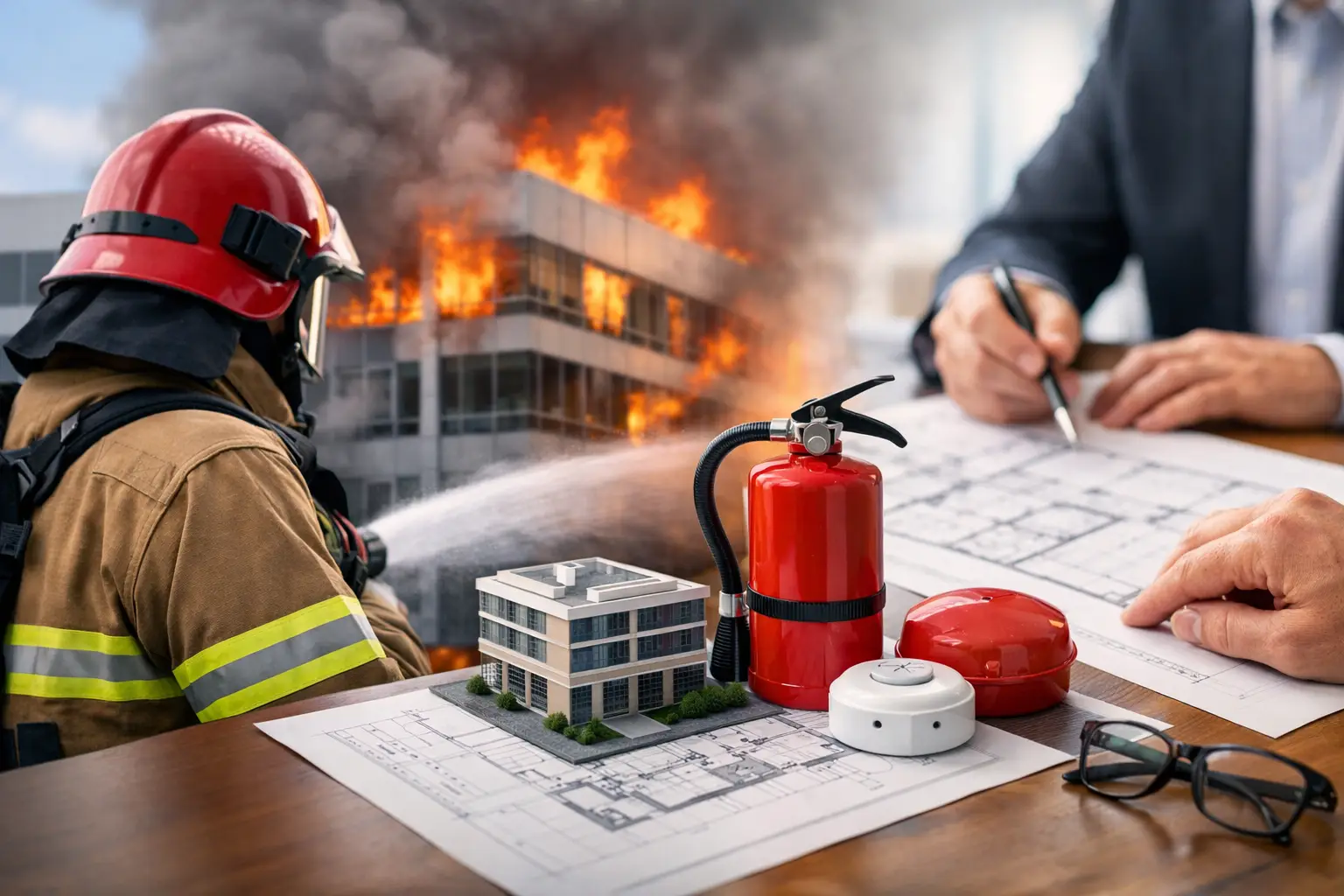
A commercial building fire strategy is not a document you produce at the end of design to satisfy a reviewer. It shapes the building from the start – how people escape, how smoke is controlled, how compartments are formed, how systems interact, and how the asset can be occupied without creating hidden compliance risk.
For owners, developers, architects, and facility teams, that distinction matters. A weak strategy often appears only when a project is already under pressure: an authority submission stalls, tenant fit-out conflicts with egress, a staircase is undersized, a fire-rated wall is interrupted by MEP routing, or an older building no longer matches current use. At that point, changes are slower and more expensive. A coordinated fire strategy prevents those issues from becoming redesign, delay, or rectification problems.
What a commercial building fire strategy actually covers
At its core, a fire strategy sets out how the building will protect life, support fire service intervention, and limit fire spread. That sounds straightforward, but in practice it requires coordination across architecture, structure, mechanical and electrical systems, occupancy planning, and statutory requirements.
The strategy typically addresses means of egress, travel distance, occupant load, exit width, fire compartmentation, fire resistance ratings, smoke control, fire detection and alarm systems, sprinkler protection, hose reel and hydrant provisions, emergency lighting, signage, access for firefighting, and the interface between active and passive fire protection. It also needs to reflect the actual building use, not just a generic building type.
An office floor, a retail podium, a data room, a commercial kitchen, and a warehouse can sit within the same development, but they do not present the same fire load, evacuation behavior, or system demands. That is why a strategy built from standard assumptions often fails once the project moves into detailed design or tenant occupation.
Why commercial building fire strategy should start early
Fire strategy decisions influence more than code diagrams. They affect net leasable area, façade design, core planning, shaft allocation, plant space, and the commercial viability of a scheme. If these issues are left too late, the project team ends up forcing compliance into a layout that was never planned to accommodate it.
Consider exit stair placement. If the stairs are too close together, too remote from occupiable areas, or constrained by structural and leasing priorities, the whole circulation logic may need revision. The same applies to fire command spaces, smoke exhaust routing, fire-rated lobbies, and refuge areas. These are not cosmetic adjustments.
Early coordination also improves submission efficiency. When the fire strategy is aligned with architectural intent, MEP design, and authority requirements from the beginning, the approval path is usually clearer. When each discipline develops its package in isolation, inconsistencies surface during review, and the project absorbs the time cost.
The key elements that determine whether the strategy works
Occupancy and use profile
The starting point is always the actual use of the premises. A building described broadly as commercial may include assembly areas, back-of-house storage, high-density workplaces, food and beverage spaces, or mixed-use interfaces with residential or industrial components. Each condition can change egress demand, system coverage, and separation requirements.
This is where assumptions can become expensive. A floor planned as standard office use may later be marketed to an education tenant or medical operator. If the original strategy did not account for that flexibility, the building may need substantial upgrades to support the new occupancy.
Means of egress
Egress is usually the most visible part of the fire strategy, but it is also one of the most frequently compromised during design development. Occupant load calculations, travel distances, dead-end limits, door swing, discharge arrangements, and stair capacity need to be resolved as an integrated system.
A plan can appear compliant on paper while still performing poorly in practice. For example, circulation routes that rely on tenant-controlled areas, lobbies that become clutter points, or stairs that discharge into operational conflicts may technically fit a drawing but create management and safety issues once the building is occupied.
Passive fire protection
Compartmentation remains fundamental. Fire-rated walls, floors, doors, shafts, dampers, and penetration seals are what prevent local fire events from becoming building-wide failures. Yet passive protection is often weakened by late-stage service coordination, renovation works, or poor site control.
In many commercial projects, the design intent is sound but the installation quality is inconsistent. A strong strategy therefore needs more than rating schedules. It should anticipate inspection points, detail interfaces clearly, and support verification during construction and fit-out.
Active fire systems
Detection, alarm, sprinklers, smoke management, and firefighting systems must be selected and coordinated based on the building configuration and risk profile. Oversimplifying this layer creates performance gaps. Overcomplicating it can create cost and maintenance burdens without a proportional safety benefit.
It depends on the building. A high-rise office tower, an atrium mall, and a low-rise business park do not require the same smoke control approach. The right design balances code compliance, maintainability, space impact, and operational resilience.
Where projects commonly go wrong
One common problem is treating fire strategy as a standalone submission rather than a live design framework. Once the report is issued, teams move on, and later architectural revisions, MEP rerouting, tenancy changes, or value engineering decisions are made without checking whether they affect the original basis of compliance.
Another issue is underestimating change of use. Existing commercial buildings are often repositioned to improve yield or adapt to market demand. That can alter occupant density, fire load, or required system performance. If the fire strategy is not reassessed, the building may operate in a condition that no longer aligns with its approved design basis.
A third issue is poor construction-stage control. Fire stopping omitted above ceilings, unprotected structural elements, noncompliant door hardware, and undocumented field changes are all capable of undermining an otherwise well-developed strategy. Compliance is not achieved by design alone. It depends on execution, inspection, and final verification.
Fire strategy in existing commercial buildings
Existing assets present a different challenge from new developments. The question is rarely whether the current layout is ideal. The real question is whether the building can safely and lawfully support its present use, planned upgrades, or leasing strategy without disproportionate disruption.
That requires a realistic review of existing drawings, prior approvals, on-site conditions, fire protection systems, and any legacy deviations. Older buildings often carry undocumented alterations, tenant works, or aging systems that complicate compliance. In these cases, the fire strategy becomes a decision tool. It helps owners understand what must be rectified immediately, what can be phased, and what constraints affect future redevelopment or fit-out.
For asset managers, this has direct commercial value. Clear fire strategy advice reduces the chance of leasing promises that the building cannot support and helps avoid reactive rectification after authority comments or inspection findings.
The role of statutory coordination
A fire strategy only becomes useful when it can stand up within the relevant approval framework. That means the technical rationale, drawings, system design, and supporting documentation must align with statutory expectations and with the broader consultant package.
This is where multidisciplinary coordination matters. Fire safety cannot be separated cleanly from architecture, structure, façades, MEP systems, and authority submissions. A consultant that understands both technical design and approval workflows is better positioned to identify submission risks early, resolve conflicting requirements, and support rectification when existing conditions fall short. For clients managing schedule and compliance exposure, that coordination is often the difference between a smooth approval process and repeated revisions.
How to assess whether your building needs a fire strategy review
If a project is new, undergoing renovation, changing use, adding tenants with higher-risk operations, or facing submission delays tied to fire safety comments, a review is usually justified. The same applies if the building has recurring deficiencies in inspections, unclear compartmentation, undocumented alterations, or uncertainty around whether current systems still match actual occupancy.
Even when there is no immediate enforcement issue, an early review can prevent avoidable cost. It is less expensive to test assumptions during planning than to rebuild stairs, reroute ductwork, or reopen completed finishes because passive protection was not coordinated.
A well-prepared commercial building fire strategy gives the project team a workable basis for design, approvals, construction, and operations. More importantly, it reduces guesswork. In a commercial asset, that means fewer delays, fewer surprises during review, and a safer building that performs as intended when it matters most.
If you are planning works or reassessing an existing asset, the most practical next step is not to ask whether a report is required. It is to ask whether the building’s current design, use, and systems still support a coherent fire strategy today.