
Temporary Works PE Endorsement for Site Hoardings Fees (Singapore Commercial Projects Cost Guide)
Introduction
If you’re budgeting for a commercial construction or renovation project in Singapore, understanding temporary works PE endorsement for site hoardings fees in Singapore is essential before mobilising on site. This cost guide breaks down what you can realistically expect to pay for professional engineer endorsement of hoarding designs on commercial projects-shopping malls, office towers, business parks, and integrated developments-in 2026.
PE endorsement fees range from S$250 to S$2,500 across all temporary works categories in Singapore. In the context of pe endorsement in singapore, this fee covers a licensed, PEB-registered Professional Engineer’s formal review and certification that hoarding plans meet applicable safety standards, statutory codes, and authority requirements. For site hoardings specifically, temporary works endorsement costs between S$500 and S$1,200 for straightforward configurations, while complex commercial projects can exceed S$2,500 for endorsement when multiple authorities, unusual ground conditions, or large-scale frontages are involved. The cost for temporary works like hoarding endorsements is not regulated and varies commercially, so having clear benchmarks is critical for decision makers preparing tender budgets.
This guide is written for main contractors, project managers, quantity surveyors, facility owners, and developers who need PE-endorsed hoarding designs for commercial works. The scope covers civil and structural PE endorsement for temporary hoardings and related protective barriers. It does not extend to full earth retaining systems (ERSS) design, permanent façade engineering, excavation support, or jurisdictions outside Singapore.
By reading this guide, you will:
- Understand the technical and regulatory cost drivers behind PE endorsement fees for site hoardings
- Know the typical fee brackets for different hoarding scenarios on commercial sites
- Learn what documents and information to prepare for a faster, lower cost quote
- Recognise common challenges that lead to scope creep and avoidable extra fees
- See how AMAN Engineering Consultancy can streamline endorsement, BIM modelling, and multi-authority structural submissions under one engagement
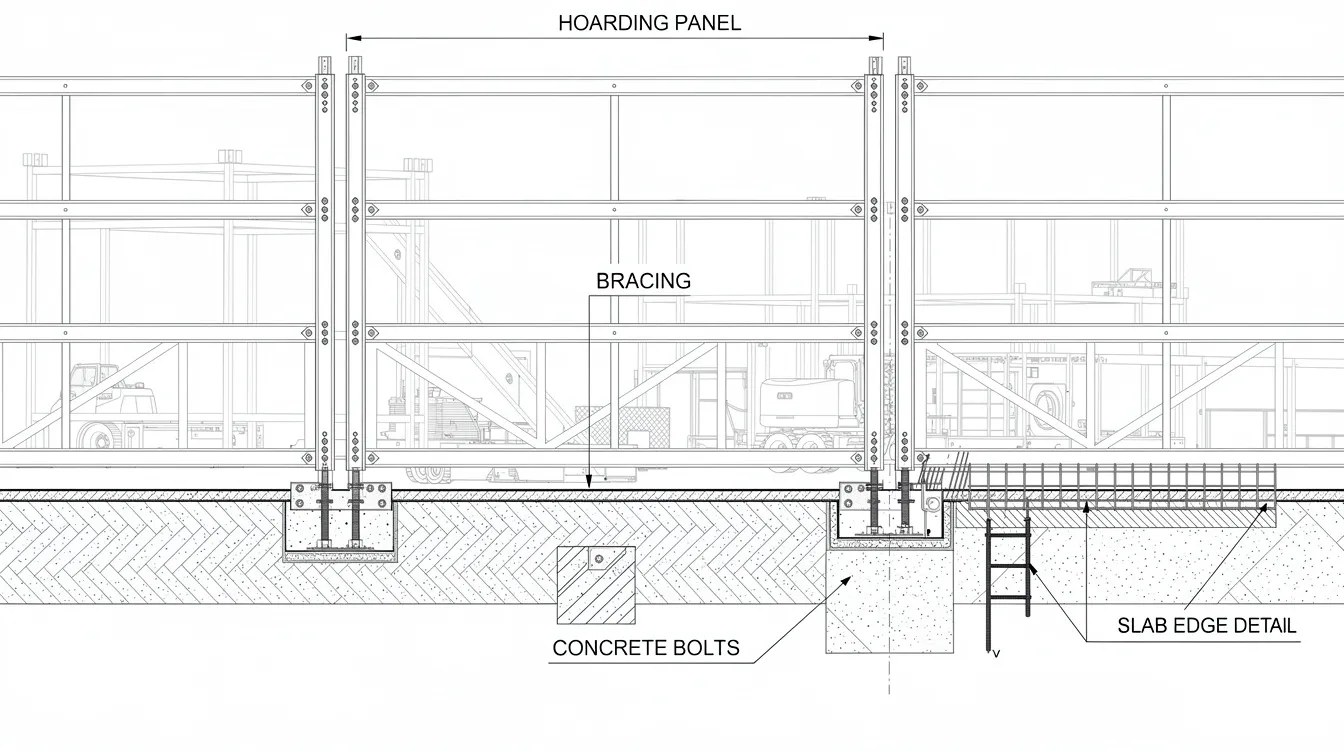
Throughout this article, example photos and diagrams illustrate compliant hoardings on commercial sites, sample cross-sections, and typical bracing details to give site teams a visual reference alongside the cost data.
Understanding Temporary Works PE Endorsement for Site Hoardings
A PE endorsement for site hoardings means that a licensed professional engineer registered with the Professional Engineers Board reviews, verifies, and legally signs off on the structural design, calculations, and method statements for a temporary hoarding, and may act as the appointed qualified person where the submission route requires it. The engineer confirms that the hoarding meets all applicable codes-covering stability under wind loads, dead loads from signage or lighting, foundation or slab bearing capacity, and compliance with authority and landlord requirements. PEs bear legal responsibility for endorsed engineering works, which is why the endorsement carries professional fees rather than being a rubber-stamp exercise.
Hoardings themselves are temporary structures erected to separate construction activities from the public, neighbouring tenants, or adjacent properties. On commercial projects in Singapore, they appear in several configurations: external perimeter hoardings along streets, internal mall hoardings around shopfront renovations, glass façade protection panels, and traffic-side barriers along LTA-managed roads. Professional Engineer (PE) endorsements for site hoardings are required by building authorities in Singapore wherever these structures pose a risk to public safety or structural elements of the host building, with the structural submission typically tied to the role of the qualified person.
Authorities and landlords insist on PE endorsement because hoardings that fail-through instability, inadequate member capacity, weak connections, or other modes of structural failure-can collapse in wind, overload a basement slab, or block fire escape routes, creating serious safety and liability consequences. Compliance with the Building Control Act, MOM’s Workplace Safety and Health (Construction) Regulations, SCDF fire safety codes, and landlord-specific technical handbooks all hinge on proper engineering sign-off.
What Counts as a “Site Hoarding” on Commercial Projects?
Not all hoardings are alike, and the project type directly affects endorsement scope and fees. The main categories encountered on Singapore commercial developments are:
- External perimeter hoarding: Erected along public footpaths, roads, or building frontages. Typically 2.4 m to 3.6 m high, constructed from timber frames, steel posts, or proprietary modular panels. These carry the highest wind exposure and often require LTA or BCA review.
- Internal mall hoarding: Installed around shopfront openings during retail fit-out or A&A works inside shopping centres. Usually 2.4 m high, timber-framed, and anchored to the floor slab. Materials must meet SCDF Fire Code 2023 requirements for non-combustibility when inside existing buildings.
- Glass façade protection hoarding: Used where works occur near curtain walls or atrium glazing. Requires careful detailing to avoid loading glass mullions or structural elements they were not designed for.
- Traffic-side hoarding along LTA roads: Hoardings adjacent to bus stops, taxi stands, or public highways managed by LTA. These trigger additional permit and traffic management plan requirements.
Heights typically range from 2.4 m (standard internal) to 3.0 m (external pedestrian frontage) and 3.6 m or more (high-exposure road frontage or where catch platforms are needed). Materials span timber boarding, steel framing, and proprietary modular systems-each with different weight, durability, and anchoring demands.
Each configuration may require separate PE checks. A project with both an external road-frontage hoarding and an internal corridor hoarding could need two distinct sets of calculations and endorsements, which influences total fees.
Regulatory Context: When Professional Engineers Board PE Endorsement Is Required for Hoardings
Several Singapore regulatory frameworks converge on hoarding design. In non-legal terms, the key ones are:
- Building Control Regulations (BCA): Require protective hoardings before building works commence, particularly where sites adjoin public roads or footpaths. PE endorsements must comply with the Building Control Act, and BCA guidelines set minimum heights, material standards, and structural stability requirements.
- MOM Workplace Safety and Health (Construction) Regulations 2007: Mandate that any supporting or protective structure-including hoardings that bear structural loads-must be safely designed and, where necessary, endorsed by a PE. Endorsements are mandatory for hoardings and scaffolding under these regulations.
- SCDF Fire Code 2023: Specifies non-combustible materials for hoardings inside existing buildings during A&A works, requires escape routes of at least 1.2 m width to be maintained, and mandates that external hoardings do not block pedestrian footpaths or emergency access.
- Landlord / MCST requirements: Most commercial landlords contractually require PE-stamped hoarding drawings regardless of whether BCA or MOM explicitly mandates it. Each landlord often has a technical handbook dictating colours, finishes, signage placement, emergency egress rules, and construction hours.
Common triggers for PE endorsement include: hoarding above 2.4 m in height, hoarding along public roads or footpaths, hoarding near MRT structures or utility services, hoardings supporting signage or lighting loads, hoardings on soft ground or filled soil, and hoardings intended for long durations that expose them to weather and fatigue. Temporary works PE endorsement is required for higher-risk structures in most cases.
More regulatory touchpoints and special conditions mean more PE time-and therefore higher fees. A simple internal mall hoarding with only landlord approval is fundamentally different in endorsement effort from a 60 m road-frontage hoarding requiring BCA permit review, LTA traffic management liaison, and SCDF fire safety compliance.
How PE Endorsement Fits into the Overall Temporary Works Process
The typical temporary works design and endorsement process for site hoardings follows a logical sequence:
- The contractor or designer proposes a hoarding scheme (layout, height, material, anchoring).
- The PE reviews-or designs from first principles-the structural arrangement, performing calculations for wind loads, dead loads, crowd loads, and slab/ground bearing.
- PE-endorsed drawings, calculations, and method statements are issued with the engineer’s stamp and signature.
- Endorsed documents are submitted to the relevant authorities or landlord for approval.
- Construction proceeds according to the endorsed details.
- If the hoarding layout changes during the project, modifications to temporary works require re-assessment before use-potentially triggering re-endorsement.
Endorsements must state loading limits and configuration constraints, so the process covers far more than affixing a stamp. Each step involves professional time, legal responsibility, and technical liability. Because each of these phases scales with project complexity, endorsement fees vary accordingly by scope and risk-which the next section unpacks with specific numbers.
Typical PE Endorsement Fees and Fee Ranges for Temporary Works of Site Hoardings
With the regulatory and technical context established, the question most contractors and QS professionals need answered is: how much will it actually cost? In 2026, PE endorsement fees for commercial site hoardings in Singapore fall within a predictable range once scope details are clear. All figures below are indicative Singapore dollar amounts for the commercial building segment. Fees for PE endorsements depend on the scope of work and complexity of the design, so an actual fixed fee quote is determined after reviewing project-specific drawings and site constraints-AMAN Engineering Consultancy typically provides this within one working day.
Indicative Fee Brackets by Hoarding Scenario
The following table summarises typical PE endorsement cost brackets across common commercial hoarding scenarios:
| Hoarding Scenario | Typical Specifications | Indicative Fee Range | Key Assumptions |
|---|---|---|---|
| Small internal mall hoarding | <15 m length, ≤2.4 m high, standard timber frame, slab-supported | S$600–S$1,000 | No external authority submission; landlord approval only; standard details available |
| Medium commercial frontage | 20–60 m long, up to 3.0 m high, slab-on-grade, simple layout with minor signage | S$1,000–S$1,800 | One authority or landlord review; basic wind load; existing drawings provided |
| Large external hoarding (public road / high pedestrian traffic) | >60 m, complex corners, signage loads, possible LTA/BCA review | S$1,800–S$3,000+ | Multiple authority submissions; LTA traffic management plan support; site visit included |
| Complex / unique cases | Hoarding on basement slab with limited capacity, near MRT structures, integrated overhead protection, façade anchoring | S$3,000+ (project-specific) | Specialist structural assessment; multiple stakeholder coordination; potential site investigations |
A standard hoarding design typically incurs lower PE endorsement costs than complex structures. PE endorsement fees vary based on height, design complexity, and submission requirements-so a 2.4 m internal corridor hoarding and a 3.6 m road-side hoarding with illuminated signage sit in very different brackets even though both are “hoardings.”
Re-endorsement due to major design changes is typically charged separately. Minor tweaks-such as small adjustments to door positions or minor bracing modifications-are often bundled within the initial agreement, but substantial layout or height changes are treated as variations.
What’s Usually Included in the Quoted Fee
A typical fixed fee quote for PE endorsement of site hoardings covers:
- Design review or design from first principles (structural calculations for wind, dead, and imposed loads)
- Endorsement of the general arrangement (GA) plan and key structural details
- Safety assessments and compliance verification against applicable codes
- One round of comments and minor revisions
- Electronic PE stamp and signed PDF for submissions
The table below contrasts what’s typically included in a basic versus enhanced support package:
| Item | Basic PE Endorsement Package | Enhanced Support Package |
|---|---|---|
| Structural calculations & endorsement | ✓ | ✓ |
| GA plan + detail endorsement | ✓ | ✓ |
| Rounds of revisions included | 1 | 2–3 |
| Physical site visits | Not included | 1–2 visits included |
| Authority/landlord liaison | Not included | Included (BCA, LTA, or landlord) |
| Expedited turnaround time | Standard (3–7 working days) | Priority processing (48–72 hours) |
| Method statement endorsement | Basic | Detailed, with erection/dismantling sequence |
Site inspections may be required for PE endorsements depending on project complexity; when needed, each visit typically adds S$300–S$600 depending on location and access conditions. Additional costs may arise for complex site inspections or coordination with multiple authorities, especially where more project resources are needed to compare budgets, likely visit scope, and coordination timelines accurately. Authority submission services are necessary for compliance with MOM and BCA regulations in Singapore, and these are usually priced as separate line items if not covered in the enhanced package.
2026 Market Snapshot: How Our Fees Compare
Across the Singapore market in 2025–2026, PE endorsement fees for temporary works including hoardings have become more transparent as several firms now publish indicative ranges. Endorsement fees range from S$250 to S$2,500 in Singapore across all PE endorsement categories, with hoarding-specific endorsements typically starting from S$500 for the simplest scopes. BCA Stage 2 submission costs S$1,500–4,000 when full structural submissions are required beyond the hoarding endorsement itself.
AMAN Engineering Consultancy positions in the mid-range, offering competitive pricing paired with higher responsiveness, multi-authority capability, and BIM integration. Unlike firms that handle only the endorsement stamp, AMAN covers wider consultancy beyond hoardings-including temporary works design for ERSS, platforms, scaffolding, plus BCA structural submissions and BIM modelling-which can deliver cost savings when bundling scopes under one engagement.
The same PE handling multiple temporary works elements on a project also ensures design consistency and reduces coordination gaps. But similar hoarding height and length can still carry very different fees due to underlying complexity and risk-the next section unpacks exactly what drives those differences.
What Drives the Cost of PE Endorsement for Site Hoardings?
Fee differences between hoarding endorsement quotes are not arbitrary. They result from clear technical and administrative factors that you can anticipate and, in many cases, control. Understanding these drivers helps QS professionals and project managers budget more accurately and avoid variation orders later in the construction phase.
Technical Complexity and Risk Level
The PE’s quotation typically accounts for structural design and compliance with local codes, and the engineering effort scales directly with:
- Height and frame type: A 2.4 m timber hoarding in a sheltered corridor requires far less calculation than a 3.6 m steel-framed hoarding exposed to open wind. Taller hoardings generate higher wind moments, need stiffer bracing, and may require anchoring to existing structural elements—with the PE also checking possible failure modes such as instability or inadequate anchorage—each adding to design time.
- Signage and lighting loads: Hoardings carrying large branding panels, LED displays, or mounted lighting introduce additional lateral and gravitational loads that must be explicitly calculated. This is a common source of underestimation on retail projects.
- Ground and support conditions: Hoarding on a solid reinforced concrete slab is straightforward to verify. Hoarding on pavers over sand, landscaped soil, planter boxes, or a basement slab with limited load capacity requires different-and more time-consuming-stability and bearing checks. Unknown ground conditions may necessitate site investigation, and stability can also be affected by drainage, nearby excavation, vibration, and other factors, which increases cost.
- Interface with existing structures: Where hoardings anchor to façade mullions, post-installed anchors into RC columns, or brace against glass panels, careful detailing and sometimes coordination with the façade PE are required, raising fees further.
Regulatory and Stakeholder Requirements
Each additional stakeholder in the approval process increases the endorsement cost:
- BCA, MOM, LTA: Separate endorsements are needed for each regulatory authority when multiple agencies have jurisdiction-for example, a hoarding along an LTA-managed road that also requires a BCA temporary building permit.
- Landlord / MCST: Major commercial landlords often maintain detailed technical handbooks specifying hoarding colours, heights, fire resistance ratings, emergency egress clearances, and construction hour restrictions. Compliance checking against these standards takes time.
- Adjacent property owners: Where hoardings are close to neighbouring lots, additional coordination or protective measures may be required.
- Traffic management plans: Hoardings affecting public walkways or vehicular lanes often need traffic diversion plans, pedestrian channelling details, and supporting documents-all of which add to the scope of PE work.
Documentation Quality and BIM/Drawings Availability
The quality of information you provide has a direct, measurable impact on PE endorsement cost:
- Well-prepared BIM / CAD files (Revit, Tekla, or clean DWG drawings with accurate dimensions, slab details, and site constraints) can reduce PE time by 20–40%, translating directly to lower fees.
- Incomplete documentation-hand-sketched layouts, PDFs without dimensions, missing as-built structural drawings-forces additional clarifications, site measurements, and design assumptions that consume engineering hours.
- AMAN can assist with BIM and 3D modelling of hoardings when needed. While this is an additional cost item, it often reduces risks and speeds landlord approval, particularly on projects with complicated slab edges or multiple services at the hoarding line.
Programme Constraints and Turnaround Time
Turnaround time for PE endorsements is usually 2 to 3 working days after submission for straightforward scopes, with temporary works endorsements typically taking 3–7 working days for more involved commercial projects. These timelines assume complete information is provided upfront.
Compressed timelines-such as mobilisation within 48 hours-attract a premium of roughly 20–40% because of after-hours work, resequencing of other commitments, and the heightened risk of errors under time pressure. Fast turnaround is available, but it comes at a cost. Earlier engagement with a PE firm like AMAN typically avoids rush fees entirely.
Scope Breadth: Hoardings Only vs Bundled Temporary Works
On large commercial fit-out or A&A projects, hoarding endorsement is rarely the only temporary works requirement. Platforms, staircases, scaffolding, protection decks, and sometimes earth retaining systems all need PE sign-off.
Bundling these scopes under a single commission-using the same PE-can be 10–20% more economical than engaging separate, fragmented endorsements. The PE already understands the site, the slab capacities, and the landlord’s requirements, which reduces duplicated effort and helps keep site operations better coordinated through design reviews, sequencing, and delivery. This is one of the most effective turnaround strategies for reducing overall temporary works expenditure on multi-phase commercial projects.
Once you understand what drives fees, the logical next step is knowing how to get an accurate, transparent quote without surprises.
Step‑by‑Step: How to Obtain a PE-Endorsed Hoarding Design (and Fee Quote)
Following a structured turnaround process when engaging a PE keeps fees at the lower end of the ranges discussed above, supports recovery by avoiding delays and cost overruns, and avoids the delays that lead to scope creep or rush premiums. Below is the standard process AMAN uses with commercial clients to scope, price, and deliver hoarding endorsements.
Information You Should Prepare Before Contacting a PE
The first step toward an efficient engagement-and a lower cost outcome-is assembling a complete information pack. Use this checklist:
- Location plan showing the proposed hoarding alignment relative to the building, roads, footpaths, and adjacent properties
- Typical cross-section and elevation with intended height, material, and bracing arrangement
- Material/system specification (timber, steel, proprietary modular panels)
- Intended duration of use (weeks, months)
- Site photographs showing ground conditions, existing structures, and access points
- Ground/slab information: slab thickness, structural drawings, or at minimum the building type and age
- Landlord/MCST technical guidelines or construction handbook (if applicable)
- Known authority constraints (e.g. proximity to bus stops, MRT entries, LTA-managed roads)
- Signage/lighting requirements (dimensions, weight, mounting method)
- Any existing BIM models or CAD files (PDF, DWG, or RVT format)
Providing this information upfront is the single most effective way to receive an accurate fixed fee quote quickly and avoid subsequent variations.
Typical Workflow AMAN Follows
AMAN’s PE endorsement workflow for commercial site hoardings follows these steps:
- Initial enquiry: You submit your scope description, drawings, and site photos via email or your preferred channel.
- Clarification call: AMAN identifies the authorities and landlords involved, confirms hoarding specifications, and flags any missing information.
- Fee proposal: A fixed fee quote is issued-typically within 1 working day-covering the agreed scope, number of revisions, and delivery date.
- Design and calculations: Upon confirmation, AMAN performs detailed structural calculations, wind load analysis, and bearing checks, then prepares or reviews the hoarding drawings.
- PE-endorsed documents issued: Stamped and signed drawings, calculations, and method statements are delivered in PDF (and hard copy if required).
- Post-endorsement support: AMAN handles authority or landlord queries, processes minor revisions within the agreed scope, and advises on any site adjustments.
This process applies whether the hoarding is a 10 m shopfront panel or a 100 m road-frontage installation. The key variable is the depth of steps 4 and 6-which is why the upfront information quality matters so much.
Suggested Cost-Control Practices During the Process
Based on lessons learned across numerous commercial hoarding endorsements, these practices consistently lead to better cost outcomes:
- Agree upfront in writing: Number of drawing revisions included, whether site visits are covered or billed separately, handling of design changes after construction starts, and authority submission responsibilities.
- Track costs simply: Maintain a spreadsheet recording the initial fee quote, any approved variations, and key milestones (design issued, comments received, revisions complete). This prevents disputes and gives management clear visibility, with success measured through better visibility over endorsement spend and approvals.
- Coordinate early with landlord: Circulate the proposed hoarding layout to the landlord or MCST before PE endorsement begins. Getting landlord buy-in on alignment, height, and finishes before engineering starts avoids a full redesign cycle later and reduces the need for restructuring the hoarding design—one of the most common sources of extra fees.
- Lock the hoarding layout: Freeze the hoarding line, height, and opening positions at least 5–7 working days before the targeted endorsement delivery date. Late changes after endorsement almost always require re-assessment and re-endorsement.
Example Cost Scenarios for Commercial Hoardings
Scenario A: Internal Mall Shop Renovation A retail tenant within a suburban mall hoards its shopfront during fit-out works. Hoarding height 2.4 m, length 10 m, timber-framed panels, anchored to slab, no signage, sheltered from wind. All structural drawings available. Only landlord approval required. PE endorsement fee: approximately S$600–S$800. One round of minor revisions included. The client provided complete drawings upfront, keeping the fee at the lower end.
Scenario B: Office Tower Lobby Refurbishment An office building owner hoardes the ground-floor lobby during upgrading works. External frontage of 40 m along a busy pedestrian walkway, hoarding height 3.0 m, modular steel panels with store branding signage. Partial structural drawings available; one site visit needed to verify slab edge conditions. BCA awareness and landlord approval required. PE endorsement fee: approximately S$1,500–S$2,500. The client’s early coordination with the building management reduced revision cycles.
Scenario C: Business Park Perimeter Hoarding Near LTA Road — case study-style example A developer erects perimeter hoarding around a business park site adjacent to an LTA-managed road. Hoarding exceeds 3.6 m, with illuminated signage, anchoring to façade elements at one section, and uncertain ground conditions along the boundary. BCA, LTA, and landlord submissions required. Multiple revision cycles anticipated. PE endorsement fee: S$3,000–S$5,000+. The use of BIM modelling for the complex slab-edge interface added upfront cost but eliminated two rounds of authority rejection, making this one of the more successful turnarounds in cost and programme terms.

Common Challenges and How to Avoid Extra Fees
Many additional costs on hoarding endorsement projects are avoidable if common pitfalls are recognised early. The challenges below are drawn from AMAN’s experience with commercial sites across Singapore-malls, office towers, and integrated developments.
Last‑Minute Scope Changes on Site
The problem: The hoarding line shifts after a landlord walkabout, the height increases to accommodate new branding panels, or additional access openings are cut after construction has begun. These are among the most frequent causes of poor performance on project budgets for temporary works.
The impact: Major layout or load changes require recalculation and re-endorsement, which are billable variations. Modifications to temporary works require re-assessment before use-this is both a regulatory requirement and a practical necessity for safety.
The solution: Freeze the hoarding layout well before endorsement. Involve the landlord early to validate alignment, height, and opening positions. If changes are likely (for example, tenant mix is still being finalised), discuss contingency provisions with your PE upfront so that the design accommodates foreseeable adjustments without full re-engineering.
Inadequate Site Information and Hidden Ground Conditions
The problem: Unknown basement voids beneath pavers, planter boxes at the hoarding line, congested underground services, or weak slab edges can invalidate standard hoarding designs and trigger redesign, additional site inspections, and extra fees.
The solution: Conduct simple pre-checks before engaging the PE: trial pits at critical anchoring points, reviewing as-built structural drawings with the building’s facilities management team, and photographing ground conditions. AMAN can review existing structural drawings to flag risks early-a process that is significantly cheaper than redesigning after hoarding is partly erected.
Misalignment with Landlord / MCST Requirements
The problem: Each major commercial landlord in Singapore maintains a technical handbook for construction works, covering hoarding colours, heights, fire resistance, materials, emergency egress rules, signage placement, and sometimes even font sizes for project signage that site teams and employees must follow during installation. When PE-endorsed designs don’t align with these requirements, a full revision cycle is triggered.
The cost impact: One misalignment cycle typically adds 3–5 working days and can increase fees by 20–30% over the original quote.
The solution: Obtain and share the landlord’s hoarding guidelines and construction hoarding approval requirements with the PE before design starts. This simple step typically eliminates one complete redesign cycle and the associated extra fees.
Underestimating Approval Timelines
The problem: Assuming that BCA, MCST, or landlord approvals happen instantly leads to compressed engineering timelines. When the delivery date for site mobilisation is immovable, this forces urgent endorsement requests at premium rates.
The solution: Build realistic float into the construction programme. Standard PE endorsement takes 3–7 working days after receiving complete information. Authority reviews-especially where BCA permits, LTA traffic plans, or landlord design committee sign-offs are involved-can add another 5–14 days. Plan for this from the outset, and you’ll avoid the 20–40% premium that crisis-mode engagement attracts. This approach consistently leads to faster approvals overall because there’s time to get submissions right the first time.
Conclusion and Next Steps
Key takeaways: PE endorsement fees for site hoardings on commercial projects are driven by technical risk (height, loads, ground conditions), regulatory complexity (number of authorities and landlord requirements), documentation quality, and programme constraints. With proper planning and information preparation, these fees are predictable and controllable.
For most commercial hoarding endorsements in 2026, expect to pay between S$600 and S$3,000, with complex multi-authority projects scaling upward from S$3,000. Proper endorsement is not optional where public safety is involved-it is a regulatory and contractual requirement that protects your project, your company, and the public.
Your actionable next steps:
- Assemble your information pack using the checklist in this guide (drawings, photos, landlord guidelines, ground/slab data)
- Map out all stakeholders who will review or approve the hoarding design (BCA, LTA, MOM, landlord, MCST, adjacent owners)
- Request an itemised quote that clearly separates base endorsement, site visits, authority submissions, and revision allowances
- Evaluate bundling opportunities with other temporary works (platforms, scaffolding, protection decks) for 10–20% cost improvement and growth in project efficiency
AMAN Engineering Consultancy supports commercial clients across the full spectrum of PE endorsement for civil and structural works-from hoarding endorsements and temporary works design to BIM modelling, multi-authority submissions, and integration with broader structural consultancy. Whether you need a single shopfront hoarding endorsed or a comprehensive temporary works package for a major development, AMAN’s team responds within 1 working day with a clear fee proposal.
Contact AMAN Engineering Consultancy with your hoarding drawings and site photos to receive a project-specific cost assessment. Attach PDF, DWG, or RVT files for the fastest turnaround.
Frequently Asked Questions on Temporary Works PE Endorsement for Site Hoardings Fees
These common questions address the cost-focused queries that commercial contractors and building owners ask most often about PE endorsement for hoardings.
How much does PE endorsement for a typical mall hoarding cost in 2026?
For a standard internal mall hoarding (10–20 m length, 2.4 m high, timber-framed, slab-supported), expect S$600–S$1,500 depending on size and project complexity. This typically includes structural calculations, safety assessments, GA plan endorsement, and one round of revisions. Costs at the lower end assume standard details, no unusual ground conditions, and no authority submissions beyond landlord approval. HDB non-load-bearing wall removal endorsement costs S$250–500 by comparison, illustrating how scope drives fees even within the same PE service category.
Is PE endorsement always required for internal hoardings inside commercial buildings?
PE endorsement is effectively mandatory when the landlord or MCST contractually requires it-which is the case for most major commercial properties in Singapore. It is also required when the hoarding is structurally complex (e.g. tall, load-bearing, or near fire escape routes) or carries public safety implications. Even where regulations don’t explicitly mandate it, endorsement is strongly recommended as it provides legal protection and insurance coverage. AMAN can quickly advise when PE endorsement is needed based on your location and scope, usually without charge at the enquiry stage.
Do I pay separately for each revision of the hoarding drawings?
Common practice is for 1–2 minor revisions to be included in the base fee. Substantial changes-such as shifting the hoarding line, altering the height, adding new openings, or changing signage loads-are treated as variations and billed separately because they require recalculation and re-endorsement. To avoid disputes, confirm the revision policy in writing with your PE before appointment, specifying what constitutes a “minor” versus “major” revision.
Can site hoarding endorsement be combined with other temporary works to save cost?
Yes. Bundling hoarding endorsement with other temporary works-such as internal platforms, temporary staircases, façade protection, or scaffolding-under one commission can achieve 10–20% savings compared to separate engagements. The same PE already understands the site conditions, slab capacities, and landlord requirements, eliminating duplication. AMAN frequently structures such combined packages for commercial A&A and fit-out projects, delivering profitability improvements for contractors managing multiple temporary works scopes.
How long does it take to get PE-endorsed hoarding drawings?
For straightforward commercial hoardings with complete information provided, expect 3–7 working days from submission to endorsed delivery. Turnaround time for PE endorsements is usually 2 to 3 working days after submission for the simplest scopes. Complex projects involving multiple authority submissions or unusual structural conditions may take 10–14 working days. Urgent service is available with a fee premium of 20–40%, subject to engineer availability and information completeness. Planning ahead remains the most reliable strategy for controlling both cost and speed.
What information do you need from us to issue a firm fee quote?
To issue an accurate fixed fee quote within 1 working day, AMAN needs:
- Location plan with proposed hoarding alignment
- Intended height, length, and material/system
- Site photographs showing ground conditions and surroundings
- Structural drawings or slab information (if available)
- Landlord or MCST technical guidelines
- Known authority requirements (BCA, LTA, MOM)
- Signage or lighting specifications (if applicable)
- Project programme and target delivery date
Share files in PDF, DWG, or RVT format via email or your preferred channel. The more complete your submission, the more accurate and competitive the quote-and the faster the overall process from enquiry to endorsed drawings on site.