
Introduction
Cathodic protection systems protect steel reinforcement in concrete from corrosion by shifting the steel to a cathodic state within an electrochemical cell. When comparing cathodic protection systems, the choice between impressed current cathodic protection (ICCP) and sacrificial anodes determines how protective current reaches the rebar, how long the system lasts, and how much ongoing intervention it requires. This article breaks down both approaches for reinforced concrete structures exposed to coastal and industrial conditions.
The focus here is preventing rebar degradation in marine and coastal concrete: piers, jetties, podium decks, coastal basements, industrial slabs, and car parks in Singapore and the broader ASEAN region. Both systems work. The question is which one fits a given structure’s exposure, size, and operational constraints.
Sacrificial anodes are passive, self-driven, and suited to small, well-coated areas with moderate chloride loads. ICCP systems use an external power source to deliver adjustable current output, and ICCP technology is therefore better suited to large or heavily contaminated structures where current demand rises over time.
This article covers reinforced concrete applications (not bare steel pipelines or systems for a ship’s hull or water heaters), including design considerations, lifecycle cost, compliance with standards such as ISO 12696:2022, and typical project workflows. Target readers include developers, asset owners, facility managers, and consultants responsible for coastal buildings, ports, waterfront developments, and car parks. Basic construction familiarity is assumed; corrosion science is explained from the ground up.
By the end of this article, you will understand:
-
How each CP system works at the electrochemical level in concrete
-
The pros and cons of each type in tropical coastal climates
-
When to choose ICCP over galvanic cathodic protection (and vice versa)
-
What a typical implementation and maintenance plan looks like
-
How to integrate CP with structural rehabilitation and authority submissions in Singapore
Understanding Cathodic Protection in Reinforced Concrete
Cathodic protection is a method that stops or slows steel reinforcement corrosion by making the rebar the cathode of an electrochemical cell. An anode (either a sacrificial metal or an externally powered inert electrode) supplies electrical current through the concrete pore solution to the steel surface, suppressing the anodic metal degradation reaction that causes rust and section loss.
CP is increasingly specified in Singapore and ASEAN coastal regions because the combination of high humidity, chloride-laden sea spray, polluted industrial atmospheres, and carbonation accelerates rebar corrosion faster than concrete cover alone can resist. Spalling, delamination, and structural safety concerns appear in podium decks and seafront structures within 10 to 15 years of construction in many cases.
CP complements concrete repair, coatings, and good detailing. It does not replace them. A structure with active corrosion needs both the damaged concrete repaired and a CP system installed to prevent corrosion from recurring in the repaired and adjacent areas.
Rebar Corrosion Mechanisms in Coastal and Industrial Environments
Chlorides from seawater, marine aerosols, and industrial processes penetrate concrete cover over time. Once chloride concentration at the rebar depth exceeds a threshold (often cited around 0.4% by weight of cement for ordinary Portland cement concrete), the passive oxide film on the steel surface breaks down, especially where the metal surface condition promotes corrosion initiation. The steel then acts as an active anode in the concrete pore solution, and corrosion begins.
Carbonation operates through a different pathway. CO₂ from the atmosphere and industrial pollutants reacts with calcium hydroxide in the concrete, reducing the pore solution pH from around 12.5 to below 9. At that pH, the passive film on rebar is no longer stable, and corrosion initiates even without chlorides present. In tropical climates with elevated temperatures and humidity, carbonation fronts advance faster than in temperate regions.
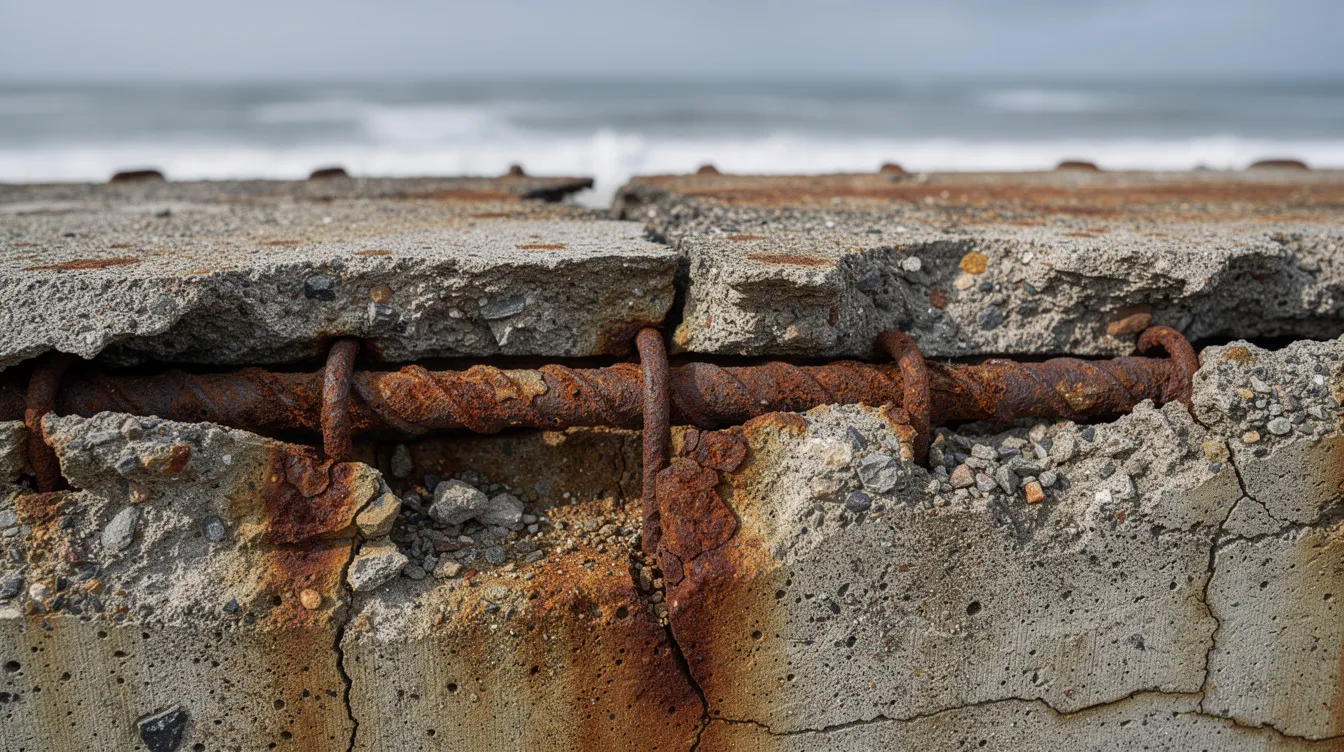
The symptoms are familiar to anyone who has inspected coastal structures in Singapore: rust staining on soffits, longitudinal cracking along rebar lines, delamination of cover concrete, and in severe cases, exposed rebar with measurable section loss. These problems are common on podium decks, seafront condominium balconies, coastal bridge abutments, and industrial facility slabs. A concrete spalling assessment is typically the first step in quantifying the damage before any protection strategy is selected.
Basic Principle of Cathodic Protection
Both ICCP and sacrificial anodes turn the protected metal into the cathode of an electrochemical cell. In ICCP, the steel reinforcement is connected to the negative terminal of the DC power source, while the anode (whether a zinc block or an MMO-coated titanium mesh) supports electron flow that suppresses the anodic reaction (iron dissolution) at the steel surface. The concrete pore solution serves as the electrolyte, completing the circuit.
In concrete CP, anodes are placed on or within the concrete to deliver protective current to the protected structure. The anode material, current flows, and driving voltage differ between the two primary methods, but the electrochemical objective is identical: keep the steel’s potential negative enough that corrosion current drops to negligible levels.
The next two sections explain how each system delivers that protection and where each one fits best.
Types of Cathodic Protection Systems for Reinforced Concrete
For reinforced concrete structures in coastal and industrial conditions, the two most relevant technologies are galvanic (sacrificial anode) CP and impressed current cathodic protection (ICCP). Hybrid systems that combine both approaches over a structure’s life cycle also exist; they are discussed briefly after the direct comparison.
Galvanic (Sacrificial Anode) Cathodic Protection
Sacrificial anode systems rely on natural electrochemical potentials for protection. Anodes made from active metals like zinc or aluminum alloys are embedded in or attached to the concrete, and galvanised steel elements with a zinc coating can also provide localized sacrificial protection at exposed steel interfaces. Because these metals have a lower (more negative) electrochemical potential than steel, the natural voltage difference between the dissimilar metals drives a direct current from the anode through the concrete pore solution to the rebar. The anode corrodes preferentially; the rebar is protected.
Sacrificial anodes corrode preferentially to protect the main structure from corrosion. The current output is self-regulating: it increases slightly when the steel surface is more active (lower resistivity, wetter concrete) and decreases in drier conditions. No external power is needed.
Typical sacrificial anode formats used in concrete include:
-
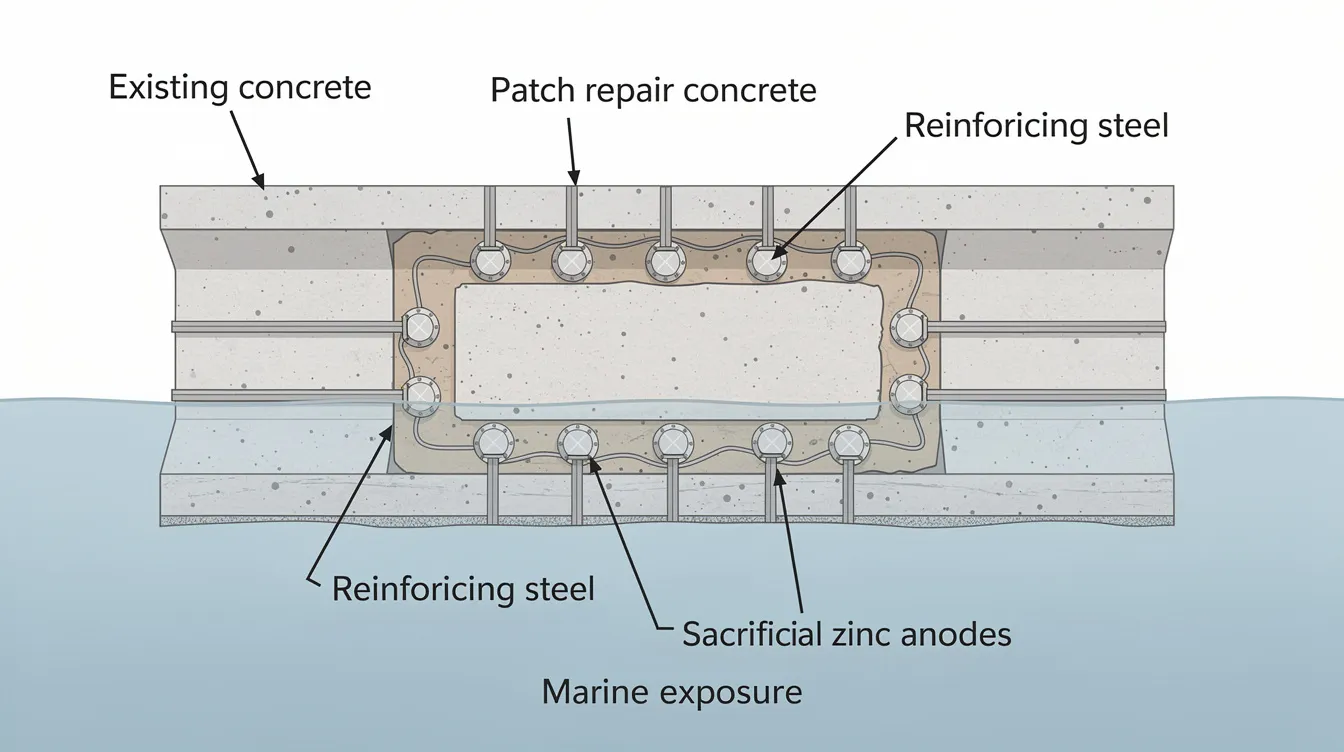
Discrete embedded anodes: zinc or zinc-alloy cylinders installed at patch repair boundaries to prevent incipient anode effects
-
Zinc mesh or strip systems: applied to soffits or surfaces, encased in cementitious overlay
-
Zinc-hydrogel jackets: wrapped around marine piles in splash and tidal zones
In Singapore, providers such as IET Pte Ltd design sacrificial anode CP systems using zinc galvanic anodes per BS EN ISO 12696:2022 and AMPP/NACE SP0216, with designs targeting approximately 10-year service life under local chloride conditions. Singapore infrastructure specifications typically exclude halide-activated anodes, so mortar-activated zinc anodes are standard.
Impressed Current Cathodic Protection (ICCP)
ICCP uses an external power source to prevent corrosion. A DC power source (transformer-rectifier) drives a regulated direct current from inert anodes through the concrete to the steel reinforcement. ICCP installation requires power cables and transformer-rectifiers, along with reference electrodes embedded at key locations for monitoring.
The main components of an ICCP system:
-
Anode system: ICCP systems use durable anodes like mixed metal oxide (MMO)-coated titanium mesh, ribbon, or discrete elements. Anodes in ICCP systems can be made from graphite or titanium as well, depending on the application. These inert anodes resist dissolution, giving them a long service life measured in decades rather than years.
-
Rectifier/power supply: converts AC mains to controlled DC; ICCP systems can deliver up to 50 amperes and 50 volts depending on the installation.
-
Reference electrodes: embedded silver/silver chloride or manganese dioxide cells that measure rebar potential for control and verification.
-
Wiring, junction boxes, and control systems: connect zones, route current, and enable remote monitoring and automatic regulation of output.
Unlike galvanic systems, ICCP provides adjustable current output for varying conditions. The rectifier can be tuned up as chloride levels increase over time or dialed down if conditions improve. This makes ICCP ideal for large, complex metal structures and reinforced concrete structures with severe chloride contamination where passive galvanic systems cannot supply sufficient current.
ICCP delivers higher protective current than galvanic systems, and that current can be directed precisely to different zones of a structure based on their individual current demand. The next section compares the two approaches directly across the criteria that matter most for coastal and industrial projects.
ICCP vs Sacrificial Anodes in Coastal and Industrial Concrete
For owners and designers, the decision is not whether to apply cathodic protection but which CP system fits the project’s risk profile, scale, and budget. Both systems aim to suppress the anodic corrosion reaction on metal structures. The differences are in current capacity, controllability, service life, cost trajectory, and operational complexity.
Technical Performance and Current Output
Galvanic cathodic protection provides a fixed current output governed by the anode material, the concrete’s resistivity, and the natural voltage difference between zinc (or aluminum alloys) and steel. In atmospherically exposed concrete with moderate chloride contamination, sacrificial anodes typically deliver 0.5 to 2 mA/m² of steel surface. That range is adequate for localised repair zones, columns, or well-coated areas where chloride concentrations sit at 5 to 10 times the depassivation threshold.
The protective current provided by sacrificial anodes is limited, making them impractical for very large structures. Sacrificial anode systems are limited by the natural potential difference and electrolyte resistance; once those parameters are fixed by the installation, the system has no mechanism to increase output.
ICCP systems deliver higher protective current. In heavily contaminated structures, required current densities can reach 5 mA/m² or more. A recent U.S. Department of Energy report documented demand of 5 mA/m², over twice the upper limit in ISO 12696 for some exposure classes. ICCP allows precise control over current output for protection; if chloride ingress deepens over the years, the rectifier output increases to match.
Consider a practical example: a 2,000 m² podium concrete slab in a tropical coastal climate with approximately 2% chloride by weight of cement. Initial current demand might be 1 to 3 mA/m². Sacrificial anodes could handle the lower end of that range if installed at adequate density. Over the following decade, as chlorides accumulate further, demand may climb above 5 mA/m² in deeper contamination zones. At that point, galvanic anodes cannot keep up. ICCP, sized with proper zoning and MMO anode capacity, can deliver the increased output without physical modification.
Design and Installation Complexity
Sacrificial anode systems are simpler to design and install. Discrete zinc anodes are typically placed during patch repair works: the contractor chisels out damaged concrete, installs the anode with a wire connection to rebar, and applies repair mortar. No rectifier room, no power cables, no complex zoning calculations. For localised concrete repairs on a beam soffit or column, this simplicity is a real advantage.
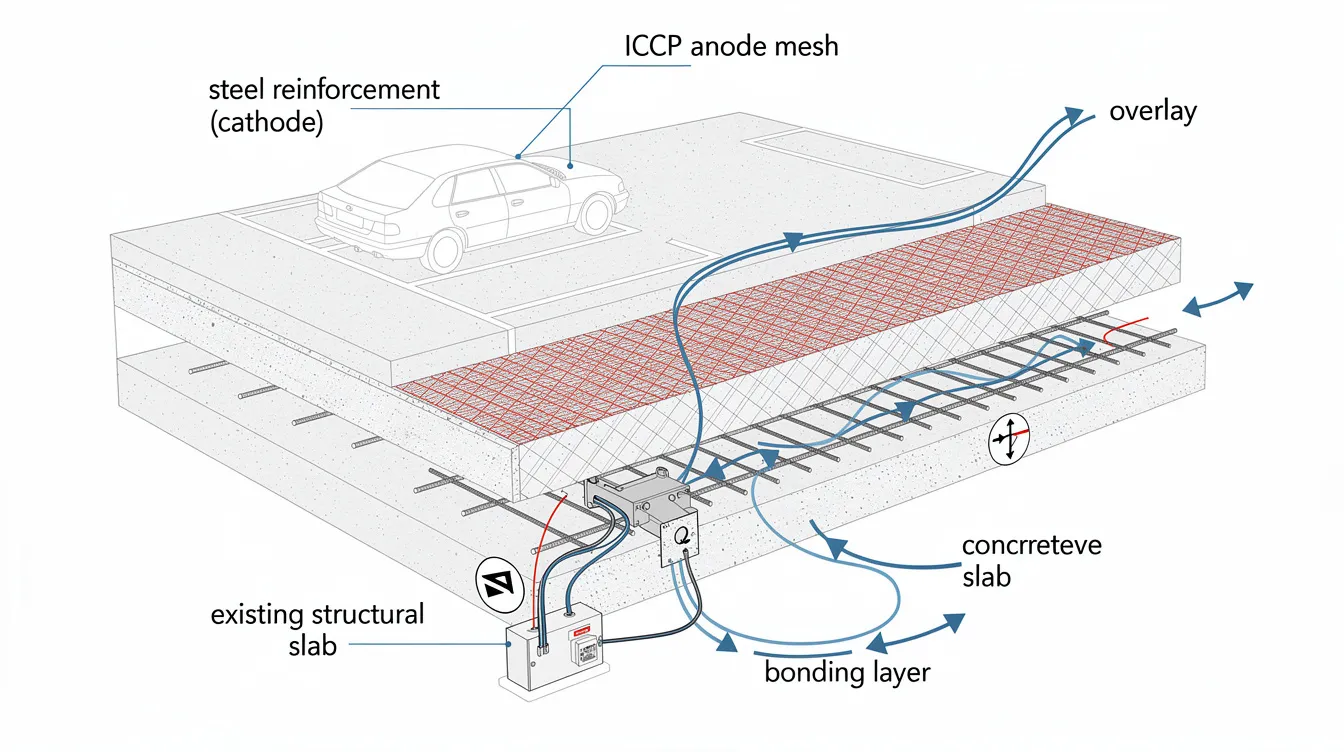
ICCP systems require more complex installation than SACP. The design process involves rebar continuity verification across the entire protected area, division of the structure into current zones, layout of anode mesh or ribbon in saw-cut chases or cementitious overlays, routing of cables to junction boxes, placement of reference electrodes, and installation of the rectifier panel with its power supply. For a coastal car park deck, this can mean several weeks of saw-cutting, cable laying, and overlay application.
In Singapore’s built environment, construction constraints shape CP selection. Live car parks cannot be shut down for months. Night-work windows are often limited to 4 to 6 hours. Architectural finishes on seafront buildings may restrict where anodes and cables can be routed. AMAN Engineering Consultancy integrates CP works with façade repair, structural strengthening, and BIM-based clash checks to resolve conflicts between anode routing, drainage details, fire safety penetrations, and waterproofing layers before work begins on site.
Monitoring, Control, and Risk Management
Sacrificial anode systems require minimal maintenance in the active sense. There is no rectifier to calibrate, no power supply to maintain. Monitoring consists of periodic potential surveys (half-cell mapping) and visual inspection of accessible anodes and concrete condition. The drawback: if conditions change and the system under-protects, there is no alarm, no automatic adjustment. The owner discovers the problem at the next scheduled survey, which may be years away.
ICCP provides continuous protection in highly corrosive environments because the rectifier runs continuously and reference electrodes provide real-time potential data. ICCP systems require regular calibration of the control unit and periodic checks of rectifier performance, cable integrity, and anode condition. ICCP maintenance involves monitoring rectifier performance and electrical checks. If protection drifts outside criteria (for example, less than 100 mV depolarisation over a 24-hour period per ISO 12696 clause 8.6), alarms trigger and the operator can adjust. Remote monitoring dashboards with IoT sensors are becoming standard in asset management contracts for marine structures and offshore platforms.
Mission-critical assets (aircraft aprons, petrochemical plant slabs, heavy-use car parks) often justify ICCP’s higher monitoring complexity because the cost of undetected corrosion failure exceeds the cost of running the CP system.
Cost, Lifecycle, and Sustainability
SACP has a low initial installation cost. Discrete zinc anodes embedded during patch repairs cost less per unit area than an ICCP overlay with its rectifier, cabling, and reference electrodes. For a small repair zone of 50 to 200 m², the savings are genuine and the simpler system makes economic sense.
ICCP has a high initial installation cost. The rectifier panel, inert anodes, wiring, reference electrodes, and monitoring infrastructure add up. But ICCP is often more economical for large structures long-term. Over a 30-year horizon on a 2,000 m² coastal podium deck, ICCP’s higher upfront investment is offset by the avoidance of multiple anode replacement cycles. SACP incurs higher long-term costs due to anode replacements; sacrificial anodes must be replaced periodically due to consumption, with Singapore SACP systems typically designed for 10-year cycles. Each replacement cycle involves access scaffolding, concrete breakout, new anode installation, and re-rendering, all of which carry labour, material, and disruption costs.
ICCP systems use durable anodes that last decades with proper design. Lerwick Pte Ltd rates their MMO/titanium ICCP anodes for 20 years in seawater environments. Over two or three SACP replacement cycles, ICCP’s per-square-metre cost drops below the cumulative SACP expenditure.
Sustainability is a practical consideration, not just a compliance checkbox. Fewer repair cycles mean less concrete demolition waste, less fresh material consumed, and less carbon emitted from repeated patch works. For structures where ensuring structural integrity in corrosive environments is already a priority, ICCP reduces the frequency and scale of invasive interventions.
Summary Comparison Table: ICCP vs Sacrificial Anodes
|
Criterion |
Sacrificial Anode CP (SACP) |
Impressed Current CP (ICCP) |
|---|---|---|
|
Typical use cases |
Localised patch repairs, columns, small beams, moderate chloride zones |
Large marine decks, jetties, wharves, industrial slabs, heavily contaminated structures |
|
Power requirement |
None; self-driven by galvanic potential of dissimilar metals |
Requires reliable DC power supply, rectifier, mains or backup |
|
Current adjustability |
Fixed current output governed by anode material and environment |
Adjustable current output via rectifier; responds to changing conditions |
|
Design complexity |
Simpler: discrete anodes, minimal wiring, fewer reference electrodes |
More complex: zoning, anode array layout, circuit design, rectifier sizing, control systems |
|
Installation impact on operations |
Less invasive; installed during patch repairs within limited areas |
Greater scope: overlay meshes, saw-cut chases, rectifier rooms, cable routing |
|
Monitoring and control |
Periodic surveys (half-cell, depolarisation); passive between surveys |
Continuous or scheduled automatic monitoring; remote monitoring dashboards; alarm triggers |
|
Expected anode service life |
~10 years in Singapore coastal concrete (IET Pte Ltd design basis); 15 to 25 years for immersed marine anodes |
20+ years for MMO/titanium ICCP anodes; system designed for 20 to 30+ years with maintenance |
|
Suitability for variable exposure |
Adequate for stable, moderate conditions; limited if contamination worsens |
Superior where chloride load increases, exposure varies, or high electrical resistivity zones exist |
|
Regulatory and documentation |
Must meet ISO 12696 performance criteria; periodic reporting |
Stronger documentation requirements: continuous potential records, current logs, depolarisation verification |
|
Fit with Singapore/ASEAN coastal projects |
Good for small, well-defined retrofit zones on live buildings |
Preferred for large coastal infrastructure, heavy-use facilities, and assets with 30+ year target life |
Choices between ICCP and sacrificial anodes depend on factors like structure size and environmental conditions. For a localised patch repair on a condominium beam soffit, sacrificial anodes deliver reliable protection with lower cost and simpler logistics. For a 5,000 m² coastal car park deck with rising chloride profiles and a 30-year target life, ICCP provides consistent protection that justifies the higher investment.
Designing Cathodic Protection for Coastal and Industrial Concrete
Regardless of which CP system is selected, the design process should follow a structured sequence supported by standards such as EN 12696 and NACE/AMPP guidance. In Singapore, AMAN Engineering Consultancy integrates CP design with structural assessment, façade inspections, and BIM/3D coordination so that the CP system does not conflict with other building systems.
Step-by-Step Design and Implementation Process
-
Diagnostic investigation: Conduct half-cell potential surveys, chloride profiling at multiple depths, cover depth measurement, carbonation depth testing, concrete resistivity mapping, and visual/hammer sounding surveys. Review existing structural drawings and previous inspection reports. Where buried services, earthing, or remote groundbed elements are part of the installation, check soil resistivity as a secondary site-design input.
-
Define protection objectives: Establish target service life extension (for example, +15 to 25 years), structural safety requirements, and the acceptable level of disruption to building operations during installation.
-
Select CP type: Apply the criteria from the comparison above to the specific asset. A coastal basement wall with localised chloride ingress may need only galvanic anodes in patch zones. A jetty deck with widespread contamination above 2% chloride by cement weight points toward ICCP.
-
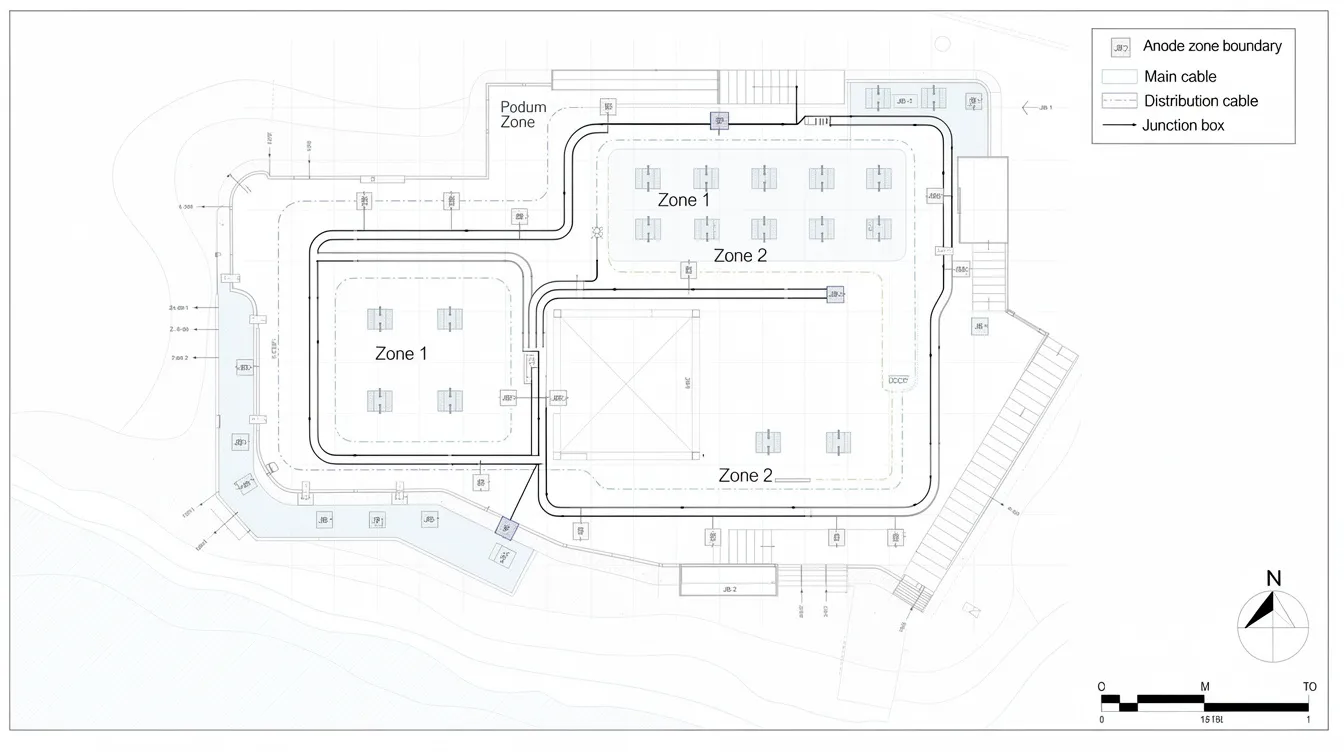
System design: Divide the structure into protection zones based on exposure severity and rebar density. Lay out the anode array, decide how many anodes are required in each zone based on protected area, current demand, and distribution needs, calculate current density requirements per zone, select anode material (zinc for SACP, MMO/titanium for ICCP), position reference electrodes, and size the rectifier and power supply for ICCP.
-
Integrate with repairs: Sequence patch repairs, crack injection, and any re-alkalisation or coating application before CP anode installation. Verify rebar electrical continuity across all zones; install continuity bonds where needed.
-
Installation planning: Determine access requirements (scaffolding, marine platforms, boom lifts), coordinate with building occupants or port operations, and schedule work within available shutdown windows. Prepare safety measures for working at height, over water, or in confined spaces.
-
Commissioning and performance verification: Set initial current and voltage parameters, conduct baseline potential mapping, perform 24-hour or 4-hour depolarisation tests per ISO 12696 clause 8.6, and adjust rectifier settings based on measured response.
-
Documentation and training: Deliver operation and maintenance manuals, monitoring schedules, and handover training for the facility management team. Include data templates for ongoing potential and current logging.
Authority and Standards Considerations in Singapore and ASEAN
BCA, LTA, JTC, and other agencies in Singapore do not prescribe a single CP standard, but they require assurance of structural safety and durability for public-facing infrastructure. Designs typically reference ISO 12696:2022 for cathodic protection of steel in concrete and NACE/AMPP standards (SP0216 for galvanic CP, SP0290 for ICCP). Cathodic protection techniques are applied to structures buried in soil or immersed in water, but ISO 12696 extends coverage to atmospherically exposed, tidal, and splash-zone concrete as well.
AMAN supports authority submissions by preparing technical justifications for the selected CP approach, coordinating peer reviews, and obtaining overseas PE endorsements where required. For example, retrofitting CP to an existing coastal car park where the original design did not include durability provisions requires a clear submission explaining the corrosion mechanism, the CP design rationale, and the monitoring plan that will demonstrate ongoing compliance.
Integrating CP with Structural and Façade Rehabilitation
CP installation rarely happens in isolation. Most projects also involve concrete repairs, crack injection, protective coatings, façade rehabilitation, and sometimes structural strengthening with FRP or steel plates.
Timing matters. Sacrificial anodes are typically installed concurrently with patch repairs: the anode goes into the chiselled cavity before the repair mortar. ICCP overlay anodes are applied after major structural repairs are complete but before final finishes (coatings, tiling, waterproofing membranes). Installing the ICCP mesh after waterproofing application, for instance, would require penetrating the membrane for cable routing, which defeats the waterproofing’s purpose.
AMAN uses Revit and Tekla 3D modelling to route cables, locate junction boxes, and position rectifier panels without conflicting with M&E services, fire safety penetrations, or landscape elements. Typical conflicts include drainage scuppers that interrupt anode mesh continuity, fire-rated wall penetrations where CP cables need to pass through, and waterproofing details at construction joints that cannot be disturbed. Identifying these conflicts on screen saves weeks of rework on site.
Common Challenges and How to Address Them
Both ICCP and sacrificial systems can underperform if not correctly designed, installed, and maintained. Early identification of issues is a core part of forensic engineering and inspection services.
Inadequate Protection or Uneven Current Distribution
Some zones remain actively corroding despite a CP system being in place. Causes include poor anode placement, shielding by thick coatings that block current, or breaks in rebar continuity that isolate sections of reinforcement from the anode circuit. In sacrificial systems, the incipient anode effect is a specific risk: a patch repair without galvanic anodes creates a potential difference between the repaired area and the surrounding chloride-contaminated concrete, accelerating corrosion at the patch boundary.
Solutions include installing additional anodes in under-protected zones, re-zoning the ICCP layout to increase current density where needed, bonding discontinuous rebar sections, and in severe cases, converting from pure galvanic protection to a hybrid or full ICCP approach.
Overprotection, Coating Damage, or Concrete Deterioration
ICCP carries a risk that galvanic systems do not: over-polarisation. Driving the steel potential too negative generates alkali at the steel surface, which can cause cathodic disbondment of organic coatings and, in extreme cases, hydrogen embrittlement in prestressed concrete tendons due to atomic hydrogen evolution. ISO 12696 sets upper limits on cathodic potential specifically to avoid these effects.
The fix is operational rather than structural. Set upper potential limits in the rectifier controller. Position reference electrodes at representative locations (not only at the most-corroded spots). Perform depolarisation tests at commissioning and at scheduled intervals. Tune the rectifier seasonally if humidity and temperature cycles shift the demand profile.
Access, Power, and Operational Constraints
Live facilities present real constraints. A car park cannot close for three months. A petrochemical plant’s explosion-risk zones restrict electrical equipment. A pier soffit is accessible only at low tide or from a barge. ICCP’s need for a reliable power supply becomes a problem when the nearest electrical panel is 200 metres away and the cable route crosses architectural façade panels that the owner will not allow to be drilled.
Mitigations: use distributed smaller rectifiers closer to each zone rather than one large central unit. For remote structures without mains power, solar-powered rectifier units with battery backup provide the DC power source. Plan installation in tidal windows or during scheduled facility shutdowns. Design the anode system for modular installation so that each zone can be completed and commissioned independently.
Inspection, Data Interpretation, and Skills Gaps
CP data, including potentials, current density readings, and depolarisation shifts, requires specialist interpretation. Misread data leads to unnecessary shutdowns (if the system is wrongly flagged as failing) or, worse, missed early warnings of genuine under-protection. In Singapore, few contractors hold AMPP CP4 certification, which means the pool of qualified interpreters is small.
Recommendations: engage certified CP specialists for periodic audits (annually at minimum). Train in-house maintenance teams to perform basic measurements using portable reference electrode kits and log results in a standardised format. Where budget allows, install digital monitoring with dashboards that flag anomalies automatically, reducing dependence on manual thorough inspections.
Conclusion and Next Steps
Both sacrificial anode and ICCP systems are proven methods to prevent corrosion of steel reinforcement in coastal and industrial concrete. Neither is universally superior. Sacrificial anodes offer simplicity, zero power requirements, and lower upfront cost for small, well-defined repair zones with moderate chloride exposure. ICCP offers adjustable current, longer anode life (20+ years for MMO anodes versus ~10 years for galvanic anodes in Singapore marine conditions), and reliable protection across large, heavily contaminated structures.
The right choice depends on the structure’s size, the severity and variability of its exposure, the owner’s risk tolerance, and the lifecycle cost strategy. For a 100 m² beam repair on a condominium soffit, sacrificial anodes are the pragmatic choice. For a 5,000 m² jetty deck with 2% chloride content and a 30-year target life, ICCP is the more defensible investment.
Actionable next steps for asset owners and project managers:
-
Commission a condition survey and corrosion assessment of your coastal or industrial concrete assets, including half-cell mapping, chloride profiling, and structural inspection.
-
Develop a durability and CP strategy early in any rehabilitation or redevelopment project, not as an afterthought once spalling is visible.
-
Evaluate ICCP vs galvanic CP options using lifecycle costing over 20 to 30 years rather than capex alone.
-
Engage an experienced consultancy such as AMAN Engineering for integrated structural, CP, BIM, and authority submission support.
-
Establish a monitoring and maintenance plan from day one, with trained personnel and clear escalation procedures.
Related topics worth exploring: periodic structural inspections (PSI), façade condition surveys, fire safety implications of invasive retrofit works, and BIM-based coordination for complex rehabilitation projects.
Additional Resources and Typical Details
Key international standards relevant to CP in concrete:
-
ISO 12696:2022: Cathodic protection of steel in concrete; performance criteria, monitoring provisions, and annexes on hybrid anodes
-
AMPP/NACE SP0216: Design, installation, and monitoring of galvanic CP systems for atmospherically exposed steel in concrete
-
NACE SP0290: Impressed current cathodic protection of reinforcing steel in concrete
-
BS EN 1504 series: Products and systems for the repair and protection of concrete structures (complements CP standards)
Typical detail examples that illustrate system layout for non-specialist readers:
-
ICCP system on a coastal car park slab: MMO-coated titanium mesh anodes installed in a cementitious overlay, divided into 3 to 6 zones per deck level. Rectifier panel located in a plant room with cable runs in PVC conduit along structural beams. Reference electrodes (silver/silver chloride) embedded at one per zone, connected to a central monitoring panel with remote monitoring capability.
-
Sacrificial anode layout in localised patch repairs: Discrete zinc anodes placed at 300 to 500 mm centres around the perimeter of each patch repair zone on a corroded seafront beam. Each anode wire-tied to exposed rebar before repair mortar application. No external wiring, no rectifier, no power supply. Thorough inspections and potential surveys scheduled every 3 to 5 years.
-
ICCP ribbon anodes in marine pile jackets: Titanium ribbon anodes spirally wound inside a GRP jacket filled with cementitious grout, applied to concrete piles in the tidal and splash zone. Cable connections routed up through the deck soffit to junction boxes and a rectifier mounted on the wharf structure. System designed for a 20-year service life with annual monitoring and 5-yearly detailed assessment.
FAQ: Choosing Between ICCP and Sacrificial Anodes
Is ICCP always better than sacrificial anode systems for coastal concrete?
No. ICCP is suitable for large structures requiring high protective current, variable exposure conditions, and long design lives exceeding 20 years. For smaller, well-defined repair areas with moderate chloride levels, sacrificial anode systems deliver adequate galvanic protection at lower cost and with less operational overhead. The choice depends on scale, contamination severity, and acceptable maintenance burden.
How do I know if my existing structure needs ICCP or just patch repairs with sacrificial anodes?
The decision should be based on a detailed investigation: extent and depth of chloride contamination, percentage of delaminated or spalled area, measured rebar section loss, concrete resistivity, and the projected service life the owner needs. A structure with localised damage and chlorides limited to patch areas may need only sacrificial anodes. A structure with widespread contamination above 1.5% chloride by cement weight across 50% or more of the rebar depth points toward ICCP. AMAN performs these assessments through its structural inspection process and recommends options based on measured data.
What is the typical design life for ICCP and sacrificial CP in Singapore’s coastal climate?
Sacrificial anode systems in Singapore are commonly designed for approximately 10 years in marine-exposed concrete, after which anode replacement is expected. ICCP systems with MMO/titanium anodes are designed for 20 to 30 years or more, with planned component replacement (reference electrodes, rectifier parts) and ongoing maintenance. The MassDOT parking garage project in the U.S. demonstrated an ICCP installation across approximately 4,830 m² that is expected to extend service life by over 30 years.
Will installing CP interfere with building operations or authority approvals?
CP can be installed in phases with careful planning. Sacrificial anodes are often installed zone by zone during scheduled repair works with minimal disruption. ICCP installation is more extensive but can be phased across floors or zones so that only a portion of the facility is affected at any time. Early coordination with authorities (BCA, SCDF for fire routing, LTA or JTC where relevant) and a clear method statement minimises approval delays.
Can CP be modelled and coordinated in BIM?
Yes. AMAN routinely models anode zones, cable trays, rectifier locations, and reference electrode positions in Revit and Tekla. This BIM coordination identifies clashes with M&E risers, fire-rated partitions, architectural finishes, and landscape elements before construction begins, reducing rework and cost on site.