
Introduction
When an existing reinforced concrete column must carry more load than it was originally designed for, engineers face a critical choice between two proven retrofit techniques: fiber reinforced polymer (FRP) wrapping and steel jacketing. This article provides a detailed, practical comparison of frp vs steel jacketing strengthening reinforced concrete columns—positioning that choice within structural engineering and wider civil engineering practice—covering structural performance, durability, cost, constructability, fire resistance, and regulatory compliance so that project stakeholders can make informed decisions.
The scope here is focused on the comparative performance of these two structural strengthening methods as applied to real buildings and infrastructure, particularly in Singapore and the broader ASEAN region. We will not cover full seismic design theory, generic materials science, or broader retrofitting options such as concrete jacketing; instead, we concentrate on what developers, asset owners, facility managers, and structural engineering consultants need to evaluate when strengthening concrete columns for change of use, additional storeys, deterioration repair, or seismic retrofitting.
In short: FRP jacketing is generally preferable when access is tight, corrosion resistance matters, and minimal disruption is essential. Steel jacketing is usually better when large load capacity gains are needed, impact protection is required, or fire resistance drives the design. Many projects benefit from a hybrid approach.
By the end of this article, you will understand:
-
How FRP and steel jacketing work mechanically to strengthen RC columns.
-
A clear side-by-side comparison of performance, durability, cost, and construction implications.
-
Typical use cases in Singapore/ASEAN buildings, carparks, industrial plants, and bridge foundations.
-
A high-level step-by-step view of a strengthening project from assessment to commissioning.
-
How AMAN Engineering Consultancy Pte Ltd supports assessment, design, BIM, and authority submissions for jacketing works.
Understanding Column Jacketing for Reinforced Concrete Structures
Column jacketing is the practice of adding a new layer or shell of material-steel, fiber reinforced polymer FRP, or concrete-around an existing column to improve its load bearing capacity, ductility, and long-term durability. Column jacketing enhances load-carrying capacity and durability, making it a cost effective alternative to demolishing and rebuilding structures.
In Singapore, column strengthening has become increasingly common since the mid-2000s. Much of the building stock dates from the 1970s–1990s and was not designed for today’s load requirements-higher imposed loads from changes of use (warehouses converted to offices, for example), additional M&E equipment, EV charging infrastructure in carparks, or the addition of new storeys. Tropical humidity, marine air chloride, and UV exposure also accelerate reinforcement corrosion and concrete spalling, further driving the need for retrofit.
Both FRP and steel jacketing are column jacketing methods, but they differ fundamentally in mechanics, material behaviour, detailing, and regulatory considerations. Understanding these differences is essential before shortlisting a method for any project.
How Jacketing Strengthens Reinforced Concrete Columns
The primary mechanism behind all jacket types is confinement: the jacket applies passive lateral restraint to the concrete core. As the concrete is loaded axially, it tends to expand laterally. The jacket resists this expansion, placing the concrete in a state of triaxial compression and thereby increasing both its compressive strength and its ability to deform without sudden failure-increasing ductility significantly.
Beyond confinement, jacketing enhances flexural and shear capacity. The jacket adds tensile material around the column, improving its resistance to bending moments and shear strengthening against diagonal cracking, which is critical under seismic forces or eccentric loading.
Key mechanisms at a glance:
-
Confinement – lateral restraint increases axial compressive strength and ductility of the core concrete.
-
Flexural enhancement – additional tensile reinforcement improves moment capacity.
-
Shear enhancement – circumferential material resists diagonal tension and prevents brittle shear failure.
-
Stiffness modification – jacketing changes column stiffness, which must be checked against global frame behaviour and compatibility with existing concrete beams and slabs.
Because jacketing changes both strength and stiffness, engineers must always verify how the strengthened column interacts with the rest of the structural systems through global analysis.
Overview of FRP Jacketing
FRP jacketing involves wrapping fiber reinforced polymer sheets-typically carbon fiber reinforced polymer (CFRP) or glass FRP (GFRP)-around the existing column and bonding them with epoxy resin. FRP uses carbon, glass, or aramid fibers embedded in resin for retrofitting, and FRP composites have been used since the 1980s for retrofitting concrete structures worldwide.
Key material properties include high strength-to-weight ratio, excellent corrosion resistance in harsh environments, and anisotropy (strength is directional, primarily along the fibre axis). FRP is lightweight and corrosion-resistant compared to steel, with jackets typically adding only a few millimetres to the column cross section-making it ideal for constrained environments. Fiber-reinforced polymer provides passive lateral confinement to concrete under load; however, FRP’s effectiveness depends on the concrete’s ability to expand under compression to activate this lateral confinement.
FRP strengthening design internationally references the ACI 440 series, fib bulletins, and similar guidelines, while local projects must follow relevant Singapore codes and authority expectations. CFRP wrapping is ideal for constrained environments due to its minimal weight addition and thin profile.
Overview of Steel Jacketing
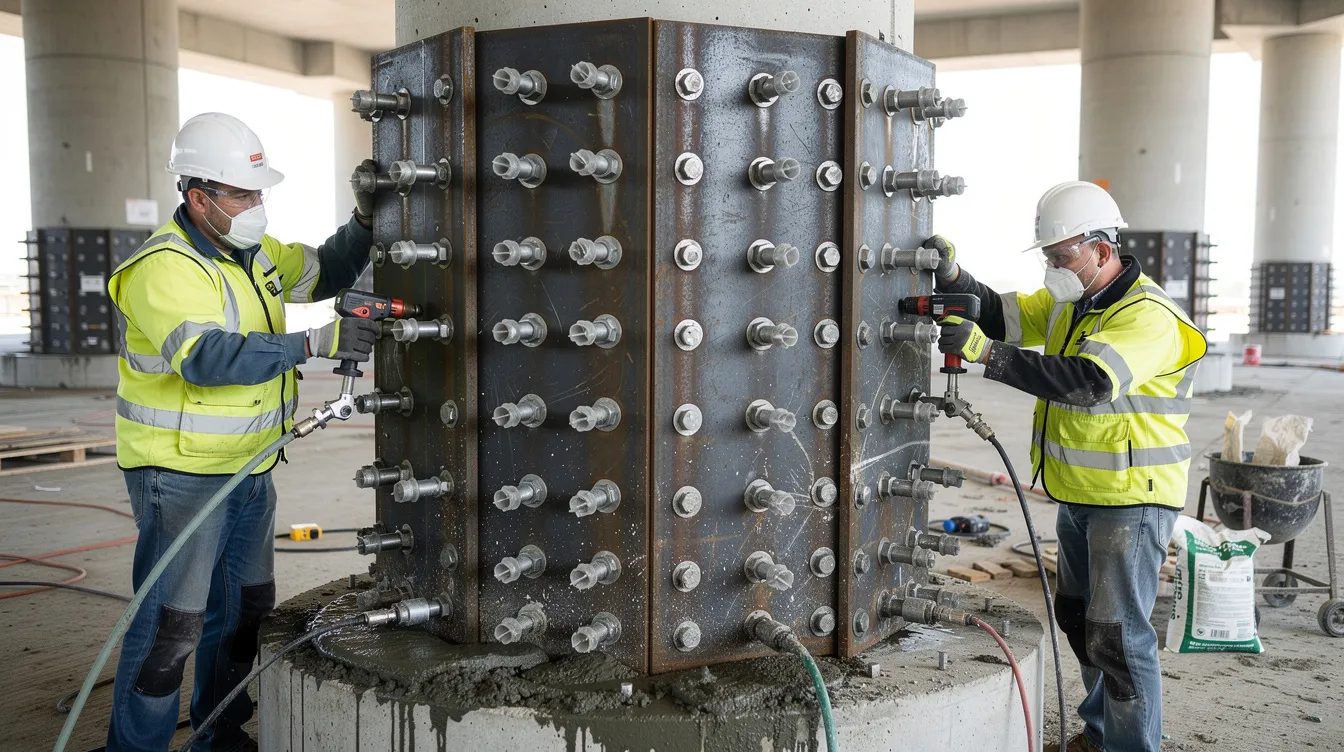
Steel jacketing uses steel plates or hollow steel sections-often 6–12 mm thick-to encase the existing column. The shell may be welded on site, assembled from segmented plates fastened with bolts, or fabricated as prefabricated shells grouted into place to ensure composite action with the original concrete.
Steel provides high stiffness, excellent energy dissipation under cyclic loads, and superior impact resistance. Steel jacketing improves strength and ductility of columns and provides high tensile strength and impact resistance. However, steel jacketing significantly increases the dead weight and cross-section of structural elements, which must be accounted for in foundation and frame analysis. Steel also requires protective coatings to prevent rust and corrosion over time, especially in Singapore’s humid tropical and marine climate.
Typical forms include full steel casing welded on site, segmented plates bolted around the column, or fabricated shells with grout injection. Each form has different constructability and performance characteristics.
With these fundamentals established, the next section examines how FRP and steel jacketing are applied in real retrofitting projects across Singapore and the region.
Applications of FRP and Steel Jacketing in RC Column Strengthening
Moving from what these methods are to how and where they are deployed: the choice between FRP and steel jacketing is always project-specific. It depends on column location, environmental exposure (marine, industrial, basement), the magnitude of the required load upgrade, construction access, programme constraints, and authority/insurer expectations.
Typical Use Cases for FRP Jacketing
FRP wrapping is commonly selected where adding significant section enlargement to the column is unacceptable-narrow carpark aisles, plant rooms with tight clearances, or retrofits in occupied buildings where disruption must be minimised. FRP installation is faster and less intrusive compared to steel jacketing, a decisive advantage in operational facilities.
In Singapore, practical examples include:
-
Carpark column strengthening for EV infrastructure: Retrofitting RC columns in existing HDB or private carparks to support new EV charging loads without reducing drive aisle width. FRP’s thin profile preserves architectural clearances.
-
Waterfront and coastal developments: Strengthening concrete columns exposed to chloride attack where corrosion resistance is critical. FRP exhibits excellent corrosion resistance in harsh environments, unlike unprotected steel.
-
Regional seismic upgrade projects: Upgrading column ductility for structures evaluated against seismic requirements in Indonesia or the Philippines, where PE endorsement is required for cross-border structural engineering work.
-
Hospitals, data centres, malls: Facilities that cannot tolerate extended shutdowns benefit from FRP’s minimal wet works and reduced noise and dust.
The TYFO® Fibrwrap® Composite System, for instance, has been used across over 3,000 buildings and 400,000 columns in Singapore, with reported installation rates of over 100 columns per week including architectural finishes.
Typical Use Cases for Steel Jacketing
Steel jacketing is often the method of choice when projects demand substantial increases in axial or flexural capacity, or when impact and abrasion resistance are concerns. Steel jacketing provides high tensile strength and impact resistance that FRP cannot match in direct collision scenarios.
Concrete examples include:
-
Industrial warehouse conversions: When warehouses are converted to high-bay storage, column loads can increase dramatically, often requiring the kind of >100% axial strength gains that steel jacketing can deliver.
-
Ground-floor columns near loading bays: Where forklifts or trucks may strike the column, steel jacketing serves double duty-strengthening the RCC column and providing impact protection.
-
Bridge piers and pier columns: In regional infrastructure work, jacketing must resist floating debris or vessel impact, making steel the preferred choice for bridge foundations in aggressive environments.
Steel jacketing may also be easier to coordinate with fire engineering, since fire safety in structural steel is well understood and simpler to detail with passive fire protection systems than unprotected FRP.
Hybrid and Staged Strengthening Strategies
Hybrid FRP-steel systems improve seismic resilience of corroded columns and offer a practical middle ground. In multi-storey buildings, engineers may specify steel jackets at ground level-where loads and impact risks are highest-and FRP wraps on upper storeys where weight and access are greater concerns. In corrosive environments such as marine or chemical plant settings, FRP strips may be used for supplementary confinement over a steel jacket to prevent corrosion of the steel shell itself.
Hybrid strategies allow engineers to optimise cost versus structural performance:
-
Steel for major capacity increase in high-demand zones.
-
FRP for supplementary confinement, corrosion protection, or ductility enhancement.
-
The method depends on load demand, environment, constructability, and authority/insurer expectations.
-
Staged construction allows occupied buildings to remain operational during works.
With applications covered, the next section addresses how these systems are designed, implemented, and compared in quantitative terms.
Design, Implementation, and Comparison of FRP vs Steel Jacketing
Once a jacketing method is shortlisted, engineers must design, coordinate, and implement it properly-not just select the material. In Singapore, any structural strengthening design must comply with the Building Control Act, BCA approved documents, relevant Eurocodes (SS EN 1992 for concrete, SS EN 1993 for steel), and may require Professional Engineer design and supervision throughout.
Step-by-Step Process for a Column Jacketing Project
A well-executed jacketing project follows a structured sequence. AMAN Engineering Consultancy supports clients through each of these stages-from feasibility study through structural modelling and authority liaison to construction-stage reviews.
-
Preliminary assessment: Desktop review of existing drawings, load histories, proposed change of use, and site constraints. Identify whether loads on the existing column exceed current capacity.
-
Site investigation: Structural inspection including non-destructive testing, cover meter readings, carbonation and chloride tests where needed, and assessment of concrete spalling or reinforcement corrosion. Corroded RC columns can lose 30% loading capacity at 20% corrosion, so establishing current condition is critical.
-
Structural analysis and strategy selection: Global frame modelling (often using BIM/Tekla) to define required column capacity, ductility targets, and overall structural performance implications. Determine whether FRP, steel, or hybrid jacketing best meets the load requirements.
-
Detailed design: Sizing of FRP layers (fibre type, number of layers, wrap orientation, lap lengths) or steel plates (thickness, weld/bolt details, grout specification), plus anchorage, fire protection, and corrosion protection. Compatibility with existing reinforcement is verified.
-
Authority and stakeholder coordination: BCA submissions, fire safety consultation with SCDF, and alignment with LTA/PUB/NEA requirements if relevant.
-
Construction planning: Phasing, temporary propping/shoring, method statements, QA/QC requirements, and access solutions (scaffolding, MEWPs).
-
Installation and supervision: Surface preparation (removal of loose concrete, smoothing sharp corners), application of FRP sheets with resin or fixing of steel plates with welding/bolts, grout injection for steel jackets, and inspection of workmanship quality.
-
Testing, monitoring, and handover: Proof load tests if required, crack monitoring, as-built 3D BIM updates, and maintenance recommendations for the service life of the installed system.
FRP vs Steel Jacketing: Side-by-Side Technical Comparison
The following table summarises the comparative performance of FRP jacketing versus steel jacketing across the criteria most relevant to project decision-making:
|
Criterion |
FRP Jacketing |
Steel Jacketing |
|---|---|---|
|
Strength gain (axial) |
Moderate: ~10–25% for rectangular columns, up to ~70% for circular columns; additional layers can increase gains further |
Very high: steel shell + grout can yield >100% axial increase; experiments show 100–240% in some configurations |
|
Ductility & seismic performance |
Good confinement-based ductility; risk of brittle debonding failure if bond or polymer matrix degrades |
Excellent energy dissipation; steel yields and maintains confinement under cyclic loads; superior seismic behavior under repeated loading |
|
Added thickness |
Minimal (few mm to ~20 mm); negligible cross sectional area increase |
Significant (steel + grout adds 50–150 mm per side); reduces architectural clearances |
|
Weight addition |
Negligible-no considerable weight penalty |
Steel jacketing significantly increases the dead weight of structural elements; foundation check required |
|
Corrosion resistance |
Excellent; fibres immune to corrosion; resin is the vulnerable component |
Steel susceptible to corrosion; requires galvanising, painting, or cathodic protection to prevent corrosion |
|
UV & moisture durability |
Resin degrades under UV and hydrothermal cycles; bond strength can drop ~28% after 6 months of subtropical exposure; CFRP more stable than GFRP |
Less sensitive to UV; moisture can cause rusting if coatings fail; regular maintenance essential |
|
Fire resistance |
Poor intrinsic fire performance; resins soften and lose bond; additional fire protection (boarding, coatings) required to meet SCDF fire code requirements |
Better understood; intumescent or vermiculite coatings can achieve required fire resistance ratings more readily |
|
Construction speed & disruption |
Fast; minimal wet trades; fewer formworks; less noise and dust; ideal for occupied buildings |
Slower; requires welding, bolting, grouting; heavier lifting; more noise and dust; greater safety/rigging needs |
|
Installation complexity |
Specialist applicators needed; surface preparation and resin mixing critical; quality depends on bond and cure conditions |
Structural steelwork skills needed; fabrication, welding quality, grouting accuracy all critical |
|
Lifecycle cost |
Lower installation cost often; maintenance for resin protection, UV shielding, and fire protection layers adds to lifecycle cost |
Higher upfront material and labour cost; ongoing coating maintenance; may be more economical where labour costs dominate and high capacity is needed |
|
Inspection requirements |
Must monitor for delamination, debonding, UV damage; periodic bond integrity checks critical |
Monitor for corrosion, paint coating integrity, steel loss; surface degradation can be hidden under finishes |
In plain language: FRP is usually superior where corrosion resistance, minimal access, and minimum downtime are critical-think basement columns in a corrosive marine environment. Steel generally provides higher stiffness, better impact resistance, and more straightforward fire protection compliance, making it preferable for interior industrial or retail spaces requiring large capacity gains. The choice should always be made on a whole-of-life basis-not only upfront material cost but also maintenance, fire protection, and structural safety over the full service life.
Visual Documentation and BIM Integration
Effective documentation is integral to any strengthening project. Key visuals that should be captured and maintained include:
-
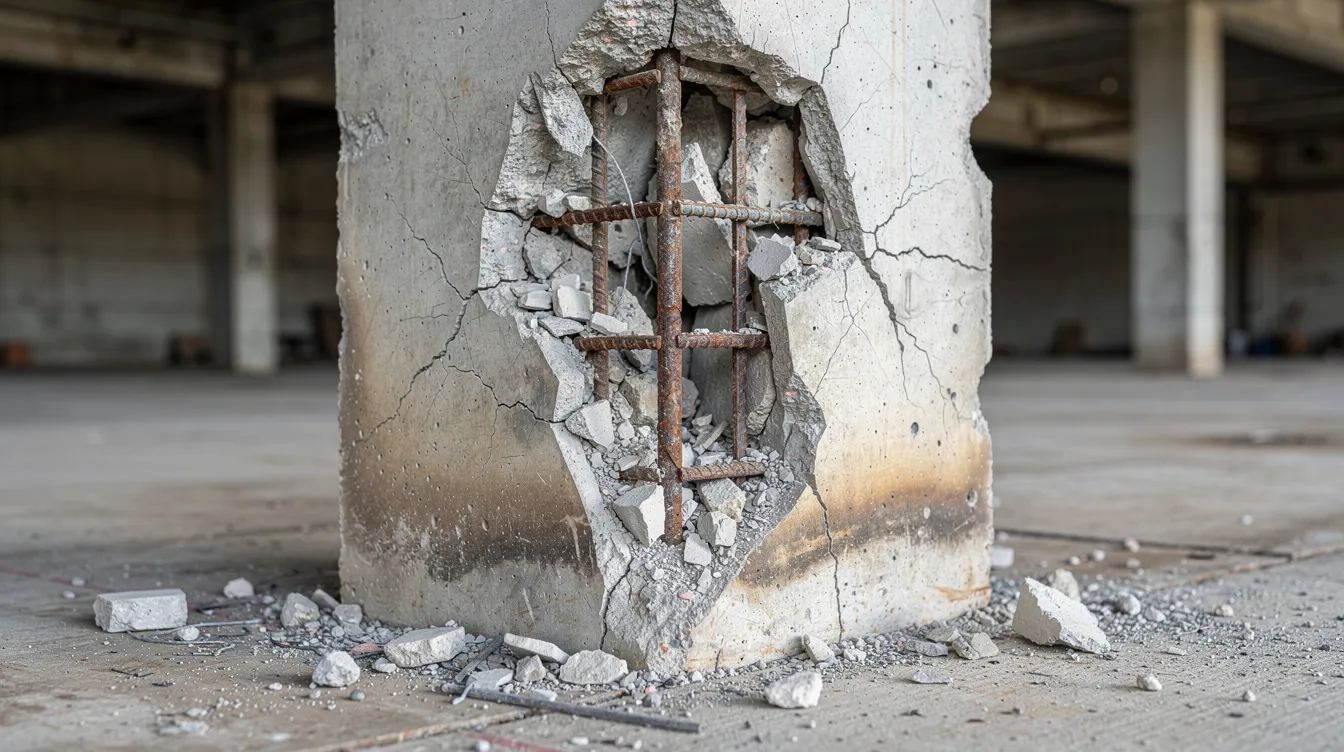
Before strengthening: Photographs of the existing column showing deterioration, corrosion staining, spalling, or crack patterns.
-
FRP wrapping in progress: Images showing fibre orientation, overlap zones, corner rounding details, and resin application.
-
Steel jacket installation: Photos of steel plates positioned around the column, weld locations, and grout injection points.
-
BIM integration: 3D models showing strengthened columns within the full structural frame, coordinated with M&E services and architectural finishes.
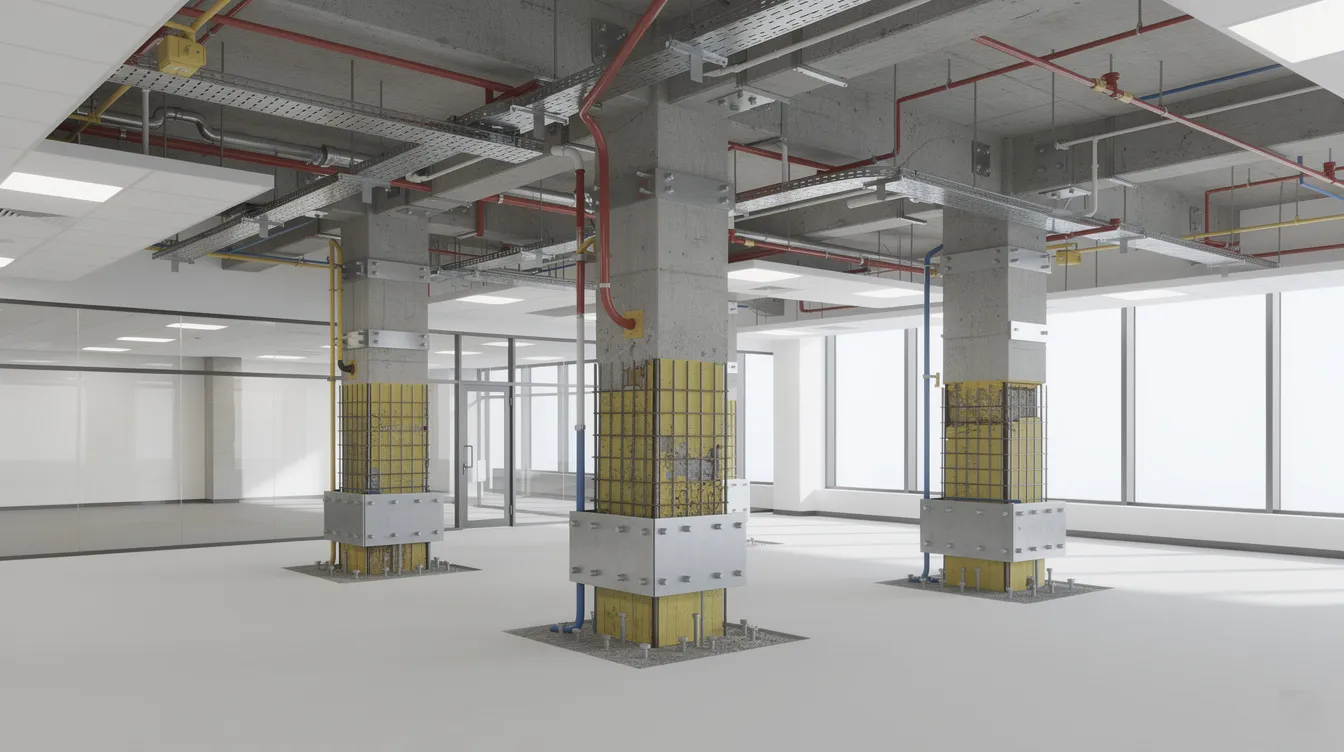
AMAN Engineering Consultancy integrates these visuals into BIM workflows and shop drawing production. Using 3D models, the team coordinates jackets with M&E services and architectural finishes, generates clash detection for steel encasements, and maintains a digital twin for future inspections and asset management. Images and models should be annotated to highlight critical details such as lap lengths, corner detailing, anchor bolts, and fire protection layers.
Common Challenges and Practical Solutions
Poorly planned jacketing work leads to construction delays, rework, and non-compliance with authorities. The following challenges are commonly encountered and have proven solutions.
Limited Access and Occupied Buildings
Narrow corridors, operating retail spaces, hospital wards, and data centres may not tolerate extended noisy or dusty works. Limited cross sectional clearance can make steel jacketing physically impossible in some locations.
Solutions:
-
Prioritise FRP jacketing where possible-its minimal wet works and smaller site footprint reduce disruption significantly.
-
Phase works during night or off-peak hours with detailed method statements agreed with building management.
-
If steel jacketing is unavoidable, use pre-fabricated steel segments and modular scaffolding to minimise on-site welding and noise.
Corrosion, Moisture, and Chemical Exposure
Basements, coastal concrete structures, wastewater plants, and industrial chemical facilities present aggressive environments that attack both the original reinforcement and the strengthening system. Corrosion costs an estimated $2.5 trillion globally (2016 figures), and seismic performance of corroded columns is significantly impacted by corrosion, making proper material selection essential.
Solutions:
-
Prefer FRP with suitable resin systems for corrosive environments, plus proper detailing at slab interfaces to prevent moisture ingress. FRP exhibits excellent corrosion resistance that steel cannot match without extensive protection.
-
If steel jacketing is used, specify appropriate coatings, cathodic protection where justified, and details to avoid water traps between the jacket and the original column.
-
Ensure robust surface preparation and crack repair before installing either jacket type-bond quality governs long-term performance.
Fire Safety and Authority Compliance in Singapore
There is an inherent tension between FRP’s poor performance at elevated temperatures and the fire resistance requirements imposed by SCDF/BCA. FRP resins soften, lose bond, and may ignite under fire exposure, whereas steel’s fire behaviour is well characterised and simpler to protect.
Solutions:
-
Coordinate early with a Fire Safety Engineer to confirm whether FRP requires fire protection boarding, renders, or intumescent systems to meet the required fire resistance rating.
-
Consider steel jacketing or RC jacketing for critical structural elements in high fire-risk areas, supported by clear fire design calculations.
-
Leverage AMAN Engineering Consultancy’s experience with fire safety certificates and code interpretation to streamline authority approvals.
Structural Continuity and Detailing at Beam–Column Joints
Ensuring that jackets are continuous through beam column joint regions-without clashing with beams, drop panels, or architectural finishes-is one of the most complex detailing challenges in any column jacketing project.
Solutions:
-
Use detailed 3D BIM modelling to visualise interference and adjust jacket geometry early in the design phase.
-
Detail local FRP wrapping or steel stiffeners to ensure confinement extends through the beam column joints, not only on the prismatic column length.
-
Plan local chipping and re-profiling of column corners to avoid premature FRP debonding (stress concentrations at sharp corners) or local steel plate buckling.
With these challenges addressed, projects can proceed with confidence toward successful completion.
Conclusion and Next Steps
Both FRP and steel jacketing are proven, code-compliant methods to strengthen reinforced concrete columns-each with distinct advantages. FRP excels in corrosion resistance, speed of installation, and minimal intrusion on the existing column’s dimensions and the building’s operations. Steel delivers higher stiffness, greater absolute strength gains, superior impact resistance, and more straightforward fire resistance detailing. Hybrid approaches offer the best of both worlds for complex projects.
For readers considering a strengthening project, the recommended next steps are:
-
Commission a structural condition survey and loading review of existing concrete columns to establish baseline capacity and deterioration state.
-
Engage a qualified structural engineer/PE to model capacity demands and define strengthening targets through structural assessment.
-
Shortlist FRP vs steel vs hybrid options based on environment, space constraints, fire requirements, and programme.
-
Develop a BIM-based strengthening scheme and coordinate with all trades to prevent clashes and optimise construction sequencing.
-
Prepare authority submission packages and tender documents with clear technical specifications for BCA, SCDF, and other relevant agencies.
AMAN Engineering Consultancy Pte Ltd can support every stage-from feasibility studies and periodic structural inspections through BIM modelling, structural design, authority submissions, and construction-stage reviews.
Related topics worth exploring include beam strengthening and shear strengthening of RC beams, slab strengthening using FRP, façade retrofits, and long-term structural health monitoring for aging concrete structures.
Additional Resources and FAQs
This section provides quick-reference material and answers the questions most commonly raised by decision-makers evaluating column jacketing options.
Reference Standards and Guidelines
-
ACI 440 series (e.g. ACI 440.2R): The primary international guide for design and installation of externally bonded FRP systems on concrete structures.
-
Eurocodes (SS EN 1992, SS EN 1993, SS EN 1994): As adopted in Singapore for concrete and steel design, including provisions relevant to strengthening and alteration of existing structural elements.
-
BCA practice notes and circulars: Local regulatory guidance on structural alteration, strengthening submissions, and material acceptance-projects must always reference the latest published versions.
-
SS 674:2021: BCA’s Design Guide for Fibre-Reinforced Concrete Structures, which includes provisions relevant to FRP use in Singapore.
-
fib Model Codes and ICE guidelines: International references for seismic retrofitting of RC columns, applicable to regional earthquake engineering projects.
These are for professional background; actual projects must follow the latest local regulations under specific PE design.
Frequently Asked Questions on FRP vs Steel Jacketing
Is FRP jacketing approved by authorities for primary structural strengthening in Singapore? Yes, FRP strengthening is generally accepted for structural strengthening in Singapore when designed by a qualified PE, supported by appropriate testing data, and compliant with fire safety requirements. The Zhong Hua Primary School project-where 70 columns were strengthened with FRP wrapping to support two additional storeys, completing in about two months (roughly half the time of conventional methods)-demonstrates regulatory acceptance of FRP for significant structural upgrades.
How long do FRP and steel jackets last in Singapore’s climate? With proper detailing and maintenance, both systems can achieve a service life of 25–50 years. However, research from the National University of Singapore has shown that GFRP tensile and bond strength can degrade noticeably within 6–12 months of tropical exposure due to UV and hydrothermal effects, meaning protective coatings and periodic inspections are essential. Steel requires ongoing coating maintenance to prevent corrosion, particularly in marine or industrial environments.
Can tenants remain in the building during jacketing works? FRP wrapping generally allows continued occupancy because it involves minimal wet trades, less noise, and a smaller work footprint. Steel jacketing typically generates more disruption-welding, bolting, and grouting produce noise and require larger exclusion zones-but phasing and night works can mitigate impact.
What is the rough cost difference between FRP and steel jacketing? FRP materials tend to have a higher cost per unit area, but lower labour and downtime costs. One documented school retrofit project recorded a cost of approximately US$25.50 per m² of floor area for FRP column wrapping-about 7.5% of the cost of constructing a new building. Steel jacketing has lower material cost but higher fabrication, welding, and protective coating expenses. The most cost effective option depends on project-specific factors including access, programme, and lifecycle maintenance.
Do I always need a full building analysis when strengthening some columns? Not always. If only a few columns are being strengthened and the overall structural integrity and load paths are not significantly altered, a local analysis may suffice. However, when jacketing changes column stiffness substantially-or when multiple columns are strengthened across a frame-a global reanalysis is needed to verify that loads redistribute safely and that beam column joints, foundations, and adjacent structural elements remain adequate. A qualified PE should make this determination.
For project-specific evaluation-including site inspection, structural modelling, and authority submission strategy-contact AMAN Engineering Consultancy to discuss your requirements.