
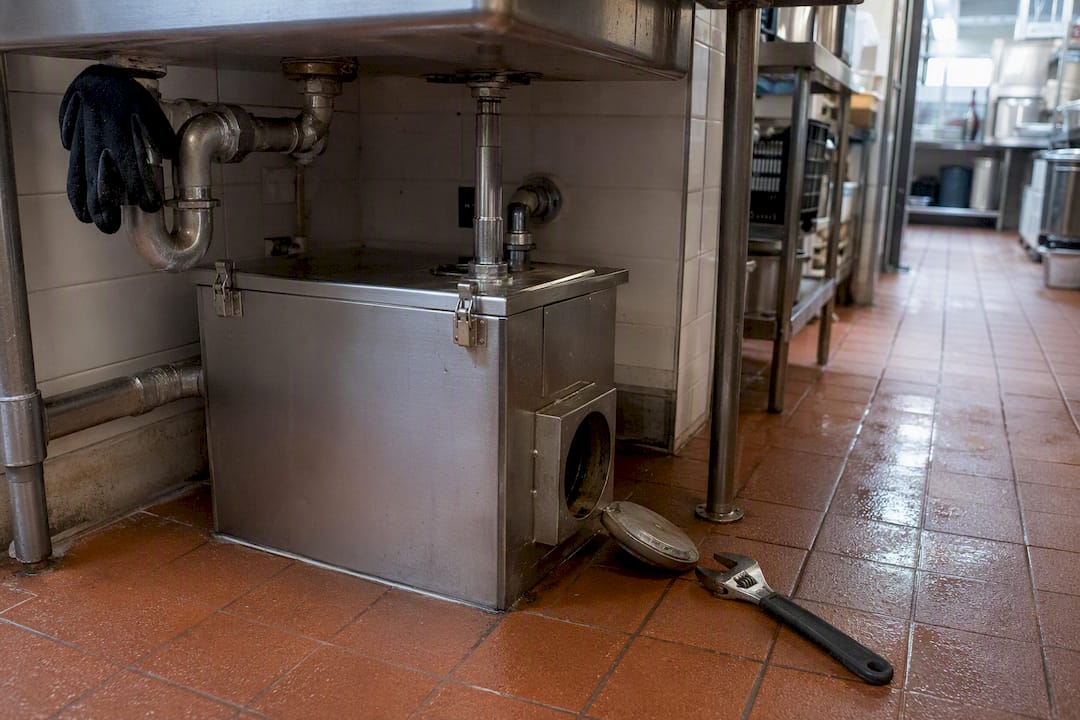
Yes, if your outlet prepares, cooks, or serves food, Singapore law requires you to install a grease trap. The core rule is straightforward: non-hydrocarbon oil and grease in your discharged effluent must not exceed 100 mg/L, a threshold set under the Sewerage and Drainage (Trade Effluent) Regulations. PUB governs the trap’s technical standards and effluent limits, while NEA governs siting, hygiene, and servicing access before you can submit Form F to PUB. Before you install anything, confirm you meet these baseline conditions:
- Trap type conforms to PUB standard drawings, BS EN 1825, or ASME A112.14.3
- Effluent leaving the trap stays at or below 100 mg/L non-hydrocarbon oil and grease
- Site allows a Class C waste collection truck to park within close proximity for servicing
- Layout has cleared NEA review before Form F goes to PUB
Key Takeaways
Grease trap compliance in Singapore rests on three fixed points: the 100 mg/L effluent limit, NEA-cleared siting with 10-meter truck access, and documented fortnightly cleaning.
| Point | Details |
|---|---|
| Effluent limit is fixed | Non-hydrocarbon oil and grease must stay at or below 100 mg/L under the Trade Effluent Regulations. |
| Approval order matters | Clear your layout with NEA before submitting Form F to PUB, not the other way around. |
| Access beats sizing in inspections | A Class C truck must park within close proximity, or even a correctly sized trap fails compliance. |
| Cleaning frequency scales with load | PUB recommends every two weeks as a baseline, increasing for heavy grease loads. |
| Documentation protects the owner | Keep cleaning logs, disposal manifests, and sampling results since owners stay liable regardless of contractor use. |
If your kitchen is due for a compliance review or you’re planning a new installation, Aman Engineering Consultancy can handle sizing calculations, NEA pre-clearance, and Form F submission as one coordinated package. For operators preparing a full statutory bundle, the Statutory Submission Checklist outlines the documentation PUB and NEA expect before approval.
Table of Contents
- Which Food Businesses Need Grease Trap Requirements in Singapore?
- What Legal Requirements and Standards Apply to Your Trap?
- How Do You Size a Grease Trap Using EN 1825?
- Where Should You Install the Trap and What Materials Are Required?
- What Approvals and Documents Does PUB Require?
- How Often Should You Clean and Document Your Grease Trap?
- What Happens If You Fail an Effluent Test?
- Your Grease Trap Compliance Checklist
- How an Engineering Consultant Supports Grease Trap Compliance
- What I’ve Seen Go Wrong on Real Kitchen Projects
- Where to Find the Official Regulations
- Frequently Asked Questions
- Sources
Which Food Businesses Need Grease Trap Requirements in Singapore?
Any premise where food is prepared or cooked, not just served, falls under Singapore’s grease trap requirements. That covers a wider range of outlets than most first-time operators assume.
You need a grease trap if you run any of the following:
- Full-service restaurants and casual dining outlets with a working kitchen
- Hawker stalls and coffee shop food stations that fry, boil, or grill
- Central kitchens and food processing facilities producing meals or sauces
- Catering companies preparing food off-site for delivery
- Cafes that cook (not just reheat) items like eggs or pasta
Non-cooking F&B outlets — think a confectionery counter, a packaged snack bar, or a drinks-only kiosk — may qualify for an exemption. That exemption is not automatic. You still need PUB’s written permission confirming your operation genuinely produces no fats, oils, or grease in its wastewater. If your menu changes later to include any hot cooking, the exemption no longer applies, and you’ll need to install a trap before continuing operations.
What Legal Requirements and Standards Apply to Your Trap?
Three layers of regulation govern a compliant installation in Singapore: the statute, the effluent standard, and the technical design standards. Get any one of them wrong and your submission stalls.
- The statute. The Sewerage and Drainage Act, through its Trade Effluent Regulations, makes grease trap installation mandatory for food establishments and sets the discharge standard.
- The effluent limit. Non-hydrocarbon oil and grease in your discharge cannot exceed 100 mg/L. PUB may require sampling to verify this, particularly for kitchens with heavy fry-load menus.
- The design standards. Your trap must match PUB’s own standard drawings, PUB/WRN/STD/040C and PUB/WRN/STD/041C, or comply with an internationally recognized alternative: BS EN 1825 or ASME A112.14.3. PUB’s Code of Practice on Sewerage and Sanitary Works (3rd Edition, March 2025) spells out sizing methodology, watertightness expectations, and material specifications in detail.
The number that matters most: 100 mg/L. That’s the ceiling for non-hydrocarbon oil and grease in your trade effluent, and it’s the figure PUB inspectors sample against when they suspect a trap is undersized or poorly maintained.
Enforcement splits cleanly between the two agencies. PUB owns the effluent standard, the trap’s technical design, and the approvals process. NEA owns environmental health, hygiene at the point of servicing, and the physical access conditions that let a waste collector reach the trap without creating a public nuisance.
How Do You Size a Grease Trap Using EN 1825?
Undersizing is the single most common reason grease traps fail inspection within their first year. PUB’s sizing framework borrows directly from BS EN 1825, and the logic is more approachable than the standard’s dense language suggests.
Here’s how the sizing calculation actually works:
- List every appliance discharging greasy wastewater, sinks, wok stations, dishwashers, and floor drains connected to the kitchen line.
- Assign flow rates to each appliance per EN 1825-2 tables, which specify typical discharge volumes for standard commercial kitchen fittings.
- Apply frequency and density factors that account for how often each appliance discharges and how heavy the grease load typically runs.
- Calculate the required nominal size (NS) from the combined flow rate, then match it against PUB’s equivalence table.
PUB maps its own standard circular traps directly onto EN nominal sizes: drawing PUB/WRN/STD/041C is deemed equivalent to NS 2, while PUB/WRN/STD/040C corresponds to NS 4. If your kitchen’s calculated flow exceeds NS 4, you’re likely looking at a custom or non-standard trap sized to BS EN 1825 or ASME A112.14.3 specifications instead of a stock PUB drawing. PUB’s Code of Practice includes a worked sizing example in Annex E, which is worth reviewing line by line before you commit to a design, since it shows exactly how the frequency and density factors get applied to a realistic kitchen layout.
Pro Tip: Size conservatively, not to the bare minimum your calculation allows. A trap sized exactly to today’s menu volume becomes undersized the moment you add a fryer station or extend operating hours, and retrofitting a larger trap after a failed inspection costs far more than building in headroom from the start.
Undersized traps don’t fail gracefully. They clog frequently, trigger recurring blockage complaints from downstream tenants, and eventually draw an enforcement notice that can halt kitchen operations until the correct apparatus is installed.
Where Should You Install the Trap and What Materials Are Required?
Accessibility for servicing carries as much regulatory weight as the trap’s technical specification, and it’s the requirement operators most often overlook during kitchen design.
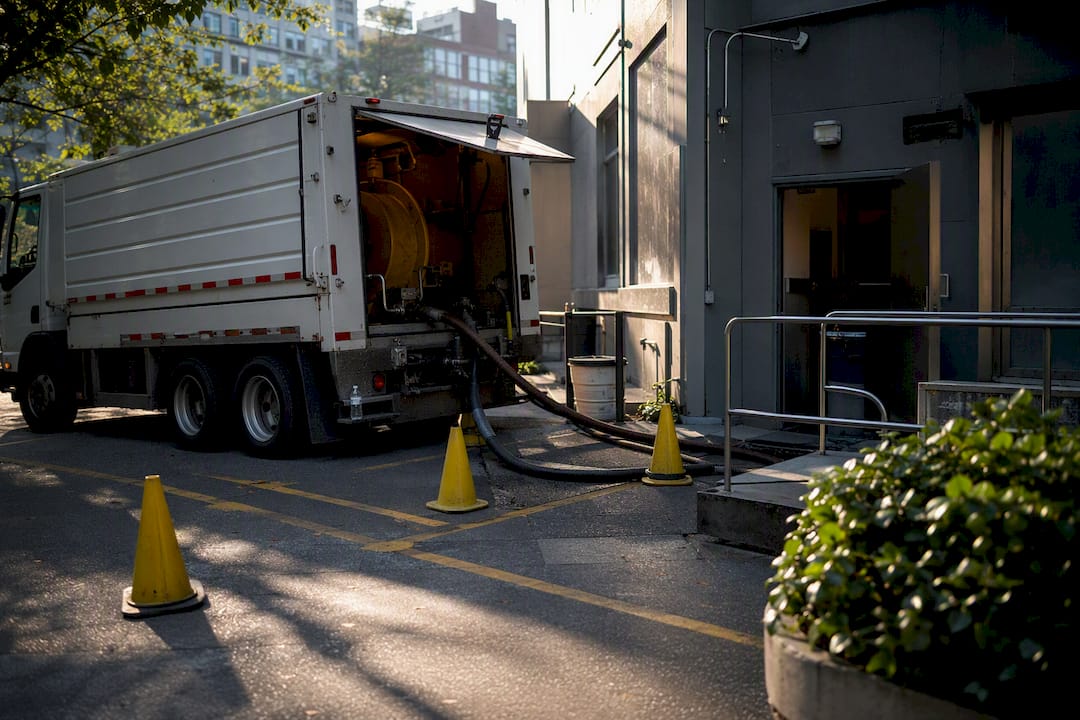
The 10-meter rule is not a suggestion. NEA’s Code of Practice on Environmental Health requires that a Class C waste collection truck be able to park within 10 meters of the trap and transfer greasy waste directly, without double handling. Traps buried behind storage racks, down narrow service corridors, or accessible only through the dining room routinely fail this test even when their sizing and materials are perfectly compliant.
Beyond access, keep these installation details in mind:
- Route culinary wastewater through dedicated drainage, never combined with toilet or sanitary discharge lines
- Use pipework rated for corrosion resistance and intermittent temperatures up to 90°C, per PUB’s sanitary plumbing specifications
- Secure inspection covers so they resist unauthorized tampering while remaining removable for cleaning crews
- Site the trap externally where possible; internal traps need extra ventilation and odor control planning
Portable interceptors compliant with BS EN 1825 or ASME A112.14.3 are permitted only in narrow circumstances, typically after URA has approved a change of land use because a fixed trap genuinely isn’t feasible on-site. For general context on kitchen drainage design, commercial kitchen plumbing guidance covers the broader plumbing considerations that intersect with grease trap placement.
What Approvals and Documents Does PUB Require?
The approval sequence trips up more first-time applicants than the technical design does. Get the order wrong and you’ll be resubmitting documents you thought were already cleared.
The workflow runs in this order:
- Clear your proposed grease trap layout with NEA first, referencing the Code of Practice on Environmental Health, before touching PUB’s paperwork
- Submit Form F to PUB once NEA has signed off on siting and access
- Include site drawings showing the trap’s exact location and truck access route
- Attach your EN 1825 sizing calculation and the specific trap standard you’re using (PUB drawing reference, BS EN 1825, or ASME A112.14.3)
- Provide URA land-use approval documentation if you’re proposing a portable interceptor
- Confirm your cleaning contractor holds a valid Class C general waste collector license before operations begin
This sequence exists because NEA clearance addresses environmental health and hygiene concerns early, before PUB evaluates the technical submission, which prevents costly redesigns after a Form F has already been lodged. Guidance on preparing a complete PUB submission package can shorten this back-and-forth considerably.
How Often Should You Clean and Document Your Grease Trap?
PUB recommends cleaning regularly as a baseline, though kitchens running heavy fry volumes, think char kway teow stalls or fried chicken outlets, often need weekly service to stay under the 100 mg/L limit. There’s no fixed formula for the right interval; it scales with your grease load, and PUB may request effluent sampling if inspectors suspect your schedule is inadequate.
The Code of Practice’s Annex J and Annex K lay out recommended cleaning procedures for standard and non-standard traps respectively. During each cleaning cycle, supervise for these core items:
- Complete removal of accumulated grease and solids, not just surface skimming
- Inspection of baffles and outlet pipes for buildup or damage
- Verification that covers reseal properly and remain watertight after servicing
- Confirmation that the collector disposes of waste through licensed channels, not informal dumping
Owners remain responsible for trap condition even when a third-party contractor handles cleaning, a point PUB’s FAQ on used-water compliance states plainly. Documentation is what separates a compliant kitchen from one that merely looks compliant during a routine visit.
Pro Tip: Keep a running maintenance log with timestamped photos of each cleaning cycle, plus the disposal manifest from your Class C collector. When an inspector asks for proof of the last six months of servicing, a folder of dated evidence resolves the question in minutes, an empty filing cabinet does not.
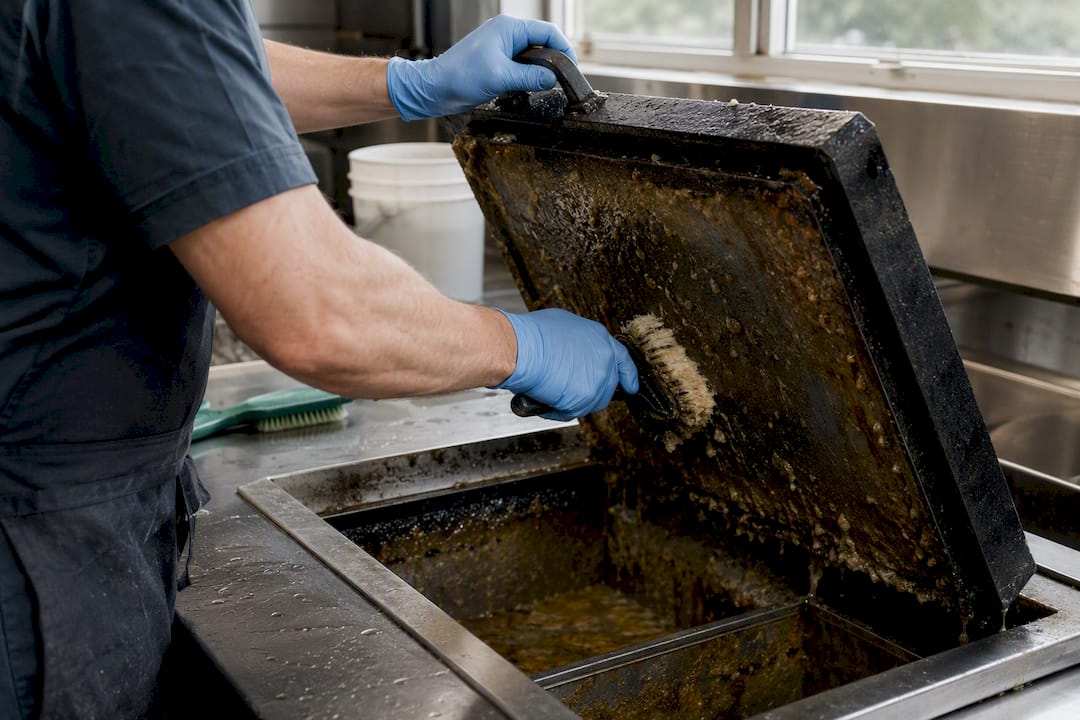
Retain cleaning reports, disposal manifests, and any sampling results for at least the period NEA or PUB specifies during your last inspection. Professional cleaning through a licensed Class C collector also gives you a documentary trail that ad hoc self-cleaning simply can’t match.
What Happens If You Fail an Effluent Test?
PUB and NEA both retain enforcement authority, and they use it. Accredited laboratories test effluent samples against the 100 mg/L limit, and new or altered installations typically undergo watertightness testing before sign-off.
When a kitchen fails, here’s what typically follows:
- A formal notice requiring repair or replacement of the non-compliant apparatus within a set timeframe
- Financial penalties scaled to the severity and recurrence of the violation
- Operational restrictions on the kitchen until the correct trap or servicing arrangement is confirmed
- Continued liability resting with the outlet owner, regardless of what a cleaning contractor did or didn’t do
The stakes extend beyond your own kitchen. Uncontrolled fats, oils, and grease entering the public sewer network cause blockages that back up into shared drainage lines, creating public health incidents that draw far more scrutiny than a single failed sample. That downstream risk is exactly why PUB and NEA treat grease trap compliance as a standing obligation, not a one-time installation checkbox.
Your Grease Trap Compliance Checklist
Use this as a working reference across the three phases of a compliant installation.
Before installation:
- Secure NEA pre-clearance for your proposed layout
- Confirm the correct PUB standard drawing reference or alternative standard (BS EN 1825, ASME A112.14.3)
- Map a site access route confirming Class C truck parking within 10 meters
- Complete your EN 1825 sizing calculation, cross-checked against Annex E
At installation:
- Verify trap type and standard match your approved submission
- Conduct watertightness testing before covering or burying the trap
- Confirm covers are secured and drainage runs separately from sanitary lines
- Check pipe materials meet corrosion and 90°C intermittent temperature ratings
Ongoing operations:
- Lock in a cleaning schedule with a licensed Class C collector, minimum fortnightly
- Retain disposal receipts and cleaning manifests
- Keep effluent sampling records on file
- Run periodic visual or CCTV inspections between scheduled cleanings
How an Engineering Consultant Supports Grease Trap Compliance
Most operators only discover a gap in their compliance during a renovation, a change of use, or a repeat NEA citation, exactly when time pressure makes DIY research risky. A statutory consultant typically handles:
- EN 1825 sizing verification against your actual menu and appliance load
- NEA pre-clearance and Form F submission to PUB
- Coordination of watertightness testing during construction
- Assembling documentation bundles for future audits or inspections
Engage one early if you’re renovating a kitchen, changing land use, facing recurring non-compliance notices, or working a site where access constraints might force a portable interceptor and trigger URA land-use review. Aman Engineering Consultancy has handled statutory submissions across PUB and NEA workflows, including compliance work on cold room installations for food factories, where similar site access and drainage coordination challenges apply.
What I’ve Seen Go Wrong on Real Kitchen Projects
Service access gets designed last, when it should be designed first. Kitchens get their sizing right, their materials right, and then discover the truck can’t reach the trap without crossing a loading dock nobody accounted for.
The second recurring mistake: treating portable interceptors as a convenient shortcut rather than what they are, a narrow exception requiring URA sign-off. Skip the licensed collector to save money, and you lose your documentary trail the moment an inspector asks for six months of records.
Priority order, in practice: confirm site access before you finalize layout, get NEA pre-clearance before you order equipment, and lock in a documented cleaning contract with a Class C collector before you open.
Where to Find the Official Regulations
For the primary source documents behind every requirement covered here, consult these directly:
- PUB’s Grease Trap requirements page, covering installation obligations and cleaning frequency
- PUB Code of Practice on Sewerage and Sanitary Works (3rd Edition, March 2025), including Annex E sizing and Annex J/K cleaning procedures
- NEA Code of Practice on Environmental Health, for siting and servicing access rules
- PUB’s FAQ on used-water compliance, clarifying owner responsibilities and approval sequencing
Download Annex E, J, and K directly from PUB’s Code of Practice before finalizing your sizing calculation or cleaning contract.
Frequently Asked Questions
Does every food outlet in Singapore need a grease trap?
Any outlet that prepares or cooks food needs one. Non-cooking F&B businesses, like a packaged snack counter, may qualify for an exemption but need written PUB permission first.
What is the maximum oil and grease level allowed in discharge water?
Non-hydrocarbon oil and grease cannot exceed 100 mg/L, per the Sewerage and Drainage (Trade Effluent) Regulations.
Can I install a grease trap myself without a consultant?
Technically yes, but the approval sequence, NEA pre-clearance before PUB’s Form F, plus accurate EN 1825 sizing, trips up most first-time applicants without professional guidance.
How often does PUB require grease trap cleaning?
At least once every two weeks as a baseline, with more frequent cleaning required for kitchens with heavier grease loads.
Are portable grease interceptors allowed in Singapore?
Only in limited cases, typically after URA approves a change of land use and a fixed trap isn’t feasible on-site. Portable units must still meet BS EN 1825 or ASME A112.14.3 and remain accessible for servicing.
This article is general information, not a substitute for advice from a qualified lawyer. Consult a qualified legal professional about your own circumstances before acting on anything here.
Sources
- Grease Trap | PUB, Singapore’s National Water …
- SEWERAGE AND SANITARY WORKS (3rd EDITION – MAR 2025)
- CODE OF PRACTICE ON ENVIRONMENTAL HEALTH
- Frequently Asked Questions