
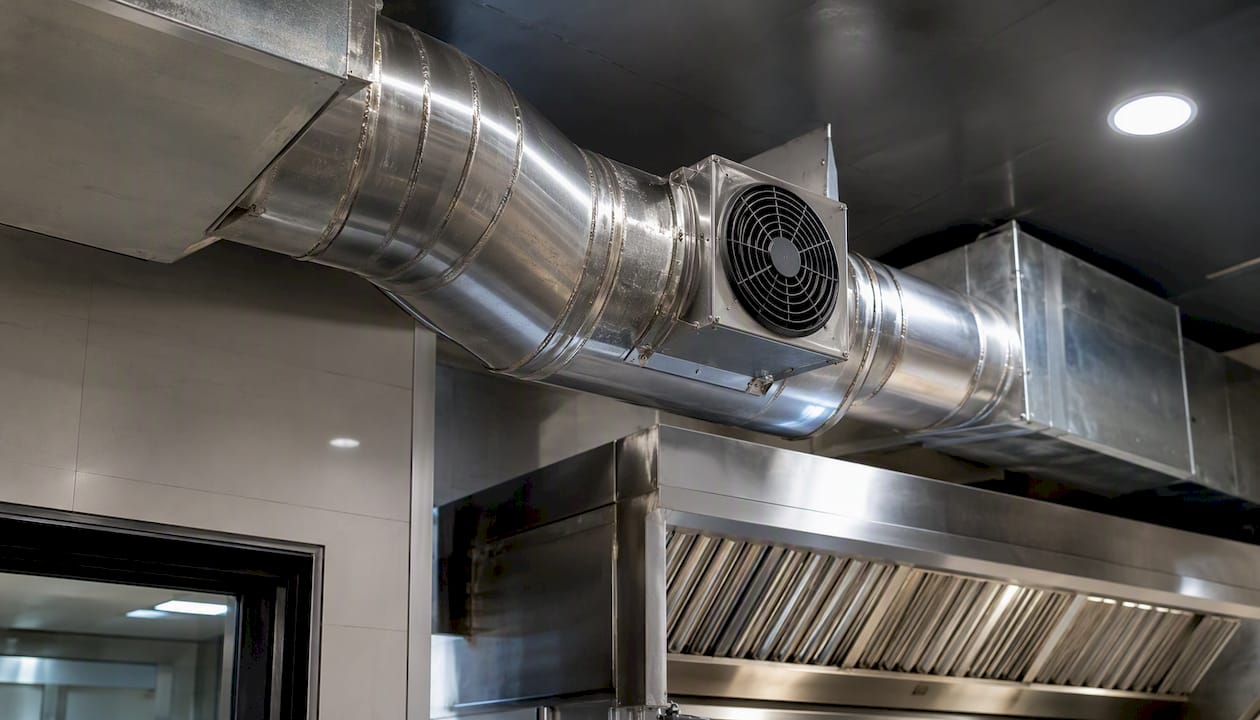
Two authorities govern commercial kitchen exhaust systems in Singapore, and both carry enforcement power. The Singapore Civil Defence Force (SCDF) sets construction, clearance, and fire-safety standards under Fire Code Clause 7.1, while the Singapore Food Agency (SFA) governs cleaning frequency, maintenance recordkeeping, and inspection outcomes for every licensed food retail premises. Meeting one without the other still leaves an operator exposed.
The non-negotiables are consistent across every commercial kitchen in Singapore, regardless of cuisine type or floor area:
- Hood coverage must fully capture cooking fumes, and ductwork must be built from non-combustible material with correct clearances from combustible surfaces.
- The entire exhaust system, interior and exterior, must be degreased at least once every year by a specialist contractor.
- Maintenance records, including signed certificates and service scope, must be kept on hand and produced on request.
- Access panels must exist at bends and regular intervals so cleaning crews can actually reach the grease.
If you manage a kitchen right now, three actions matter more than anything else on this page: confirm the date of your last degreasing service, locate the signed certificate that proves it happened, and walk your duct run to check that clearances and access panels haven’t been compromised by a fit-out change. Aman Engineering Consultancy works with F&B operators and facility teams on exactly this gap between paperwork and physical reality.
Key Takeaways
Compliant kitchen exhaust systems in Singapore require Fire Code Clause 7.1 construction standards, annual specialist degreasing under SFA rules, and retained maintenance records.
| Point | Details |
|---|---|
| Two regulators, one system | SCDF governs construction and clearances under Clause 7.1; SFA governs cleaning frequency and records. |
| Annual degreasing is the floor | Clean the entire interior and exterior duct and hood at least once every year, more often for high-grease kitchens. |
| Documentation beats verbal claims | Keep signed certificates, before/after photos, and disposal invoices for every service. |
| Design drives maintenance cost | Access panels and clearances built in at design stage make every future cleaning cycle faster and cheaper. |
| Get a professional audit | Aman Engineering Consultancy reviews existing systems against Clause 7.1 and packages documentation for SFA and SCDF inspections. |
Table of Contents
- What Does SCDF Fire Code Clause 7.1 Require for Kitchen Exhaust?
- What Does SFA Require for Kitchen Exhaust Maintenance?
- How Should Hoods, Ducts, and Fans Be Designed for Compliance?
- How Often Should Kitchen Exhaust Systems Be Cleaned?
- What Records Do Inspectors Actually Check?
- What Happens if a Kitchen Fails to Meet Exhaust Requirements?
- Your Compliance Timeline: What to Do Now and Every 12 Months
- How Aman Engineering Consultancy Supports Kitchen Exhaust Compliance
- Why Noise and Vibration Standards Matter for Kitchen Exhaust Systems
- How Do Air Emissions Rules Apply to Kitchen Exhaust?
- Why Proactive Exhaust Compliance Beats Reactive Fixes
- Get a Compliance Audit for Your Kitchen Exhaust System
- Frequently Asked Questions
- Sources
What Does SCDF Fire Code Clause 7.1 Require for Kitchen Exhaust?
Clause 7.1 of the SCDF Fire Code governs air-conditioning and mechanical ventilation systems, and kitchen exhaust falls squarely inside that scope. The clause treats a commercial kitchen hood, its ductwork, and the exhaust fan as a single fire-safety system, not a piece of kitchen equipment that happens to move air. That distinction shapes almost every design decision that follows.
The clause sets construction and clearance rules that apply from the moment a duct leaves the hood canopy to the point it discharges outside the building. Ductwork must be built from non-combustible material capable of withstanding sustained heat and grease ignition without deforming or failing structurally. Where ducts pass through fire compartments or floor slabs, fire-resisting construction is required to stop a kitchen fire from traveling into adjacent tenancies or vertical shafts, a scenario that has driven serious losses in shophouse conversions where ducts were routed through party walls without proper sealing.
Clearance from combustible material is the rule most commonly missed on-site. Timber ceiling battens, plasterboard bulkheads, and even decorative wood cladding installed after handover routinely encroach on duct clearance zones during renovation works, which is one of the most frequent causes of failed resubmissions.
Key construction and clearance points to verify on any kitchen exhaust design:
- Minimum clearance from ductwork to combustible building elements, maintained along the entire duct run, not just at the hood connection.
- Non-combustible duct material specified and documented on shop drawings, not assumed from a generic supplier catalog.
- Fire dampers or fire-resisting construction wherever ductwork penetrates a compartment wall or floor.
- Access panels positioned at every change of direction and at regular straight-run intervals, sized for a technician to physically reach inside with cleaning tools.
- Fan and discharge point positioned to avoid re-entrainment of grease-laden air into occupied spaces or fresh-air intakes.
Pro Tip: Bring your mechanical and fire safety consultants into the same conversation before shop drawings are finalized. A duct route drawn without clearance checks against the architectural reflected ceiling plan is the single most common reason FSSD reviewers send back a kitchen exhaust submission for revision.
Grease accumulation inside ductwork is the specific hazard the SCDF Fire Code is written to prevent, and it identifies grease buildup as a recurring cause of fire incidents in food establishments. That single fact explains why access provisions in Clause 7.1 are as detailed as the construction rules themselves: a duct nobody can clean is a duct that will eventually catch fire.
What Does SFA Require for Kitchen Exhaust Maintenance?
The SFA’s Guidelines for Licensed Food Retail Premises set the operational half of the compliance picture: cleaning frequency, contractor qualifications, and documentation. Every licensed food retail premise must have its exhaust duct and kitchen hood degreased and cleaned, both interior and exterior surfaces, at least once every year. The work must be carried out by a specialist, and the operator must retain records for inspection.
That last clause is where most enforcement problems actually originate. A kitchen that has genuinely been cleaned but cannot produce a record is treated the same as a kitchen that was never cleaned at all, because SFA officers verify compliance through documentation, not verbal assurance.
During an inspection, an SFA officer typically expects to see:
- A signed maintenance certificate stating the date of service and the scope of work performed.
- The service provider’s company name and contact details, confirming the work was done by a specialist rather than in-house staff without proper equipment.
- Before and after photos documenting the condition of the duct interior, hood surfaces, and filters.
- A waste disposal record or invoice showing grease waste was removed and disposed of correctly.
- Any safe work method statement relevant to confined-space duct access, where applicable.
SFA inspects the exterior condition of exhaust systems during routine visits and will ask operators to produce these records on the spot. When documentation is missing, incomplete, or the visible contamination suggests the system has been neglected well beyond the 12-month cycle, SFA can refer the case to SCDF for follow-up action under fire safety provisions. That handoff matters: it converts a food-licensing issue into a fire-code enforcement matter, with a different set of penalties and a different regulator involved.
How Should Hoods, Ducts, and Fans Be Designed for Compliance?
Getting the paperwork right starts with getting the engineering right. A kitchen exhaust system that is undersized, poorly routed, or fitted with the wrong fan will struggle to pass inspection no matter how diligently it gets cleaned.
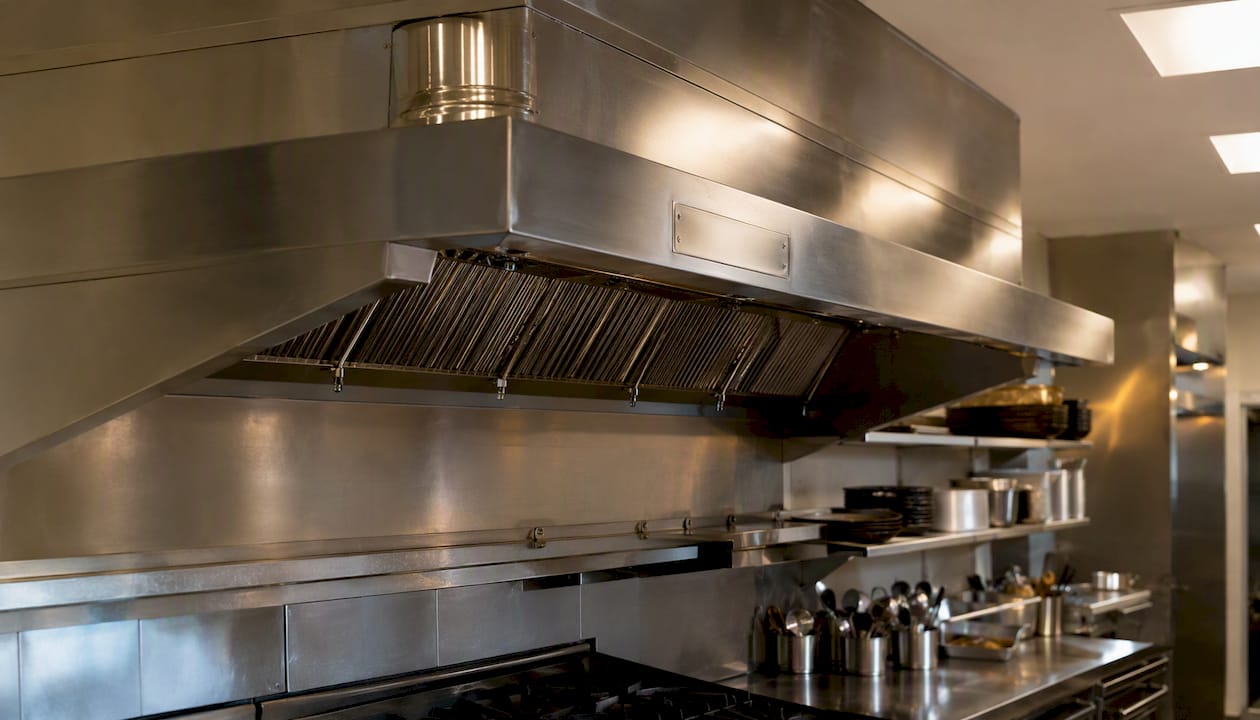
Hood coverage and capture. The hood canopy must extend beyond the footprint of the cooking equipment it serves, with overhang sized to the type of cooking being done. A wok range producing high heat and heavy grease-laden vapor needs more overhang and higher extraction volume than a row of steam tables. Undersized hoods let smoke and grease escape into the kitchen rather than into the duct, which shows up later as grease film on ceiling tiles, an easy visual flag for an inspector.
Duct material and sealing. Ductwork must be built from non-combustible material with welded or properly sealed joints that resist grease migration through seams. A duct that leaks grease into a ceiling void doesn’t just fail inspection; it creates a hidden fire load that nobody sees until it ignites. Access panels and cleaning ports need to be built into the design from the start, not retrofitted after a contractor discovers there’s no way to physically reach a bend.
Fan positioning and discharge. Exhaust fans typically discharge at roof level, positioned away from fresh-air intakes and neighboring units to avoid re-entrainment and odor complaints. Discharge height, backdraft dampers, and vibration isolation all factor into fan selection, and system suppliers commonly flag noise and vibration control as a design consideration that gets overlooked when a project is optimizing purely for airflow.
Performance targets. Airflow rate, measured in cubic meters per hour or liters per second, needs to be matched to the cooking load, and static pressure across the duct run determines whether the specified fan can actually deliver that airflow once bends, filters, and duct length are accounted for. A fan selected purely from a catalog rating without accounting for system static pressure loss will underperform once installed, leaving the kitchen with poor capture despite a “compliant” hood on paper.
A practical installation sequence looks like this:
- Confirm cooking equipment layout and heat load before finalizing hood size and overhang.
- Route ductwork to minimize bends, and mark access panel locations on shop drawings before fabrication begins.
- Select fan capacity based on calculated static pressure, not nameplate airflow alone.
- Coordinate duct penetrations through fire compartments with fire-resisting construction details.
- Submit design drawings for statutory review before fabrication and installation proceed.
- Commission the system and collect certificates confirming installation matches approved drawings before handover.
Pro Tip: The most common reason a kitchen exhaust submission gets rejected isn’t the hood or the fan. It’s a duct route that clashes with structural beams or sprinkler pipework discovered only after coordination drawings are reviewed. Run a clash check against the full M&E and structural layout before submission, not after.
How Often Should Kitchen Exhaust Systems Be Cleaned?
Once every 12 months is the regulatory floor, not a target. Kitchens running high-volume frying, char-grilling, or wok cooking generate grease at a rate that can saturate filters and coat duct interiors well before the annual mark, and visible indicators are usually obvious to anyone paying attention: grease dripping from filter edges, a sooty film on the hood exterior, a persistent burnt-oil smell near the duct riser, or filters that clog faster than they did a few months earlier.
“Entire system” cleaning means exactly that. A compliant service covers the hood interior and exterior, all filters, the fan housing and blades, the full interior duct run, and the exterior discharge point on the roof. Cleaning only the hood and filters while leaving the duct interior untouched is a partial job that will not satisfy an SFA inspection, even if it looks clean from the kitchen floor.
Acceptable cleaning methods include mechanical degreasing with scrapers and brushes for heavy buildup, high-pressure water washing for duct interiors, and chemical degreasing agents suited to stainless steel and galvanized surfaces. Reputable contractors document which method was used and why, particularly for confined-space duct sections that require specific safety controls.
When selecting a contractor, verify:
- Direct experience producing documentation formatted for SFA and SCDF inspections, not just a generic cleaning invoice.
- Confined-space entry procedures for technicians working inside ductwork.
- Proper grease waste disposal records, since improperly discarded grease waste creates its own regulatory exposure.
- Current public liability insurance covering work performed on your premises.
Local providers increasingly package cleaning with compliance documentation as a single service, precisely because operators have learned the hard way that a clean duct without paperwork still fails an inspection. Operators managing grease-heavy waste streams alongside exhaust maintenance should also look at grease trap maintenance best practices, since the two systems are often serviced on related schedules and both feed into the same fire and hygiene risk profile.
Pro Tip: Make before-and-after photos and a signed completion certificate a standing requirement in every cleaning contract, not an optional extra. If a contractor hesitates to provide either, that hesitation is itself worth noting.
What Records Do Inspectors Actually Check?
Every maintenance event should generate a minimum record set: the date of service, the technician’s name and company, the exact scope of work performed, before-and-after photos, a signed completion certificate, and the waste disposal invoice tied to that job. Missing even one of these items weakens your position if an inspector asks for evidence.
SFA officers verify compliance primarily by inspecting the visible exterior condition of the exhaust system and requesting documentation on the spot. Original signed maintenance records carry more weight than digital summaries created after the fact, and officers commonly ask for the actual certificate rather than a verbal confirmation that cleaning took place. Where records are missing or the system shows contamination inconsistent with recent servicing, SFA can refer the matter to SCDF, at which point the case shifts from a licensing conversation into a fire-code enforcement matter.
A simple log template covers most operational needs:
| Field | What to record |
|---|---|
| Service date | Exact date cleaning was performed |
| Contractor | Company name, technician, and license or registration details |
| Scope of work | Hood, filters, duct interior, duct exterior, fan housing |
| Evidence | Before/after photos, signed certificate |
| Waste disposal | Invoice or disposal receipt reference |
Pro Tip: Keep original signed certificates in both paper and PDF form, and build a single master digital folder covering the full inspection history for the premises. An operator who can hand an inspector a folder covering the last several service cycles in under a minute sends a very different signal than one still searching through email attachments.
What Happens if a Kitchen Fails to Meet Exhaust Requirements?
Enforcement typically escalates in stages. A first visit with missing or incomplete records often results in a warning and a deadline to produce documentation. Repeated noncompliance, or contamination severe enough to suggest cleaning hasn’t happened in well over a year, tends to draw fines and can trigger a referral from SFA to SCDF for fire-safety follow-up.
Operators facing sustained non-compliance risk more than a fine. Licence conditions can be affected, remedial works can be mandated on a deadline, and in serious cases, sections of the kitchen can be ordered out of service until corrective action is verified.
The operational cost of enforcement rarely shows up on the fine notice alone. A mandated remedial cleaning or duct repair often means shutting down cooking equipment for the duration of the work, and depending on how contaminated the system is, that downtime can run longer than a routine scheduled service would have taken. Prevention through documentation remains the cheaper path by a wide margin.
- On-site warnings for missing or incomplete maintenance records.
- Fines for confirmed non-compliance with cleaning frequency requirements.
- Referral to SCDF when records are absent or contamination indicates a fire-safety risk.
- Potential licence conditions or operational restrictions in serious or repeated cases.
Your Compliance Timeline: What to Do Now and Every 12 Months
Compliance breaks down into what needs attention today and what needs to repeat on a fixed cycle.
Immediate actions:
- Locate your most recent exhaust cleaning certificate and confirm the service date against the 12-month requirement.
- Physically inspect hood and duct clearances against combustible materials, particularly if any fit-out work has happened since the original installation.
- Confirm access panels exist at every duct bend and haven’t been sealed over or obstructed by later renovation work.
Within 30 to 90 days:
- Correct or install missing access panels before the next scheduled cleaning cycle.
- Engage a contractor who can document work to SFA and SCDF standards, not just perform the physical clean.
- Update your maintenance log format so every future service captures the full record set.
- Check fan discharge arrangements for backdraft protection and clearance from fresh-air intakes.
Recurring 12-month cycle: Facilities management should own the scheduling of degreasing services, operations staff should own the day-to-day visual checks for grease buildup between cycles, and an external specialist contractor should own the actual cleaning and certification. Splitting ownership this way prevents the common failure mode where everyone assumes someone else is tracking the due date.
How Aman Engineering Consultancy Supports Kitchen Exhaust Compliance
Getting a kitchen exhaust system from design intent to a passed inspection usually involves more coordination than operators expect, particularly when a duct route needs to be corrected after the fact or a statutory submission gets kicked back for revision. Aman Engineering Consultancy works through this as a structured engagement: site survey, engineering assessment, remedial design or cleaning specification, statutory submission, and documentation handover.
Services relevant to kitchen exhaust compliance include:
- FSSD and SCDF submission support for new installations and remedial works.
- Duct and hood remedial design where existing clearances, access, or construction fall short of Clause 7.1.
- Compliance audit and documentation packaging suited to SFA inspection requirements.
- Authority liaison throughout the submission and approval process.
Pro Tip: If your kitchen exhaust system was installed years ago under a prior tenant, treat it as unverified until someone with engineering credentials reviews it against current Fire Code requirements. Layouts change, fit-outs get added, and clearances that passed inspection once don’t stay compliant automatically.
Aman’s broader capability spans structural, facade, fire safety, and BIM-based digital engineering, which matters when a kitchen exhaust fix needs to be coordinated against structural beams, sprinkler layouts, or a building’s overall fire compartmentation strategy rather than treated as an isolated mechanical fix.
Why Noise and Vibration Standards Matter for Kitchen Exhaust Systems
Kitchen exhaust fans move a serious volume of air, and that volume creates mechanical noise and vibration that neighboring tenants, especially residential units above or beside a food outlet, will notice long before an inspector does. Complaints about fan noise are one of the more common sources of friction between F&B tenants and building management in mixed-use developments.
Vibration isolation mounts on the fan unit reduce the transfer of mechanical vibration into the building structure, which matters both for noise complaints and for the long-term integrity of ductwork connections that can loosen under sustained vibration. Discharge point placement also affects perceived noise: a fan discharging directly toward a neighboring unit’s window will generate far more complaints than one angled away from occupied spaces, even at identical decibel output.
Duct-borne noise, distinct from fan noise, travels through the ductwork itself and can surface in unexpected locations, including tenancies several floors away from the kitchen if the duct passes through a shared riser. Acoustic lining or duct silencers address this where standard vibration isolation isn’t enough.
Getting fan selection and discharge placement right at the design stage avoids a costly retrofit later, when a noise complaint forces remedial acoustic work on a system that’s already installed and operating. Coordinating this alongside the fire-safety design review, rather than as an afterthought once tenants start complaining, is the more efficient sequence for any new kitchen fit-out.
How Do Air Emissions Rules Apply to Kitchen Exhaust?
Kitchen exhaust doesn’t just carry grease and odor. It also releases combustion byproducts and cooking particulates into the outdoor air, which places it within the scope of environmental and health-focused air emissions expectations that sit alongside SCDF and SFA requirements.
Discharge point placement plays a direct role here. Exhaust outlets need to be positioned to avoid directing cooking fumes and particulates toward fresh-air intakes, operable windows, or outdoor seating areas, both for the building’s own occupants and for neighboring properties. This overlaps directly with the fan discharge and clearance rules already covered under Clause 7.1, since a well-placed discharge point serves both fire-safety and air-quality goals at once.
Odor and particulate control also factor into hood and filter specification. Grease filters that are undersized or poorly maintained let more particulate matter pass through into the discharge airstream, which is one more practical reason the 12-month degreasing cycle exists beyond fire prevention alone: a clean system performs better on both fronts.
Operators running heavier cooking loads, particularly char-grilling or high-volume frying, should treat air emissions considerations as part of the same design conversation as fire safety and noise control, rather than a separate regulatory track. A kitchen exhaust system designed and maintained properly against Clause 7.1 and SFA cleaning requirements will, in most cases, already be performing reasonably well against air-quality expectations, since the same clean, well-sized, well-positioned system serves all three goals simultaneously.
Why Proactive Exhaust Compliance Beats Reactive Fixes
Kitchen exhaust compliance gets treated as a cleaning schedule problem far too often, when it’s actually a design problem that surfaces later as a cleaning schedule problem. A duct that was routed without proper access panels will always be harder and more expensive to clean correctly, no matter how good the contractor is, because the underlying construction is fighting against the maintenance requirement from day one.
The operators who spend the least on compliance over time are the ones who treat design, installation, maintenance, and documentation as one connected chain rather than four separate tasks handled by four different people who never talk to each other.
Pro Tip: If retrofitting full access panel coverage across an existing duct run feels disruptive, stage it. Fix the worst-access sections first, during a scheduled off-peak cleaning window, rather than waiting for a failed inspection to force the issue all at once.
Compliance is a lifecycle, not a checkbox: design decisions made at the drawing-board stage determine how hard maintenance will be for the next decade, and skipping any single link in that chain, whether it’s a clearance shortcut during fit-out or a missing certificate during an inspection, tends to cost more later than it saved at the time.
Get a Compliance Audit for Your Kitchen Exhaust System
If any part of this article raised a question about your own kitchen, whether it’s a duct clearance you’re not sure about or a certificate you can’t immediately find, that uncertainty is exactly what an audit resolves before an inspector forces the issue. Aman Engineering Consultancy runs site surveys and engineering assessments specifically for kitchen exhaust systems, covering both the Clause 7.1 construction side and the SFA documentation side in one engagement.

A typical audit delivers a site report identifying where the current system falls short, a corrective action list ranked by urgency, and a documentation pack structured to hold up under SFA or SCDF inspection. For kitchens that need remedial duct work or a fresh statutory submission, Aman carries that through from engineering assessment to authority liaison, so the operator isn’t managing multiple contractors and consultants separately.
If your last cleaning certificate is hard to locate, or your duct run has never actually been reviewed against current Fire Code standards, get in touch through Aman Engineering Consultancy’s site to schedule a kitchen exhaust compliance assessment before your next SFA visit, not after.
Frequently Asked Questions
How often must a commercial kitchen exhaust system be cleaned in Singapore?
At least once every year, covering the entire interior and exterior of the duct and hood, per SFA guidelines for licensed food retail premises. Kitchens with heavy grease output often need more frequent servicing than the annual minimum.
Who enforces kitchen exhaust requirements, SCDF or SFA?
Both, covering different aspects. SCDF governs construction, clearances, and fire-safety elements under Fire Code Clause 7.1, while SFA governs cleaning frequency, contractor qualifications, and recordkeeping for licensed food premises. SFA can refer noncompliant cases to SCDF.
What records does an SFA inspector expect to see?
A signed maintenance certificate with service date and scope of work, the contractor’s company details, before-and-after photos, and a waste disposal invoice. Missing documentation is treated the same as missing maintenance.
Can I clean my own kitchen exhaust system instead of hiring a specialist?
SFA guidelines require maintenance to be carried out by a specialist, not general kitchen staff. A specialist contractor also provides the documentation needed to satisfy an inspection, which in-house cleaning typically cannot.
What happens if my kitchen exhaust system fails inspection?
Outcomes range from a warning with a deadline to produce records, to fines, to referral from SFA to SCDF for fire-safety follow-up in more serious cases. Repeated or severe noncompliance can affect operating licence conditions.