
Introduction
Even microscopic oscillations can ruin products with nanometer-scale features – making vibration control the single most consequential engineering discipline in modern high tech manufacturing. Whether you operate a semiconductor fab, a precision metrology lab, or an automated cleanroom production line, unmanaged vibration directly erodes yield, increases scrap rates, and can halt multi-million-dollar tools mid-process.
This article covers vibration control strategies, isolation technologies, regulatory compliance, and monitoring systems relevant to Singapore’s semiconductor, electronics, pharmaceutical, and precision machinery sectors. It does not address basic residential vibration nuisance or general construction noise. The content is written for plant managers, JTC industrial lessees, logistics companies operating in industrial parks, and facility engineers who must reconcile strict regulatory requirements with operational precision demands.
Direct answer: Effective vibration control requires a layered approach for sub-micron stability – combining high-stiffness structural design, carefully selected passive or active vibration isolation systems, and continuous monitoring protocols aligned with Singapore’s BCA guidelines and JTC environmental impact requirements.
By reading this guide, you will gain a clear understanding of:
- Regulatory requirements under BCA, JTC, and NEA frameworks affecting facility vibration performance
- Isolation strategies spanning passive air springs, elastomeric mounts, and active vibration isolation platforms
- Monitoring systems for detecting abnormal vibrations and predicting maintenance needs
- Cost-effective compliance methods including phased implementation and value engineering
- Long-term operational stability through proactive maintenance and continuous improvement
Understanding Vibration Control Fundamentals in Manufacturing Environments
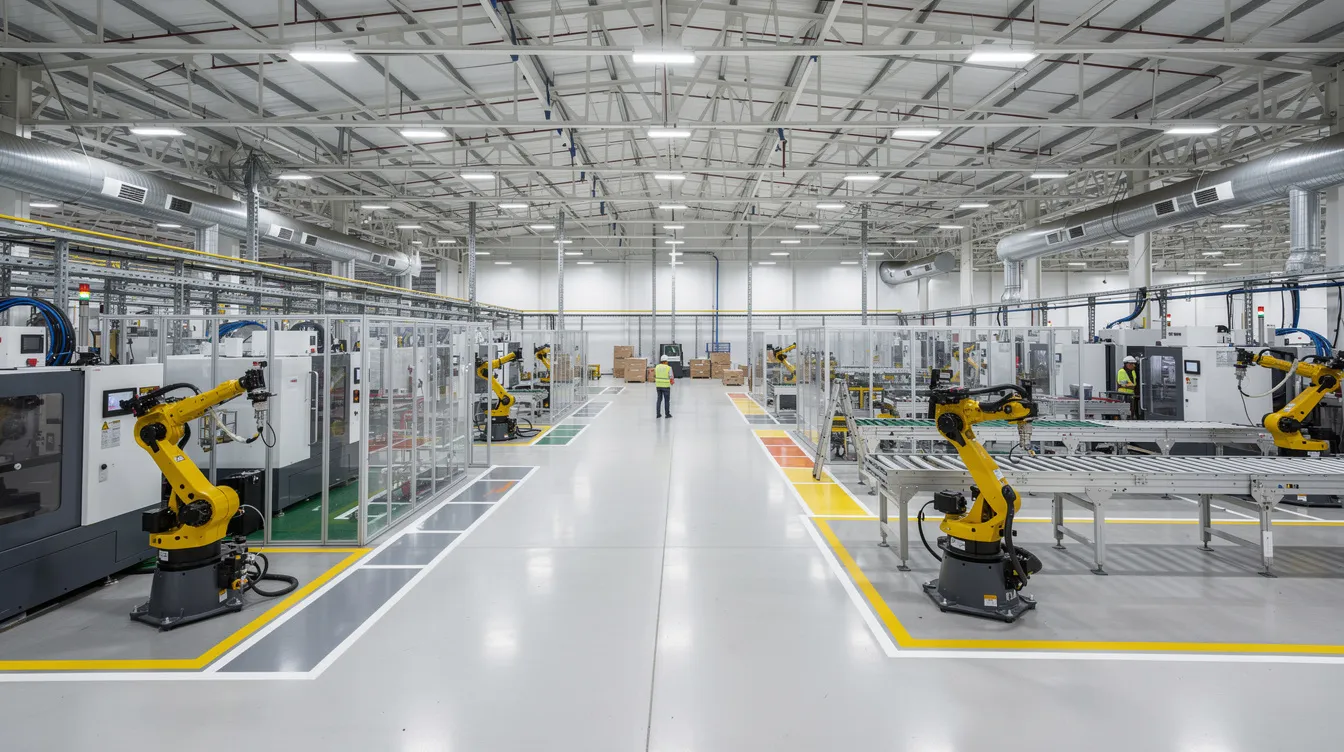
Vibration control in high tech manufacturing refers to managing and mitigating both ground-borne and structure-borne motion that can degrade production accuracy. It is distinct from noise control – vibrations may be imperceptible to the human ear yet still severely disrupt lithography alignment, coordinate measuring machine (CMM) accuracy, or metrology calibration. Vibration control is crucial in high-tech manufacturing because even tiny disturbances at the nanometer scale can cause cumulative errors in motion stages, leading to defective products and significant downtime.
In Singapore’s context, the rapid expansion of semiconductor fabs, photonics facilities, biotech cleanrooms, and national metrology centres has made vibration a first-order design concern. Identifying and addressing vibration sources is a critical first step in control efforts – and one that must begin during site selection and structural design rather than after tool installation.
Critical Frequency Ranges and Tolerance Levels
Micro-vibrations – oscillatory motions typically in the frequency range of 1–100 Hz – represent the primary threat to nanometer-scale operations. At frequencies between 1 and 10 Hz, even sub-nanometer displacement can cause lithography misalignment or compromise CMM accuracy. CMMs are particularly affected by environmental noise and machine-related vibrations, while payload-generated vibration occurs from moving stages in semiconductor tools.
The industry-standard IEST Vibration Criteria (VC) curves define allowable third-octave spectral amplitudes across critical frequency bands. These criteria – from VC-A through VC-G – establish progressively tighter tolerance levels:
- VC-C allows approximately 12.5 µm vibration amplitude in the 1–80 Hz band, acceptable for many lithography and inspection tools
- VC-D reduces the threshold to approximately 6.25 µm for more sensitive metrology equipment
- VC-E and above require 3.1 µm or less, achievable only under highly controlled environmental conditions
Highly sensitive tools such as scanning electron microscopes (SEM), transmission electron microscopes (TEM), and EUV scanners often demand VC-E or even VC-F performance levels. Selecting the appropriate VC criterion for each tool room directly determines the structural and isolation engineering required.
Regulatory Framework and Compliance Requirements
Singapore’s regulatory landscape for vibration in manufacturing facilities spans several authority bodies, each addressing different aspects of structural safety, environmental impact, and operational performance.
Building and Construction Authority (BCA): Under the Building Control Act and associated Building Control Regulations, plan submissions for industrial or Addition & Alteration (A&A) works must include allowable vibration limits when relevant. BCA’s Annex P5 guidelines specify shock design parameters including maximum shock acceleration of 15g in each axis, shock velocity of 0.60 m/s, and shock displacement of 0.05 m in x, y, and z axes. Compliance with these parameters is essential during structural modelling and analysis and PE endorsement submissions.
JTC Corporation: As the primary industrial estate landlord, JTC requires Environmental Impact Assessments (EIAs) for new developments. These EIAs mandate baseline vibration monitoring – typically using tri-axial accelerometers at 1-minute intervals over several days – and assessment of ground-borne vibration and noise. Notably, JTC EIAs increasingly reference VC curves when evaluating vibration impact on sensitive equipment receptors.
NEA (National Environment Agency): While NEA regulates environmental noise – factory premises affecting residential premises must not exceed approximately 70 dBA during daytime – vibration per se has no direct national legal limit for precision manufacturing performance. This gap means that facility designers must proactively adopt international criteria such as IEST VC or ASHRAE vibration standards for tool-dependent requirements.
Understanding this regulatory foundation is essential before selecting vibration control techniques, as the chosen approach must satisfy both authority compliance and precision manufacturing demands.

Vibration Sources and Impact Assessment in High Tech Facilities
With the regulatory framework established, the next step is systematically identifying where significant vibration originates – because you cannot mitigate what you have not measured and characterized.
External Environmental Sources
External vibrations from traffic represent a persistent challenge in Singapore’s dense urban-industrial landscape. Heavy trucks on expressways, MRT train operations, and industrial vehicle corridors generate ground-borne vibration that propagates through soil and into building foundations. In industrial parks such as JTC’s Bahar estate, baseline PPV (Peak Particle Velocity) data demonstrates that even relatively distant road traffic can elevate vibration levels at sensitive tool foundation slabs beyond VC-C thresholds if unmitigated.
Environmental vibrations can also originate from nearby heavy machinery operated by adjacent tenants. In multi-tenant JTC complexes, common structural components – shared floor slabs, partition walls, and service corridors – act as efficient transmission paths for these disturbances.
Additionally, Singapore’s soil and fill stratigraphy presents unique challenges. While seismic events are rare in Southeast Asia, areas of marine clay and reclaimed land exhibit variable soil stiffness that can amplify vibrations in certain frequency bands. Differential soil conditions under foundations or raised floors may cause unexpected resonance, making low-vibration site selection important for effective vibration control in manufacturing.
Internal Equipment-Generated Vibrations
Mechanical systems can be major vibration generators in manufacturing facilities. High-speed spindles, wafer steppers, chemical mechanical polishing (CMP) tools, and CNC machines generate internal vibrations across a broad frequency spectrum. Common sources include:
- Rotating machinery: Imbalance can cause significant vibration in rotating machinery, while misalignment leads to increased friction and wear. Looseness in parts can create unwanted vibrations during operation.
- HVAC and air handling units (AHUs): Cleanroom AHUs operating at high airflows induce tonal vibrations at specific frequencies (commonly 16 Hz, 50 Hz depending on motor speeds) that may coincide with building structure resonant frequencies, leading to amplification.
- Raised floor interactions: Precision tools often rest on raised floors where small irregularities in underfloor plenums or panel joints transmit micro-vibrations during robot, cart, or FOUP (Front Opening Unified Pod) transport. A 2026 Taiwanese study demonstrated that combining flexible tire stiffness with active isolation platforms under FOUP carts significantly suppressed vibration introduced by raised floor irregularities, maintaining yield and alignment.
Vibration levels can increase by 15 dB within 17 months if degradation in isolation systems or mounting integrity goes undetected – underscoring why continuous monitoring is non-negotiable.
Human Activity and Operational Vibrations
Personnel walking and material handling within cleanrooms and production areas can disturb precision tool calibration, especially where motion stages operate in sub-micron ranges. Forklift operations and automated guided vehicles (AGVs) moving across production zones contribute transient shocks that affect settling time in semiconductor production operations significantly.
The connection between operational vibrations and production yield is well-documented. A case study applying DMAIC methodology to semiconductor motion stages demonstrated a 15.3% improvement in units per hour (UPH) and 68.2% reduction in downtime after implementing active monitoring and mitigation to handle internal vibration sources. Effective vibration mitigation increases the throughput of sensitive equipment and directly protects revenue.
Understanding these vibration sources – external, internal, and human – provides the analytical foundation for selecting the right vibration control solutions.
Vibration Control Solutions and Implementation Strategies
With vibration sources identified and quantified, facility engineers can now implement a comprehensive vibration control strategy. The most effective approach combines structural design measures, tailored isolation systems, and ongoing monitoring – applied in layers to achieve the required VC performance level.
Structural Design and Foundation Solutions
Structural modifications deliver the greatest leverage when incorporated during the facility planning phase. When conducting a periodic structural inspection or planning renovations, engineers should evaluate the following foundation solutions:
- Isolated foundation systems with mass-spring configurations: Heavy equipment installations benefit from dedicated inertia blocks – concrete inertia blocks can weigh hundreds of tons for stability – decoupled from the main building structure via spring or elastomeric elements. For highly sensitive tools like EUV scanners, two-stage isolation (base slab plus active isolation platform) is standard practice. The mass lowers natural frequency and increases stability.
- Reinforced concrete plinths designed to BCA structural codes: Plinths should be over-reinforced to minimize deflection and stiffened to shift resonance above critical tool operation frequencies. High-stiffness building structures prevent resonance with machinery, and high natural frequencies in structures help reduce resonance in vibration-sensitive environments. Proper foundation design minimizes vibrations in manufacturing facilities – particularly when deep piles are driven through reclaimed soils.
- Decoupled floor systems separating production areas from building structure: Structural isolation techniques create “buildings within buildings,” using vibration-damping joints, isolated raised floor panels, and resilient mountings to prevent transmission between zones. Physical decoupling minimizes wear on sensitive equipment by reducing environmental disturbances, and isolation prevents floor vibration from reaching precision machines in high-tech environments.
- Trenching and isolation barriers: Vibration-damping trenches, isolation joints in structural slabs, and floating floor designs with rubber or air bladders separate high-vibration zones (mechanical rooms, loading docks) from sensitive tool rooms. These barriers are especially valuable in multi-use industrial buildings where different operations share a common structure.
Vibration isolation strategies often involve creating “quiet islands” in facilities – designated zones where multiple isolation layers converge to deliver VC-E or VC-F performance while the rest of the building operates at less stringent criteria.
Active and Passive Isolation Systems Comparison
Selecting the right isolation system requires balancing equipment sensitivity, operational requirements, budget constraints, and Singapore’s specific environmental conditions. Below is a comparison of common isolator types:
| Isolation Method | Typical Natural Frequency | Precision Level Achievable | Maintenance Requirements | Initial Cost |
|---|---|---|---|---|
| Pneumatic Air Isolators | 2–3 Hz | Sub-micron above ~5–10 Hz; amplification near resonance | Compressed air supply, level control, periodic calibration | High |
| Negative-Stiffness Isolators | 0.5–2 Hz | Excellent low-frequency isolation without air supply | Sensitive to loading changes, alignment, environmental conditions | Very High |
| Spring & Elastomeric Mounts | 5–20 Hz | Micron level above natural frequency | Periodic inspection, elastomer replacement cycle | Medium–Low |
| Active Control Systems | DC (0 Hz) to ~200 Hz | Sub-nanometer across multiple axes | Complex control electronics, specialized sensor support | Very High |
Passive vibration isolation – using air springs, elastomeric mounts, and mass-spring-damper filters – simplifies resonant frequencies and filters higher frequency vibrations effectively. Pneumatic isolators block low-frequency vibrations effectively, and air isolators typically have a natural frequency of 2–3 Hz, providing excellent attenuation above that range. Elastomeric isolators absorb vibrations and dampen noise simultaneously. However, passive systems can amplify vibrations near their natural frequency, and soft-mount isolators result in long settling times and large payload motion.
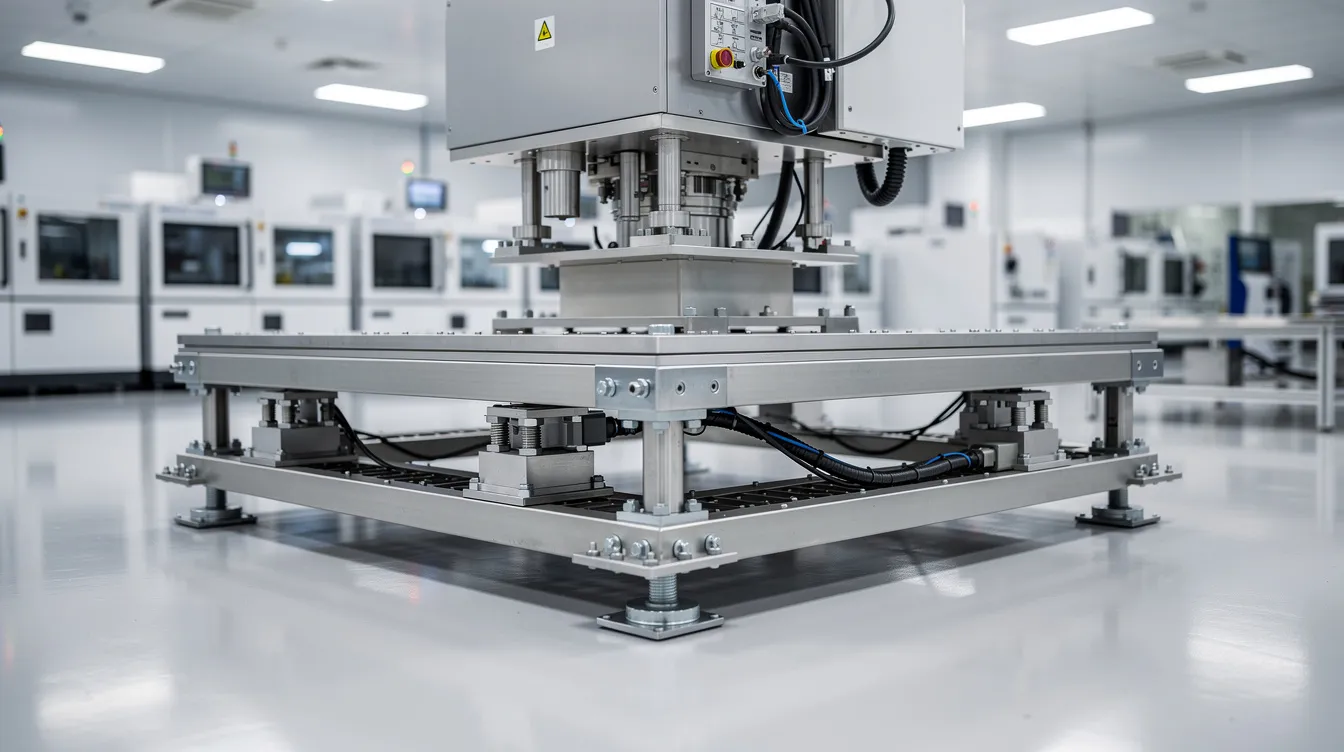
Active vibration isolation systems use sensors (accelerometers, geophones) to generate opposing forces against detected vibrations in real-time. Active isolation systems counteract vibrations across the full frequency spectrum, excelling in the critical 0–10 Hz range where passive systems struggle. Hard-mount active isolators result in 40 times less payload displacement compared to soft-mount passive alternatives. The tradeoff: active systems require specialized maintenance, control system calibration, and carry higher failure-mode complexity.
Engineered damping systems absorb vibration energy effectively and are frequently combined with isolation platforms. Additionally, sophisticated software helps suppress internal payload vibrations in automated robots and motion stages – addressing vibration at both the structural and equipment level.
For Singapore’s manufacturing sector, phased implementation is often the most practical path: begin with passive foundation isolation and structural stiffening, then add point-of-use active vibration isolation only at tools where process sensitivity demands it. This approach achieves cost-effective compliance while preserving the option to upgrade as production requirements evolve.
Common Challenges and Solutions in Singapore’s Manufacturing Sector
Even with sound engineering principles, vibration control in operational facilities presents persistent challenges – particularly for JTC lessees and high tech manufacturers working within existing building envelopes.
Retrofitting Existing Facilities for Enhanced Vibration Control
Retrofitting is inherently more constrained than greenfield design. Existing structural slabs, service risers, and ceiling heights limit what can be modified without major disruption. Engineers typically begin with non-destructive testing: deploying accelerometers to map vibration spectra across floors and structural components, identifying resonant modes and modal damping characteristics. A structural engineer inspection can establish baseline structural conditions before any isolation work begins.
One instructive case: in a large semiconductor fab, a persistent 16 Hz tonal vibration was traced not to nearby equipment but to a blast gate rattling inside an exhaust duct nearly 120 metres away. The fix involved securing the blast gate, adding dampers in ductwork, and isolating the duct attachment from the building structure – reducing the tonal vibration below the tool’s VC limit. This illustrates why comprehensive analysis across the entire facility network is essential, not just the immediate tool environment.
Practical retrofit methods in Singapore include adding point-of-use active isolation platforms, smoothing raised floor surface tolerances, introducing base masses beneath sensitive tools, and decoupling equipment frames via resilient mountings – all achievable without disrupting ongoing production operations.
Balancing Cost Constraints with Precision Requirements
Achieving VC-E or VC-F performance across an entire facility is prohibitively expensive. A more practical vibration control strategy is to design for VC-C or VC-D baseline performance and apply ultra-high-performance isolation only to designated tool rooms. This targeted approach can reduce capital expenditure by an order of magnitude while still achieving the required precision where it matters.
Life-cycle cost analysis is critical: an active system may cost several times more upfront and require specialized maintenance, but vibrations can lead to structural fatigue in precision tools, and poor vibration control can result in tool misalignment, higher scrap rates, and downtime costing potentially millions of dollars per week in advanced fabs. Value engineering – such as evaluating negative-stiffness isolators to eliminate compressed air infrastructure in cleanrooms – offers additional savings.
Managing Multi-Tenant Industrial Facility Vibrations
JTC industrial parks are frequently multi-tenant environments where shared mechanical rooms, common walls, and shared floor slabs act as vibration transmission paths between lessees. Managing this requires coordination: establishing operational agreements, implementing buffer zones, inserting vibration joints in floors or structure between tenant zones, and conducting shared ambient vibration monitoring.
In recent CleanTech Park EIAs, monitoring plans have begun requiring collaborative source control – scheduling mechanical plant operation, maintaining AHUs and fans on regular cycles, and ensuring vibration harmonics are managed. These multi-tenant protocols represent an evolving practice area that will likely become more formalized as high tech tenants push stricter vibration demands.
Solving these challenges requires not just engineering expertise but also robust monitoring infrastructure to verify performance over time.
Monitoring, Measurement, and Continuous Control
Regular monitoring and preventive maintenance are vital for effective vibration management. Without continuous measurement, isolation systems degrade silently while production quality erodes.
Baseline measurements should be conducted before tool installation: measure ambient vibration spectra over 24–72 hours at representative points in tool rooms, under varying conditions (equipment off and on, during traffic peaks, during quiet periods). Metrics include displacement amplitude in µm, velocity in mm/s, acceleration in g or m/s², and PPV for ground-borne vibration.
Continuous monitoring uses sensors installed on floors, tool foundations, and equipment frames. Data acquisition across multiple axes (vertical and two horizontal) enables trending of long-term behaviour to detect degradation of isolation systems.
Continuous monitoring helps detect abnormal vibrations and predict maintenance needs, while regular vibration monitoring can detect early signs of machinery issues before they cause excessive vibration or safety hazards. Proactive maintenance enables scheduled repairs during planned downtime and reduces the need for costly emergency repairs.
Establishing monitoring intervals is crucial for effective maintenance – and training personnel in vibration monitoring enhances maintenance effectiveness across the operation.
A notable Singapore implementation: the National Metrology Centre installed a DVIA-UB700 active vibration isolation platform with approximately 600 kg payload capacity, achieving performance consistent with VC-F class – an extremely quiet research-grade environment. The platform’s transmissibility data across vertical and horizontal axes confirmed suppression of vibration amplitude below critical bands, validating active platform solutions for Singapore’s demanding applications.
Conclusion and Next Steps
Successful vibration control in high tech manufacturing demands an integrated approach: high-stiffness structural design to prevent resonance, carefully selected isolation technology to mitigate disturbances at the tool level, and ongoing monitoring aligned with Singapore’s BCA, JTC, and international VC requirements.
The design of building structures influences vibration performance fundamentally – and every decision from site selection to isolator specification compounds to determine whether a facility can support current and future precision demands.
To move forward effectively:
- Conduct a facility vibration assessment according to BCA guidelines and IEST VC criteria, establishing baseline spectra across all critical tool locations
- Engage qualified engineering consultants for compliance review and PE endorsement of structural and isolation designs
- Develop a phased implementation plan starting with structural and passive isolation foundations, adding active systems at high-sensitivity tools as budgets allow
- Establish monitoring protocols with defined intervals, alert thresholds, and staff training for continuous improvement and reliability
Facilities looking to expand their vibration control programs should also explore structural health monitoring systems, cleanroom design optimization for reducing vibration transmission, and equipment-specific isolation strategies as next steps toward achieving world-class manufacturing performance.
Additional Resources
- BCA Code of Practice for structural design, vibration limits, and shock displacement parameters in industrial facility plan submissions – BCA Guidelines for Plan Submission
- JTC guidelines for heavy machinery installation, environmental impact assessments, and baseline vibration monitoring in industrial estates – JTC CleanTech Park EIA Report
- IEST VC Criteria reference for determining appropriate vibration criteria levels for specific manufacturing tools – VC and Nano Criteria Documentation
- Professional engineering endorsement requirements for vibration control system design, structural analysis, and implementation in Singapore – PE Endorsements and Structural Modelling Design & Analysis