
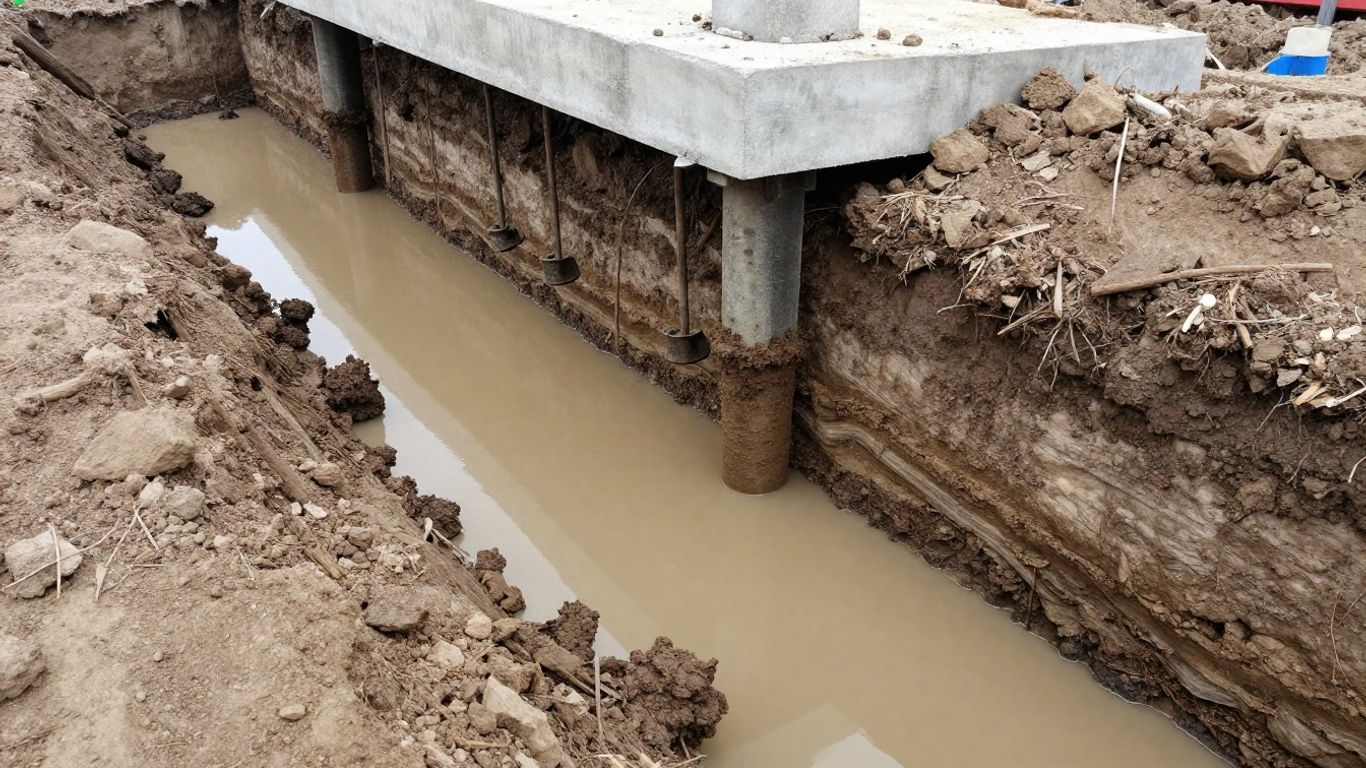
Engineers working in soft soil environments, such as the lacustrine zones of Mexico City, face unique challenges when designing friction pile foundations. Regional subsidence driven by groundwater extraction induces negative skin friction (NF), complicating load bearing calculations. Recent advancements in finite element analysis (FEA) are providing new insights into how these foundations interact with consolidating ground and transient load events.
Key takeaways
- Numerical modeling demonstrates that negative skin friction can be partially offset or even replaced by external transient loads.
- The neutral level, where skin friction shifts from negative to positive, is dynamic and depends heavily on initial pile loading conditions.
- Border and corner piles within a foundation group are more susceptible to limit shear conditions than central piles.
- Modern design criteria allow for more precise estimates of load-carrying capacity, moving away from overly conservative assumptions.
Understanding negative skin friction
Negative skin friction occurs when surrounding soil settles faster than the pile itself, dragging the structure downward. In regions like Mexico City, this process is exacerbated by groundwater pumping, which consolidates the clay subsoil. Historically, engineers struggled to calculate the exact impact of this drag on pile stability. However, research combining 2D and 3D finite element modeling has mapped how this force manifests across different pile configurations within a foundation group.
Numerical modeling and design advancements
Traditional pile design often adds the effects of permanent loads and negative skin friction together, which can lead to inefficient foundations. Advanced FEA simulations have revealed that when transient loads—such as seismic activity or high winds—are applied, the pile behaves like a pre-loaded element. Under these conditions, the NF is significantly mitigated and can even turn into positive skin friction.
By utilizing these numerical models, practitioners can now perform more accurate structural safety reviews. The studies suggest that for large pile groups, the NF observed on central piles is capped by the apparent increase in the submerged weight of the surrounding soil. For perimeter and corner piles, which carry higher loads due to mat stiffness, the model confirms that limit conditions are reached much sooner, necessitating targeted reinforcement strategies.
Implications for structural design
These findings have significant implications for building codes. Rather than using fixed, overly conservative estimates for NF, engineers are now encouraged to employ explicit numerical modeling to account for future pore pressure drawdowns. This approach ensures greater structural safety while reducing material waste. By understanding the interaction between transient forces and long-term soil consolidation, designers can create more resilient foundations that are specifically calibrated to the complex geotechnical realities of dense, clay-rich urban landscapes.
References
- Client Challenge, Nature.
- Client Challenge, Nature.
- Client Challenge, Nature.
- Criteria for the design of friction piles subjected to negative skin friction and transient loads, SciELO México.