
Engineering isn’t always as simple as a pen-and-paper calculation. Sometimes, you’re staring at a piece of hardware—like an engine component or a complex bracket—and the geometry is just too messy for standard formulas. That is when engineers pull out the big gun: the finite element method (FEM). It helps us break down complex physical problems into tiny, manageable chunks that a computer can actually solve.
Key takeaways
- FEM turns impossible-to-calculate geometries into solvable numerical models.
- The process involves ‘discretization,’ where we chop a structure into smaller parts called elements connected at nodes.
- Each element acts like a spring with its own stiffness matrix.
- We stitch these matrices together into a massive web to calculate how the whole structure will bend, stretch, or break under pressure.
Why do we need it?
Most of the formulas you learn in school work great for static beams or simple shapes. But in the real world, things get weird. Whether you’re checking if a satellite can handle a rocket launch or trying to shave weight off a car suspension, you rarely have a ‘simple’ object. Without computers, we’d be stuck guessing or building expensive prototypes just to watch them fail. FEM lets us simulate all of that—stress, heat transfer, or even fluid flow—before the first part is ever machined.
The art of discretization
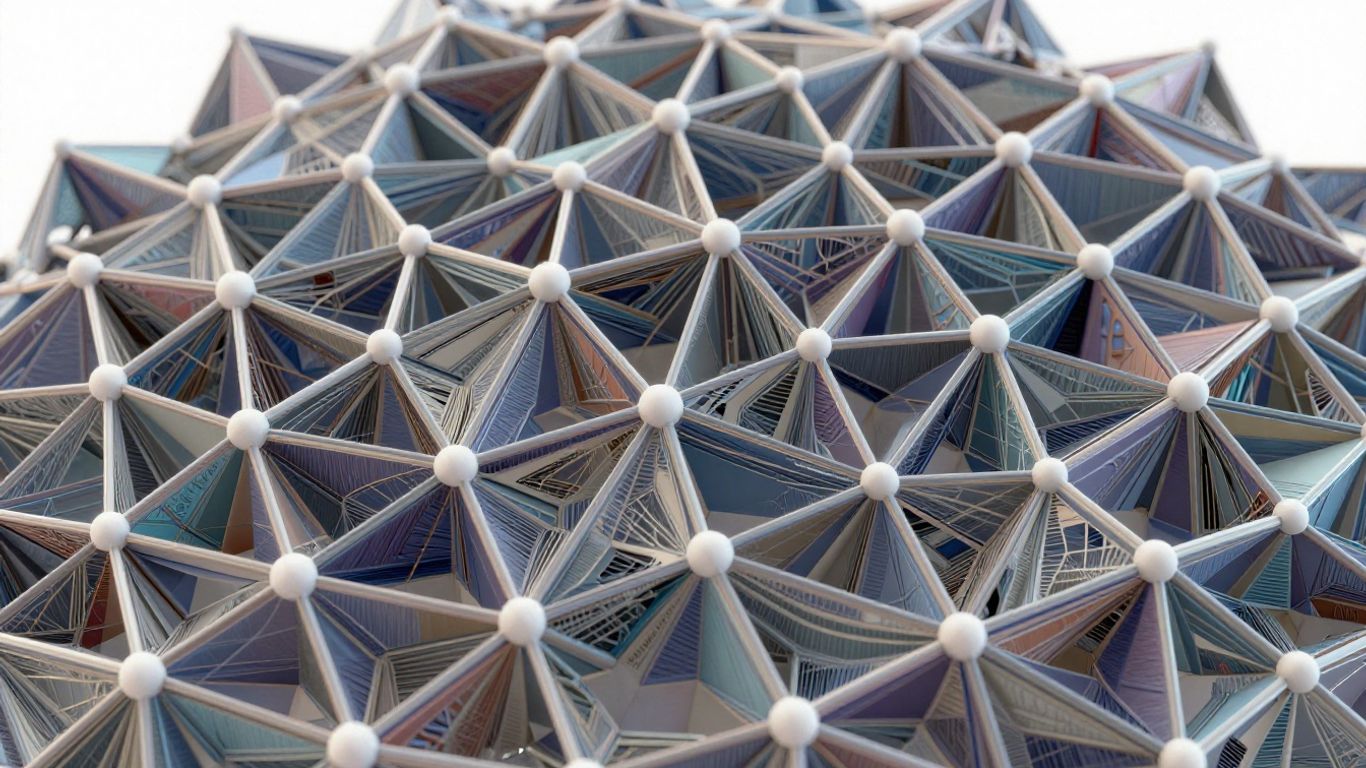
The secret sauce of FEM is discretization. Instead of trying to define the stress at every single point in an entire car part, we split it into smaller, simpler shapes. These are our ‘elements,’ and they link up at specific points called ‘nodes.’
| Element Type | Primary Use Case |
|---|---|
| Line elements | Beams, bars, and trusses |
| Surface elements | Thin plates and shells |
| Solid elements | Complex 3D components |
It’s a bit like building an object out of LEGO bricks. Sure, the original object is curved or rounded, but if you have enough small bricks, you can get a pretty damn accurate representation.
The math behind the stiffness
Here is where it gets interesting. Every element in your mesh is treated like a tiny spring. You’ve likely heard of Hooke’s Law—force equals stiffness times displacement. In FEM, we use an entire matrix to describe how each element resists movement. It accounts for how a node translates or rotates in 3D space. When an element is pushed, it doesn’t just move; it moves based on how stiff it is and how its neighbors are pulling on it.
Building the global map
If one element is a spring, a full model is a massive web of those springs. We take every element’s stiffness matrix and assemble them into a giant, sparse table called the ‘global stiffness matrix.’ It sounds fancy, but it just tells the computer how every node in the entire structure affects every other node.
Once that matrix is set, we add the boundary conditions—like where the part is bolted down or where a force is hitting it—and the computer solves the system of linear equations. It essentially calculates the displacement of every single node in the entire mesh. Once you know how much each point moved, calculating the actual stress is just a bit of extra math.
Who actually calculates this?
Honestly, nobody does this by hand anymore. If your model has a hundred thousand degrees of freedom, you’d be there until the end of time. While the software does the heavy lifting, the human factor is still crucial. As engineers, we have to make sure the mesh is high-quality and that we aren’t misinterpreting what the software is telling us. It’s a powerful bridge between abstract physics and real-world manufacturing, as long as you respect the approximations you’re making along the way.