

Key Takeaways
- The finite element method provides a robust framework for simulating the performance of intricate structural assemblies under various design loads.
- Accurate representation of material properties and geometric configurations remains essential for reliable results in structural simulations.
- Integration between architectural geometry and analytical models ensures that complex structures meet safety and performance requirements.
- Stability and buckling assessments distinguish between local and global failure modes in high-demand structural scenarios.
- Rigorous quality assurance processes, including mesh sensitivity studies and benchmarking, are required to confirm the validity of finite element data.
Fundamentals of FEM analysis for complex steel structures
Designing modern steel buildings requires a transition from simplistic manual calculations to sophisticated computational methods. By discretizing a continuous structure into finite elements, engineers can predict how loads transfer through complex geometries with high precision. Understanding the underlying physics is crucial for any engineer aiming to produce safe and efficient structural solutions.
Principles of finite element discretization
Discretization is the foundational step in turning a physical structure into a solvable system of algebraic equations. A model is divided into a mesh of nodes and elements that translate the complex shape of a building into recognizable geometric sub-units. The denseness of this grid dictates the fidelity of the simulation, balancing between computational runtime and the accuracy of capturing local stress variations.
Linear versus nonlinear structural behavior
Most routine tasks safely assume linear elastic behavior where displacements remain proportional to loads. However, for significant deformations or material yielding, nonlinear analysis becomes mandatory to observe phenomena like geometric instability or plastic hinge formation. Deciding when to bridge from linear to nonlinear workflows is a key component of modern structural analysis and engineering judgment.
Selection of appropriate element types
Engineers must map the physical structure to the correct digital counterparts, choosing between frame elements for beams or shell elements for plates and slabs. Using STAAD Pro as a structural analysis powerhouse, designers can categorize members effectively, ensuring the element type matches the physical behavior being assessed. Choosing the wrong element, such as using beams where membrane action dominates, leads to a significant loss of result integrity.
Material constitutive models for steel
Steel models in software must account for linear elasticity, yield thresholds, and strain hardening behaviors. These constitutive models allow software to reflect how steel responds during an over-limit loading event. By accurately defining the yield strength and modulus of elasticity, the analyst ensures that the simulation mirrors the behavior of actual materials under diverse construction environments.
Modeling complex geometry and structural interaction
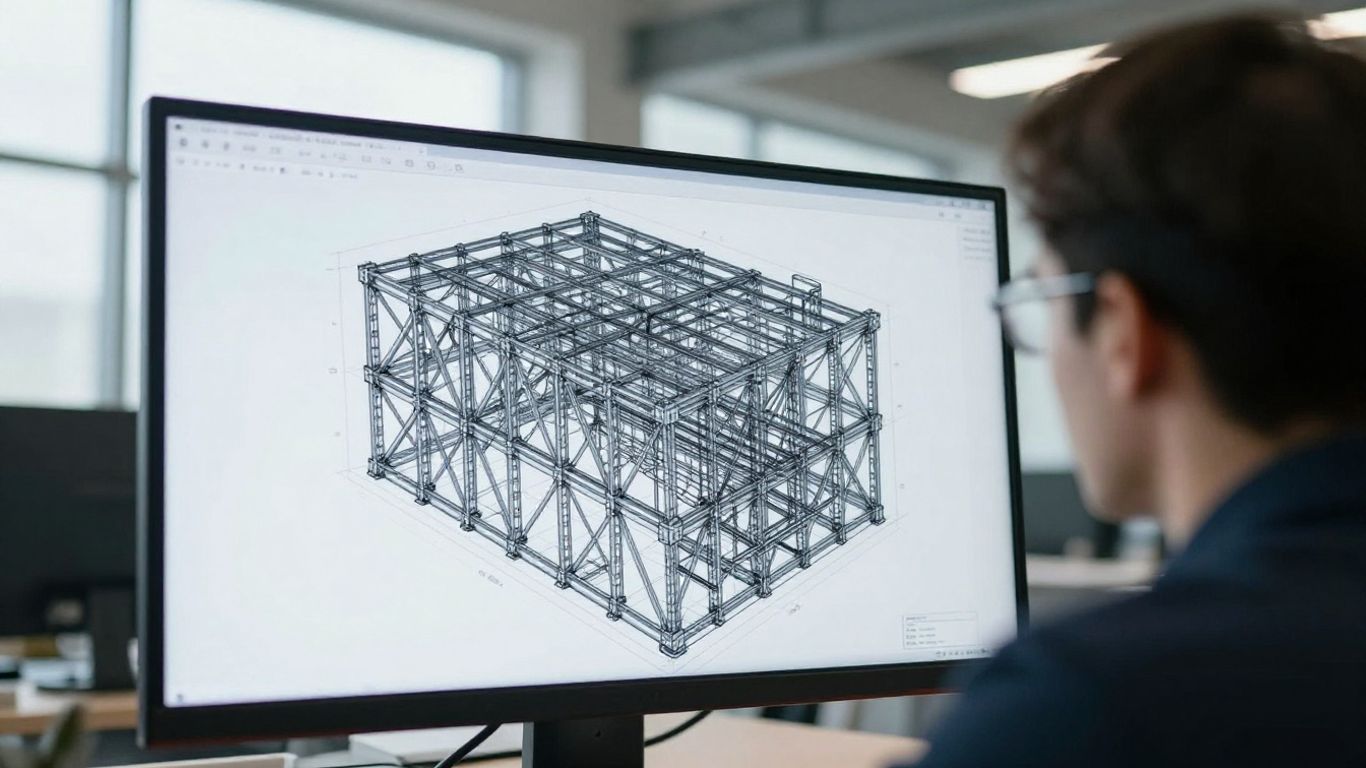
Modeling the physical reality of a site is rarely a matter of simple lines and curves. Real-world structures often involve non-uniform configurations that require specialized attention to maintain structural integrity. This requires careful consideration of the interaction between various structural systems and the surrounding context.
Handling non-uniform architectural configurations
Architectural flair often demands unconventional structural forms that defy standard framing rules. Addressing these unique configurations involves segmenting the structure into manageable zones where continuity can be modeled effectively. Careful software interaction is necessary when applying standard codes to non-standard shapes.
Integration of primary and secondary steel systems
Primary frames serve as the backbone, while secondary members provide stability and support for cladding or internal partitions. Analyzing the connection between these systems is essential for determining how loads fluctuate across the assembly. Proper distribution of these loads ensures the entire system works in harmony.
Simplifying geometric complexity without loss of accuracy
Abstraction is necessary to prevent models from becoming computationally overloaded. By removing items like minor hardware or aesthetic features, engineers focus the mesh density where it matters most. Stripped-down geometry retains the essential structural characteristics needed for valid analysis.
Importing and cleaning CAD data for analysis
Importing files directly from architectural platforms often creates messy data that requires immediate refinement. A systematic cleaning process ensures that nodes are connected correctly and redundant geometries do not skew results. Consider these essential steps:
- Standardizing unit systems to align analytical platforms with original design documents.
- Eliminating overlapping or disconnected segments to ensure closed surfaces or continuous frames.
- Collapsing tiny gaps that might cause singularity errors during the solution process.
- Verifying the overall unit consistency across different imported components.
Defining load paths and boundary conditions
Understanding how loads travel from floors to foundations requires meticulous attention to the definition of boundary conditions. Without clear load path tracking, even the most sophisticated analysis will fail to reflect structural reality.
Applying dead, live, and environmental loads
Dead loads from the structure and live loads from typical occupancy define the primary demand. Environmental loads like wind or temperature transitions add time-dependent forces that oscillate or build up stress. These inputs must be carefully balanced against code-prescribed scenarios to build a complete picture of the building’s demand.
Modeling support reactions and structural constraints
Supports define where a structure is restrained against movement or rotation. In complex projects, assigning the correct stiffness to these supports—ranging from idealized pin-joints to complex, semi-rigid foundation connections—is a common source of significant modeling variance. Ensuring these constraints match the real-world connection stiffness prevents major calculation errors.
Capturing soil-structure interaction effects
Foundation behavior directly influences how the superstructure deflects above ground. By utilizing PLAXIS for geotechnical analysis excellence, analysts can bridge the gap between simple pinned supports and realistic, elastic-plastic foundation behavior. This integration is vital for structures where differential settlement may pose a threat to the frame.
Combining dynamic and static load cases
Static and dynamic loads coexist in many environments, creating distinct combinations that require iterative evaluation. Static analysis handles predictable gravity loads, while dynamic simulation addresses vibration or impact events. These cases are assessed in tandem to verify that the structure remains stable under extreme conditions.
Stability and buckling assessment methods
Stability is the ultimate check for thin-walled or slender elements vulnerable to geometric instability. If a structure behaves properly under load but fails through buckling, the entire design is invalid.
Eigenvalue buckling analysis for thin-walled sections
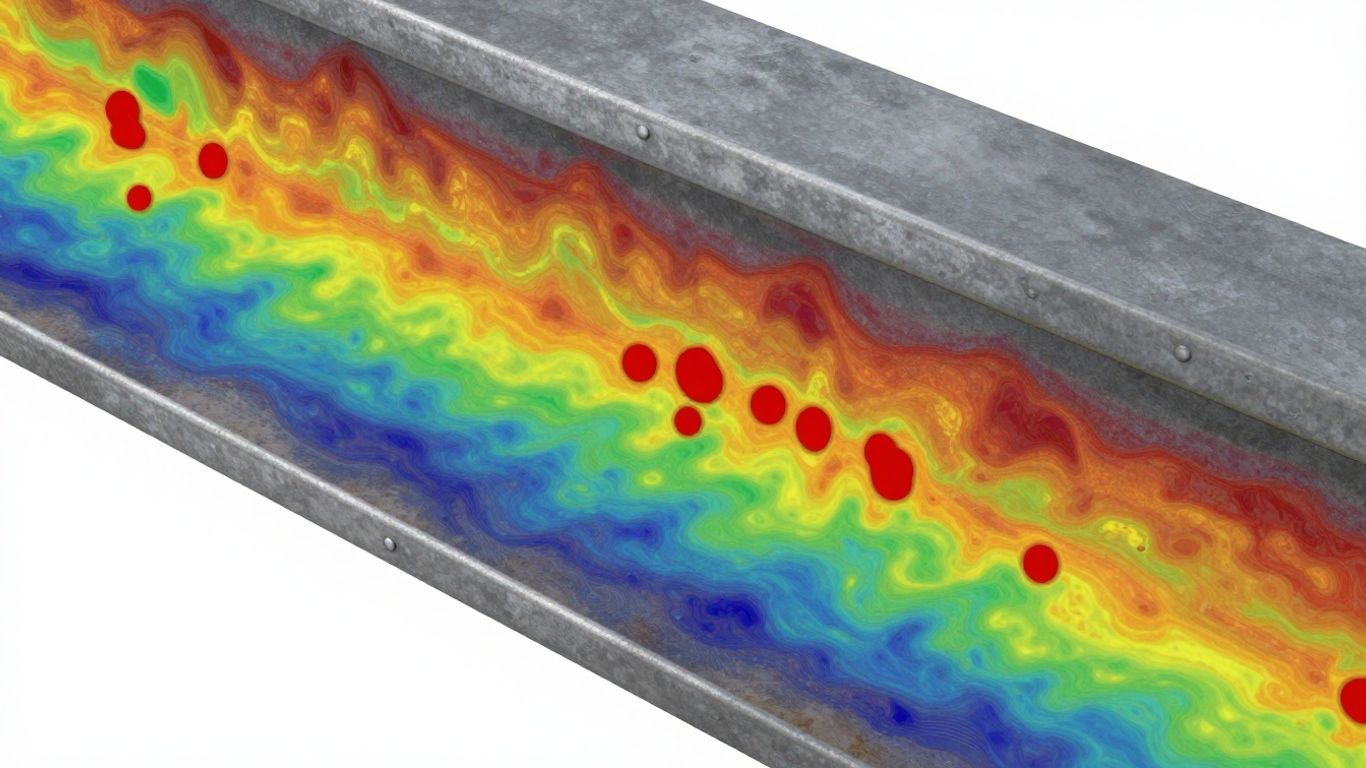
This method estimates the theoretical elastic limit where a member fails under axial compression. It serves as an early screening tool for identifying critical buckling shapes. While useful for idealized scenarios, it rarely accounts for real-world deviations.
Incorporating initial geometric imperfections
Manufacturing and erection tolerances result in members that are never perfectly straight. Including these initial "out-of-plumb" or "out-of-straightness" factors in the analysis provides a more realistic view of the stability limit. Without these, models often overestimate the strength of thin sections.
Distinguishing between local and global instability
Global instability involves the entire frame shifting or collapsing, whereas local buckling affects just a single flange or web. Distinguishing between these allows engineers to strengthen members without over-engineering the connection between them. Below is a breakdown of how buckling modes influence design choices.
| Buckling Mode | Impact on Strength | Remedial Action |
| :— | :— | :— | (
| Local Buckling | Moderate | Increase plate thickness |
| Distortional | High | Add stiffeners |
| Global Buckling | Extreme | Improve lateral bracing |
Nonlinear post-buckling behavior analysis
Modern software permits simulating what happens after a member reaches its buckling load. In some ductile steel sections, there remains a capacity to absorb further load through redistribution. Capturing this involves intense nonlinear iteration, often requiring robust computational resources to maintain convergence.
Precision modeling of steel connections
Connections form the junctions where structural behavior is often dictated by the local detail. Inaccurate assumptions here can lead to either unsafe designs or excessive material usage.
Defining rigid versus semi-rigid connection behavior
Rigid connections transfer full moments, while semi-rigid ones allow for some rotations that redistribute force. In Tekla Structures for steel detailing, documenting these nuances ensures that the fabrication model matches the engineer’s design intent. Choosing correctly between these two modes is essential for accurate global structural performance.
Detailed analysis of welded and bolted joints
Detailed simulations of joints often look at individual bolts or specific weld paths to check for local failure. This level of detail confirms that the load path through the gusset or plate is clear. Such granular analysis validates the chosen connection type against real force magnitudes.
Accounting for stress concentrations and heat-affected zones
Welded connections create heat-affected zones that potentially alter material properties. Ignoring these variations can lead to underestimating stresses at critical welding points. A high-fidelity model addresses these localized property changes as part of the total check.
Evaluating stiffness impacts on global structural performance
Connection stiffness is not just a detail; it affects the distribution of forces throughout the building. By refining how connections are modeled, users ensure that the stiffness inputs in global simulation reflect shop drawings. This harmony between connection modeling and global structural performance represents the pinnacle of standard professional practice.
Fatigue and serviceability limit states
While structural strength covers the failure threshold, serviceability ensures the building is comfortable for its inhabitants. Fatigue, meanwhile, addresses the durability of connections under repetitive cycling.
Analyzing cyclic loading and stress ranges
Buildings subjected to recurring loads like heavy machinery or wind gusts experience stress fluctuations that can lead to fatigue. Calculating the total number of cycles vs. the stress range determines the expected lifespan of a connection. This assessment is vital for industrial facilities where equipment-induced vibration is common.
Vibration assessment in long-span steel structures
Large spans often struggle with human-induced vibrations or footsteps. Analyzing these frequencies ensures the building doesn’t feel bouncy or uncomfortable. Mitigation might involve tuning the mass or stiffness of the system to push natural frequencies outside the range of typical occupancy.
Control of deflections and excessive deformation
Excessive deflection can damage finishes or lead to glass breakage in curtain walls. Managing these limits helps maintain the aesthetic and functional longevity of the structural system. Engineers reconcile these limits by checking the service-level load cases against the calculated stiffness of the beams.
Verification against code-based serviceability criteria
Codes provide benchmarks for how much a structure should deform under service loads. These requirements are distinct from safety factors. Rigorous verification ensures the design meets all local building regulations, guaranteeing the structure maintains its intended appearance and comfort throughout its life.
Quality assurance and validation of FEA results
Finite element results are a product of inputs and the user’s choices. Validation ensures that the output is not garbage by verifying the sanity of every result set.
Sensitivity studies for mesh density and convergence
Convergence checks involve rerunning the model with a finer grid until result values stop changing significantly. This proves that the results are not dependent on the specific meshing choice. A model that hasn’t converged is not a reliable source of information.
Checking model equilibrium and reaction forces
Checking that the sum of vertical and lateral reaction forces equals the total applied load is the most basic yet necessary check. If the numbers don’t add up, the boundary supports aren’t transferring the loads as expected. This balance is simple arithmetic that prevents major design oversights.
Benchmarking against simplified analytical methods
Compare the FEA outcome for a primary member against an analytical calculation like a simple beam formula. If the FEA results deviate significantly, investigate whether the local model assumptions are valid or if the discretization logic is flawed. These manual checks ground digital models in basic physics.
Documentation requirements for regulatory compliance
Regulatory authorities require clear reports detailing every assumption and result set. Keeping precise logs of the modeling methodology satisfies both compliance checks and future maintenance needs. Complete documentation ensures that others can verify, audit, and trust the analysis when re-visiting the structure years down the line.
Conclusion
Successfully implementing finite element analysis in steel structures hinges on the careful balance between detailed modeling and fundamental engineering intuition. By maintaining accuracy in discretization, material modeling, and load validation, engineers build structures that are both efficient and resilient. Continued focus on refining the analytical process, from initial design through to final quality assurance, ensures that modern steel projects stand the test of time.
Frequently Asked Questions
Why is meshing so important for the accuracy of an FEA model?
Meshing breaks down complex shapes into smaller pieces that a computer can calculate. If these pieces are too coarse, the model misses stress concentrations, but if they are too fine, the simulation may not finish. Finding the right balance allows for results that are both representative of real-world stress and computationally manageable.
How do initial geometric imperfections influence the buckling capacity of a beam?
Real beams are never perfectly straight, and an initial curve or a slight tilt can significantly lower the axial load an element can hold before it buckles. By explicitly modeling these small imperfections, the analysis provides a more realistic lower bound of the structure’s real-world strength compared to a perfect geometry.
What is the difference between a static and a dynamic analysis in steel design?
Static analysis assumes loads are applied slowly and remain constant to find a state of balance. Dynamic analysis accounts for the time-dependent nature of loads like seismic activity or vibrations, which have the potential to initiate movement or oscillations that a static model would completely ignore.
When should an engineer use nonlinear analysis instead of linear analysis?
Linear analysis works for standard loads where material stress stays below the yield point. Nonlinear analysis becomes necessary when a structure undergoes geometry changes that significantly alter force paths, or when material yields under excessive force, as it allows for tracking post-yield performance.
How is soil-structure interaction addressed in large building foundation models?
Engineers define the soil’s stiffness as part of the structural supports rather than assuming fixed points at every location. This allows the building model to account for differential settlements, which influences the distribution of moments in the superstructure and affects the long-term strain on connection points.
What steps ensure that a computer model correctly represents a design intent?
Validation involves benchmarking the computer results against hand calculations and simplifying the model to check equilibrium. If the reactions at the supports do not equal the total applied loads, it suggests that the connections or stiffness assumptions in the model do not reflect the physical structure it is intended to simulate.
Why do fatigue and serviceability limits receive separate attention from ultimate strength?
Ultimate strength ensures the structure does not collapse under extreme events, while serviceability concerns occupant comfort, such as vibration sensitivity or deflection. Fatigue addresses long-term degradation from repetitive cycling, so distinct calculations are required to ensure the structure lasts for its entire design life without premature failure.