

LTA project approval is the authorized regulatory clearance process issued by Singapore’s Land Transport Authority, required for any construction or development work that affects public roads, transport infrastructure, or rail corridors. Every developer, contractor, or property owner undertaking such work must secure this clearance before proceeding. The process operates across three mandatory submission gateways and integrates directly with the Corenet X digital platform, which coordinates simultaneous reviews by agencies including BCA and URA. Understanding what is LTA project approval, its stages, and its documentation requirements is the difference between a project that proceeds on schedule and one that faces costly rework.
What is LTA project approval and how does it work?
LTA project approval is the formal permit process through which Singapore’s Land Transport Authority reviews and authorizes development works that interact with public transport infrastructure, roads, and rail systems. The approval is not a single event. It is a multi-gateway regulatory process structured around three distinct submission stages, each with its own documentation requirements and review criteria.
The three mandatory gateways are the Design Gateway (DG), the Construction Gateway (CG), and the Completion Gateway, which corresponds to the Temporary Occupation Permit or Certificate of Statutory Completion (TOP/CSC). Each gateway serves a specific regulatory function. The DG stage establishes the project’s spatial and design intent, the CG stage confirms technical readiness for construction, and the Completion Gateway verifies that the finished works comply with all approved plans.

Qualified Persons (QPs), typically registered Professional Engineers or architects, must endorse all submissions at each stage. LTA will reject incomplete applications. The QP endorsement requirement also requires full names and designations of all responsible parties to be annotated on submitted documents.
The LTA approval process is legally grounded in the Road Traffic Act and the Rapid Transit Systems Act. Both statutes give LTA the authority to mandate compliance and impose penalties for unauthorized works near protected infrastructure.
Submission requirements by gateway stage
The table below summarizes the core documentation required at each stage of the LTA project approval process.
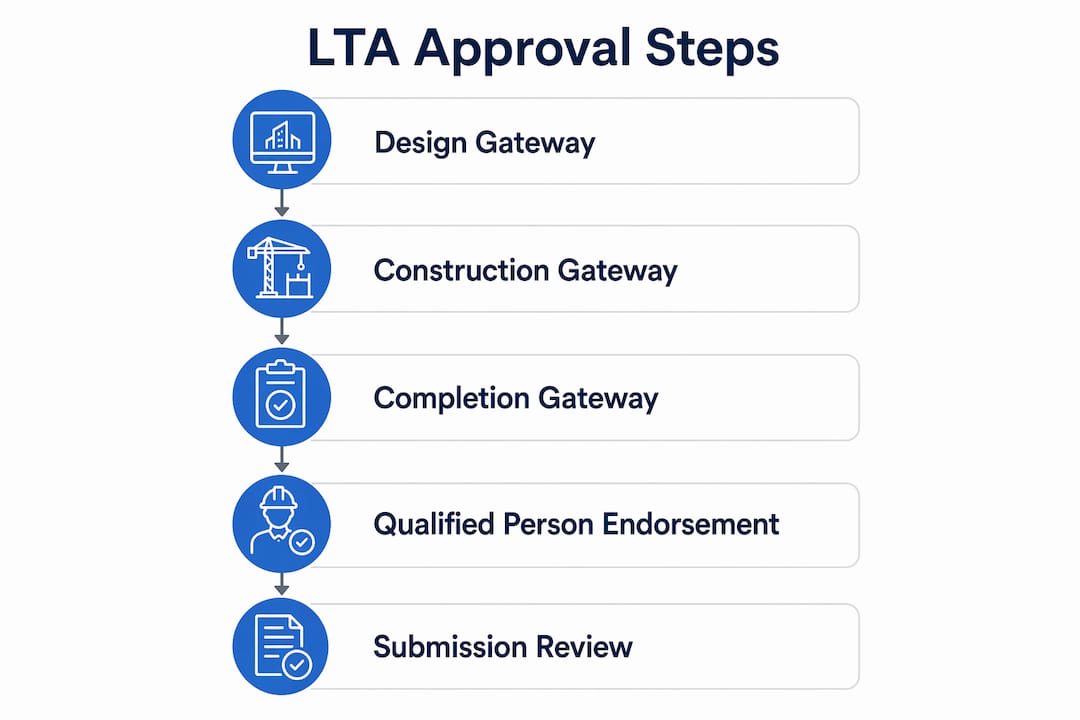
| Gateway Stage | Key Submissions Required |
|---|---|
| Design Gateway (DG) | Site plans, topography surveys, traffic impact assessments, preliminary utility coordination |
| Construction Gateway (CG) | Detailed design calculations, utility service plans, structural drawings, traffic management plans |
| Completion Gateway (TOP/CSC) | As-built drawings, inspection reports, compliance certifications, QP sign-off |
Submissions for Civil and Transport works, as well as Mechanical and Electrical (M&E) systems, must each meet the specific document requirements at DG and CG stages. Omitting any required item triggers a rejection, which restarts the review clock.
- Site plans must show the full extent of proposed works relative to road reserves and rail protection zones.
- Topography surveys must be current and certified by a licensed surveyor.
- Traffic management plans must address both construction phase and post-construction conditions.
- Utility coordination must confirm no conflicts with existing PUB, SP Group, or Singtel infrastructure.
Pro Tip: Submit a pre-application consultation request to LTA before the formal DG submission. This informal review identifies documentation gaps early and reduces the risk of a first-round rejection.
How does Corenet X reduce LTA approval timelines?
Corenet X is a joint digital regulatory platform developed by BCA, URA, LTA, and four other agencies to enable concurrent review of development submissions. Before Corenet X, applicants submitted to each agency separately and reconciled conflicting requirements manually. The platform eliminates that duplication.
The Corenet X platform reduces the overall regulatory approval timeline by up to 20%. That reduction is significant on large projects where multi-agency delays previously added months to pre-construction schedules. Corenet X became mandatory for large projects exceeding 30,000 square meters, and its coordinated agency responses give applicants consolidated feedback rather than fragmented, sometimes contradictory, instructions from individual agencies.
The practical benefits for LTA submissions include:
- Simultaneous review by seven agencies, including LTA, BCA, and URA, from a single submission.
- Consolidated responses that reduce the need to reconcile differing regulatory requirements.
- Improved certainty before construction begins, as all agency conditions are resolved at the design stage.
- A digital audit trail that supports compliance verification at the Completion Gateway.
For developers and contractors, the Corenet X submission process requires BIM-compliant digital models and structured data formats. Projects that invest in proper BIM preparation before submission consistently achieve faster turnaround times.
Pro Tip: Use the Corenet X pre-submission checklist to verify that all agency-specific data fields are populated before uploading. Incomplete digital submissions generate automated rejections that do not pause the review clock.
What operational permits fall under LTA approval?
LTA project approval extends beyond construction plan clearances. It also covers operational permits for activities that affect public roads during and after construction. The most common category is the Oversized Vehicle Movement (OVM) permit, which governs heavy haulage vehicles transporting loads that exceed standard road dimensions or weight limits.
OVM permits come in two types. Ad-Hoc permits cover a single move and are suited to one-time deliveries of large equipment or prefabricated structural elements. Term permits cover recurring identical moves and are valid for 3–6 months, making them practical for ongoing construction supply chains. Both permit types require submission at least 3–7 working days before the scheduled move. Standard processing takes 3–5 working days, but complex routes or unusual loads may require additional time.
For loads exceeding 80 tonnes, LTA requires a structural assessment and a Professional Engineer evaluation confirming that the proposed route can bear the load. Failure to submit proper engineering assessments results in permit delays or outright refusals. Route coordination with other agencies may also be required when moves cross restricted zones or rail corridors.
Common documentation requirements for OVM permits include:
- Vehicle specifications, including axle configuration and gross vehicle weight.
- Detailed load dimensions and weight distribution calculations.
- Proposed route map with all turning radii and overhead clearance points identified.
- Professional Engineer structural assessment for loads above 80 tonnes.
- Escort vehicle arrangements and traffic management plan for the move.
Applicants submit OVM permit applications through the LTA One-Stop portal. The types of building permits in Singapore extend across multiple categories, and OVM permits represent one of the most time-sensitive due to their fixed operational windows.
What are the common compliance challenges in LTA approvals?
The most frequent and costly mistake in the LTA project approval process is treating approval as a final step rather than an integrated design requirement. Applicants who begin LTA coordination only after completing their design often discover that road reserve setbacks, rail protection zone buffers, or utility conflicts require significant redesign. That rework delays the entire project, not just the LTA submission.
LTA’s approval framework is built on a safety-first principle that requires comprehensive risk management and technical validation at every stage. This principle applies equally to construction plan approvals and operational permits. A submission that does not demonstrate adequate risk mitigation will not receive clearance, regardless of how complete the documentation appears on the surface.
QP endorsement is not a formality. The QP is legally accountable for the accuracy and completeness of every submission. Appointing a QP late in the design process, or selecting one without specific LTA submission experience, introduces significant compliance risk. LTA submissions require knowledge of road reserve regulations, rail protection zone requirements, and utility coordination protocols that are distinct from general building plan submissions.
Non-compliant or incomplete submissions do not simply result in a request for additional information. LTA rejects them outright, and the applicant must resubmit from the beginning of the relevant gateway stage. On a large development project, a single rejected CG submission can delay construction commencement by four to eight weeks.
Pro Tip: Integrate LTA requirements into the project brief at the feasibility stage. A construction compliance checklist that includes LTA road reserve setbacks and rail buffer zones prevents the most common causes of design rework.
Key Takeaways
LTA project approval is a multi-gateway, agency-integrated regulatory process that requires early design coordination, QP endorsement, and full documentation compliance at every submission stage.
| Point | Details |
|---|---|
| Three mandatory gateways | Every development submission must pass Design, Construction, and Completion gateways with distinct documents at each. |
| Corenet X reduces timelines | The platform cuts overall approval time by up to 20% through simultaneous seven-agency review. |
| OVM permits have strict deadlines | Heavy haulage permit applications must be submitted 3–7 working days before the scheduled move. |
| QP endorsement is legally binding | A Qualified Person is accountable for submission accuracy; appointing one late creates compliance risk. |
| Early integration prevents rework | Treating LTA approval as a final step causes redesign delays that affect the entire project schedule. |
Why early coordination defines LTA approval outcomes
Having worked across statutory submissions for construction and infrastructure projects in Singapore, I have observed one consistent pattern: the projects that clear LTA approvals efficiently are the ones where LTA requirements were built into the design brief from day one, not retrofitted after the architect had already committed to a layout.
The introduction of Corenet X has genuinely changed the approval environment. Simultaneous agency review means that a well-prepared submission now receives consolidated feedback within a defined window, rather than trickling in from seven agencies over several months. That is a material improvement. However, the platform amplifies both good and poor preparation. A complete, well-structured submission moves faster than ever. An incomplete one fails faster than ever.
The distinction between LTA project approval and a Lender’s Technical Advisor (LTA) review is also worth clarifying for developers working with project finance. The regulatory approval from Singapore’s Land Transport Authority and the technical review conducted by a lender’s appointed advisor are entirely separate processes. Conflating the two creates confusion in project timelines and financing conditions.
My practical recommendation is to engage a QP with direct LTA submission experience before the schematic design is finalized. That single decision eliminates the most common source of costly rework. Regular pre-submission consultations with LTA, combined with disciplined use of the Corenet X checklist, give any project the best possible foundation for timely clearance.
— Aman
Professional support for LTA project approval submissions
Navigating the LTA project approval process requires precise documentation, QP-endorsed submissions, and coordination across multiple regulatory agencies. A single gap in any gateway submission can reset the review process entirely.
Com, Aman Engineering Consultancy, provides end-to-end support for LTA submissions, from Design Gateway documentation through Completion Gateway sign-off. The team covers civil and structural design, M&E coordination, QP endorsement, and Corenet X digital submissions. For developers and contractors who need a reliable partner to manage the full regulatory compliance process, Com offers the technical depth and agency familiarity to get submissions right the first time. Visit Aman Engineering Consultancy to review the full range of services and contact the team directly.
FAQ
What is LTA project approval in Singapore?
LTA project approval is the regulatory clearance issued by Singapore’s Land Transport Authority for construction and development works affecting public roads, transport infrastructure, and rail corridors. It requires submissions at three mandatory gateways: Design, Construction, and Completion.
How long does the LTA approval process take?
Processing timelines vary by project complexity and submission completeness. The Corenet X platform reduces overall approval time by up to 20% through simultaneous multi-agency review, but incomplete submissions restart the review clock at the relevant gateway stage.
Who can submit LTA project approval applications?
All LTA submissions must be endorsed by a Qualified Person, either a registered Professional Engineer or architect with relevant LTA submission experience. The QP is legally accountable for the accuracy and completeness of every document submitted.
What is an OVM permit under LTA?
An Oversized Vehicle Movement (OVM) permit is an operational permit issued by LTA for heavy haulage vehicles exceeding standard road dimensions or weight limits. Applications must be submitted 3–7 working days before the scheduled move, and loads above 80 tonnes require a Professional Engineer structural assessment.
What happens if an LTA submission is rejected?
LTA rejects incomplete or non-compliant submissions outright, requiring the applicant to resubmit from the beginning of the relevant gateway stage. On large projects, a rejected Construction Gateway submission can delay construction commencement by several weeks.