

An HDB submission is the official application to Singapore’s Housing & Development Board (HDB) that initiates eligibility verification and formal approval for purchasing, selling, or financing a public housing flat. The term covers three distinct application types: the HDB Flat Eligibility (HFE) letter, new flat applications under the Build-To-Order (BTO) or Sale of Balance Flats (SBF) schemes, and resale flat submissions. Each type carries its own documentation requirements, processing timelines, and compliance obligations. Understanding what is HDB submission means understanding which application applies to your transaction and what the consequences of procedural errors can be.
What is HDB submission and what types exist?
An HDB submission is not a single form. It is a category of formal applications to HDB, each serving a different stage of the flat purchase or sale process. The three primary types are the HFE letter application, the BTO or SBF new flat application, and the resale flat application. Knowing which type applies to your situation determines the documents you need, the fees you pay, and the deadlines you must meet.

The table below compares the three main submission types:
| Submission Type | Purpose | Fee | Validity / Timeline |
|---|---|---|---|
| HFE Letter | Confirms eligibility, grants, and loan amount | No fee stated | Valid for 6 months; processing takes ~21 working days |
| BTO / SBF Application | Applies for a new flat during a launch window | S$10 non-refundable application fee | 7-day application window per launch; option fees S$500–S$2,000 |
| Resale Flat Application | Formalizes the purchase or sale of an existing flat | Varies by transaction | Both parties submit within 7 calendar days; approval ~2 weeks after complete endorsement |
Key distinctions between submission types:
- The HFE letter is a prerequisite for both BTO and resale applications. You cannot proceed without it.
- BTO applications are ballot-based. Demand in mature estates can exceed supply by 4–7 times, making priority scheme awareness critical.
- Resale applications require coordinated action from both buyer and seller within the same 7-calendar-day window. There are no extensions.
What is the step-by-step process for submitting an HDB resale application?
The resale flat submission process is the most procedurally demanding of all HDB application types. It requires synchronized action from two parties, strict adherence to deadlines, and compliance with physical inspection requirements. A single missed step can cancel the entire transaction without a refund.
The process follows this sequence:
- Grant the Option to Purchase (OTP). The seller grants the OTP to the buyer. The buyer has 21 calendar days to decide whether to exercise it. The agreed sale price and flat details are fixed at this stage.
- Exercise the OTP. The buyer exercises the OTP by paying the option fee to the seller. This commits both parties to the transaction and starts the submission clock.
- Submit the resale application online. Both buyer and seller log in to the HDB Flat Portal using Singpass and submit their respective applications. The 7-calendar-day deadline begins from the date the OTP is exercised. Neither party can submit on behalf of the other.
- Endorse documents and pay fees. After submission, HDB issues a checklist of required documents for endorsement. Both parties must complete this step before HDB begins formal processing.
- Attend the flat inspection. HDB Technical Executives conduct a mandatory physical inspection of the flat. Structural modifications, unauthorized renovations, or non-compliant additions will delay or block approval.
- Receive HDB approval. Once documents are complete and the inspection passes, approval is typically granted within approximately 2 weeks. The completion appointment is then scheduled.
Pro Tip: Coordinate the submission date with your buyer or seller before exercising the OTP. Both parties must submit within the same 7-day window, and a scheduling conflict between parties has no remedy under HDB rules.
Failing to submit within the 7-calendar-day window results in automatic cancellation with no refund and no exceptions. This rule is strictly enforced. If your flat has undergone renovations, review the HDB renovation compliance requirements before the inspection to avoid last-minute complications.
How to apply for an HDB Flat Eligibility (HFE) letter and why is it important?
The HFE letter is the foundational document in the HDB submission process. It consolidates three separate assessments into one: your eligibility to purchase an HDB flat, the housing grants you qualify for, and the HDB Housing Loan amount available to you. Without a valid HFE letter, you cannot submit a BTO application or proceed with a resale flat purchase.
Required documents and steps for the HFE application include:
- Log in to the HDB Flat Portal using Singpass. Myinfo automatically populates most personal data fields, reducing manual entry errors.
- Upload current financial documents, including the IRAS Notice of Assessment. Outdated or incorrect documents are the leading cause of processing delays.
- Declare all property ownership interests accurately. Incomplete declarations trigger additional requests from HDB and extend processing time.
- Submit the application and await the outcome. Processing takes approximately 21 working days from the date of complete submission.
The HFE letter is valid for 6 months from the date of issue. Applicants who do not secure a flat within this window must reapply, which restarts the full 21-working-day processing cycle. This is a common and costly mistake, particularly for buyers who apply for the HFE letter too early before a BTO launch or before identifying a resale flat.
Pro Tip: Apply for the HFE letter approximately 4–6 weeks before your intended BTO application window or before you begin serious resale flat viewings. This timing gives you a buffer for processing delays while keeping the letter valid when you need it.
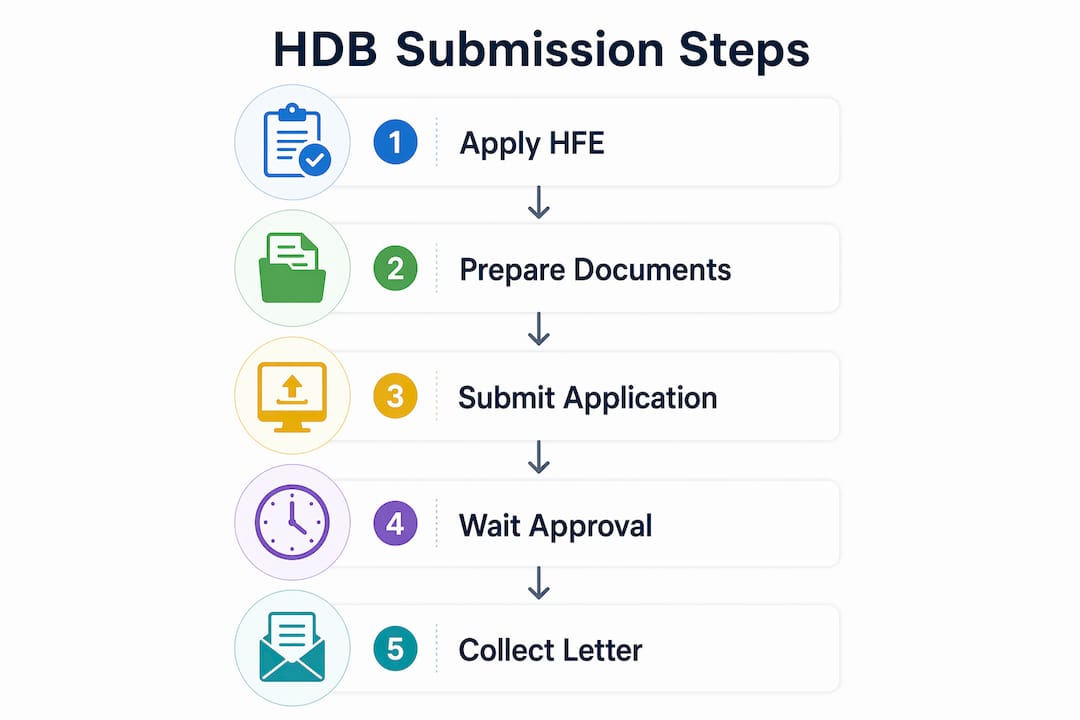
Digital submission via the HDB Flat Portal integrated with Singpass and Myinfo reduces manual errors significantly. The system pre-fills verified data from government records. However, financial documents such as payslips and tax assessments must still be uploaded manually and must reflect current income accurately.
What are the common pitfalls and expert tips for a successful HDB submission?
Most HDB submission failures are procedural, not eligibility-related. Applicants who understand the rules in advance avoid the delays and financial losses that catch unprepared buyers and sellers off guard.
The most critical compliance points are:
- The 7-day resale submission deadline is absolute. There are no extensions, no appeals, and no refunds upon cancellation. Both buyer and seller must plan their schedules around this window before exercising the OTP.
- Flat inspections can block resale approvals. Non-compliance with structural and renovation rules can delay or cancel the entire resale process. Sellers should conduct a pre-inspection review using the HDB pre-renovation checklist before listing their flat.
- BTO oversubscription is severe in mature estates. Ballot pressure in popular locations can exceed 10 times the available supply. Applicants who do not understand priority schemes, such as the Married Child Priority Scheme or the Parenthood Priority Scheme, reduce their effective chances significantly.
- Financial document accuracy is non-negotiable. Outdated IRAS Notices of Assessment or incorrect income declarations delay HFE processing and can affect grant and loan calculations.
- Digital portal errors require user correction. The HDB Flat Portal does not automatically flag all inconsistencies. Applicants must review all pre-filled Myinfo data before submission, particularly after changes in employment, income, or marital status.
Applicants who treat the HDB submission process as a checklist exercise rather than a compliance obligation consistently encounter the most delays. Proactive document preparation and deadline management are the two factors that separate successful submissions from cancelled ones.
For transactions involving structural modifications or specialized renovation works, professional review of architectural drawings before submission can prevent inspection failures that derail the entire resale timeline.
Key Takeaways
A successful HDB submission depends on selecting the correct application type, meeting strict deadlines, and submitting accurate and current documentation at every stage.
| Point | Details |
|---|---|
| Three submission types exist | HFE letter, BTO or SBF application, and resale flat application each serve a distinct purpose. |
| HFE letter is a prerequisite | Apply 4–6 weeks before your intended flat application to account for the 21-working-day processing period. |
| Resale deadline is absolute | Both buyer and seller must submit within 7 calendar days of OTP exercise or the application is cancelled without refund. |
| Flat inspection is mandatory | Non-compliant renovations or structural changes will delay or block resale approval; pre-inspection review is advisable. |
| Document accuracy prevents delays | Outdated financial documents and incorrect declarations are the primary causes of HFE processing delays. |
My assessment of where applicants consistently go wrong
I have reviewed enough HDB submission cases to identify a pattern that the formal guides do not address directly. Most applicants focus on eligibility and overlook execution. They qualify for the flat, they have the finances in order, and they still miss the deadline or fail the inspection because they treated the procedural steps as secondary concerns.
The 7-calendar-day resale submission rule is the single most underestimated requirement in the entire process. Buyers and sellers often exercise the OTP on a Friday without confirming that both parties have Singpass access, current documents uploaded, and time available over the following week. The result is a cancelled application and a lost option fee. This is entirely avoidable.
On the BTO side, the priority scheme landscape in 2026 is more complex than most first-time applicants realize. Schemes like the Married Child Priority Scheme, the Parenthood Priority Scheme, and the Senior Priority Scheme each carry specific eligibility criteria and application requirements. Applicants who do not map their household profile against available schemes before submitting are leaving ballot priority on the table.
The HFE letter timing issue is also more consequential than it appears. Many applicants treat it as a one-time administrative step. When the letter expires before they secure a flat, they restart a 21-working-day processing cycle that delays their entire purchase timeline. Timing the HFE application to align with a specific BTO launch or an active resale search is a discipline that pays off consistently.
For professionals managing multiple HDB-related transactions, the HDB approval process requires the same level of procedural rigor as any statutory submission to BCA or URA. The consequences of non-compliance are equally concrete.
— Aman
How Com supports your HDB submission and approval process
Navigating the HDB submission process involves more than completing online forms. Structural compliance, renovation permits, and technical inspections are critical checkpoints that require professional input, particularly for resale transactions involving modifications or for developers managing multiple units.
Com, operating as Aman Engineering Consultancy, provides statutory submission, inspection, and compliance consultancy services across Singapore’s public housing and construction sectors. The firm’s expertise covers structural assessments, renovation compliance reviews, and authority approvals for HDB, BCA, URA, and related agencies. For buyers and sellers facing inspection requirements or renovation compliance questions, Com’s technical team provides the documentation and advisory support needed to keep transactions on schedule. Visit Aman Engineering Consultancy to learn how professional consultancy support can reduce submission risk and accelerate approval timelines.
FAQ
What is an HDB submission?
An HDB submission is a formal application to Singapore’s Housing & Development Board to initiate eligibility verification or approval for a flat purchase, sale, or financing arrangement. The three main types are the HFE letter application, BTO or SBF new flat application, and resale flat application.
How long does the HDB HFE letter take to process?
The HFE letter takes approximately 21 working days to process from the date of complete submission. Delays occur when financial documents such as the IRAS Notice of Assessment are outdated or when declarations contain errors.
What happens if I miss the 7-day resale submission deadline?
Missing the 7-calendar-day deadline results in automatic cancellation of the resale application with no refund and no exceptions. Both buyer and seller must submit their respective applications within this window after the OTP is exercised.
Do I need an HFE letter before applying for a BTO flat?
Yes. A valid HFE letter is mandatory before submitting a BTO or resale flat application. The letter confirms your eligibility, applicable grants, and loan amount, and it must remain valid at the time of your flat application.
How competitive are BTO applications in mature estates?
BTO applications in mature estates are highly competitive. Ballot pressure can exceed 10 times the available supply in popular locations, making knowledge of priority schemes such as the Married Child Priority Scheme and the Parenthood Priority Scheme a practical necessity before submission.